What Should You Avoid With Corten Steel Planters?
Thanks to their outstanding weather resistance and structural strength, corten steel planters have become the go-to choice for gardening enthusiasts, landscape designers, and engineering projects. Their surfaces naturally develop a unique brown-orange patina, giving them a sophisticated architectural texture that blends seamlessly with a variety of settings, including greenery, stone, concrete, and wooden landscapes.
Many users have a misconception that weathering steel is inherently highly durable and requires no special maintenance. In fact, the planter’s placement, drainage conditions, soil selection, and cleaning methods all directly affect the stability of the rust patina, plant growth, and the planter’s overall service life.
In daily use, the vast majority of issues—such as uneven aging and rusting, stains on the surface, and plant root rot—stem from avoidable human errors. Only by avoiding common usage pitfalls can weathering steel planters maintain their structural integrity and natural aesthetic appeal over the long term, fully realizing the material’s long-term value.
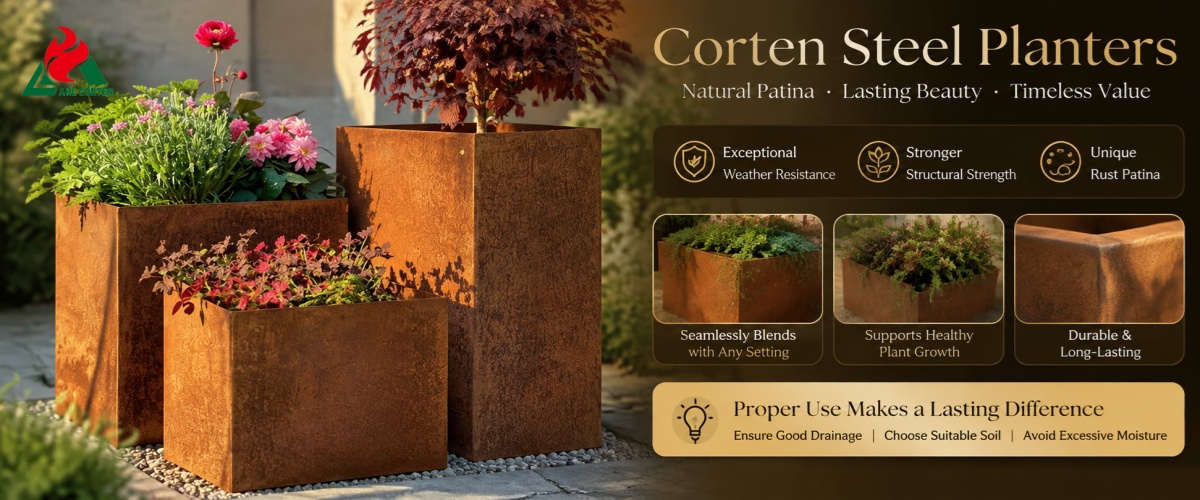
Strictly Prohibit Prolonged Water Accumulation of Corten Steel Planter
1. The Dual Hazards of Prolonged Water Accumulation
A high-quality rust layer on weathering steel requires a natural environment with alternating dry and wet conditions to form and stabilize. Prolonged water accumulation completely disrupts this cycle, causing the steel to undergo continuous oxidation and corrosion. This leads to a loose and unstable rust layer, accelerated corrosion, and ultimately a significant reduction in the planter’s service life.
At the same time, standing water in the potting soil causes oxygen deprivation, leading to root rot, stunted growth, and frequent pest and disease outbreaks. This is particularly true for large, deep planters, where the topsoil may appear dry while hidden pockets of standing water easily accumulate at the bottom, posing a significant risk.
2. Proper Drainage and Placement Guidelines for Corten Planters
When selecting a location, prioritize areas with level ground and good drainage, avoiding low-lying areas prone to water accumulation and drainage outlets where water tends to pool.
When placing the planter on a courtyard, concrete, or stone surface, ensure the ground has a drainage slope. It is recommended to elevate the planter by 3–5 centimeters using spacers or stands to reduce moisture absorption at the base and prevent rust water from staining the ground.
Before purchasing or installing, be sure to check the number and distribution of drainage holes at the bottom. Large, elongated planters should not rely solely on a single drainage hole, as this can easily lead to blockages and water accumulation. Regularly inspect the drainage holes to ensure they are not blocked by soil, fallen leaves, or roots.
3. Waterproof Lining Solutions for Planters
If the planter is placed on surfaces prone to staining—such as light-colored stone, concrete, or wooden decks—you may install an inner pot or a waterproof liner. This not only prevents soil and water from coming into contact with the steel structure and eliminates rust seepage and contamination but also facilitates future repotting and cleaning.
Note that the liner must not completely block the drainage channels; drainage space must be left to prevent water from accumulating in the gap between the liner and the steel structure, which could cause localized corrosion.
4. Brand Advantage: AHL Customized Drainage System
AHL rustic steel planters can be customized with drainage hole layouts, raised bases, waterproof liners, and overflow drainage structures based on dimensions, plant types, and installation scenarios. This scientifically designed drainage system not only safeguards the health of plant roots but also stabilizes the rust layer, reducing corrosion and pollution to achieve long-lasting durability and low-maintenance performance.

Avoid Highly Water-Retaining Soils for Rusted Steel Planters
1. Drawbacks of Using Highly Water-Retaining Growing Media
Corten steel square planters are designed for a caring environment with alternating dry and wet cycles. Potting mix that remains damp for extended periods will cause the interior of the planter to remain persistently stuffy and damp. This not only leads to oxygen deprivation and root rot but also causes uneven oxidation of the steel, resulting in a mottled and irregular rust patina that detracts from the overall aesthetic appeal.
Pure compost, heavy clay, high-water-retention fillers, and untested hydroponic pellets are all unsuitable as primary planting media. These types of soil are prone to compaction and poor drainage; they will cling tightly to the inner walls of the planter, obstructing air circulation and accelerating moisture-induced corrosion of the steel structure.
2. Opt for a Loose, Well-Aerated Soil Mix
Planting soil suitable for corten pots must be loose and well-aerated, with moderate drainage and water retention, balancing plant growth with steel maintenance. We recommend a mix of high-quality potting soil, coconut coir, peat moss, perlite, pumice, pine bark, and coarse sand.
The mix ratio can be flexibly adjusted based on plant type: for drought-tolerant plants such as succulents and herbs, increase the proportion of drainage materials; for shrubs, flowers, and small trees, strike a balance between water retention and aeration.
3. Taboos Regarding the Bottom Drainage Layer
Never blindly lay a thick layer of gravel at the bottom of the planter; a gravel layer cannot replace the function of drainage holes and high-quality soil. Improper installation may create a water-retaining layer, exacerbating localized waterlogging issues and reducing usable planting space.
Strictly follow the product’s design when installing the drainage structure. After confirming that the drainage holes are unobstructed, lay gravel and a permeable geotextile as needed, and regularly remove any fine soil or root systems that may cause blockages.
4. Brand Advantage: Compatible Planting System Design
High-quality bespoke corten steel planters require a scientifically designed planting system to achieve low maintenance. AHL planters are compatible with various breathable, well-draining growing media. Combined with a standardized drainage structure, they not only ensure healthy plant growth but also prevent the planter from becoming chronically damp, allowing the weather-resistant steel to perform consistently over time.

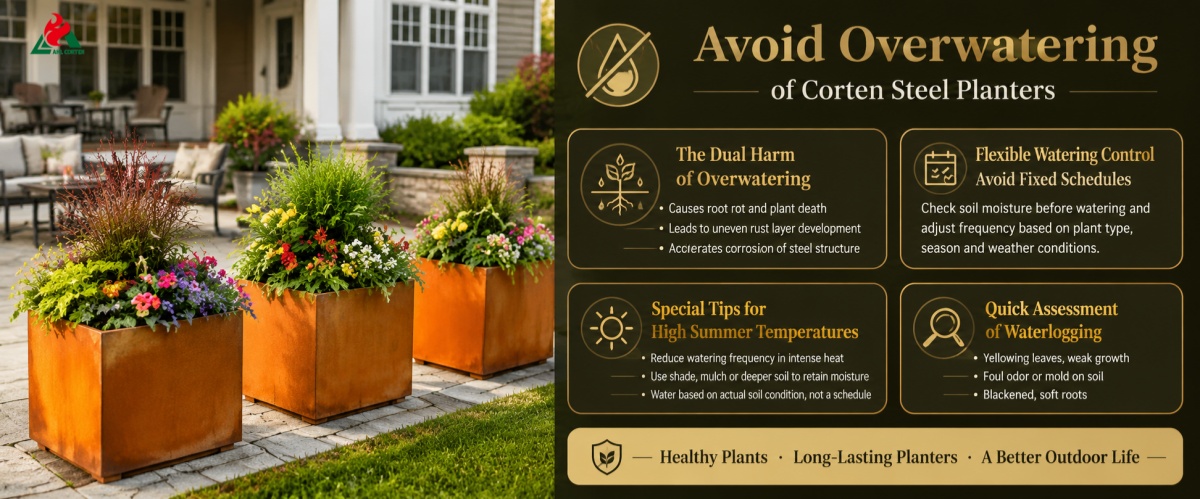
Avoid Overwatering of Corten Steel Planters
1. The Dual Harm of Overwatering
When it comes to watering, more isn’t always better. Overwatering fills the soil’s pores, leading to oxygen deprivation in the root system, root rot, yellowing leaves, and ultimately the withering and death of the plant. For weathering steel planters, prolonged soil moisture can cause uneven rust layer development, increased rust stains on the bottom, and accelerated corrosion around the drainage holes.
2. Flexible Watering Control: Avoid Fixed Watering Schedules
Watering frequency should be adjusted flexibly based on plant species, planter size, soil condition, seasonal climate, and light conditions. Avoid mechanical, scheduled watering.
Before watering, conduct a thorough check: Is the topsoil dry? Is the soil 5 centimeters deep moist? Is there standing water at the bottom of the planter after rain? Do the plants show signs of abnormal wilting or yellowing leaves? If only the topsoil is dry, there is no need to water. Wait until the soil reaches the appropriate moisture level, then water thoroughly in one go to ensure excess water drains away smoothly.
3. Special Watering Tips for High Summer Temperatures
In the intense sunlight and high temperatures of summer, metal planters heat up more quickly, significantly accelerating the evaporation of moisture from the potting soil. During this time, avoid frequent watering to prevent overwatering and root rot.
Optimize the root environment by providing appropriate shade, increasing the soil depth, covering the surface with a protective mulch, or insulating the planter. Base your watering on the actual soil moisture level rather than a fixed schedule.
4. Quick Assessment of Waterlogging Damage
Signs of waterlogging include yellowing leaves, wilted plants despite moist soil, stunted growth, foul odors from the soil, mold on the potting mix, prolonged lack of drainage, and blackened, soft, and rotting roots. Immediately stop watering, clear any clogged drainage holes, adjust the soil mix, and, if necessary, remove the plant from the pot to inspect the root system.
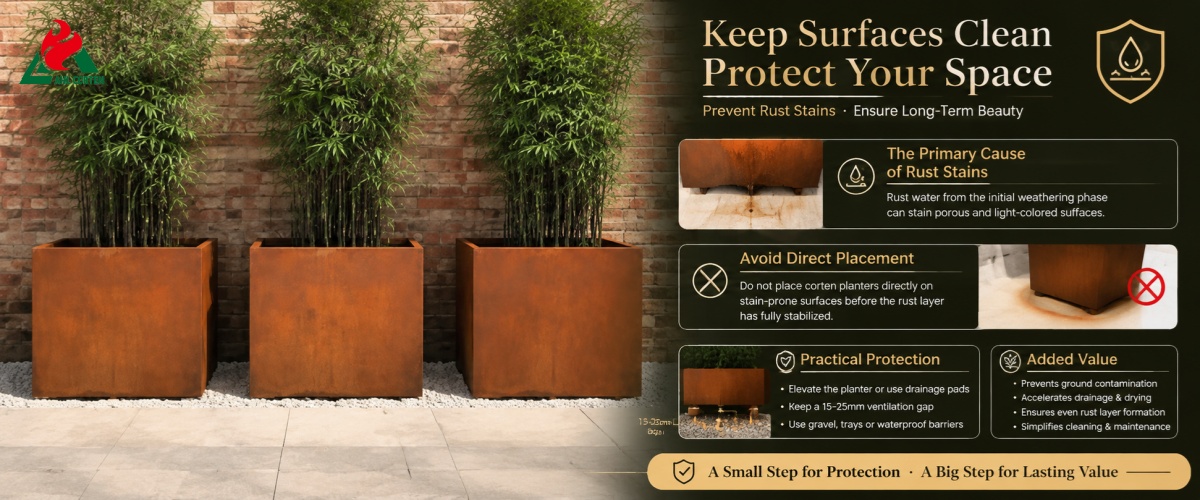
Do Not Place the Corten Planter Directly on Surfaces Prone to Staining
1. The Primary Cause of Rust Stains
During the initial weathering phase of round corten planters, rust water containing iron oxides is produced. Rainwater runoff carries this rusty water to the bottom of the planter and the surrounding ground. Porous materials such as light-colored concrete, natural stone, porous bricks, wooden decks, light-colored tiles, and marble are highly susceptible to absorption, leading to stubborn rust stains that are difficult to remove.
2. Avoiding High-Risk Placement Scenarios
Until the planter’s rust layer has fully stabilized, do not place flat-bottomed planters directly against light-colored, porous, or easily stained surfaces. Avoid completely sealing the bottom of the planter against the ground, as this can cause water and rust to accumulate, leading to rust rings and localized corrosion.
3. Practical Solutions for Surface Protection
Protection can be achieved by elevating the planter, laying a permeable gravel layer, installing rubber spacers, EPDM waterproofing pads, drainage trays, or a stain-resistant barrier layer. It is recommended to leave a 15–25-millimeter ventilation gap to improve airflow and drying efficiency at the base.
After rain, promptly inspect and clean up any residual rust stains to prevent them from drying and hardening, which could permanently damage the floor surface.
4. The Added Value of Bottom Protection
A professional bottom protection design not only prevents ground contamination but also accelerates drainage and drying at the bottom, allowing the rust layer on the planter to form evenly. At the same time, it simplifies daily cleaning and maintenance while enhancing the overall stability of the planter.
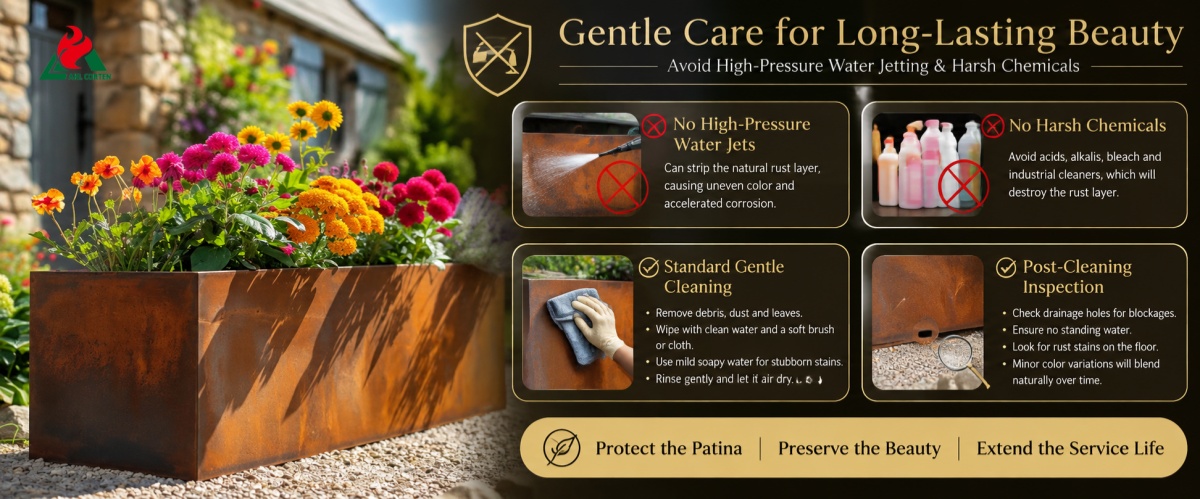
Avoid High-Pressure Water Jetting and Harsh Chemical Cleaners
1. Hazards of High-Pressure Water Jet Cleaning
The use of high-pressure water jets to clean weathering steel planters is strictly prohibited. The unstable surface rust layer has a loose texture; high-pressure water jets will directly wash away and peel off the rust layer, resulting in color variations, mottling, and localized roughness on the planter’s surface. The uneven rate of rust layer regeneration will permanently compromise the overall aesthetic appeal. Additionally, water can easily seep into joints and the bottom, accelerating localized corrosion.
2. Prohibited Cleaning Products
For routine maintenance, avoid using strong acids, strong alkalis, bleach, powerful rust removers, industrial solvents, and sealants or anti-rust coatings not specifically formulated for weathering steel. These products will dissolve and destroy the natural rust layer, causing the surface to turn black, resulting in uneven reflectivity and erratic localized corrosion.
3. Standard Gentle Cleaning Procedure
First, remove loose debris such as fallen leaves, dust, and spider webs. Wipe the surface with clean water using a soft cloth or soft nylon brush. For stubborn stains, use a small amount of mild, neutral soapy water. After cleaning, rinse gently with clean water and allow to air dry naturally.
Avoid using abrasive tools, steel wool, or sandpaper throughout the process to preserve the texture of the natural rust layer as possible.
4. Post-Cleaning Inspection
After cleaning, inspect the drainage holes for blockages, check for standing water at the bottom of the unit, and examine the surface for surface rust and stains on the surrounding floor. If minor color variations are present, no intervention is necessary; they will naturally blend and even out during subsequent cycles of drying and wetting.
Avoid Scratches from Hard Objects and Rough Handling of Corten Steel Planters
1. Irreversible Damage from Scratches by Hard Objects
Hard tools such as wire brushes, metal scrapers, and abrasive pads can directly scratch through the continuous natural rust layer. Residual metal debris can also cause localized color variations and uneven rusting, compromising the planter’s overall texture.
When changing soil, trimming roots, or cleaning the inner walls, metal shovels can easily scratch the corners and inner walls of the planter, causing permanent marks.
2. Recommended Safety Maintenance Tools
For daily maintenance and repotting, prioritize the use of plastic trowels, wooden tools, soft-edged rubber tools, soft nylon brushes, and soft sponges or cloths. For stubborn soil on the inner walls, spray water to soften it first, then clean gently. Do not strike or scrape the planter violently.
3. Guidelines for Repairing Minor Scratches
Minor surface scratches do not require sanding or repainting; subsequent natural cycles of wet and dry conditions will gradually regenerate the rust layer, restoring a uniform texture. In cases of extensive flaking, deep scratches, or structural damage, repairs must be carried out according to the manufacturer’s professional guidelines. Do not paint or seal the entire surface on your own.
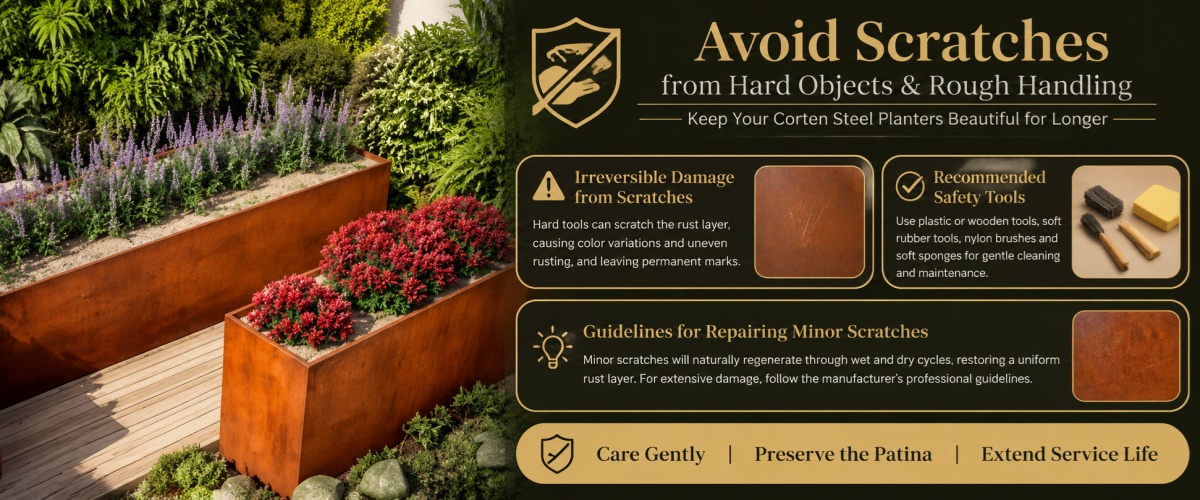
Do Not Paint, Wax, or Seal the Planters Without Authorization
1. Drawbacks of Unauthorized Sealing
The core value of weathering steel lies in the layered rust colors and architectural texture that evolve naturally over time. Premature or unauthorized painting, waxing, or spraying sealants blocks air and moisture, halting the natural weathering process.
This leads to mottled color variations and localized peeling and water pooling on the planter surface, significantly increasing the difficulty of future cleaning and restoration, and completely destroying the unique natural texture of weathering steel.
2. Applicable Scenarios and Standards for Sealing Treatment
Standard outdoor settings do not require sealing maintenance. Only when corten rectangular planters are placed on light-colored, high-value paved surfaces, and after the rust layer has fully stabilized, may you optionally use outdoor-specific sealing products compatible with weathering steel.
The use of non-specialized products, such as indoor varnishes or wood wax oils, is strictly prohibited. Before application, ensure that the treatment does not impair drainage or ventilation, does not void the product warranty, and strictly follow the manufacturer’s application guidelines.
Prioritize resolving rust and staining issues by elevating the planter, installing liners, or incorporating drainage structures, rather than applying a full-coverage sealant directly.
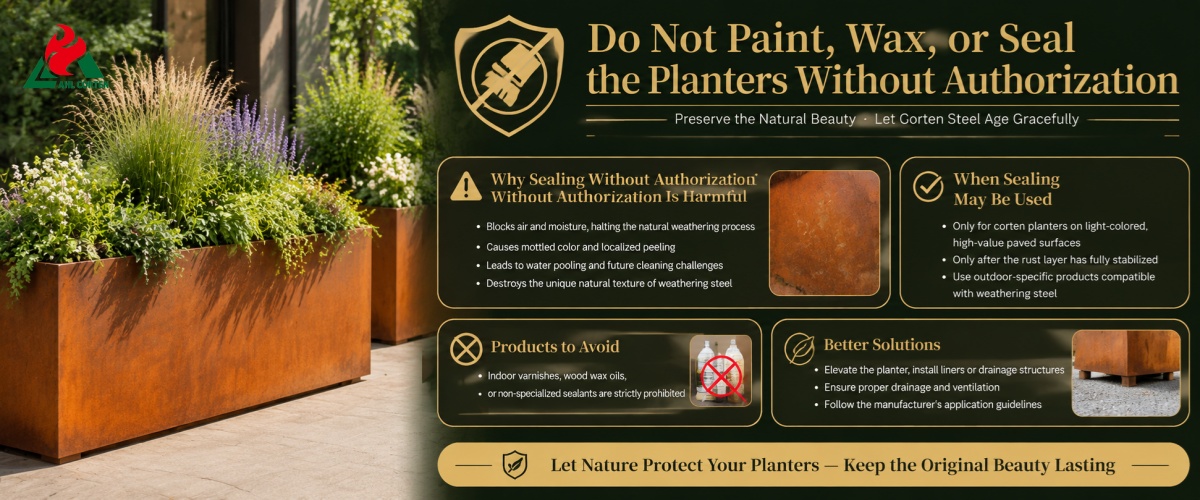
Full Burial in Soil Is Strictly Prohibited: Ensure Ventilation and Dryness to Prevent Hidden Corrosion
1. Multiple Hazards Associated with Fully Buried Planters
Standard weathering steel planters should never be fully buried in soil. If the side walls and bottom of the planter are sealed and buried in damp soil for extended periods, the natural cycle of moisture and drying will be completely disrupted, ventilation will be blocked, and the planter will be unable to air-dry.
This leads to uneven rusting, water accumulation at seams, and accelerated corrosion. Additionally, it makes subsequent inspections, cleaning, and maintenance extremely difficult, significantly shortening the planter’s service life.
2. Standard Installation Guidelines
During installation, ensure sufficient ventilation gaps are left; do not bury the planter’s side walls. Elevate the planter using a base or supports, and lay a permeable gravel layer around the perimeter to ensure drainage holes and seams remain free of soil coverage and that air circulates freely around the planter.
If a project requires an underground planting basin or retaining structure, use a specialized, custom-designed waterproofing and drainage system; do not directly bury standard weathering steel planters.
3. Proper Use of Permeable Subbase
Laying gravel around the planter accelerates rainwater runoff, reduces soil adhesion to the planter, and facilitates bottom inspections and debris removal. Note that the gravel layer cannot replace the planter’s own drainage system; ensure that drainage holes remain unobstructed and the ground has an appropriate drainage slope.
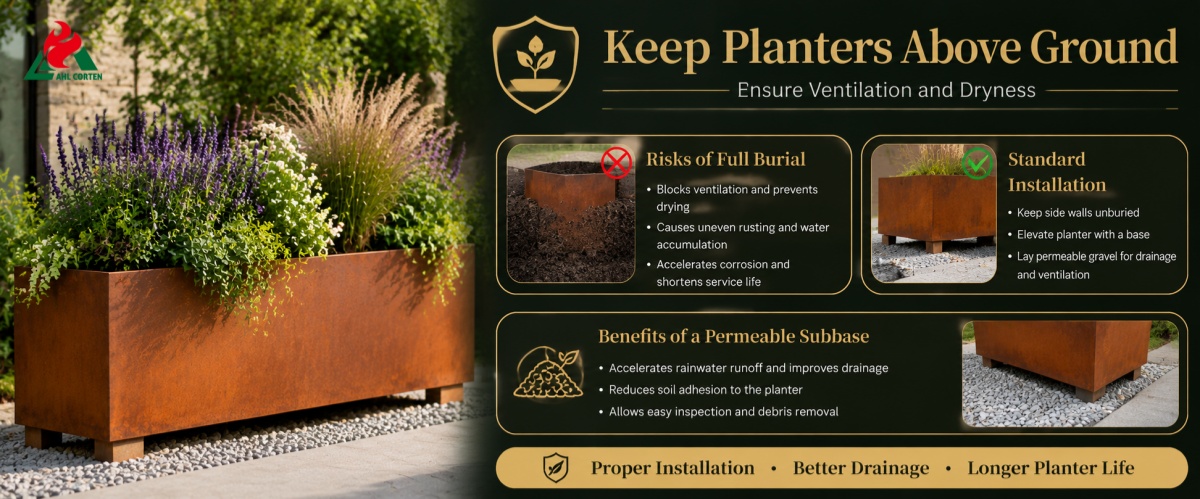
Ignoring Thermal Conductivity and Incompatible Plant Selection
1. Planting Risks Associated with Steel’s Thermal Conductivity
Under intense sunlight, weathering steel heats up rapidly, and this heat is conducted to the soil inside the planter. Plants with shallow root systems, young seedlings, and shade-loving or cool-climate plants are highly susceptible to root damage from high temperatures, rapid water evaporation, and stunted growth.
2. Plant Categories Requiring Special Protection
Plants with shallow root systems, newly transplanted seedlings, shade-loving foliage plants, cool-weather leafy greens, plants sensitive to water and soil conditions, and potted plants with limited root space require special protection when placed in west-facing or unshaded, sun-exposed locations.
3. Practical Methods for Optimizing the Root Zone Environment
You can optimize the root growth environment and prevent heat damage by increasing soil depth, providing moderate shade during summer, adjusting the orientation of the plants, avoiding reflective walls, covering the soil surface with root-protecting materials, installing thermal insulation liners, and using large-capacity planters.
4. Recommended Plants for Corten Steel Planters
The most suitable plant categories are those that are drought- and heat-tolerant and adapt well to well-ventilated, dry-to-humid environments. These include Mediterranean herbs such as rosemary, thyme, and lavender; Crassulaceae succulents; ornamental grasses; perennial flowers; potted shrubs; and large fruit and vegetable plants. Shade-loving and moisture-loving plants should be grown in conjunction with shading, thermal insulation, and water retention systems.
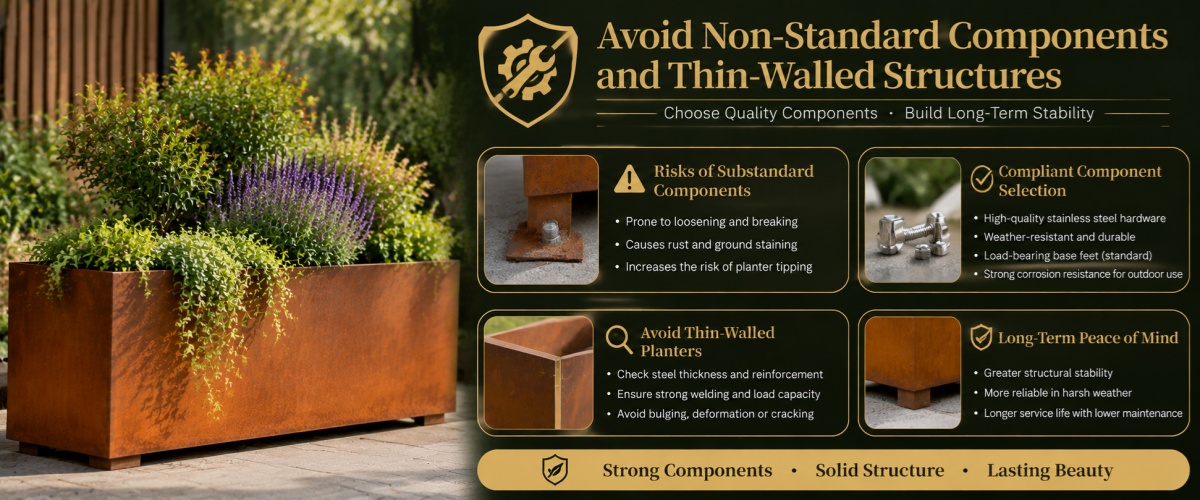
Avoid Non-Standard Components and Thin-Walled Structures
1. Safety Hazards of Substandard Components
The quality of components such as planter base feet, bolts, brackets, and casters directly determines overall stability. Substandard, non-standard hardware is prone to loosening and breaking. When different metals come into contact in a damp outdoor environment, electrochemical corrosion can occur, causing the planter to rust, staining the ground, and posing a risk of tipping.
2. Selection Criteria for Compliant Components
Prioritize high-quality stainless steel bolts, weather-resistant outdoor hardware, load-bearing base feet that meet standards, and casters and fasteners suited to the structure. In coastal, high-humidity, freeze-thaw, and commercial settings, select components with high corrosion resistance ratings. Comprehensively consider the planter’s own weight, the weight of soil and water, and wind conditions—and reject low-cost, substandard components.
3. Avoiding Pitfalls with Unstable Thin-Walled Planters
When selecting planters, do not focus solely on appearance and price; instead, carefully inspect the steel plate thickness, reinforcing ribs, top reinforcement, welding process, bottom load-bearing capacity, and drainage structure. Planters that are too thin or lack reinforcing structures are prone to issues such as bulging side walls, edge deformation, bottom subsidence, and cracked welds when subjected to long-term pressure from water and soil, as well as wind forces.
Neglecting Winter and Extreme Weather Maintenance: Preventing Damage Through Attention to Detail
1. Key Causes of Winter Damage
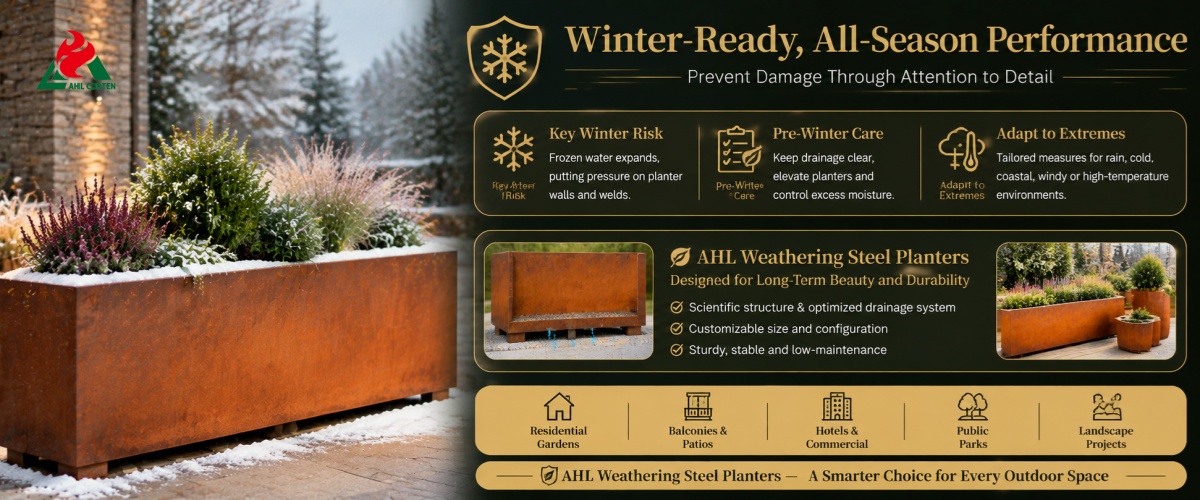
Corten steel planters UK can be used outdoors year-round; low winter temperatures alone do not damage the planter. The real hidden danger is water accumulation that freezes and expands, putting pressure on the planter walls, welds, and drainage structures—this is the primary cause of planter damage in cold regions.
2. Special Inspection and Maintenance Before Winter
Before winter sets in, thoroughly clear clogged drainage holes, fallen leaves, and silt to ensure unobstructed drainage. Raise the planters to prevent their bottoms from coming into direct contact with ice, snow, or wet ground, and prevent rainwater from continuously dripping onto the planters. If the soil remains saturated with water for an extended period, take timely measures to control and drain the water.
Once the soil is completely frozen, do not move the planters forcefully to avoid damaging the bottom supports and welds through pulling or tugging.
3. Adaptation Strategies for Different Extreme Environments
In rainy regions, prioritize optimizing drainage and flood prevention; in permafrost regions, strictly control water accumulation to prevent ice expansion; in coastal regions, reinforce hardware to resist salt fog corrosion; in windy regions, inspect the stability of planter bases; in high-temperature regions, provide shade and moisture retention while cooling the root system; for rooftop terrace installations, verify load-bearing capacity, waterproofing, and drainage systems.
AHL Weathering Steel Planters: Avoiding Common Usage Issues at the Source
AHL weathering steel planters integrate weathering steel, scientific structural design, customized drainage systems, and modern landscape aesthetics to address various misconceptions and potential hazards in daily use right from the product design stage, making them suitable for all outdoor planting scenarios.
The product features transparent technical specifications, allowing for precise matching of steel plate thickness and internal reinforcement structures based on planter size, plant species, soil and water load, and usage environment—thereby eliminating issues such as thin-walled deformation and structural instability.
Styles include square, rectangular, round, and elongated landscape planters, as well as large tree pits, with support for non-standard customization. They can be flexibly configured with features such as distributed drainage holes, waterproof and heat-insulating liners, reinforcement supports, raised bases, and drainage trays, providing a one-stop solution to core issues like drainage, thermal insulation, stain resistance, and structural stability.
Widely suitable for residential gardens, balconies and patios, hotel and commercial landscapes, public parks, and landscape projects, their natural rust color seamlessly blends with various outdoor settings, combining aesthetic appeal, texture, and long-term practicality.
Frequently Asked Questions (FAQ) About Corten Steel Planters
1. Do Weathering Steel Planters Require Sealing or Anti-Rust Treatment?
Sealing is not required for standard outdoor settings. The natural rust layer serves as the core protective structure and aesthetic highlight of weathering steel; a healthy cycle of wet and dry conditions allows the rust layer to form and stabilize. Only in settings with light-colored, high-value surfaces should specialized outdoor sealing products be used after the rust layer has stabilized—prioritizing solutions such as raised bases, liners, and drainage isolation.
2. Can Corten Planters Be Placed Directly On a Concrete Surface?
Yes, they can be placed directly on concrete, but during the initial weathering phase, rust water may stain the concrete surface. We recommend using spacers, bases, or drainage trays to elevate the planter, avoiding prolonged direct contact with the ground to prevent stubborn rust stains and moisture-related corrosion at the base.
3. Can Rusted Steel Planters Be Left Outdoors Long-Term?
Absolutely. Weathering steel is specifically designed for outdoor environments. As long as drainage remains unobstructed and standing water is avoided, and measures such as de-icing, water drainage, elevation, and ventilation are taken during winter, the planters can be used stably outdoors year-round.
4. Can I Clean The Planters With a High-Pressure Water Jet?
This is not recommended. High-pressure water jets can wash away unstable rust layers, causing color variations and localized rough corrosion on the surface. For daily cleaning, simply use clean water or neutral soapy water with a soft cleaning tool.
5. Can I Grow Edible Vegetables and Herbs in Garden Planters?
Yes. If you plan to grow edible plants, use a food-grade liner to prevent direct contact between the soil, water, and the steel, while ensuring proper drainage. Be sure to strictly follow the manufacturer’s planting guidelines.
6. Will the Planter Overheat in the Summer and Damage the Roots?
Temperatures may rise under intense sunlight. For plants with shallow root systems or those that prefer shade, provide shade, insulation, and a thicker layer of soil for protection. Drought- and heat-tolerant plants are perfectly suited to the planter environment and will thrive even better.
Conclusion: Are You Ready to Choose the Perfect Outdoor Corten Steel Planter for You?
The durability and premium aesthetic of weathering steel planters do not rely solely on the material itself but depend even more on scientific installation, planting, and maintenance practices.
By avoiding common pitfalls—such as prolonged waterlogging, poor-quality soil, overwatering, aggressive cleaning, unauthorized painting, fully buried planting, mixing incompatible accessories, and neglecting extreme weather conditions—you can effectively stabilize the rust patina, extend the planter’s lifespan, and ensure healthy plant growth.
By adhering to the core principles of proper drainage, proper placement, suitable soil, and gentle care—without the need for complex maintenance—weathering steel planters will develop a unique, vintage patina over time, becoming a timeless and visually appealing classic in outdoor landscapes.
Back


 Fill In The Inquiry