Should You Seal Or Paint Corten Steel Lights?
Corten steel lights have become a mainstream choice for outdoor lighting in courtyards, gardens, and commercial landscapes thanks to their unique rust-colored texture and natural patina that evolves over time. However, the vast majority of users face the same core question: Should newly purchased weathering steel lighting fixtures be painted or sealed for protection?
Many people worry that using the fixtures without any treatment will lead to continuous rusting, water seepage, and deterioration, while others fear that sealing or painting will ruin the fixtures’ original vintage aesthetic. This article will clearly explain the pros and cons, suitable scenarios, and proper procedures for the three approaches—painting, sealing, and natural weathering—based on the material properties of weathering steel and professional maintenance standards, helping you avoid common maintenance pitfalls and extend the lifespan of your fixtures.
.jpg)
Most Outdoor Lights Require Neither Painting Nor Sealing
-
The Core Protective Mechanism of Corten Steel Differs From That of Ordinary Steel
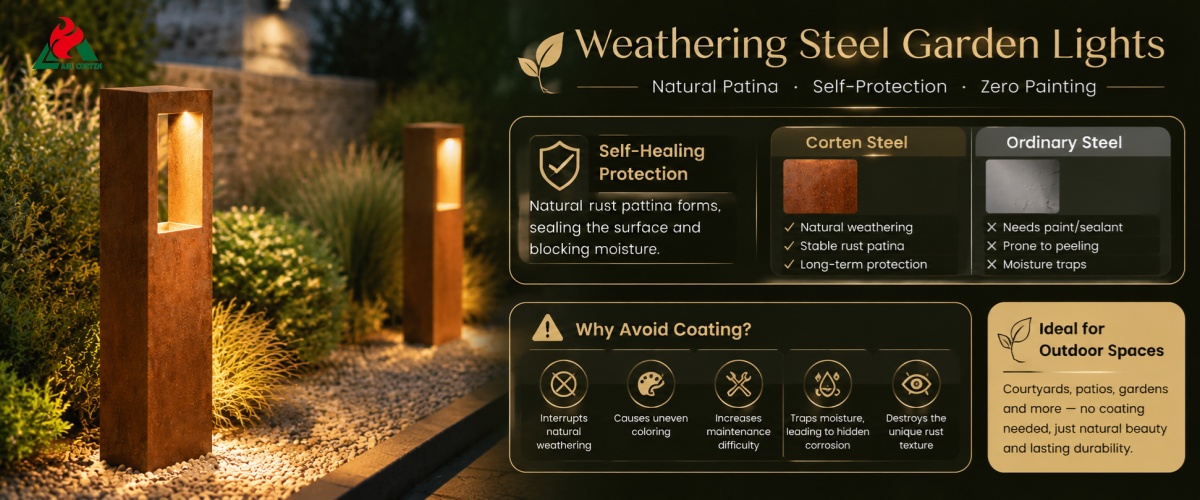
Ordinary steel lights must rely on spray paint or powder coatings to block out air and moisture and prevent ongoing corrosion. In contrast, Corten landscape lighting is made from an alloy of weathering steel specifically developed for outdoor environments, featuring a self-healing protective mechanism.
Under normal outdoor conditions involving cycles of dry and wet weather, a dense, stable layer of oxidized rust (also known as a rust patina) naturally forms on the surface of weathering steel. This natural patina firmly seals the steel’s surface, blocking air and moisture from penetrating deeper and providing self-sustaining corrosion protection.
-
5 Major Drawbacks of Blindly Painting or Sealing
Randomly painting, waxing, or sealing weathering steel lights not only fails to protect the fixtures but also causes irreversible damage. The specific issues are as follows:
First, it interrupts the natural weathering process of weathering steel, preventing the formation of a stable protective patina;
Second, it results in uneven coloring and a mottled appearance on the fixture’s surface, disrupting the overall aesthetic quality of the landscape;
Third, it significantly increases the difficulty of future maintenance and renovation; Fourth, once the coating is damaged, it traps moisture, triggering hidden internal corrosion; Fifth, it completely obscures the unique natural rust color and textural beauty of weathering steel.
-
Optimal Choice for Standard Outdoor Settings
For standard outdoor settings such as courtyard lawns, gravel surfaces, ordinary patios, and landscape gardens, no coating treatment is necessary. Simply ensure the installation site has proper drainage and good ventilation, allowing the fixtures to weather naturally—this is the most cost-effective and visually appealing maintenance method.
Special Scenarios: When Should Corten Lights Be Sealed with a Transparent Protective Coating?
Natural weathering is the preferred option, but it is not suitable for all scenarios. In certain special installation environments, applying a specialized transparent sealant can effectively prevent staining and rust water leakage.
-
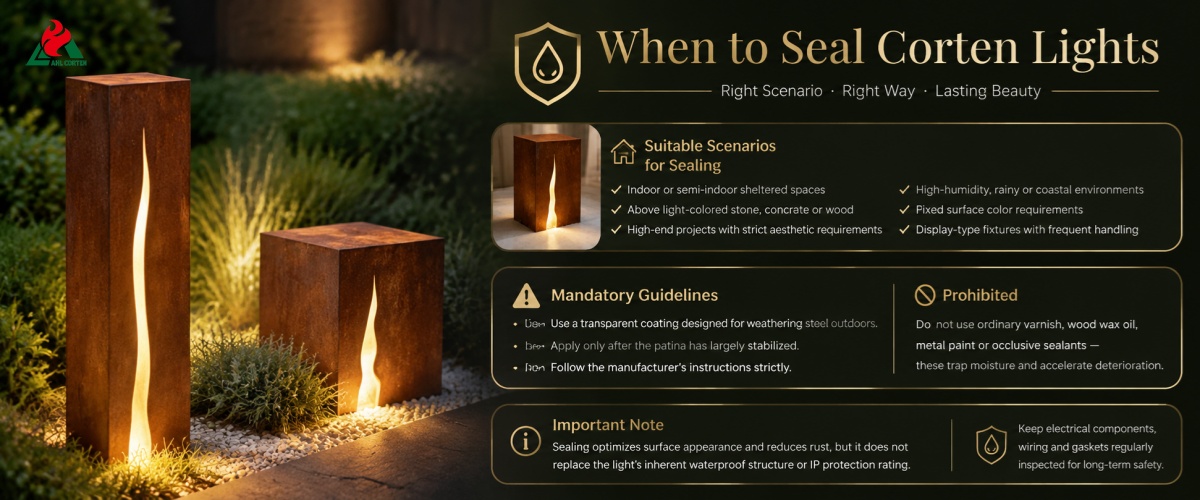
6 Scenarios Where Corten Steel Lights are Suitable for Sealing
A professional transparent protective coating can be used in the following scenarios: indoor or semi-indoor sheltered spaces; above light-colored stone, concrete, or wood paving; high-end projects with strict requirements regarding rust stain contamination; high-humidity, rainy, and coastal salt-fog environments; landscape projects requiring a fixed surface color; and display-type fixtures subject to frequent handling.
-
Mandatory Guidelines and Prohibitions for Sealing Lights
Sealing is by no means simply applying adhesive for maintenance; it involves strict requirements regarding materials and timing. If you must select a transparent coating specifically designed for outdoor use on weathering steel, you must wait until the patina on the light fixture’s surface has largely stabilized before applying the coating in strict accordance with the manufacturer’s instructions.
The use of ordinary varnish, wood wax oil, metal paint, and occlusive sealants is strictly prohibited, as these products trap moisture and accelerate the aging and deterioration of the luminaires.
-
Important Note: Sealing ≠ Waterproof Protection for the Light
Transparent sealing only optimizes the surface appearance and reduces surface rust; it cannot replace the fixture’s inherent waterproof structure, electrical seals, drainage design, or IP protection rating.
The waterproof safety of the electrical compartment, wiring, lamp holders, and sealing gaskets in Corten steel landscape lights still requires regular maintenance in accordance with product standards and installation specifications; one cannot rely solely on surface sealing for protection.
Why Is Painting Outdoor Corten Lights Strongly Discouraged?
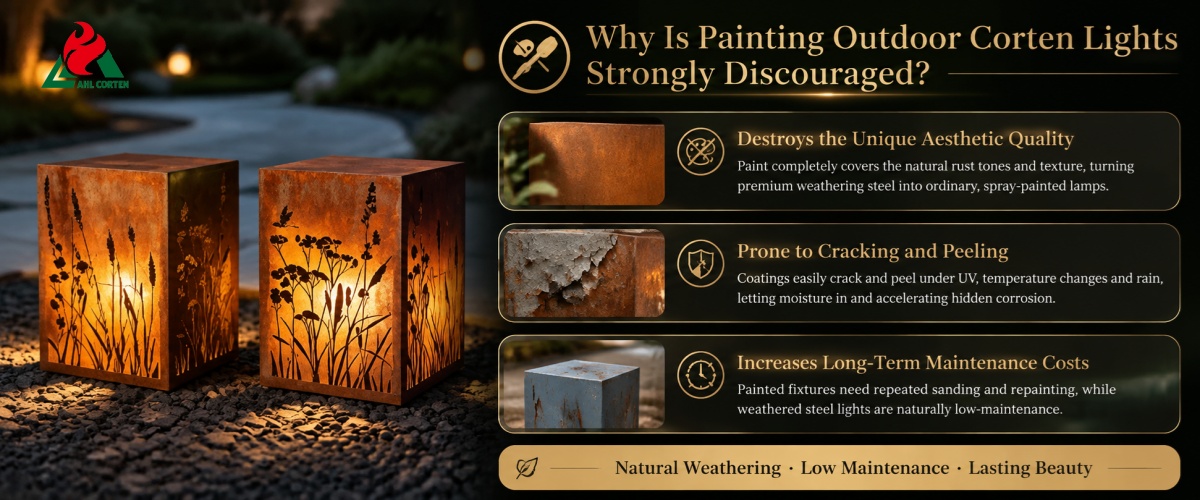
1. It Completely Destroys the Unique Aesthetic Quality of the Landscape
The paint completely covers the gradual rust-color gradations and natural texture of weathering steel. The uniform coating of artificial paint cannot replicate the subtle texture of natural weathering, reducing high-end weathering steel luminaires to ordinary spray-painted steel lamps and completely eliminating their landscape value.
2. Coatings Are Prone to Cracking and Peeling, Accelerating Luminaire Damage
If the luminaire has not yet completed its natural weathering process and the patina has not stabilized, the adhesion between the paint and the steel will be extremely poor. After prolonged exposure to UV radiation, temperature fluctuations, and rain, problems such as blistering, cracking, peeling, and curling edges are highly likely to occur.
Once the coating is damaged, rainwater seeps into the gaps between the paint and the steel. Since moisture cannot evaporate, a localized damp environment forms, accelerating hidden corrosion at a faster rate than that of bare, weathered steel.
3. Significantly Increases Long-Term Maintenance Costs
Weathered steel outdoor lighting is virtually maintenance-free. In contrast, painted fixtures may experience coating degradation every year, requiring repeated sanding, paint removal, surface leveling, priming, and repainting.
This completely negates the core advantage of weathering steel—its low maintenance—and results in significant time and maintenance costs. Unless a project has specific custom color requirements, painting is strongly discouraged.
Why Is Standard Sealing Unsuitable for Conventional Outdoor Lights?
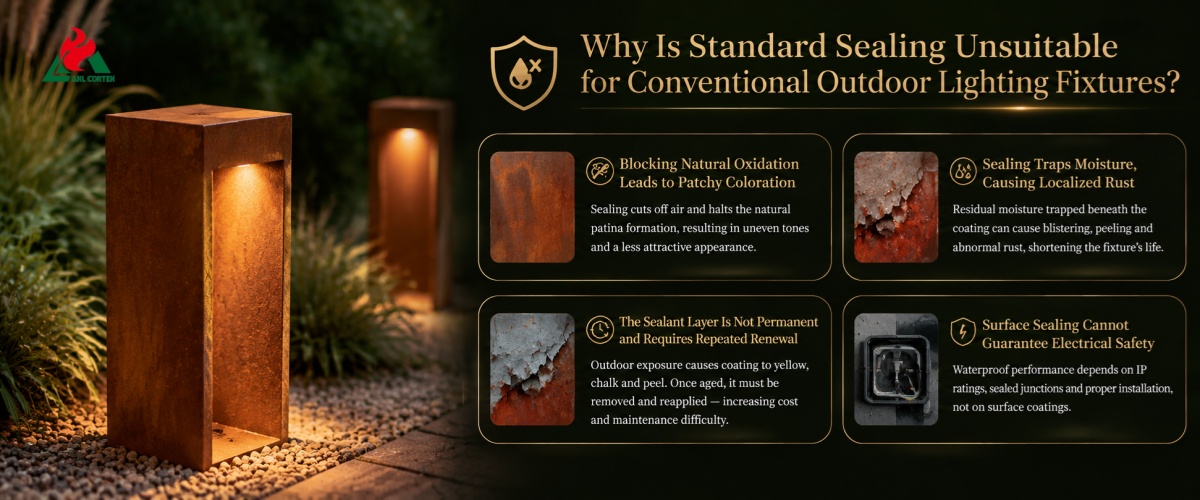
1. Blocking Natural Oxidation Leads to Patchy Coloration
Weathering steel requires air and moderate moisture to develop a uniform protective patina. Premature or indiscriminate sealing cuts off air, halting the normal oxidation process. This results in uneven surface tones and inconsistent coloring, significantly compromising the fixture’s aesthetic appeal.
2. Sealing Traps Moisture, Causing Localized Rust
If the gaps, bases, and seams of Corten steel landscape lights are not completely dry before sealing, residual moisture will be permanently trapped beneath the coating. Long-term accumulation can lead to abnormal localized rust, blistering and peeling of the sealant layer, and uneven coloration, significantly shortening the luminaire’s service life.
3. The Sealant Layer Is Not Permanent and Requires Repeated Renewal
Transparent sealing layers are not permanent. Prolonged exposure to outdoor sunlight, rain, and dust will cause the sealing layer to yellow, lose transparency, chalk, crack, and peel off.
Once aged, the layer must be partially scraped off and reapplied; however, color discrepancies between old and new coatings—as well as between old and new rust stains—are highly likely to occur. This increases maintenance difficulty and completely fails to achieve the original goal of “low-maintenance care.”
4. Surface Sealing Cannot Guarantee Electrical Safety
Many users mistakenly believe that sealing enhances a light fixture’s waterproofing performance—this is a fundamental misconception. The safety of outdoor light fixtures relies primarily on standard IP protection ratings, waterproof junction boxes, sealing gaskets, dedicated drainage structures, and proper installation.
A transparent surface coating cannot protect the internal electrical components. To ensure the safety of light fixtures, the focus should be on regularly inspecting wiring, seals, and drainage holes—not on surface sealing treatments.
Prioritize Structural Optimization Before Sealing Lights
Even in specific situations where sealing is appropriate, it is recommended to address rust stains primarily through installation optimization, reserving sealing as a last resort.
1. Basic Installation Optimization Solutions
Rust runoff can be redirected—and direct contamination of light-colored paving avoided—by adjusting the fixture’s mounting position, raising the fixture base, adding drip edges and drip pans, or laying a permeable gravel base.
These methods do not interfere with the fixture’s natural weathering process, are easy to maintain, and provide long-lasting results, making them superior to full sealing treatments.
2. Selection Criteria for Sealing Products
When sealing is absolutely necessary, a transparent protective coating specifically designed for weathering-resistant steel must be used. It must meet requirements such as outdoor weather resistance, UV resistance, compatibility with the rust layer, preservation of the original rust color, and adaptability to temperature fluctuations in the luminaire. Ordinary wood stains, anti-rust paints, and indoor varnishes are strictly prohibited.
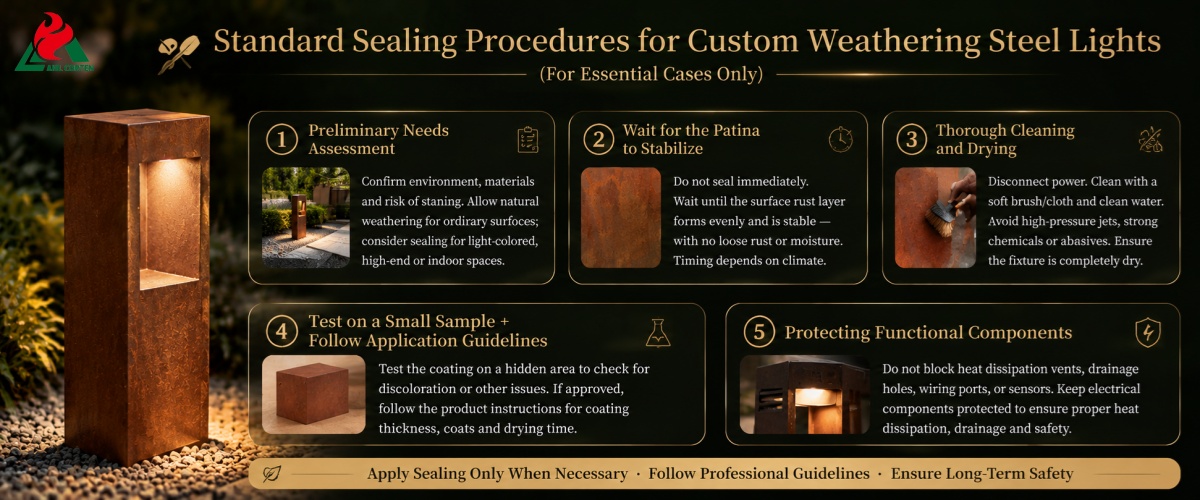
Standard Sealing Procedures for Custom Weathering Steel Lights (For Essential Cases Only)
1. Preliminary Needs Assessment
Before installation, confirm the installation environment, surrounding materials, risk of staining, frequency of contact, and color coordination requirements. For ordinary grass, gravel, or dirt surfaces, allow for natural weathering; for light-colored, high-end paving or indoor transitional spaces, a sealing solution may be implemented.
2. Wait for the Patina to Stabilize
New fixtures should not be sealed immediately. Wait until the surface rust layer has formed evenly, with no loose rust, no visible water seepage, and no dust or impurities. Assess the timing for application only after the surface has fully stabilized. The formation period is influenced by temperature, humidity, rainfall, and sunlight, so there is no fixed timeframe.
3. Thorough Cleaning and Drying
Disconnect the fixture’s power supply before the application. Use a soft brush, soft cloth, and clean water to remove surface dust, grease, and loose rust particles. Do not use high-pressure water jets, strong acids or alkalis, or abrasive tools, to avoid damaging the unstable patina. After cleaning, ensure the luminaire’s surface, crevices, and base are completely dry and free of moisture.
4. Test on a Small Sample + Follow Application Guidelines
Before formal application, conduct a test on a small sample in a concealed area of the Modern Corten Light Design to observe for any discoloration, whitening, stickiness, or color variation. Once the test is passed, strictly follow the product instructions to control coating thickness, number of coats, and drying time.
5. Protecting Functional Components
When sealing, do not block heat dissipation vents, drainage holes, wiring ports, gaps in the lampshade, sensors, or other functional components. Ensure electrical components are properly protected to prevent the coating from affecting the luminaire’s heat dissipation, drainage, and safety performance.
Simple Daily Maintenance Guide for Rustic Corten Outdoor Lighting
1. Gentle Surface Cleaning
Periodically use a soft brush, soft cloth, and low-pressure clean water to remove debris such as fallen leaves, dust, cobwebs, and bird droppings from the luminaire’s surface. For stubborn stains, gently wipe with neutral soapy water and rinse thoroughly. Never use harsh abrasive tools or corrosive cleaning agents.
2. Do Not Use Harsh Maintenance Products
Strictly avoid using acidic cleaners, bleach, strong alkaline solvents, rust removers, abrasive pads, and any unvalidated sealing or maintenance products. This prevents damage to the natural patina and avoids surface discoloration or secondary rusting.
3. Regularly Inspect Drainage and Base
Pay close attention to whether the drainage holes of ground-mounted fixtures are clogged, whether water has accumulated at the base, whether the surrounding soil remains persistently damp, and whether the fixtures are tilted or sinking. Clear drainage structures promptly to prevent prolonged waterlogging, thereby reducing the risk of rust at its source.
4. Regular Electrical System Inspections
During maintenance, simultaneously inspect the condition of the lampshades, LED bulbs, junction boxes, sealing gaskets, and mounting bolts. If aging, water leakage, or loosening is detected, promptly disconnect the power supply and perform repairs or replacements to ensure outdoor electrical safety.
5. Appropriate Maintenance Frequency
For standard outdoor Corten lights, a comprehensive cleaning and inspection once a year is sufficient. In coastal areas with salt fog, rainy and humid environments, high-dust areas, or commercial and public settings, the maintenance frequency may be appropriately increased.
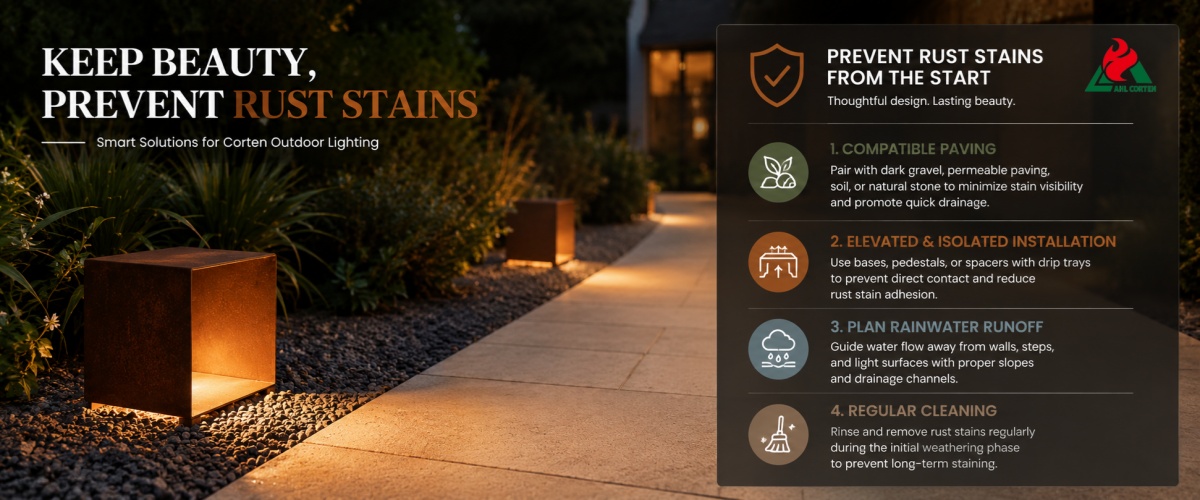
Solutions for Preventing Rust Stains on Surrounding Surfaces
During the initial weathering phase, Corten outdoor lighting may produce a small amount of rust water, which can easily stain light-colored paving. There is no need to rush to seal the fixtures; staining issues can be avoided by optimizing the surface treatment.
1. Opt for Compatible Paving Materials
For Corten garden lights, prioritize pairing the base with dark-colored gravel, permeable paving, natural soil, or dark-colored landscape stone. This minimizes the visual impact of minor rust stains while accelerating drainage and drying through rainwater.
2. Elevated and Isolated Installation
When installing on patios or light-colored hard surfaces, elevate the luminaires using metal bases, concrete pedestals, or isolation spacers. Add drip trays to prevent direct contact between the luminaires and the paving, thereby reducing rust stain adhesion.
3. Plan Rainwater Runoff Paths
Plan the drainage flow in advance during installation to prevent rusty water from directly washing over light-colored walls, steps, and stone surfaces. Use slight ground slopes and drainage channels to divert rainwater and prevent localized water accumulation and rust buildup.
4. Regular Cleaning During the Initial Phase
During the initial weathering phase of weathering steel lights, regularly rinse the surrounding paving and promptly remove rust stains to prevent rusty water from seeping in over time and forming stubborn stains.
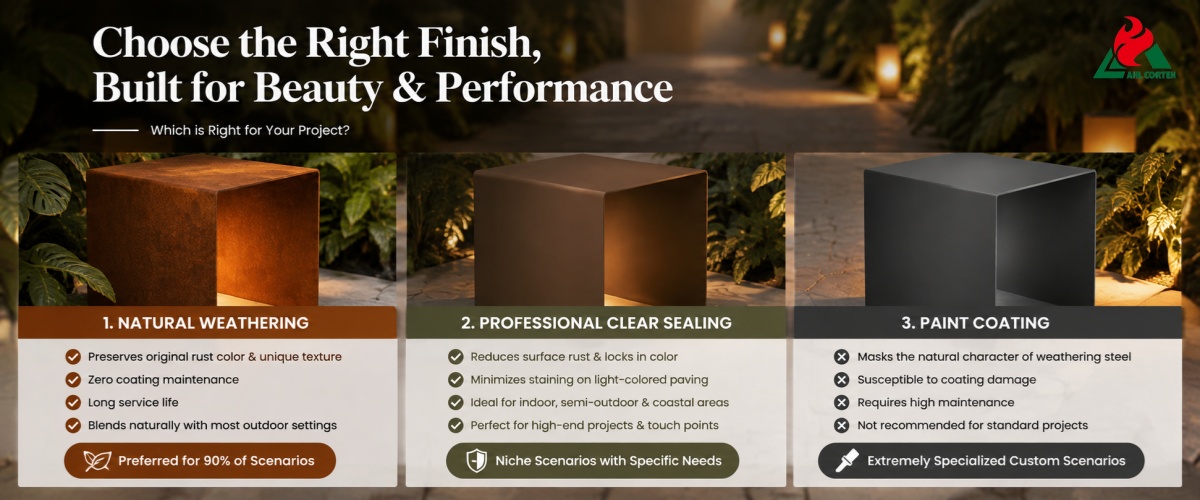
Final Selection Comparison: Natural Weathering, Sealing, or Painting—Which to Choose?
1. Natural Weathering (Preferred for 90% of Scenarios)
Advantages: Preserves the original gradient rust color and unique texture; requires zero coating maintenance; offers a long service life; and blends perfectly with various natural landscapes. Suitable for the vast majority of outdoor settings, including courtyards, lawns, gravel surfaces, and standard gardens.
2. Professional Clear Sealing (Niche Scenarios with Specific Needs)
Advantages: Reduces surface rust, locks in color, and lowers the risk of staining light-colored paving. Suitable for indoor and semi-outdoor spaces, coastal high-humidity environments, high-end light-colored paving projects, and frequently touched display fixtures.
Disadvantages: Restricts the natural patina’s ongoing evolution; requires periodic re-coating; improper application may lead to water accumulation and rust; carries a risk of color variation.
3. Paint Coating (Extremely Specialized Custom Scenarios)
Suitable only for custom projects requiring exclusive color schemes and uniform finishes. Drawbacks include completely masking the distinctive characteristics of weathering steel, susceptibility to coating damage, and cumbersome long-term maintenance; this option is strongly discouraged for standard landscape projects.
Why Choose AHL High-Quality Weathering Steel Lights?
1. Inherent Weathering Performance, Low Maintenance, and Peace of Mind
AHL Corten landscape lighting uses genuine weathering steel, which naturally forms a stable protective patina in typical outdoor environments. It does not require frequent repainting or refinishing and retains its aesthetic appeal over the long term.
2. Versatile Landscape Aesthetics, Continuously Enhanced Visual Appeal
The fixtures’ natural rust tones blend seamlessly with various landscape materials such as greenery, stone, wood, and concrete. By day, they serve as elegant landscape accents; by night, they create layered ambiance through laser-cut patterns and play of light and shadow, combining practicality with decorative value.
3. Versatile for All Settings, Customizable
The product line includes a variety of styles—such as courtyard lights, in-ground lights, wall sconces, and landscape light boxes—suitable for residential courtyards, hotel gardens, commercial plazas, and public landscapes. Customization options for laser patterns, dimensions, and shapes are available to meet personalized landscape design needs.
4. Scientifically Engineered Design, Safe and Durable
The products feature a design that separates the outer casing from the electrical compartment and are equipped with dedicated drainage, ventilation, and waterproofing structures that meet standard outdoor IP protection ratings. This design preserves the natural weathering advantages of weather-resistant steel while thoroughly ensuring the long-term safety and stability of the internal electrical system.
.jpg)
Frequently Asked Questions (FAQ) About Corten Steel Lights
1. Do High-Quality Corten Steel Lights Need To Be Painted To Prevent Rust?
No. The natural patina that forms on weathering steel is the best rust-preventive layer. Paint can damage the material’s natural protective mechanism, making it more trouble than it’s worth. Painting may be considered on a case-by-case basis only for custom projects with special color schemes.
2. Is It Necessary To Seal Outdoor Weathering Steel Lights?
Sealing is not required in standard applications. Only in special scenarios—such as light-colored paving, high-humidity coastal areas, or indoor/semi-indoor settings—should a transparent coating specifically designed for weathering steel be applied.
3. Can Sealing Completely Prevent the Lights From Rusting?
No. Sealing can only slow down surface rust formation and lock in the color; it cannot completely prevent oxidation and may also hinder the ongoing development of the natural patina. Prioritize resolving rust stains through proper drainage during installation rather than relying on sealing.
4. Can Ordinary Varnish Or Wood Stain Be Used For Sealing?
Absolutely not. Ordinary coatings are extremely incompatible with weathering steel and are prone to peeling, bubbling, whitening, and water pooling leading to rust, which significantly shortens the luminaire’s lifespan.
5. What Is the Simplest Way to Maintain Custom Corten Landscape Lighting?
Daily maintenance simply involves gently removing surface debris, ensuring proper drainage, and periodically inspecting electrical components—no complex refinishing or coating maintenance is required.
6. Does the Surface Sealing Protect the Lamp’s Internal Circuitry?
No. Electrical safety relies entirely on the product’s waterproof design, sealed components, and proper installation; surface sealing provides no electrical protection whatsoever.
Ready To Choose The Perfect Outdoor Corten Lights For You?
For the vast majority of outdoor landscape projects, natural weathering is the optimal, most hassle-free, and most aesthetically pleasing maintenance method for durable Corten garden lighting. No painting or routine sealing is required; the material’s inherent weathering mechanism provides long-lasting corrosion resistance and a unique landscape aesthetic.
Issues such as rust stains and color instability should be addressed primarily by optimizing installation locations, drainage structures, and ground paving—do not blindly rely on various coating treatments. Only in special, high-end settings should a specialized transparent coating be applied for precise sealing and protection after the patina has stabilized.
The core value of high-quality Corten lights lies in their natural texture—which becomes more refined with use—and their ultra-low maintenance costs. Choose AHL’s high-quality weathering steel fixtures to let the lights evolve naturally with the landscape, consistently showcasing a sophisticated, vintage outdoor lighting aesthetic.
Back

 Fill In The Inquiry