Does a Corten Water Feature Contaminate the Water With Rust?
In modern garden and commercial landscape design, corten steel water features have become a striking visual focal point with their distinctive vintage reddish-brown patina, complemented by flowing water.
However, most homeowners and designers share the same concern. Watching the ever-changing rust marks on the steel surface, it is natural to feel a sense of unease.
The key concerns are as follows:
Will the flowing water wash away rust particles, turning the pool water a murky reddish-brown?
Will floating rust particles clog the pump, endangering koi carp and aquatic plants?
If children or pets accidentally come into contact with or even drink the water, are there any health and safety risks?
In conventional thinking, rust is synonymous with corrosion, dirt and structural damage. However, the rusting mechanism of weathering steel is fundamentally different from that of ordinary steel.
Drawing on AHL Group’s 20 years of practical experience in international projects, this article explains the principles of weathering steel rusting in simple, easy-to-understand terms. It also clarifies the causes of water discolouration, explains why this phenomenon is harmless to water quality, and outlines systematic water purification solutions to help alleviate any concerns you may have when making a purchase.
Understanding Corten Steel Rust: It Is Not the Same Substance as Ordinary Rust
Core Principle: A Dense, Self-Protective Oxidation Layer
When ordinary steel rusts, the resulting rust layer is loose and porous, acting like a sponge that continuously absorbs moisture and air. The corrosion spreads inwards, eventually leading to the complete deterioration and failure of the steel.
Weathering steel water features contain rare metals such as copper, chromium and nickel, resulting in a completely different oxidation mechanism. In outdoor environments subject to wet-dry cycles, a dense, highly adhesive oxide film spontaneously forms on the steel’s surface; this is known in the industry as a patina.
This protective film acts like a suit of metal armour, isolating the steel from oxygen and moisture, preventing deep corrosion and enabling the steel to protect itself.
Aesthetic Advantages of Corten Steel Water Features
Ordinary steel develops mottled, yellowish rust accompanied by black signs of decay, and large chunks may flake off, creating a dirty, untidy and poor-quality appearance.
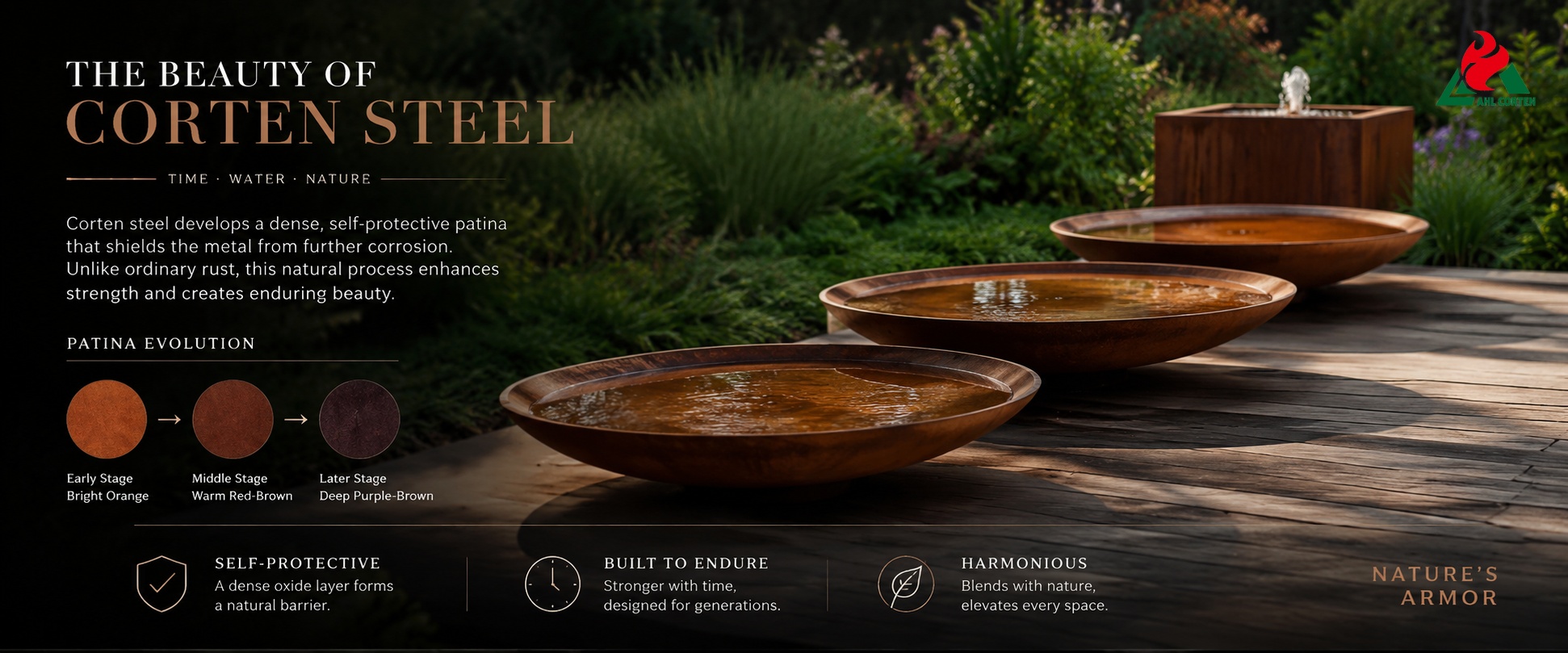
The rusting of weathering steel is a controlled evolutionary process, with colours changing gradually: bright orange-brown in the early stages → warm red-brown in the middle stages → deep purple-brown in the later stages, with a texture comparable to aged red wine.
Under long-term water erosion, the steel surface becomes increasingly smooth and compact. This unique patina is also the core reason why it has become the primary material for high-end outdoor water features.
Key Q&A: Does a Corten Water Feature Actually Pollute The Water?
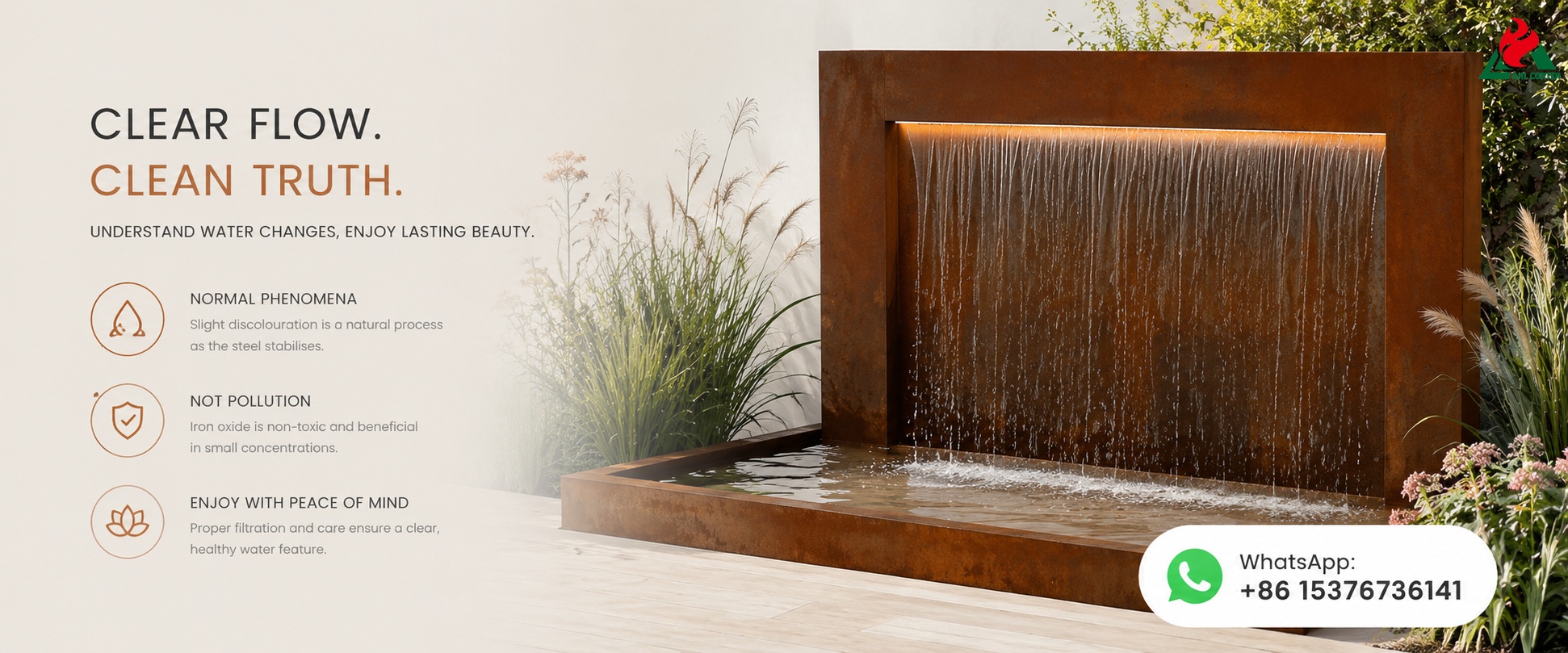
Straightforward Conclusion: No Severe Pollution; Water Quality Issues are Entirely Manageable.
A corten water wall will not inevitably turn the water into murky reddish-brown sludge. However, during the initial stabilisation phase of a new installation, or when maintenance is improper, water discolouration and trace iron rust impurities may indeed occur.
Put simply, it is not entirely free of impurities, but the risks are manageable and the harm is minimal; there is no need for undue alarm.
To provide a clear visual comparison of the difference in water quality between the two, the table below compares the performance of ordinary carbon steel and weathering steel in water features:
| Comparison Dimension |
Mild Carbon Steel (Low-grade Steel) |
Corten Steel (Weathering Steel) |
| Rust Layer Structure |
Porous & continuously peeling |
Dense patina with strong adhesion |
| Water Discoloration |
Permanent dark & murky water |
Slight early yellowing, naturally clear later |
| Rust Shedding Frequency |
Continuous large-scale peeling |
Only tiny particles in the initial stage |
| Aquatic Toxicity |
Harmful impurities, risky for fish |
Non-toxic iron, safe for aquatic life |
| Maintenance Difficulty |
Easy to pump blockage, hard to clean |
Concentrated sediment, easy quarterly cleaning |
5 Main Causes of Water Discolouration in Corten Water Features: How to Accurately Mitigate Risks
Rusty, cloudy water is rarely due to defects in the corten steel water feature, but rather to external conditions and design issues. The five main causes are clear and easy to understand:
New products have not yet stabilised: Brand-new bare steel that has not undergone pre-treatment has a loose surface layer of rust flakes that are easily washed away by water flow; this is the stage most prone to water quality issues.
Inappropriate Water Flow Design: Excessive water level differences or excessively fast flow rates result in high-intensity scouring that damages the protective film, generating metal particles.
Inadequate Filtration System: Systems equipped only with coarse filtration to trap leaves are unable to intercept fine rust particles; the accumulation of impurities causes the water to turn yellow.
Acidic water environment: Acid rain or the indiscriminate addition of acidic algaecides can corrode the protective rust layer, causing the leaching of large quantities of iron ions.
Prolonged inactivity of metal water features: Following shutdown in autumn and winter, stagnant water becomes oxygen-deprived, allowing rust powder and impurities to settle at the bottom, which can easily lead to pitting corrosion.

Common Misconception: Water Discolouration ≠ Severe Water Pollution
Most owners assume water pollution upon observing yellowing water or a film on the surface, but this confuses visual phenomena with actual pollution. The initial changes in water quality observed in rusted steel water features are mostly normal physical phenomena.
3 Common Harmless Water Quality Phenomena
- Initial slight yellowing and cloudiness: The first four weeks of operation constitute a material purification period, during which harmless micron-sized iron particles are suspended in the water. These contain no heavy metal toxins and can be gradually filtered out by the filtration system.
- Coloured reflective film on the water surface: This is not oil contamination, but a thin layer of iron oxide formed when iron ions oxidise upon contact with air; it is automatically filtered out by the overflow outlet.
- Reddish-brown sediment at the bottom of the pool: In still water, high-density rust particles settle naturally due to gravity; this can be removed by simple quarterly cleaning.
Water Quality Management Recommendations for Fish and Aquatic Plants
Iron oxide is non-toxic in itself and serves as a trace element nutrient for aquatic plants. However, high concentrations of suspended particles can adhere to fish gills, impairing respiration.
If a water feature is used to house koi or grow water lilies, steel materials should not be allowed to come into direct contact with the water. A precision filtration system combining quartz sand and activated carbon must be installed to increase water circulation frequency and trap suspended impurities.
Transparent Marketing: Rejecting False ‘Zero Discolouration’ Promises
Some retailers on the market falsely claim that their products will never discolour or produce sediment, leading to subsequent disputes with customers. AHL Group adheres to transparent marketing practices, informing clients in advance of the natural, phased changes in water quality.
Furthermore, our factory pre-treatment removes 90% of loose rust particles, bypassing the initial period of high turbidity. Upon delivery, the water is already in a stable and aesthetically pleasing condition.
5 Key Technical Solutions to Prevent Rust Migration in Corten Water Fountains at Source
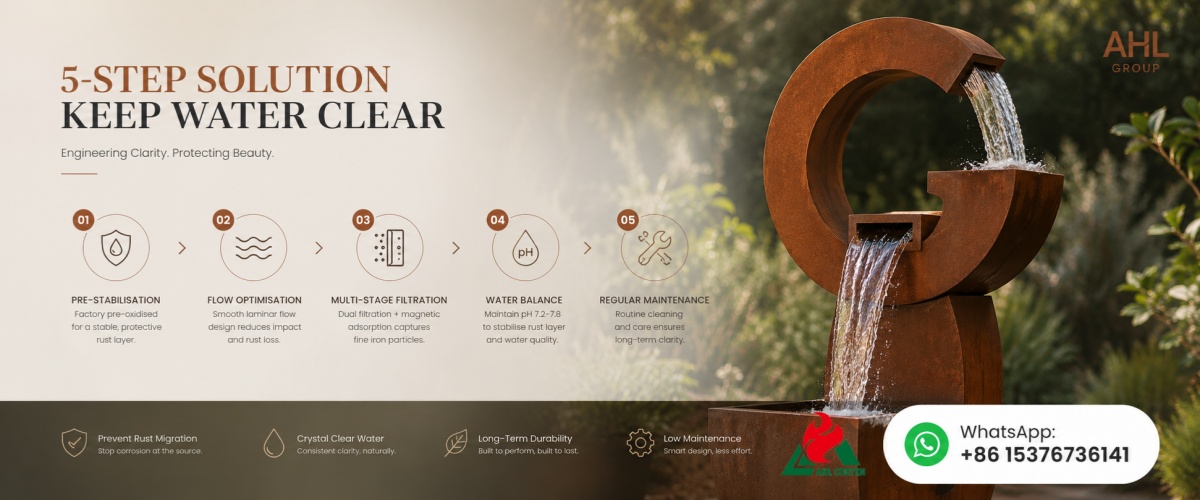
Maintaining crystal-clear water over the long term cannot be left to chance. AHL has developed a five-dimensional integrated solution that blocks the pathways through which rust dissolves into the water, suitable for a wide range of settings.
1. Factory Pre-Stabilisation Treatment to Reduce Initial Colour Fading Risks
We strictly avoid filling bare weathering steel water fountains with water on-site. Using a proprietary non-toxic formula, we complete pre-oxidation and curing before leaving the factory, forming a dense, waterproof crystalline film.
This process reduces the initial release of rust particles by over 85%, preventing water discolouration at the source.
2. Optimization to Minimise Water Flow Impact
Water flow impact is the primary cause of rust flake detachment. By precisely calculating the angle of the flow channels and the water discharge pressure, we create a smooth laminar flow.
This avoids high-altitude waterfall-style impacts, whilst concealed baffles installed in the collection tank create a low-speed settling zone to intercept iron filings and impurities.
3. Corten Water Fountain Multi-Stage Filtration System: Adsorption and Interception of Metal Particles
A dual-stage filtration system combines coarse and fine filtration: a stainless steel hair trap intercepts large impurities, whilst a combination of PP cotton and activated carbon filters out fine particles.
High-end models are fitted with a magnetic adsorption ring, which uses magnetic force to capture 99% of the iron powder. It is simple to remove, clean and reinstall, thereby extending the service life of the filter cartridge.
4. Scientific Water Quality Control to Maintain a Stable Rust Layer On the Water Fountain
Strictly control the water’s pH level, maintaining it within the slightly alkaline range of 7.2–7.8. Under these conditions, the solubility of iron ions is at its lowest, ensuring the protective rust layer remains in the most stable state.
Avoid strongly acidic algaecides such as copper sulphate; instead, use a specialised bio-enzyme algaecide solution to protect both the weathering steel water fountain and the water itself.
5. Long-term Maintenance Procedure for Corten Water Features
- Quarterly Desilting: Use a pond vacuum cleaner to remove dark sediment from the bottom of the settling area.
- Regular Filter Cleaning: Remove the filter mesh every 2–4 weeks and rinse it under high-pressure water to ensure unobstructed water circulation.
- Winter Protection: In northern regions, drain standing water from pipes during winter and apply a specialized protective wax to prevent corrosion caused by wind and drying.
Risk Classification by Corten Water Feature Type
The design of the rusted steel water feature directly determines the dynamics of the water flow, and the risk of rust flaking varies accordingly. Please refer to the following risk classification when making your selection:
High Risk: Fountains and Waterfall Features
Significant water level differences and strong water impact mean surface rust flakes are easily washed into the water. Deep curing treatment is required, along with a standard magnetic precision filtration system to increase the frequency of water circulation.
Medium Risk: Water Curtain and Rain Curtain Features
Water flows smoothly in a thin film with minimal impact force. Relying on CNC-machined precision outlets ensures uniform laminar flow; measures to prevent localised scouring marks are sufficient.
Low Risk: Still Water Pools, Overflow Basin Water Features
The water flows gently and is almost stationary, resulting in minimal corrosion of the steel. Only a funnel-shaped drainage structure at the bottom is required, with quarterly one-button drainage to remove sediment and impurities.
Water Outlet Structure Risk Ranking
Side-jet outlets (High risk) > Bottom fountains (Medium risk) > Concealed recirculation (Very low risk). Concealed recirculation structures minimise steel contact with water, offering the best rust prevention and water purification.
Procurement Checklist: Avoiding Pitfalls with Substandard Corten Water Features
To ensure your metal water feature remains clear and durable year-round, be sure to verify the following five criteria before purchasing to avoid water quality issues later on:
Material Certification: Request an SPA-H/A588 material certificate to distinguish between raw, untreated steel and pre-weathered finished products.
Welding and Sealing: Use weathering steel welding rods of the same material, and apply an industrial sealant resistant to acids and alkalis to the joints.
Drainage Structure: Ensure the base of the water tank features a sedimentation channel and a drain valve to simplify the cleaning process.
Supporting Systems: Reject standalone steel structures; prioritise integrated solutions that include filtration and water quality regulation.
After-Sales Support: Request a full-cycle maintenance manual that clearly outlines seasonal maintenance procedures and contingency plans.
Why Choose AHL Group for Bespoke Corten Water Features?
AHL does not merely sell steel plate ornaments; we provide end-to-end water feature system solutions. We are committed to delivering crystal-clear, flowing water, suitable for a variety of settings including private gardens and commercial plazas.
Free Environmental Assessment: We produce a bespoke risk assessment report based on the site’s latitude and longitude, water quality, and aquaculture requirements.
Fluid Simulation Design: Software simulates water flow trajectories to control particle dispersion at source and stabilise water quality.
Lifetime Maintenance Service: A 30-year water quality monitoring and maintenance plan is included as standard, making upkeep straightforward even for novices.

Customise Your Own Crystal-Clear Weathering Steel Water Feature
No need to hesitate over rust-related water quality issues. The vast majority of potential turbidity risks in weathering steel water features can be eliminated in advance through the use of proper materials, optimised fluid dynamics design and professional filtration systems. Weathering steel is a premium landscaping material and should not have its visual impact on gardens or commercial projects compromised by substandard craftsmanship.
With 20 years of experience in delivering overseas projects, AHL Group offers a one-stop bespoke service encompassing factory pre-rusting and curing, fluid hydraulics design, magnetic precision filtration and lifetime maintenance. We control rust precipitation at the source to ensure the water remains crystal-clear and transparent for the long term. Whether it’s an artistic water feature for a private garden or a large-scale landscape project for a commercial plaza, we can tailor solutions to your exact requirements.
Would you like to receive a bespoke water feature proposal, an accurate quotation and construction advice? Request a quote now by sending us your site conditions, dimensions and style requirements. AHL engineers will provide you with a free water quality risk assessment and a no-obligation customised quotation, allowing you to create a beautiful, stable and permanently clear high-end weathering steel water feature with complete peace of mind.
Back


 Fill In The Inquiry