

Find answers about specifications, installation, lead time, and custom fabrication for Corten steel ponds.
Yes. The body and base are fabricated from corten steel plate and fully welded, so the vessel itself holds water — a liner is only needed if you specifically choose an open-base version for a lined installation. If you plan to use a liner, tell us at the quotation stage and we will supply the base detail that suits your lining system.
For a water-filled vessel we recommend 4 mm and above, which is our published guidance for corten water bowls used as primary features. 3 mm is our most popular thickness for general garden use and is suitable for smaller ponds; 4–6 mm is what we recommend for commercial landscapes, public spaces and high-traffic installations where impact and load are higher.
Corten is a long-life material. Our published service-life guidance for corten landscape products is 20–50+ years with minimal maintenance, and the range is set by steel thickness, water chemistry, climate, coastal exposure and installation quality. Choosing 4 mm or thicker, keeping the water circulating and avoiding permanently trapped moisture all push you toward the top of that range.
No. The rust-coloured surface is a dense oxide layer — a patina — not ongoing deterioration. That layer reduces oxygen penetration, so further corrosion slows significantly and the steel stays structurally stable. This is the fundamental difference between corten and ordinary mild steel, where corrosion keeps spreading.
New steel arrives grey, silver or dark metallic. With rain and humidity it develops bright orange and copper tones within the first few months, then matures into deeper reddish-brown and dark earthy tones over several months to years. Loose rust particles do wash off during that early phase and the runoff decreases once the patina stabilises. The speed depends on local rainfall, humidity, sun exposure and air circulation.
Temporary staining can occur during the early weathering period as loose rust particles wash from the surface, and it decreases once the patina stabilises. Four ways to prevent it: pre-weather the steel before installation, put a gravel or mulch buffer zone between the pond and the paving, apply a rust stabiliser, or design the drainage so runoff is carried away from paving surfaces. If your project is going next to pale concrete or limestone, choose the pre-weathered option.
Yes, once the patina has stabilised. During the first weathering phase iron-rich runoff is still washing off the surface, so flush and refill the pond before you introduce fish or plants. After that the surface is stable and the pond is suitable for fish and aquatic planting — this is exactly the application our large corten vessels are made for.
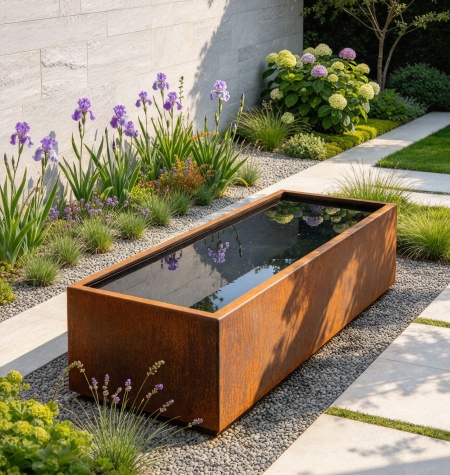
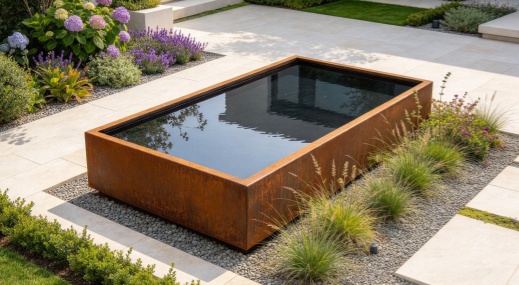
Our large corten water vessels run from roughly 1.2 m to 2 m in diameter with 40–60 cm water depth, which is the range that forms a proper small ecological pond. Smaller bowls and larger custom vessels are both available — dimensions are quoted per project rather than from a fixed catalogue.
Yes. Fabrication is laser cutting, CNC processing, bending, welding and precision forming, so height, thickness, diameter, shape and decorative detail are all made to order. Round, oval, square, trough and curved layouts are all produced this way, for private gardens, hotels, resorts and public spaces.
Standard products: 2–4 weeks. Custom fabrication: 3–6 weeks. Exact timing depends on order quantity, complexity and factory workload, and we confirm it in writing with the quotation.
Ponds are crated for sea freight and shipped FCL or LCL from China. We confirm the destination port nearest your site, the transit time and the delivered cost against your address and quantity when we quote — Australian projects are quoted port-by-port rather than with a single flat freight figure.
Plan the position and airflow first, then prepare a level, well-compacted base. Set the vessel so the rim sits just above the finished paving level, keep the surrounding soil from trapping moisture against the steel, and make sure runoff drains away from paving and light-coloured surfaces. Bring the water and any pump connection in after the vessel is levelled, and check the level again once it is full.
No painting, coating or frequent maintenance. Corten protects itself through the stable patina. What it does need is occasional removal of accumulated debris and drainage that stops water sitting against the steel permanently. Coastal sites need thicker steel and better drainage, not more coating.
MOQ and price both depend on diameter, height, thickness and finish, so we quote per project rather than publish a single figure. Send your drawing — or just your diameter, height, quantity and destination port — and we will come back with a firm quotation.
01 Recyclable, coating-free Corten needs no paint and no chemical coating, and the steel is fully recyclable at end of life. A long service life is the real environmental argument — not a green label.
02 The patina is the protection The rust-coloured surface is a dense oxide layer that slows further corrosion. It is not decay — and it is exactly why corten outlasts mild steel.
03 Ø1.2–2 m, or to your drawing Standard large vessels run 1.2–2 m in diameter at 40–60 cm water depth. Round, oval, square and trough forms; laser cut, CNC formed and welded to your dimensions.
04 3 mm standard, 4–6 mm for commercial Thickness is specified to span, load and exposure. With the right thickness and drainage, published service life is 20–50+ years
Want the Latest Prices for Corten Steel Water Features? Contact Us!


 Fill In The Inquiry