5 Best Corten Steel Edging Designs for Curved Gardens
Curved garden edging can create a soft, natural transition between lawns, flower beds, walkways, and landscaped areas. However, achieving smooth, flowing curves while avoiding creases in the steel sheets, misaligned seams, and subsequent loosening or warping has always been a challenge in landscape construction.
Corten steel lawn edging features a unique rust-colored texture, clean and crisp lines, and high design flexibility, making it ideal for a wide range of outdoor gardens and commercial landscape projects.
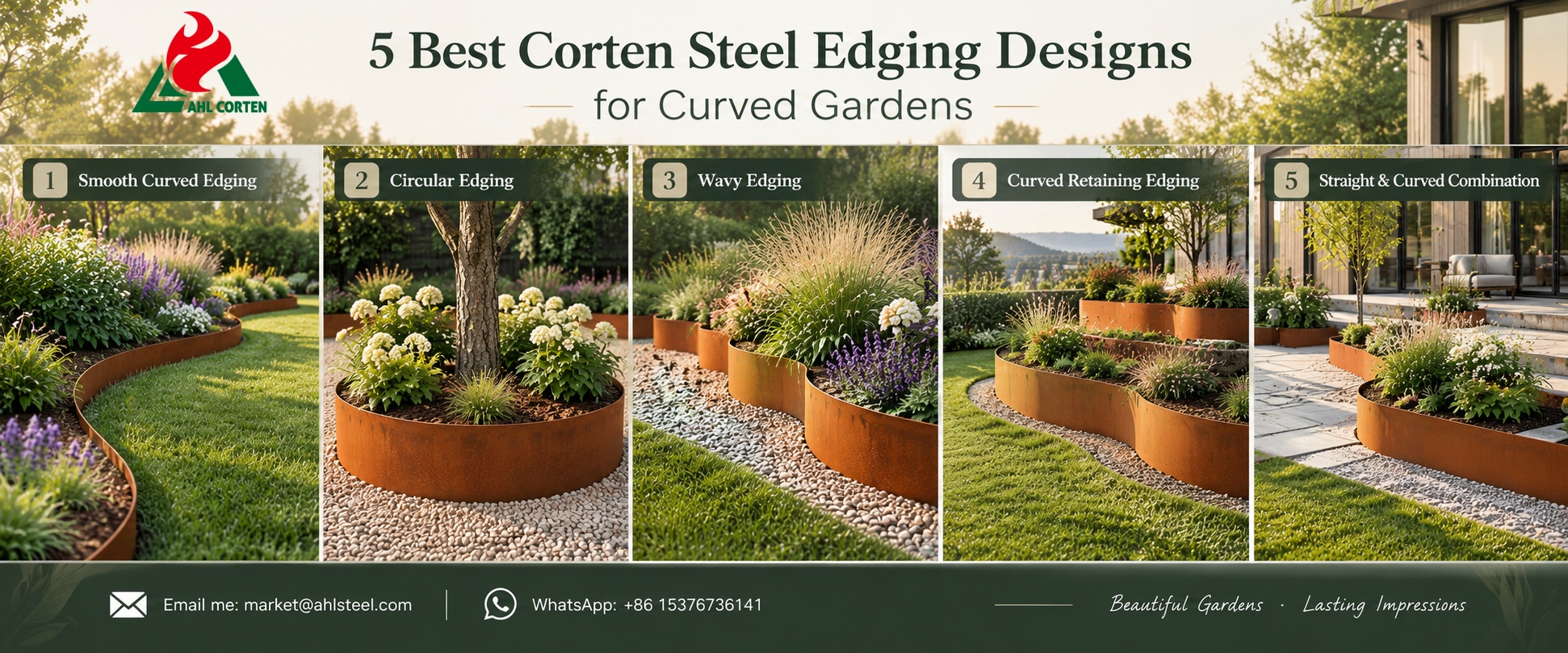
The appropriate edging solution depends on the radius of the curve, steel plate thickness, edging height, soil conditions, and installation techniques.
Whether you’re a private garden designer, a procurement manager for commercial landscape projects, or a construction contractor, choosing the right metal garden border can both enhance the aesthetic appeal of your garden and ensure the long-term stability of its boundaries.
This article compiles five mainstream styles of curved weathering steel edging, explains key considerations for selecting specifications, and outlines the details that need to be confirmed before placing a custom order.
Quick Answer: Which Corten Steel Edging Design Is Best for Curved Gardens?
| Design |
Best Application |
Main Advantage |
| 1. Smooth Flowing Curves |
Organic gardens and sweeping lawns |
Creates natural, continuous lines |
| 2. Circular and Ring Edging |
Trees, shrubs, and central planting beds |
Defines focal points neatly |
| 3. Wavy and S-Shaped Borders |
Contemporary and informal landscapes |
Adds movement and visual interest |
| 4. Multi-Level Curved Edging |
Sloped gardens and raised planting areas |
Separates levels and planting zones |
| 5. Mixed Straight and Curved Edging |
Modern gardens with geometric features |
Combines structure with softer lines |
Note: The achievable curve radius depends on the steel thickness, edging height, profile, and fabrication method. Not all Corten steel edging products are equally suitable for tight curves.
Why Choose Corten Steel Lawn Edging for Curved Gardens?
1. The Benefits of Weathering Steel for Curved Garden Borders
Weathering steel is a type of patinated steel that gradually develops a stable, brownish-red oxide layer in outdoor environments characterized by alternating dry and wet conditions. This rustic texture blends seamlessly with lawns, ornamental grasses, gravel, natural stone, and pressure-treated wood.
For curved gardens, weathering steel edging offers the following features:
- Unique texture: The warm rust tones create a gentle contrast with greenery and light-colored paving;
- Sleek profile: Thin steel edging offers a clean, crisp look, unlike the heavy, bulky appearance of stone or wood;
- Flexible shaping: Standard-sized sheets can be fabricated into various forms, such as arcs, circles, and straight-to-curved transitions;
- Customizable: Length, height, thickness, and curvature can all be adjusted according to drawings.
The rust patina develops gradually, and the final appearance is influenced by rainfall, sunlight, and ventilation. Proper site drainage and attention to detail at joints are essential for achieving a uniform and stable rusted surface.
2. Corten Steel Edging vs. Galvanized Steel and Aluminum Edging
Different metal edging materials serve different design and performance requirements.
| Material |
Appearance |
Key Consideration |
| Corten steel |
Natural rust-brown patina |
Patina development and potential rust runoff need consideration |
| Galvanized steel |
Zinc-coated metallic finish |
Coating condition and edge protection matter |
| Aluminum |
Lightweight metal appearance |
Profile stiffness and anchoring require attention |
Corten steel is particularly attractive when the project calls for a warm, natural material palette. However, the best material should be selected according to the desired appearance, mechanical requirements, budget, and installation environment.
3. How Corten Steel's Natural Patina Enhances Garden Design
The earthy tones of weathered steel complement natural stone, wooden decks, ornamental grasses, and minimalist modern architecture.
Curved rusted steel edging creates a subtle boundary that delineates planting areas without overshadowing the plants themselves.
There is one key detail that requires advance planning:
If the edging is placed directly adjacent to hard surfaces prone to staining—such as white concrete or light-colored stone—there is a risk of rust runoff causing staining during the initial period. Choosing pre-weathered panels or leaving a drainage gap can help minimize staining issues.
5 Best Corten Steel Edging Designs for Curved Gardens
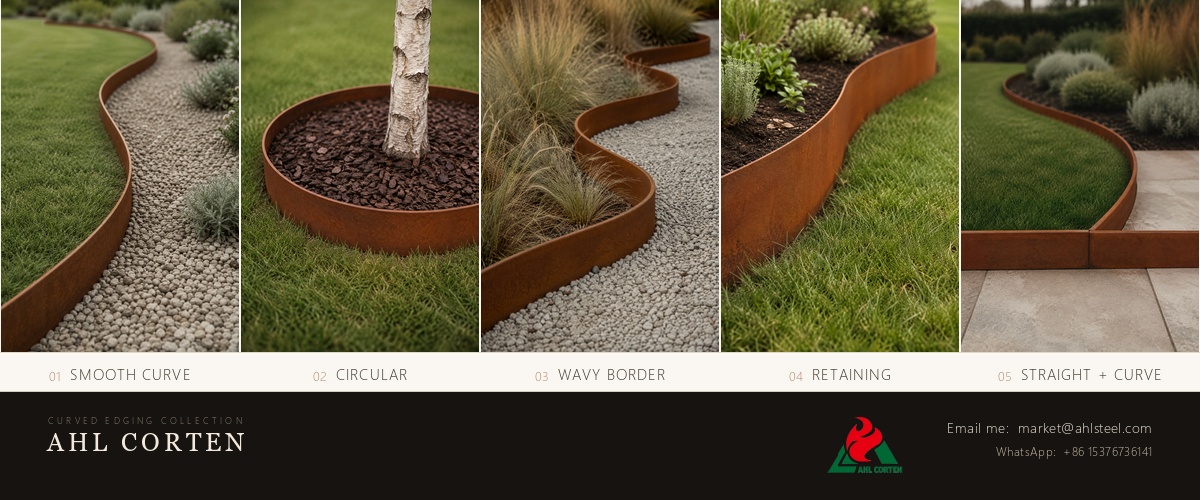
1. Smooth Curved Corten Steel Edging — The Top Choice for Natural-Style Gardens
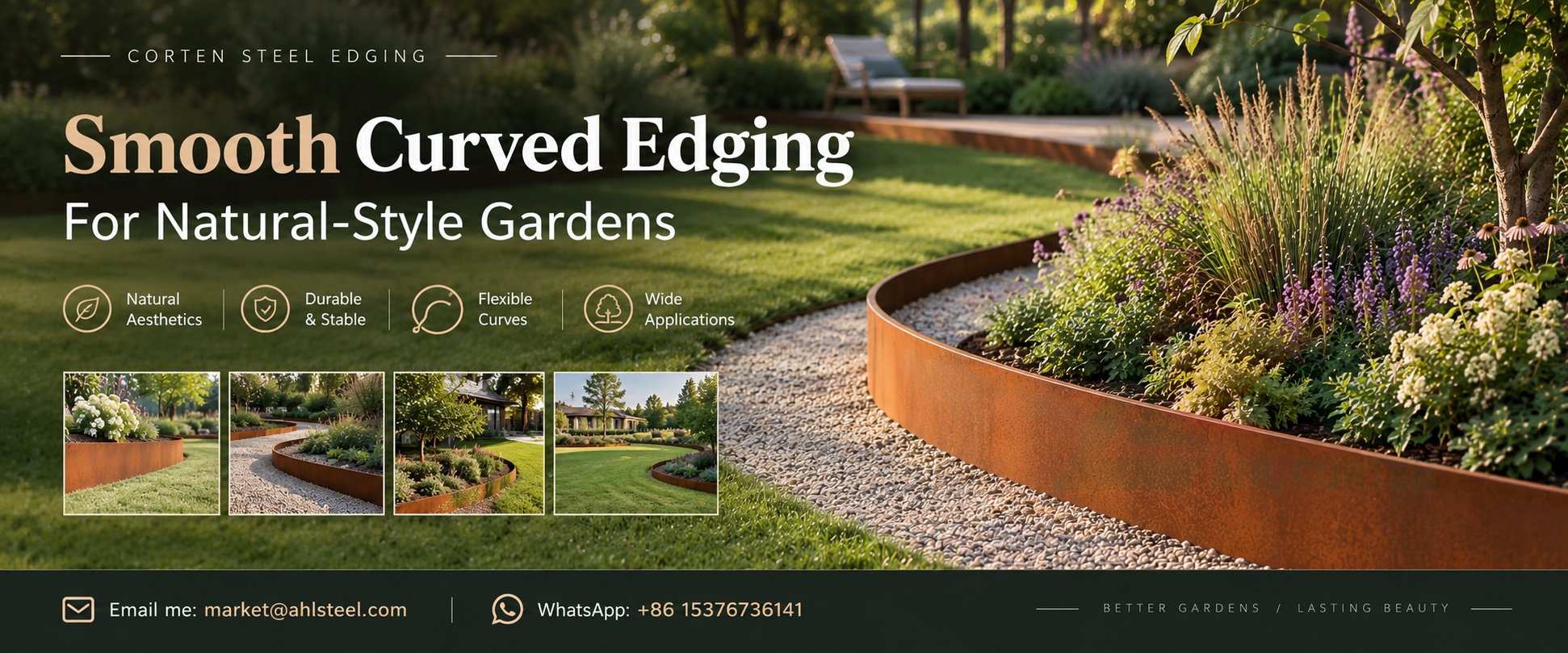 Continuous, gentle, sweeping curves are the most common design style for natural-style gardens, large lawn borders, and rustic flower borders.
Why Choose This Design?
- Create a seamless, gentle transition between lawns and planting areas;
- Softens the harsh straight lines created by buildings and hardscaping;
- Highly versatile for residential gardens, parks, and commercial landscaping projects.
Application Scenarios
- Residential lawns with curved flower beds.
- Cottage gardens and informal planting schemes.
- Public parks and landscaped green spaces.
- Hotel gardens and outdoor leisure areas.
- Winding garden paths and lawn boundaries.
Who Is Most Likely To Choose It?
- Homeowners who want a softer, more natural garden layout.
- Landscape designers creating organic planting schemes.
- Garden contractors installing large curved lawn borders.
- Property developers are seeking a consistent finish across outdoor spaces.
What Should You Consider Before Ordering?
Determine the arc radius, edging height, steel plate thickness, and joining method in advance.
Thin plates are suitable for on-site bending to create gentle, wide-radius arcs; for tight arcs with very small radii, factory pre-bending is recommended to avoid creases caused by forceful on-site bending.
For large-scale projects, prioritize prefabricated curved sections to ensure consistent curvature and a visually uniform appearance along the entire curve.
2. Circular Corten Steel Edging for Trees and Round Flower Beds
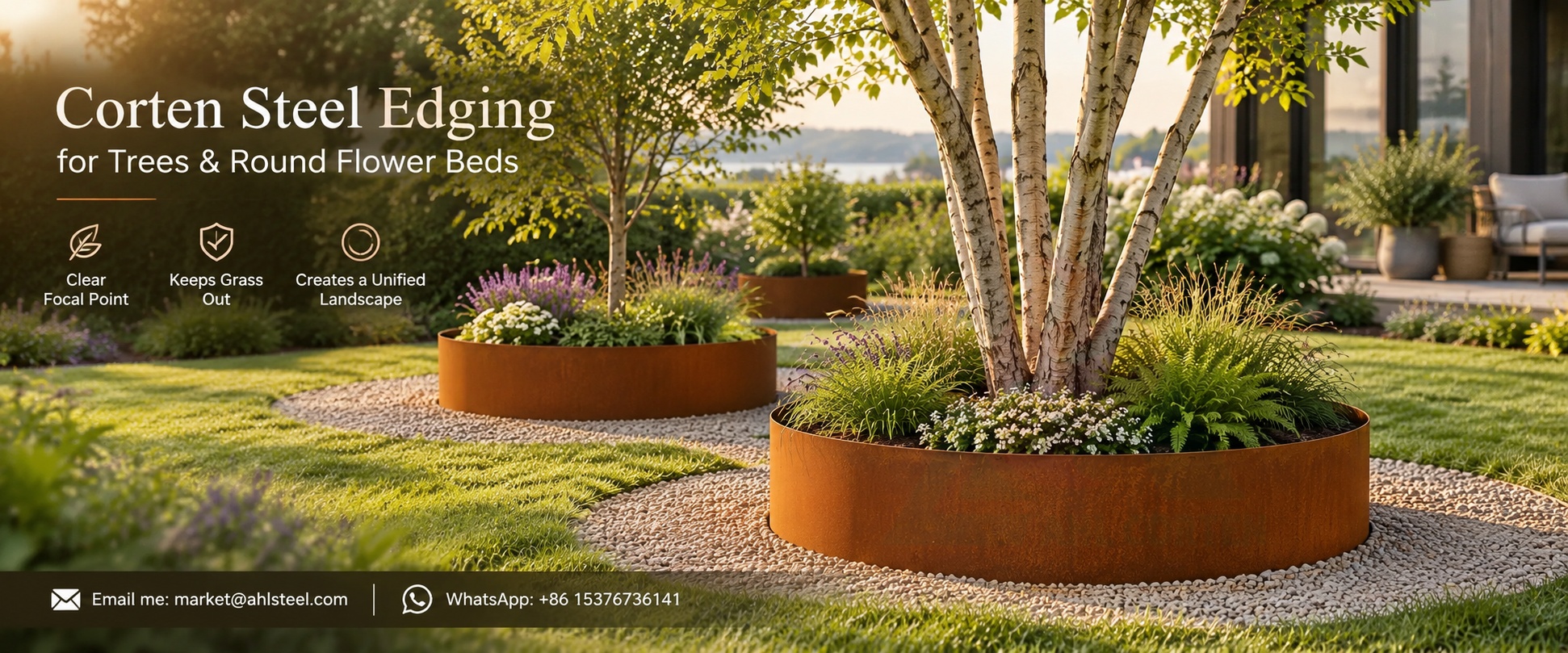
Circular and elliptical weathering steel edging is used to enclose landscape trees, sculpted shrubs, ornamental grass clusters, or central flower beds.
Why Choose This Design?
- Creates a clear visual focal point;
- Separate the lawn from the planting area by preventing grass from growing into tree pits or flower beds;
- Repeating multiple identical rings creates a unified rhythmic landscape.
What Should You Consider Before Ordering?
Confirm the ring’s diameter, height, thickness, and method of segmental assembly. For standard sizes, ready-made ring segments can be selected directly.
For non-standard diameters or elliptical shapes, custom fabrication at the factory is recommended.
Also, allow space for tree growth; do not place the edging too close to the trunk to avoid restricting the tree’s growth later on.
3. Wavy Corten Steel Garden Borders for Modern Landscapes
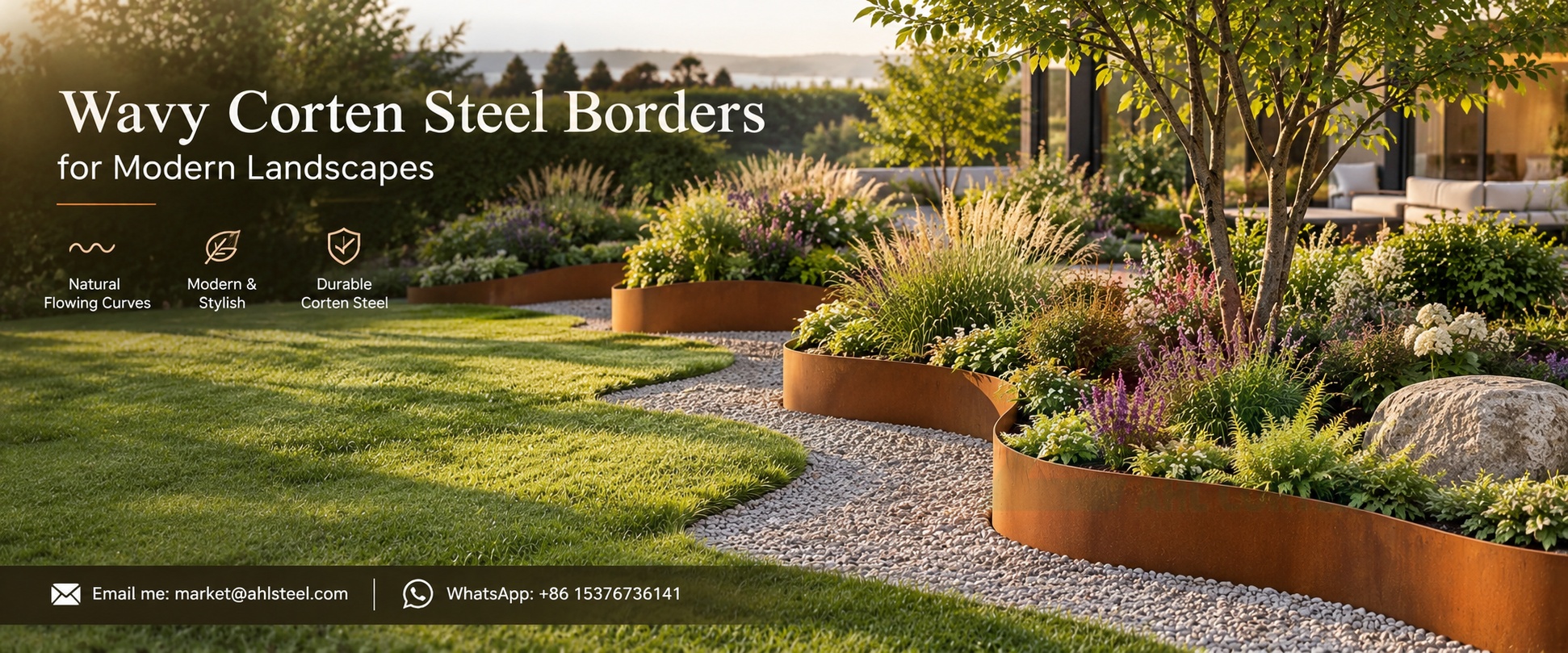
Wavy and S-shaped undulating edging naturally conveys a sense of movement, making it ideal for modern gardens, ornamental grass borders, and spaces where gravel and lawns intermingle.
Why Choose This Design?
- It serves as a landscape art feature in its own right;
- It breaks up the monotony of large, flat lawns and flower beds;
- It combines the clean lines of metal edging with the natural feel of curves.
What Should You Consider Before Ordering?
The wavy design requires high precision in fabrication.
Be sure to confirm in advance whether the curvature can be bent on-site or must be prefabricated at the factory.
Do not forcefully bend rigid panels into small waves, as this can easily cause bulging, twisting, or deformation. For projects with repeating S-shaped patterns, provide the factory with drawings or samples whenever possible.
4. Curved Corten Steel Retaining Edging for Layered Gardens
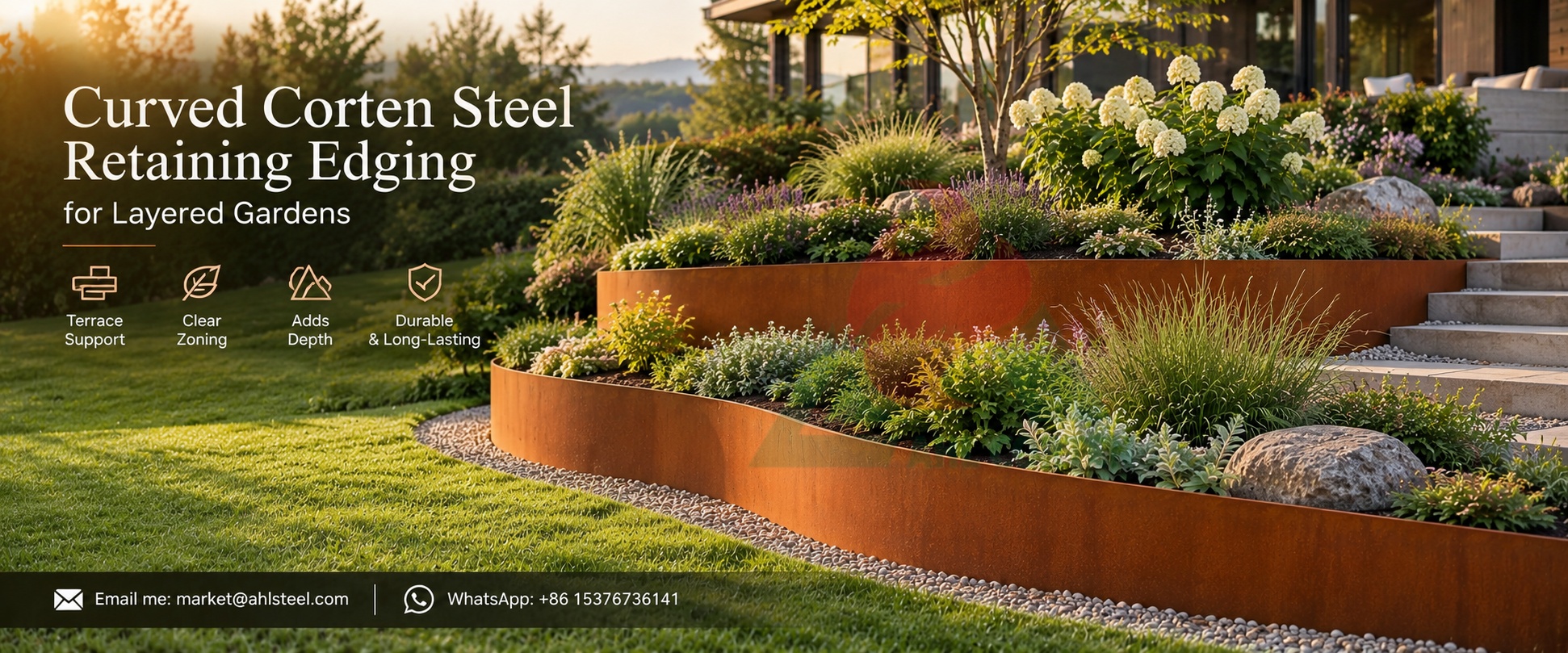 Curved retaining edging is suitable for raised flower beds and gently sloping terraces, where curved contours are needed and there are elevation differences.
Why Choose This Design?
- To divide different planting platforms on sloped terrain;
- To clearly separate lawns from raised flower beds;
- To add vertical depth to tiered gardens.
What Should You Consider Before Ordering?
Soil pressure and elevation differences create loads; standard lawn edging lacks the structural capacity to retain soil.
You must confirm the retaining height, soil type, drainage plan, steel plate thickness, and ground spike anchoring method.
In scenarios with significant elevation differences, heavy clay soil, or high groundwater levels, relying solely on thicker steel plates is insufficient; specialized structural calculations are required.
5. Combining Straight and Curved Corten Steel Edging for Contemporary Gardens
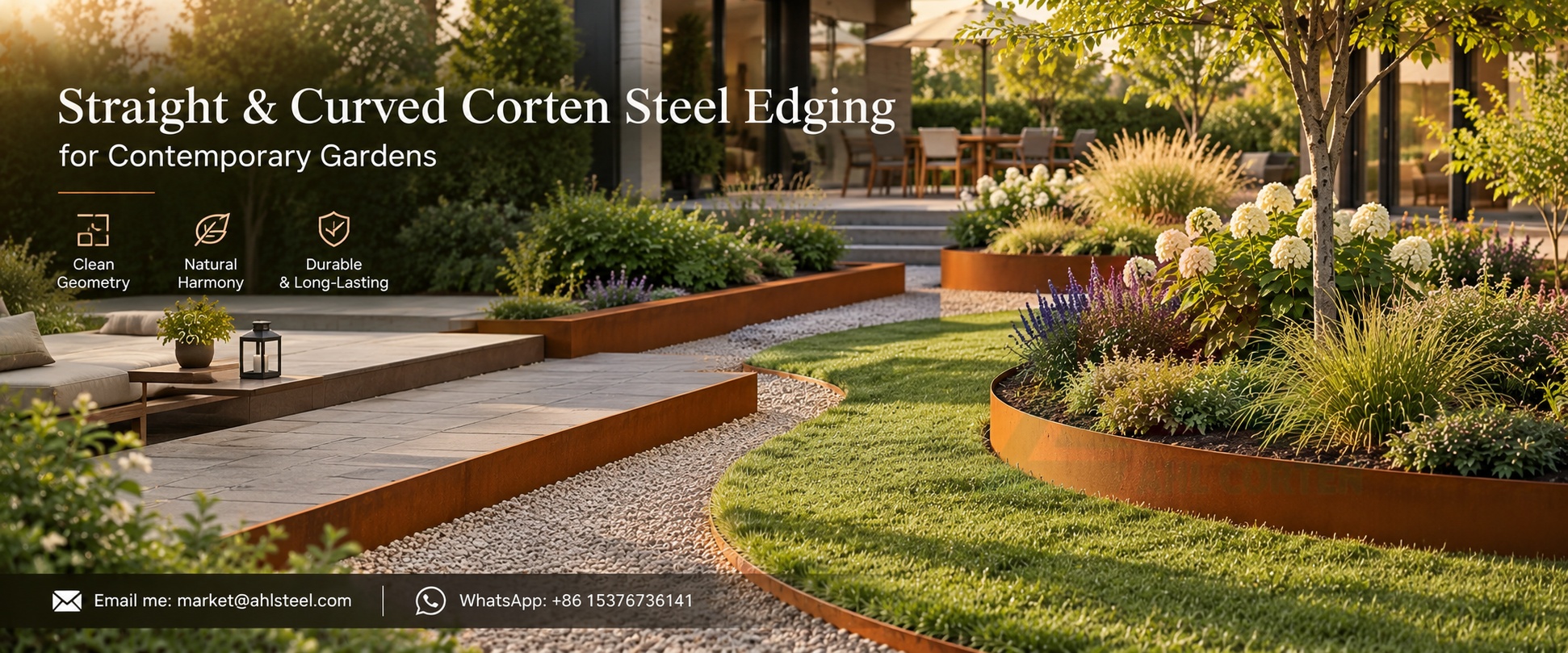
The combination of straight lines and curves is a classic approach in modern garden design, commonly used at the junctions of garden paving, patios, walkways, and flower beds.
Why Choose This Design?
- Balances the geometric, hard lines of the structure with the soft curves of the plants;
- Clearly delineate the three main areas: patios, lawns, and flower beds;
- Using a single material throughout the space creates a more cohesive landscape.
What Should You Consider Before Ordering?
Plan in advance for joint connections, corner angles, uniform heights, and segment lengths.
Straight and curved sections must ensure that cross-sections and connectors are compatible.
For projects with complex joints, it is best to provide dimensioned drawings to facilitate factory cutting, pre-bending, and pre-drilling.
How to Choose the Right Corten Steel Edging Thickness for Curved Gardens
1. 1.6mm vs. 2mm vs. 3mm Corten Steel Edging
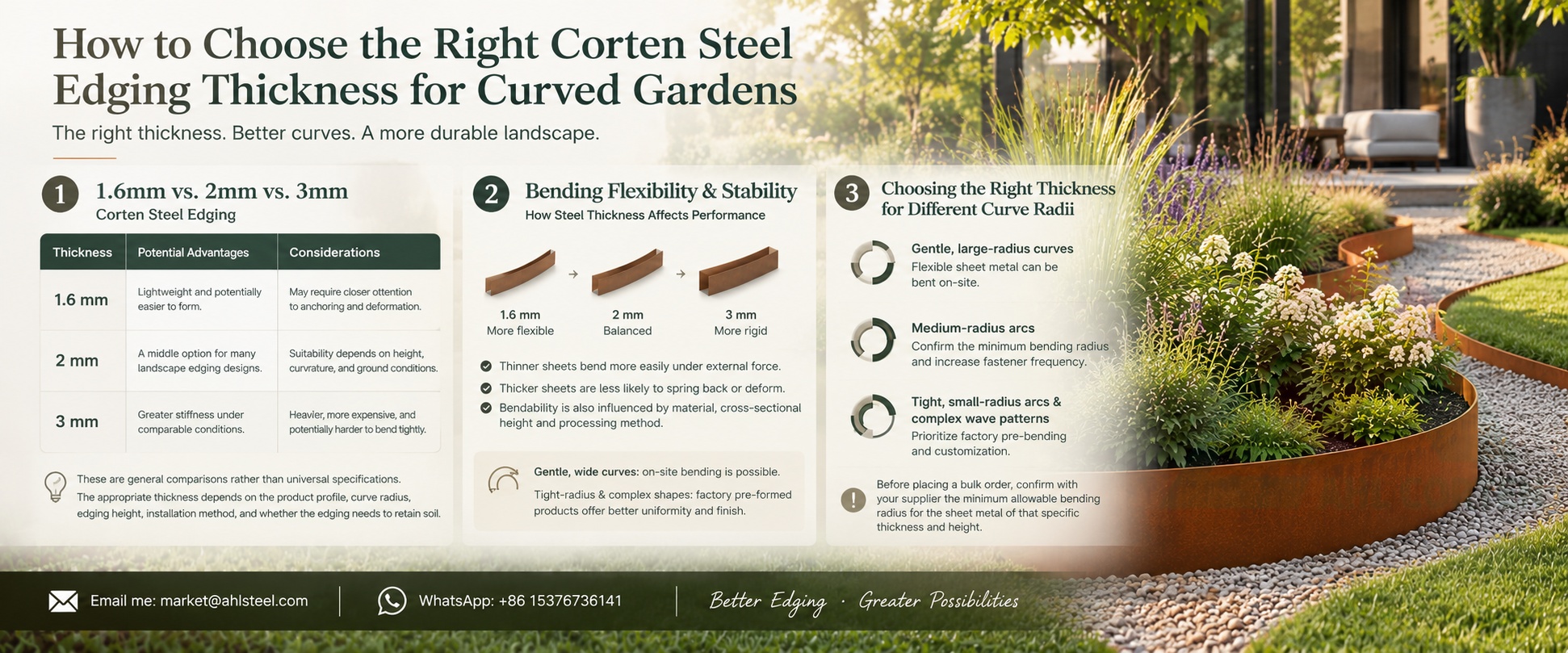
Steel thickness affects bending behavior, rigidity, weight, and cost. There is no single thickness suitable for every curved garden border.
| Thickness |
Potential Advantages |
Considerations |
| 1.6 mm |
Lightweight and potentially easier to form |
May require closer attention to anchoring and deformation |
| 2 mm |
A middle option for many landscape edging designs |
Suitability depends on height, curvature, and ground conditions |
| 3 mm |
Greater stiffness under comparable conditions |
Heavier, more expensive, and potentially harder to bend tightly |
These are general comparisons rather than universal specifications. The appropriate thickness depends on the product profile, curve radius, edging height, installation method, and whether the edging needs to retain soil.
2. How Steel Thickness Affects Bending Flexibility and Stability
The thinner the sheet, the easier it is to bend under external force; the thicker the sheet, the less likely it is to spring back or deform after forming.
However, bendability is also influenced by the material, cross-sectional height, and processing method.
For gentle, wide curves, flexible sheets can be adjusted on-site;
For tight-radius curves and complex wave shapes, factory-preformed products offer better curvature uniformity and a superior finished appearance.
3. Choosing Corten Steel Edging Thickness for Different Curve Radii
The tighter the curve, the higher the requirements for the sheet’s bending performance:
- Gentle, large-radius curves: Flexible sheet metal can be bent on-site;
- Medium-radius arcs: Confirm the sheet’s minimum bending radius and increase the frequency of fasteners;
- Tight, small-radius arcs and complex wave patterns: Prioritize factory pre-bending and customization.
Before placing a bulk order, be sure to confirm with the supplier the minimum allowable bending radius for sheet metal of that specific thickness and height.
How to Install Curved Corten Steel Lawn Edging Without Bending or Kinking
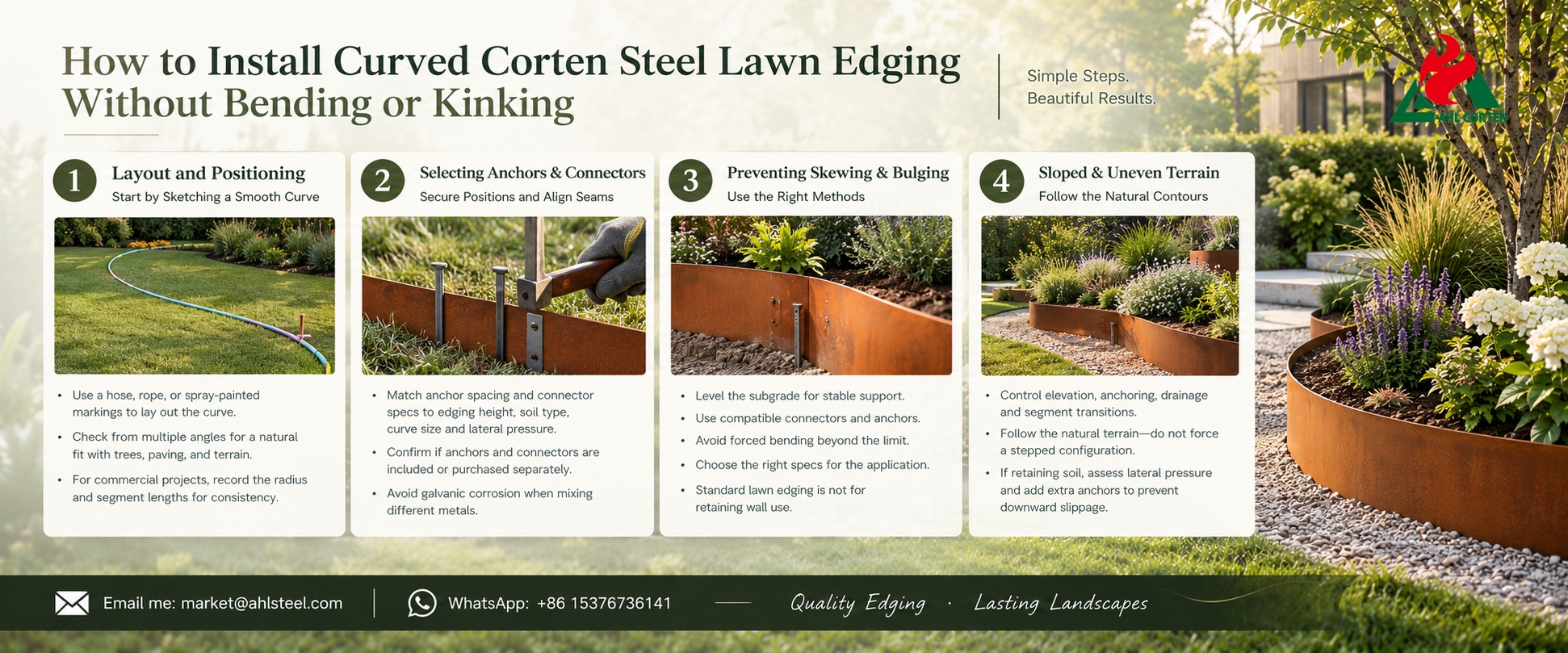
Layout and Positioning: Start by Sketching a Smooth Curve
Before excavating the trench, use a hose, rope, or spray-painted markings to lay out the designed curve on the ground.
Examine the curve from multiple angles to ensure it harmonizes naturally with surrounding trees, paving, and terrain.
For commercial projects, it is recommended to record the curve’s radius and segment lengths to ensure consistency across large construction areas.
Selecting Ground Anchors and Connectors
Ground anchors and connectors are used to secure positions and align seams. The spacing of ground anchors and the specifications of connectors must be matched to the edging height, soil type, curve size, and lateral pressure.
When placing an order, confirm whether ground anchors and connectors are included as standard accessories or need to be purchased separately.
When mixing different metals, take care to avoid galvanic corrosion.
Preventing Skewing and Bulging of Edging
Common causes of skewing and deformation in edging include insufficient anchoring, an uneven subgrade, forced bending, weak joints, and excessive lateral soil pressure. The risk can be mitigated through several methods:
- Level the subgrade to ensure stable bottom support;
- Use compatible connectors and arrange ground anchors appropriately;
- Do not apply excessive force beyond the panel’s allowable bending limit;
- Select the appropriate specifications based on the application; standard lawn edging should not be used for retaining wall applications.
Installation Techniques for Sloped and Uneven Terrain
When installing on slopes, focus on controlling elevation, anchoring, drainage, and segment transitions. Arrange the panels along the natural contours of the terrain; do not force the steel panels into a stepped configuration.
If a section requires earth retention, assess the lateral earth pressure prior to installation and add additional anchor points to resist downward slippage.
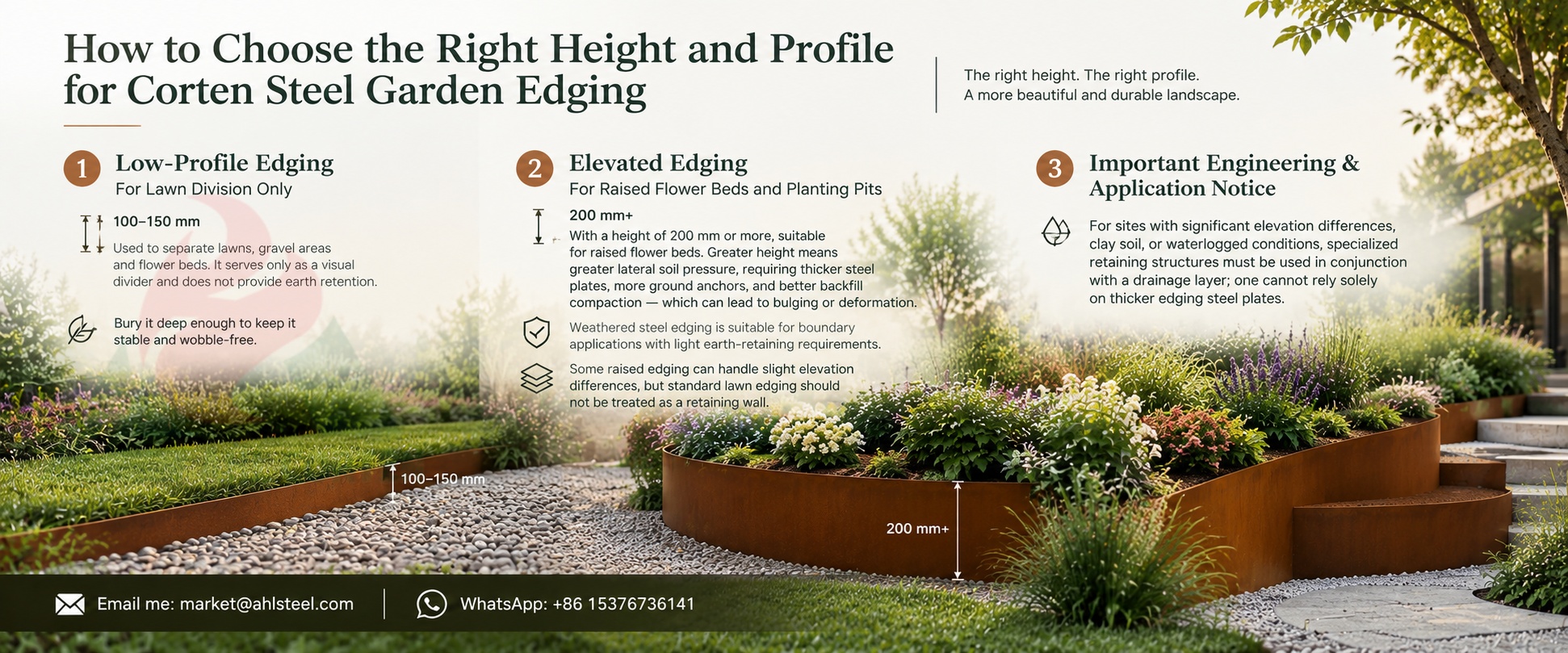
How to Choose the Right Height and Profile for Corten Steel Garden Edging
1. Low-Profile Edging: For Lawn Division Only
The low-profile edging, with a height of 100–150 mm, is primarily used to separate lawns, gravel areas, and flower beds.
It serves only as a visual divider and does not provide earth retention. When selecting a model, ensure it is buried deep enough into the ground to remain stable and wobble-free.
2. Elevated Edging: For Raised Flower Beds and Planting Pits
With a height of 200 mm or more, these are suitable for raised flower beds.
The greater the height, the greater the lateral thrust from the soil, placing higher demands on steel plate thickness, ground anchor density, and backfill compaction—which can easily lead to bulging or deformation.
Weathered steel edging is suitable for boundary applications with light earth-retaining requirements.
Some raised edging can accommodate very small elevation differences, but standard lawn edging should not be equated with a retaining wall.
3. Important Engineering & Application Notice
For sites with significant elevation differences, clay soil, or waterlogged conditions, specialized retaining structures must be used in conjunction with a drainage layer; one cannot rely solely on thicker curved garden edging steel plates.
Why Choose AHL Corten Group for Corten Steel Lawn Edging?
1. Custom Corten Steel Edging for Residential and Commercial Landscapes
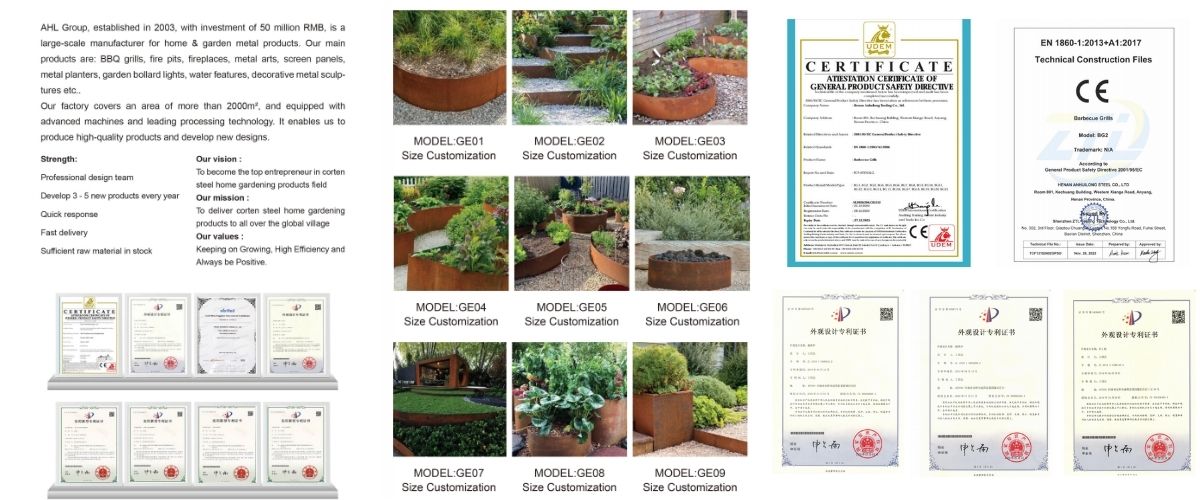
AHL Corten Group offers Corten steel outdoor products and can discuss project requirements for customized edging. Buyers should provide dimensions, drawings, and installation details so the appropriate product options can be evaluated.
2. Manufacturing Capabilities for Cutting, Bending, and Fabrication
Cutting, bending, welding, and assembly capabilities can support different product configurations. For curved edging, confirm the available thicknesses, minimum bend radius, dimensional tolerances, and connection details before production.
3. Wholesale Corten Steel Edging for Contractors and Distributors
For larger landscaping projects, wholesalers and contractors should confirm order quantities, production schedules, packaging specifications, shipping arrangements, and consistency between batches.
4. Request a Quote for Custom Corten Steel Garden Edging
Share your garden layout, total corten steel landscape edging length, preferred height and thickness, curve radius, and project location to help the supplier prepare a more accurate quotation.
Frequently Asked Questions
1. Can Corten Steel Lawn Edging Be Bent Into Curves?
Yes, provided the selected thickness and profile can accommodate the required radius. Tight curves may require pre-formed or custom-fabricated sections.
2. What Thickness of Corten Steel Is Best for Curved Edging?
The best thickness depends on the curve radius, edging height, ground conditions, anchoring, and intended use. Compare 1.6 mm, 2 mm, and 3 mm options against the project requirements rather than choosing by thickness alone.
3. Is Corten Steel Edging Suitable for Tight Curves?
It is suitable when the product is designed or fabricated for the required radius. Confirm the minimum bend radius before installation.
4. How Deep Should Corten Steel Lawn Edging Be Installed?
Installation depth depends on the metal garden border height, ground conditions, anchoring system, and intended application. Follow the product manufacturer's installation guidance.
5. Can Corten Steel Edging Be Used as a Retaining Border?
It may suit some light-duty applications, but standard lawn edging is not automatically suitable for retaining substantial soil loads. Higher or loaded borders may require an engineered retaining system.
6. How Can I Prevent Corten Steel Edging from Leaning?
Use appropriate stakes, stable ground preparation, secure connections, and a product suitable for the intended loads. Check the edging alignment during installation.
7. Will Corten Steel Edging Stain Nearby Paving?
It can produce rust runoff during patina development, potentially staining nearby surfaces. Plan drainage carefully and consider pre-weathered finishes where appropriate.
8. Can I Order Custom-Shaped Corten Steel Edging?
Custom options may be available depending on the manufacturer's capabilities. Provide drawings, dimensions, curve radii, and quantity requirements for assessment.
Order Custom Corten Steel Lawn Edging for Your Curved Garden Project
The best metal garden border combines the right design, thickness, height, curve radius, and installation method. Smooth curves suit naturalistic landscapes, circular edging defines focal points, and custom sections can help achieve complex designs with consistent dimensions.
For landscaping contractors, distributors, and project buyers, confirming these specifications before ordering can reduce installation issues and avoid unnecessary material costs.
Planning a Curved Garden Edging Project?
Contact AHL Corten Group to discuss your required dimensions, curved profiles, and customization options.
Back

 Fill In The Inquiry