10 Expert Tips For Securing Corten Steel Edging
With their clean lines and natural fading, vintage rust tones, weathering steel edgings have become a mainstream landscaping material for high-end gardens, commercial landscapes, and municipal parks. They precisely define the boundaries between lawns, gravel, flower beds, and hardscaped areas, enhancing the overall refinement and sophistication of the site.
However, in many projects, various damage issues arise within just one season of completion. After rainfall, edging strips bulge outward, tilt, or collapse, while the securing ground anchors loosen and fall out. Misaligned joints and uneven edges transform smooth curves into jagged lines, severely compromising the landscape’s aesthetic appeal.
More critically, poorly secured edging strips lead to soil spillage and rust water seepage. This not only stains the surrounding granite and paving tiles but also incurs significant costs for cleaning and rework.
The industry’s core engineering conclusion is clear: 90% of the loosening, deformation, and misalignment issues with metal garden bed edging are not caused by material defects, but rather by unscientific fastening systems and non-standard construction practices.
To ensure corten steel edging remains straight and uniform with 30 years of stable performance, simply burying it in soil is not enough. Drawing on AHL’s years of hands-on engineering experience, this article shares 10 industrial-grade fastening techniques to eliminate various construction risks at their source.
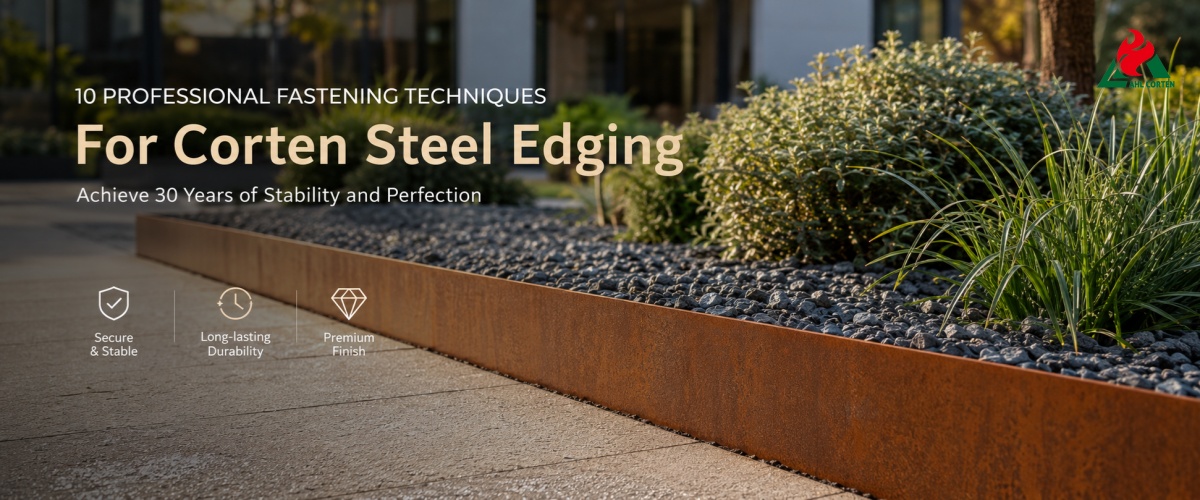
The 4 Main Causes of Deformation and Loosening in Corten Steel Edging
1. Uneven Foundation Base and Uneven Settlement Stress
To meet deadlines, construction teams often perform only simple excavation and trenching before directly pressing the edgings for landscaping into place. Issues such as protruding gravel, voids, and loose soil at the bottom of the trench make the area highly susceptible to uneven settlement after rainwater erosion.
Once the base becomes unstable, the weight of the soil will continuously compress the metal garden bed edgings, eventually causing the steel plates to arch outward and bulge.
2. Incompatible Anchors and Excessive Fixing Spacing
The plastic anchor pins and thin sheet metal ground nails supplied by small workshops have extremely poor load-bearing capacity and cannot withstand frost heave, root pressure from plants, or lateral soil thrust.
Additionally, many construction sites have anchor spacing that is far too wide, exceeding standard limits. The steel plates between two fixing points lack effective support and will bend or collapse after prolonged stress.
3. Cutting and Welding Defects Causing Stress Concentration
Burrs and rough edges resulting from on-site cutting, drilling, bending, and welding create points of metal stress concentration.
Under prolonged wet-dry cycling, these areas are the first to experience electrochemical corrosion and microcrack propagation, ultimately leading to seam cracking and overall misalignment.
4. Insufficient Backfill Compaction and Blocked Drainage Pathways
If the backfill soil on both sides is of inconsistent density and layered compaction is inadequate, a significant lateral pressure differential will form, continuously pushing the metal edging in one direction.
Combined with the inability to drain accumulated water at the bottom, the soil becomes muddy and softened over time, causing the anchor points to lose all grip, making the rusted garden edging highly prone to tilting and collapsing.
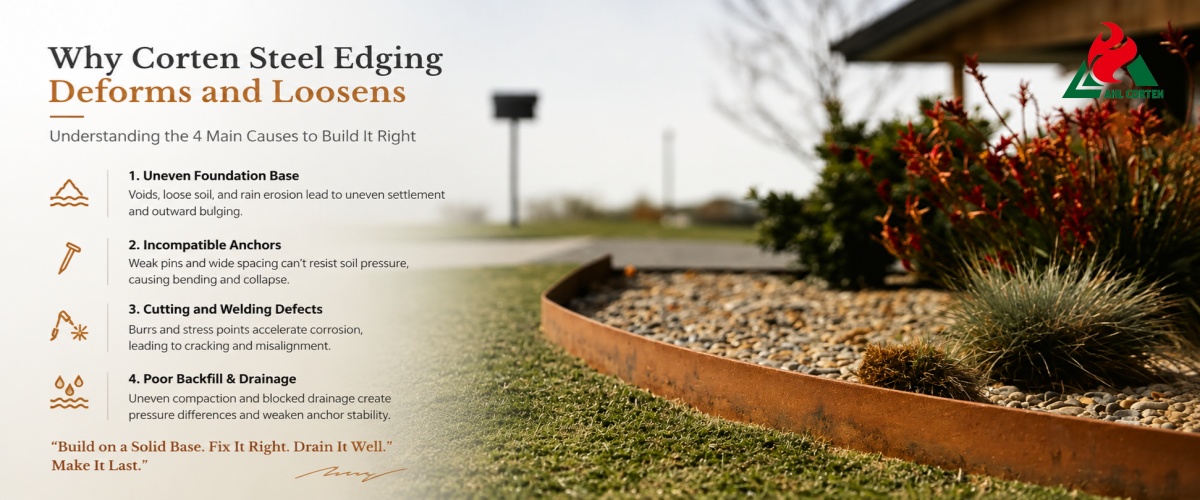
10 Professional Installation Techniques for Long-Lasting, Secure Corten Steel Edging
Technique 1: Double-Line Closed-Loop Alignment for Millimeter-Level Precision
Eliminate the crude practice of grooving and backfilling by eye by adopting the double-line closed-loop alignment method. Drive positioning rebar into both ends of the work area and stretch two high-strength nylon lines.
One line serves as the horizontal reference line, controlling the straightness and curvature of the corten edging; the other serves as an elevation control line to standardize the exposed height of the edging strips.
For 90° right-angle corners, verify using the 3-4-5 Pythagorean theorem and precisely mark lines with lime powder to keep construction errors within ±2 mm.
AHL’s original weathering steel edging strips undergo CNC precision straightening before leaving the factory, ensuring the base material is straight and free of deformation, thereby reducing construction calibration errors at the source.
Tip 2: Layered Subgrade Leveling and Rigorous Compaction of the Foundation Pit
The trench depth should exceed the steel garden edging perth’s burial depth by 2–3 cm to allow for subgrade leveling and compaction. After trenching, use a plate compactor to fully compact the original soil at the bottom of the trench.
Site-Specific Subgrade Techniques: For soft soil or grassy areas, lay a 3–5 cm layer of crushed stone and coarse sand, then compact it again; for areas adjacent to high-end hard paving, pour a dry-hard cement mortar to create a hardened subgrade.
This method completely resolves uneven settlement issues. The crushed stone layer rapidly drains rainwater, preventing long-term waterlogging, corrosion, and loosening at the base of the edging strips.
Tip 3: Site-Specific Anchor Selection and Customized Anchoring Solutions
Avoid the common mistake of using the same standard anchors for all sites; instead, select specialized anchoring components based on soil type and paving conditions.
- Soft clay and sandy soil: Use 25–30 cm extended barbed, V-shaped weather-resistant steel ground anchors, relying on their large cross-sectional area to resist lateral thrust.
- Gravelly, hard soil, stony foundations: Upgrade to high-strength solid weather-resistant steel ground anchors, which can easily penetrate hard soil without bending or breaking.
- Hard paving, soil-free rocky areas: Forgo ground anchors and use L-shaped side brackets secured with expansion bolts to a frost-resistant concrete base layer for maximum stability.
Tip 4: Dynamically Adjust Anchor Spacing to Scientifically Distribute Loads
Avoid blindly spacing anchors at equal intervals. Instead, dynamically adjust anchor density based on the edging strip’s height, curvature, and soil pressure to precisely distribute lateral shear forces.
- Standard straight sections (height ≤ 10 cm): Maintain anchor spacing between 60–80 cm to balance stability and construction efficiency.
- Sections with high elevation differences (height > 15 cm) and high-stress areas: Reduce spacing to 40–50 cm to increase the density of fixation points.
- Bidirectional curved surfaces and large-radius corners: Reinforce the apexes and start/end points of curves by shortening the spacing to 30 cm, and use double-screw reinforcement at joints.
AHL features a built-in quick-locking groove structure and standardized anchor positioning, eliminating issues such as excessive spacing and failed fastening caused by substandard workmanship.
Tip 5: Deburr and Chamfer Cut Edges to Eliminate Potential Structural Stress Hazards
After on-site cutting and bending, all cut edges must be ground on both sides using 80-grit sandpaper to create rounded corners (R-radius).
When performing right-angle bends, do not force the material into the bend. At the fold line on the back of the corten steel landscape ring, mill a V-shaped stress relief groove no deeper than one-third of the panel thickness to evenly release internal stresses in the steel.
Rough cut edges leave microscopic tear burrs that are highly prone to inducing localized electrochemical corrosion and cracking under wet-dry cycles. Grinding and chamfering these edges completely eliminates such issues while also preventing personnel from being cut during subsequent maintenance.
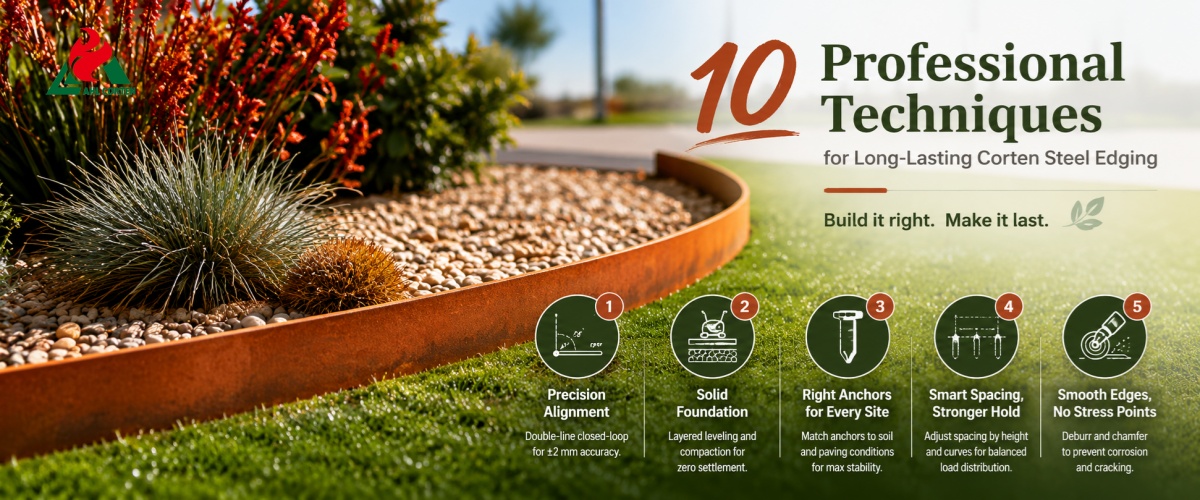
Tip 6: Modular Jointing Process for Seamless and Stable Curved Corners
Joints are the weakest points of metal garden bed edging. Arbitrary spot welding or the use of scrap material on-site is strictly prohibited; instead, a standardized modular overlapping solution must be adopted.
- Long straight joints: Use embedded sleeve connections made of the same material, with an overlap length of no less than 5 cm, secured from the back with anti-loosening, weather-resistant bolts.
- 90° External Corners: Prioritize the use of AHL’s original factory-made, cold-rolled, one-piece pre-formed corner pieces to replace on-site bending, thereby eliminating issues such as angular deformation and weld cracking.
- High-Curvature Curved Sections: Employ an internal flexible overlap technique, reinforced with dual ground anchors at the overlap points, to ensure smooth, uniform curves without jarring edges.
Tip 7: Three-Layer Backfilling Process for Three-Dimensional Support and Stable Edging
Backfilling is not simply a matter of filling with soil and compacting it; a scientific three-layer backfilling method must be adopted to firmly secure the corten steel edging 150mm through a layered, compacted structure.
- Bottom Stabilization Layer: Backfill one-third of the height with graded crushed stone and coarse sand, compacting it to secure the base of the edging strip and quickly drain accumulated water.
- Middle Compression Layer: Backfill with clean, undisturbed soil or clay, compacted a second time to eliminate internal voids and strengthen lateral support.
- Top Landscape Layer: Cover with planting soil, turf substrate, or gravel; level and compact moderately to balance aesthetic appeal with structural stability.
This three-layer structure forms a gravity-retaining system that effectively resists root pressure and rainwater erosion, eliminating issues such as single-sided collapse and hollow settlement.
Tip 8: Provide Expansion Joints to Adapt to Extreme Temperature Fluctuations
Steel exhibits thermal expansion and contraction. In regions with significant temperature variations between summer and winter or frequent freeze-thaw cycles, expansion allowances must be provided for long-distance edging.
For straight edging sections exceeding 15 meters in length, install a flexible expansion joint every 6–8 meters. Replace fixed round-hole bolts with elongated slot holes to allow for 3–5 mm of axial expansion.
This design releases expansion stress during high summer temperatures and accommodates contraction during cold winters, completely preventing issues such as bulging and arching in summer and bolt breakage in winter.
AHL flexible edging accessories come with CNC-punched expansion slots; workers simply snap them into place, automatically accommodating standard deformation allowances and eliminating human error.
Tip 9: Two-Way Drainage to Eliminate Water Pooling Hazards at the Source
Water pooling is the primary cause of soil softening and anchor failure; therefore, installation must be accompanied by a two-way drainage system.
The installation elevation of the edging strips must precisely align with the site’s drainage ditches and storm drains to ensure smooth overall drainage.
Create a 1°–2° micro-drainage slope along the lawn edges, while installing concealed horizontal permeable channels in the base gravel layer every 3 meters to rapidly drain accumulated water.
This prevents prolonged waterlogging and mud accumulation in the edging area, which could cause anchor bolts to lose friction, thereby resolving issues of unilateral displacement and tilting deformation at their source.
Tip 10: Three-Stage Inspection and Maintenance for Long-Term, Flawless Results
High-end landscape aesthetics depend 30% on construction and 70% on maintenance. Establish a standardized three-stage inspection mechanism to ensure the long-term stability of edging lines.
Initial inspection 1–2 weeks after handover: Comprehensively verify flatness and elevation, check for settlement in the backfill soil, and promptly correct minor deviations.
Special Inspection After Heavy Rain: Check for blocked drainage channels, water seepage at joints, and loose or floating ground anchors.
Regular Inspection During Spring and Fall Seasonal Transitions: Tighten bolts on curved surfaces and high-stress areas; remove humus, dead branches, and fallen leaves from the back to prevent long-term moisture-induced corrosion.
After undergoing a full cycle of wet and dry conditions, as well as hot and cold temperatures, and undergoing fine-tuning and reinforcement, the edging structure can remain stable and distortion-free for decades.
FAQ: Precise Solutions to Construction and Maintenance Challenges
1. Why Do Corten Edging Strips Tend to Bulge and Deform After Rain or Freeze-Thaw Cycles?
The primary causes are foundation settlement, inadequate backfilling, and poor drainage. Standing water softens the soil, and when combined with freeze-thaw expansion stresses and root pressure, the fixing system becomes unbalanced, ultimately causing the steel plates to buckle and bulge. This is not a material quality issue, but rather the result of substandard installation and fixing techniques.
2. What Is the Standard Anchor Spacing for Residential and Commercial Projects?
For standard low edging in residential gardens: 60–80 cm for straight sections and 30–40 cm for curved sections. For commercial high retaining walls and high-traffic areas: uniformly increase spacing to 40–50 cm, with double-nailed reinforcement at joints to enhance load-bearing stability.
3. Is It Mandatory to Provide Expansion Joints In Freeze-Thaw Regions?
Yes, it is mandatory. In areas with significant temperature fluctuations and frequent freeze-thaw cycles, steel is subjected to extreme deformation stresses. Without expansion allowance, the entire structure may develop wave-like deformation and joints may crack; flexible expansion joints are an essential technique for long-term stability.
4. How Should Old, Loose, or Tilted Edging Strips Be Repaired?
First, excavate the backfill layer, level the subgrade, and recompact the soil. After correcting the flatness of the edging strip, install additional compatible anchor bolts at closer intervals, repair the drainage channels, and restore the layered backfill structure to ensure stability.
5. How Can Rust Water Contamination of Surrounding Paving Be Prevented?
Ensure unobstructed drainage and prevent water accumulation on the base to minimize rust water seepage; simultaneously, standardize joint construction practices to avoid rainwater pooling. Combined with a scientifically designed slope, this allows rainwater to be channeled away via the drainage system, preventing it from stagnating in paving joints.
Learn how to install Corten Steel Edging like a pro →
Summary and Consultation: Customizing Long-Lasting, Stable Corten Steel Edging Solutions
The stability of weathering steel edging strips never depends on the material itself, but rather on a systematic set of engineering practices. Precise positioning, a hardened base, compatible anchor points, scientific spacing, standard joints, layered backfilling, drainage and pressure relief, and regular maintenance—none of these can be overlooked.
By abandoning crude burial methods and strictly adhering to industrial-grade standards, we ensure that weathering steel edging remains straight and uniform year-round, combining a vintage aesthetic with high-end landscape appeal, while significantly extending the project’s lifespan and enhancing its visual appeal.
Want to get your weathering steel edging installed right the first time, eliminating future issues like deformation, rework, and pollution? Contact us now for a quote and a customized solution!
✅ Free Site Survey and Assessment: We precisely match sheet thickness, anchor specifications, and fixing intervals based on the project’s soil conditions, climate, and edging height.
✅ Custom Solutions for Commercial Projects: We provide prefabricated corner pieces, expansion joints, and a full set of reinforcement accessories, suitable for high-standard municipal, hotel, and garden landscape projects.
✅ Comprehensive Construction Documentation Support: Receive free standardized construction manuals, CAD drawings, and inspection checklists to guide your team in proper implementation.
✅ Custom Sample Service: Request samples of factory-direct weathering steel sheets, anchor bolts, and lap joints to verify quality on-site.
Act now to request a quote and secure an industrial-grade, standardized installation solution—ensuring your weathering steel edging landscape remains beautiful and maintenance-free for years to come!
Back

 Fill In The Inquiry