What Is the Best Way to Cut Corten Edging?
The Landscape Application Value of Corten Steel Edging
Corten steel edging is a core material in modern courtyard and landscape design. It is primarily used to delineate the boundaries of flower beds, lawns, and walkways, helping to organize the layout of courtyard spaces. With its unique, vintage rust-colored texture, it complements a variety of landscape styles, including minimalist and industrial designs.
Many people focus solely on the material quality of corten steel itself, yet overlook the importance of the cutting process. In fact, cutting techniques directly determine the final appearance, safety in use, and stability of installation—they are the key details that define the quality of a landscape.
3 Major Issues Caused by Improper Cutting
- Safety Hazards: Rough cut edgings produce sharp burrs, which can easily cause cuts, scrapes, or bumps during routine garden maintenance, children’s play, or pet activity, posing long-term safety risks.
- Aesthetic Flaws: Misaligned cutting angles and uneven edges compromise the clean lines of weathering steel. What should be an elegant landscape boundary ends up with noticeable imperfections, diminishing the overall sophisticated feel of the garden.
- Installation Instability: Dimensional deviations and rough joint finishes lead to gaps and misalignment at the seams. After prolonged outdoor use, the edges are prone to loosening and shifting, undermining the element’s core function of defining a structured space.
Key Conclusion
High-quality weathering steel must be paired with standardized cutting techniques. Only precise, smooth, and burr-free cuts will create clean, crisp, and durable professional landscape borders.
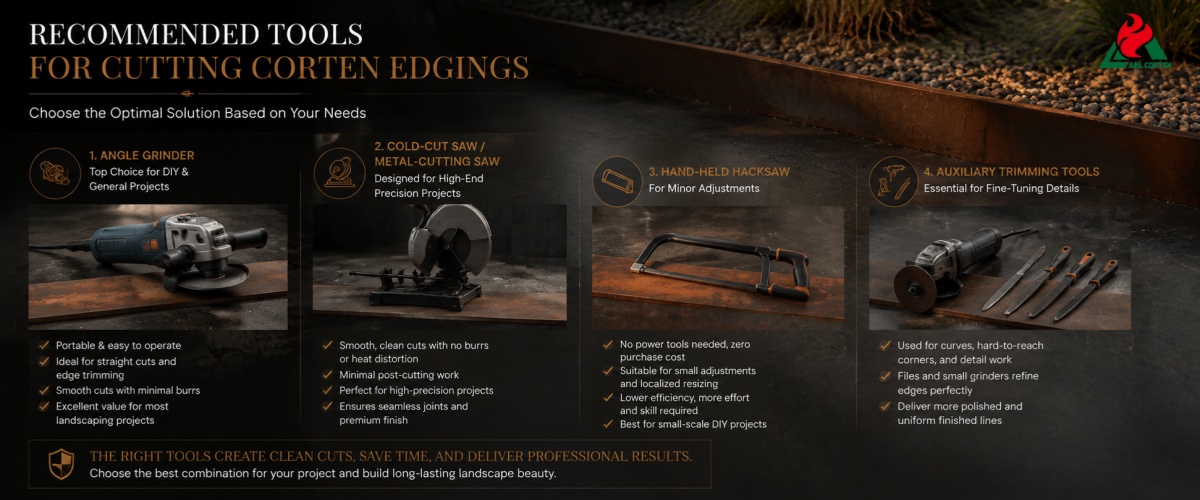
Recommended Tools for Cutting Corten Edgings: Choose the Optimal Solution Based on Your Needs
There is no single “one-size-fits-all” cutting tool; rather, the optimal combination depends on the project’s scale and precision requirements. Selecting the right tools can significantly improve cutting efficiency and finished product quality.
1. Angle Grinder (Top Choice for DIY & General Projects)
The angle grinder is the mainstream tool for cutting weathering steel on outdoor job sites. It is portable and easy to operate, making it suitable for the vast majority of residential and small-scale landscaping projects.
It can easily handle straight cuts and rusted steel edging. When paired with specialized cutting discs, it produces smooth cutting surfaces with minimal burrs. After simple polishing, it meets the requirements of standard landscaping construction, offering excellent value for money.
2. Cold-Cut Saw/Metal-Cutting Saw (Designed for High-End Precision Projects)
For high-precision construction scenarios such as commercial landscaping and high-end gardens, the cold-cut saw is the superior choice. It employs a stable mechanical cutting method, producing cuts with virtually no burrs or heat-induced scorching, and achieving a level of smoothness far surpassing that of an angle grinder.
This tool effectively reduces the amount of post-cutting sanding and trimming required, ensuring seamless joints, making it ideal for projects with stringent quality requirements.
3. Hand-Held Hacksaw (For Minor Adjustments)
Requiring no power tools and incurring zero purchase costs, this tool is suitable for simple tasks such as minor adjustments and localized resizing.
The drawbacks are low cutting efficiency, time-consuming and labor-intensive work, and a certain level of skill required for operation. It is only suitable for small-scale DIY projects and is not recommended for large-area cutting.
4. Auxiliary Trimming Tools (Essential for Fine-Tuning Details)
Auxiliary tools such as small grinders and files are primarily used to handle details that main tools cannot cover, such as curved shapes, hard-to-reach corners, and localized fine-tuning, resulting in more refined and uniform finished lines.
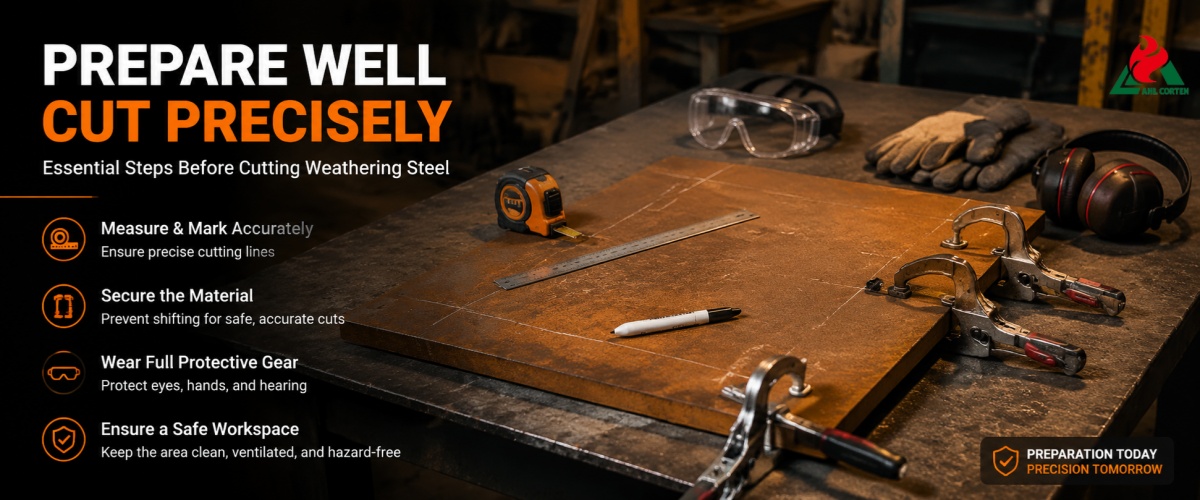
Essential Preparations Before Cutting: Ensuring Precision and Work Safety
Preliminary preparations are key to avoiding dimensional errors and safety incidents. Though they may seem trivial, they directly determine the smoothness of the work and the quality of the final product, so they must never be skipped.
1. Accurate Measurement and Marking of the Cutting Line
Use a tape measure to repeatedly verify the required dimensions, and use a marker pen and marking tools to draw clear, precise cutting lines. Never cut by feel; this prevents dimensional deviations and rework from the outset.
2. Secure the Material to Prevent Shifting or Wobbling
Before cutting, use clamps to secure the edges of the weathering steel to a stable work surface. Material movement can cause crooked cuts and inaccurate dimensions, and may also cause the tool to slip, creating a safety hazard.
3. Wear a Full Set of Protective Gear
Metal cutting generates sparks, metal debris, and noise, so personal protective equipment is essential: safety goggles block flying debris, protective gloves prevent cuts and burns, long-sleeved clothing minimizes skin exposure, and ear muffs mitigate noise-induced hearing damage.
4. Creating a Safe Work Environment
The work area must be kept away from flammable and explosive materials. Keep the floor level and free of debris, and ensure adequate ventilation to promptly remove dust and fumes generated during cutting, thereby mitigating safety risks.
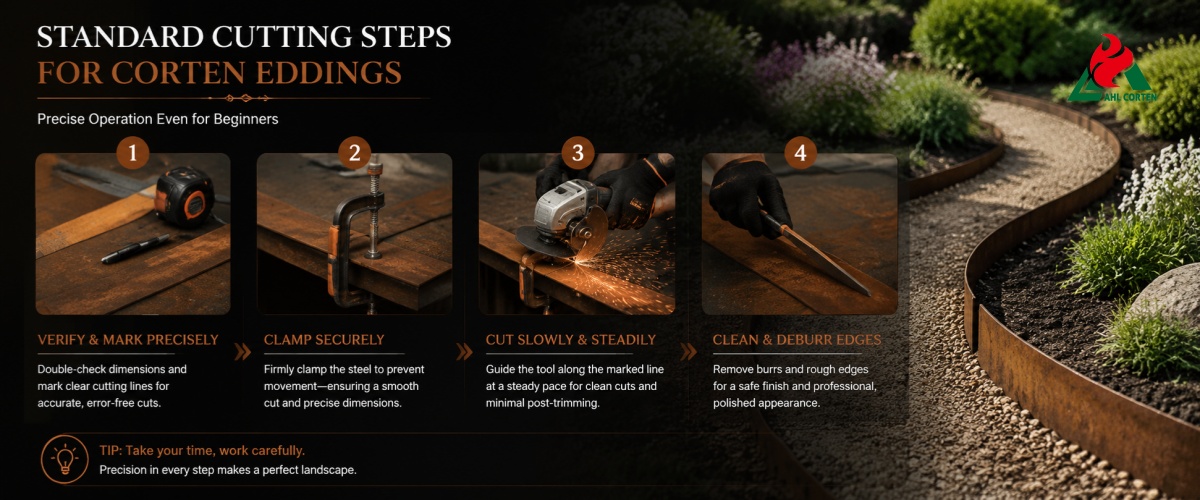
Standard Cutting Steps for Corten Edgings: Precise Operation Even for Beginners
1. Verify Dimensions and Mark Precisely
Double-check the length dimensions based on on-site installation requirements. Use a marker to draw fine, clear cutting reference lines, providing a clear guide for precise cutting and avoiding cutting deviations caused by blurred lines.
2. Securely Clamp the Steel
Use clamps to firmly secure the weathering steel edging, completely eliminating any shifting or vibration during the cutting process. This is the fundamental prerequisite for a smooth cut and precise dimensions.
3. Cut at a Slow, Steady Pace
Move the tool smoothly along the marked lines, maintaining a slow and steady pace. Avoid pushing or pulling the tool rapidly in an attempt to speed up the process, as this can cause the equipment to vibrate and your hand to waver, resulting in crooked cuts and rough edges.
Slow, steady operation ensures a smooth cut and reduces the amount of post-cutting trimming required.
4. Cleaning the Cut Edge, Deburring, and Trimming
After cutting, use a file or a small grinder to thoroughly remove burrs and protruding imperfections from the cut edge. This step is the key distinction between amateur DIY work and professional installation, directly enhancing the safety and aesthetic appeal of the finished product.
The Necessity of Post-Cutting Trimming: Dual Improvements in Safety and Aesthetics
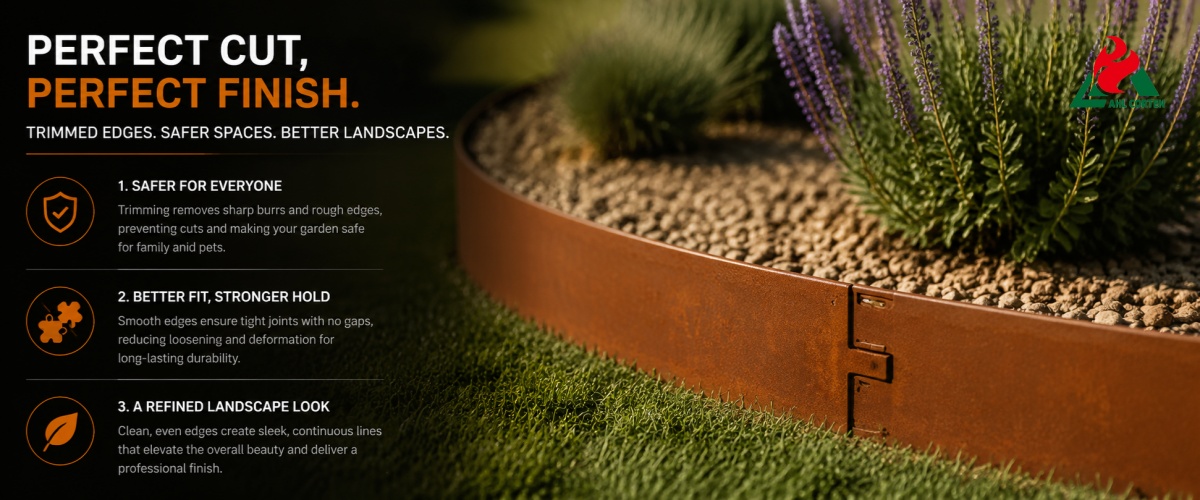
1. Eliminating Safety Hazards and Safeguarding the Home Environment
Untreated cut metal landscape borders are covered with fine, sharp burrs that can easily cause cuts during daily gardening, when people touch them, or when pets are active. After trimming and grinding, the edges become rounded and smooth, completely eliminating safety risks and making the material suitable for use in home gardens.
2. Optimizing Joint Fit for Enhanced Stability
Rough cut edges can cause gaps and misalignment when steel sections are joined, leading to loosening and deformation over time. Smooth, polished cut edges ensure a seamless fit, resulting in a more secure installation and a longer service life.
3. Enhancing the Overall Aesthetic Refinement of the Landscape
Burrs and uneven cut edges can detract from the clean, crisp lines characteristic of weathering steel. After precise trimming, the edge lines are continuous and uniform, significantly enhancing the overall aesthetic quality of the landscape and delivering a professional finish.
Common Cutting Mistakes: Avoiding the Pitfalls of Re-work
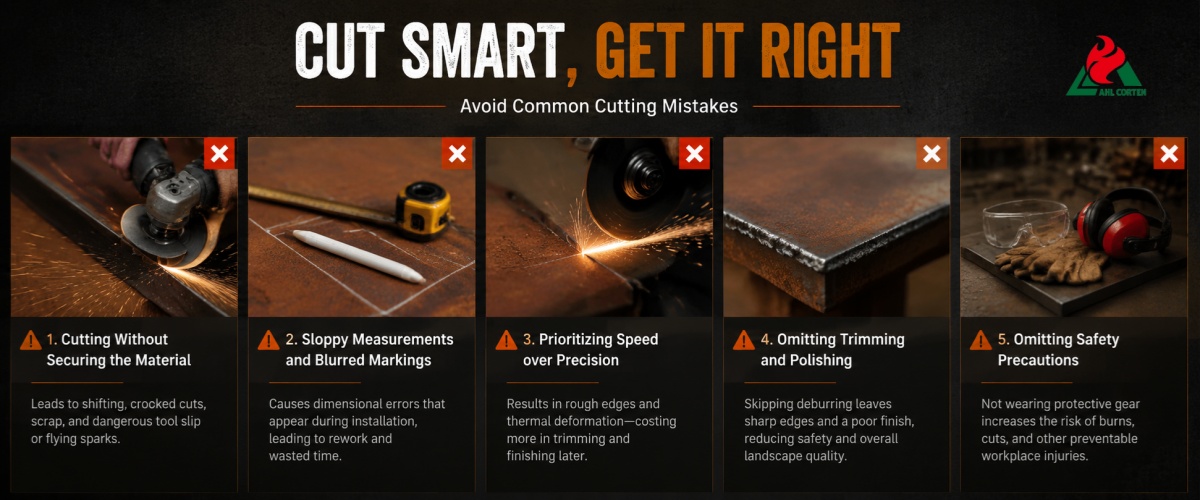
1. Cutting Without Securing the Material
Cutting by hand or without clamps to secure the steel allows the material to shake and shift easily. This not only results in crooked cuts and scrap material but also increases the risk of safety incidents such as tool slippage and flying sparks.
2. Sloppy Measurements and Blurred Markings
Rough measurements, blurred lines, or cutting based solely on experience can lead to dimensional deviations. These issues often only become apparent during assembly and installation, requiring rework and adjustments that waste both materials and time.
3. Prioritizing Speed Over Precision
High-speed cutting may seem efficient, but it results in rough cut edges and thermal deformation of the steel. The cost of subsequent trimming and finishing far exceeds that of slow, steady cutting, making it a case of “more harm than good.”
4. Omitting the Trimming and Polishing Process
Many people mistakenly believe that the job is complete once cutting is finished, neglecting the deburring step. This ultimately results in poor safety and a rough finish, significantly lowering the quality of the landscape.
5. Omitting Safety Precautions
Failing to wear protective gear for the sake of convenience makes workers highly susceptible to burns and cuts from sparks and metal debris, leading to unnecessary workplace injuries.
Bending Instead of Cutting? Applicable Scenarios and Limitations
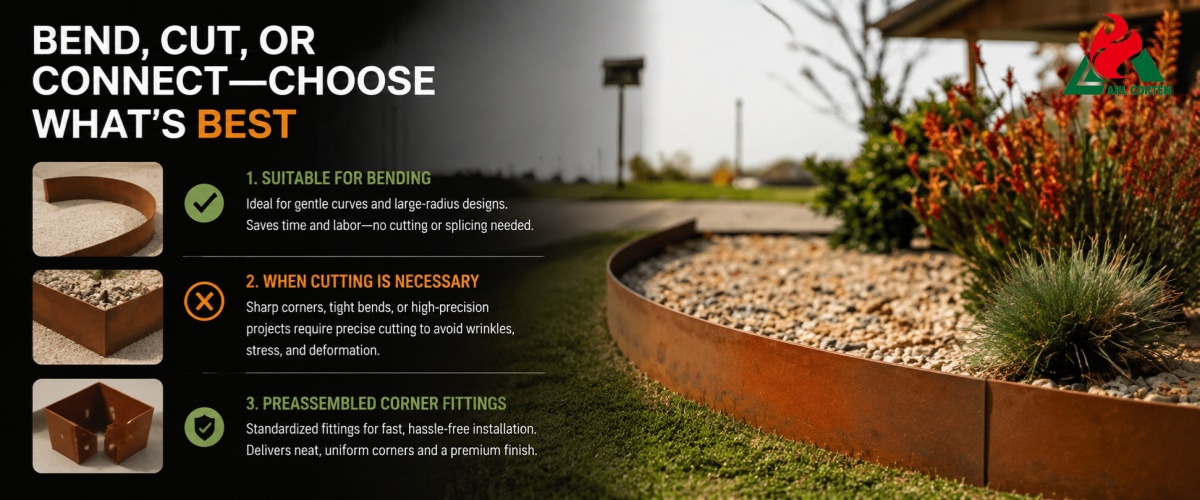
1. Scenarios Suitable for Bending
Weathered steel possesses a certain degree of ductility. For curved designs with gentle arcs and low curvature, it can be directly bent into shape without the need for cutting or splicing, making construction more time- and labor-efficient.
2. Scenarios Where Cutting Is Essential
For sharp corners, tight bends, and applications requiring high dimensional accuracy, simply bending the steel can easily cause stress concentration, leading to wrinkles and deformation. In such cases, precise cutting is the safer and more professional solution.
3. A High-End, Hassle-Free Solution: Prefabricated Corner Fittings
High-quality flexible steel garden edging is paired with standardized, prefabricated corner fittings, eliminating the need for complex on-site cutting and allowing for direct assembly and installation. This not only reduces installation complexity but also ensures neat, uniform corners, resulting in a more standardized and professional finished look.
High-Quality Corten Steel Edging: Laying the Foundation for Perfect Cutting and Installation
Exquisite cutting craftsmanship relies on high-quality base materials; material quality fundamentally determines the installation outcome and service life.
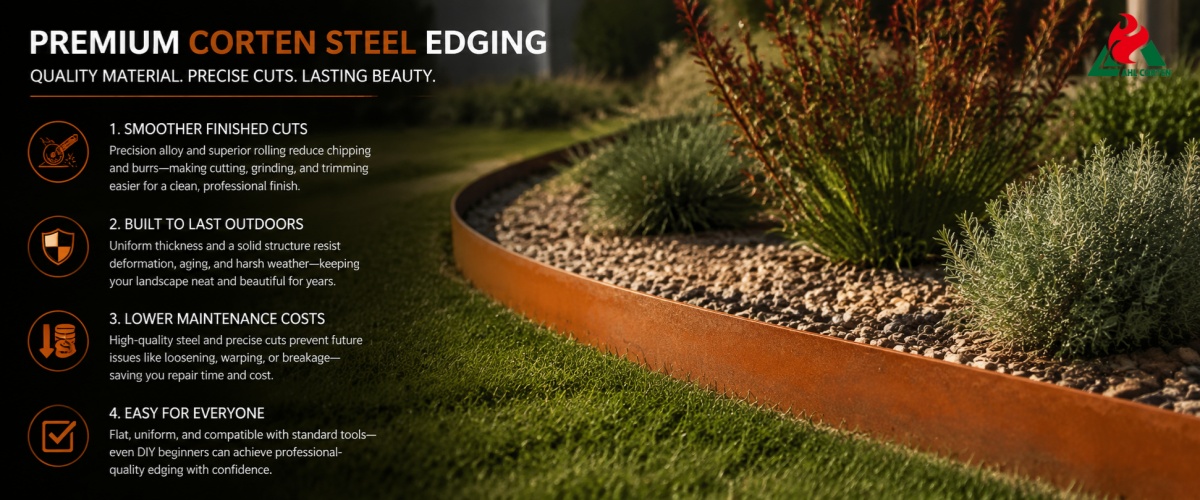
1. Smoother Finished Cuts with Fewer Defects
High-quality weathering steel features precise alloy ratios and superior rolling processes, resulting in minimal chipping and burrs during cutting. This makes grinding and trimming easier, allowing you to effortlessly achieve clean, professional-looking cuts.
2. Structural Stability and Enhanced Outdoor Durability
High-quality steel features uniform thickness and a solid structure, offering excellent resistance to deformation and aging. Even after prolonged exposure to the elements—including sunlight, wind, and rain—it resists warping and damage, maintaining the landscape’s neat appearance over time.
3. Reduced Maintenance and Rework Costs
The combination of high-quality base material and precise cutting effectively prevents future issues such as loosening, warping, and breakage, significantly reducing repair and rework costs and offering better long-term value.
4. Even Beginners Can Achieve Professional Results
The material is flat and uniform, compatible with all standard cutting tools. Even DIY beginners can easily create rusty metal edging results that rival professional-grade work.
Frequently Asked Questions (FAQ): Corten Steel Edging
1. What’s the Best Tool for Cutting Corten Steel Edgings at Home?
An angle grinder is the optimal choice for home DIY projects. It offers great value for money, is easy to operate, and provides consistent cutting performance, meeting the needs of most backyard cutting tasks. For high-end projects requiring extreme flatness, a cold-cut saw is recommended. A hand-held hacksaw can be used for minor adjustments.
2. Can Beginners Cut Rusted Steel Edgings On Their Own?
Absolutely. As long as you mark the lines accurately, secure the steel properly, follow safety precautions, and operate at a steady, consistent pace, even beginners can achieve standard cuts without professional skills—the key is attention to detail and patience.
3. Does Cutting Affect the Rusting and Corrosion-Resistant Properties of Corten Steel?
It has no negative impact. Cutting merely alters the physical dimensions of the steel. Newly cut edges will oxidize naturally in the environment, gradually forming a protective rust layer that matches the corrosion resistance of the rest of the material. There may be a brief color difference in the initial rusting stage, but the color will naturally even out over time.
4. Is It Necessary to Grind and Deburr the Edgings After Cutting?
Grinding is mandatory. Trimming the edges is not only for aesthetic purposes but, more importantly, to eliminate safety hazards and ensure tight joints. Omitting this step will directly affect the safety, stability, and visual quality of the finished product.
5. How Should Complex Corners and Irregular Angles Be Handled?
Prioritize the use of prefabricated corner fittings. Standardized angles eliminate the need for precise on-site cutting and result in the neatest finished product. If on-site construction is necessary, perform precise measurements and marking, cut slowly, and use small grinding tools to refine the details.
Summary: Precision Cutting Enables High-Quality Weathering Steel Landscapes
The key to cutting weathering steel edgings perfectly lies in “appropriate tools + standardized procedures + meticulous edge finishing.” Select suitable tools—such as angle grinders or cold-cut saws—based on project requirements, and strictly follow the entire process of measuring, securing, cutting at a constant speed, and deburring, while avoiding common construction pitfalls.
This seemingly simple cutting process is the key detail that distinguishes an ordinary yard from a high-end landscape. Meticulous construction fully harnesses the material advantages of weathering steel—durability, aesthetics, and a vintage look—to create clean, crisp, safe, stable, and timeless professional landscape borders.
Want to create a high-quality yard landscape? Choose premium metal garden edging paired with standardized cutting and installation techniques to make your garden borders neater, more durable, and more sophisticated!
Get a Quote
Back

 Fill In The Inquiry