Should You Choose Corten or Mild Steel Garden Edging?
In modern courtyard, commercial landscape, and municipal landscaping projects, steel edging is the most commonly used boundary material. It can be used to delineate lawns, edge flower beds, separate walkways, divide gravel areas, and outline tree pits, offering clean, crisp lines and a sturdy, durable structure.
Currently, the two mainstream materials on the market are Corten Steel Edging and Mild Steel Edging. Both offer good malleability and structural strength, capable of meeting basic landscaping boundary requirements.
However, there are significant differences between the two materials in terms of weather resistance, aesthetic appeal, texture, maintenance difficulty, and long-term costs. For most landscape owners, designers, and contractors, the key questions center on five key aspects: which is more durable, has a lower initial cost, requires less maintenance, better complements the aesthetic of modern gardens, and is more suitable for long-term outdoor use.
This article will provide a comprehensive comparison to clearly outline the pros and cons of these two types of steel edging. Key conclusion upfront: Weathering steel excels in long-term weather resistance, natural texture, and low maintenance; ordinary carbon steel offers better initial value for money and is more suitable for short-term, budget-constrained landscaping projects.
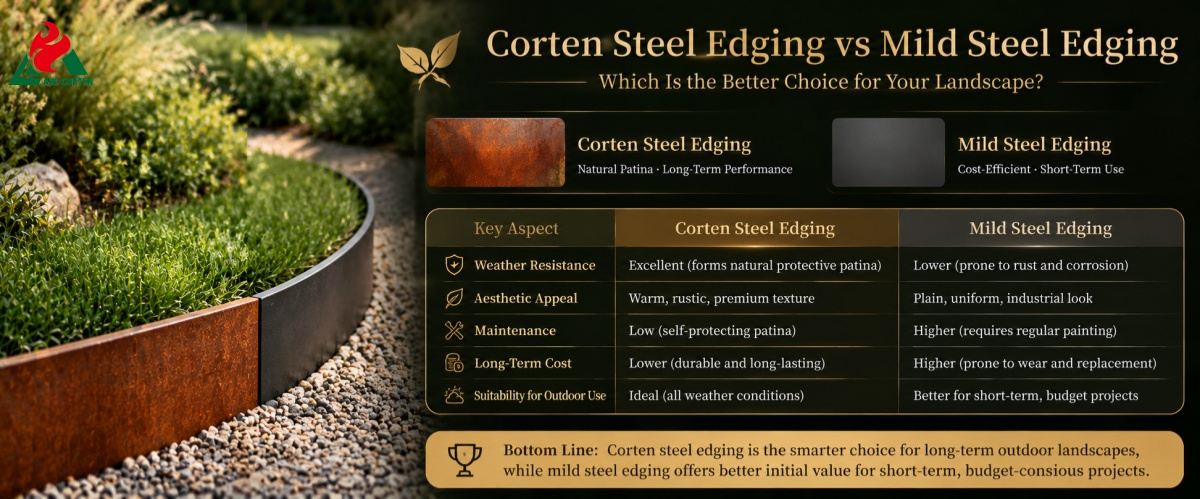
A Comparison of the Durability of Two Types of Edging: Which Has a Longer Outdoor Service Life?
The Long-Term Weathering Resistance Advantages of Corten Edging
The core of weathering steel’s durability lies in its stable, self-passivating rust layer. Unlike ordinary steel, which continues to rust, this dense rust layer firmly seals the steel’s surface, preventing deep corrosion and maintaining structural integrity over the long term.
Corten steel edging in Perth is ideally suited for the wet-dry cycles typical of conventional landscaping. It withstands sun exposure, rain, and seasonal temperature fluctuations, performing consistently in ordinary garden soil, lawns, flower beds, and gravel areas.
In terms of service life, when installed according to specifications and in well-drained, inland garden settings, Corten steel garden edging can last 5–30 years or more. The thicker the sheet, the milder the environment, and the better the drainage conditions, the longer the service life.
It is important to note that weathering steel is not completely rust-proof; its lifespan is influenced by factors such as sheet thickness, soil pH, salinity, humidity, burial depth, and installation techniques, so generalizations cannot be made.
Durability Limitations of Ordinary Carbon Steel Edging
In environments with mild climates, excellent drainage, and dry soil, ordinary carbon steel—even when using thicker plates—can last for many years and meet basic landscaping needs.
However, its critical weakness is the instability of its rust layer, which causes corrosion to progressively worsen over time. After prolonged outdoor use, issues such as rust layer peeling, edge thinning, localized perforations, corrosion at seams, and reduced structural rigidity will gradually emerge.
To maintain both appearance and structural stability, regular manual maintenance is essential, including rust removal, applying anti-rust paint, touching up the topcoat, and performing spot repairs; in cases of severe deterioration, the panels must be replaced entirely.
Environments Where Weathering Steel Is Not Suitable
The self-protective mechanism of weathering steel relies on a well-ventilated environment with alternating dry and wet conditions. In environments with prolonged dampness, standing water, and extremely poor ventilation, a stable patina cannot form, and weather resistance is significantly reduced.
Scenarios unsuitable for installation include: low-lying areas with chronic water accumulation, perpetually damp clay soils, coastal salt fog zones, soils with high salt or acid content, areas where the material is completely buried for extended periods, and areas where the surface is continuously covered with organic humus.
Many projects focus solely on the aesthetic appeal of the rusted surface of rusty steel garden edging, neglecting drainage at the base and the buried soil environment. This ultimately leads to premature corrosion of the steel and a significantly shortened service life.
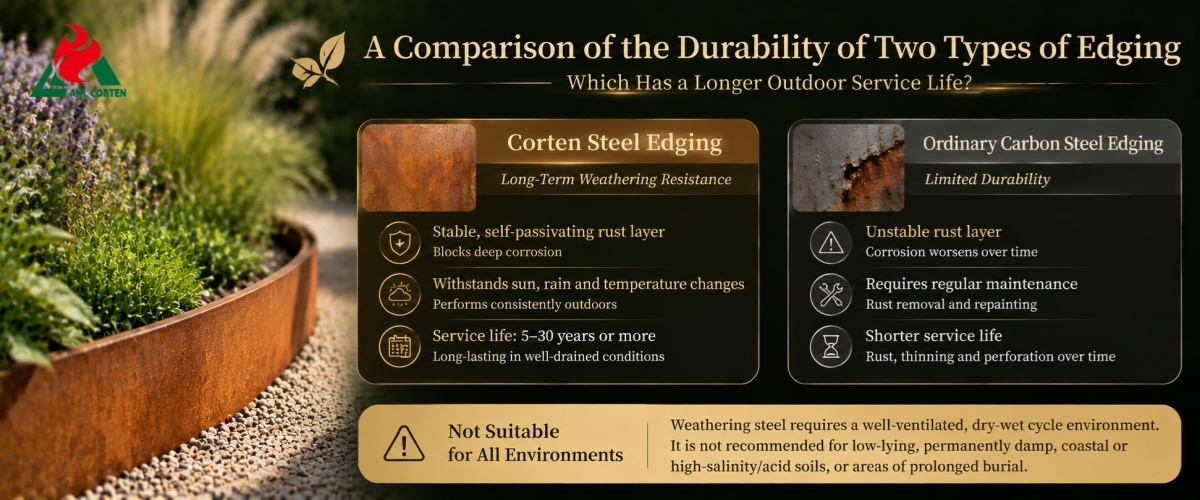
Aesthetic Comparison of Two Types of Garden Edging
1. Corten Steel Garden Edging: Natural Aesthetics That Evolve with the Garden
The core appeal of weathering steel lies in its dynamic, natural, and one-of-a-kind appearance. New sheets feature a clean metallic gray; once installed, exposure to wind and sunlight gradually brings out warm rust tones, with layers of color settling over time to create an increasingly warm, rich, and deep appearance.
The entire color-changing process is slow and uniform, without any abrupt or mottled appearance. Since climate, humidity, and sunlight vary from site to site, the resulting rust texture differs slightly at each location, creating a unique landscape quality.
In terms of versatility, weathering steel complements the vast majority of landscape materials: paired with greenery, it highlights natural vitality; combined with stone, it enhances the architectural solidity; paired with wood, it creates a warm and soft ambiance; and when combined with concrete or gravel, it achieves a minimalist industrial style.
The design value of Corten edging extends beyond simply defining boundaries; it serves as a landscape accent that elevates the overall aesthetic of the garden, perfectly complementing modern, minimalist, natural, industrial, and high-end, light-luxury landscape designs.
Key Design Highlight: Weathered steel edging evolves alongside the garden, becoming more natural with use and gaining richer character over time.
2. Standard Carbon Steel Edging: Customizable, Practical Appearance
Standard carbon steel edging has no inherent aesthetic advantages; its appearance depends entirely on post-installation surface treatments. A wide range of styles are available, including bare steel, rust-proof primer, spray-painted topcoats, powder coating, custom-colored baked enamel, and artificially pre-rusted finishes.
Its advantage lies in color control—tones can be customized to match architectural styles and garden color schemes, making it suitable for various minimalist and functional landscaping projects.
However, its shortcomings are quite evident: in its bare steel state, rusting is haphazard and the color is patchy and uneven; peeling and flaking occur very easily. Its long-term appearance relies entirely on frequent repainting and maintenance, and it cannot develop a natural, sophisticated textural quality.
3. Aesthetic Material Selection Recommendations
If you are seeking a natural, vintage texture, architectural lines, a patina that evolves over time, and a high-end yet understated garden atmosphere, prioritize weathering steel edging.
If you prefer a uniform, fixed color scheme, a minimalist and practical style, do not require a natural rusted appearance, and are willing to repaint periodically, standard carbon steel edging offers better value for money.
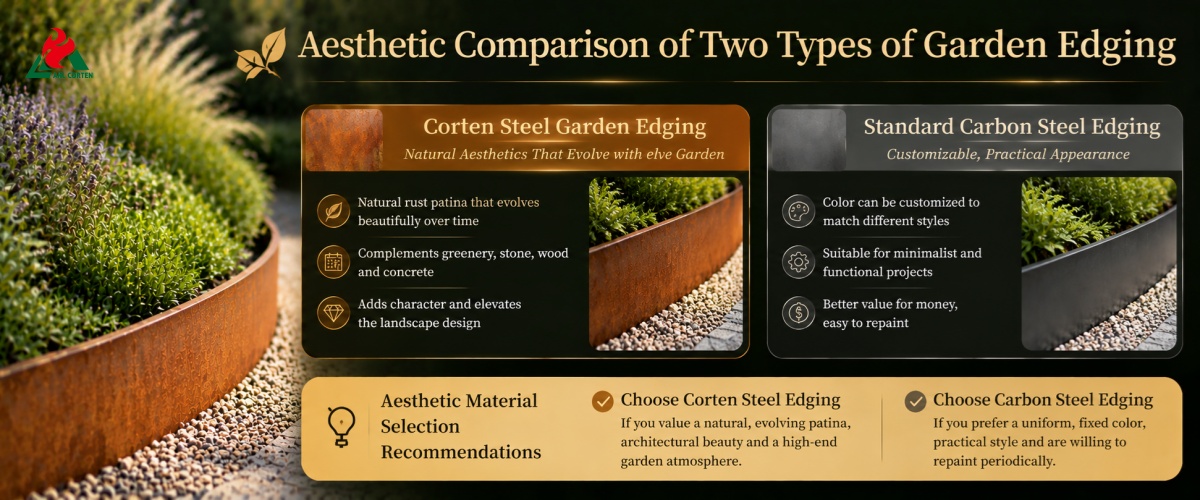
Comparison of Maintenance Difficulty Between the Two Types of Edging
1. Corten Steel Edging: Minimal maintenance, installed once for long-term use
Once formed, weathering steel requires no painting or frequent rust prevention treatments; it relies on its own patina layer for self-protection, significantly reducing the burden of long-term maintenance.
Daily maintenance is simple and basic: ensure surrounding drainage remains unobstructed, avoid prolonged waterlogging, promptly remove fallen leaves and decomposed soil from the base, and periodically check the verticality of the panels and the condition of the joints.
The only point to note is the runoff of rusty water during the initial installation phase; you can plan drainage paths in advance to prevent light-colored stone or concrete from being slightly stained.
2. Standard Carbon Steel Edging: Continuous, High-Frequency Maintenance with Hidden Costs
The core of maintaining standard carbon steel lies in continuous rust control, which requires regular inspections to identify various issues, including the spread of surface rust spots, cracking or peeling of the coating, panel deformation, rusting at joints, and erosion caused by prolonged soil moisture.
Over the long term, repeated tasks such as rust removal, applying primer, painting the topcoat, and spot repairs are necessary. When severe deterioration occurs, the entire structure must be replaced, and the hidden costs of labor and materials accumulate year after year.
Even if the initial cost is low, the total investment is not insignificant when the long-term comprehensive maintenance costs are factored in.
Comparison of the Two Types of Marginal Costs
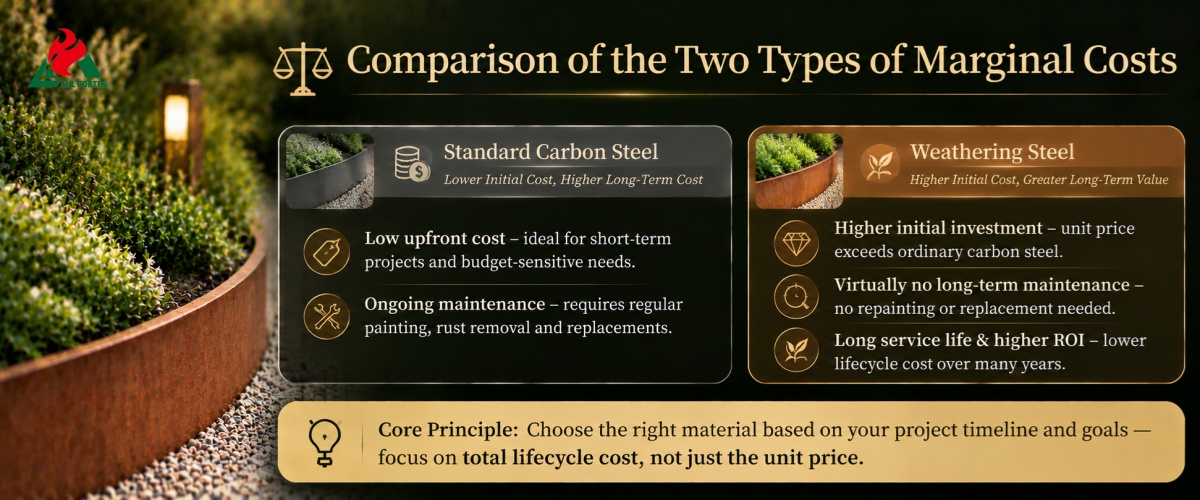
1. Standard Carbon Steel: Saves Money Upfront, but Costs More Time and Effort Later
The key advantage of standard carbon steel is its low initial purchase and installation costs, making it ideal for short-term landscaping, temporary installations, and small gardens with limited budgets.
However, its shortcomings are significant: long-term use requires ongoing investment in maintenance costs and labor, including frequent repainting, rust removal, and replacements, causing the total lifecycle cost to rise steadily.
2. Weathering Steel: Higher Initial Investment, Maximum Long-Term Value
Weathering steel sheets have a higher unit price, resulting in an overall initial cost that exceeds that of ordinary carbon steel, which creates greater financial pressure upfront.
However, it requires virtually no long-term maintenance costs—no repainting or refurbishment is needed, nor does it require frequent replacement. Combined with its exceptionally long service life, the full-lifecycle ROI over many years far exceeds that of ordinary carbon steel.
3. Core Principles for Cost-Based Material Selection
For short-term, rapidly evolving, and budget-sensitive projects, prioritize ordinary carbon steel; for long-term, permanent landscape features and projects seeking long-lasting, low-maintenance solutions, prioritize weathering steel. When selecting materials, do not focus solely on unit price; instead, calculate the comprehensive cost over the entire life cycle.
Precise Application Scenarios: Optimal Uses for Both Steel Types
1. Exclusive Applications for Weathering Steel Edging
Suitable for all high-quality landscape projects that prioritize long-term stability, sophisticated aesthetics, and a unified style, including high-end private gardens, terrace landscapes, commercial landscaping, hotel landscapes, municipal parks, campuses, and public green spaces in industrial parks.
It can be used for lawn borders, flower bed edging, walkway dividers, gravel zoning, and tree pit edging. It is particularly well-suited for pairing with weathering steel planters, screens, sculptures, feature walls, and other related products to create a cohesive industrial-natural landscape system.
2. Ideal Applications for Standard Carbon Steel Edging
Suitable for small gardens with limited budgets, short-term landscaping projects, sites requiring future redesign or reconfiguration, and functional landscaping projects that do not require a natural rust finish and allow for regular maintenance.
In standard inland locations with good drainage and a mild climate, standard carbon steel is sufficient to fulfill basic boundary demarcation functions and offers a clear cost-effectiveness advantage.
A Guide to Avoiding Pitfalls in the Procurement and Installation of Weathering Steel Edging
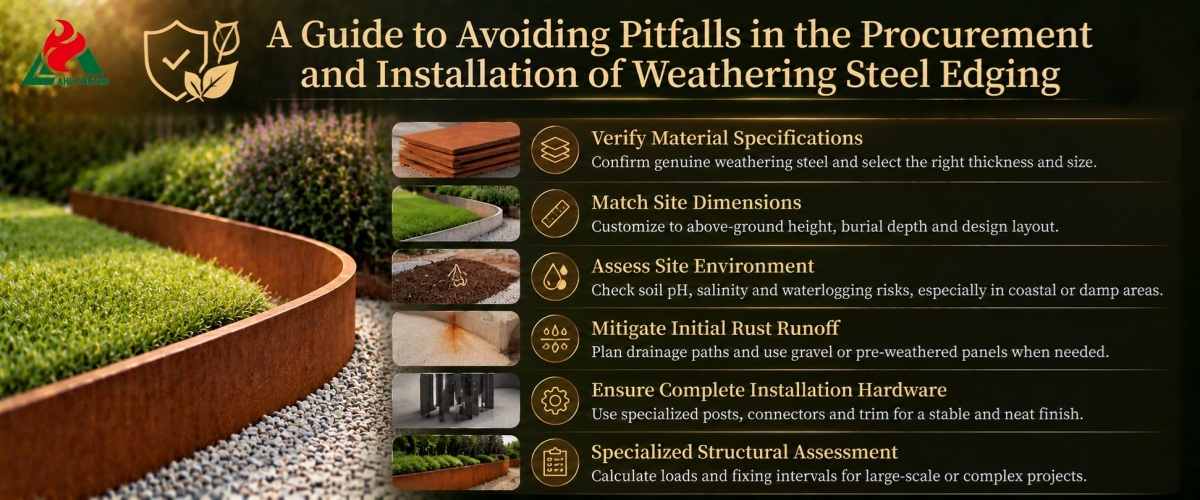
When selecting rusted steel edging, do not focus solely on price and color; instead, consider material specifications, site conditions, and installation systems comprehensively to avoid choosing the wrong specifications that could compromise performance.
First, verify material specifications: Confirm that the material is genuine weathering steel, and check the sheet thickness, height, length, and manufacturing process. Select the appropriate thickness based on the application scenario; specifications for high and low edging, as well as retaining wall edging, are not interchangeable.
Second, match site dimensions: Customize based on above-ground exposure height, burial depth, terrain elevation differences, and straight/curved designs, as well as corner structures. For tree pits, slopes, and sites with elevation differences, additional calculations for soil pressure are required to ensure structural stability.
Third, assess the site environment: Investigate soil pH, salinity, groundwater level, and waterlogging conditions in advance. Specialized assessments are required for coastal, high-rainfall, and damp clay sites to prevent weathering steel failure caused by prolonged exposure to moisture.
Fourth, mitigate the impact of initial rust runoff: Newly installed weathering steel will produce temporary rust runoff. In areas adjacent to light-colored stone, concrete, or tile surfaces, plan drainage paths in advance, add a gravel buffer layer, and use pre-weathered panels when necessary.
Fifth, ensure all installation hardware is included: High-quality weathering steel edges must be paired with specialized mounting posts, connectors, corner fittings, and edge trim. A complete hardware system ensures straight lines, neat corners, and long-term stability.
Sixth, specialized structural assessment for large-scale projects: For high retaining walls, slopes, and large tree pits, calculate wind pressure, earth pressure, burial depth, and fixing intervals to select appropriate panel thicknesses, avoiding unnecessary cost overruns caused by blindly opting for thicker panels.
Why Choose AHL Weathering Steel Edging?
AHL Weathering Steel Edging focuses on long-lasting landscape value, balancing stability, natural aesthetics, and adaptability to provide a one-stop steel edging solution for residential, commercial, and municipal landscapes.
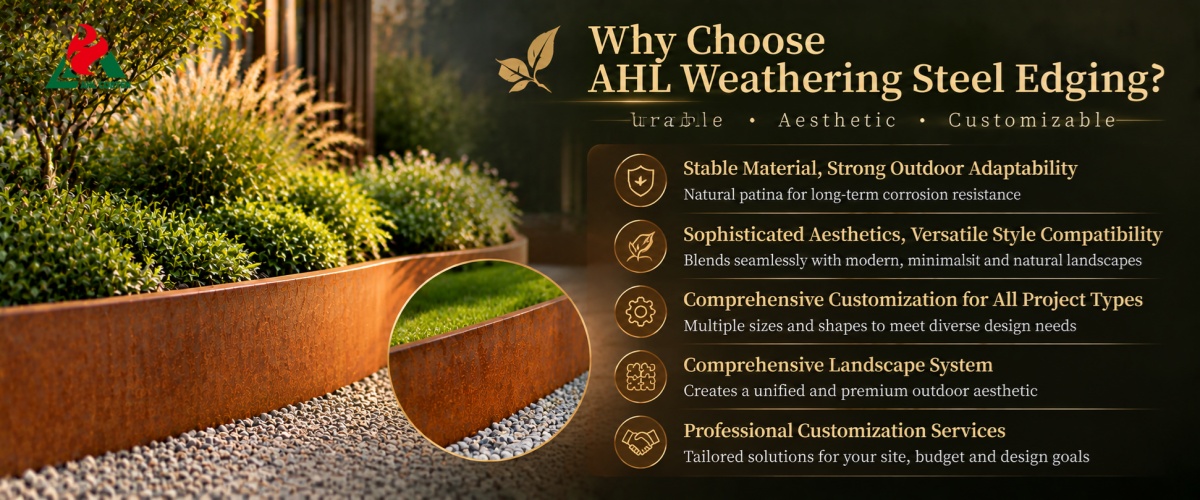
Stable Material, Strong Outdoor Adaptability: Made from genuine weathering steel specifically designed for landscaping, it naturally forms a stable protective patina in environments with good drainage and wet-dry cycles, providing long-term resistance to outdoor corrosion and adapting to various landscape boundary scenarios.
Sophisticated Aesthetics, Versatile Style Compatibility: With clean, crisp linear boundaries and a naturally gradated rust-colored texture, these edging solutions seamlessly integrate with modern, minimalist, industrial, and natural landscape designs. They harmonize with a variety of materials, enhancing the overall quality of any courtyard.
Comprehensive Customization for All Project Types: Supports customization in multiple heights, thicknesses, and lengths. It can be fabricated into straight, curved, corner, and other custom shapes, and comes with a complete set of installation hardware to meet personalized construction needs.
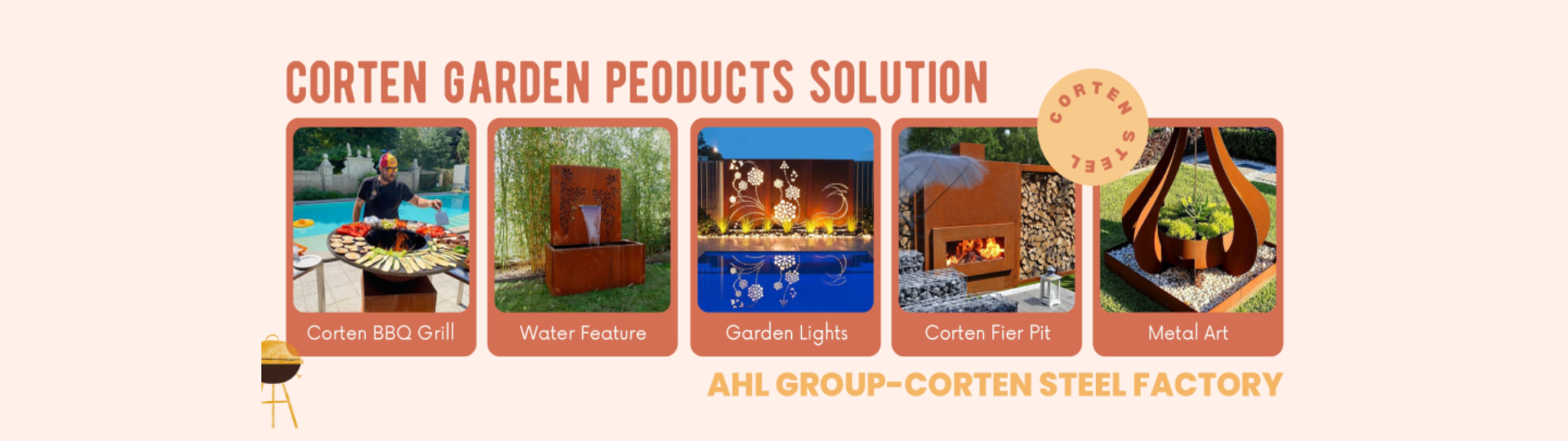
Comprehensive Landscape System for a Unified Aesthetic: Can be combined with AHL weathering steel planters, screens, sculptures, landscape lighting, and other products to create a cohesive weathering steel landscape system, enhancing the project’s premium quality.
Professional Customization Services: We tailor the optimal specifications and installation solutions based on the project site’s environment, dimensional requirements, and budget, avoiding unnecessary thickness increases or over-specification, while balancing quality and value.
Frequently Asked Questions (FAQ) About Corten Steel Edging
1. Is Rusted Steel Edging Definitely More Durable Than Ordinary Carbon Steel?
Under the same thickness, installation conditions, and environmental conditions, weathering steel offers superior corrosion resistance and service life. However, in harsh environments such as standing water, salt fog, or prolonged exposure to damp soil, the performance of weathering steel will decline significantly; in such cases, installation techniques and drainage design are more important than the material itself.
2. Will Weathered Steel Continue to Rust Indefinitely and Eventually Rust Through?
No, it will not rust indefinitely. Under normal conditions, weathering steel quickly forms a stable rust layer that prevents deep corrosion. Continuous rusting and damage will only occur in harsh environments with prolonged standing water, high salt fog, or persistent dampness.
3. Is Ordinary Carbon Steel Suitable for Home Gardens?
It is suitable for small home gardens with limited budgets, short usage cycles, good site drainage, and where periodic painting and maintenance are acceptable. However, for gardens seeking long-term peace of mind and a natural aesthetic, weathering steel is highly recommended.
4. Is The Higher Cost Of Weathering Steel Worth The Investment?
It offers excellent value for long-term, permanent landscape projects. It eliminates the costs of years of maintenance, renovation, and replacement, while combining unique aesthetic value with long-term stability, making it the preferred material for high-end landscaping. For short-term, temporary projects, ordinary carbon steel is more cost-effective.
5. Do the Edgings of Weathering Steel Need to Be Painted to Prevent Rust?
No. The core advantage of weathering steel is that it can be used as-is to form a natural protective film; painting would disrupt the formation of this patina. Daily maintenance simply involves ensuring proper drainage and clearing debris from the surface. Specialized protection can be applied in specific scenarios where staining is a concern, but general-purpose paint is not recommended.
6. Can Weathering Steel Be Used in Coastal Salt Fog Environments?
It can be used, but it is not the optimal environment. High levels of salt fog near the coast can damage the stable rust layer and accelerate localized corrosion. Based on the distance from the shoreline and salt fog concentration, a specialized design should be developed that includes thicker plates, optimized drainage and burial depth, and the selection of corrosion-resistant fittings.
Are You Ready to Choose the Right Outdoor Corten Steel Edging for Your Project?
There is no absolute superiority or inferiority between corten steel edging and ordinary carbon steel edging; the difference lies solely in their suitability for different scenarios. The key to material selection is matching the project budget, service life, site environment, and design requirements.
Corten steel edging is a long-term solution for landscaping, offering low maintenance, a natural, sophisticated texture, and long-term stability. It is ideal for high-end gardens, commercial, and municipal permanent landscaping projects.
Standard carbon steel edging is a short-term, practical choice, featuring low initial costs and flexible installation. It is suitable for short- to medium-term landscaping projects with limited budgets that may undergo future renovations.
Regardless of the material chosen, standardized sheet specifications, proper drainage design, and professional installation techniques are key to ensuring the long-term stability of landscape edging.
If you want to create attractive, low-maintenance, and durable garden edging that requires minimal upkeep, consider AHL weathering steel edging. We offer long-lasting, aesthetically pleasing, and cost-effective customized edging solutions for your landscape projects.
Get a Quote
Back

 Fill In The Inquiry