Round vs. Square Corten Steel Planters: Which Is Better?
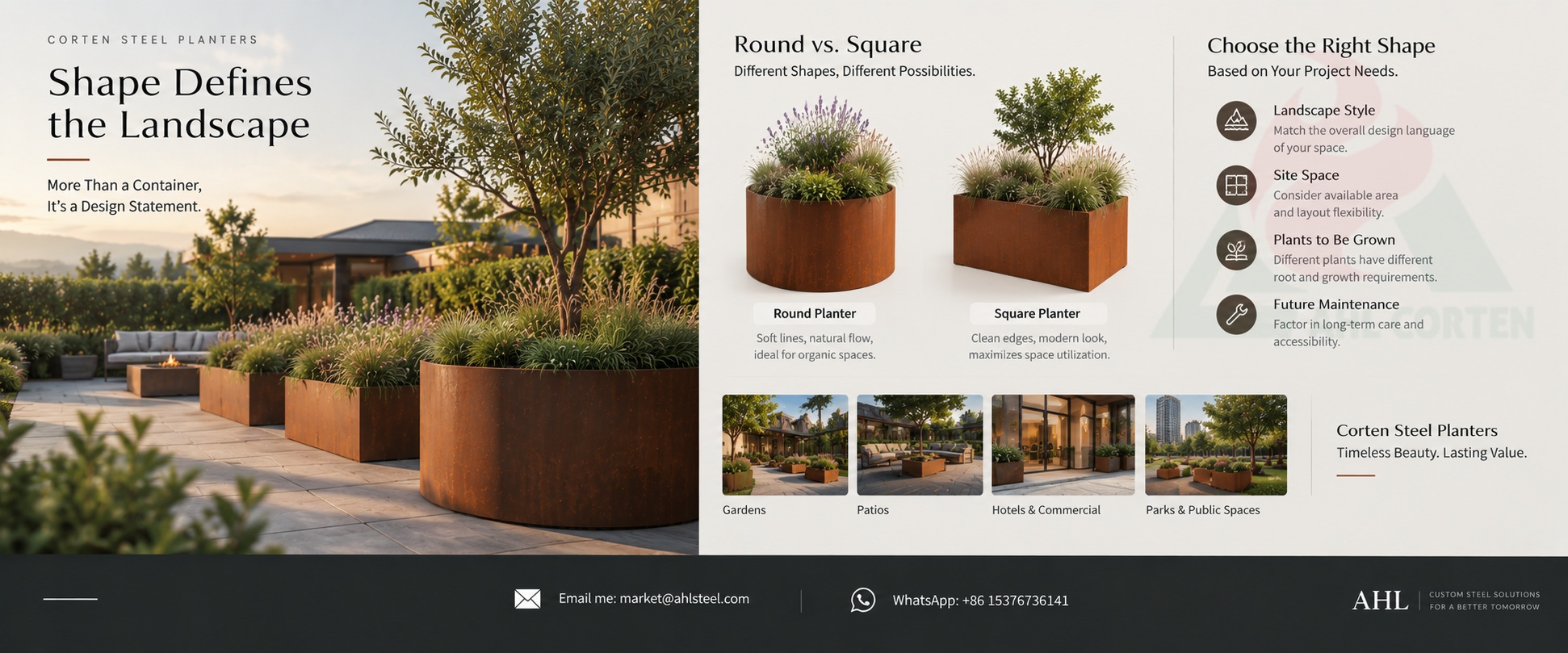
In landscape design, the shape of rusted steel planters directly influences the overall aesthetic. Thanks to their vintage rusted finish and exceptionally long outdoor lifespan, corten steel planters are widely used in gardens, patios, hotels, commercial plazas, and public parks. Many buyers focus solely on materials and dimensions, overlooking the ripple effects caused by shape.
The design of metal planters not only determines the visual style but also affects space utilization, plant root growth, and the difficulty of future maintenance. There is no absolute “better” choice between round and square shapes; evaluation must be based on four key dimensions: landscape style, site space, plants to be grown, and future maintenance.
4 Key Considerations for Selecting a Corten Steel Planter
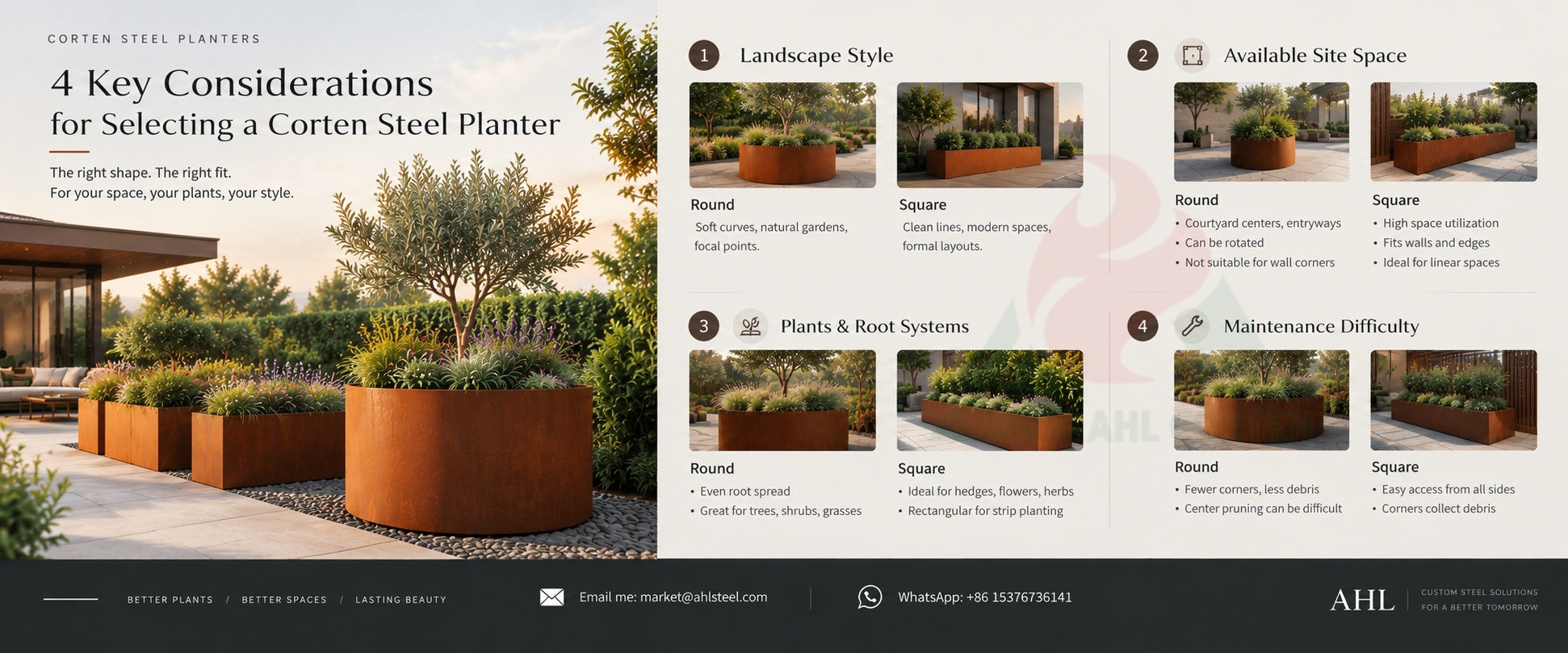
1. Matching the Landscape Style
Round planters feature soft, flowing curves that complement natural-style gardens, winding garden paths, and casual planting arrangements. They are ideal for creating visual focal points or serving as containers for feature trees.
Square planters have clean, bold lines that align with modern, minimalist and formal garden styles. They help define boundaries and are well-suited for orderly layouts dominated by straight lines and right angles.
2. Available Site Space
Round corten steel planters are suitable for courtyard centers, entryways, and irregular open spaces. They can be rotated to adjust their orientation but cannot be placed flush against wall corners, leaving triangular dead spaces.
Square planters offer high space utilization and can be placed flush against walls, fences, and building edges. They are particularly suitable for linear spaces such as patios, driveways, and commercial plazas.
3. Plant and Root System Requirements
The curved inner walls of round planters allow roots to spread evenly in all directions without tangling, making them suitable for solitary trees, shrubs, and ornamental grasses.
Square and rectangular planter boxes are suitable for hedges, flower borders, and herbs and vegetables. Rectangular planters enable continuous strip planting, serving as screens or edging.
4. Maintenance Difficulty
Round planters have fewer corners, leaving fewer areas for debris to accumulate; however, pruning and weeding in the center of large-diameter round planters can be difficult.
Square planters allow for access from all sides, making pruning and harvesting convenient. However, dead branches and fallen leaves tend to accumulate in the right-angle corners, requiring regular cleanup.
Round Corten Planters: Advantages, Limitations, and Suitable Applications
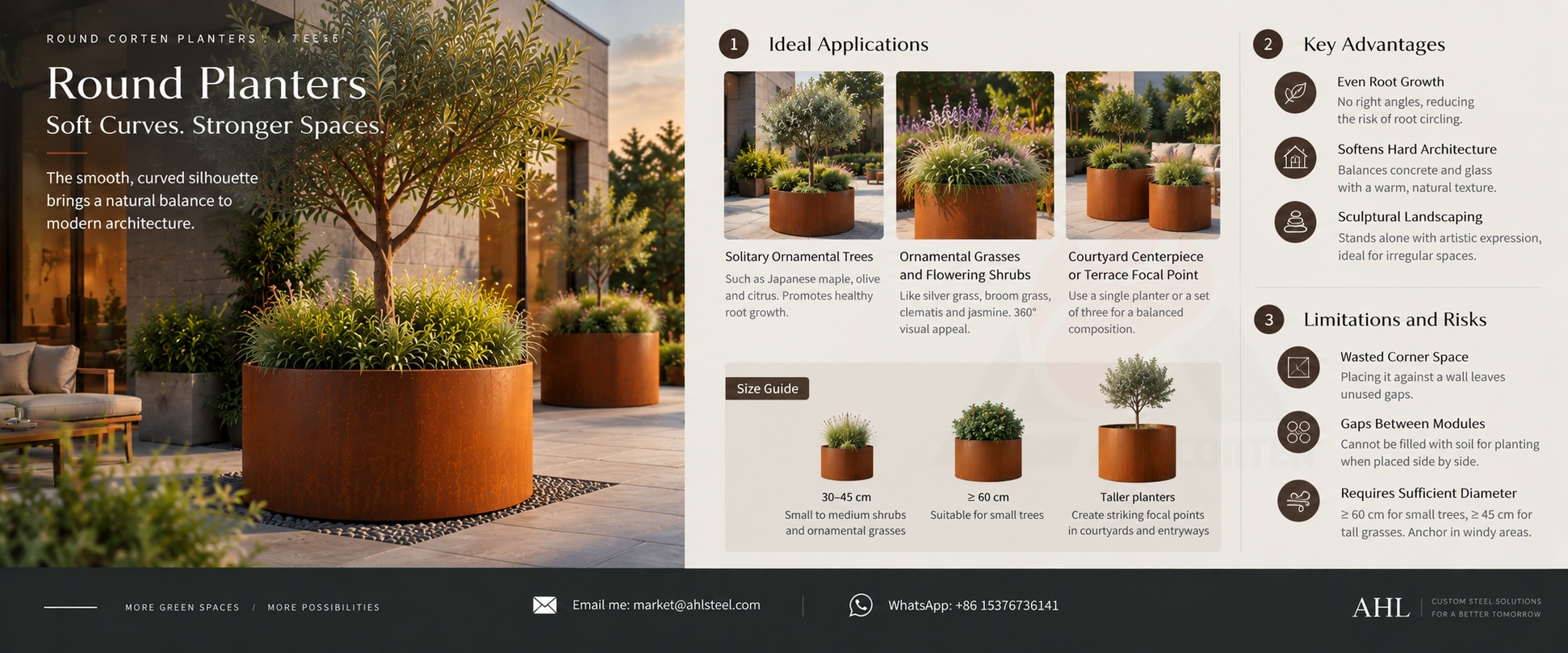
The smooth, curved silhouette of round planters helps counteract the cold, hard feel of building walls, striking a balance between formal and natural atmospheres.
1. Ideal Applications
Solitary ornamental trees: Topiary trees such as Japanese maple, olive, and citrus allow roots to spread evenly, promoting healthier long-term growth. Tall round planters paired with topiary trees serve as visual focal points in courtyards and entryways.
Ornamental Grasses and Flowering Shrubs: Species such as silver grass and broom grass pair exceptionally well with the rust-colored patina of weathering steel, offering a 360° viewing experience. Climbers like clematis and jasmine can be trained to create scenic displays.
Courtyard Centerpiece or Terrace Focal Point: Place a single planter independently or arrange a set of three in varying sizes to create a balanced composition.
Size Guide: Diameters of 30–45 cm are suitable for small to medium shrubs and ornamental grasses; sizes of 60 cm or larger are suitable for small trees.
2. Key Advantages
1. Even Root Growth: The absence of right angles prevents root entanglement and reduces the risk of root circling.
2. Softens hard architectural elements: Mitigates the straight lines of concrete and glass structures, adding a warm, textured quality.
3. Sculptural standalone landscaping: No need to align with other elements; stands alone with artistic expression, suitable for irregularly shaped spaces.
3. Limitations and Risks
1. Wasted corner space: Placing the planter against a wall or in a corner creates significant unused gaps.
2. Gaps Between Modules: When multiple planters are placed side by side, the gaps between them cannot be filled with soil for planting.
3. Sufficient Diameter Required for Stability: If the diameter is insufficient for tall plants, the planter may topple in strong winds. For small trees, a diameter of ≥60 cm is recommended; for tall ornamental grasses, a minimum of 45 cm is required. In wind-exposed locations, the base must be weighted down or anchored.
Square Corten Planters: Advantages, Limitations, and Suitable Applications
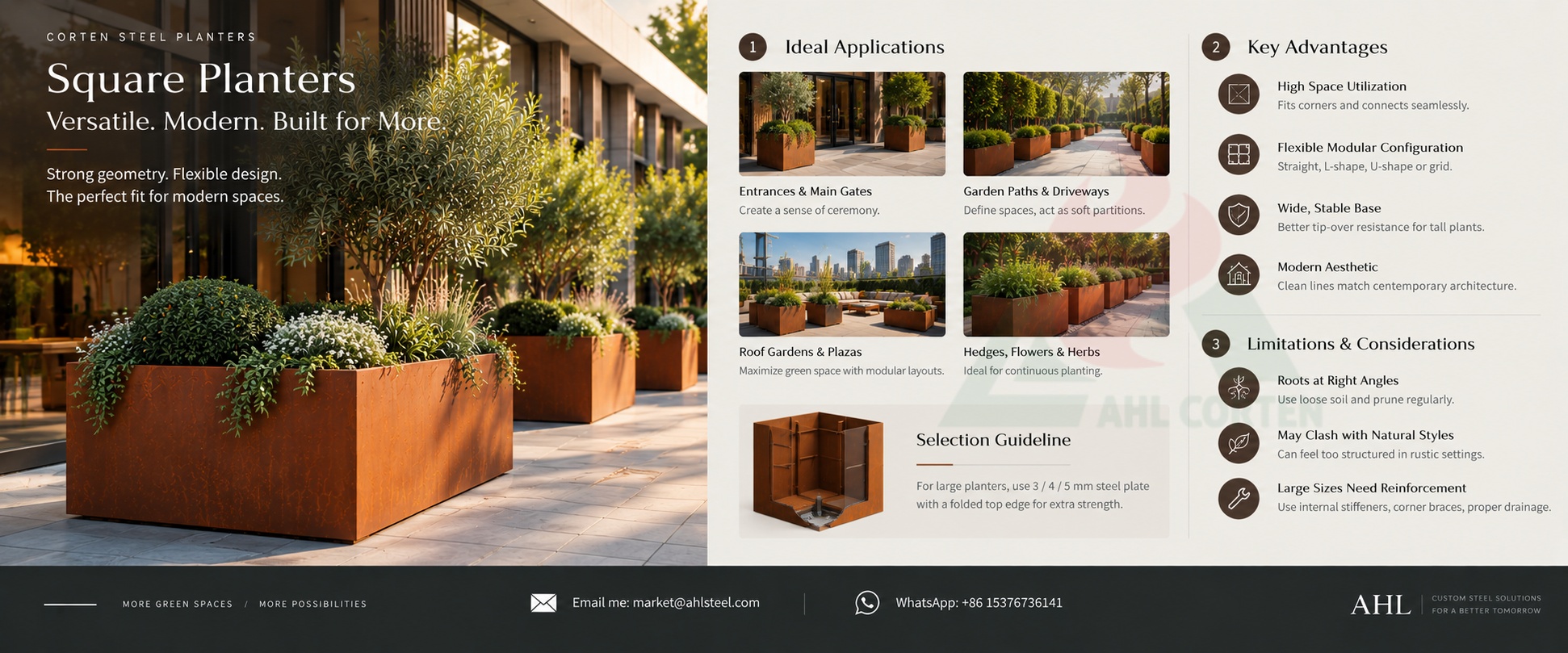
Square and rectangular planters are the most commonly used styles in commercial projects and modern residences, featuring a strong geometric aesthetic and flexible modular design.
1. Ideal Applications
Entrances and both sides of main gates: Placed in pairs to create a sense of ceremony, this is a classic solution for the entrances of hotels, office buildings, and villas.
Along garden paths and driveways: Arranged along walkways and walls to delineate spaces; long planters can serve as soft partitions.
Roof gardens and commercial plazas: A grid-based modular layout placed directly against parapet railings maximizes green space.
Hedges, flower borders, and herbs/vegetables: Long trough-style planters are ideal for continuous planting of hedges, herbs, and vegetables.
2. Key Advantages
1. High Space Utilization: Fits snugly into wall corners and connects seamlessly edge-to-edge, enabling continuous, large-scale planting.
2. Flexible Modular Configuration: Can be arranged in straight lines, L-shapes, U-shapes, or grid layouts.
3. Wide, Stable Base: Offers superior tip-over resistance compared to round planters of the same volume, making it suitable for tall hedges and densely planted shrubs.
4. Compatibility with modern architecture: Clean, angular lines create a unified aesthetic with concrete and glass curtain walls.
3. Limitations and Construction Considerations
1. Roots tend to coil at right angles: When root systems reach right angles, they are prone to bending and coiling. Solution: Increase the planting volume, use loose soil, and prune the roots of large trees regularly.
2. May appear out of place in natural-style courtyards: In rustic, pastoral settings, neatly arranged square planters can clash with the overall atmosphere.
3. Large-sized planters require structural reinforcement: Large square Corten steel planters with side lengths exceeding 1200mm experience significant lateral soil pressure.
- Internal stiffeners and transverse tie rods must be installed to prevent side panels from bulging;
- Corner braces must be added, with full-penetration welds to prevent stress cracking;
- Drainage holes should be evenly distributed and not concentrated in one corner;
- Raise the planter on support legs to prevent the bottom from sitting in water and rusting.
Selection Guidelines: For large square planters, steel plate thicknesses of 3, 4, or 5 mm are recommended, with the top edge folded over for reinforcement.
A Comprehensive Comparison of Round and Square Corten Steel Planters
| Comparison Factor |
Round Corten Planter |
Square Corten Planter |
| Visual Style |
Organic, soft and sculptural |
Modern, geometric, and architectural |
| Best Use |
Focal points and specimen plants |
Rows, corners, entrances, and boundaries |
| Space Efficiency |
Better in open areas |
Best in narrow and structured spaces |
| Plant Suitability |
Trees, grasses, flowers, and rounded plants |
Shrubs, hedges, grasses, and structured planting |
| Root Distribution |
Even more around the container |
May concentrate roots near corners |
| Stability |
Depends on diameter and base |
Usually stable due to flat sides and corners |
| Grouping |
Works well in varied clusters |
Easy to arrange in modular layouts |
| Maintenance Access |
Accessible from all sides |
Convenient beside walls and paths |
| Best Project Type |
Residential gardens and feature landscapes |
Commercial, architectural, and formal landscapes |
| Customisation |
Diameter and height |
Length, width, height, and modular combinations |
Selecting Planters Based on Plant Type: Soil Volume Takes Precedence Over Shape
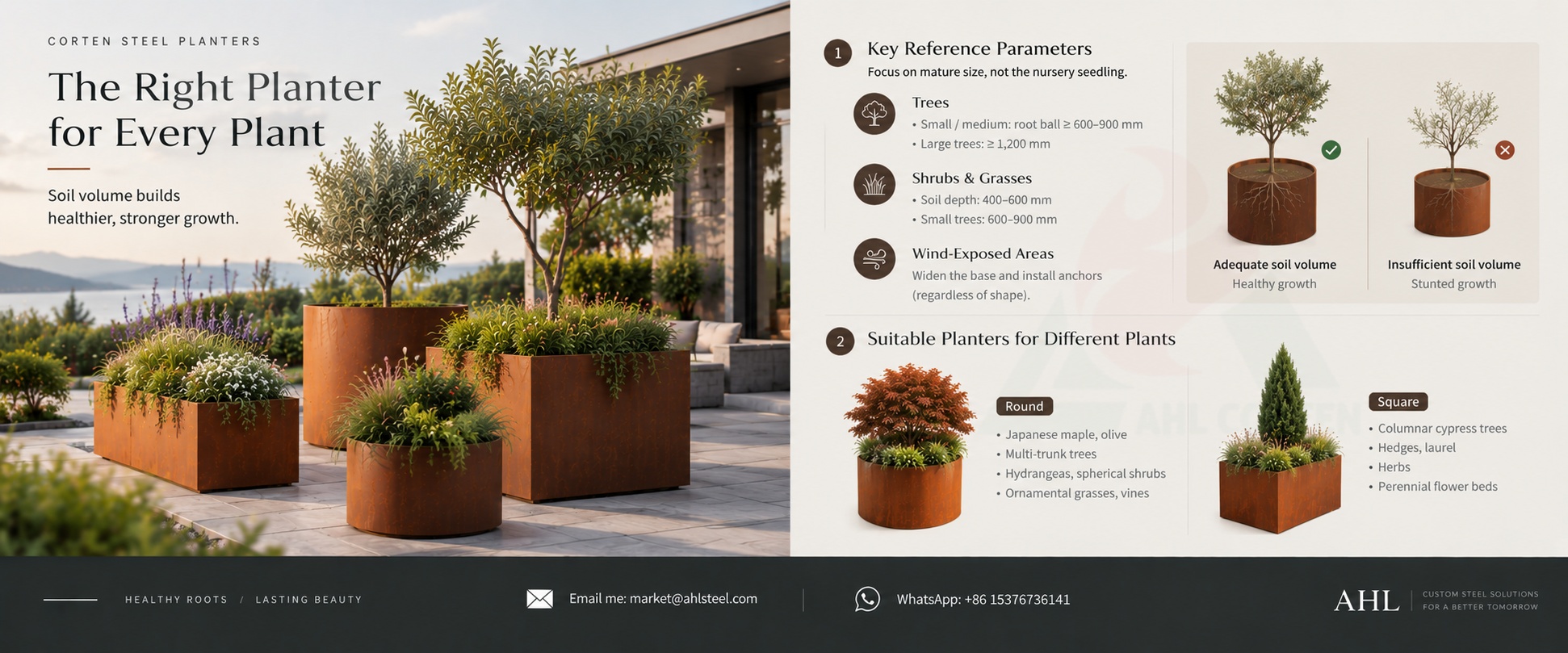
The shape of a planter is merely a matter of appearance; soil volume and depth are the primary factors for healthy plant growth. A square planter with sufficient volume can support the healthy growth of trees, whereas a round planter with insufficient volume will result in stunted growth.
Reference Parameters for Trees and Large Shrubs
When selecting a rusted steel planter, consider the plant’s mature size, not the size of the seedling at the nursery.
- For small to medium-sized landscape trees, the root ball area should be at least 600–900 mm; large trees require 1,200 mm or more.
- For shrubs and ornamental grasses, the soil depth should be 400–600 mm; for small trees, at least 600–900 mm.
- For wind-exposed rooftops and seaside plazas, widen the base, regardless of shape, and install anchors if necessary.
Suitable Planters for Different Plants
- Round: Japanese maple, olive, multi-trunk trees, hydrangeas, spherical shrubs, ornamental grasses, vines.
- Square: Columnar cypress trees, hedges, laurel, herbs, perennial flower beds.
Landscape Design Layout Strategies
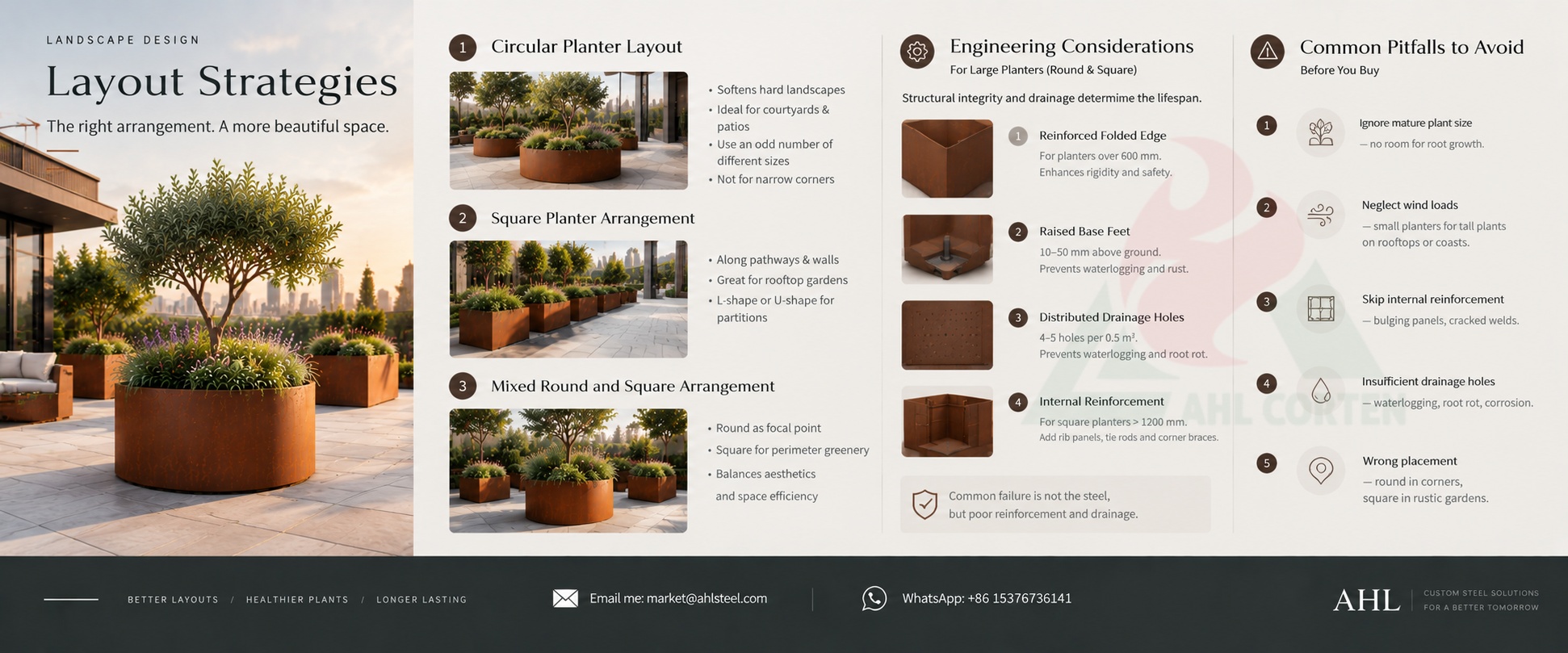
1. Circular Planter Layout
The greatest benefit is softening hard landscapes. Placing large circular planters in a modern courtyard with wall-to-wall paving can break up the cold, linear feel. Suitable for courtyard centers and visual focal points on patios; an arrangement of an odd number of planters of varying sizes creates a more harmonious composition. Not recommended for narrow wall corners.
2. Square Planter Arrangement
Arrange along pathways by the perimeter wall to define boundaries; square modular planters are preferred for rooftop gardens; they can be arranged in L- or U-shapes to serve as low partitions.
3. Mixed Round and Square Arrangement
You don’t have to choose one or the other. Use large round planters as the visual focal point, surrounded by square modular planters for perimeter greenery, balancing curved aesthetics with spatial efficiency.
General Engineering Considerations for Large Planters (Round & Square)
Regardless of shape, structural integrity and drainage determine a planter’s lifespan.
1. Reinforced folded top edge: For planters over 600 mm in height, a folded top edge enhances rigidity and prevents cuts to the hands.
2. Raised base feet: Add 10–50 mm feet to the bottom to prevent waterlogging and rust caused by direct contact with the ground.
3. Distributed Drainage Holes: A base area of 0.5㎡ should have at least 4 to 5 holes to prevent waterlogging and root rot.
4. Internal Reinforcement: For square planters with long sides exceeding 1200mm, add rib panels and tie rods; install corner braces at the corners.
Round planters naturally have good compressive strength, but tall round models require additional reinforcement of the base to prevent tipping.
Failures of weather-resistant steel planters are often not due to material issues, but rather defects in reinforcement and drainage.
Common Pitfalls to Avoid When Purchasing
1. Focusing only on appearance while ignoring the mature size of plants—leaving no room for root growth after a few years.
2. Neglecting wind loads—using small planters for tall plants on rooftops or near the coast poses a risk of tipping.
3. Omitting internal reinforcement in large square planters, leading to bulging side panels and cracked welds.
4. Insufficient drainage holes or holes concentrated in one corner, causing waterlogging, root rot, and bottom corrosion.
5. Incorrect placement: Round planters in tight corners; square planters in rustic gardens.
Quick Decision-Making Guide
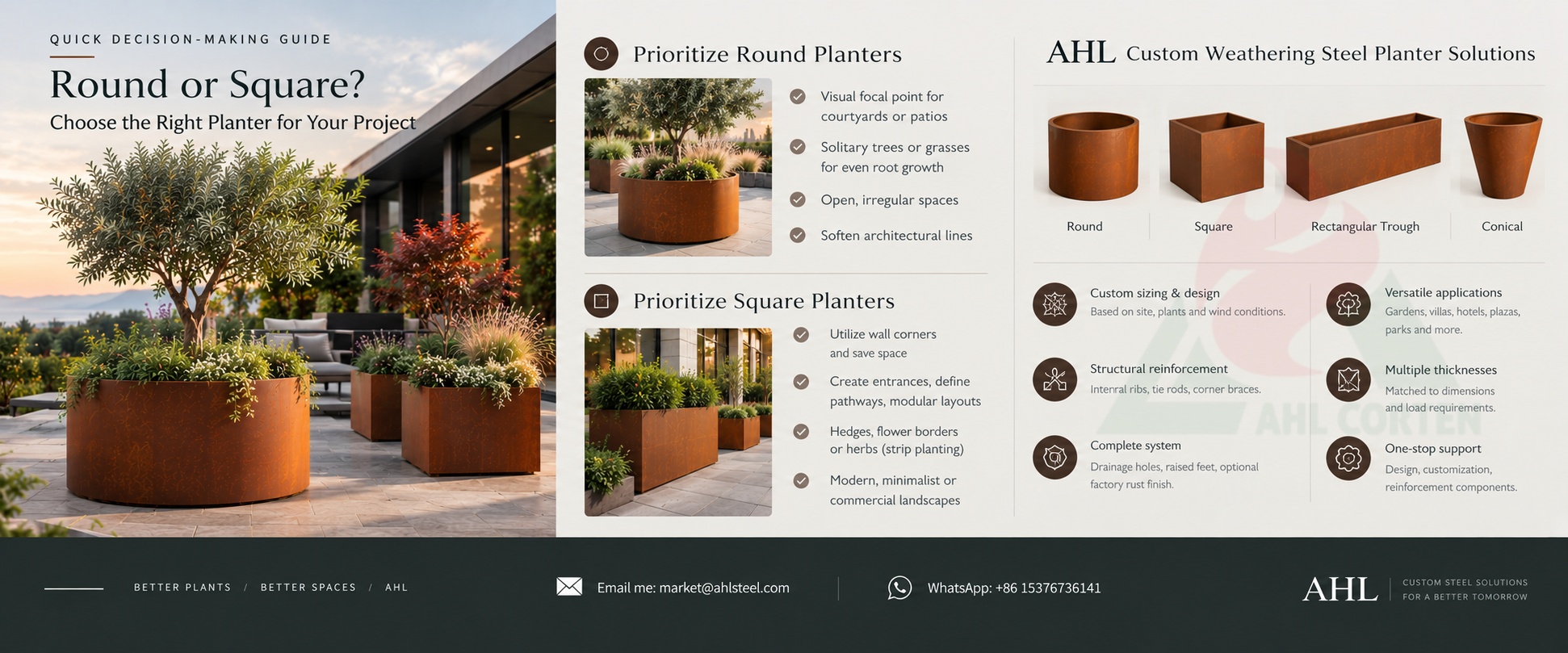
✅ Prioritize Round Planters
- When you need a standalone visual focal point for a courtyard or patio;
- When planting solitary ornamental trees or ornamental grasses to ensure even root growth;
- For open, irregularly shaped spaces;
- To soften the straight lines of architecture.
✅ Prioritize Square Planters
- Need to utilize wall corners and maximize space efficiency;
- Create a ceremonial entrance, define pathway boundaries, or implement modular rooftop layouts;
- Plant hedges, flower borders, or herbs requiring continuous, strip-style planting;
- Projects featuring modern, minimalist, or commercial public landscapes.
AHL Custom Weathering Steel Planter Solutions
Whether you prefer rounded curves or clean, square lines, AHL can customize weathering steel planters based on the site, plants, and wind conditions.
Corten steel planters are available in circular, square, rectangular trough, and conical shapes.
Steel plate thickness is matched to the dimensions, and large planters are equipped with internal reinforcing ribs, horizontal tie rods, and corner reinforcements. They come factory-equipped with distributed drainage holes and raised feet, with optional naturally weathered or factory-accelerated rusted surfaces.
Projects span private gardens, villa terraces, hotel resorts, commercial plazas, and municipal parks, offering a one-stop solution that includes structural design, custom sizing, and reinforcement components.
Frequently Asked Questions:Corten Steel Planter
Q1: When Planting Trees, are Round Corten Planters Always Better Than Square Ones?
A: Round planters allow roots to spread out more easily, but large square planters with sufficient volume and the right soil mix can also successfully support trees. Soil volume is more important than shape.
Q2: Which Type of Garden Planter Is More Wind-Resistant?
A: For the same volume, flat-bottomed square planters are more stable. Round planters require a sufficient diameter; in windy locations, the base must be weighted down or anchored.
Q3: Do Square Planters Make Better Use of Space?
A: Yes. Square planters can be placed flush against walls or in corners and join seamlessly; round planters leave a triangular gap when placed against a wall.
Q4: Do All Large Planters Require Internal Reinforcement?
A: Square planters with a long side exceeding 1200mm must be reinforced; cylindrical planters are inherently resistant to lateral pressure, but tall, large-diameter models require a reinforced base to prevent tipping.
Q5: Which Type of Corten Steel Planter Is Recommended for Commercial Projects?
A: For plaza rooftops, prioritize square modular designs; for signature features and entrances, use large circular planters as visual focal points.
Q6: Does AHL Corten Steel Planters Support Custom Shapes?
A: Yes, we can customize non-standard planters such as round, square, conical, and L-shaped designs, and provide structural and drainage recommendations.
Are You Ready to Choose an Outdoor Corten Steel Planter That’s Right for You?
Both round and square weathering steel planters have their own advantages. While appearance serves aesthetic purposes, soil capacity, structural reinforcement, and drainage design are the foundation for long-term, stable use.
If you’re undertaking a backyard renovation or commercial landscaping project:
Need a Factory Quote for Corten Steel Planters?
Send your drawings, size list, quantity, and destination country. Corten Factory can support custom weathering steel fabrication, export packing, and project quotation.
Back

 Fill In The Inquiry