Focus On The Latest News
Home > News
How to Accelerate Rust Patina on Your Corten BBQ Grill?
Date:2026.09.29
Share to:

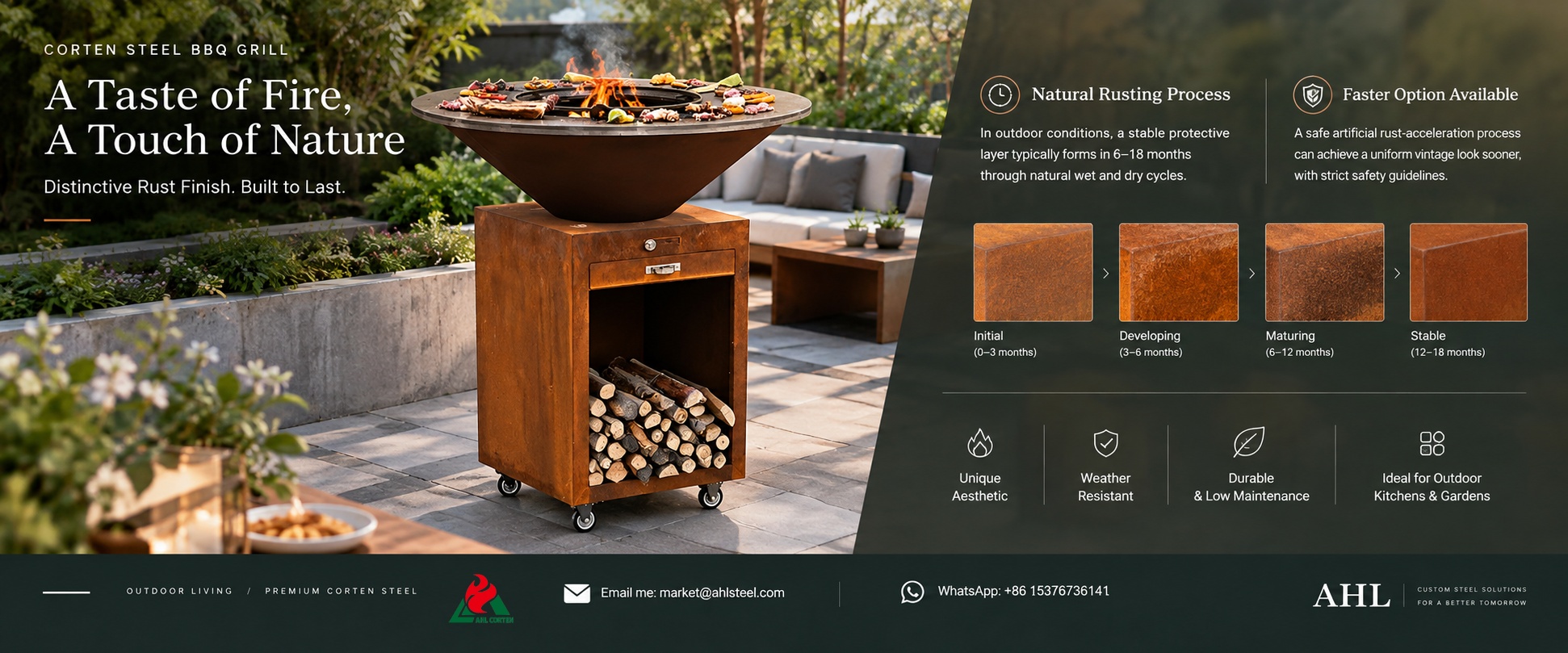
The large Corten BBQ grill has become a popular choice for outdoor kitchens and garden landscaping thanks to its distinctive vintage rust-coloured finish. Weathering steel naturally develops a protective rust layer through cycles of wet and dry conditions; in natural outdoor environments, it typically takes 6–18 months for a complete and stable passivation layer to form.
 

If you wish to achieve a uniform vintage appearance more quickly, you can use a safe, artificial rust-acceleration process, though there are strict safety guidelines that must be followed.
charcoal BBQ grill

Designing the Perfect Corten BBQ Grill for Your Outdoor Kitchen


Benefits of Artificially Accelerating the Rusting Process


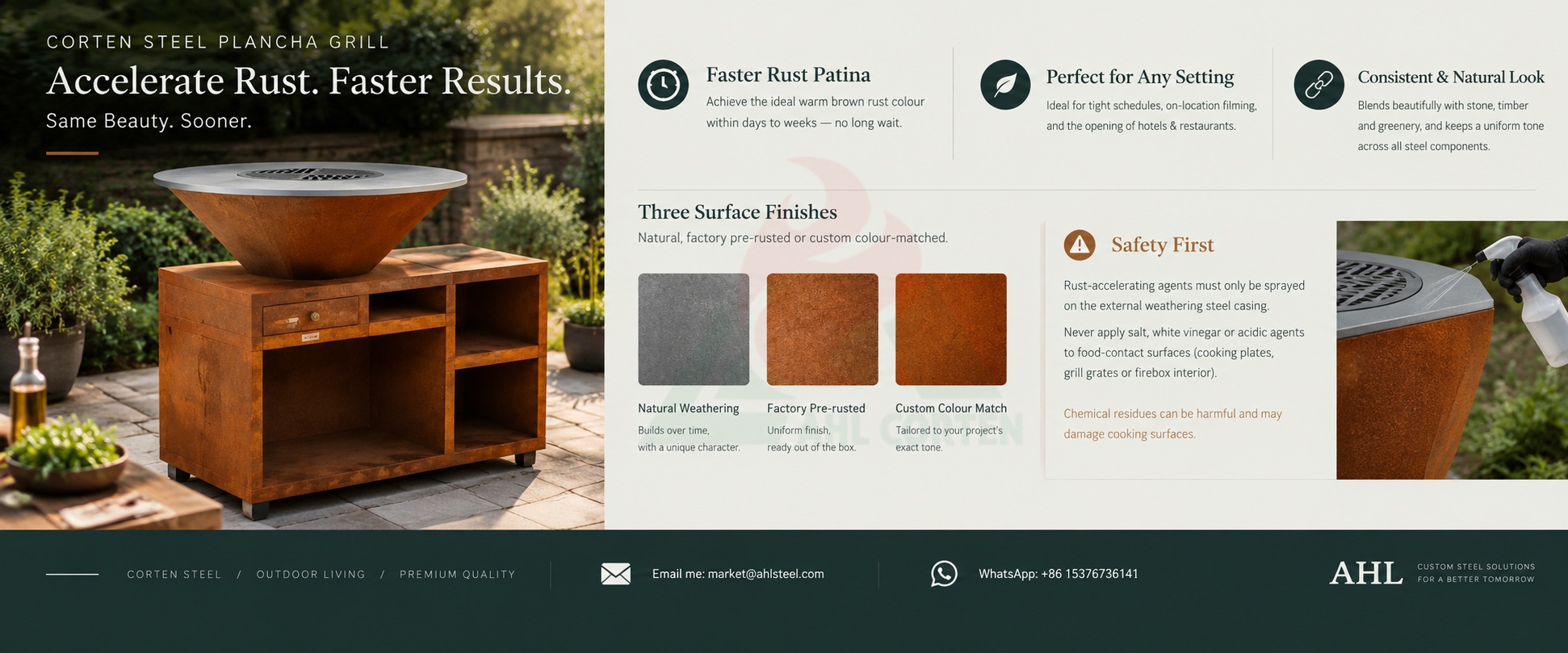
Artificial rusting allows you to achieve the ideal warm brown rust colour within a matter of days to weeks, without the need for a lengthy wait.
 

  • Suitable for projects with tight deadlines, on-location filming, and the opening of hotels and restaurants, ensuring the full aesthetic effect is achieved upon completion.
  • The rusted appearance blends naturally with stone, natural timber and greenery, eliminating the jarring effect often associated with new steel.
  • Ensures colour consistency across the entire set of weathering steel landscape components, matching the tones of weathering steel planters, screens and garden edging, and preventing mottled colour variations caused by uneven weathering rates.
 

Important safety rule: Rust-accelerating agents must only be sprayed onto the external weathering steel casing of the barbecue. Salt, white vinegar and acidic rust accelerators must not come into contact with any food-contact surfaces, such as the cooking plates, grill grates or the inner lining of the firebox. Chemical residues pose food safety risks and may damage cooking surfaces.


AHL custom corten plancha grills offer three surface finishes: natural weathering, factory-pre-rusted and custom colour-matched, suitable for outdoor kitchen projects in private gardens, hotels and restaurants.
Upgrade Your Garden with a Custom Corten BBQ Grill


Natural Weathering vs. Artificially Accelerated Rust Layer


Natural weathering relies on repeated cycles of wet and dry conditions caused by rain, humidity and sunlight, during which the steel gradually forms a dense, self-repairing protective oxide layer.
 

  • 2–3 weeks: Slight discolouration.
  • 6–12 months: A noticeable rust layer forms.
  • 1.5–3 years: The rust layer is fully stabilised.


Climate affects the rate of weathering. In humid coastal areas, the process is faster and may take approximately 6–8 months. In arid regions, weathering is slower and may require 12–24 months.

Natural weathering provides a uniform and stable rust layer, contains no chemical residues and offers strong long-term durability. It is suitable for private gardens with a flexible construction schedule.
 

Artificial acceleration is suitable for scenarios requiring colour consistency with existing weathering steel landscape elements or for commercial projects requiring an immediate visual impact.
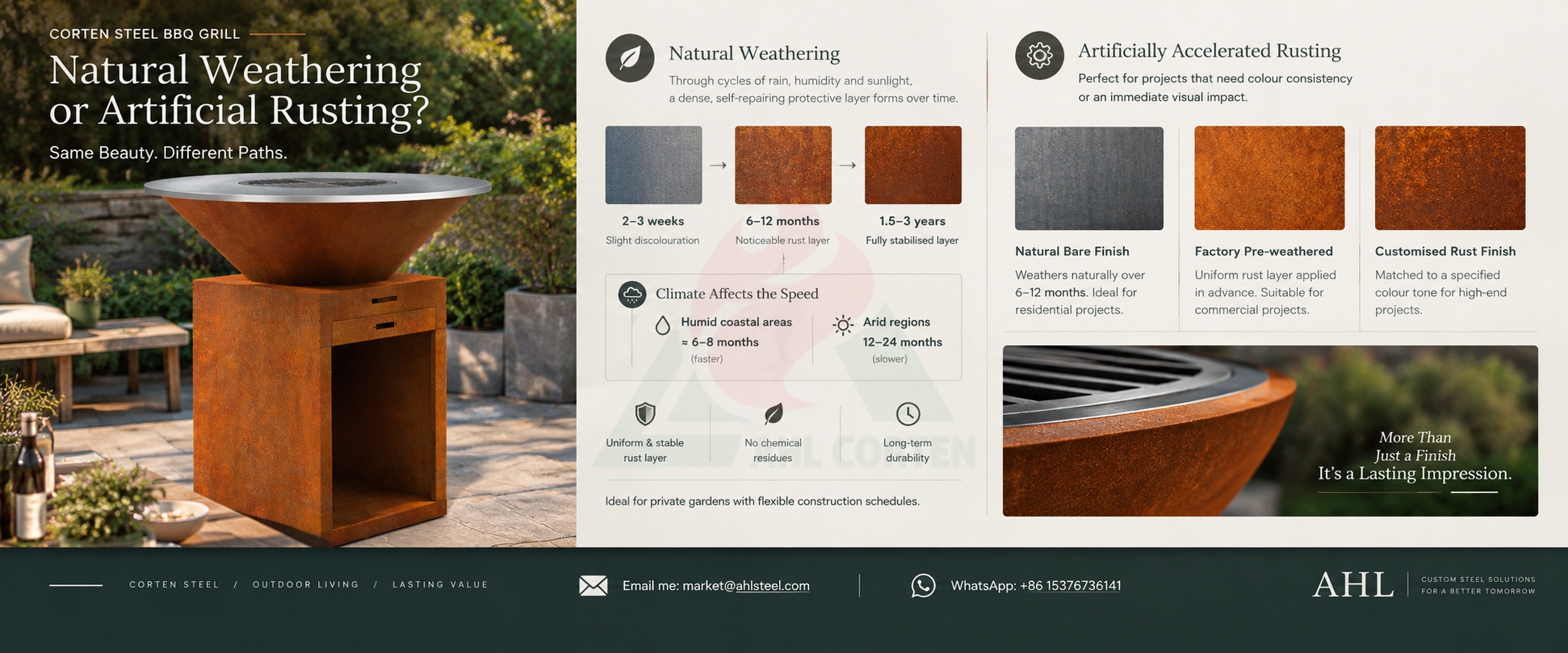
 

  • Natural bare finish: Raw steel that weathers naturally over 6–12 months; suitable for residential projects.
  • Factory-pre-weathered: A uniform rust layer is applied in advance using a controlled factory process; suitable for commercial projects.
  • Customised rust finish: A passivation layer is developed to match a specified colour tone for high-end projects.
Choose a BBQ Grill Built for Outdoor Entertaining


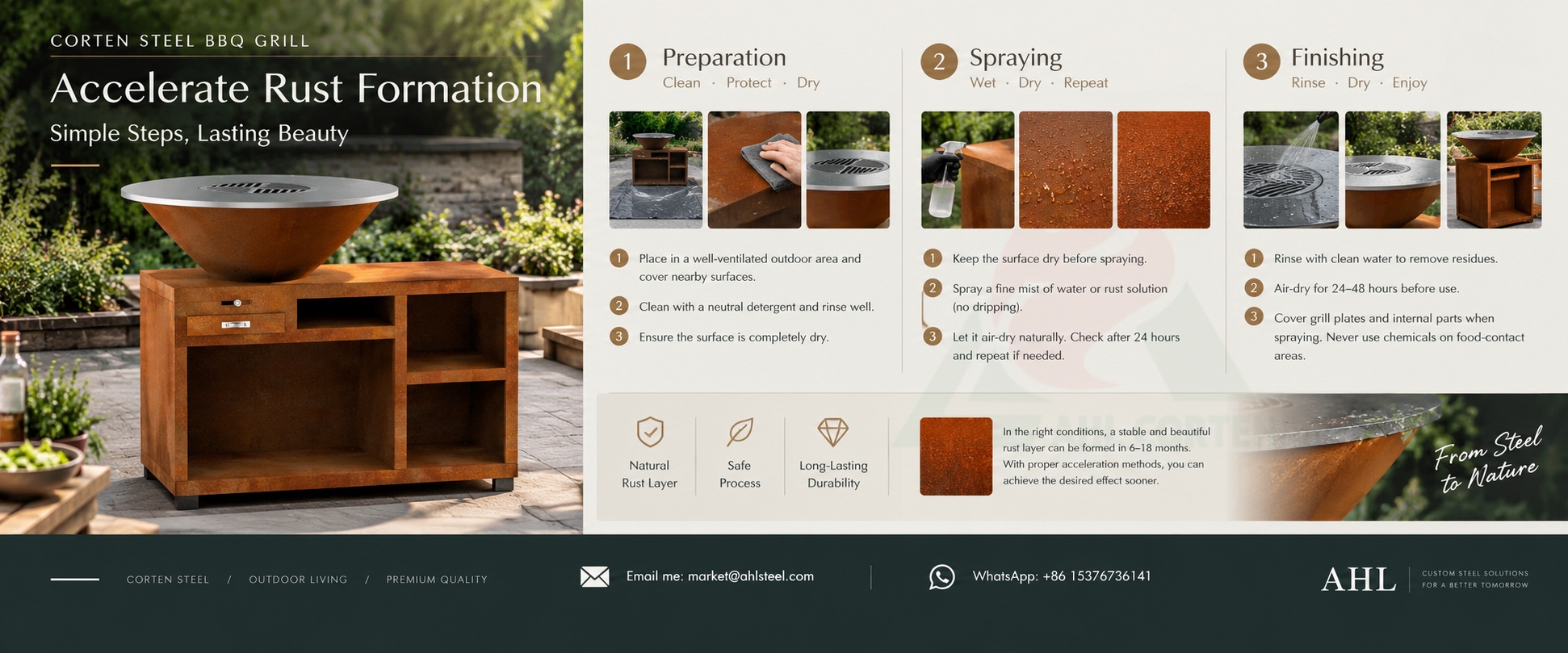
Practical Steps for Accelerating Rust Formation on a Corten BBQ Grill


Preliminary Preparation

 
  1. Place the outdoor fire grill in a well-ventilated, open outdoor area. Moisture build-up in enclosed spaces can cause patchy rusting.
  2. Cover surrounding paving and plants with a waterproof sheet to prevent contamination from chemical agents and rust runoff.
  3. Clean the outer surface with warm water and a neutral detergent to remove grease, dust and factory residues. Rinse thoroughly and allow the surface to dry completely.
 

Spraying Procedure

 
  1. Ensure that the steel surface is completely dry.
  2. Spray a fine mist of water or a compatible rust-accelerating solution to keep the surface damp without dripping.
  3. Allow the surface to air-dry naturally, completing one wetting-and-drying cycle. This is crucial for the formation of a stable rust layer.
  4. Check the colour after 24 hours. If it appears too light, repeat the spraying process.
 

Finishing

 
  1. Once the desired orange-brown colour has been achieved, gently rinse the exterior with clean water to remove salt and acetic acid residues.
  2. Allow the grill to air-dry for 24–48 hours before lighting the barbecue to avoid chemical residues producing foul-smelling fumes when heated.
  3. Before spraying, cover the grill plates, grill grates, combustion pipes and the interior of the firebox. Under no circumstances should the chemical be sprayed onto areas that come into contact with food.

Want the Latest Catalog of Outdoor BBQ Grills? Contact Us! 


DIY Salt and Vinegar Rust-Inducing Formula


Proportions: Mix 1 litre of clean water with 2 tablespoons of white vinegar containing approximately 5% acetic acid and 1–2 tablespoons of table salt. Pour the mixture into a spray bottle and shake well.


Method of use: Spray a light mist onto the exterior surface, leave it for 15–30 minutes and allow it to air-dry naturally. Repeat once daily for 3–7 consecutive days until the desired rust colour is achieved.

DIY risk warning: Excessive spraying or insufficient drying may result in powdery surface rust that is prone to flaking. Salt residue may cause pitting corrosion, shorten the service life of the steel and stain light-coloured stone or concrete. Salt runoff may also damage nearby plants.


For high-end projects, purchasing factory-pre-rusted products is recommended to avoid the risks associated with on-site chemical treatment.


Key Points for Protecting Cooking Surfaces

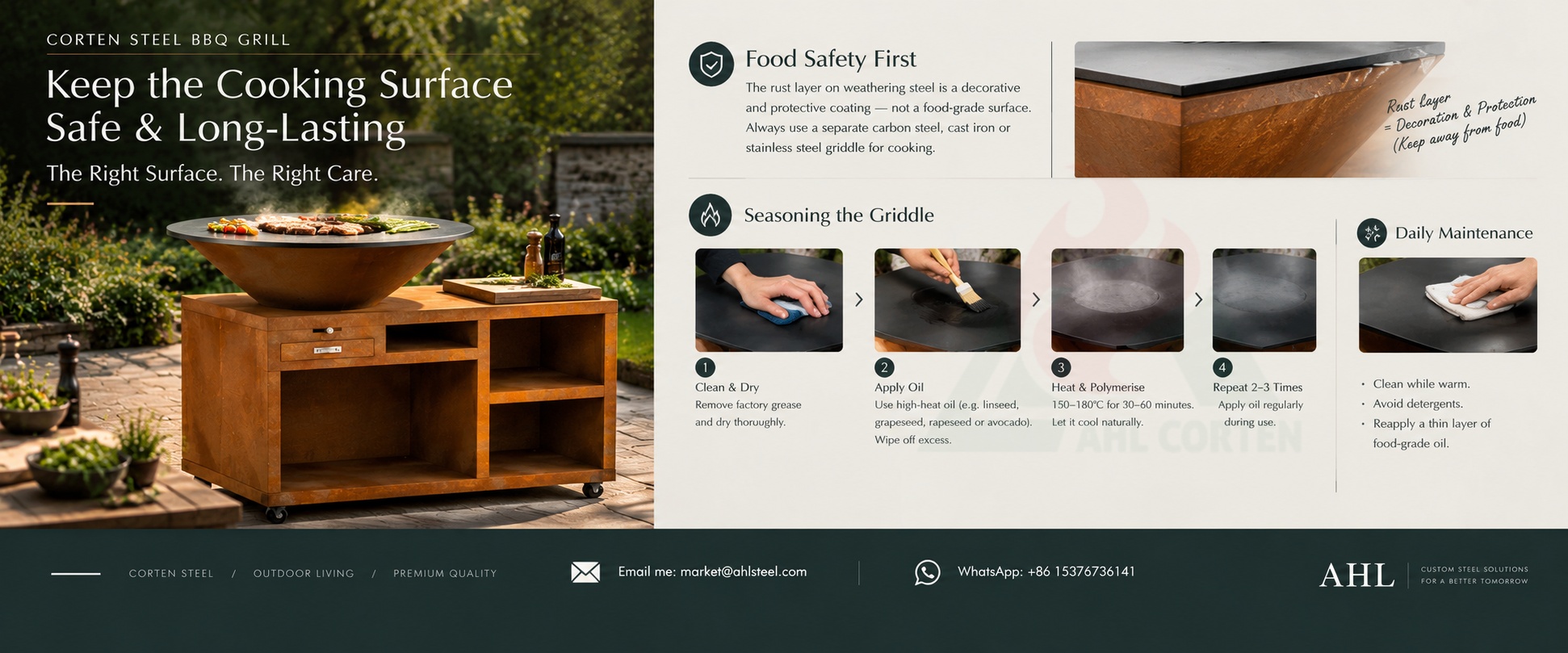
The outer rust layer is not the same as a food-grade cooking surface. The rust layer on a weathering steel casing serves as a decorative and protective coating and must never come into direct contact with food. For cooking, use a separate carbon steel, cast iron or stainless steel griddle.


Seasoning the Griddle

 
  1. Clean the griddle to remove factory grease, then dry it thoroughly.
  2. Apply a thin layer of high-temperature cooking oil, such as linseed oil, grapeseed oil, rapeseed oil or refined avocado oil. Wipe off any excess oil.
  3. Heat the griddle to 150–180°C for 30–60 minutes. The oil will polymerise to form a non-stick protective film. Allow it to cool naturally.
  4. Repeat steps 2–3 two or three times. Apply oil regularly during use to maintain the surface.


Daily Maintenance


Clean any food residues while the griddle is still warm. Avoid detergents where possible to prevent washing away the protective oil film. After cleaning and drying, apply a thin layer of food-grade oil to help prevent rust.
 

Do not use the following on the cooking surface: vinegar, salt spray, rust accelerators, sealing coatings, or strong acidic or alkaline cleaning agents.


Avoiding Pitfalls: Preventing Patchy Rust and Staining

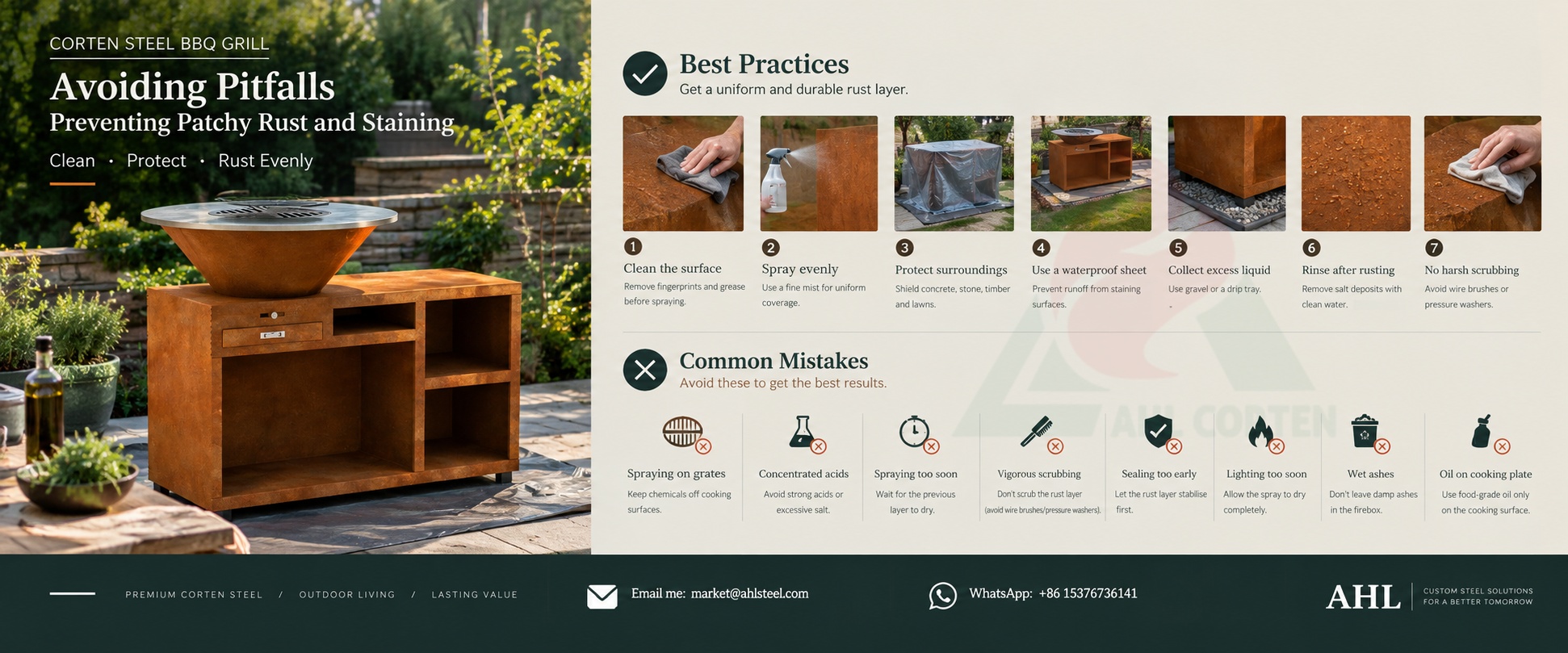
  • Clean fingerprints and grease from the external surface before spraying, as contaminants can cause uneven rusting.
  • Use a spray bottle to apply a fine mist evenly across the surface instead of spraying isolated spots.
  • Protect concrete, light-coloured stone, timber and lawns from rust-inducing agents and rusty water.
  • Place a waterproof sheet beneath the grill during application.
  • Use a gravel bed or drip tray to collect excess liquid and runoff.
  • Once the rust layer has formed, gently rinse the surface with clean water to remove salt deposits.
  • Do not scrub the newly formed rust layer vigorously.

Common Mistakes

  • Spraying rust-accelerating agents onto grill grates or cooking trays.
  • Avoid using concentrated acids or excessive amounts of table salt.
  • Apply additional spray before the previous layer has dried.
  • Scrubbing develops rust with a wire brush or pressure washer.
  • Applying a sealing coat before the rust layer has stabilised.
  • Light the fire before the rust-inducing agent has dried completely.
  • Leaving damp ashes in the firebox for prolonged periods.
  • Coat the exterior rust layer with food-grade seasoning oil on the cooking plate.


Want to Create Unique Corten Steel Grills? Contact Us!Want the Latest Catalog of Outdoor BBQ Grills? Contact Us! 


Long-Term Maintenance After the Rust Layer Has Formed


Weathering Steel Outer Casing

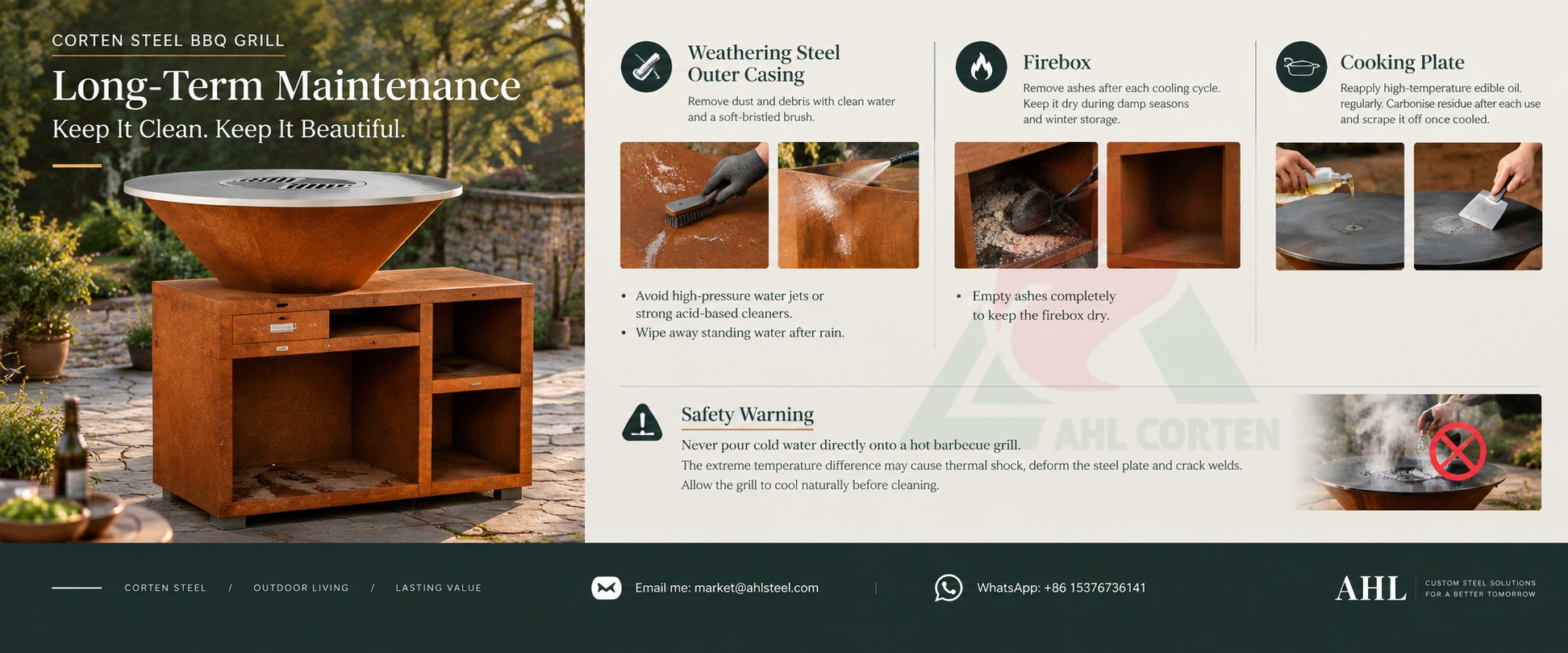
Clean dust and debris with clean water and a soft-bristled brush. Do not use high-pressure water jets or strong acid-based cleaners. Wipe away standing water after rain to reduce the risk of localised corrosion.


Firebox

Remove ashes after each cooling cycle. During damp seasons and before winter storage, empty the ashes completely to keep the firebox dry.


Cooking Plate

Regularly reapply high-temperature edible oil. After each use, carbonise residue at high temperature and scrape it off once the plate has cooled.
 

Safety warning: Never pour cold water directly onto a hot barbecue grill. The extreme temperature difference may cause thermal shock, deform the steel plate and crack welds. Allow the grill to cool naturally before cleaning.


Advantages of the AHL Corten Steel Barbecue Grill


AHL offers customisable weathering steel BBQ grills suitable for residential gardens, hotels, restaurants and commercial landscapes.
 

  • Surface treatment: Natural weathering, factory pre-rusting and custom colour matching.
  • Material thickness: Main bodies made from 4–5mm weathering steel. Cooking plates are available in 10–12mm carbon steel or stainless steel to improve resistance to high-temperature deformation.
  • Dimensions: Diameters from 600mm to more than 2,000mm, with custom sizes available.
  • Optional accessories: Flat griddles, grill grates, ring-shaped fire pits, ash trays, drainage holes, raised bases, castors and windbreak panels.
  • Landscape coordination: Can be paired with weathering steel planters, screens and garden edging to create a unified landscape style.


FAQ


How Long Does It Take for Corten Steel to Develop a Rust Layer?

Under natural weathering conditions, slight discolouration may appear after 2–3 weeks. A distinct rust layer may form within 6–12 months, while the surface may stabilise fully after 1.5–3 years. With controlled artificial acceleration, an orange-brown colour may become visible within several days to one week.

Can I Treat a Corten BBQ Grill with White Vinegar and Salt?

Only if the manufacturer permits it, and only on the external casing. Contact with the cooking surface is strictly prohibited. Once the desired colour has developed, rinse the exterior with clean water to remove residual salt.

Is It Safe for Food to Contact the Rust on Weathering Steel?

The rust layer on the external casing must not come into contact with food. Use a separate carbon steel, cast iron or stainless steel cooking plate, and season it with food-grade cooking oil.

Can I Speed Up the Rusting Process on the Cooking Plate?

No. The cooking surface must only be seasoned with food-grade, high-temperature cooking oil.

How Can I Prevent Rust Water from Staining Paving?

Use a waterproof sheet during installation, place gravel or a drip tray nearby, and keep the grill away from light-coloured stonework. Factory-pre-rusted models usually produce less early-stage runoff.

Should I Choose a Factory-Pre-Rusted Model?

Factory-pre-rusted models are recommended for commercial projects with tight deadlines. For private gardens with flexible schedules, a natural weathering finish may be the preferred option.


Call to Action


Obtain a bespoke quote for a weathering steel barbecue grill and select the diameter, steel plate thickness and surface finish that best match your project.
 

  • Enquire about the factory pre-rusting process.
  • Receive expert guidance on accelerating rust formation and maintenance.
  • Learn about selecting flat griddle plates and grill grates.
  • Get advice on cooking-surface seasoning and long-term care.

Contact AHL today to create a custom Corten steel BBQ grill for your garden, outdoor kitchen, hotel or restaurant project.
 

Need a Factory Quote for Corten Steel BBQ Grills?

Send your drawings, size list, quantity, and destination country. Corten Factory can support custom weathering steel fabrication, export packing, and project quotation.


Back
Next:
Back to list
Fill In The Inquiry
After receiving your enquiry, our customer service staff will contact you within 24 hours for detailed communication!
* Name:
*Email:
* Telephone/Whatsapp:
Country:
* Inquiry: