How to Secure a Corten Steel Privacy Screen Fence?
Date:2026.06.01
Share to:
Weathering steel landscape screen fences have become a mainstream design element in modern gardens, high-end villas, and commercial landscapes, thanks to their unique openwork play of light and shadow and the textured, vintage reddish-brown rust patina. Combining the aesthetic appeal of artistic sculpture with the practical function of spatial partitioning, they effectively demarcate private areas and enhance the sense of sophistication in any setting.
However, during the actual installation process, many property owners and designers have numerous concerns. This is the core challenge hindering the widespread adoption of weathering steel screens.
Many worry that the large surface area of the screen facade will cause it to sway violently, tilt, or even topple over in high winds. Under prolonged exposure to wind and rain, the bottom screws and base connectors are prone to loosening and falling off, shortening the overall service life.
Additionally, DIY installation without professional expertise and non-standard construction practices often lead to rework issues. Repeated disassembly and reassembly are not only time-consuming and labor-intensive, increasing costs, but they also damage the uniform rust patina on the weathering steel surface, ruining the overall aesthetic effect.
Drawing on years of experience in high-end weathering steel landscape projects, this article provides a comprehensive breakdown of a stable installation solution—covering core principles, preliminary preparation, system selection, hardware configuration, standardized installation, and long-term maintenance—to thoroughly resolve issues such as screen swaying, rusting, and deformation.
The Installation Method Determines the 30-Year Service Life of Corten Steel Screens
Material Advantages Cannot Compensate for Installation Shortcomings
Weathering steel inherently possesses extremely high hardness and natural corrosion resistance, making it suitable for long-term outdoor use. However, 90% of a screen’s wind resistance, stability against overturning, and resistance to aging do not depend on the material itself, but rather on the concealed wind-resistant framework and foundation anchoring system. Weathering steel screens are tall structures with large wind-exposed surfaces. During high winds outdoors, the entire steel panel acts like a giant sail, with massive instantaneous wind loads. If the installation method is non-standard, the enormous shear forces generated by the wind will concentrate at the connection points between the screws and the base, causing metal fatigue fractures in the screws and displacement of the base, ultimately leading to the corten fence panelstilting or collapsing.
The Three Core Benefits of Standardized Installation
Structural Safety, Eliminating Sway Risks: A standardized industrial-grade anchoring system completely eliminates issues such as noise, resonance, and swaying of rusted steel panels during high winds, ensuring the safety of people, pets, and facilities on-site.
Consistent Aesthetics, Preserving the Patina: Incorrect installation methods can cause uneven stress distribution on the steel panels, leading to warping and deformation over time due to repeated exposure to wet and dry conditions, which distorts the minimalist lines. Additionally, improper hardware can trigger electrochemical corrosion, resulting in blackening and unsightly rust stains that completely ruin the distinctive vintage patina of weathering steel.
Zero-Maintenance, Long-Lasting, and Hassle-Free: Properly securing the foundation and framework from the outset completely avoids the need for rework caused by foundation settlement or loose screws, enabling long-term, zero-maintenance outdoor use.
Professional Engineering Philosophy: Avoiding the Pitfalls of Single-Panel Installation
Many substandard suppliers in the industry merely sell individual steel panels without structural wind-resistant, seismic, or load-bearing calculations, creating significant safety hazards for future use. High-end weathering steel screens are not merely decorative panels, but a complete wind-resistant load-bearing system. This includes high-rigidity wind-resistant main columns, anti-loosening fasteners made of the same material, and integrated heavy-duty pre-embedded bases, eliminating installation risks at the source and meeting the long-term usage requirements of high-end gardens.
Preparations Before Installing Corten Steel Screens
High-Precision Spatial Measurement and Layout Planning
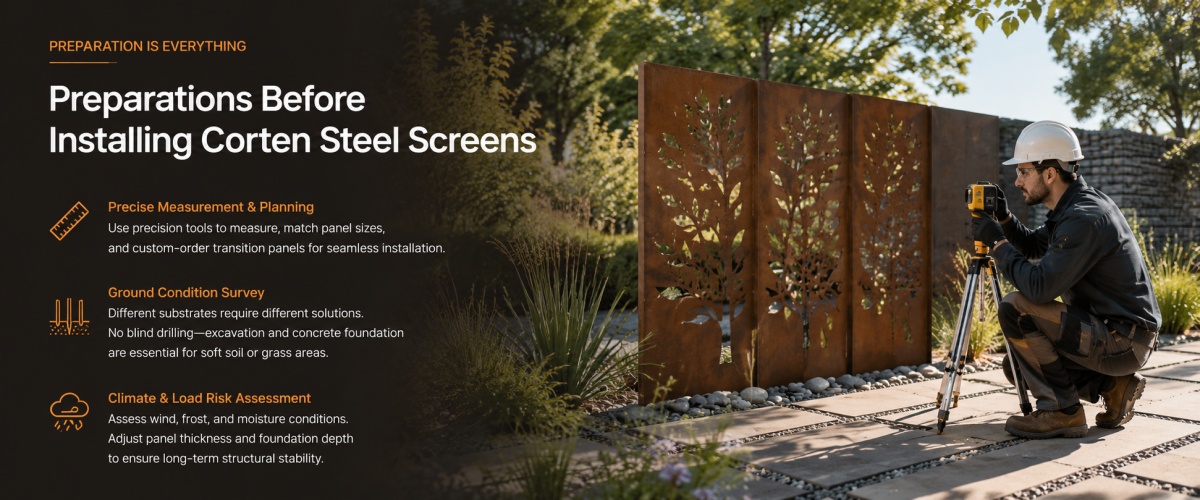
Use a high-precision infrared rangefinder to conduct a comprehensive survey of the installation area, accurately calculate the total length, match it with the standard dimensions of individual screen panels, and custom-order non-standard transition panels in advance to ensure seamless and orderly connections. Strictly maintain a 3–5 cm clearance between the bottom of the corten steel fence panel and the ground—this is a critical construction detail. This gap prevents water accumulation and the buildup of fallen leaves at the base, thereby protecting the steel from prolonged water exposure and resulting in pathological rust. It also facilitates air circulation at the base, effectively reducing wind load pressure.
On-site Survey of Ground Geology
Different ground substrates require completely different mounting solutions; standardized construction and blind drilling are strictly prohibited. Grass and soft soil areas: Expansion bolts cannot be driven directly into the ground; sufficient time and budget must be allocated for excavation and concrete pouring. Concrete-hardened surfaces and wooden platforms: Precisely match the drill hole diameter, anchorage depth, and joist connection points; it is strictly prohibited to secure screens to non-load-bearing hollow decorative panels.
Microclimate and Structural Load Risk Assessment
Site climate directly determines core parameters such as column thickness and foundation pit depth; advance site surveys and assessments are required. Coastal salt fog areas and wind tunnel zones between buildings: Wind forces are amplified exponentially; thicker steel plates and heavier foundation ballast are required to enhance wind resistance. Areas subject to rain, snow, and freeze-thaw cycles: The foundation pit must be excavated to a depth exceeding the local frost line to prevent spring soil heave from compressing the foundation and causing the screen to tilt or deform.
Suitable Scenarios: Standalone outdoor perimeters, tall screens ≥1.8 meters in height, and open areas with strong winds.
Structural Principle: Single or multiple screens are supported on both sides by heavy-duty columns made of 4.0–6.0 mm thick weather-resistant steel square tubing. The screens are secured via side flanges or hidden slot inserts, and the columns are anchored to a concrete foundation using heavy-duty base plates.
Key Advantages: An architectural-grade rigid frame that evenly distributes lateral wind forces from the screen to the columns and underground ballast foundation. Withstands wind speeds of up to Level 10 or higher, ensuring zero sway and zero displacement over the long term.
Wall-Mounted Frame (Space-Saving, High Utilization)
Suitable Scenarios: Courtyard settings where the screen is backed by concrete walls, brick walls, or load-bearing building walls.
Structural Principles: No ground-level posts are required. Custom weather-resistant steel Z-shaped and U-shaped suspension brackets are used to semi-recess the screen into the existing wall using expansion bolts.
Key Advantages: Significantly reduces the area required for foundation work. By relying on the load-bearing capacity of the existing wall, the screen is free from the risk of displacement or overturning. It also transforms plain concrete walls, imparting a vintage, artistic aesthetic to the courtyard.
Suitable Scenarios: High-end villas and luxury landscape projects seeking a minimalist, seamless effect.
Structural Principle: 2–3 hidden reinforcement beams are horizontally installed on the inner side of the screen. Panels are secured using countersunk bolts and hidden rivets, with columns concealed within the panel joints, resulting in no exposed components on the front.
Key Advantages: The overall lines are continuous and fluid, creating a pure and sophisticated interplay of light and shadow. With the hardware and support structures completely concealed, this is the preferred solution for high-end landscape designers.
Same Material Origin, Eliminating Electrochemical Corrosion
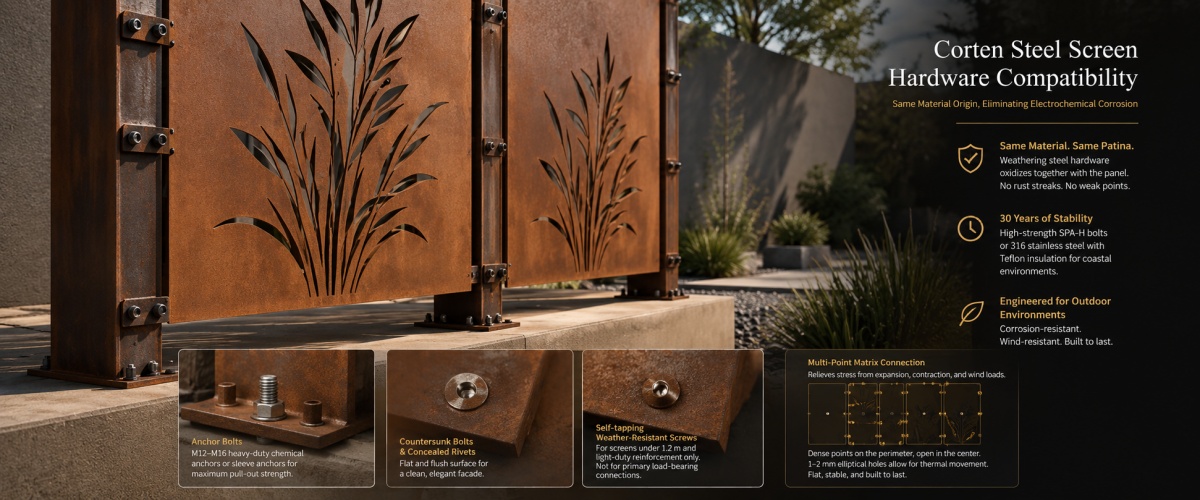
In humid outdoor environments and salt spray conditions, contact between different metals and water can trigger electrochemical corrosion. Ordinary carbon steel screws will rust and break rapidly, leaking a dark brown rust liquid that stains the screen surface. Standard solutions require the use of high-strength bolts made from the same SPA-H weathering steel. For harsh coastal environments, 316 stainless steel hardware is used, paired with Teflon-insulated washers. This ensures that the hardware and the screen oxidize simultaneously, forming a dense rust layer together, guaranteeing 30 years of stability without corrosion.
Precise Hardware Selection for Specific Applications
Anchor Bolts: As the core load-bearing components for the foundation, M12–M16 heavy-duty chemical anchors or sleeve-type expansion anchors must be used to ensure underground pull-out resistance.
Countersunk Bolts and Concealed Rivets: Used for joining panels and crossbeams, they provide a flat, flush surface to ensure a clean and aesthetically pleasing screen facade.
Self-tapping Weather-Resistant Screws: Suitable only for low screens under 1.2 meters and light-duty auxiliary reinforcement; strictly prohibited for use in core load-bearing joints of tall screens.
Multi-Point Matrix Connection to Relieve Panel Stress
Installation methods that secure panels only at the four corners prevent stress from being released during thermal expansion and contraction or wind loads, leading to warping, twisting, and wavy deformation in the center.
Standard practice employs a matrix layout featuring “dense points around the perimeter with open space in the center,” with at least four sets of vertical connection points per screen panel. Additionally, 1–2 mm elliptical micro-adjustment holes are reserved to allow the panels to expand and contract slightly with seasonal temperature fluctuations, completely eliminating internal stress and maintaining a flat panel surface.
Corten Steel Screen: Foundation Anchoring Solution
Grass/Soft Soil Foundations: Preventing Settlement and Uplift
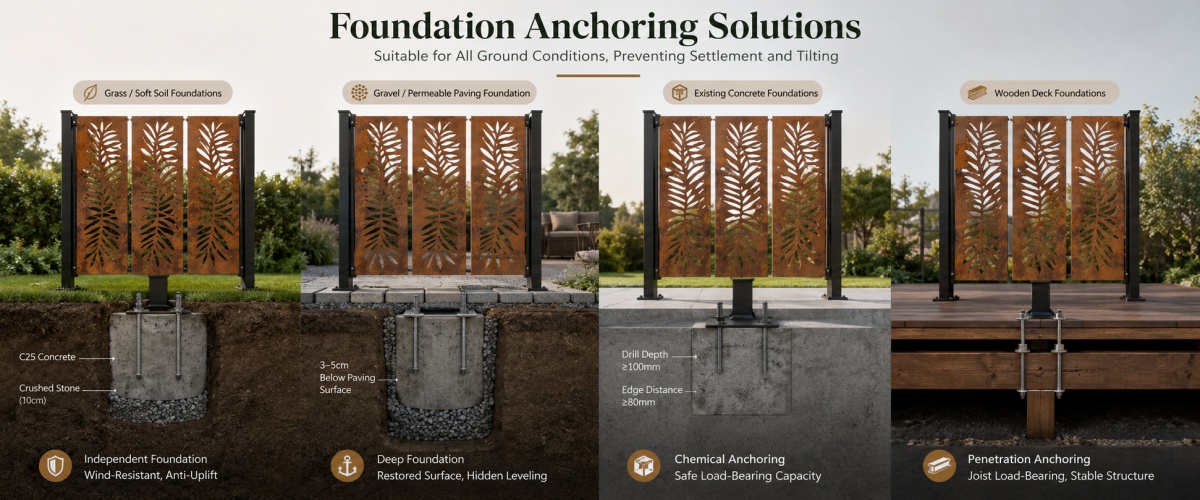
It is strictly prohibited to drive posts directly into soft soil. An independent foundation pit with a diameter of ≥30 cm and a depth of 60–80 cm must be excavated at each post location. Lay a 10 cm layer of crushed stone at the bottom of the pit and compact it. Secure the posts using J-shaped embedded anchor bolts, then pour C25 or higher grade concrete to form a gravity-type independent foundation. The concrete’s self-weight and the lateral pressure from the surrounding soil counteract wind uplift and lateral forces, preventing the rusted steel screen from toppling at the source.
Gravel/Permeable Paving Foundation: Deep Foundation, Hidden Leveling
The surface layer of gravel and permeable pavers is a flexible structure with no load-bearing or uplift resistance, so columns cannot be directly anchored to it. The surface paving must be removed, the gravel layer excavated, and the underlying hard native soil reached. An independent concrete foundation must then be poured in accordance with soft soil foundation standards. The top of the foundation should be 3–5 cm below the paving surface. Upon completion, backfill with crushed stone and restore the paving to ensure both the stability of the underground structure and the overall aesthetic appeal of the surface.
Existing Concrete Foundations: Chemical Anchoring, Safe Load-Bearing Capacity
Concrete floors provide the optimal load-bearing base; the key to successful installation lies in proper drilling and dust removal. Drill holes to a depth of ≥100 mm, and thoroughly clean dust from the holes after drilling to prevent reduced friction of the anchor bolts. Inject specialized chemical anchoring adhesive and insert M12 high-strength anchor bolts to secure the column base plate. Drilling points must be at least 80 mm from the edge of the concrete to prevent concrete cracking or localized collapse caused by stress from hole expansion.
Wooden and WPC decking panels are prone to aging and creep, and have limited load-bearing capacity; therefore, it is prohibited to secure posts directly with standard wood screws.
The column base plate must be precisely aligned with the underlying main joists or steel structural load-bearing beams. Use large-diameter stainless steel bolts to penetrate the decking and joists, with thick washers installed on the back and double nuts tightened in opposite directions.
This fully transfers the wind load from the metal screen to the platform’s load-bearing framework, ensuring uniform stress distribution and stable load-bearing capacity.
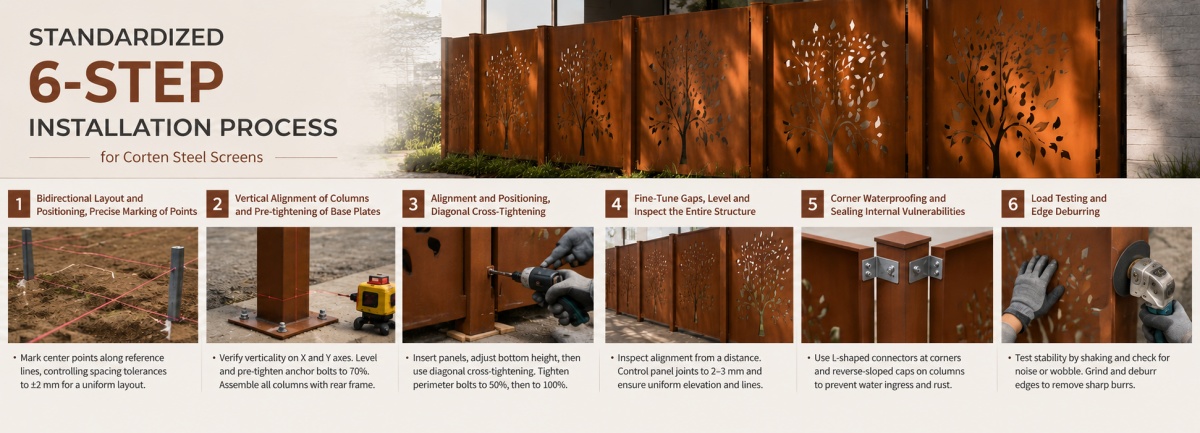
Standardized 6-Step Installation Process for Corten Steel Screens
Step 1: Bidirectional Layout and Positioning, Precise Marking of Points
Secure positioning rebar at both ends of the installation path, then establish bidirectional reference lines to control both axial straightness and horizontal elevation.
Precisely mark the center points of each column along the reference lines, strictly controlling spacing tolerances to ±2 mm to ensure a uniform and consistent overall layout.
Step 2: Vertical Alignment of Columns and Pre-tightening of Base Plates
After erecting the columns, do not rely on visual inspection for alignment. Use an infrared level and dual-direction plumb lines to verify verticality along both the X and Y axes.
After leveling the base plates with shims, pre-tighten the foundation anchor bolts to 70% of their full torque. Complete the preliminary assembly of all columns with the rear frame in sequence.
Step 3: Alignment and Positioning, Diagonal Cross-Tightening
Insert the rusted steel screen panels into the slots and beam supports. Use wooden wedges to fine-tune the bottom height, ensuring the panels fit naturally against the frame.
Never tighten the screws on one side at once; instead, use a diagonal cross-tightening method. First, evenly tighten the perimeter bolts to 50% of their torque. Once the panels are fully centered and no longer warping due to internal stress, tighten them to 100% torque to prevent diagonal twisting and deformation.
Step 4: Fine-Tune Gaps, Level and Inspect the Entire Structure
After securing a single screen unit, raise the reference line and inspect the overall alignment from a distance. Control panel joints to 2–3 mm to allow for thermal expansion and contraction, while ensuring uniform top elevation and straight, neat horizontal and vertical lines.
Step 5: Corner Waterproofing and Sealing Internal Vulnerabilities
Use factory-prefabricated L-shaped corner connectors at 90° corners to replace rough on-site welding, ensuring structural stability and a seamless, aesthetically pleasing finish.
Install reverse-sloped waterproof caps on the tops of all hollow columns to prevent rain and snow from seeping inside, avoiding internal water accumulation and rust, and providing long-term protection for the base material.
Step 6: Load Testing and Edge Deburring
After completion, firmly shake the columns and the center of the screen with both hands to test the overall structural stability and check for any unusual metallic noises or resonance/wobbling.
Grind and deburr both sides of edges resulting from on-site cutting and welding to remove sharp burrs and eliminate the risk of injury to people or pets.
FAQ: Answers to Key Questions About Corten Steel Screen Installation and Stability
1. How Long Does It Take to Install a Weathering Steel Screen?
The total installation time depends on the type of foundation. For concrete foundations secured with drilled-in anchors, two workers can install 15–20 meters of corten screen per day. For soft soil foundations, which require excavation, concrete pouring, and curing, the total installation time is approximately 3 days.
2. Will the Screen Become Loose After Prolonged Exposure to Wind and Rain?
By strictly adhering to the multi-point matrix connection and two-stage tightening process, combined with weathering steel accessories from the same source, loosening will not occur. The primary causes of loosening are the corrosion and breakage of ordinary screws, and the lack of expansion holes leading to panel tension on the bolts; these issues can be completely avoided through proper construction.
3. Which Anchoring Components Are Suitable For Different Ground Types?
Concrete surfaces require M12–M16 heavy-duty chemical anchors; soft soil foundations require pre-embedded J-type anchors combined with a concrete foundation; gravel surfaces require deep excavation of the original soil to pour a foundation, followed by installation with heavy-duty anchors.
4. How Can Corner Joints Be Made More Stable and Aesthetically Pleasing?
On-site manual welding is prohibited. Instead, use factory-produced CNC-machined one-piece L-shaped corner brackets, which provide seamless joints and even load distribution, increasing the shear stability of the corner by more than three times.
5. How To Provide Specialized Reinforcement In Coastal Areas With Strong Winds?
Implement a triple reinforcement plan: perforated panels to reduce wind resistance, 5.0–6.0 mm thickened posts, post spacing reduced to 1.0–1.2 meters, and foundation pits deepened to 80–100 cm. This dual approach of weight reduction and counterweight ensures wind resistance.
Ready to Choose Your Own Corten Steel Screens?
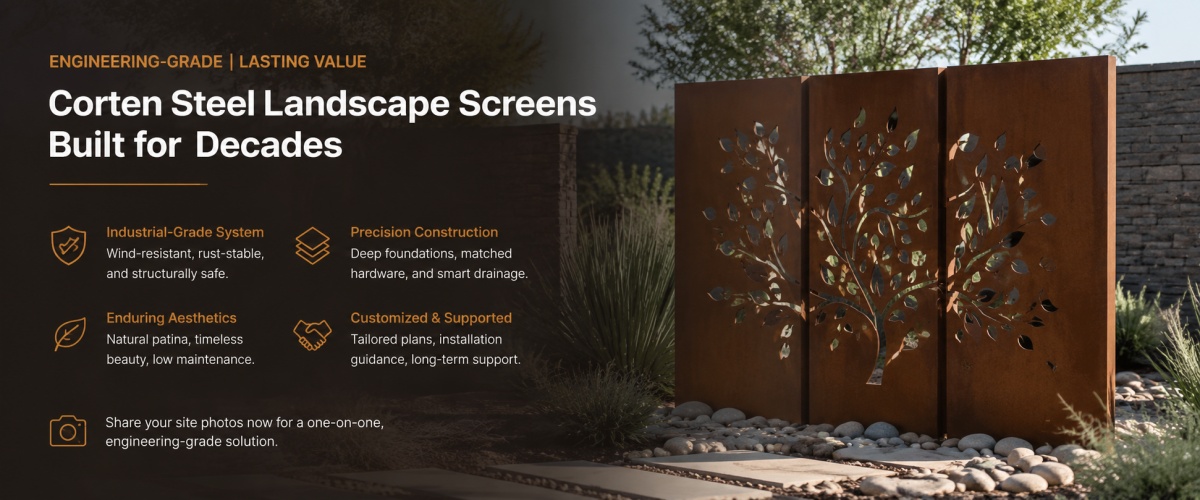
Corten steel landscape screens are far more than simple decorative panels; they constitute a small-scale outdoor engineering system that balances aesthetics with structural safety.
Their long-term stability does not rely on the material itself, but rather on deep-buried ballast foundations, precisely matched hardware systems, and scientifically designed ventilation and drainage structures.
By avoiding the pitfalls of crude, single-panel installation and adopting industrial-grade standardized construction, we preserve the unique patina of weathering steel while ensuring decades of wind resistance, rust prevention, and structural integrity—continuously enhancing the value of your garden landscape and architectural assets. Need a customized wind-resistant reinforcement plan and standardized installation drawings for your site? Provide us with actual site photos to receive a one-on-one, engineering-grade customized solution, full-process implementation guidance, and long-term after-sales support. Contact us now!

.jpg)

 Fill In The Inquiry