How to Choose the Height of Corten Steel Edging?
Corten steel garden edging is currently a popular choice for residential landscaping and municipal green spaces. It features a natural, vintage rust-brown finish, requires minimal maintenance, and is extremely durable.
Many homeowners and designers fall into a common trap: they focus solely on the steel material while neglecting to consider the proper height selection. Choosing the wrong height can lead to problems such as grass encroachment, soil spillover, and slope collapse—all of which result in wasted landscaping costs.
Drawing on practical experience with residential and commercial projects in Oceania—taking into account local soil and climate conditions—this article provides a detailed explanation of the logic behind selecting the appropriate height for weathering steel garden edging, the suitable applications for each specification, pairing techniques, and key points to avoid pitfalls, helping you choose the right size for your garden the first time.
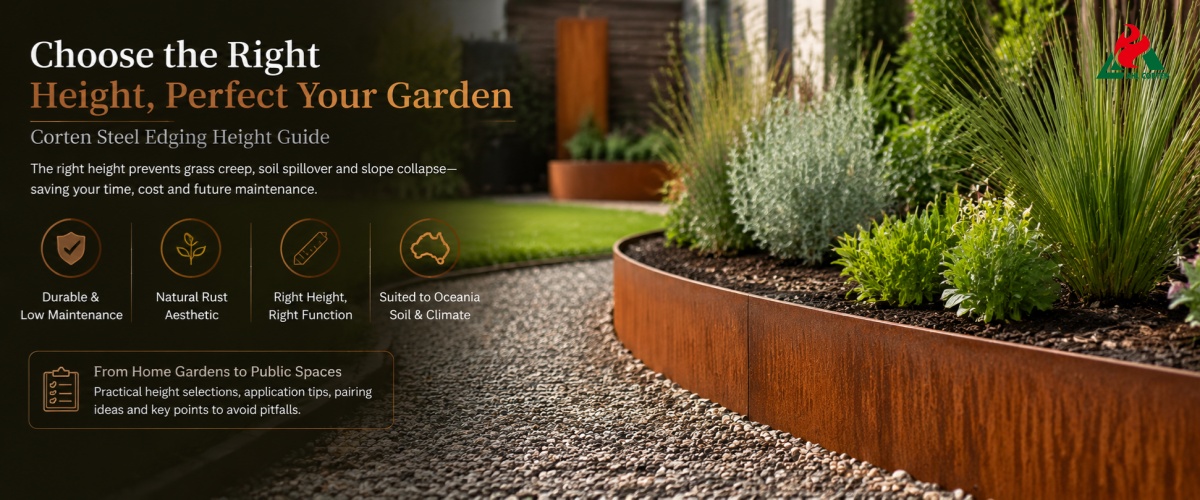
How the Height of Corten Edging Determines Garden Aesthetics and Durability
The core value of Corten steel edging lies not only in decorative landscaping but also in defining boundaries and stabilizing soil. Profiles of different heights vary significantly in function and are suited to entirely different garden scenarios.
1. Low-Profile Edging: Clean Demarcation Without Obstructing Views
Low-profile landscape corten edging focuses on creating a minimalist zoning effect. It clearly separates lawns, flower beds, and walkways while effectively preventing grass from spreading into planting areas.
With a moderate height above ground, low-profile edging doesn’t obstruct garden views, resulting in an open and tidy overall landscape that complements minimalist and natural-style garden designs.
2. Medium-to-High Edging: Miniature Retaining Walls Suitable for Complex Terrain
Medium-to-high-strength corten steel lawn edging can serve as small retaining walls, securely holding in soil, bark mulch, landscape pebbles, and other materials.
In coastal areas such as the Mornington Peninsula, strong sea winds can easily scatter lightweight mulch; the raised steel edging effectively secures these materials, preventing damage to the landscape.
3. Suited to the Unique Soil and Water Conditions of Oceania
Soil conditions vary significantly across Oceania and the surrounding peninsulas, directly influencing the selection of edging height. In areas like Frankston, heavy clay soil drains slowly and exerts high soil pressure, requiring taller edging buried deeper to ensure stability.
In areas like Mount Eliza, where sandy loam predominates and drainage is rapid, low-profile edging is sufficient to separate lawns from flower beds. At the same time, the unique rust layer structure of weathering steel resists coastal salt corrosion, making it better suited to the local climate than ordinary steel.

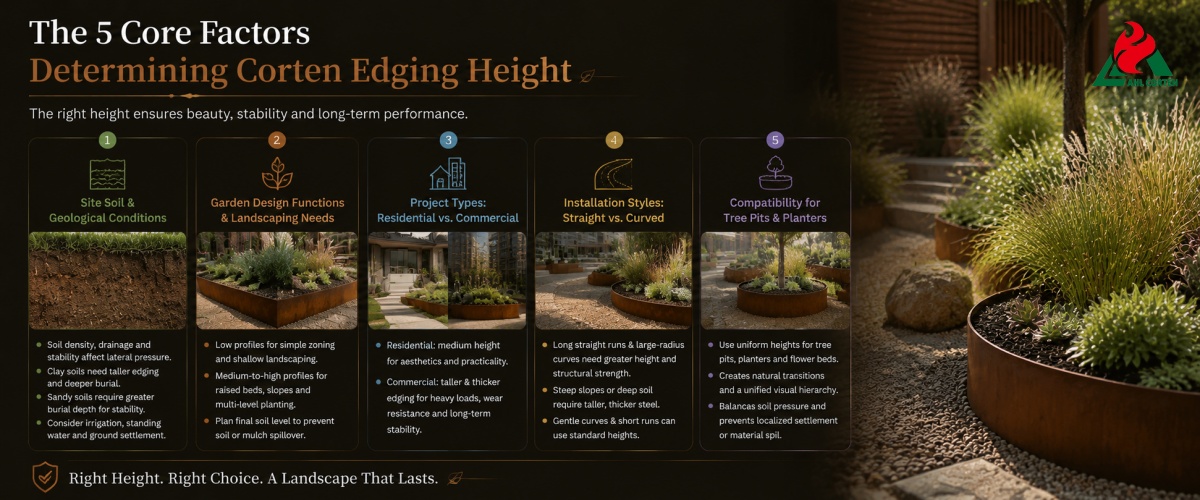
The 5 Core Factors Determining Corten Edging Height
Height selection cannot be based solely on aesthetics; it requires a comprehensive assessment of site conditions, design purpose, and project type. All five key factors are essential.
1. Site Soil and Geological Conditions
Soil density, drainage, and stability directly determine the load-bearing capacity of the steel edging. Heavy clay exerts significant lateral pressure; if the edging is not tall enough or buried deeply enough, deformation and soil spillover are highly likely.
Sandy soil is loose, requiring a greater burial depth in proportion to the profile height to ensure a stable boundary. Additionally, factors such as standing water from irrigation and minor ground settlement require sufficient edge height to offset these effects.
2. Garden Design Functions and Landscaping Needs
For simple zoning and shallow-layer landscaping, prioritize low-profile edging profiles; for raised flower beds, slope stabilization, or multi-tiered landscaping, medium-to-high-profile edging profiles are essential.
Inadequate height selection is the most common issue. After heavy rain or routine watering, soil and mulch can easily spill out of the flower beds, compromising the garden’s neat appearance. The final soil level must be planned in advance before selecting the edging profile.
3. Project Types: Residential Gardens vs. Commercial Landscapes
Residential gardens primarily feature lightweight landscaping; medium-height edging is sufficient to define the garden’s contours, balancing aesthetics with practicality and complementing the everyday home environment.
Commercial landscapes experience high foot traffic, extensive planting areas, and heavier soil loads. They require taller edging paired with thicker steel to withstand long-term wear and tear from external forces and soil pressure, ensuring structural stability for decades.
4. Installation Styles: Straight-Line Installation vs. Curved Landscaping
Long stretches of straight-line installation and large-radius curved landscaping place higher demands on edging height and structural strength. In scenarios with steep slopes or deep soil cover, tall edging must be paired with steel of the required thickness to prevent long-term bending or deformation under pressure.
For gentle curves and short straight-line divisions, standard edging heights are sufficient to meet design requirements, balancing aesthetics with ease of construction.
5. Overall Compatibility for Tree Pits and Raised Planters
For tree pits, raised planters, and flower bed edges within a garden, it is recommended to use uniform height specifications. Consistent dimensions create more natural landscape transitions and a more unified visual hierarchy.
At the same time, uniform specifications help balance soil pressure across all areas, preventing excessive local height differences that could lead to localized subsidence or material spillage.
Corten Steel Edging: Steel Thickness—The Key to Selecting the Right Height
Many people mistakenly believe that weathering steel is inherently corrosion-resistant and therefore do not need to consider its thickness—this is a common misconception. Corrosion protection addresses rusting, while thickness determines structural stability.
1. The Critical Impact of Thickness on the Performance of Edging
Thinner steel is easy to handle but has poor compressive strength. When subjected to long-term soil pressure, it is prone to bending, deformation, and edge curling, resulting in extremely high maintenance costs down the line.
1.6mm thickened steel offers excellent resistance to bending, allowing it to maintain its shape over the long term. It is suitable for complex scenarios such as high-traffic areas, deep soil cover, and sloped surfaces, ensuring maximum structural stability.
2. Structural Advantages Exclusive to Corten Steel Edging
The dense rust layer formed on weathering steel after patination isolates the steel from air and salt, preventing deep corrosion. However, even with superior corrosion resistance, sufficient thickness is still required in high-height applications to withstand lateral soil pressure and prevent structural failure.
Detailed Explanation of Corten Edging Heights Across All Sizes (100mm–590mm)
1. 100mm | Designed for Minimalist Lawn Division
When buried 30mm underground, the visible height above ground is approximately 70mm—just clear of the mower’s cutting height. Primarily used to demarcate boundaries between lawns and flower beds, walkways, and driveways.
It effectively blocks the spread of creeping grass, features a clean and understated design, and requires no complex installation, making it the top choice for small yards and minimalist landscapes.
2. 150mm | General-Purpose Standard Flower Bed Edging
As the most commonly used classic size in gardens across Oceania and Europe, it has an exposed height of approximately 120mm when buried 30mm deep. It strikes a balance between aesthetics and practicality, appearing neither bulky nor out of place.
Suitable for front yard landscaping, green belts, tree pit borders, and low shrub planting areas, it is a versatile choice for the vast majority of standard garden flower beds.
3. 185mm | Deep Soil Layers and Shallow Slope Landscaping
With a visible height of approximately 150mm and greater soil-holding capacity, this size is ideal for flower beds requiring mounded landscaping or tiered planting.
Perfectly suited for gardens with the sandy soil of the Mornington Peninsula, it meets the planting needs of deep-rooted plants and tree rings, and easily accommodates slight terrain variations.
4. 230mm | Raised Beds and Gentle Slope Terracing
When buried 30–50mm deep, the visible retaining height reaches 180–200mm, allowing you to create raised vegetable gardens and flower planting platforms without the need for professional retaining walls.
Ideal for backyard vegetable garden renovations and leveling gentle slopes, it’s easy to install yourself. Paired with a pre-drilled hole kit, installation is convenient and results in a neat, uniform finish.
5. 290mm | Terraced Landscaping, Large Shrub Planting Areas
With a visible height of approximately 230–250mm, these profiles offer superior retaining capacity, allowing you to transform gently sloping terrain into level, terraced flower beds.
The ample soil depth accommodates the root growth needs of large shrubs and small trees, balancing landscape depth with structural stability.
6. 390mm | Steep Slope Stabilization, Raised Flower Beds
With a visible height of 330–350mm, these high-strength retaining walls are specifically designed for steep slopes and gardens with significant elevation differences.
It securely supports large volumes of backfill, preventing soil erosion on slopes. Precise control of post spacing is required during installation; for complex soil conditions, reinforcement with a simple base can be used. Suitable for large and medium-sized landscape projects.
7. 590mm | Structural Retaining Walls, Landmark-Level Landscapes
As the highest-standard specification, with a visible height of approximately 500–520mm, this is no longer a simple decorative edging but a standalone, lightweight retaining wall.
Suitable for steep-sloped courtyards, streamside terrain, and large-scale commercial landscapes, it offers exceptional structural load-bearing capacity and can withstand Melbourne’s complex and variable site geological conditions.
(1).jpg)
Common Critical Mistakes in Height Selection—Avoid Them All at Once
Most failures of steel edging and landscape failures stem from initial selection errors, not product quality issues. Be sure to avoid the following four pitfalls.
1. Selecting specifications based solely on price: Blindly choosing thin or short profiles may save money in the short term, but they are highly prone to deformation and collapse over time, resulting in higher rework costs.
2. Ignoring the finished soil layer height: Failing to allow for soil settlement can lead to soil overflow immediately after completion during heavy rain or irrigation.
3. Disregarding variations in site soil conditions: Not increasing the burial depth or using larger profiles for clay or loose soil results in uneven soil pressure and tilting edges later on.
4. Using insufficiently tall profiles for raised flower beds: Selecting short profiles for scenarios with deep soil cover results in inadequate earth-retaining capacity, causing the landscape to fail completely.
Practical Installation Techniques for Steel Edging at Different Heights
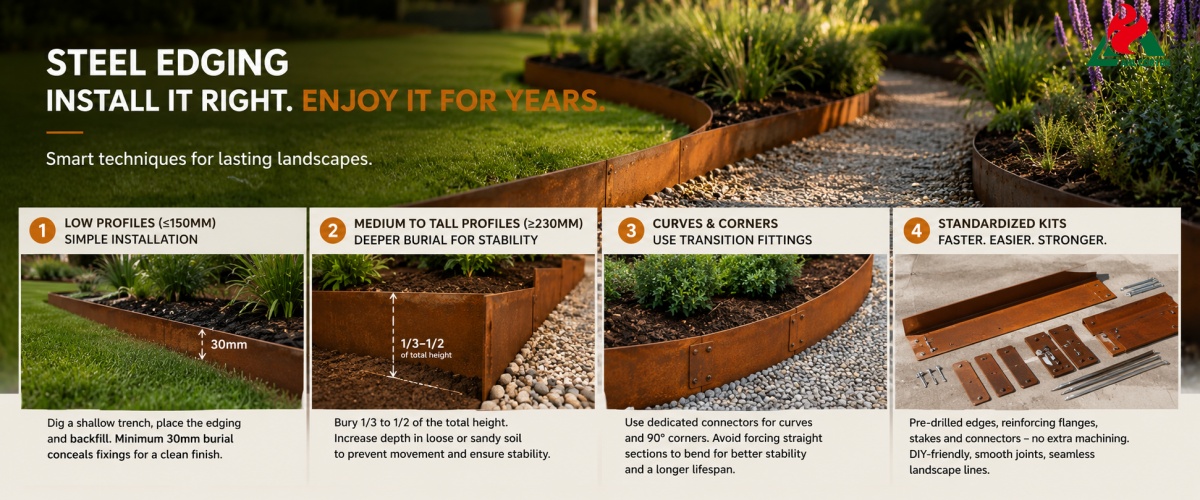
Once the correct height has been selected, proper installation is key to ensuring durability, and the key considerations vary depending on the profile specifications.
1. Low-Profile Profiles (≤150 mm): Simple Installation with Shallow Burial
Simply dig a shallow trench, place the steel edging inside, then backfill and compact the soil. The minimum burial depth is 30 mm, which fully conceals the mounting screws and ensures an aesthetically pleasing finish.
2. Medium-to-Tall Profiles (≥230mm): Deeper Burial for Structural Stability
Medium-to-tall retaining wall profiles are subjected to greater stress and must follow the general installation principles: the burial depth should be 1/3 to 1/2 of the total height. In loose sandy soil, the burial depth must be increased further to prevent tilting or wobbling.
3. Key Points for Curved and Corner Installations
For large-radius landscaping and right-angle turns, prioritize the use of specialized transition fittings; forcing straight steel sections to bend is not recommended. This ensures a neater finish, greater structural stability, and a longer service life.
4. Advantages of Standardized Kits
The complete weathering steel edging kit comes with pre-drilled holes, reinforcing flanges, reinforcing stakes, and specialized connectors. No secondary processing is required—it can be quickly installed via DIY, resulting in smooth joints and flowing lines.
Why Choose AHL Weathering Steel Garden Edging?
Weathering steel edging on the market vary widely in quality; even subtle differences in height, thickness, and craftsmanship can directly impact the lifespan and visual impact of your garden landscape. AHL Corten Steel Edging is specifically designed for the local climate and landscaping conditions in Oceania, making it the preferred brand for both residential yards and commercial landscapes.
1. Precision-Engineered Materials from the Original Manufacturer for Maximum Durability
The entire product line uses genuine weathering steel, with a standard 1.6mm thick gauge. Unlike the thin, non-standard steel products commonly found on the market, it offers superior resistance to compression, bending, and deformation, and can withstand the long-term pressure of clay soil and coastal salt fog corrosion. Thanks to the protective structure of weathering steel’s dense rust layer, no paint is needed for corrosion protection, truly achieving long-term, maintenance-free outdoor use.
2. Locally Tailored for Oceania and Europe
Deeply adapted to the local environmental conditions of Melbourne, the Mornington Peninsula, and other Australian regions, specifications are optimized for complex conditions such as heavy clay, sandy loam, sloped terrain, and strong coastal winds. The full range covers heights from 100 mm to 590 mm, meeting the needs of all scenarios—from minimalist gardens and raised flower beds to terraced landscapes and structural retaining walls.
3. Prefabricated DIY Kits for Effortless Installation
The products come pre-drilled from the factory and are paired with specialized connectors, reinforcing ribs, and non-slip ground stakes. No professional equipment or complex techniques are required—individuals can install them on their own. Straight, curved, and corner designs can all be easily achieved, resulting in smooth, seamless joints and a premium, uniform finish.
4. Long-Term Warranty, Better Value for Money
We offer a 10-year structural warranty, eliminating concerns about future deformation, collapse, or rust-related failure. A one-time investment ensures decades of stable use without the need for frequent renovations or maintenance, significantly reducing long-term landscaping maintenance costs and effectively safeguarding your landscape investment.
5. Combines Aesthetics and Practicality
Over time, the steel naturally weathers to develop a warm, vintage rust-brown patina that seamlessly blends with a variety of garden styles, including modern, natural, and rustic. Clean, crisp boundary lines not only precisely demarcate areas and stabilize the soil but also enhance the overall landscape’s depth and sophistication.
.jpg)
Frequently Asked Questions About Weathering Steel Garden Edging
Q1: Will Corten Edging Continue to Rust and Shed Rust, Contaminating the Garden?
No. Genuine AHL weathering steel, after undergoing natural oxidation, quickly forms a dense, stable rust layer that seals the inner steel and stops further corrosion. It will not shed or leach rust water later on, so it won’t contaminate the lawn, stones, or potting soil, remaining clean and tidy over the long term.
Q2: What Is The Most Versatile And Foolproof Height For a Home Garden?
For standard flat gardens and conventional flower bed and lawn divisions, the 150mm size is the top choice; for slightly undulating terrain requiring minimal earthwork for landscaping, the 185mm size is recommended. These two sizes are the most versatile and widely used in Australian residential gardens.
Q3: Do Sloped Gardens Absolutely Require the Taller Weathering Steel Edging?
Yes. For gentle slopes, choose the 230mm or 290mm sizes to create terraced landscaping; for steep slopes or terrain with significant elevation differences, you must select the 390mm or 590mm structural retaining wall models to prevent soil slippage and slope collapse, ensuring structural stability.
Q4: What are the Advantages of 1.6mm-Thick Corten Steel Edging Compared to Thinner Options?
The 1.6mm-thick factory-grade steel offers superior resistance to bending and soil pressure, ensuring it will not warp, deform, or collapse over the long term. Thinner steel may offer better short-term value, but it is highly susceptible to deformation under pressure, and the cost of future repairs far exceeds the initial price difference.
Q5: Is Weathering Steel Edging Suitable for Installation In Coastal Salt Fog Environments?
It is highly suitable. AHL weathering steel is specifically optimized for Australia’s coastal climate; its dense rust layer resists salt corrosion, offering 4–8 times the weather resistance of ordinary steel. It withstands sea winds and salt fog erosion, making it more durable than wrought iron or galvanized steel.
Q6: Do Corten Edging Profiles Require Regular Maintenance After Installation?
No daily maintenance is required. There is no need for painting, rust removal, or anti-corrosion treatment; simply allow it to weather naturally. The texture becomes more refined over time, truly achieving “install once, worry-free for the long term.”
Q7: Can Corten Steel Edging Be Shaped Into Curves or Corners?
Yes. The product offers excellent flexibility. When paired with specialized corner connectors, it can easily form large-radius curves, right-angle corners, and custom shapes, adapting to all kinds of personalized landscape designs with smooth and neat contours.
Q8: What Special Considerations Are Needed When Selecting Products For Heavy Clay Soil?
Heavy clay soil exerts high lateral pressure and has poor drainage. We recommend prioritizing medium-to-high specifications of 185 mm or larger, while increasing the burial depth (to about half the total height) and using 1.6 mm thickened steel to effectively resist soil pressure and prevent deformation or soil overflow.
Q9: What Is The Warranty Period for Edging? What Is Its Typical Service Life?
The entire AHL product line comes with a 10-year structural warranty. Under normal outdoor use and in the absence of severe external damage, genuine weathering steel edging can last over 30 years, offering far better value than ordinary landscaping edging materials.
Q10: Can Non-Standard Lengths and Heights Be Customized To Fit The Dimensions Of My Garden?
We support personalized customization. In addition to standard heights ranging from 100 mm to 590 mm and a standard length of 2.4 m, we can customize non-standard specifications based on site dimensions and design requirements to accommodate various niche and complex landscaping projects.
Request a Quote Now to Receive a Customized Garden Design Solution
When selecting the height of weathering steel garden edging, the key is to determine the height based on the site, the specifications based on the intended use, and the burial depth based on soil conditions.
Low-profile models are ideal for simple zoning, medium-to-high models are designed for elevated landscaping and slope stabilization, and extra-tall models serve as structural retaining walls. Combined with 1.6mm thick, Australian-manufactured weathering steel, these products not only showcase a unique, vintage weathered aesthetic but also come with a 10-year structural warranty and require zero maintenance for complete peace of mind.
Unsure which height is right for your garden? Struggling with thickness, burial depth, or installation options? No need to go through trial and error!
AHL’s professional landscaping team offers free, one-on-one consultations to help you select the right model, customize dimensions, and provide installation recommendations based on your site’s soil type, terrain slope, and landscape design needs. Whether it’s a residential yard renovation or a large-scale commercial landscaping project, we can tailor a solution just for you.
Feel free to contact us anytime for a quote, real-time pricing, and professional implementation guidance to help you create durable, beautiful, and maintenance-free weathering steel landscaping that stands the test of time!
Get a Quote
Back

 Fill In The Inquiry