Avoid These Mistakes When Installing Corten Steel Siding
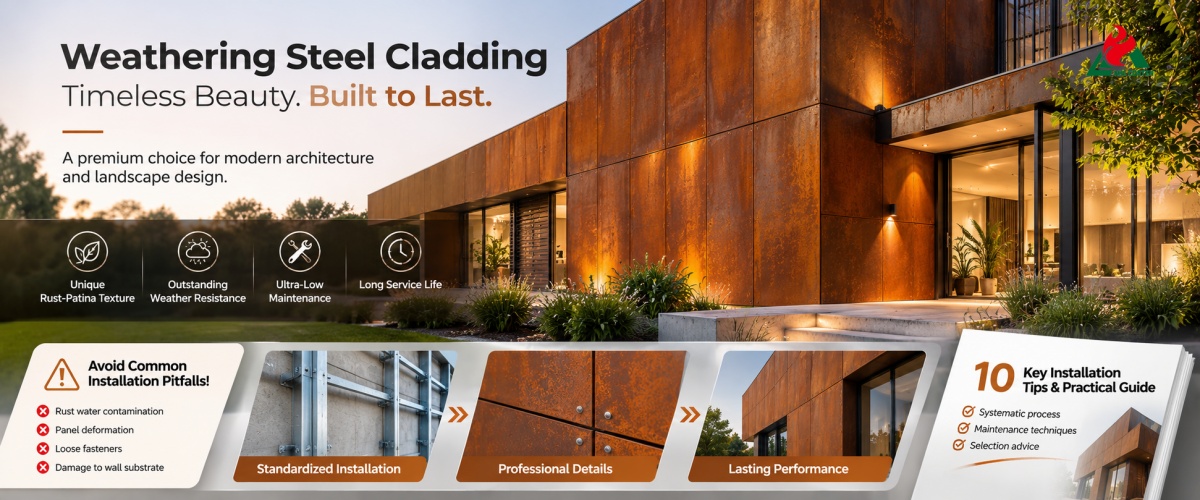
Weathered steel cladding has become a mainstream, high-end material of choice for modern residential facades, commercial buildings, and landscape art walls, thanks to its unique vintage rust-patina texture, exceptional weather resistance, and extremely low maintenance costs.
Many people mistakenly believe that weathering steel is inherently rust-resistant and that installation can be simplified at will. In fact, the aesthetic appeal, stability, and service life of weathering steel depend entirely on standardized, systematic installation processes.
Installation errors can easily lead to a series of problems, such as rust water contamination, internal rot, panel deformation, loose fasteners, and damage to the wall substrate, significantly increasing the cost of future repairs.
This article compiles the top 10 common installation pitfalls in the industry, along with standardized construction procedures, maintenance techniques, and selection guidelines, to help you eliminate potential risks from the start and maximize the aesthetic and practical value of corten steel siding.
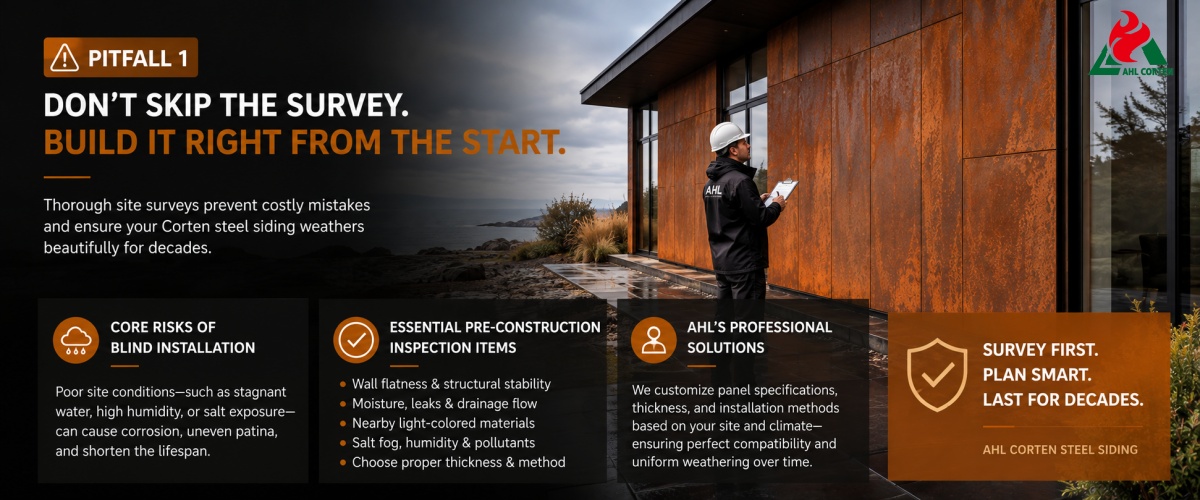
Pitfall 1: Skipping Site Surveys and Blindly Installing Corten Steel Siding
On-site surveys are a fundamental prerequisite for corten cladding construction—and also the most easily overlooked critical step. Many construction teams proceed directly to installation, ultimately creating numerous hidden risks.
1. Core Risks of Blind Installation
Weathering steel requires a natural environment with alternating dry and wet conditions to form a dense, stable protective rust layer. Environments with prolonged water accumulation, damp and enclosed spaces, or salt fog exposure will completely disrupt the oxidation process, leading to localized corrosion and uneven coloration.
2. Essential Pre-Construction Inspection Items
Before construction begins, thoroughly inspect the flatness of the wall substrate, the structural stability, and any moisture or water seepage issues. Additionally, assess the flow of rainwater and identify nearby light-colored stone, concrete, or wooden structures—materials that are susceptible to rust from water contamination.
For coastal, high-humidity, or industrial sites, evaluate in advance the impact of salt fog and pollutants on the panels, and select appropriate panel thicknesses and installation methods accordingly.
3. AHL’s Professional Solutions
The AHL team can customize panel specifications, thicknesses, and installation methods based on the project site’s environment, climatic conditions, and substrate status. This approach eliminates site compatibility issues at the source and ensures uniform weathering over time.
Misconception 2: Installing Corten Steel Siding Directly Against the Wall Without a Ventilated Cavity
Installing weathering steel exterior siding directly against insulation, masonry, wood, or soil is a critical industry mistake and the root cause of most hidden corrosion issues.
1. Hazards of Direct Adhesion
When there is no gap between the panels and the substrate, airflow is completely blocked. Rainwater and condensation cannot evaporate quickly and accumulate behind the panels over time, creating a sealed, damp environment.
This ultimately leads to hidden rust on the back of the panels, color discrepancies between the front and back surfaces due to weathering, and localized flaking of the rust layer. In severe cases, it can cause the wall substrate to become damp, develop mold, and suffer structural damage.
2. Standard Construction Requirements
Professional weathering steel exterior walls must utilize a ventilated curtain wall system, with a 20–40 mm ventilation and drainage cavity left between the panels and the wall structure.
Combined with a waterproof barrier, support framework, and upper and lower ventilation and drainage openings, this ensures unobstructed air circulation, rapid drainage of standing water, and uniform alternation between dry and wet conditions.
3. Advantages of the AHL Process
The AHL standardized cavity installation system not only protects the building’s wall structure but also allows corten steel cladding to weather uniformly and naturally, ensuring consistent and stable color and significantly extending the service life of the panels.
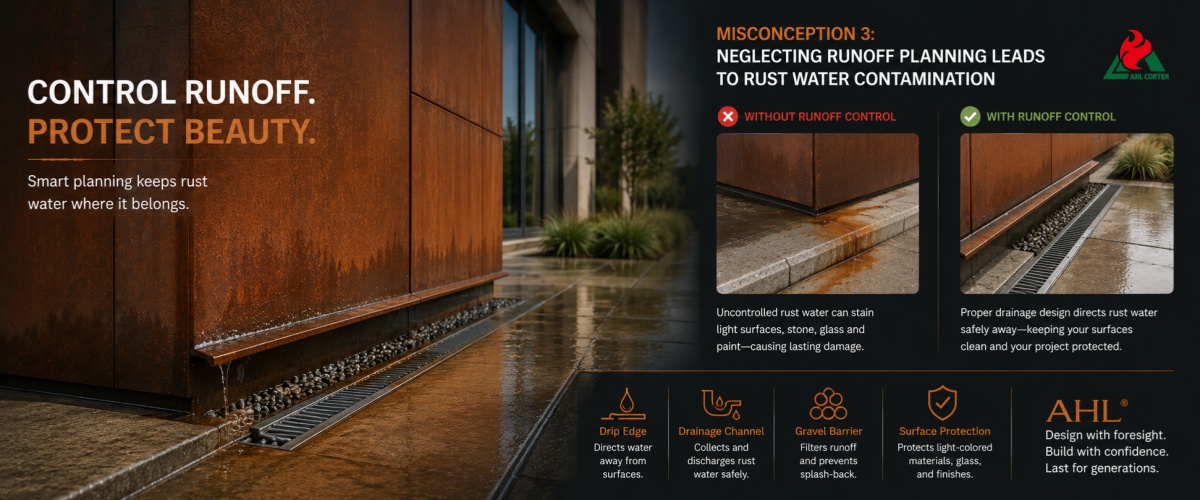
Misconception 3: Neglecting Runoff Planning for Corten Steel Siding, Leading to Rust Water Contamination
During the initial 1–2 years of weathering, weathering steel produces a small amount of rust-containing runoff. This is a normal oxidation process of the material and does not indicate a quality issue.
However, in many projects, the lack of a runoff design allows rust water to flow unchecked, contaminating light-colored surfaces, stone, glass, and exterior wall paint, causing irreversible staining and damage.
1. Standardized Runoff Control Design
Prior to construction, drainage paths must be planned in advance. Components such as drip lines, flashing, drainage channels, and gravel barriers should be installed to precisely direct the flow of rust water and rainwater.
For sensitive areas such as entryway floors, pool surrounds, and landscape paving, temporary protective measures can be added at the start of construction to completely prevent contamination.
2. The AHL Design Philosophy
AHL insists on coordinating runoff control from the design phase rather than relying on remedial measures afterward. Through systematic drainage design that balances the natural weathering characteristics of materials with site cleanliness, AHL reduces future cleaning and renovation costs.
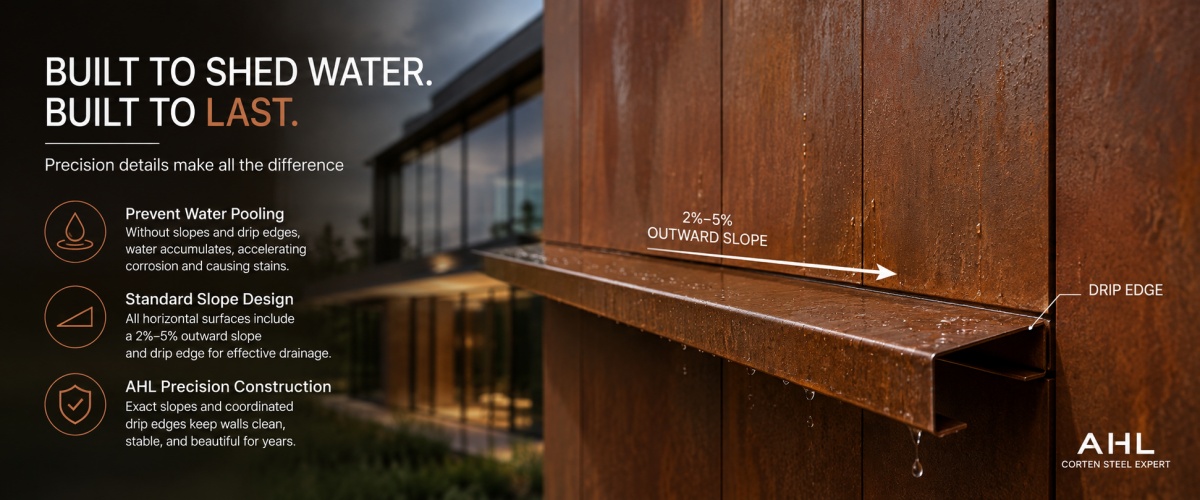
Misconception 4: Lack of Drip Edges and Slopes Leading to Water Pooling and Corrosion on Corten Steel Siding
Horizontal surfaces such as wall copings, window sills, and the bottom edges of panels are prime areas for water accumulation. To simplify the process, many contractors omit drip edges and outward-sloping gradients.
1. Construction Hazards Caused by Water Accumulation
Without a slope or drip edge on horizontal surfaces, rainwater will stagnate for extended periods and seep in slowly. This accelerates localized corrosion, causes severe color variations due to weathering on the panel surface, and allows water to seep into the wall structure through gaps.
2. Standard Slope Requirements for Installation
All horizontal joints must be installed with a 2%–5% outward drainage slope, combined with a dedicated drip edge design, to ensure rainwater does not stagnate and is rapidly drained away from the panel surface.
3. Advantages of AHL’s Precision Construction
AHL’s precision joint construction process, through precise slope design and coordinated drip edge structures, eliminates the risk of water accumulation at the finest details, ensuring the exterior walls remain clean, stable, and aesthetically pleasing over the long term.
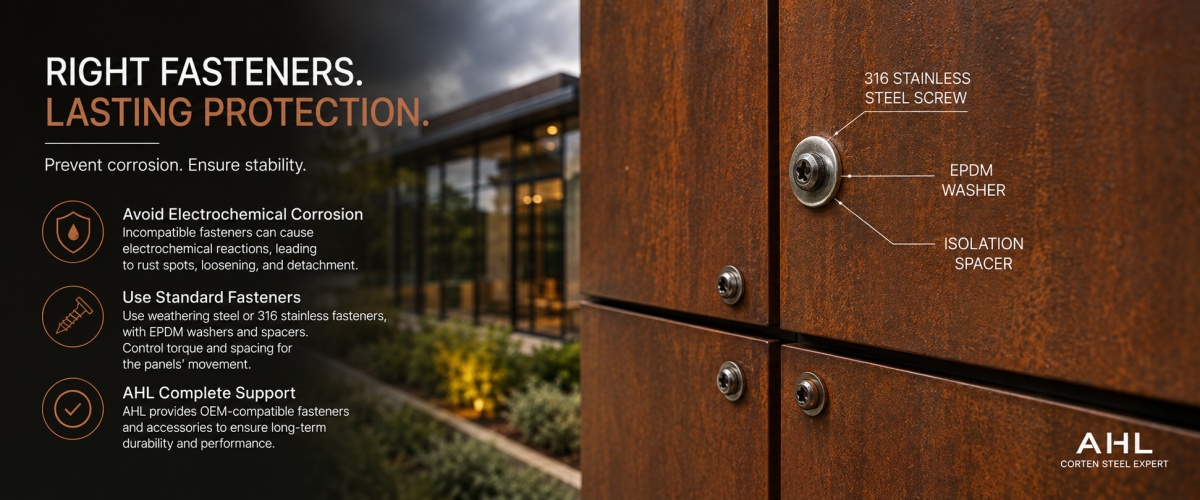
Misconception 5: Use of Incompatible Fasteners with Corten Steel Siding, Leading to Electrochemical Corrosion
Fastener selection is a detail that is easily overlooked, yet it is one of the primary causes of corrosion and loosening in weathering steel exterior walls. When different metals come into contact in a humid environment, they trigger electrochemical reactions.
1. Hazards of Incorrect Fasteners
Using ordinary carbon steel, aluminum, or non-standard galvanized fasteners creates a potential difference with weathering steel. In rainy or humid conditions, this accelerates panel corrosion, leading to rust spots, perforations, loosening, and detachment around the fasteners.
Additionally, installing fasteners too tightly or too closely together can compress the panels, causing stress-induced deformation and warping, which compromises overall flatness.
2. Specifications for Selecting Standard Fasteners
It is essential to use fasteners specifically designed for weathering steel or 316 stainless steel components, paired with EPDM isolation washers and spacers to ensure metal isolation and even force distribution.
Strictly control fastening torque and spacing, allowing room for the panels’ thermal expansion and contraction, and avoid rigid, compressive fastening.
3. AHL Support Services
AHL provides a complete set of original equipment manufacturer (OEM)-compatible accessories, including specialized screws, washers, brackets, and flashing panels, eliminating the need for haphazard on-site selection and preventing corrosion risks at the component level.
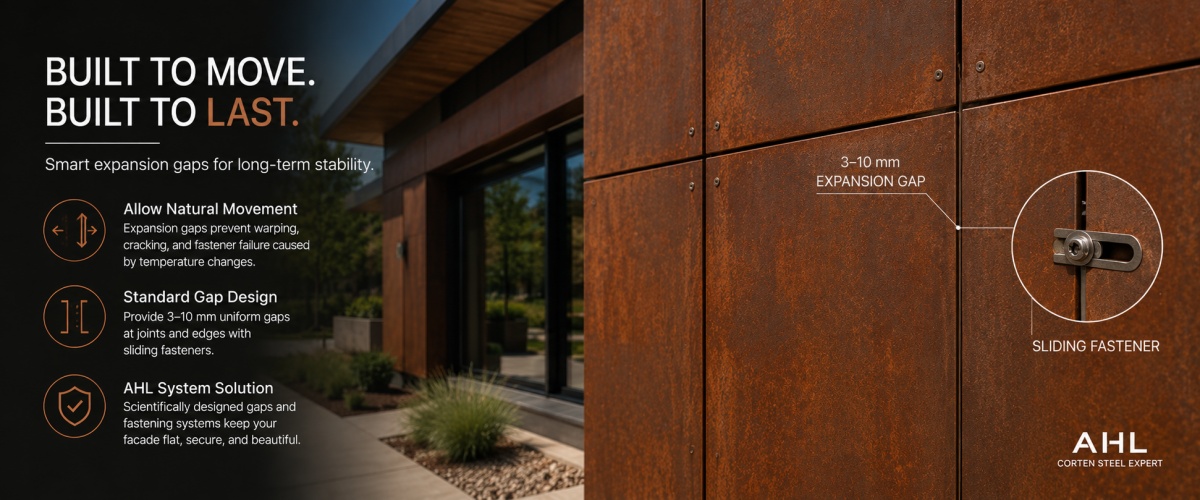
Misconception 6: Ignoring Thermal Expansion and Contraction—Failing to Leave Expansion Joints for Corten Steel Siding
Steel possesses the physical property of thermal expansion and contraction; temperature fluctuations outdoors cause weathering steel panels to expand and contract. Installation methods that do not allow for expansion gaps will directly compromise the integrity of the entire structure.
1. Consequences of Lacking Expansion Joints
Without space for the panels to expand and contract, the panel surface may warp, edges may deform, screw holes may tear, sealant may crack, and joints may become uneven—severely compromising the aesthetic appeal and structural stability of the exterior facade.
2. Standard Expansion Joint Design
Uniform expansion gaps of 3–10 mm should be provided at panel joints, corners, and finishing points, combined with sliding fasteners to accommodate panel deformation caused by temperature changes.
3. Advantages of the AHL Process
The AHL systematic installation solution fully accommodates the physical properties of steel. Through scientifically designed expansion gaps and a dynamic fastening structure, it ensures the exterior wall panels remain flat and the joints stay neat over the long term.
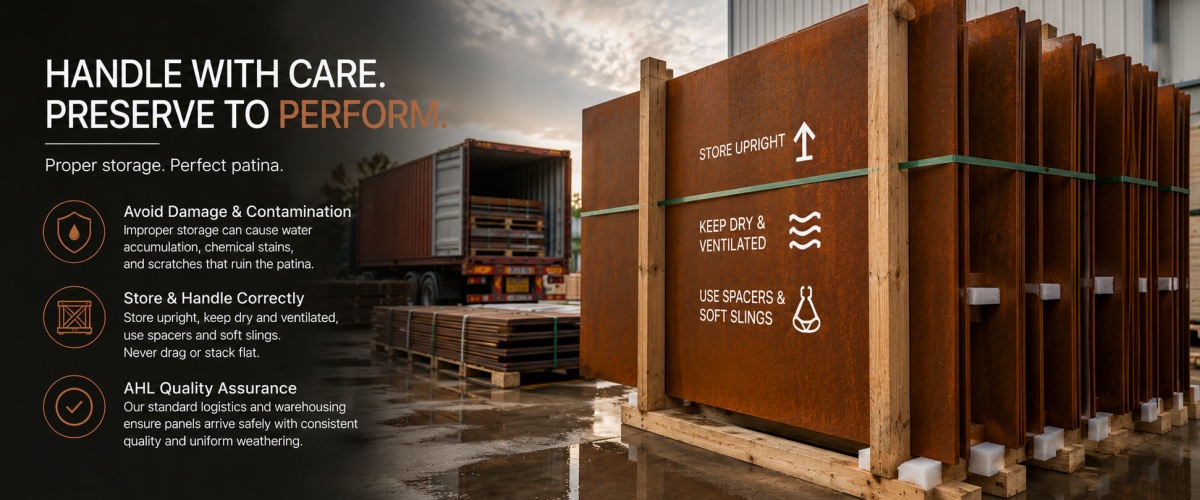
Misconception 7: Improper Storage and Transportation Damages Corten Steel Siding Panels
Weathering steel panels have a delicate surface; improper handling during transportation and storage after leaving the factory can cause irreversible damage, directly affecting the weathering effect later on.
1. Common Storage and Transportation Errors
Stacking panels flat, wrapping them in airtight packaging, or allowing direct contact with the ground, concrete, or chemical building materials can cause water accumulation leading to rot, chemical contamination, and dark spots or color variations.
Lifting with iron chains or dragging panels across the ground can scratch the protective layer on the surface, creating localized, irregular rust spots that compromise the overall aesthetic appeal.
2. Standard Storage and Handling Guidelines
Panels must be stored upright in a dry, well-ventilated area, elevated off the ground using wooden blocks, with spacer pads placed between panels to prevent water accumulation, dust, and chemical contamination.
Use flexible slings for lifting throughout the process; handle with care. Do not drag or impact the panels to ensure the original integrity of the panel surface.
3. AHL Quality Control Assurance
AHL’s standardized logistics and warehousing system strictly controls every stage of transportation and storage for each panel, ensuring that panels arrive on-site undamaged and with uniform weathering effects.
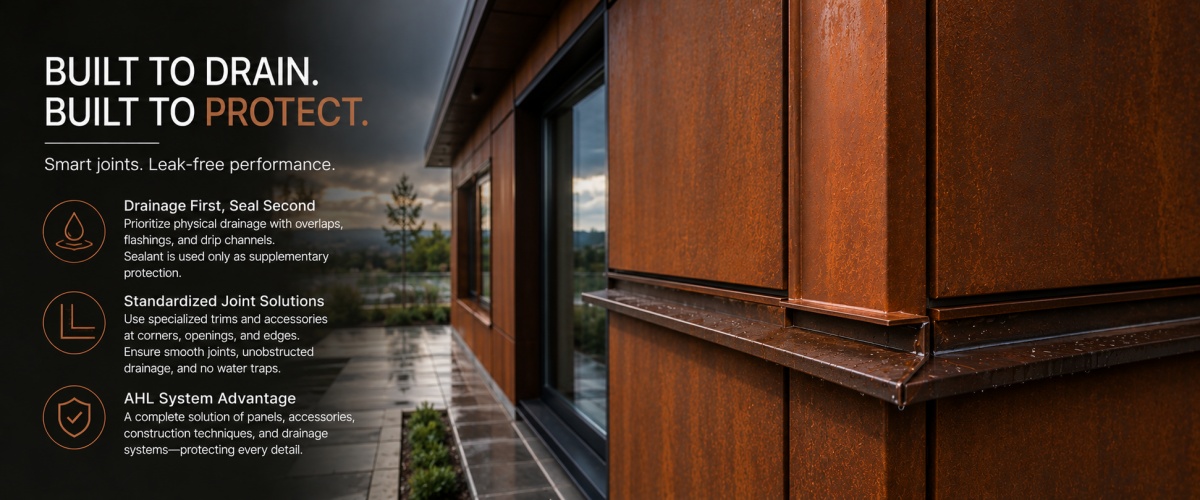
Misconception 8: Sloppy Joint Construction on Corten Steel Siding Creates Hidden Leak Risks
Seams, corners, door and window trim, and top and bottom edges are the weak points of weathering steel exterior walls and are also high-risk areas for leaks, dirt accumulation, and corrosion.
1. Common Joint Construction Issues
Most construction projects rely excessively on sealant for waterproofing while neglecting drainage design. Once the sealant layer ages and cracks, moisture becomes trapped within the joints, causing hidden internal corrosion.
Additionally, issues such as incorrect panel overlap directions, the absence of specialized corner trim, and the lack of flashing around door and window openings lead to water leakage and dirt accumulation throughout the entire system.
2. Standardized Joint Solutions
Adhering to the core principle of “drainage first, sealing second,” priority is given to physical drainage through panel overlaps, flashing, and drip channels, with sealant used only as supplementary protection.
All corners, door and window openings, and end points utilize specialized finishing accessories to ensure smooth joints, unobstructed drainage, and no dead zones where water accumulates.
3. Advantages of the AHL System
The AHL weathering steel exterior wall is not a single panel product, but rather a complete solution comprising panels, accessories, joint construction techniques, and a drainage system—eliminating construction risks down to the finest details.
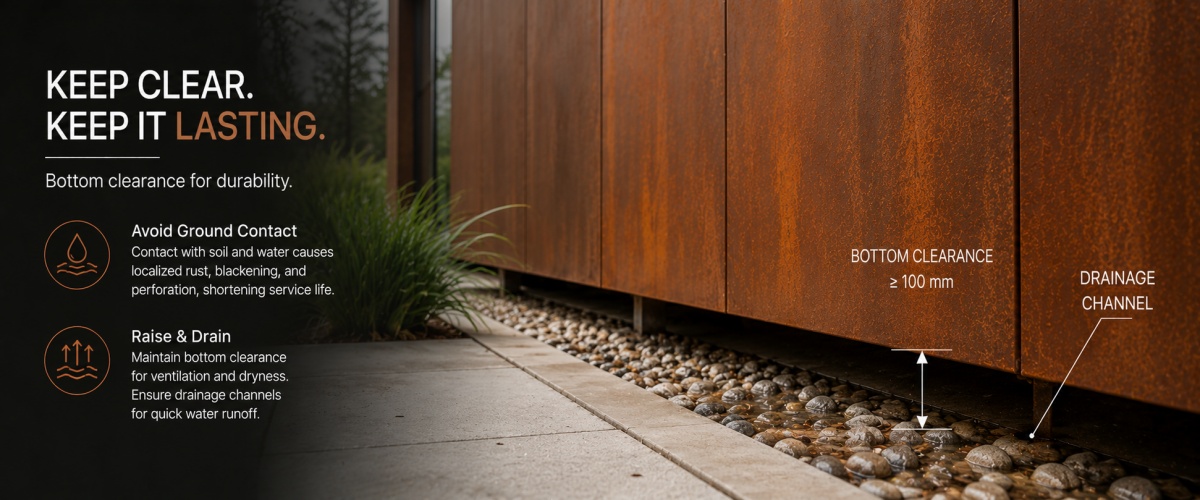
Misconception 9: Corten Steel Siding Comes Into Contact With Water and Soil at the Bottom, Leading to Localized Rusting
Weathering steel is weather-resistant but not completely corrosion-resistant. Prolonged contact with soil, standing water, fallen leaves, and humus keeps it in a constantly damp environment, disrupting the balance between dry and wet conditions.
1. Hazards of Bottom Contact with the Ground
If the bottom of the panel is buried in soil or installed directly against the ground, the bottom will remain constantly damp, leading to localized thickened rust, blackening of the panel surface, and corrosive perforations, which significantly shorten the service life.
2. Standardized Construction Requirements for the Bottom
A clearance must be left between the bottom edge of the panels and the ground to ensure ventilation and dryness, preventing direct contact between the panel surface and soil, fallen leaves, snow, or standing water.
Provide drainage channels at the bottom to ensure rapid drainage of standing water, maintain a normal moisture cycle, and ensure the stable formation of the rust layer.
Misconception 10: Treating Corten Steel Siding As An Independent Waterproofing Structure
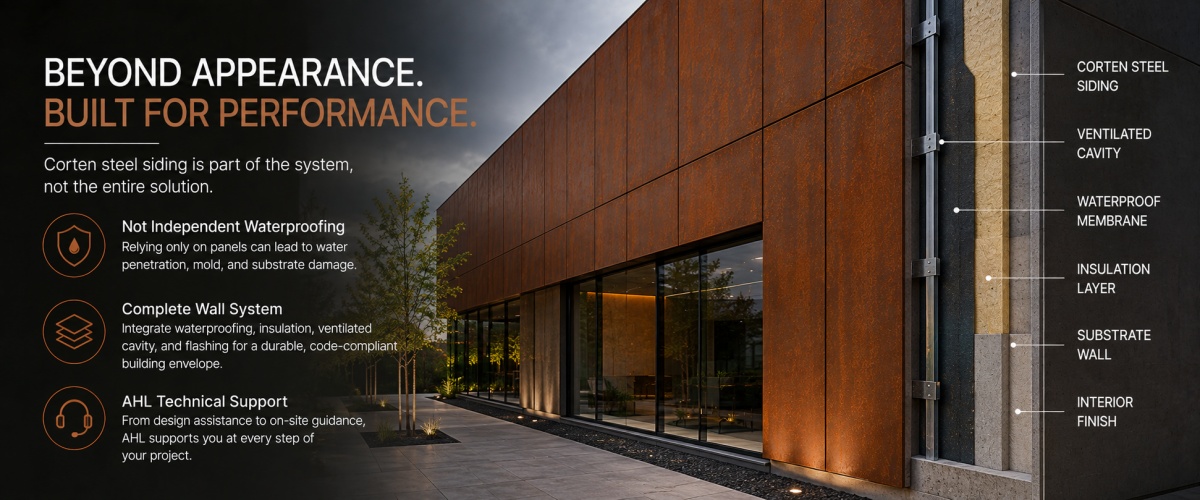
This is the most critical misconception in design and construction. Weathering steel cladding is a decorative cladding panel and cannot replace the building’s overall waterproofing system.
1. Risks of This Misconception
If waterproofing relies solely on weathering steel panels while neglecting the proper installation of wall waterproofing membranes, insulation layers, and protective barriers, moisture will penetrate the interior of the wall, causing the substrate to become damp, develop mold, and peel away.
2. Requirements for a Complete Wall System
Weathering steel exterior walls must be integrated with the wall’s waterproofing barrier, insulation layer, ventilated cavity, and flashing system to form a complete waterproofing, ventilation, and enclosure system.
For large-scale commercial and high-rise projects, professional designers and engineers must coordinate the overall construction plan to ensure compliance with local building codes.
3. Comprehensive Technical Support from AHL
AHL provides a full range of technical support to designers, contractors, and project owners—from panel selection and system integration to on-site construction guidance—to meet the needs of various building projects.
Standardized Construction Inspection Checklist for Corten Steel Siding
To ensure construction quality, please use the following checklist to inspect each item upon completion to avoid potential hidden defects.
1. Substrate: Walls must be level, dry, and structurally sound; the waterproofing barrier must be intact and free of damage.
2. Cavity: The rear ventilation cavity must be continuous and unobstructed, with no blockages or obstructions.
3. Drainage: Drainage at the bottom is unobstructed; drip edges and flashing are properly installed; and the slope is designed for proper drainage.
4. Fasteners: All fasteners are compatible, specialized components; they are tightened to the appropriate torque, allowing for expansion and contraction.
5. Joints: Panel overlaps, corners, and door/window finishes must comply with specifications, with no dead corners where water can pool.
6. Protection: Protective measures must be in place around areas prone to contamination; panel surfaces must be clean, free of debris, and free of scratches or stains.
Tips for Maintaining Corten Steel Siding
Weathering steel is known for its low-maintenance properties, but it is not maintenance-free. Simple, regular maintenance can significantly extend its service life and preserve its aesthetic appeal.
1. Prohibited Daily Practices
Do not use high-pressure water jets, wire brushes, or coarse sandpaper for cleaning. Avoid strong acidic or alkaline corrosive cleaners to prevent damage to the protective rust layer on the surface.
2. Routine Maintenance Methods
For daily cleaning, simply use a soft-bristled brush and clean water to gently remove dust and debris from the panel surface. Conduct a comprehensive inspection at least once a year; in coastal and industrial areas, inspections are recommended every six months.
3. Key Inspection Items
Regularly clear fallen leaves and silt accumulated in drainage outlets and vents. Check for loose fasteners, ensure joints are intact, and inspect the panel surface for localized corrosion.
If minor water pooling or rust spots are detected, promptly adjust the drainage structure to address the root cause; blindly painting over the issue is not recommended.
Why Choose the AHL Corten Steel Siding System?
Weathering steel products on the market are highly homogeneous; what truly sets a project apart is systematic craftsmanship, complementary accessories, and professional installation services.
1. Comprehensive Customization Capabilities
We support non-standard dimensions, custom thicknesses, laser engraving, and custom bending, making our products suitable for a wide range of applications, including residential facades, commercial curtain walls, landscape art walls, and courtyard structures.
2. Complete System-Based Solution
The system comes with a full set of dedicated furring strips, fasteners, flashing panels, drip edges, and corner trim accessories, eliminating the need for on-site improvisation and ensuring a perfect fit with the entire installation system.
3. Strong Adaptability to Multiple Scenarios
Widely applicable to residential exterior walls, courtyard landscape walls, commercial building facades, artistic curtain walls in public spaces, and entrance architectural structures.
4. Comprehensive Professional Technical Services
We provide one-stop services including preliminary site surveys, customized solutions, construction guidance, and after-sales maintenance, addressing challenges throughout the entire process—from material selection to installation and upkeep.
Frequently Asked Questions About Corten Steel Siding Installation
Q1: Does Weathering Steel Siding Require Separate Waterproofing Membranes?
Yes. Weathering steel panels serve only as a decorative envelope and cannot replace a building’s waterproofing system. They must be paired with a wall waterproofing barrier, a ventilated cavity, and a drainage system to ensure the wall remains dry over the long term.
Q2: How Can Rust Runoff From Weathering Steel Be Completely Prevented From Staining Floors and Walls?
Initial runoff cannot be completely eliminated, but by using drip lines, flashing, drainage channels, temporary protective measures, and proper slope design, water flow can be precisely directed to completely avoid staining issues.
Q3: Can Weathering Steel Be Directly Fastened to Wooden Walls?
Direct fastening is not recommended. Brackets must be used to create a ventilation cavity, providing isolation and protection to prevent moisture and mold growth in the wooden substrate, while also preventing rot and discoloration on the back of the panels.
Q4: Do AHL Weathering Steel Metal Sidings Require Paint for Corrosion Protection?
No. The naturally weathered rust layer is both its core protective structure and aesthetic feature. Painting would compromise the material’s properties and increase long-term maintenance costs; pre-painting is available only for special color requests.
Q5: Is Weathering Steel Suitable For Exterior Walls In Coastal Salt Fog Environments?
Yes, it is suitable, but requires custom thickened panels, specialized corrosion-resistant fasteners, enhanced drainage and ventilation designs, and increased inspection frequency to adapt to high-salt-fog corrosion environments.
Q6: Can AHL Weathering Steel Siding Be Installed As a Diy Project In a Regular Backyard?
Small, simple landscape walls can be installed as a DIY project; however, for building exteriors, large-scale curtain walls, high-rise buildings, and coastal projects, we recommend installation by a professional team to ensure structural safety and aesthetic quality.
Q7: How Long Does It Take for a Rusted Steel Siding to Form a Stable Rust Layer?
Depending on the climate, a uniform, dense, and stable protective rust layer typically forms within 18–36 months. Afterward, it requires virtually no maintenance and develops a warm, sophisticated patina.
Q8: What Is the Service Life of a Properly Installed Weathering Steel Exterior Wall?
Under standard ventilation and drainage conditions and with proper maintenance, the service life can exceed 50 years, far surpassing that of conventional exterior wall cladding materials.
Q9: How Should Localized Color Variations or Minor Corrosion Be Repaired?
First, identify and resolve root causes such as standing water or poor ventilation. Clean any debris from the panel surface, then allow the panels to weather naturally. There is no need for excessive sanding or patching; the color will gradually even out over time.
Q10: Do Weathering Steel Siding Require Special Seasonal Maintenance?
No complex seasonal maintenance is required. Simply clear debris from drainage channels after the rainy season and typhoon season, and inspect the fasteners and joint seals.
Summary and Inquiries Regarding AHL Corten Steel Siding
The premium texture and exceptionally long lifespan of weathering steel exterior walls do not rely solely on the material itself but also on standardized, systematic professional installation techniques.
By avoiding the 10 major installation pitfalls listed above and ensuring the five core aspects—site survey, ventilation, drainage, fasteners, and joints—are properly executed, you can completely resolve common issues such as color variation, corrosion, deformation, and contamination.
If you are planning a residential, commercial, or landscape weathering steel project and are unsure about panel selection, thickness combinations, or installation plans, please feel free to contact the AHL team for a free consultation at any time.
Based on your project site, design requirements, and intended use, we will provide a one-on-one, customized solution and an accurate quote to help you create a corten panel project that is both aesthetically pleasing and long-lasting, with zero hidden risks.
Get a Quote
Back

 Fill In The Inquiry