How to Build Corten Steel Edging for Outdoor Garden Landscaping?
Date:2026.07.21
Share to:
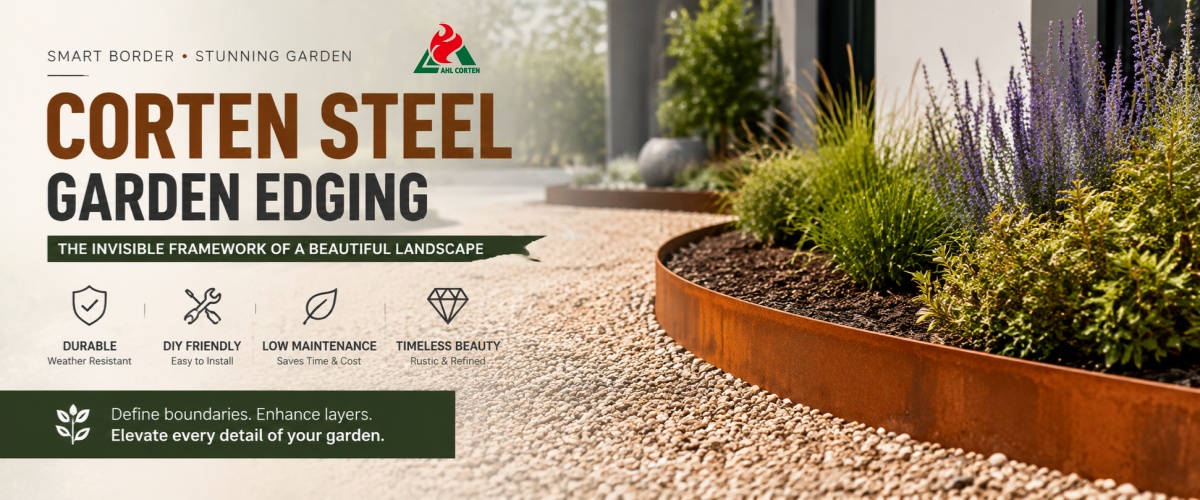
In garden landscape design, most people focus on greenery, paving and water features, yet often overlook the detail of garden edging. In fact, edging serves as the garden’s “invisible framework,” directly determining the overall neatness and refinement of the space.
Without clear boundaries, lawns, flower beds, and gravel paths can easily blend into one another, resulting in a cluttered and disorganized appearance. In contrast, a clean, crisp edging line can quickly define spatial layers, giving even a modest courtyard the polished look of a professionally designed landscape.
Among the many edging materials available, corten steel edging has become the top choice for both designers and DIY enthusiasts. Combining aesthetic appeal, durability, and low maintenance with the ability to install it yourself, it offers an extremely cost-effective solution for upgrading your garden.
This article provides a comprehensive guide to installing weathering steel garden edging—covering material principles, installation preparation, step-by-step DIY instructions, tips for avoiding common pitfalls, and suitable applications—so even beginners can get started with ease.
Weathering steel is a special type of alloy steel whose most notable feature is that it requires no artificial anti-corrosion treatment. When exposed to the natural outdoor environment, it gradually forms a dense, stable, reddish-brown oxide protective layer.
Unlike ordinary steel, which rusts more and more over time and eventually corrodes through, the rust layer on weathering steel acts as a self-protective barrier. Once formed, it completely isolates the internal metal, preventing further corrosion and ensuring long-term durability outdoors.
2. 4 Practical Functions of Weathering Steel Edging in Gardens
Weathered steel edging is not merely a decorative trim; it is a highly functional landscape element suitable for a variety of garden settings.
Flower Bed Boundary Delineation: Precisely delineates planting areas, prevents soil and mulch from spilling over, and keeps walkways and lawns clean and tidy.
Lawn Edging and Shaping: Neatly defined lawn edges, suppresses weed growth, and significantly reduce the effort required for routine mowing and maintenance.
Pathway Zoning: Clearly distinguishes gravel paths, hardscaped areas, and green spaces, streamlining traffic flow and enhancing the garden’s sense of depth.
Landscape Contour Finishing: Used to define the outlines of tree pits, micro-topography, and feature areas, unifying the garden’s design language and creating a more cohesive landscape.
3. Value-Added Effects of Landscape Design
The unique vintage rust-colored texture of weathering steel ties together scattered greenery, stone, and wood elements throughout the garden. Unified metal lines integrate what were once fragmented landscape elements into a cohesive whole, elevating the overall design quality of the garden at a low cost.
Pre-Construction Preparation for Corten Steel Edging
While installing rusted steel edging is relatively straightforward, inadequate planning in the early stages can easily lead to issues such as crooked lines, dimensional discrepancies, and unsightly joints. Taking a little time to prepare properly will result in a more professional and uniform finished product.
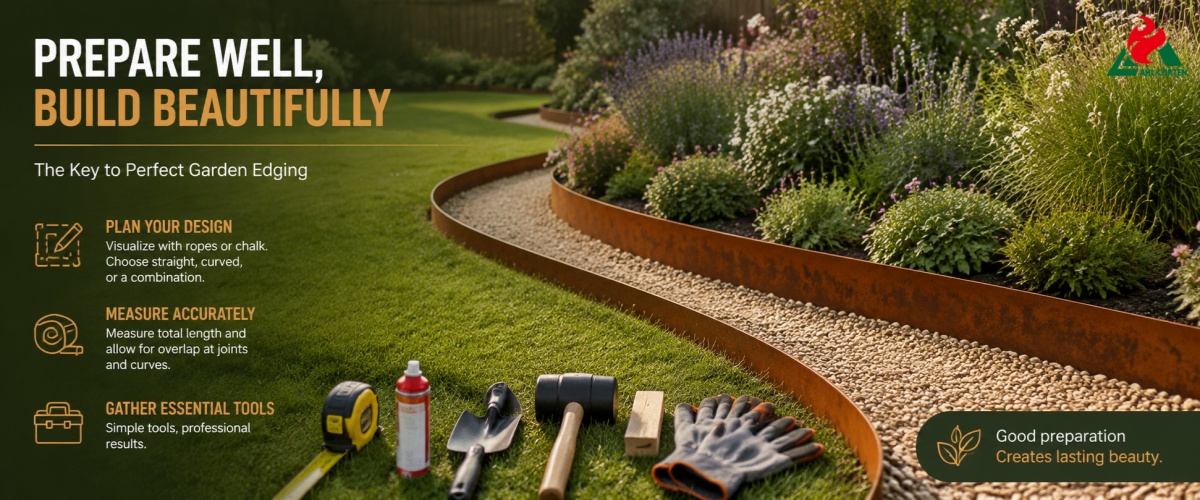
1. Planning an Edging Design: Combining Straight Lines and Curves
Before construction begins, determine the overall design style in advance. There are three main styles: clean straight lines, natural curves, and a combination of straight and curved lines. Different styles require different measurements and construction methods. We recommend using the ground layout simulation method: use rope, hose, or chalk to mark out lines on the ground and view the effect from multiple angles. This helps avoid the problem of “the design looking good on paper but appearing out of place on-site.” Only begin construction after confirming everything is correct. At the same time, consider the garden’s overall layout to ensure that metal landscape edging follows the contours of the lawn, the path of walkways, and the placement of flower beds, avoiding any jarring divisions of space.
2. Precise Dimension Measurement: Allow for Error Margins
Measure the total length along the pre-marked boundary lines to determine the total amount of steel required.
Key Note: For corners, curves, and areas with multiple sections, be sure to allow for joint overlap. This effectively prevents issues such as material shortages or misaligned seams caused by cutting errors. If using custom weathering steel edging, confirm the sheet thickness, dimensions, and joining methods with the manufacturer in advance to prevent mismatches in size or joints upon delivery.
3. Essential Tool Checklist
No large-scale professional equipment is required throughout the process; the entire installation can be completed with basic tools, making it easy for beginners to handle: Tape measure (for measuring dimensions and calibrating height), marking paint/chalk (for ground positioning), small shovel/edging trowel (for digging trenches), rubber mallet (for securing panels and preventing damage to the paint finish), shims (for even force distribution and preventing steel plate deformation), non-slip gloves (to prevent cuts from the sharp edges of the steel plates).
Step-by-Step DIY Installation Guide: Building Professional Corten Steel Edging from Scratch
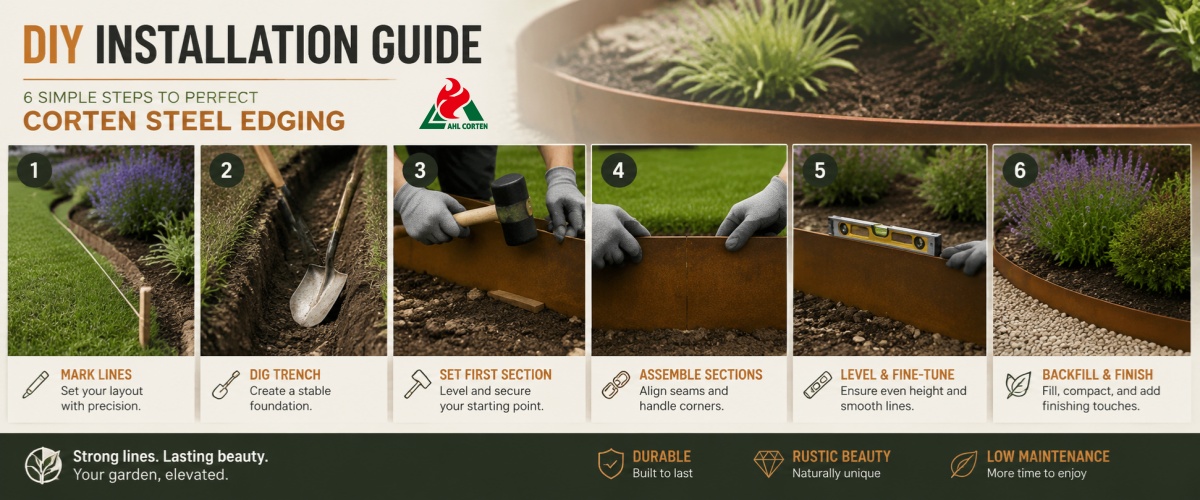
By following this standardized six-step installation method, you can create smooth, straight, and seamless steel edging for your yard on your own—no professional contractor needed.
Step 1: Mark Lines Precisely to Establish the Installation Reference
Marking the lines is the key step that determines the final appearance; do not cut corners. For straight sections, secure both ends of the string and pull it taut to create a standard straight line; for curved sections, simply use chalk to trace a smooth curve.
Step back and observe from multiple angles throughout the process to ensure straight lines are perfectly straight and curves are smooth, with no waviness or skew. At the same time, mark key points such as corners, starting points, and end points in advance to prepare for subsequent assembly.
Step 2: Dig the Trench to Create a Stable Foundation
Dig a shallow trench along the marked lines. The trench width should be slightly greater than the thickness of the steel plate; there is no need to make it excessively wide.
Adjust the depth according to the total height of the corten steel edging and the desired exposed height. Typically, bury one-third to one-half of the plate’s height to ensure both stability and aesthetic appeal. Once excavation is complete, be sure to level and compact the soil at the bottom of the trench. An uneven base is the primary cause of unevenness, loosening, and deformation of the steel plates later on.
Step 3: Secure the First Section of Steel Plate to Establish the Installation Reference
Begin installation at a corner or the starting point of the metal garden border. The levelness of the first section directly determines the overall finished result. After placing the steel plate in the trench, make slight adjustments from multiple angles and use a tape measure to calibrate the exposed height at multiple points to ensure a level and uniform surface. Once the position is confirmed, place wooden spacers underneath and use a rubber mallet to tap it gently and evenly into the soil to secure it. Apply gentle, even force to avoid deformation or displacement of the steel plate caused by excessive force.
Step 4: Segment-by-Segment Assembly: Handling Seams and Corners
Using the first steel plate segment as a reference, extend and install the panels forward one segment at a time, ensuring each segment is level and properly aligned. Key points for assembly: Keep the seams tightly fitted, with no visible gaps or misalignment, to achieve a virtually seamless overall visual effect. Take advantage of the slight ductility of weathering steel to fine-tune the curvature, ensuring a perfect fit for various curved landscape features. For corners, use prefabricated corner pieces to ensure a more standardized joint; for complex angles, cut the steel on-site with precision to achieve a perfect fit.
Step 5: Overall Leveling and Fine-Tuning for a Consistent Visual Effect
Once all steel plates are installed, conduct a comprehensive inspection, focusing on local variations in height, depressions, and protrusions. For uneven areas, use shims and a rubber mallet to make minor adjustments, leveling each section individually. Finally, stand at key viewing angles—such as the courtyard entrance or by indoor windows—to assess the overall continuity of the lines and ensure a smooth, uniform appearance throughout.
Step 6: Backfilling and Compaction to Finalize the Installation
Evenly backfill the area on both sides of the steel plates with native soil, crushed stone, or landscape mulch to fill the gaps between the plates and the trench. Thoroughly compact the backfill to prevent the steel plates from loosening or shifting due to rainwater erosion or soil settlement in the future. Finally, depending on the garden’s style, incorporate finishing materials such as sod, gravel, or bark mulch to refine the boundary layers and enhance the overall aesthetic quality of the landscape.
Corten Steel Edging vs. Standard Edging: Why Is It the Better Choice?
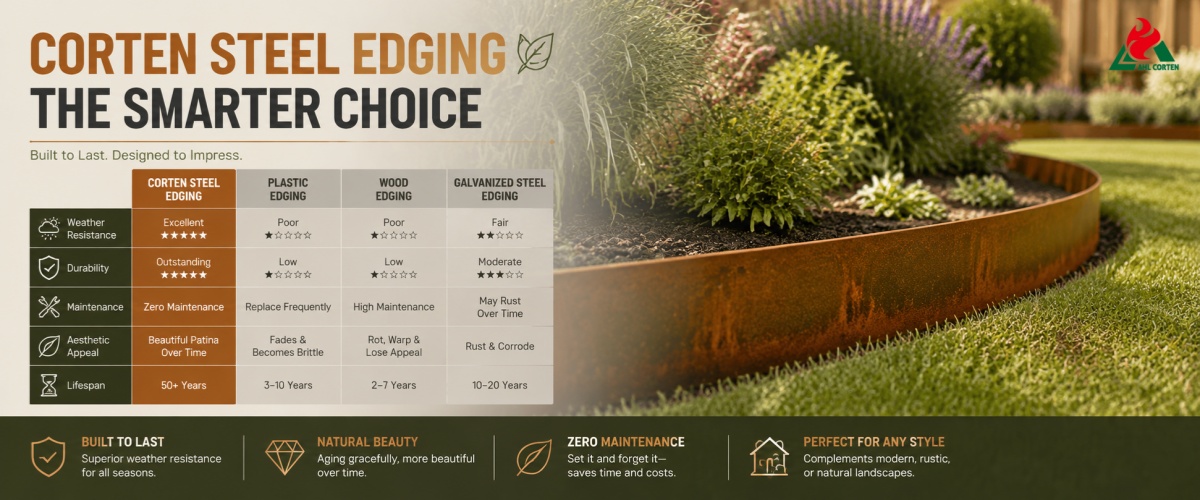
Plastic, wood, and standard galvanized steel edging available on the market may seem inexpensive, but their drawbacks become apparent with long-term use. rusted steel edging far surpasses traditional materials in terms of overall value and quality.
1. Exceptional Weather Resistance and Long-Lasting Outdoor Durability
Plastic edging is prone to aging, brittleness, cracking, warping, and fading when exposed to prolonged sunlight; wood is susceptible to rot, insect infestation, and mold; while ordinary steel continues to rust and eventually perforates. Corten steel edging relies on a naturally formed, dense oxide layer to withstand wind, rain, and UV erosion over the long term, offering exceptional stability for outdoor use.
2. Unique Vintage Texture—It Gets More Beautiful Over Time
Ordinary materials become increasingly worn and unsightly with use, developing issues such as fading, peeling, and damage. In contrast, the rust patina of weathering steel deepens over time, developing richer layers and a sophisticated, unique texture, making it a natural choice for landscape decoration.
3. Zero Maintenance Costs—a One-Time Installation For Long-Term Peace Of Mind
No need for regular painting, anti-corrosion treatment, or repairs, and no frequent replacements. Once installed, it requires virtually no follow-up maintenance, putting an end to the hassle of repeatedly repairing garden edging.
4. Versatile and Adaptable, Compatible With All Garden Styles
The warm, vintage rust color is a neutral tone that pairs perfectly with greenery, natural stone, and raw wood. Whether in a modern minimalist, natural rustic, or industrial-style garden, it blends seamlessly to enhance the overall design cohesion.
Installation Details: A Guide to Avoiding Pitfalls—Eliminate Future Issues
Most problems with loose, warped, or failed edging stem from oversights in installation details. By following these key points, you can significantly reduce the likelihood of rework and extend the product’s service life.
Avoid Low-Lying Areas Prone to Water Pooling: Prolonged exposure to standing water can compromise the stability of the steel plate’s buried ends. Before installation, prioritize optimizing drainage or adjust the layout of the metal garden border to avoid areas where water accumulates.
Ensure Tight, Gap-Free Seams: Excessively wide gaps are susceptible to thermal expansion and contraction of the soil, as well as daily foot traffic, leading to gradual misalignment and shifting of the steel plates. Be sure to compact the joints during installation.
Ensure Sufficient Burial Depth to Prevent Grass Root Invasion: At the boundary between the lawn and flower beds, insufficient burial depth allows grass roots to penetrate the edging from below, compromising the division effect. Ensure sufficient burial depth to achieve complete isolation.
Ensure safety precautions during installation: The edges of the cut steel plates are sharp. Wear non-slip gloves at all times and handle them with care to avoid cutting your hands.
Suitable Scenarios: Which Gardens are Suitable for Corten Steel Edging?
Weathering steel edging is extremely versatile and can be installed in both residential gardens and commercial landscapes, making it suitable for a wide range of applications.
Modern Private Gardens: Ideal for minimalist garden designs, its clean metal lines enhance the space’s sophistication and create a well-organized layout.
Functionally Zoned Gardens: Used to separate lawns from flower beds, define the boundaries of gravel paths, partition vegetable gardens, and edge patios, ensuring functional areas are clearly defined and organized.
High-End Commercial Landscapes: Ideal for boutique hotel gardens, commercial showcase areas, public green spaces, and similar settings. Its low-maintenance nature and premium aesthetic ensure the landscape retains its refined appearance over the long term.
Frequently Asked Questions (FAQ) About Corten Steel Lawn Edging
Q1: As a Complete Beginner With No Prior Experience, Can I Install This Myself?
Absolutely. The entire installation process is simple and straightforward, requiring no specialized technical skills or heavy equipment. By following the six-step method—marking, grooving, placing, joining, leveling, and backfilling—even ordinary homeowners can complete the installation independently.
Q2: Can Corten Steel Edging Be Shaped Into Arcs or Curves?
Yes. The steel sheets possess moderate flexibility and can be bent naturally, allowing you to easily create smooth arcs and circular designs that complement various natural-style garden layouts. Making small, incremental adjustments during the bending process will result in a more fluid and natural curve.
Q3: Is It Necessary To Hire Professional Installers?
Standard straight lines and simple curved garden edges do not require professional installation. However, for large-scale custom projects—such as those involving extensive multi-curve splicing or complex irregular corners—we recommend professional assistance to ensure precision and flatness.
Q4: Will The Rust From The Steel Contaminate the Soil or Harm Plants?
No. The oxidation of weathering steel is a controlled surface reaction. The stable rust layer that forms will not continue to flake off or corrode; it will not contaminate the soil or affect plant growth, making it a safe material for landscaping.
Q5: Does It Require Frequent Maintenance?
It is virtually maintenance-free. Once the rust layer has stabilized, there is no need for painting, anti-corrosion treatment, or repairs. You only need to occasionally check for loosening or shifting, making it one of the landscape edging materials with the lowest maintenance costs available today.
Are You Ready to Choose Your Own Outdoor Corten Steel Edging?
The sophistication of a garden often lies in the details of its edging. Corten steel edging is not merely a simple partitioning element; it is a core detail that enhances the design, tidiness, and durability of your garden. It eliminates many of the drawbacks of traditional materials and, with its key advantages of high aesthetic appeal, strong weather resistance, zero maintenance, and ease of DIY installation, offers a one-time installation that provides long-term benefits. As time passes, the rust patina becomes increasingly warm and rich, making your garden landscape more refined with use. If you want to upgrade your garden’s aesthetic at a low cost, say goodbye to cluttered borders, and reduce the hassle of future maintenance, corten steel garden bed edging is a high-quality investment that combines practicality with aesthetic value.


 Fill In The Inquiry