Can a 3mm Corten Grill Handle Harsh Weather?
Outdoor grills are exposed to the elements year-round, and extreme cold, frost, heavy snow accumulation, prolonged heavy rain, and humid “return-of-the-south” weather are all major factors contributing to equipment aging, deformation, and rust.
Many outdoor cooking enthusiasts have this question: Can an outdoor corten steel grill be left outdoors year-round? Will it crack in cold temperatures? Will standing water from heavy rain shorten its lifespan?
This article provides a clear answer: A high-quality 3mm weathering steel grill can fully withstand extreme cold, frost, freeze-thaw cycles, and prolonged heavy rain, making it the top choice for all-weather outdoor use.
However, weathering steel is not a “maintenance-free” material. Its durability relies on a natural oxidation process driven by cycles of drying and wetting. If left with prolonged standing water, trapped moisture, or accumulated dust and grime, issues such as pitting, peeling, and damage to welds will still occur.
Next, this article will comprehensively explain the all-weather durability of the 3mm heavy-duty BBQ grill from various perspectives, including material advantages, principles of cold and rain resistance, core structural design, standardized maintenance, key points to avoid pitfalls, and product comparisons.
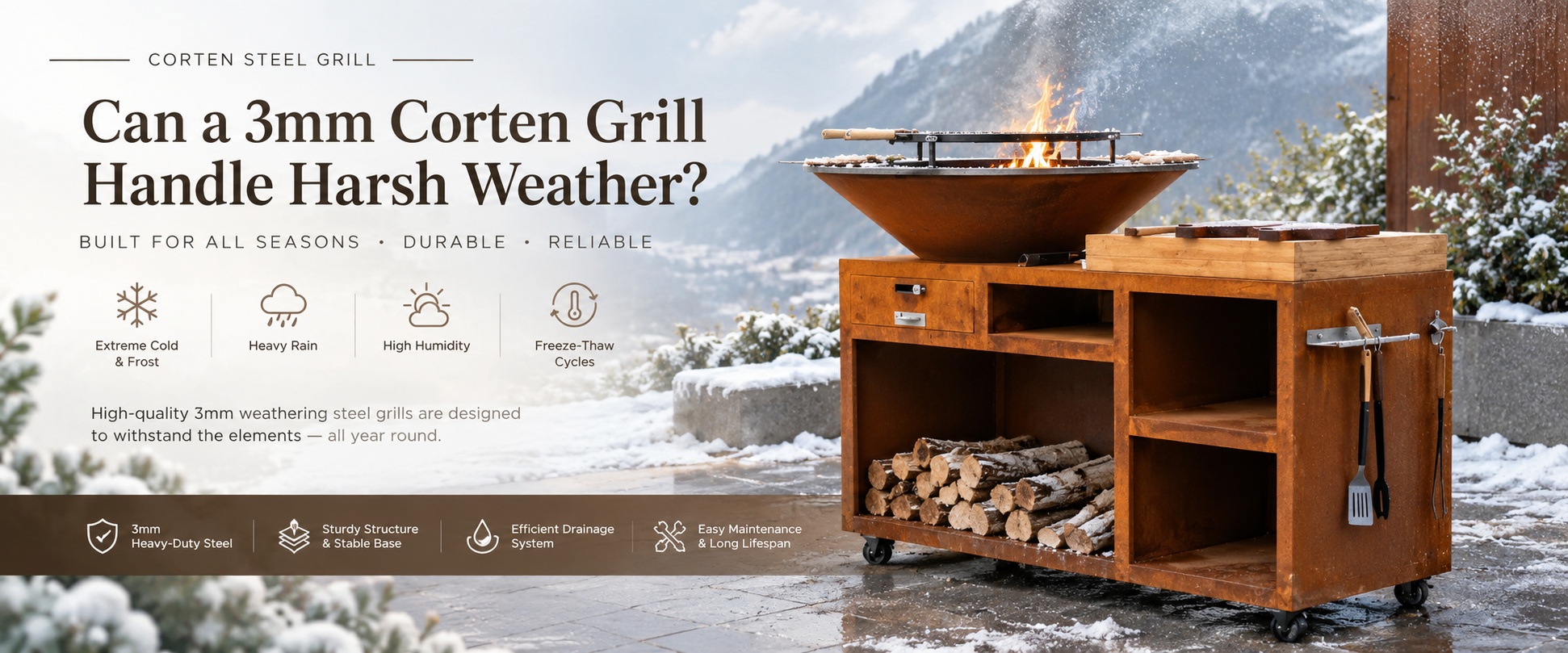
Why 3mm Corten Steel Is a Strong Choice for Outdoor BBQ Grills
1. What Does “3mm Corten Steel” Mean?
3mm weathering steel refers to the use of 3-millimeter-thick, specialized weathering steel sheets for the barbecue grill body and fire bowl. Unlike ordinary thin sheet metal or painted carbon steel, authentic weathering steel contains alloy elements such as copper and chromium, giving it weather-resistant properties that allow for self-oxidation and self-repair.
Professional weathering steel barbecue grills feature a differentiated material combination design. The outer shell of the grill body and the main body of the fire basin are made of 3mm weathering steel, balancing toughness and weather resistance; the grilling surface is typically constructed from 8–12mm-thick carbon steel plates to ensure heat retention and resistance to deformation.
2. Why Thickness Matters in Freezing Conditions
Thicker steel typically offers better structural rigidity and thermal capacity.
3 mm Corten steel reduces the risk of warping in thin steel sheets caused by frequent heating and cooling.
The metal is not completely immune to deformation; excessive localized heating, pouring cold water directly onto hot steel sheets, overloading the grill, or uneven support can still cause thermal stress issues.
AHL 3mm Corten grill bodies are designed for outdoor use and can be specified with reinforced edges, adjustable legs, drainage openings, and heavy-duty cooking components.
3. The Difference Between Corten and Ordinary Steel
| Comparison |
3mm Corten Steel BBQ Grill |
Thin Ordinary Steel Grill |
| Outdoor Weathering |
Develops a natural protective patina |
May require paint or coating to slow visible corrosion |
| Rain Exposure |
Handles normal rain when drainage is good |
More likely to blister, peel, or corrode where coatings fail |
| Cold-Weather Stability |
Thick body helps resist deformation |
Thin panels may distort more easily under thermal cycling |
| Maintenance |
Low-maintenance body, but requires drainage and ash care |
Often needs repainting or additional corrosion control |
| Visual Finish |
Natural orange-brown to dark brown patina |
Painted, coated, or conventional metal appearance |
| Key Risk |
Standing water, wet ash, and salt exposure |
Coating damage, rust, and thin-wall distortion |
How Does BBQ Grill Respond to Extreme Cold?
1. No Brittle Cracking at Low Temperatures
Cast iron equipment becomes brittle in sub-zero temperatures and is highly susceptible to cracking and damage when subjected to thermal shock. In contrast, genuine weathering steel maintains excellent tensile strength and toughness even in extremely cold conditions.
Even when exposed to temperatures around -10°C and then heated directly to 300–400°C, it will not experience cracking, deformation, or material failure during normal use, making it perfectly suited for winter outdoor barbecuing.
2. The Real Hidden Dangers of Winter
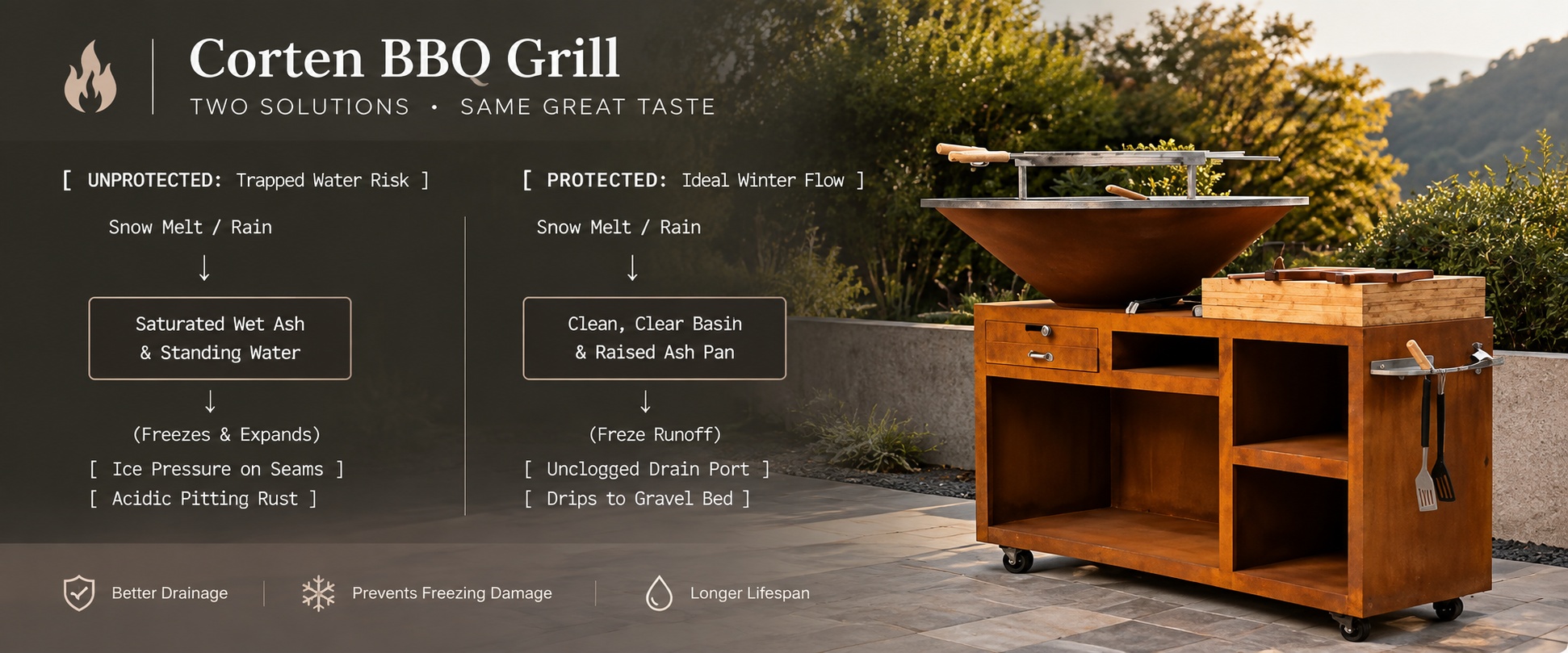
Extreme cold does not directly damage rusted steel BBQ grill; the true source of damage is standing water and damp ash. Residual water inside the grill freezes and expands, exerting compressive stress on the corners and welds of the grill body. Prolonged and repeated freeze-thaw cycles can cause localized micro-damage.
In winter, the air dries slowly. Residual ash absorbs moisture and forms a highly alkaline, damp ash sludge. This substance adheres continuously to the steel’s inner walls, blocking the natural cycle of drying and wetting, and leading to pitting corrosion and flaking.
3. Tips for Lighting Fires in Winter to Prevent Freezing and Deformation
When using a weathering steel barbecue grill in winter, avoid sudden high heat or intense localized burning. It is recommended to first use small, thin firewood to slowly preheat the grill, allowing the body and grill grate to warm up evenly. Then, distribute the charcoal evenly to prevent localized hot spots.
At the same time, never pour cold water onto a hot grill body or hot grill grate. Sudden thermal expansion and contraction can directly cause the grill grate to warp and damage the welds, significantly shortening the equipment’s service life.
How Does a 3mm Corten Grill Handle Heavy Rain?
1. Rain Helps the Patina—But Prolonged Soaking Does Not
Many users mistakenly believe that exposure to rain will damage rusted steel barbecue grills, but the opposite is true. Natural rainfall is essential for weathering steel to form a protective rust layer. Rainwater wets the steel, and combined with the cycle of wetting and drying caused by ventilation, this allows a dense, stable, self-healing oxide layer to form on the steel’s surface, enhancing its corrosion resistance.
However, while brief exposure to rain is beneficial, prolonged standing water is detrimental. After a heavy rain, if water accumulates inside the grill, in drainage holes, or in hard-to-reach areas and cannot air-dry, the stable rust layer will continue to flake off and fail to form properly, ultimately leading to severe corrosion.
2. Why Wet Ash Is More Damaging Than Rainwater
Clean rainwater causes virtually no damage to weathering steel, but when rainwater mixes with furnace ash, it forms highly alkaline corrosive sludge with a pH as high as 10–12. This wet ash adheres firmly to the bottom and inner walls of the grill, continuously trapping moisture and cutting off air exposure.
The naturally-occurring oxidation process is completely blocked, causing the inner walls of the steel to develop pitting and flaking from the inside out—the primary cause of premature aging and perforation in barbecue grills. Therefore, clearing ash and draining accumulated water after rain is the top priority in rain-proof maintenance.
3. Protecting Cooking Surfaces vs. the Corten Exterior
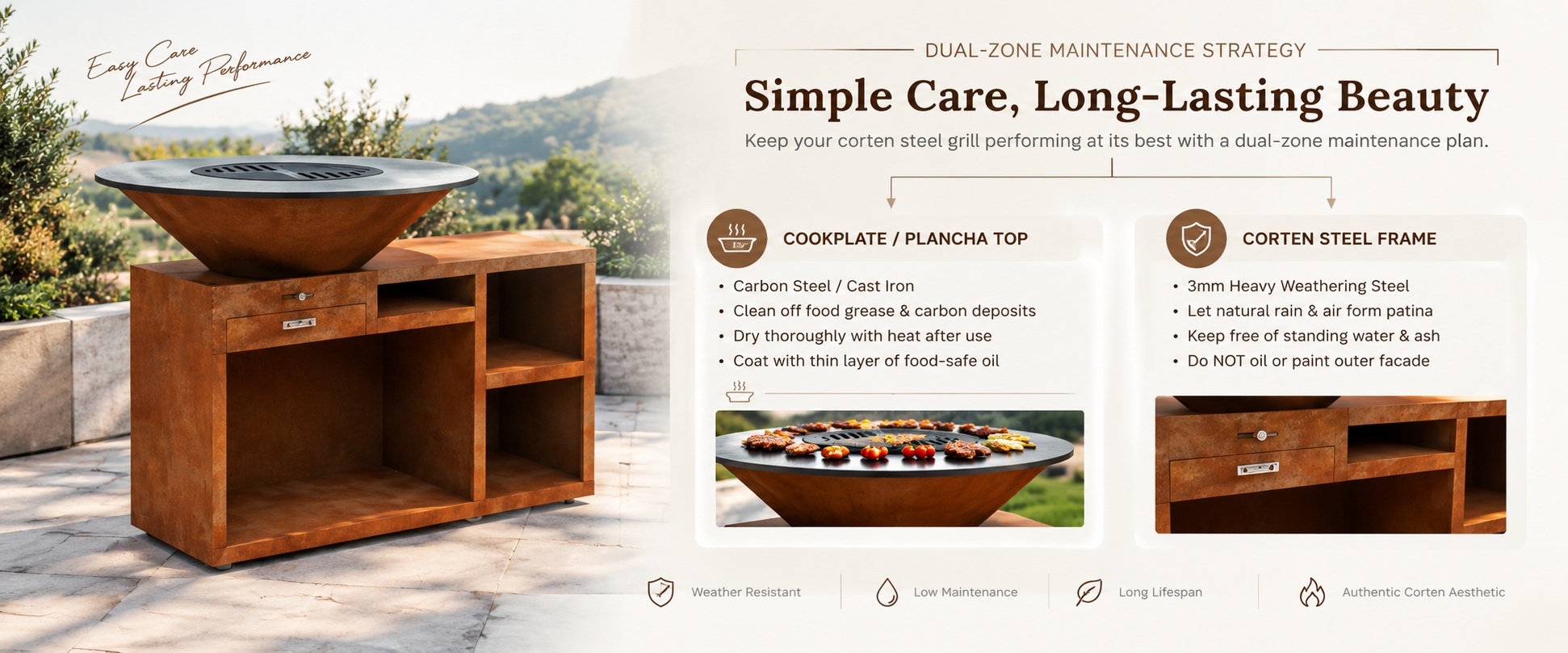
The weathering steel oven body does not require oiling or painting; it undergoes passivation and maintenance naturally through exposure to wind and rain. However, carbon steel and cast iron baking trays are entirely different; they require regular oiling to form a protective oil film, preventing moisture absorption, rust, and warping of the trays.
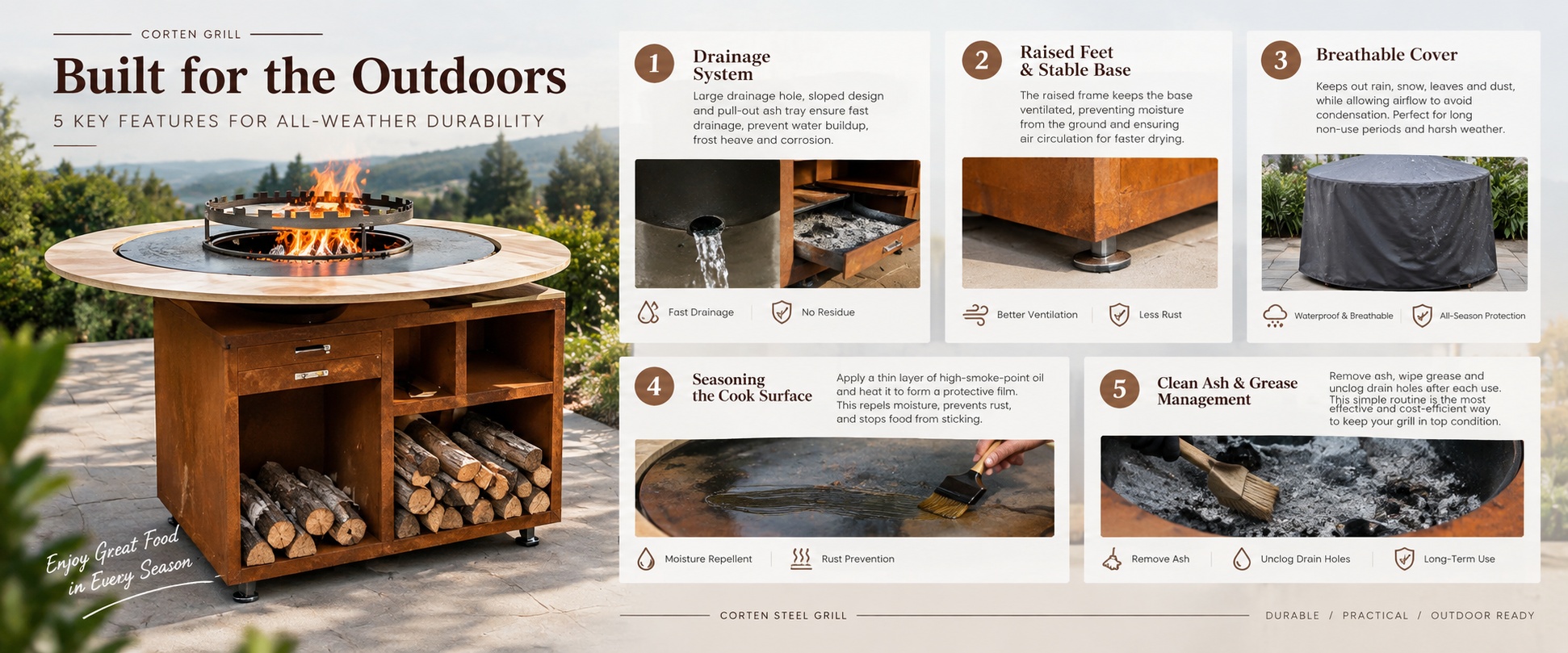
5 Features That Help a 3mm Corten Grill Survive Harsh Weather
1. A Well-Designed Drainage System
A durable, all-weather steel barbecue grill must be equipped with a professional drainage system. The fire bowl features a large-diameter drainage hole and a sloped drainage design, paired with a pull-out ash tray, allowing rainwater to drain quickly without leaving any residue or causing blockages, thereby completely preventing issues such as water accumulation, frost heave, and corrosion caused by trapped moisture.
2. Raised Feet and a Stable Base
The raised design of the furnace frame ensures a ventilation gap between the furnace base and the ground. This prevents moisture from lawns, paved surfaces, and wetlands from continuously seeping into the furnace base, while also ensuring air circulation beneath it, accelerating drying after rain, and preventing rust caused by trapped moisture.
3. Breathable Grill Cover for Long Non-Use Periods
When the oven is left unused for long periods, during rainy or snowy weather, or during the fall and winter leaf-fall season, it is essential to use a specialized breathable, waterproof cover. It keeps out snow, heavy rain, fallen leaves, and dust, while not trapping condensation like a sealed plastic wrap does, thus providing both protection and ventilation to safeguard the oven body and baking pans.
4. Proper Cook-Surface Seasoning
Before each use, after cleaning, and before winter storage, apply a thin layer of oil to the carbon steel grill pan. After drying it thoroughly at high temperature to remove all moisture, apply a thin layer of high-smoke-point cooking oil. This will polymerize to form a stable protective film that repels moisture, prevents rust, and prevents food from sticking, making it suitable for long-term outdoor storage.
5. Clean Ash and Grease Management
Residual ash, food grease, and carbon deposits are the primary causes of corrosion inside a barbecue grill. After each use, once the heavy duty Corten BBQ grill has cooled down, promptly remove any accumulated ash, wipe away grease, and unclog the drain holes—this is the most cost-effective and efficient way to ensure long-term maintenance.
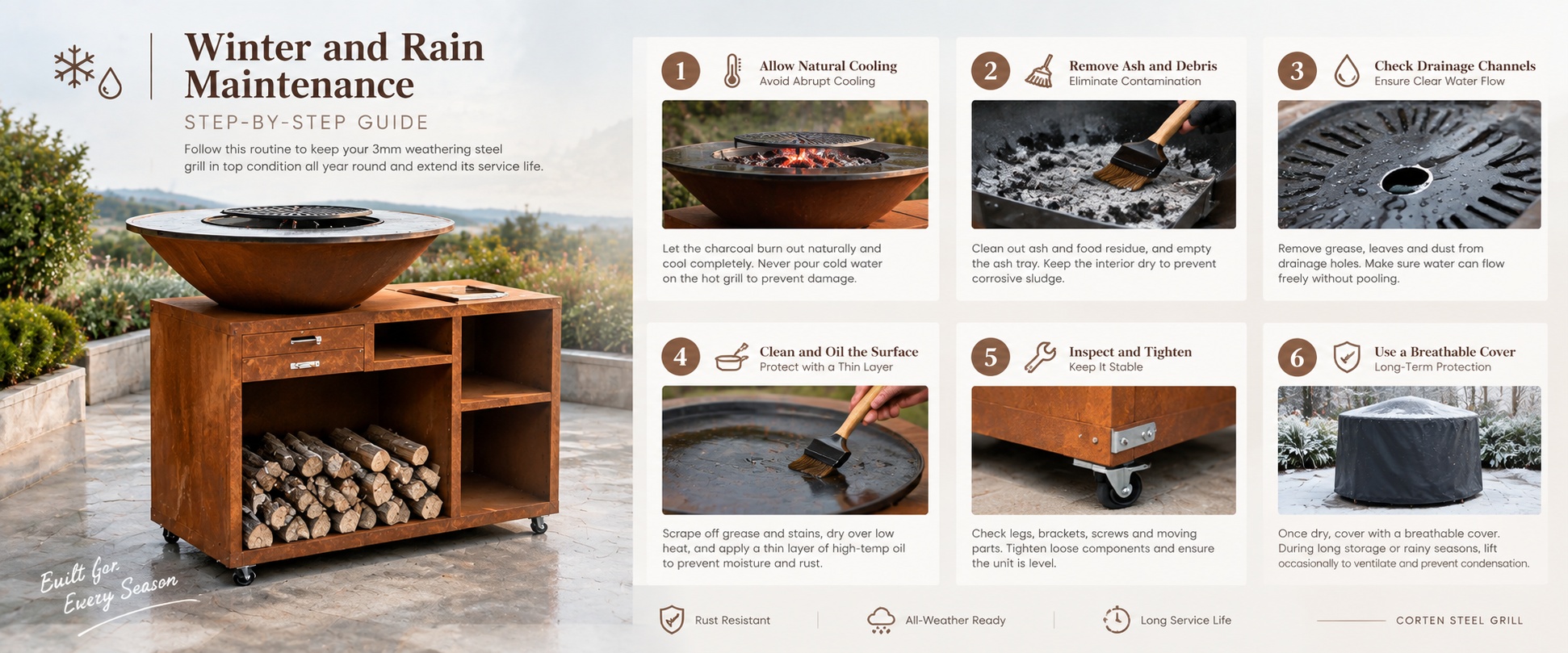
Winter & Rain Maintenance: Step-by-Step Guide
Following this standardized maintenance procedure ensures that your 3mm weathering steel barbecue grill will operate reliably year-round and significantly extends its service life.
1. Allow Natural Cooling; Avoid Abrupt Cooling
After barbecuing, wait for the charcoal to burn out naturally and for the grill body to cool completely. Never pour cold water onto the hot grill body or grill tray, as thermal shock can cause structural deformation and damage to the welds.
2. Thoroughly Remove Ash and Debris; Eliminate Sources of Contamination
Once the grill body has cooled, thoroughly clean out charcoal ash and food residue from the interior, and empty the ash tray completely. Ensure no damp ash remains inside the grill to prevent the formation of corrosive sludge during rainy or snowy weather.
3. Clear Drainage Channels and Check for Unobstructed Water Flow
Remove grease, fallen leaves, and charcoal dust blockages from the drainage holes. Confirm there are no areas where water can pool inside the grill body to ensure rapid drainage and drying during rainy or snowy weather.
4. Clean and Oil the Cooking Surface to Protect It
Scrape off residual grease and burnt-on stains from the baking tray, dry it over low heat, and apply a thin layer of high-temperature-resistant cooking oil to form a stable protective coating that prevents moisture and rust.
5. Inspect the Entire Unit and Tighten Structural Components
Before the onset of rain, snow, or severe winter, inspect the stove legs, brackets, screws, and moving parts. Tighten any loose components and ensure the stove is level to prevent uneven stress distribution and water pooling.
6. Breathable Cover for Long-Term Protection During Storage
Once the stove is completely dry, cover it with a dedicated breathable protective cover. During long periods of winter inactivity or prolonged rainy seasons, periodically lift the cover to ventilate and prevent condensation buildup.
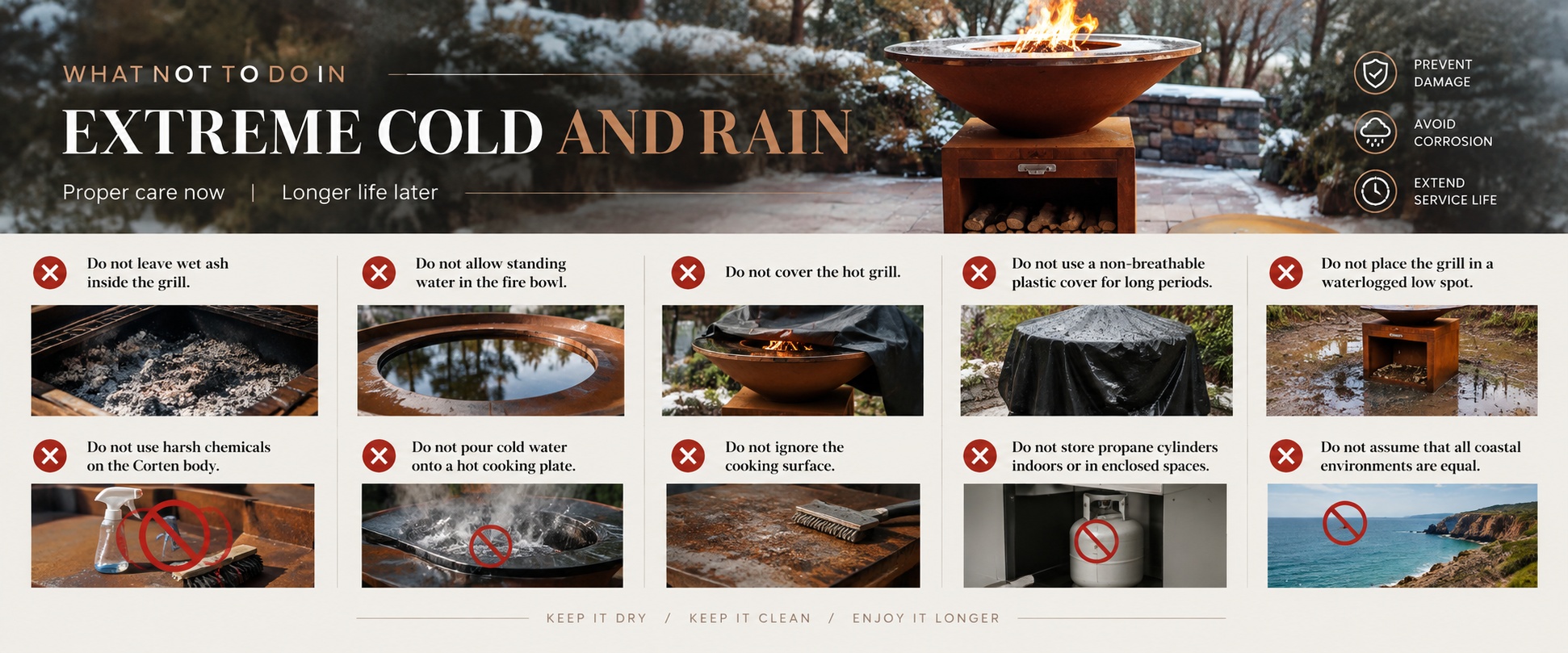
What Not to Do in Extreme Cold and Rain
× Do not leave wet ash inside the grill.
× Do not allow standing water to remain in the fire bowl.
× Do not cover the hot grill.
× Do not use a non-breathable plastic cover for long periods.
× Do not place the grill in a waterlogged low spot.
× Do not use harsh chemicals on the Corten body.
× Do not pour cold water onto a hot cooking plate.
× Do not ignore the cooking surface.
× Do not store propane cylinders indoors or in enclosed spaces.
× Do not assume that all coastal environments are equal.
× Do not leave wet ash inside the grill.
× Do not allow standing water to remain in the fire bowl.
× Do not cover the hot grill.
× Do not use a non-breathable plastic cover for long periods.
× Do not place the grill in a waterlogged low spot.
× Do not use harsh chemicals on the Corten body.
× Do not pour cold water onto a hot cooking plate.
× Do not ignore the cooking surface.
× Do not store propane cylinders indoors or in enclosed spaces.
× Do not assume that all coastal environments are equal.
Want to Get Your Own Corten Barbecue Grill? Click to Customize!
Comparison Table: 3mm Corten Grill vs Standard Thin Steel Grill
| Features |
3mm Corten BBQ Grill |
Standard Thin Steel Grill |
| Body Strength |
High structural rigidity |
More prone to dents and thermal distortion |
| Rain Performance |
Good with drainage and dry-down time |
Coatings may chip, peel, or trap corrosion |
| Cold-Weather Use |
Suitable for winter use with proper care |
More vulnerable to coating damage and thin-wall warping |
| Natural Finish |
Develops a weathered rust patina |
Often relies on paint or powder coating |
| Standing-Water Tolerance |
Poor — must be drained |
Poor — also vulnerable, often more quickly |
| Wet Ash Tolerance |
Poor — remove promptly |
Poor — remove promptly |
| Cooking Surface Care |
Requires cleaning and oil seasoning |
Also requires cleaning; varies by grate material |
| Cover Requirement |
Recommended during prolonged rain, snow, or storage |
Often recommended for general weather protection |
| Long-Term Maintenance |
Focus on drainage, ash removal, oiling, and cleaning |
Focus on coating condition, rust prevention, and cleaning |
| Best User |
Outdoor cooking enthusiasts wanting lasting weathered style |
Budget buyers or occasional users |
Why Choose the AHL 3mm Weathering Steel BBQ Grill?
1. Commercial-Grade Materials and Craftsmanship, Designed for All-Weather Outdoor Use
The entire AHL grill series features an authentic 3mm thickened weathering steel body, precision-cut via CNC and constructed with seamless, fully welded joints. This design eliminates issues such as thermal deformation, weld cracking, and premature rusting at the source, making it specifically engineered for long-term use in harsh outdoor environments.
2. Designed for All-Season Outdoor Entertaining
The unit comes equipped with a built-in drainage system, a pull-out ash collection compartment, and a raised, ventilated base—perfectly resolving the two core issues of water accumulation and corrosion from damp ash. It is suitable for a wide range of challenging conditions, including heavy rain, harsh winters, high humidity, and coastal environments.
3. Premium Components: Balancing Performance and User Experience
Comes standard with an 8–12mm thickened carbon steel grilling plate that retains heat steadily, resists warping, and supports multi-zone cooking. Paired with a dedicated breathable, waterproof cover and rust-resistant hardware, this complete setup simplifies maintenance.
4. Comprehensive Customization for Any Setting
Supports personalized customization of dimensions, design, structure, and logos, making it suitable for various settings such as private backyards, hotel terraces, outdoor dining areas, scenic campgrounds, and commercial plazas—creating visually appealing and durable outdoor cooking spaces.
Frequently Asked Questions (FAQ): About the Corten BBQ Grill
Q1: Can The 3mm Corten Barbecue Grill Be Left Outdoors In Winter And Covered In Heavy Snow?
Yes. The material itself is resistant to low temperatures and does not become brittle or crack. As long as you promptly clear snow, drain accumulated water, and remove wet ash to prevent frost heave and corrosion caused by trapped moisture, it can safely withstand the winter.
Q2: Will Prolonged Rainfall Permanently Damage The Weathering Steel Bbq Grill?
No. Normal rainfall helps the rust layer form. As long as there is no standing water or trapped wet ash, and the grill is ventilated and air-dried after rain, the equipment will not only remain undamaged but will also gradually develop a more stable protective surface layer.
Q3: Do I Need To Cover The Grill During Rainy Or Snowy Weather?
There’s no need to cover it on a daily basis; natural ventilation is best for maintenance. However, during prolonged periods of inactivity, continuous rain or snow, or long-term winter storage, we recommend using a breathable, waterproof cover to prevent the buildup of dust and snow.
Q4: How Should I Store And Maintain The Grill During Long Periods Of Winter Inactivity?
Thoroughly clean off ash and grease, unclog drainage channels, dry out any moisture, and oil the grill pan. Once completely dry, cover it with a breathable cover and periodically ventilate and inspect it.
Q5: Can It Be Used In Coastal Environments With High Salt Fog?
Yes, it can be used. We recommend choosing the AHL thickened outdoor kitchen grill. Regularly rinsing off salt deposits with clean water, increasing inspection frequency, and avoiding direct exposure to sea fog by positioning the grill away from the wind can effectively extend the equipment’s service life.
Are You Ready to Choose an Outdoor Corten Grill That’s Right for You?
The reason 3mm weathering steel grills can withstand harsh weather conditions—such as extreme cold, heavy rain, frost, and freeze-thaw cycles—lies in the high-quality material thickness, scientific structural design, and proper maintenance practices.
Weathering steel’s self-healing properties give the equipment a natural resistance to the elements, while proper drainage, timely ash removal, exposure to alternating wet and dry conditions, and proper covering are key to preventing aging and corrosion. By avoiding incorrect maintenance habits and performing basic seasonal upkeep, a high-quality weathering steel barbecue grill can provide reliable service for many years, combining vintage aesthetics with practical performance.
If you’re looking for a low-maintenance, all-weather durable grill suitable for a variety of outdoor settings, the AHL custom 3mm corten steel barbecue grill is the ideal choice for outdoor patios and commercial spaces.
Get a Free Quote and Price!


 Fill In The Inquiry