Large corten steel planters are a popular modern landscape feature for plazas, rooftops and commercial sites. Filled with soil, they function as retaining walls exposed to heavy lateral earth pressure and harsh outdoor conditions. Without adequate internal reinforcement, tall or long planters suffer bulging, corner cracking, weld rupture and base deformation. This article explains key reinforcement practices, selection tips and common project pitfalls.
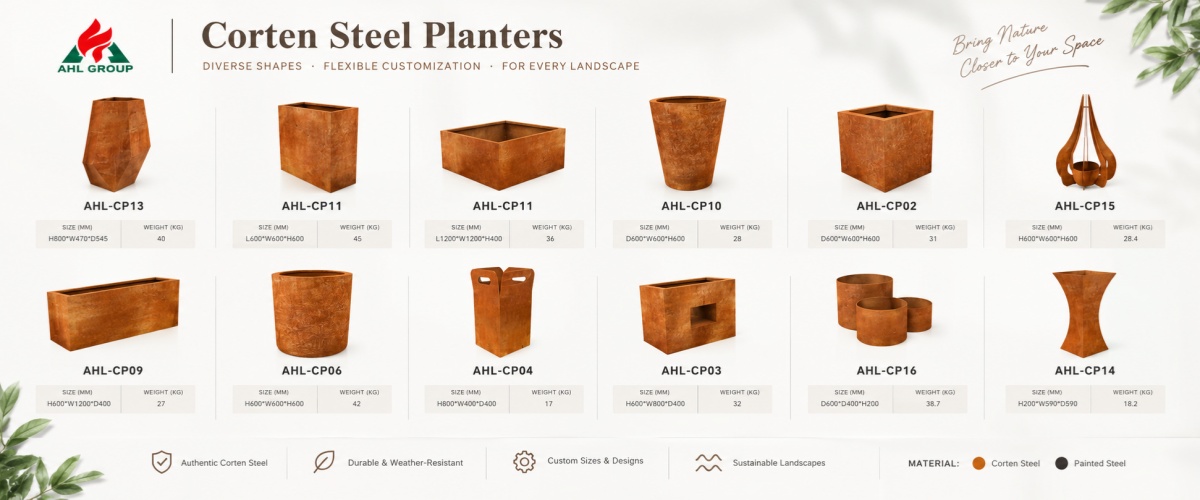
Quick Answer: How are Large Planters Reinforced?
| Reinforcement Method |
Main Function |
Best Application |
| Thicker Steel |
Improves rigidity and load resistance. |
Tall, deep, and commercial planters. |
| Folded Top Edge |
Reduces wall movement and improves edge stiffness. |
Long rectangular planters. |
| Internal Ribs |
Prevents side-wall bowing. |
Large trough planters. |
| Cross-Braces |
Connects opposite walls to control outward movement. |
Deep or oversized planters. |
| Reinforced Corners |
Protects high-stress joints and improves shape stability. |
Welded square and rectangular planters. |
| Base Frame |
Supports weight and stabilises the planter structure. |
Large commercial installations. |
| Raised Feet |
Improves drainage and reduces continuous moisture contact. |
Wet climates and paved areas. |
| Interior Liner |
Reduces direct soil-to-steel contact and helps manage moisture. |
Long-term and high-moisture applications. |
| Thickness |
Height |
Soil Depth |
Uses |
Key Limits / Notes |
| 2 mm |
400–600 mm |
250–400 mm |
Balconies and small residential gardens. |
Needs bracing if length exceeds 1,200 mm or height exceeds 600 mm. |
| 3 mm |
600–900 mm |
400–600 mm |
Courtyards, streetscapes, and plazas. |
A standard commercial choice with a strong cost-to-strength balance. |
| 4–6 mm |
Over 900 mm |
Over 600 mm |
Tree pits, municipal projects, and heavy-use zones. |
Provides greater lateral strength for freeze-thaw climates; engineering review is recommended. |
Request a Custom Planter Quote
Important Note: Thicker panels do not automatically eliminate the need for reinforcement. Even with 5–6mm steel panels, if a single section exceeds 2000mm in length and lacks internal ribs or cross-bracing, the panel will still bulge outward and deform.
When selecting panel thickness, consider the following four variables:
1. Length: For long planters exceeding 1500mm in length—regardless of height—the panel thickness must be increased or internal reinforcing ribs added.
2. Height: When the planter height exceeds 800 mm, the overturning moment and lateral pressure increase significantly.
3. Soil Weight: When the soil depth exceeds 500 mm or in regions with heavy rainfall where the soil remains saturated for extended periods, the load increases substantially.
4. Transportation and Installation: Steel plates 6 mm or thicker have significant dead weight, which increases logistics and hoisting costs.
Flanging and Reinforcement of the Box Opening
The top edge of a commercial metal planter is a structurally weak point, and exposed edges are prone to impact and deformation. The standard manufacturing process involves a double inward flange, with a flange width of 30–50 mm.
Flanging the Box Edges Serves 4 Primary Functions:
1. Reducing box wall deformation: The full-circumference fold acts as a top stiffener, minimizing sway in long and tall planters under pressure and wind loads.
2. Maintaining dimensional stability: The fold forms a tensile structure that resists box opening caused by thermal expansion and contraction as well as soil compression.
3. Safety protection: Eliminates sharp burrs to prevent injuries to pedestrians, pets, and maintenance personnel—a mandatory requirement in public settings such as schools and hotels.
4. Enhances aesthetic appeal: Conceals welds and internal reinforcements, maintaining a clean and sleek exterior.
Suitable applications: Long flower troughs, public space planters, and tall planters with a height of 600 mm or more.
Industry Standard: High-quality outdoor long trough planter typically employ a 30–50mm double-sided inward-folding process to balance rigidity and aesthetics.
.jpg)
Internal Ribs and Reinforcing Bars
Internal ribs and reinforcing bars are welded to the inner walls of the large tree planter to divide unsupported, long-span walls. They are completely concealed by soil and plants, preserving the exterior appearance of the weathering steel.
- Vertical Ribs: Welded vertically along the inner walls of the long sides at intervals of 400–600 mm, these divide the long side panels into multiple short spans, reducing outward bulging at its source. Their use is strongly recommended for planters longer than 1,500 mm.
- Transverse stiffeners: Multiple ring-shaped steel bands are welded at a high position within tall planters to enhance resistance to overturning and wind pressure. This is a critical configuration for planters taller than 800 mm.
- Applicable Projects: Long planting troughs, large rectangular planters, and commercial landscaping projects.
- Design Advantages: By relying on internal reinforcements, there is no need to excessively thicken the outer steel shell, thereby controlling weight and cost while maintaining a clean, minimalist appearance.
Internal Cross-Braces and Tie Rods
Cross-braces and tie rods connect two opposing box walls to prevent soil pressure from pushing the sides apart. This is critical for tall boxes, deep soil coverage, and extra-long planters.
- Cross-braces: Steel members welded or bolted horizontally or diagonally at intervals of 600–1000 mm along the length; suitable for planters wider than 1000 mm or taller than 800 mm.
- Tie rods: Through-threaded rods with nuts and washers pull the two sides of the planter walls together; the preload tension is adjustable to prevent bulging.
- Important Note: Under no circumstances should the tie rods be removed after installation, as this will cause the planter to deform rapidly.
- Recommended Applications: Planters with a height >800 mm, soil depth >600 mm, and length >2000 mm, as well as tree planters where root growth exerts significant outward thrust.
- Design Benefits: Achieves excellent strength without the need for extra-thick steel plates, resulting in a lightweight, cost-effective solution.
.jpg)
Corner Reinforcement and Welding Techniques
The corners of a heavy-duty planter are the points of highest stress in the entire structure. Defects in the corners and poor weld quality are the most common causes of leaks, deformation, and damage.
Reliable Corner Reinforcement Solutions:
1. Full-penetration continuous welds: Weld the entire length of the corners; avoid spot welding to ensure watertightness and structural continuity.
2. Corner Reinforcement Plates: Triangular or L-shaped steel plates are welded to the inner corners to distribute localized stress; recommended for planters where any side exceeds 1,000 mm.
3. One-Piece Folded Corners: Formed by bending a single sheet of metal without any seams, completely eliminating the risk of leakage and corrosion; suitable for planters designed for a minimalist appearance.
4. Internal Corner Bracket Supports: Angle iron welded or bolted to the inner corners to prevent the planter from being compressed into a parallelogram; used for heavy-duty, large planters.
Welding Quality Pitfalls:
❌ Spot welding only or intermittent spot welding — Insufficient structural strength
❌ Insufficient penetration depth — — leading to water seepage, corrosion, and cracking later on
❌ Defects such as porosity and undercut —— accelerate steel corrosion
✅ Structural joints are fully penetrated with full-penetration welds; exposed welds are ground smooth, and weld inspections are completed before weathering begins.
Key Point: No matter how thick the steel plate is, poor welding will cause premature failure; with proper welding, even standard-thickness plates can provide stable service for 30–50 years or more.
Reinforcing the Base, Support Legs, and Lifting Structure
Large planters must support the weight of the planter itself, saturated soil, and mature plants; in some scenarios, they must also withstand foot traffic and impacts from equipment. If the base is not reinforced, the bottom panel may sag and the welds may tear.
Base Reinforcement Solutions:
1. Welded Base Frame: An angle iron, square tubing, and channel steel frame forms the bottom load-bearing structure, evenly distributing the load and preventing the base plate from sagging. This is mandatory for units longer than 1,200 mm or taller than 600 mm.
2. Raised Support Feet: 50–150 mm support feet lift the planter off the ground, allowing for ventilation at the bottom and preventing water accumulation, thereby reducing the likelihood of rust.
3. Base Plinth: A steel or concrete plinth provides a stable foundation and can incorporate drainage channels, making it suitable for permanent installation in plazas and courtyards.
.jpg)
Lifting Structures for Large Planters:
1. Forklift Sockets: Openings are reserved in the bottom of the planter for forklift tines. This is essential for on-site handling of large planters weighing 500 kg or more, protecting the planter from impact during lifting.
2. Lifting Eyes: Specially welded lifting points are provided for crane handling of extra-large planters. These require structural calculations to ensure they can support the combined weight of the planter, soil, and plants, and are commonly used in large-scale municipal projects.
3. Multiple Benefits of Raised Support Legs: Prevent direct contact between steel and damp ground; ensure unobstructed drainage at the bottom; prevent rust stains from staining light-colored paving; and facilitate cleaning underneath.
4. Applications: Rooftop gardens, high-traffic commercial plazas, and projects requiring mechanical lifting.
Drainage and Interior Liner Design
Drainage is not merely a matter of landscape design; it is also a structural consideration. If drainage fails, soil moisture content surges, lateral pressure on the container walls increases, and internal corrosion accelerates. Saturated soil is 30–50% heavier than moist soil, significantly increasing outward thrust.
Engineering-Grade Drainage Configuration:
1. Distributed Drainage Holes: Drill 20–32 mm holes evenly across the base plate, spaced 30–40 cm apart. Avoid concentrating them in one corner to prevent localized water accumulation; in freeze-thaw regions, increase the number of holes to prevent individual holes from freezing and becoming blocked.
2. Gravel Drainage Layer: Lay a 50–100 mm layer of crushed stone or expanded clay aggregate at the bottom of the box to isolate the soil and prevent clogging of the holes. Use 50 mm for small containers and 100 mm for large, deep soil containers.
3. Geotextile barrier layer: Lay this over the gravel to block the infiltration of fine soil; fold it upward 100–150 mm to form a complete barrier while maintaining permeability.
4. Improved potting soil: Mix in 20–30% inorganic material such as perlite or coarse sand to prevent heavy clay soil from retaining water and increasing weight.
Key Points for Internal Lining: HDPE liners or asphalt coatings can isolate the soil from the steel plate. ⚠️ The liner must not block the drainage holes; otherwise, a “water tank effect” will occur, causing root asphyxiation and a sharp increase in the load on the planter.
.jpg)
Reinforcement by Planter Size
The table below serves as a selection guide; actual projects must be verified based on soil depth, plant species, wind conditions, and installation environment.
| Planter Size |
Recommended Reinforcement |
| Under 600mm Long |
1.5–2mm steel with folded edges. |
| 600–1200mm Long |
2–3mm steel with a reinforced rim. |
| 1200–2000mm Long |
3mm steel with internal ribs. |
| Over 2000mm Long |
3–5mm steel with a base frame and cross-bracing. |
| Over 1000mm High |
4–6mm steel with structural reinforcement. |
| Large Tree Planter |
Reinforced frame, deep drainage system, lifting design, and project-specific structural assessment. |
Special Reinforcement Requirements for Tree Planters and Commercial Projects
Tree planters and commercial public planters face the most demanding conditions, enduring extreme soil loads, wind loads, and root pressure year-round.
Key Design Considerations for Tree Planters:
1. Design dimensions based on the root ball of a mature tree, not the current size of a sapling. Small landscape trees require 600–900 mm of backfill, while large trees require 1,200 mm or more. Design logic: First determine the tree species and root volume, then establish the planter dimensions, and finally specify panel thickness and reinforcement.
2. When filled with saturated soil, large tree planters can weigh up to 6–8 metric tons; the base and side walls must withstand enormous loads.
3. The tree canopy acts as a “sail,” generating significant overturning torque due to wind forces. In open areas, foundation anchoring is required, with the planter bolted to a concrete base.
4. A gravel drainage layer and multiple sets of dispersed drainage holes are essential; channels must be reserved for irrigation lines without interfering with drainage.
Additional Requirements for Commercial Projects:
1. Lifting Structure: Standard for units longer than 1,500 mm and weighing over 500 kg are forklift sleeves; units weighing one metric ton or more are equipped with lifting eyes, and the lifting components themselves are reinforced with additional welding.
2. Transport and Stacking Protection: Reinforce box openings and corners to prevent damage during stacking; pack support legs and cover plates separately.
3. Impact Resistance: Use 4–6 mm thick panels with reinforced corners for plaza sidewalks to withstand equipment impacts.
4. Maintenance-Friendly Design: Include access hatches to facilitate drainage cleaning, liner inspection, and root trimming.
5. AHL Engineering Customization Capabilities: Engineering-grade custom plate thicknesses of 2–6 mm, internal frame cross-bracing, reinforced base frames, forklift-access lifting lugs, integrated drainage and irrigation channels, and anchoring support structures.
.jpg)
Common Reinforcement Mistakes to Avoid Premature Flower Box Failure
❌ Simply increasing steel plate thickness without internal reinforcement — 5–6 mm steel plates will still bulge over long spans.
❌ Long flower boxes with completely unsupported side panels — spans exceeding 1,500 mm without rib panels to divide the span.
❌ Ignoring the weight-increasing effect of wet soil — treating drainage as a horticultural need rather than a structural requirement.
❌ Using only spot welding or intermittent welding at corners — stress is most concentrated at corners, making welds highly prone to cracking and soil leakage.
❌ Placing the base plate directly on damp ground — without raised feet, the bottom to become waterlogged, accelerating rust.
❌ Insufficient number of drainage holes or improper placement —— Water continuously accumulates inside the planter.
❌ Large, heavy planters lack forklift openings or lifting lugs —— This makes it extremely easy to damage the planter during on-site hoisting and handling.
❌ Tree planters designed solely based on sapling dimensions —— No space is reserved for the growth of mature root systems.
Purchase and Acceptance Checklist:
· Fully welded inner corners, free of pinholes or sand holes
· Confirm that large planters are equipped with corner reinforcements
· Sufficient number of drainage holes, located at the lowest point of the base plate, preventing water from flowing along the outer walls
· Confirm the presence of raised feet to ensure smooth drainage and prevent water from pooling at the bottom of the planter
.jpg)
Why Choose AHL Custom-Engineered, Reinforced Planters
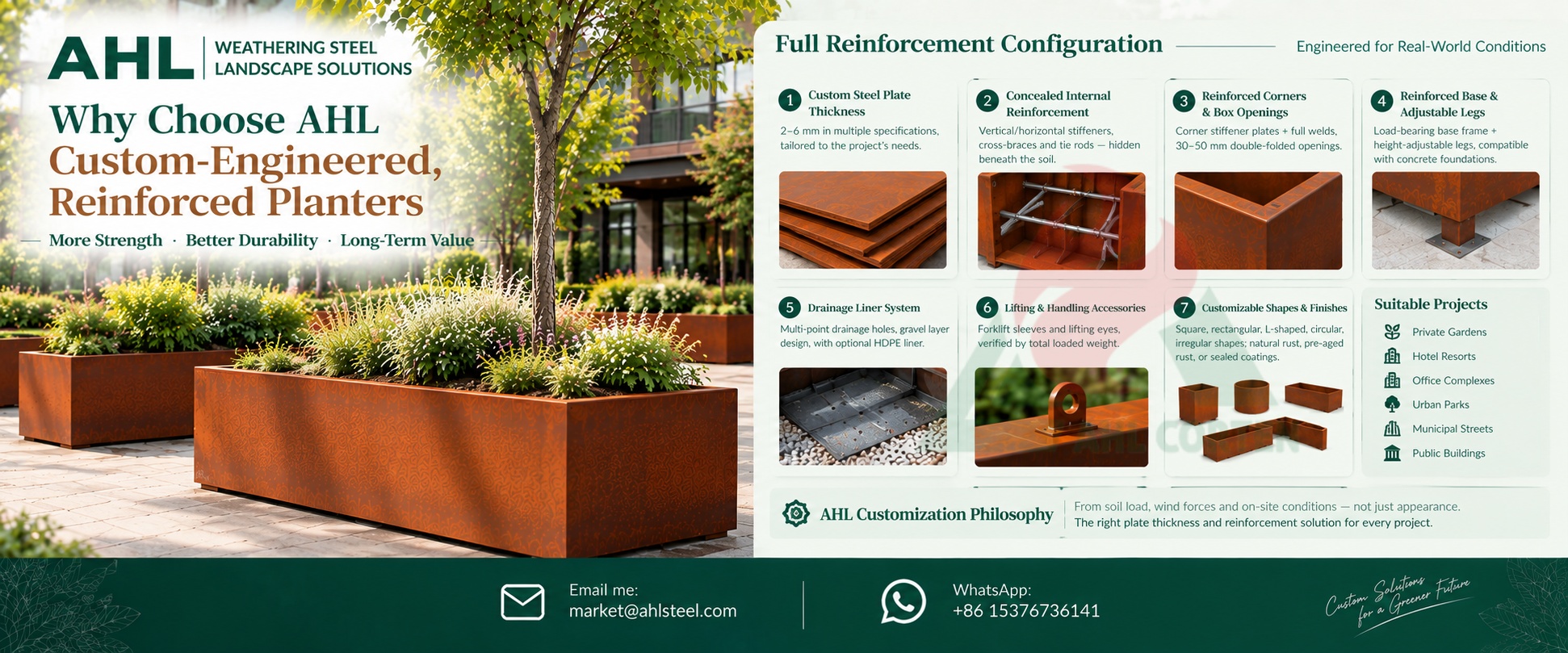
AHL designed large weathering steel planters as a complete structural system, rather than simply bent steel boxes. From internal reinforcement to drainage and hoisting hardware, every detail is focused on long-term outdoor performance.
Full Reinforcement Configuration:
1. Custom steel plate thickness: 2–6 mm in multiple specifications, tailored to the project’s requirements.
2. Concealed internal reinforcement: Vertical and horizontal stiffeners, cross-braces, and tie rods are all hidden beneath the soil, maintaining a clean, uncluttered exterior.

3. Reinforced corners and box openings: Corner stiffener plates combined with full-welded construction, plus 30–50 mm double-folded box openings, ensuring both rigidity and safety.
4. Reinforced Base and Height-Adjustable Legs: Load-bearing base frame + height-adjustable legs, compatible with concrete foundations.
5. Complete Drainage Liner System: Multi-point drainage holes, gravel layer design, with optional HDPE inner liner.
6. Lifting and Handling Accessories: Forklift sleeves and lifting eyes, structurally verified based on total loaded weight.
7. Customizable Shapes: Square, rectangular, L-shaped, circular, and irregular shapes; various surface finishes including natural rust, pre-aged rust, and sealed protective coatings.
8. Suitable Projects: Private gardens, hotel resorts, office complexes, urban parks, municipal streets, and public building landscapes.
9. AHL Customization Philosophy: Whether it’s a small garden planter or a tree pit for a plaza weighing several metric tons, plate thickness and reinforcement solutions are determined based on soil load, wind forces, and on-site conditions—not solely on appearance.
FAQ Frequently Asked Questions: Corten Steel Planters
Q: Do Large Steel Planters Require Internal Reinforcement?
A: For boxes longer than 1,200 mm or taller than 600 mm, internal reinforcement components such as ribs and cross-braces are generally required. Thicker steel plates alone cannot prevent outward bulging over large spans.
Q: What Is The Appropriate Sheet Thickness?
A: For residential use up to 1,200 mm, choose 2–3 mm; for commercial use between 1,200 and 2,000 mm, 3 mm is standard; for tall planters, tree planters, and public projects, choose 4–6 mm.
Q: What Prevents The Planter Walls From Bulging Outward?
A: A combination of measures: vertical and horizontal internal stiffeners, cross-braces and tie rods, and reinforced edges at the top and bottom, paired with panel thicknesses appropriate for the span.
Q: Must Large Planters Be Equipped With Cross-Braces?
A: For planters wider than 1000mm or taller than 800mm, we strongly recommend installing cross-braces to prevent the side walls from being pushed apart.
Q: How Does Drainage Affect the Lifespan of Planters?
A: Proper drainage prevents soil saturation and weight gain, reduces lateral pressure, and minimizes internal corrosion. Failed drainage is the primary cause of premature planter damage.
Q: Does AHL Offer Reinforced Tree Planters?
A: Yes, we provide a full range of custom solutions, including engineering-grade plate thickness, complete internal framing, reinforced bases, forklift lifting eyes, and integrated drainage and anchoring systems.
Conclusion and Call to Action
The durability of large, weather-resistant steel planters does not rely on a single thick steel plate, but rather on the synergistic design of plate thickness, hidden internal reinforcements, reinforced corner bases, and a scientific drainage system.

✅ Get a Custom Project Quote: Provide dimensions, soil cover depth, and on-site conditions to receive a reinforcement plan and quote.
✅ Inquire about structural reinforcement details: Consult with AHL engineers regarding engineering details such as rib plates, cross-braces, and base frames.
✅ Get technical advice: For commercial and municipal projects, consult us for recommendations on soil loads, wind resistance, and structural selection.
✅ Explore AHL’s full range of commercial-grade weathering steel planter solutions.
Need a Factory Quote for Corten Steel Planters?
Send your drawings, size list, quantity, and destination country. Corten Factory can support custom weathering steel fabrication, export packing, and project quotation.

 Fill In The Inquiry