Why Corten Steel Is Ideal for Garden Edging
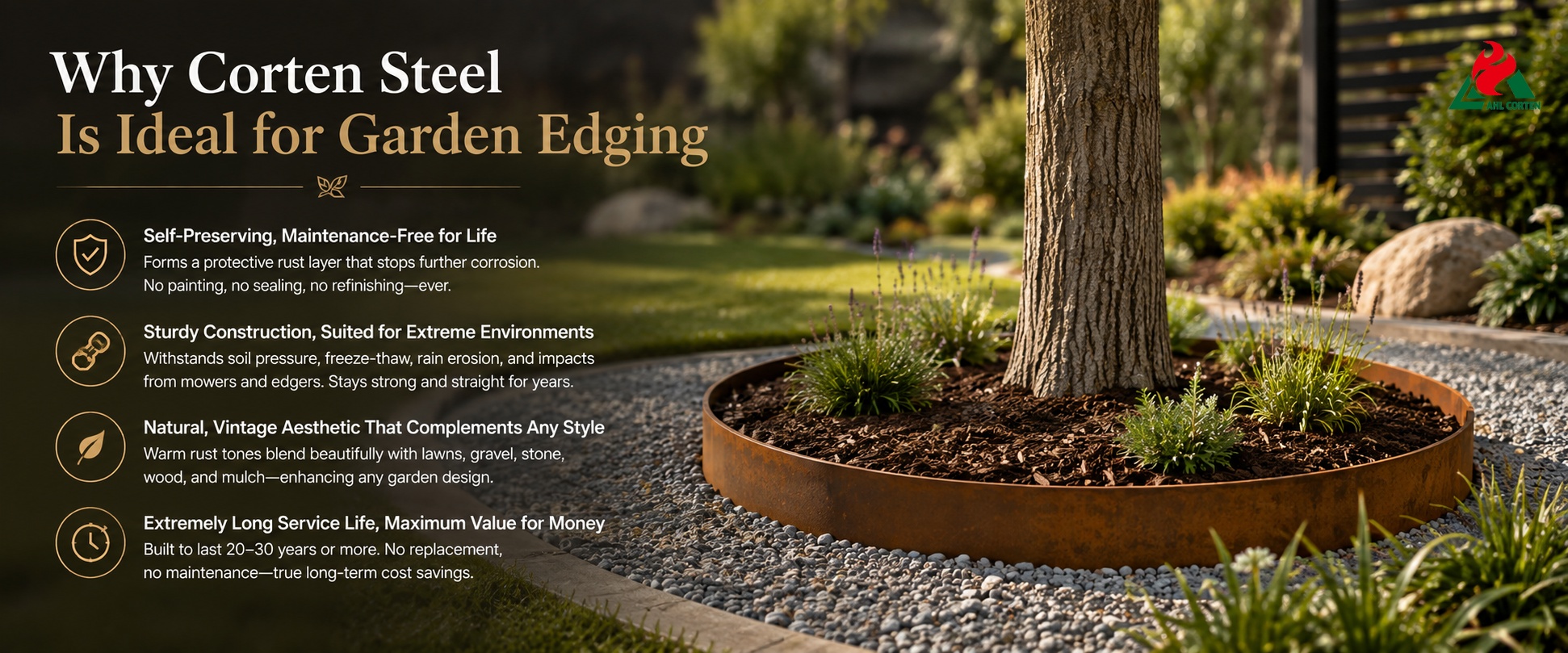
1. Self-Preserving, Maintenance-Free for Life
Weathering steel differs from ordinary steel in that the dense rust layer formed on its surface acts as a natural protective barrier, isolating the steel from air and moisture and preventing further corrosion of the underlying material. Once installed outdoors, it requires no painting, sealing, or refinishing, completely eliminating the frequent maintenance issues associated with traditional edging materials.
2. Sturdy Construction, Suited for Extreme Outdoor Environments
With high hardness and structural integrity, this steel withstands soil compression, freeze-thaw cycles, rain erosion, and daily impacts from lawn mowers and edgers. Long-term use prevents issues such as plastic cracking, wood rot, or aluminum denting, ensuring the edging lines remain neat and straight year-round.
3. Natural, Vintage Aesthetic That Complements Any Garden Style
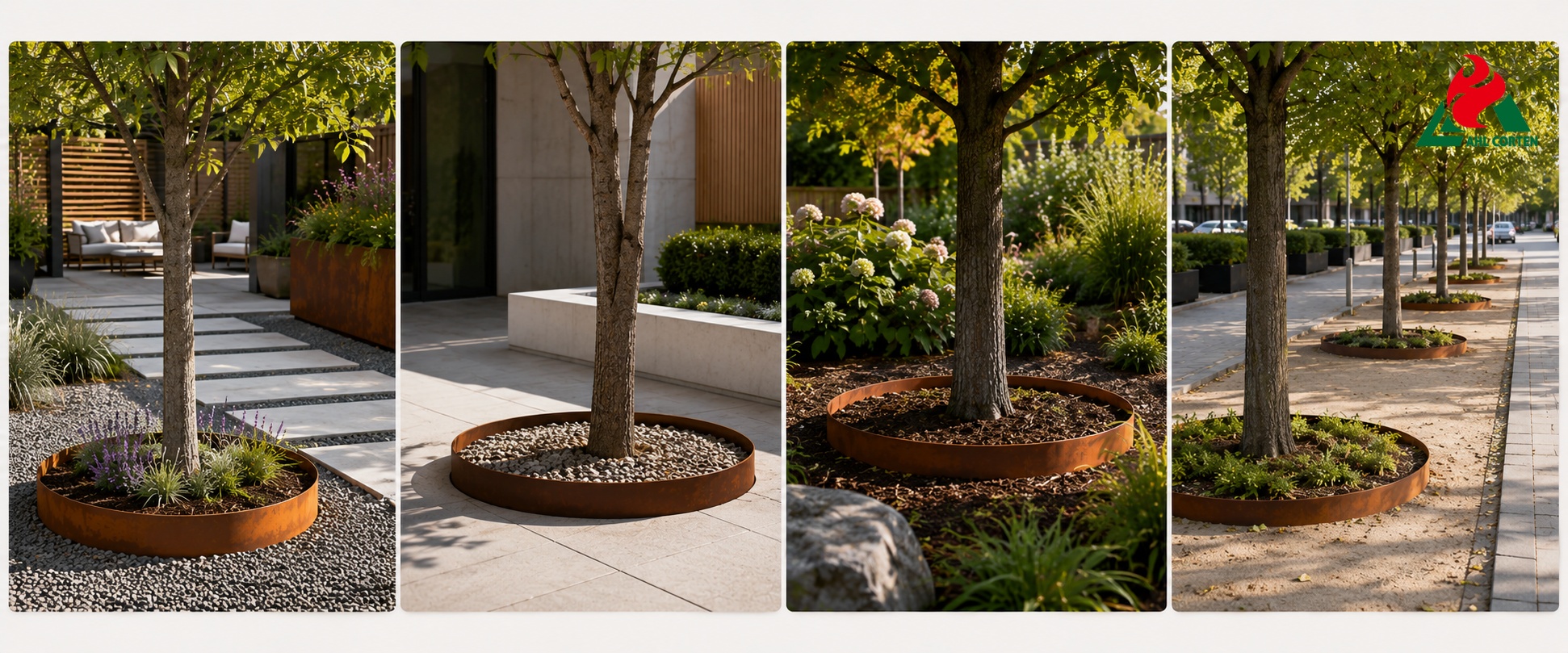
The warm, rust-colored texture exudes a sophisticated vintage charm, perfectly complementing green lawns, dark mulch, light-colored gravel, stone pavers, and wood features. It blends seamlessly into a variety of landscaping styles—including modern, rustic, natural, and minimalist—enhancing the overall depth and dimension of the landscape.
4. Extremely Long Service Life, Maximum Value for Money
Compared to traditional edging materials, weathering steel tree rings have a service life of 20–30 years or more. Although the initial cost is slightly higher, they require no replacement or maintenance, and their long-term usage costs are far lower than those of plastic, wood, or ordinary aluminum, making them a cost-effective choice for long-lasting landscapes.
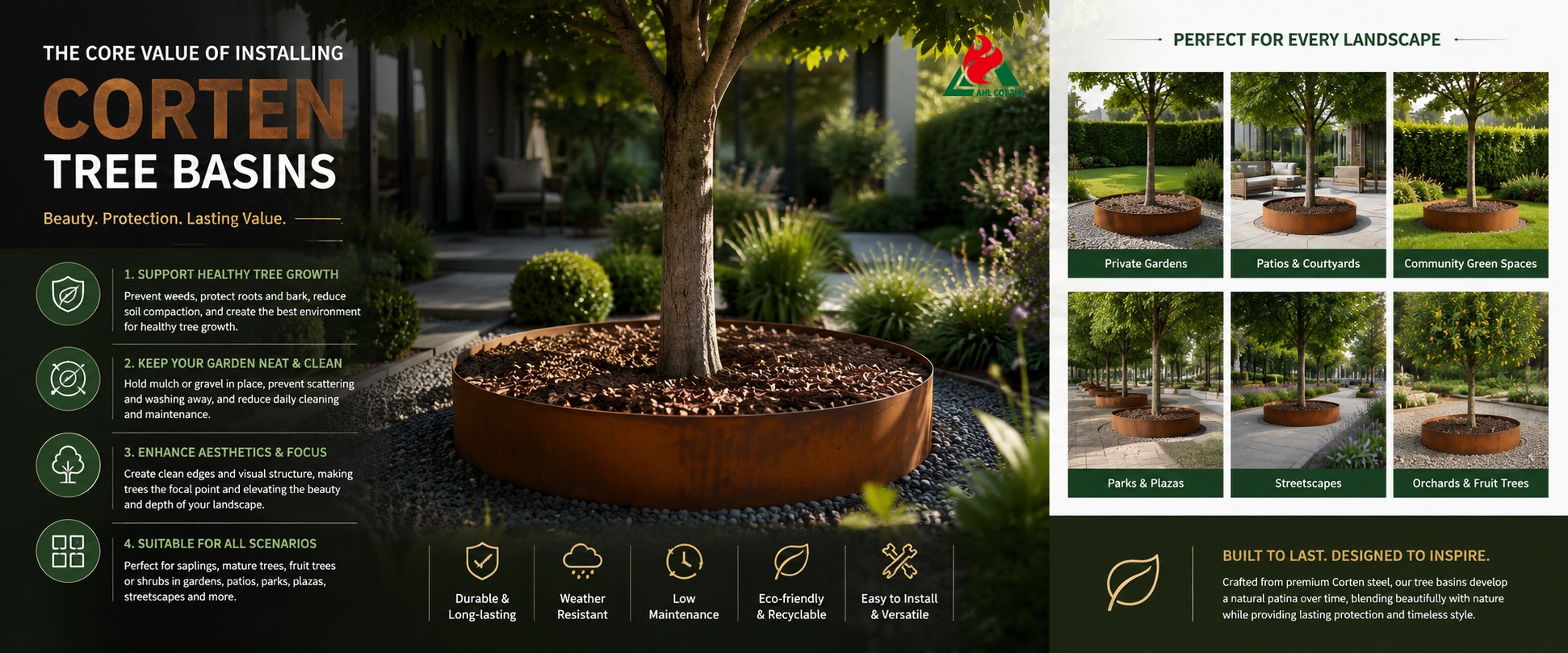
The Core Value of Installing Corten Tree Basins in Your Garden
1. Scientific Tree Care to Promote Healthy Growth
Tree basins effectively prevent lawn weeds from spreading toward tree roots, ensuring weeds do not compete with trees for water and nutrients. At the same time, they form a physical protective barrier that prevents damage to the tree bark and surface root system caused by manual pruning or mechanical mowing, while reducing soil compaction from foot traffic. This makes them particularly suitable for the care of newly planted saplings.
2. Neat Landscaping: Say Goodbye to Cluttered Tree Pits
Unedged tree pits filled with bark mulch or gravel are easily washed away by rain or scattered by pedestrians, leaving the yard looking messy year-round. Weathering steel tree rings securely hold the fill material in place, creating clean, crisp edges and significantly reducing the workload of daily cleaning and maintenance.
3. Enhance Garden Depth and Elevate Overall Aesthetics
Ordinary trees paired with a messy lawn often look unremarkable. Installing a weathering steel tree surround instantly transforms the tree into the visual focal point of the garden. Whether it’s the front-yard entrance landscape, the backyard leisure area, or tree pits along walkways, it creates a more organized and refined landscape layout.
4. Versatile and Suitable for All Landscaping Scenarios
Suitable for a wide variety of greenery—including newly planted saplings, mature landscape trees, fruit trees, and topiary shrubs—these tree guards can be widely used in residential and commercial settings such as private gardens, patios, community green spaces, parks and plazas, and commercial street landscapes.
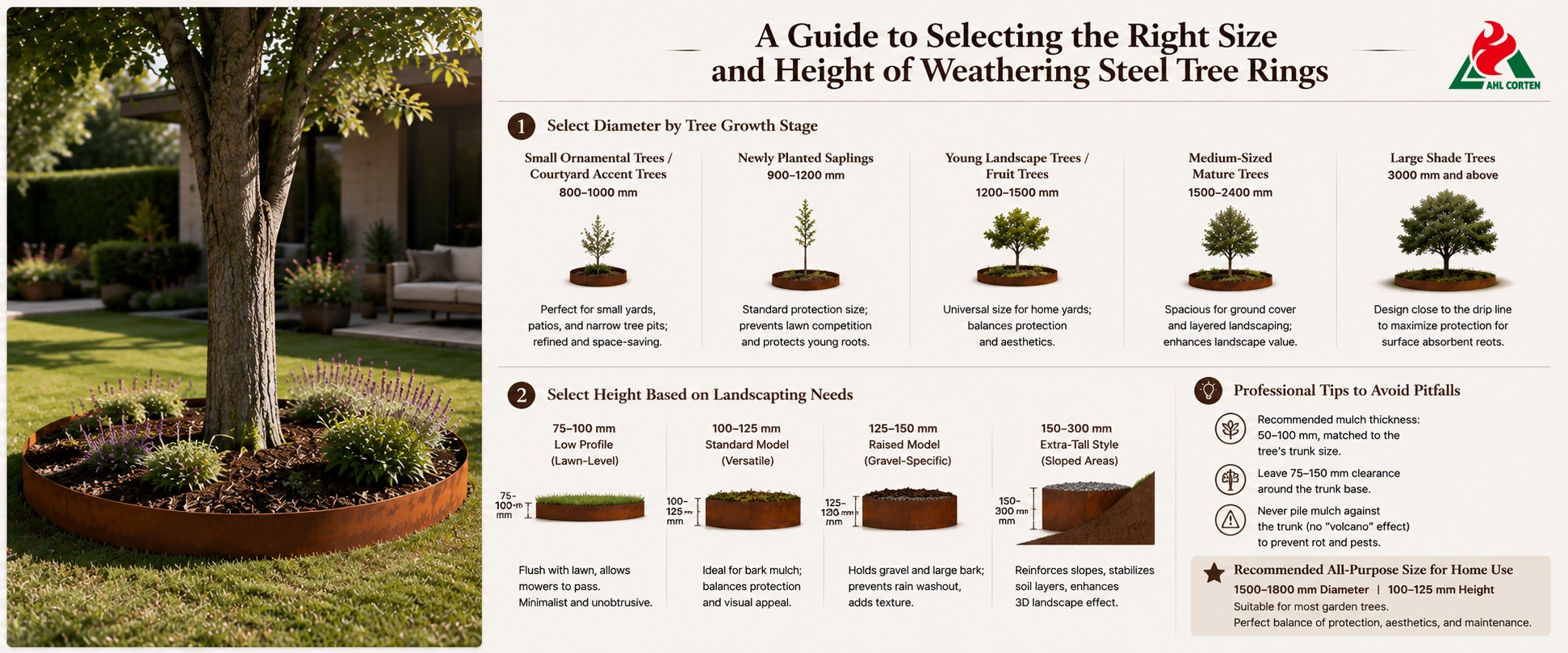
A Guide to Selecting the Right Size and Height of Weathering Steel Trees
Key Principles for Size Selection: Choose the diameter based on the tree’s growth stage and the height based on the fill material, balancing the tree’s growth space with landscape functionality.
1. Selecting Diameter by Tree Growth Stage
- Small Ornamental Trees/Courtyard Accent Trees (800–1000mm): Suitable for small yards, patios, and narrow tree pits; designed for a refined decorative effect without taking up excessive space.
- Newly Planted Saplings (900–1200mm): Standard size for basic protection; provides ample buffer zone to prevent competition from lawn grass and protect the root system of young trees.
- Young Landscape Trees/Fruit Trees (1200–1500 mm): A universal size for residential yards that balances protection and aesthetics, suitable for most small- to medium-sized landscape trees.
- Medium-Sized Mature Trees (1500–2400 mm): The preferred choice for high-end gardens; spacious tree pits allow for rich ground cover and layered landscaping, providing broader protection.
- Large Shade Trees (3,000 mm and above): Design as close as possible to the tree’s drip line to maximize protection of the surface absorbent roots; suitable for large yards, parks, plazas, and other open spaces.
2. Select Height Based on Landscaping Needs
- 75–100 mm Low Profile (Lawn-Level): Installs flush with the lawn, allowing mowers to pass unimpeded. Minimalist and virtually invisible, it creates a clean boundary and is ideal for tree pits with pure lawns.
- 100–125mm Standard Model (Versatile General-Purpose): Suitable for standard bark mulch layers, offering moderate visual depth while balancing protection and aesthetics—the top choice for home gardens.
- 125–150mm Raised Model (Gravel-Specific): With ample height, it securely holds gravel and large pieces of bark, effectively preventing rainwater from washing material away and creating a more textured landscape.
- 150–300mm Extra-Tall Style (Sloped Areas/Raised Planting Beds): Suitable for sloped terrain, uneven lawns, and raised planting beds; reinforces slopes and stabilizes soil layers, emphasizing a three-dimensional landscape effect.
Professional Tips to Avoid Common Pitfalls
The recommended thickness for tree bed mulch is 50–100mm, precisely matched to the tree’s trunk circumference. Additionally, a 75–150mm clearance area must be left around the base of the tree trunk; piling mulch to form a “soil volcano” is strictly prohibited to prevent the trunk from rotting and the spread of pests and diseases.
Recommended Versatile Size for Home Use: 1500–1800mm in diameter and 100–125mm in height, suitable for the vast majority of garden trees, balancing protection, landscaping, and maintenance needs.
Best Diameter-and-Height Combinations
| Landscape scenario |
Recommended Corten tree ring |
Why it works |
| Small courtyard tree |
1000–1200mm diameter × 75–100mm high |
Compact, subtle and easy to maintain |
| Newly planted garden tree |
1200mm diameter × 100mm high |
Creates a useful mulch buffer without overwhelming the tree |
| Young ornamental tree |
1500mm diameter × 100–125mm high |
Best balance of tree protection, appearance and material containment |
| Medium lawn tree |
1800–2400mm diameter × 125–150mm high |
Provides more mulch area and a stronger landscape feature |
| Gravel-filled tree feature |
1500–2000mm diameter × 125–150mm high |
Contains aggregate effectively and highlights Corten colour |
| Mature feature tree |
2400–3000mm+ diameter × 125–200mm high |
Supports a generous mulch zone and premium landscape scale |
| Sloped or lightly raised tree bed |
1800–3000mm diameter × 150–200mm high |
Better containment, provided drainage and anchoring are upgraded |
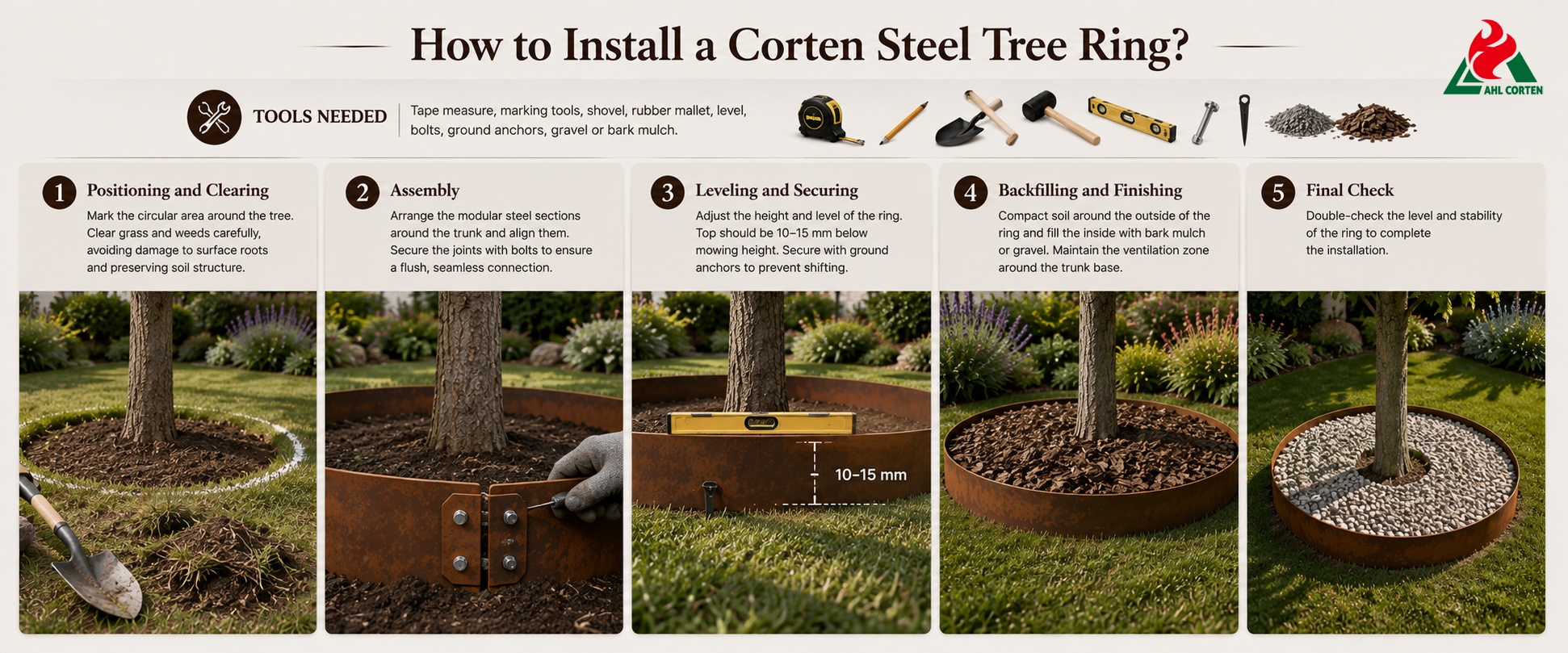
How to Install a Corten Steel Tree Ring?
Corten steel mulch rings are designed for easy DIY installation. No specialized equipment is required, making the process simple and efficient—even for beginners.
1. Tools Needed
Tape measure, marking tools, shovel, rubber mallet, level, matching bolts, ground anchors, and, as needed, fill materials for the tree pit such as gravel and bark.
2. Positioning and Clearing
Mark the circular tree pit area with the tree trunk as the center, then carefully remove the grass and weeds within the circle. Avoid digging too deeply during cleanup to prevent damage to the tree’s surface roots, and preserve the original soil structure around the root system.
3. Assembly
Arrange the modular tree ring sections around the tree trunk and align them. Secure the joints with the included bolts, ensuring the seams are flush and seamless, and that the entire ring is neat and smooth.
4. Leveling and Securing
Adjust the height and level of the tree ring. It is recommended that the top be 10–15 mm below the lawn’s mowing height to facilitate future mechanical mowing. Secure it by tamping it down with ground anchors; on soft soil or slopes, add additional anchor points to prevent shifting or settlement.
5. Backfilling and Finishing
Compact the soil around the exterior of the tree ring and evenly spread bark mulch or gravel inside the ring. Ensure the ventilation zone around the base of the tree trunk is fully maintained. Finally, double-check the level and stability to complete the installation.
Outdoor Garden Corten Steel Tree Ring Design Ideas
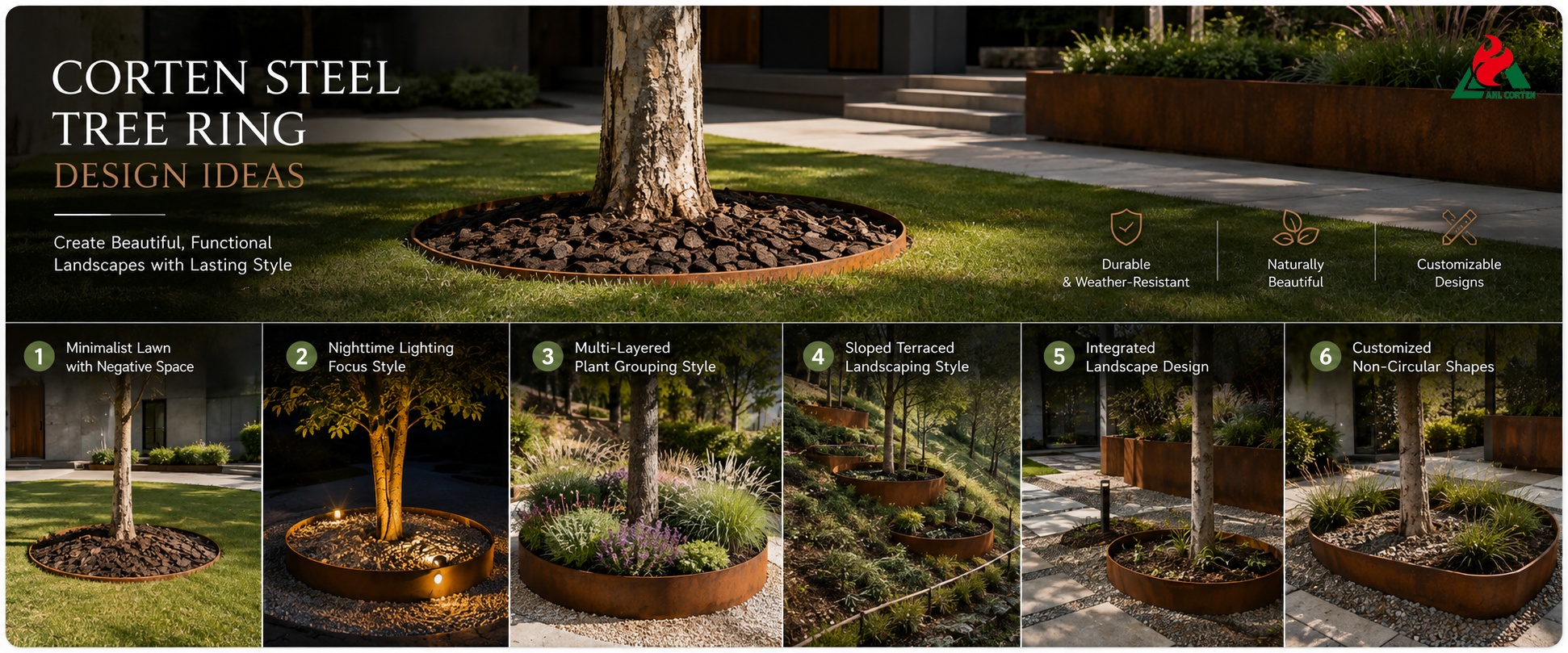
1. Minimalist Lawn with Negative Space
Features 75–100mm low tree borders installed flush with the lawn, paired with dark-colored bark mulch. The clean, crisp lines create a subtle, understated look that perfectly complements modern, minimalist entry courtyards.
2. Nighttime Lighting Focus Style
Features 125–150mm raised tree borders filled with light-colored gravel and paired with low-mounted tree spotlights. At night, the lighting highlights the rust-colored textures and greenery, transforming the trees into the focal point of the garden’s nighttime landscape and creating a rich, atmospheric ambiance.
3. Multi-Layered Plant Grouping Style
Inside the large-diameter tree ring, space is left around the trunk for airflow, while the outer ring is filled with ornamental grasses, perennial flowers, and groundcover plants. The bold, angular lines of the steel structure contrast with the soft greenery, creating a harmonious blend of strength and softness with rich, natural layers.
4. Sloped Terraced Landscaping Style
In sloped gardens, segmented, tiered tree surrounds are used to create circular tree pits at varying heights that follow the terrain. This helps stabilize the soil, prevent erosion, and resolves the issue of cluttered tree pits on slopes.
5. Integrated Landscape Design
Unify the materials of the tree surrounds with garden paths, gravel paving, weather-resistant steel planters, and landscape edging to ensure a consistent landscape style throughout the garden, creating a cohesive, high-end aesthetic.
6. Customized Non-Circular Shapes
Break free from the constraints of perfect circles by adopting non-circular designs such as off-center circles, ovals, and partial arcs. These adapt to unique garden layouts, creating niche, personalized modern garden landscapes.
Corten Tree Rings vs Other Garden Edging Materials
| Material |
Advantages |
Limitations |
Typical Lifespan |
| Plastic edging |
Low cost, lightweight and flexible |
May fade, crack, lift and look less premium over time |
1–3 years |
| Timber edging |
Natural, warm appearance and easy installation |
May rot, warp, mould and require replacement |
2–5 years |
| Aluminium edging |
Lightweight, corrosion-resistant and suitable for curves |
Softer material; may dent or bend and lacks visual weight |
5–10 years |
| Brick, stone or concrete |
Strong, decorative and long-lasting |
Higher cost, complex installation and limited curve flexibility |
20+ years |
| Corten steel tree rings |
Strong, low-maintenance, weather-resistant, customisable and visually distinctive |
Higher initial cost; consider rust runoff during early weathering |
20+ years |
A Guide to Avoiding Common Mistakes When Selecting and Installing Corten Steel Rings
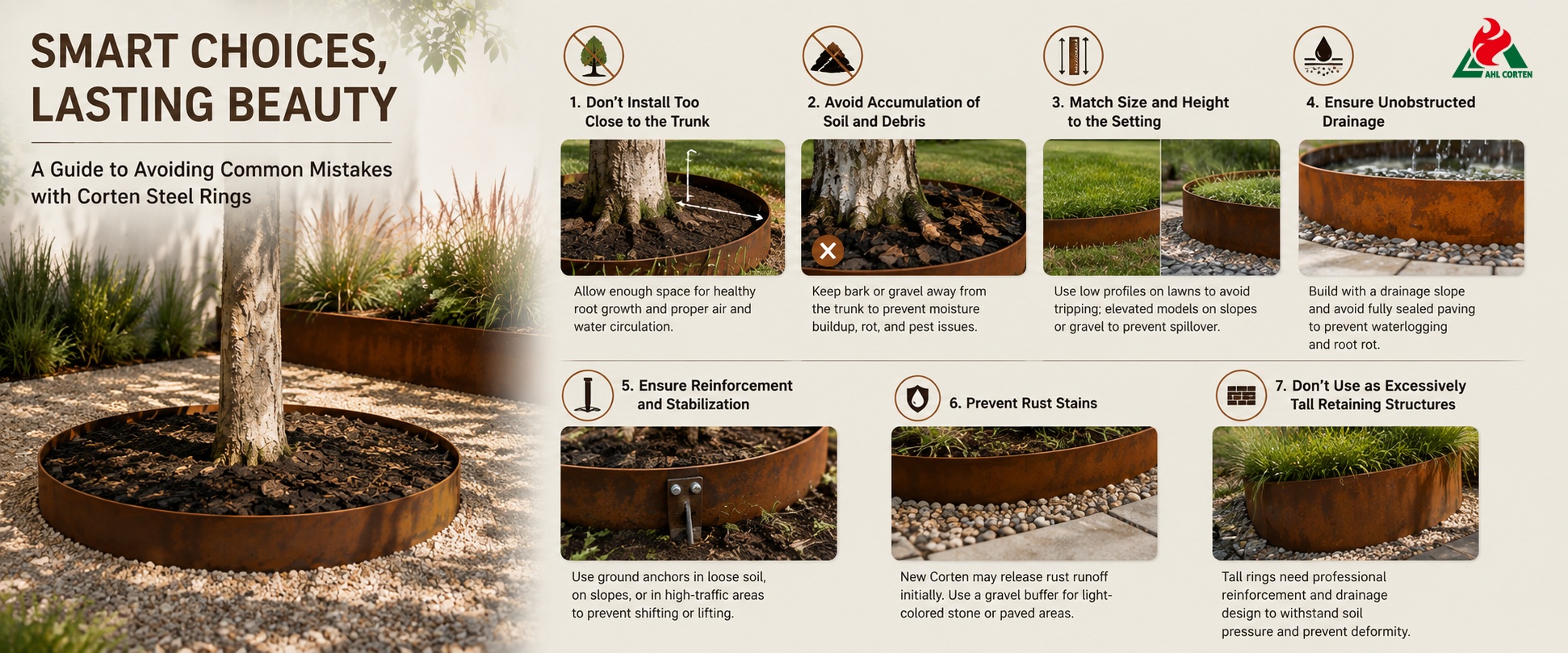
- Do Not Install Too Close to the Trunk: Placing the ring too close to the tree trunk will restrict root growth, hinder air and water permeability, and impair the tree’s growth.
- Avoid Accumulation of Soil and Debris: Never pile bark or gravel directly against the trunk to prevent prolonged moisture buildup, which can lead to rot and attract pests.
- Match Size and Height to the Setting: Choose low-profile models for lawn areas to prevent tripping, and elevated models for gravel slopes to prevent spillover; select the right type based on your needs, not on a whim.
- Ensure Unobstructed Drainage: Tree pits must be built with a drainage slope to prevent waterlogging and root rot; completely sealed paving is prohibited.
- Ensure Reinforcement and Stabilization: In areas with loose soil, on slopes, or in high-traffic zones, ground anchors must be installed to prevent the tree surround from shifting or lifting at the edges.
- Prevent Rust Stains: During the initial weathering phase of new tree surrounds, slight rust runoff may occur. For light-colored stone or paved areas, use a gravel buffer zone to prevent staining.
- Do not use as excessively tall retaining structures: Excessively tall tree guards must not be used directly as retaining walls; they require professional reinforcement and drainage design to prevent deformation caused by soil pressure.
Why Choose AHL Weathering Steel Tree Guards?
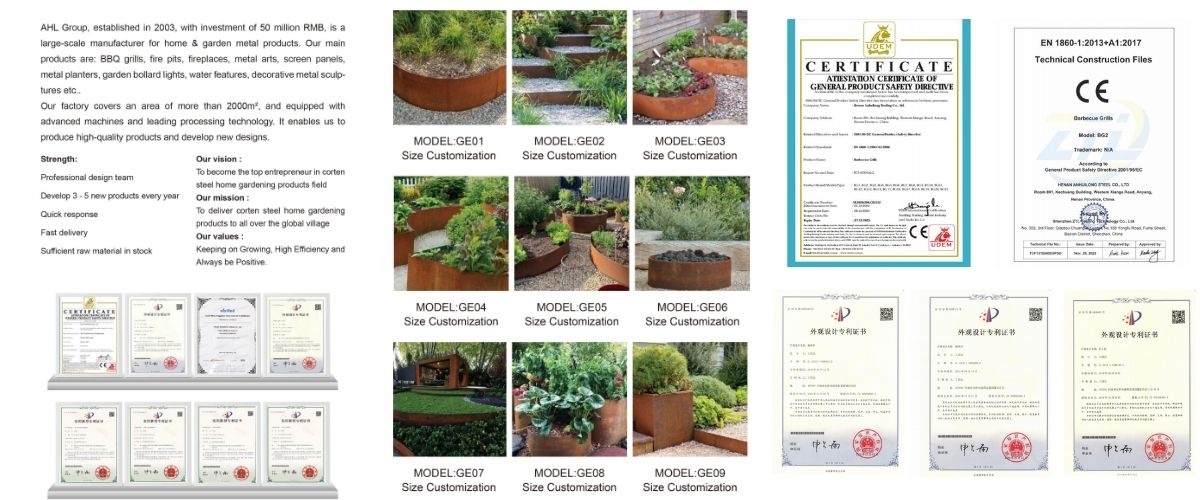
AHL specializes in high-end weathering steel landscape components, focusing on the long-term landscaping needs of residential gardens and commercial landscapes. Our products balance quality, aesthetics, and practicality.
- Guaranteed High-Quality Materials: Made from standard 2.0mm thick weathering steel, our products feature stable material properties, uniform weathering, resistance to deformation, and a longer service life.
- Comprehensive Customization Services: We support customization for any diameter, height, or irregular shape, making our products suitable for a wide range of settings, including small and large gardens, irregularly shaped tree pits, and commercial landscapes.
- Complete Set of Accessories: Comes standard with specialized connecting bolts and reinforcing ground anchors. With all necessary components included, installation is quick and effortless right out of the box.
- Styles for Multiple Scenarios: Options include lawn-level, standard tree pit, raised gravel, and elevated slope designs to meet diverse landscaping needs.
- Suitable for All Settings: Ideal for residential and commercial projects, including private yards, community green spaces, parks and plazas, commercial streets, and hotel landscapes.
- Unified Landscape Style: Can be paired with AHL weathering steel planters, landscape screens, edging strips, and other products to achieve a consistent material and style throughout the entire yard.
Are You Ready to Choose an Outdoor Tree Ring That’s Just Right for You?
Weathering steel tree surrounds may seem like a minor detail in a garden, but they are a key element in enhancing the landscape’s neatness, sophistication, and practicality. They overcome the pain points of traditional edging—such as being “cheap, fragile, and difficult to maintain”—and, with their minimalist design, natural texture, and exceptionally long lifespan, deliver a long-lasting landscaping effect with a single installation and years of maintenance-free use.
Whether renovating an older garden, creating an elegant entryway landscape, or implementing a commercial landscaping project, weathering steel tree surrounds—when carefully selected and properly installed—can transform every tree into a refined visual focal point of the garden.
Want the Latest Catalog of Steel Tree Edging? Contact Us!
Frequently Asked Questions About Corten Steel Tree Rings
1. What Is the Service Life of Weathering Steel Trees?
Under normal outdoor conditions, they can last 20–30 years or more. The thicker the material and the more securely they are installed, the longer their service life—requiring virtually no maintenance.
2. Can Beginners Install Corten Steel Tree Rings Themselves?
Absolutely. The product features a modular design with complete accessories and simple assembly. No specialized tools or technical skills are required; a single person can complete the installation.
3. How Can I Prevent Rust Water From Staining the Paved Ground?
During the initial weathering phase of a new tree ring, you can lay a gravel buffer zone around it or temporarily cover and protect the area. Once the patina stabilizes after 3–12 months, rust water runoff and staining will generally no longer be an issue.
4. What Are the Most Common Tree Ring Sizes for Home Gardens?
For the vast majority of home gardens, we recommend a tree ring with a diameter of 1,500–1,800 mm and a height of 100–125 mm. This size is suitable for all types of small to medium-sized landscape trees and offers the greatest versatility.
5. Can Tree Rings Be Installed on Slopes or Soft Ground?
Yes, they can be installed. We recommend using a taller tree ring model and adding additional ground anchor points for reinforcement. If necessary, use a leveling underlayment to improve overall stability.

 Fill In The Inquiry