How Do I Choose the Right Size of a Corten Planter for My Garden?
Corten planters are a popular choice for modern gardens, patios, and commercial landscapes. Setting them apart from ordinary plastic, ceramic, and wooden planters, their unique natural rust patina, exceptional weather resistance, and virtually zero-maintenance requirements make them a long-lasting solution for both landscape decoration and plant cultivation.
Many gardening enthusiasts fall into a common trap when shopping for planters: they focus solely on appearance and design while neglecting size compatibility. An improperly sized planter not only leads to poor plant growth, root rot, and frequent wilting but also disrupts the overall proportions of the garden. It can even result in issues such as planter deformation, ground staining, and exceeding weight limits.
This article will provide a comprehensive guide to selecting the right size for rusted planter boxes, covering aspects such as selection logic, plant-appropriate dimensions, spatial coordination, structural thickness, key pitfalls to avoid, and customization options—all designed to help you choose the optimal solution for your garden.
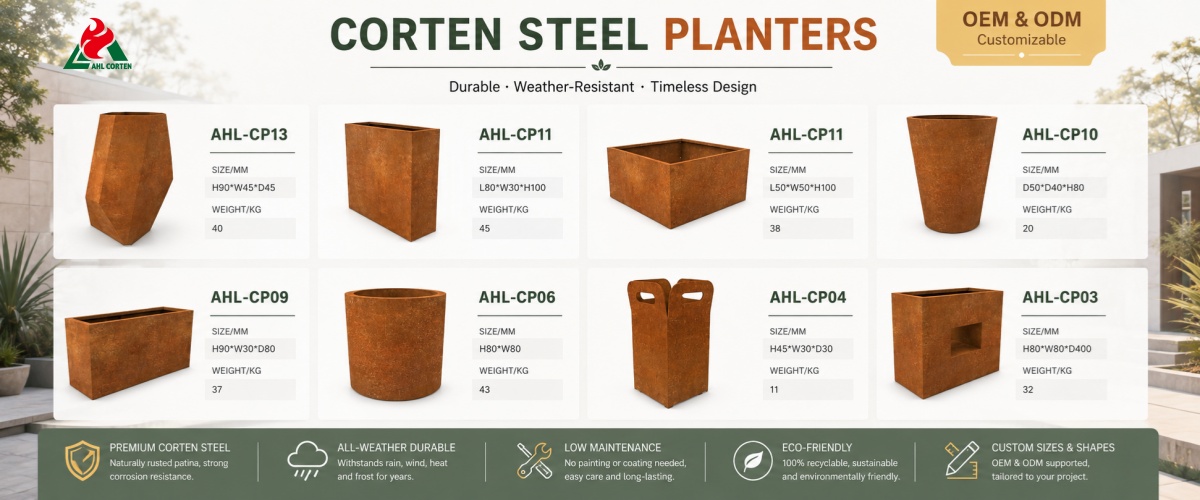
Why Are the Dimensions of Corten Planter Boxes So Critical?
Dimensions are the core criterion for selecting large outdoor metal planters, directly determining plant survival, the planter’s lifespan, the aesthetic appeal of your garden, and site safety—all four core values are indispensable.
1. Determining Plant Growth and Root Health
The width and depth of a planter directly control the amount of soil it holds. Soil acts as a buffer layer that insulates and retains moisture for plant roots. Planters that are too small or too shallow cause the soil to heat up rapidly in summer and freeze through easily in winter, making the roots susceptible to damage.
At the same time, cramped spaces cause plant roots to coil and knot, resulting in “root-bound seedlings” that suffer from stunted growth, malnutrition, wilting, and premature aging. Appropriate dimensions ensure the roots can spread out, maintain stable soil temperature and humidity, and reduce the frequency of watering.
2. Impact on the Structural Stability and Service Life of Rusted Steel Planters
Moist soil is extremely heavy. If the walls of an oversized planter are not thick enough, prolonged exposure to lateral soil pressure can cause the side panels to bulge, deform, or develop cracks in the welds.
Only when the dimensions are precisely matched to the steel thickness can the structural integrity of the planter be ensured. High-quality weathering steel can last stably for over 40 years under normal outdoor conditions; however, a mismatch between dimensions and thickness will significantly shorten its service life.
3. Maintaining the Overall Visual Proportions and Aesthetics of the Yard
If the dimensions of rusted metal planter boxes are out of balance with the yard space, it will directly diminish the quality of the landscape. Pairing a small balcony with an oversized planter box will make the space feel cramped and oppressive, while placing a miniature planter box in a spacious yard will make it appear sparse and empty.
Reasonable size proportions allow the planter boxes to blend seamlessly with buildings, walkways, and greenery, creating a neat and sophisticated sense of depth in the yard.
4. Avoiding Safety and Maintenance Risks
Large, fully loaded planters can weigh hundreds of jin. When placed on elevated areas such as balconies or rooftop terraces, oversized planters can easily lead to structural overload risks.
Additionally, larger planters have a greater surface area exposed to the elements, resulting in more noticeable rust runoff during the initial period. Drainage and protective measures must be planned in advance based on the planter’s dimensions to prevent staining of the ground.

3 Key Factors for Selecting Corten Planter Dimensions
There’s no need to blindly follow trends—simply follow these three key factors to precisely identify the right size that balances practicality and aesthetics.
1. Based on Mature Plant Size and Root Depth
Core Selection Principle: Choose based on the plant’s mature size, not its seedling size. Small planters designed for seedlings cannot support long-term growth and will inevitably lead to stunted growth later on.
2. Based on the Actual Available Space in the Yard
Accurately measure the length and width of the placement area, the distance between pathways, and the ceiling height. For small living spaces, prioritize lightweight, slim, and compact sizes; for large yards, opt for large-sized or modular planters to ensure the space remains open and uncrowded.
3. Based on the Site’s Load-Bearing Capacity and Paving Materials
Full-size planters are suitable for ground-level gardens; for balconies and rooftop terraces, strictly calculate the load-bearing capacity and prioritize lightweight, shallow models.
In areas paved with light-colored stone, permeable pavers, or wood, pay special attention to rust runoff from large planters and take protective measures in advance.

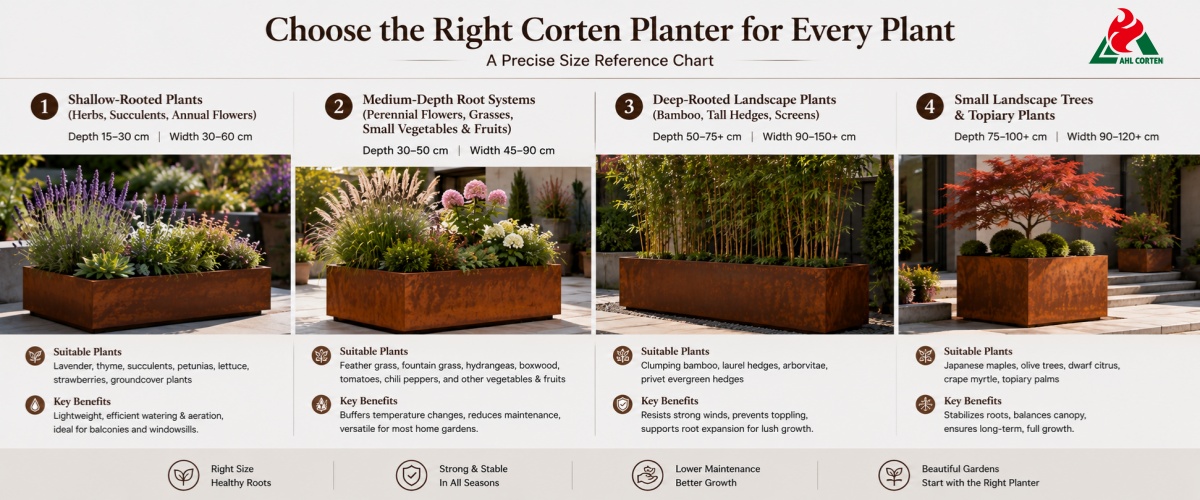
Selecting the Right Corten Planter by Plant Type: A Precise Size Reference Chart
The root growth habits of different plants vary greatly, and the corresponding standards for planter depth and width differ accordingly. Below are general and precise selection guidelines.
1. Shallow-Rooted Plants (Herbs, Succulents, Annual Flowers)
- Recommended Dimensions: Depth 15–30 cm, Width 30–60 cm
- Suitable varieties: Lavender, thyme, succulents, petunias, lettuce, strawberries, groundcover plants
- Selection benefits: A shallow soil layer supports shallow root growth, requiring less soil and resulting in a lighter overall weight. It also ensures efficient watering and aeration, making it ideal for small spaces such as balconies and windowsills.
2. Plants with Medium-Depth Root Systems (Perennial Flowers, Ornamental Grasses, Small Vegetables and Fruits)
- Recommended Dimensions: Depth 30–50 cm, width 45–90 cm
- Suitable Plants: Feather grass, fountain grass, hydrangeas, boxwood hedges, tomatoes, chili peppers, and other common vegetables and fruits
- Selection Advantages: Ample soil volume helps buffer seasonal temperature fluctuations, preventing summer drought and winter root freeze, and significantly reducing maintenance frequency. This is the most versatile size range for home gardens.
3. Deep-Rooted Landscape Plants (Bamboo, Tall Hedges, Landscape Screens)
- Recommended Dimensions: Depth 50–75 cm or more, width 90–150 cm or more; long, trough-style designs are preferred
- Suitable Plant Types: Clumping bamboo, laurel hedges, arborvitae, privet evergreen hedges
- Selection Advantages: Larger dimensions provide greater self-weight, effectively resisting strong winds and preventing tall plants from toppling over; ample space accommodates root expansion, ensuring lush, well-formed foliage.
4. Small Landscape Trees and Topiary Plants
- Recommended Dimensions: Depth 75–100 cm or more, width 90–120 cm or more
- Suitable Plant Types: Japanese maples, olive trees, dwarf citrus, crape myrtle, topiary palms
- Selection Advantages: The extra-large soil volume stabilizes tree roots, balances the tree’s canopy, buffers against extreme temperatures, and ensures long-term, stable growth and a full, lush shape for landscape trees.
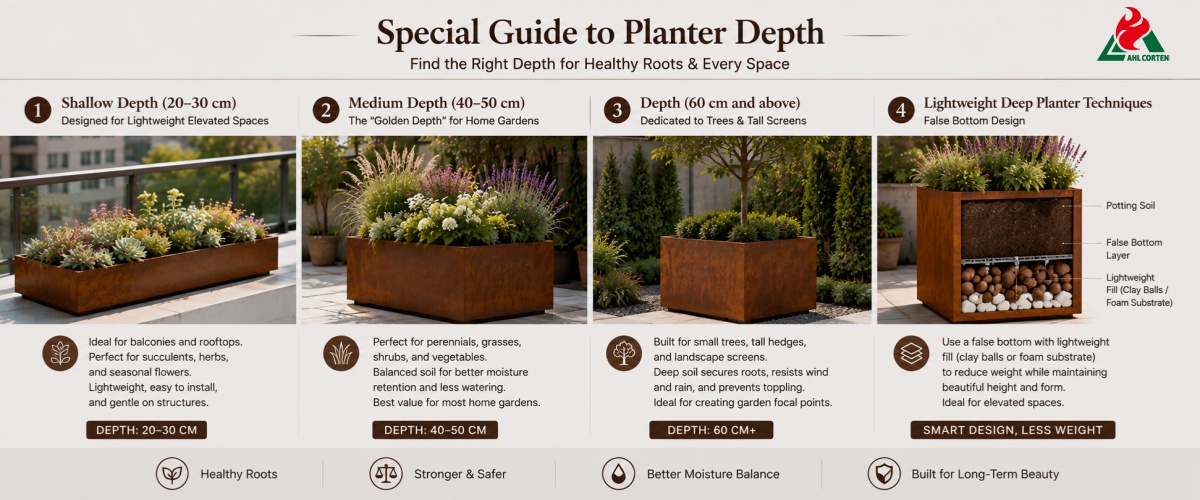
Special Guide to Planter Depth: Optimal Depth Standards for Different Scenarios
Depth is a more critical selection criterion than length or width, as it directly determines the survival quality of plant root systems. Different scenarios have specific optimal depth ranges.
1. Shallow Depth (20–30 Cm): Designed for Lightweight Elevated Spaces
Suitable for areas with limited load-bearing capacity, such as balconies and rooftop terraces. Ideal for growing succulents, herbs, and seasonal flowers. The overall weight is manageable, installation is convenient, and it does not place undue stress on elevated structures.
2. Medium Depth (40–50 cm): The “Golden Depth” for Home Gardens
Suitable for the vast majority of perennials, ornamental grasses, small-to-medium shrubs, and vegetables and fruits. The soil provides a balanced combination of heat retention and moisture retention, reducing the need for frequent watering. It strikes a balance between aesthetics and low-maintenance requirements, offering the best value for money.
3. Depth (60 cm and above): Dedicated to Landscape Trees and Tall Screens
Designed specifically for small trees, tall hedges, and landscape screens, the ample depth secures plants, withstands wind and rain, and prevents top-heavy plants from toppling over, making it ideal for creating the main focal point of a garden.
4. Techniques for Lightweight Deep Planters: False Bottom Design
Many people prefer the three-dimensional appearance of tall planters but do not need to grow deep-rooted plants. You can use an internal false bottom or storage layer design, filling the bottom with lightweight expanded clay pellets or foam substrate and covering it with potting soil.
This method preserves the planter’s attractive three-dimensional proportions while significantly reducing the overall weight and minimizing soil waste, making it ideal for landscaping in elevated areas.
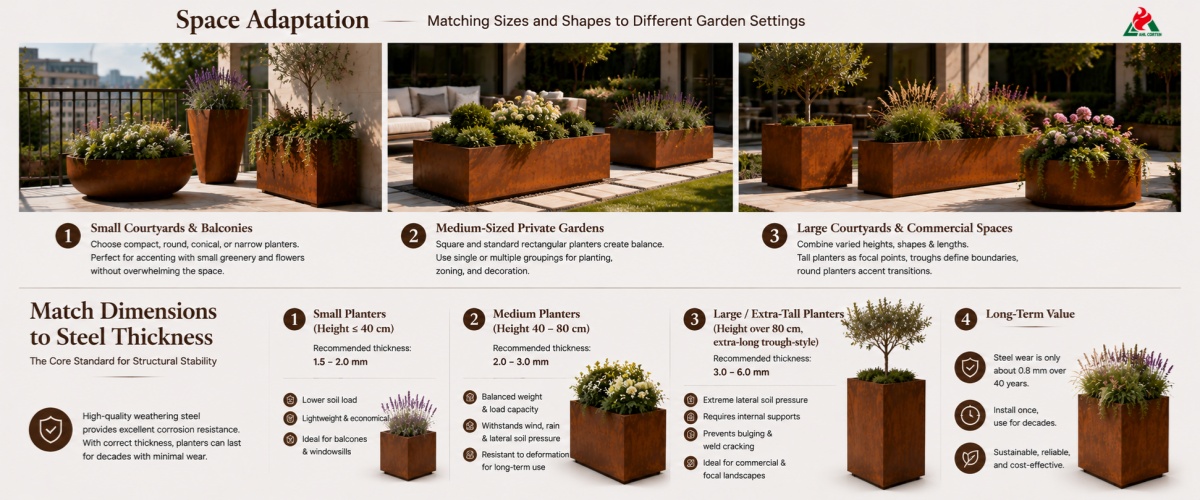
Space Adaptation: Matching Sizes and Shapes to Different Garden Settings
Planter sizes must be tailored to the scale of the space and the style of the site to maximize the landscape effect.
1. Small Courtyards and Balconies
Prioritize compact, round, conical, or narrow-sided rectangular planters, which are compact in size and create a light, airy visual impression. Avoid wide, bulky designs to prevent the space from feeling cramped and oppressive; these planters are best suited for accenting with small greenery and flowers.
2. Medium-Sized Private Gardens
Square and standard rectangular planters are the optimal choice, offering neat dimensions and balanced proportions. They can be arranged in single groups to create a symmetrical landscape or in multiple groups to delineate functional zones within the courtyard, serving the triple purpose of planting, zoning, and decoration.
3. Large Courtyards and Commercial Landscape Spaces
Use a combination of varying heights, shapes (square, round, and rectangular), and lengths. Tall planters serve as visual focal points, long trough-style planters define the boundaries of the space, and round planters accent transitional areas, enriching the landscape’s depth and preventing large open spaces from appearing monotonous or empty.
Matching Dimensions to Steel Thickness: The Core Standard for Structural Stability
The wall thickness of corten steel trough planters must increase as the size increases; otherwise, prolonged pressure may cause deformation or cracking, directly affecting their service life.
1. Small Planters (Height ≤ 40 cm)
Recommended wall thickness: 1.5–2.0 mm
Due to their small size and low soil load, thinner steel is sufficient to ensure stability. These planters are lighter in weight and offer better value for money, making them ideal for placement on balconies and windowsills.
2. Medium-sized planters (height 40–80 cm)
Recommended wall thickness: 2.0–3.0 mm
These are the standard sizes for home gardens. They strike a balance between weight and load-bearing capacity, withstanding daily exposure to wind and rain as well as lateral soil pressure, and are resistant to deformation over long-term use.
3. Large/Extra-Tall Planters (height over 80 cm, extra-long trough-style)
Recommended wall thickness: 3.0–6.0 mm; must be reinforced with internal supports
Large planters experience extreme lateral soil pressure. The combination of thick-walled steel and an internal cross-brace structure completely eliminates issues such as side panel bulging and weld seam cracking, making them suitable for commercial landscaping and as focal points in gardens.
4. Long-Term Value
High-quality weathering steel offers exceptional corrosion resistance; under normal outdoor conditions, steel wear is only about 0.8 mm over 40 years. Planters with precisely matched dimensions and thicknesses can be installed once and used reliably for decades.
8 Common Mistakes in Selecting Corten Steel Planter Sizes (A Guide to Avoiding Pitfalls)
1. Focusing Only on Appearance and Ignoring Plant Root Requirements
Many visually appealing narrow or tall planters have extremely limited internal planting space and are only suitable for short-term display of seedlings. Long-term planting can lead to root restriction and premature plant decline; never choose a planter based solely on its appearance.
2. Insufficient Depth Doubles Maintenance Difficulty
Shallow planters hold little soil. In summer, water evaporates quickly and there are large temperature fluctuations between day and night, making plants extremely prone to drought and wilting. This requires frequent watering and maintenance, which is time-consuming and labor-intensive.
3. Ignoring the Total Weight Can Lead to Overloading of the Supporting Structure
Empty planters are relatively lightweight, but their weight doubles once filled with moist soil and plants. Installing large planters on balconies or rooftops without first calculating the load-bearing capacity poses significant safety hazards.
4. Neglecting Drainage Design Makes It Difficult To Grow Plants Well, Even With The Right Size
Regardless of size, planters must be equipped with drainage holes. Poor drainage leads to waterlogging and root rot; furthermore, prolonged moisture in the planter will damage the natural patina of weathering steel, compromising both aesthetics and durability.
5. Inappropriate Soil Mix Impedes Root Growth
Large corten steel planters must never be filled with heavy garden soil or pure potting mix, as these tend to compact and retain water. The soil should be amended with coarse-grained soil and gravel to ensure proper aeration and drainage.
6. Failure to Plan for Rust Runoff Can Stain Paved Surfaces
New weathering steel planters undergo a natural weathering period of 6–12 months, during which rust runoff occurs. Larger planters have a greater weathered surface area, resulting in more noticeable runoff; therefore, light-colored stone or wooden surfaces must be protected in advance.
7. Inaccurate Site Measurements Lead to Overcrowded Placement
If passageways and doorways are not accounted for before purchase, large planters may obstruct walkways, doors, and windows once installed, affecting daily access and site usage.
8. Haphazard Installation of Liners Impedes Drainage and Aeration
Inappropriate liners can trap water and cause root suffocation, while also blocking the steel’s natural cycle of drying and wetting. This prevents weathering steel from forming a stable protective layer, accelerating localized rusting and deterioration.
.jpg)
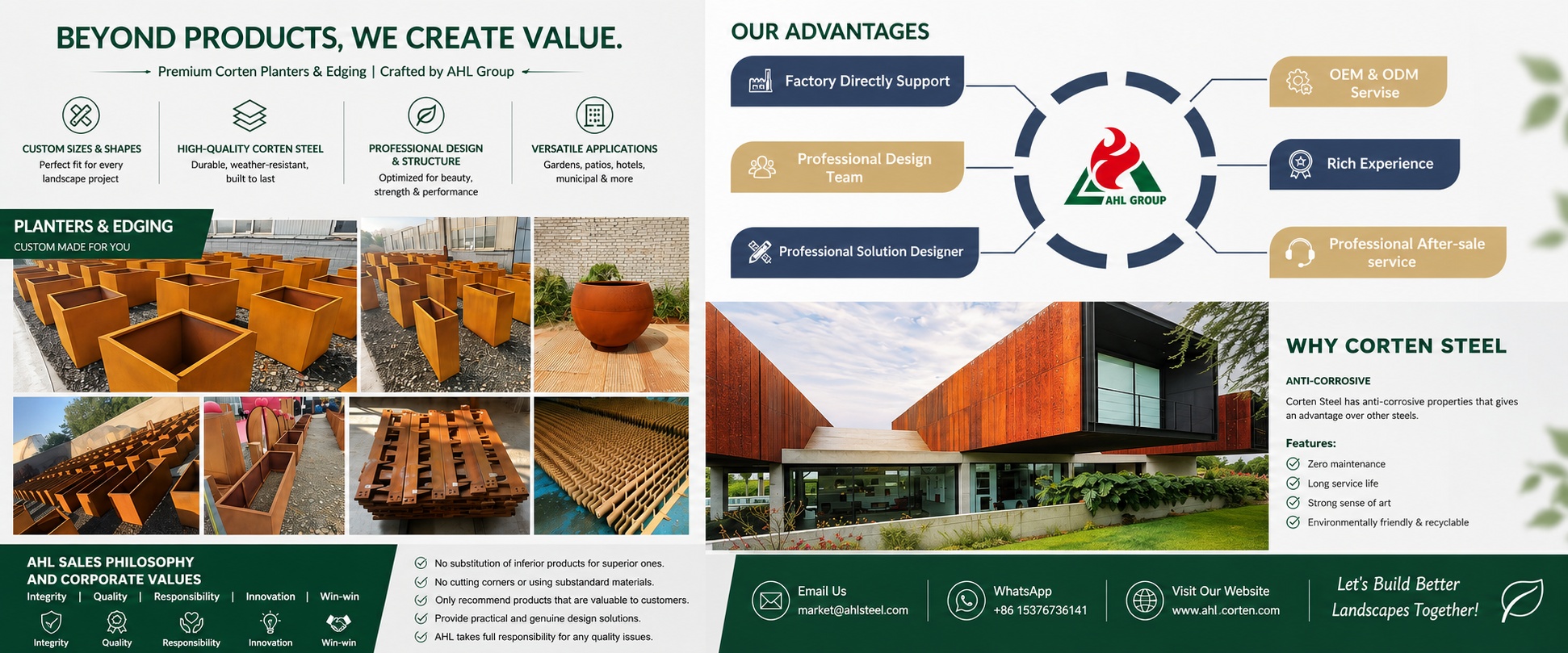
AHL Custom Corten Planters: Full Range of Sizes to Suit All Types of Landscape Projects
Standardized sizes often fail to accommodate all garden layouts and landscaping needs. AHL offers a full range of sizes and shapes for custom weathering steel planters, suitable for a variety of settings including residential gardens, patios, hotel landscapes, and municipal landscaping.
1. Comprehensive Customization Services
We support customization of length, width, height, planting depth, and steel thickness, covering a wide range of shapes—including square, rectangular, circular, conical, and irregular—to perfectly match site dimensions and design styles.
2. Professional Structural Optimization Design
We can configure pre-weathered finishes, internal false bottoms, drainage systems, and reinforced support structures as needed, balancing lightweight construction, stability, and aesthetics while addressing common issues with standard planters such as warping, water pooling, and staining.
3. Versatility Across Multiple Settings
Whether for small apartment balconies, private gardens, large commercial plazas, or rooftop gardens, we provide customized sizing solutions that harmonize aesthetic appeal with practicality.
.jpg)
Are You Ready to Choose Your Very Own Outdoor Corten Steel Planter?
When selecting the size of a rusted steel planter, the key is not to pursue larger or more elaborate designs, but to precisely match the plant’s growth habits, spatial dimensions, and site conditions.
Reasonable dimensional proportions not only ensure healthy plant growth and reduce maintenance costs but also maximize the aesthetic advantages of weathering steel, creating a long-lasting garden landscape that becomes more refined and durable over time.
Standardized sizes are suitable for most home gardening scenarios, while custom solutions are recommended for unique home layouts and commercial landscapes to avoid issues such as dimensional imbalance, structural instability, and visual disharmony from the outset.
Get a Quote
Frequently Asked Questions (FAQ) About Corten Steel Planters
1. What Are the Most Common Sizes for Corten Planters in Home Gardens?
A depth of 40–50 cm with standard square or rectangular dimensions is the optimal choice. These sizes accommodate the vast majority of flowers, shrubs, and ornamental grasses, balancing the three key advantages of being easy to care for, visually appealing, and low-maintenance.
2. Can Large Weathering Steel Planters Be Placed On Balconies And Rooftops?
Yes, but the site’s load-bearing capacity must be verified in advance. Prioritize models with a lightweight design featuring a false bottom to reduce the weight of fill material, while ensuring proper ground protection and drainage.
3. How Can Size Design Help Prevent Root System Aging in Plants?
Allow for sufficient depth and width based on the mature root system size of the plant, rather than just the size of the seedling. For large trees and tall hedges, prioritize large, deep planters to ensure long-term space for the root system to spread.
4. Do Planter Dimensions Affect the Patina Formation on Weathering Steel?
Yes. Larger planters have a greater surface area exposed to the elements, resulting in more noticeable rust runoff initially, but the patina forms at a relatively even rate. Smaller planters experience faster cycles of drying and wetting, leading to a shorter patina formation period and a finer overall texture.
Back

 Fill In The Inquiry