Corten Steel Edging Installation Depth Guide
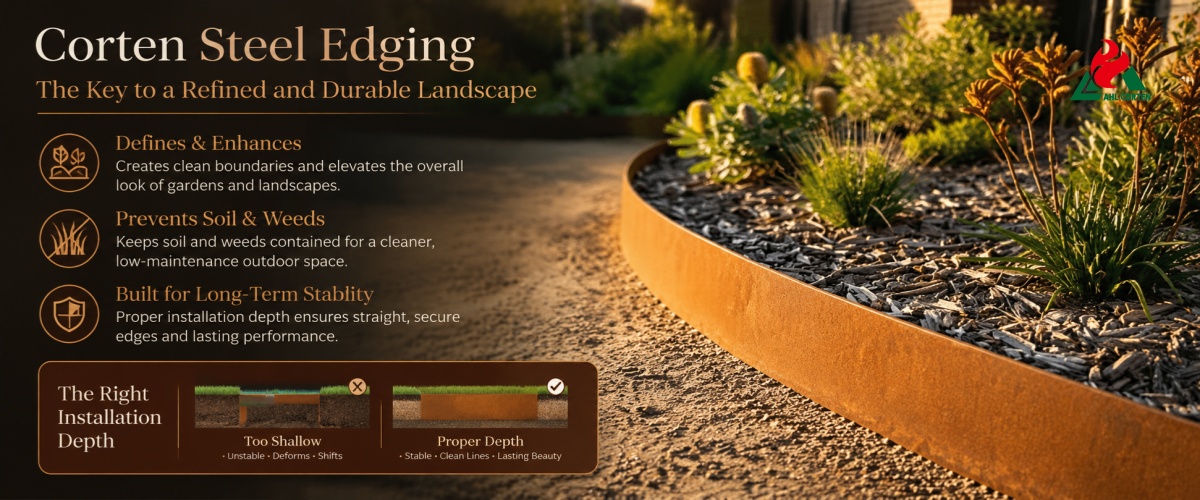
Corten steel edging is a key finishing material for modern gardens and landscape design, widely used for flower beds, lawns, walkways, and landscape boundaries. It helps define the layout of a space, prevents soil and weeds from spreading, and significantly enhances the overall refinement of the landscape.
Many construction and gardening enthusiasts focus solely on the material’s appearance, yet overlook the critical detail of installation depth. Improper installation depth directly affects the structural stability of the edging, its effectiveness in preventing weed growth, and the overall aesthetic appeal.
If buried too shallowly, the edging strips are prone to loosening, deforming from being stepped on, or shifting as they are pushed up by soil or grass roots. If buried too deeply, they obscure the visible surface, impair drainage, and make the landscape boundary appear bulky and oppressive.
Adhering to the standard installation depth ensures that the weathering steel edging remains straight and secure, with clean, crisp lines, truly achieving a “design-grade boundary effect” rather than serving as a mere decorative metal strip.
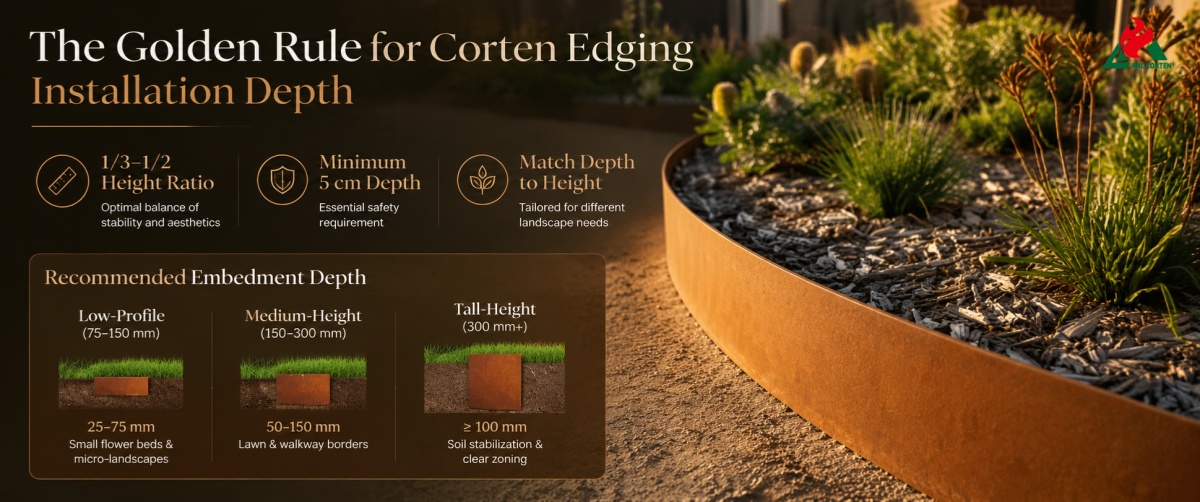
The Golden Rule for Corten Edging Installation Depth
1. Average Burial Depth Ratio: The 1/3–1/2 Principle
The general standard for burial depth in the vast majority of landscaping scenarios is 1/3 to 1/2 of the total height. This ratio represents the optimal balance between stability and aesthetics.
Taking a common 150mm-high edging strip as an example, the standard burial depth should be maintained between 50–75mm. This firmly secures the profile while preventing it from being pushed up by grass roots or soil, and ensures sufficient vertical clearance to display a clean, defined edge.
2. Minimum Safe Burial Depth: 5 cm (2 inches) Threshold
Regardless of the setting or height, the minimum burial depth for weathering steel edging must not be less than 5 cm. This is an essential safety requirement during installation and must be strictly adhered to.
Meeting the required burial depth serves three key functions: concealing fasteners to enhance overall aesthetics; strengthening resistance to displacement caused by foot traffic and soil expansion; and blocking the lateral spread of grass roots from the base layer to achieve effective weed control.
3. Match the Embedment Depth to the Edging Height
Weathering steel edging of different heights experiences varying stress levels and is used in different scenarios, so embedment depth standards must be tailored accordingly:
Low-profile edging (75–150 mm): Embedment depth of 25–75 mm, suitable for small flower beds and micro-landscapes, emphasizing a refined visual boundary.
Medium-height edging (150–300 mm): Burial depth of 50–150 mm, suitable for lawn and walkway borders, balancing weed control, soil stabilization, and structural stability.
Tall-height edging (300 mm and above): Burial depth of 100 mm or more, used in areas requiring strong soil stabilization and clear zoning to create a bold, defined three-dimensional boundary.
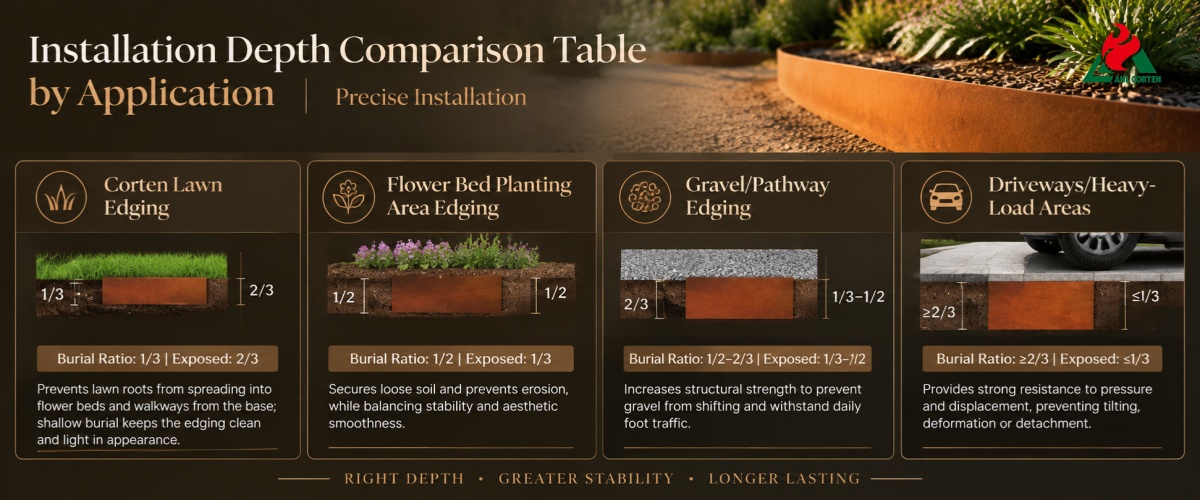
Installation Depth Comparison Table by Application (Precise Installation)
1. Corten Lawn Edging
Burial Ratio: 1/3 of total height, with 2/3 exposed above ground.
Key Function: Prevents lawn roots from spreading into flower beds and walkways from the base; the shallow burial ratio ensures the edging does not appear bulky, maintaining clean, light lines in the landscape.
2. Flower Bed Planting Area Edging
Burial Ratio: 1/2 of total height, with 1/2 exposed above ground.
Since flower bed soil is loose and prone to erosion, a half-buried installation effectively secures the profiles, preventing soil loss and boundary collapse while balancing stability with aesthetic smoothness.
3. Gravel/Pathway Edging
Burial Ratio: 1/2–2/3 of total height, with 1/3–1/2 exposed above ground.
Pathways experience frequent foot traffic, and gravel tends to spill out. Increasing the burial depth enhances structural strength, effectively preventing gravel from shifting and withstanding daily wear and tear from foot traffic.
4. Driveways/Heavy-Load Areas
Burial Depth Ratio: 2/3 or more of the total height, with no more than 1/3 exposed above ground.
These areas are at risk of vehicle crushing and heavy-object compression. A deeper burial significantly enhances resistance to pressure and displacement, preventing the edging from tilting, deforming, or detaching.
3 Key Environmental Factors Affecting the Burial Depth of Corten Edging
1. Soil Conditions
Loose Soil: A greater burial depth is required to enhance soil grip and prevent the edging from being lifted or displaced by the soil.
Hard Clay: The soil layer is dense and stable, so a standard shallow burial depth can be used without the need for excessive excavation.
Sandy Soil: The soil is loose and prone to subsidence; a greater burial depth is required, along with additional anchor piles for reinforcement to prevent loosening.
2. Climatic Conditions
Permafrost Regions: A greater burial depth is mandatory to prevent frost heave from lifting or distorting the edging strips.
Rainy and Humid Regions: Standard burial depth is appropriate, with a focus on optimizing drainage at the base to prevent long-term waterlogging from causing structural loosening.
Arid Regions: Soil is prone to drying, shrinking, and cracking; increasing the burial depth can reduce loosening and displacement caused by gaps in the soil layers.
3. Edging Height
The taller the corten steel edging, the greater its susceptibility to wind pressure and earth pressure; the burial depth must be correspondingly increased. Shallow burial of tall edging is highly prone to tilting, swaying, and displacement; strict adherence to the “taller edging requires deeper burial” principle is essential to ensure long-term stability.

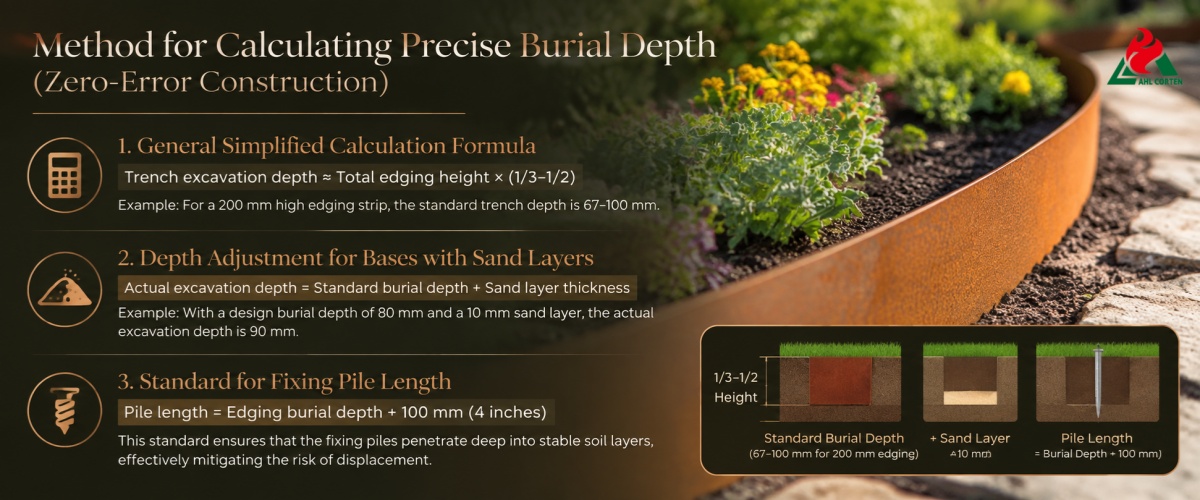
Method for Calculating Precise Burial Depth (Zero-Error Construction)
1. General Simplified Calculation Formula
Trench excavation depth ≈ Total edging height × (1/3–1/2)
Example: For a 200 mm high edging strip, the standard trench depth is 67–100 mm, suitable for the vast majority of conventional landscape projects.
2. Depth Adjustment for Bases with Sand Layers
To facilitate leveling and improve drainage and stability, it is recommended to lay a 5–10 mm layer of fine sand at the bottom of the trench. In this case, the excavation depth must be adjusted as follows:
Actual excavation depth = Standard burial depth + Sand layer thickness
Example: With a design burial depth of 80 mm and a 10 mm sand layer, the actual excavation depth is 90 mm. This effectively prevents localized stress concentration and reduces deformation of the edging.
3. Standard for Fixing Pile Length
The length of the fixing piles must match the burial depth. Standard reference: Pile length = Edging burial depth + 100 mm (4 inches).
This standard ensures that the fixing piles penetrate deep into stable soil layers, effectively mitigating the risk of displacement caused by soil expansion, frost heave, or external foot traffic.
Standardized Installation Steps (Focus on Depth and Levelness)
1. Layout and Positioning
Use rope, spray paint, or wooden stakes to mark the edging boundaries. Ensure straight sections are perfectly straight and smooth, and curved sections follow the designed curvature to avoid abrupt bends, laying the foundation for precise trenching.
2. Precise Trenching
Dig the trench to the calculated depth, ensuring that the trench bottom is as level as possible. The trench width should be slightly greater than the edging thickness to allow for minor adjustments during subsequent alignment and leveling.
3. Laying a Sand Bed (Recommended)
Laying a 5–10 mm layer of fine sand at the bottom of the trench is a best practice. This allows for flexible adjustment of the edging’s height and levelness while optimizing drainage at the base and preventing waterlogging that causes root rot and bottom loosening.
4. Installation, Positioning, and Leveling
Install the edging strips section by section, starting in the corner. Continuously check the exposed height throughout the process to ensure uniform overall height. Use a rubber mallet to gently tap the edging into place; avoid forceful hammering to prevent deformation of the steel.
5. Securing, Backfilling, and Compacting
In standard areas, place one anchor stake every 60–90 cm; in corner areas subject to concentrated stress, add an additional anchor stake every 30 cm to reinforce stability at critical points.
After installation, backfill with soil or crushed stone in layers, compacting each layer to ensure the metal landscape edging fits snugly against the soil, preventing future settlement or loosening.
.jpg)
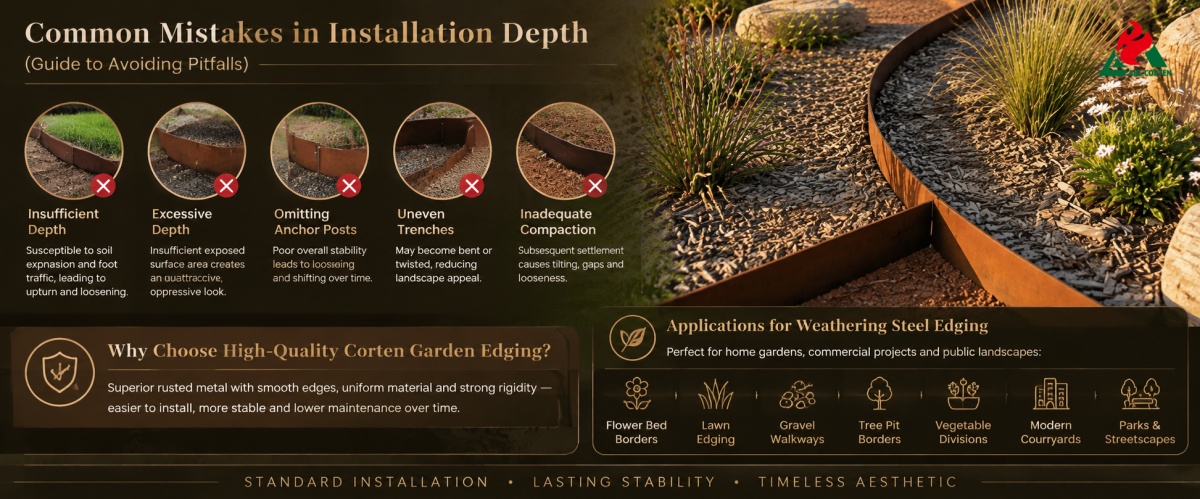
Common Mistakes in Installation Depth (Guide to Avoiding Pitfalls)
Insufficient Depth: Highly susceptible to soil expansion, foot traffic, and frost heave, leading to displacement,Upturn, and loosening.
Excessive Depth: Insufficient exposed surface area results in a lack of visual depth along the boundary, creating an oppressive and unattractive overall landscape.
Omitting Anchor Posts: Poor overall structural stability inevitably leads to loosening and shifting over time.
Uneven Trenches: After installation, corten metal edging may become bent or twisted, significantly reducing the landscape’s aesthetic appeal.
Inadequate compaction of backfill: Subsequent soil settlement causes the edging to tilt, develop gaps, and become loose or deformed.
Why Choose High-Quality Corten Garden Edging?
High-quality rusted metal garden edging features smooth edges, uniform material composition, and greater structural rigidity. During installation, it is easier to maintain straight lines and consistent height, making it compatible with standard burial depth practices and offering a higher margin for error.
High-quality profiles offer stable weather resistance; they are resistant to rust, damage, deformation, and failure during long-term outdoor use, eliminating the need for frequent repairs or replacements and significantly reducing long-term maintenance and rework costs.
From a construction perspective, combining high-quality materials with standard burial depth techniques makes it easy to create professional-grade landscape edging, comprehensively enhancing the aesthetic quality of residential and commercial landscapes.
Applications for Weathering Steel Edging
Rusted metal garden edging is suitable for all types of landscape settings, ranging from private home gardens to commercial projects: flower bed borders, lawn edging, gravel boundaries for walkways, tree pit borders, vegetable garden divisions, modern courtyards, commercial street landscapes, park renovation projects, and more.
Whether in a small private garden or a large-scale commercial landscape, standardized installation of weathering steel edging creates clear, clean-cut boundaries that enhance the overall design aesthetic and cohesiveness.
Frequently Asked Questions (FAQ) About Corten Steel Edging
Q1: What Is The Minimum Burial Depth For Corten Edging?
The general safety standard is 5 cm (2 inches). This depth conceals fasteners, prevents displacement, and blocks the spread of grass roots, meeting basic installation requirements.
Q2: Is Trenching Required For Installing Weathering Steel Edging?
Yes, trenching is required. Trenching allows for precise control of burial depth and levelness, ensuring the edging is straight and secure—it is a fundamental process for preventing future issues.
Q3: How Should the Burial Depth Be Adjusted for Soft Soil?
The burial depth should be appropriately increased beyond half the standard depth, while also increasing the number of anchor posts to strengthen the soil’s grip on the edging.
Q4: How Is the Standard Length of the Anchor Stakes Determined?
Anchor stake length = actual burial depth + 100 mm, ensuring sufficient anchorage depth for stability and preventing displacement.
Q5: How Should Installation Be Carried Out In Permafrost Regions?
Increase the burial depth to two-thirds or more of the total height, and prioritize proper drainage at the base to prevent water accumulation and freezing, which can cause the edging to deform or warp.
Are You Ready to Choose the Perfect Outdoor Corten Steel Lawn Edging for Your Space?
The final result of rusted steel edging depends 30% on the material and 70% on the installation—with installation depth being the critical factor. Precise and compliant burial depth can completely resolve common issues such as loosening, displacement, weed growth, and messy lines.
By following scenario-specific burial depth standards, making minor adjustments based on soil type and climate, applying proper construction techniques, and selecting high-quality weathering steel edging, you can create a design-grade landscape border that is sturdy, durable, and clean-lined—combining both aesthetic appeal and practicality—ensuring your garden looks its best for years to come.
Contact us today for a Free Quote on Corten Steel Edging!
Back


 Fill In The Inquiry