Are Corten Steel Planters Better Than Fiberglass Planters?
When selecting planters for courtyards, commercial landscapes, and outdoor balconies, the decision goes far beyond mere aesthetics. The material of the planter directly determines the overall landscape’s lifespan, long-term maintenance costs, structural stability, and the overall design quality of the space. Currently, the two most popular materials for outdoor planters are corten steel planters and fiberglass planters.
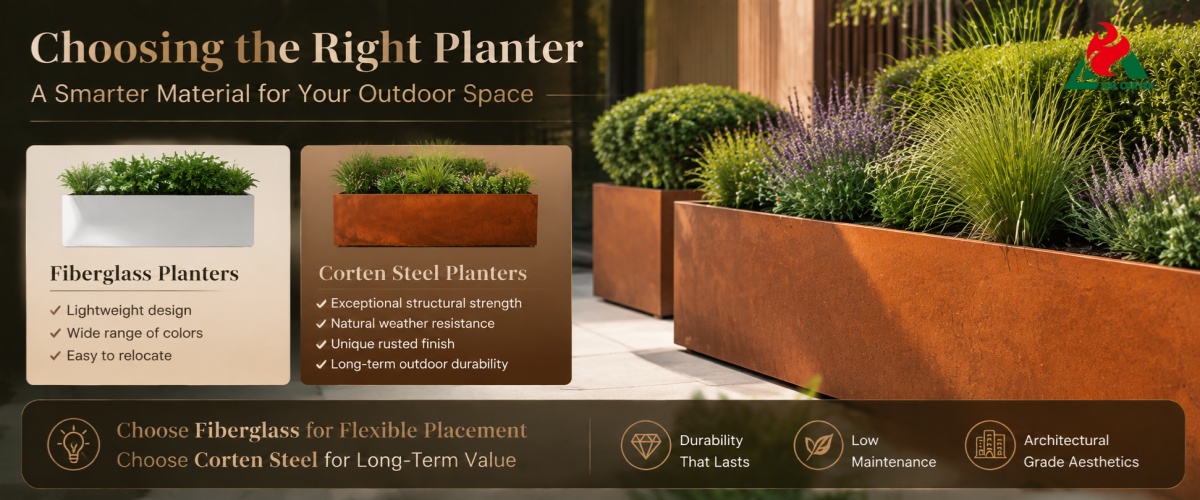
Fiberglass planters, with their lightweight design, wide range of colors, and ease of relocation, are well-suited for a variety of temporary or ever-changing landscape settings. Weathered steel planters, on the other hand, offer exceptional structural strength, natural weather resistance, and a unique, vintage rusted finish, making them the preferred choice for long-term outdoor landscaping.
Simply put: if you’re looking for flexible placement and short-term landscaping, choose fiberglass; if you prioritize long-term durability, low maintenance, and architectural-grade aesthetic quality, custom corten steel planters are the better investment.
Core Characteristics of Both Types of Planters
1. What are Weathering Steel Planters?
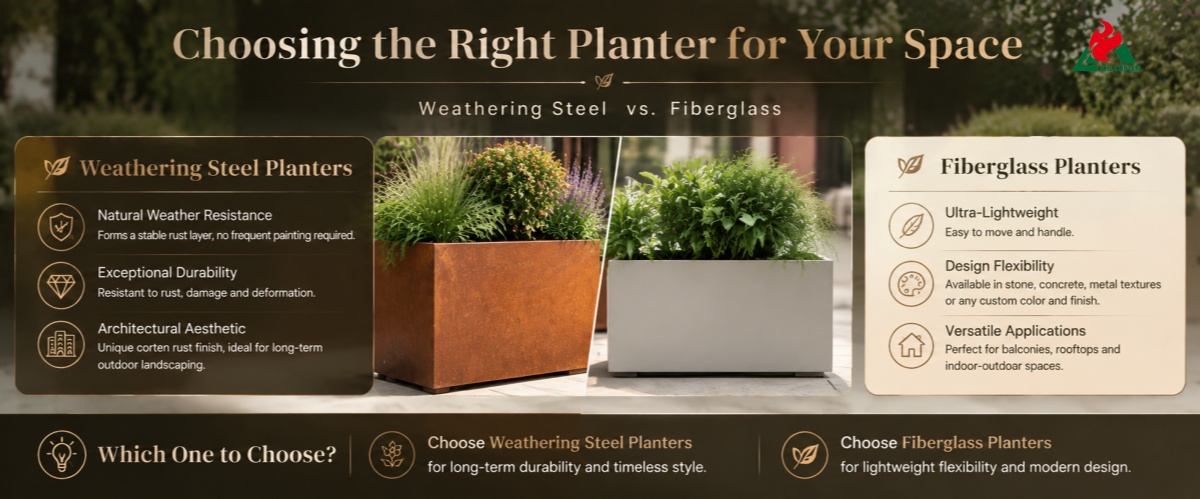
Weathering steel planters are made from weathering steel specifically designed for outdoor use and are metal planting containers developed exclusively for open-air landscaping. Unlike ordinary steel, weathering steel gradually forms a dense, stable layer of rust under the influence of sunlight, rain, and natural ventilation.
This natural protective layer prevents further corrosion of the steel beneath, eliminating the need for frequent manual painting or rust-proofing treatments. Over time, the surface of the planter will develop a natural gradient of orange-brown, reddish-brown, and dark brown hues, giving it an increasingly rich and distinctive texture.
Corten steel trough planters are designed for long-term, permanent landscaping and are suitable for residential courtyards, villa entrances, hotel and commercial landscapes, parks, plazas, and other permanent outdoor landscaping projects.
Tip: During the initial weathering phase, weathering steel planters may produce a slight rust-colored runoff. When placed on light-colored floors or walls, take drainage and protective measures in advance.
2. What are Fiberglass Planters?
Fiberglass planters are lightweight planting containers made from a composite of resin and glass fiber, and they are currently the mainstream material for lightweight landscaping. Through process adjustments, they can replicate the textures of stone, concrete, and metal, and can also be customized with any solid color, matte, or glossy finish.
The greatest advantages of fiberglass planters are their extremely light weight, ease of handling, and high design flexibility. They are ideal for balconies, rooftop gardens, indoor-outdoor transition spaces, and settings that require frequent layout adjustments or seasonal changes.
It is important to note that the outdoor durability of fiberglass planters depends entirely on the quality of the resin, UV protection process, and surface coating; the lifespan of different products can vary significantly.
Comprehensive Comparison of Key Dimensions: Weathering Steel vs. Fiberglass Planters
1. Structural Strength and Stability
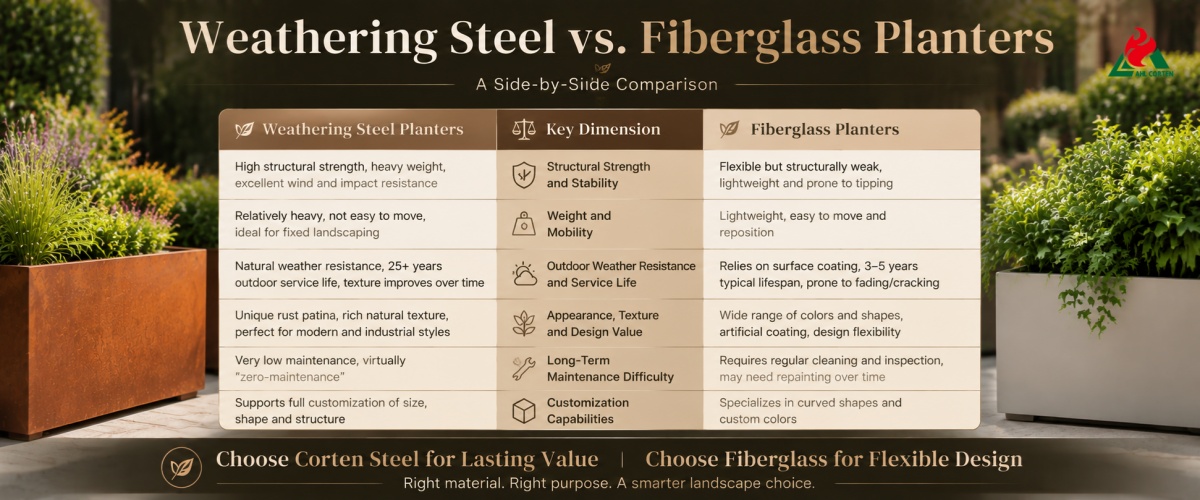
Bespoke corten steel planters: The one-piece metal construction offers extremely high structural strength and outstanding load-bearing capacity. Even when filled with soil and planted with large shrubs or landscape trees, they will not deform or crack. Their substantial weight provides excellent wind and impact resistance, allowing them to remain stable even in open-air environments with strong winds or in public areas with heavy foot traffic.
Fiberglass Planters: The material is flexible but structurally weak, and the planters are too lightweight. When planted with large greenery and filled with soil, they are highly prone to tipping over or shifting when exposed to strong winds or external impacts. Long-term outdoor use may also lead to localized deformation and surface cracking.
2. Weight and Mobility
Weathering Steel Planters: Their overall weight is relatively heavy, making them unsuitable for frequent relocation. However, this characteristic makes them ideal for fixed landscaping, allowing them to remain in place for extended periods without the need for repeated adjustments—a key advantage for permanent garden landscaping.
Fiberglass Planters: Lightweight design is their key feature; a single person can easily move and reposition them. They are well-suited for scenarios requiring frequent changes, such as temporary exhibition displays, seasonal balcony rearrangements, and temporary setups for commercial events, offering maximum flexibility.
3. Outdoor Weather Resistance and Service Life
Corten Steel Planters: Possess natural outdoor weather resistance and feature a built-in corrosion-resistant passivation layer. They can withstand year-round exposure to sunlight, rain, seasonal temperature fluctuations, and freeze-thaw cycles without requiring manual protection. High-quality weathering steel planters have an outdoor service life of over 25 years, and their texture improves with use.
Fiberglass Planters: Lacks natural weather resistance; protection relies entirely on the surface coating and resin material. Prolonged exposure to direct sunlight can cause fading, chalking, and coating peeling, while freezing and thawing cycles at low temperatures can lead to aging and cracking. Standard-quality products typically show noticeable signs of aging within 3–5 years.
4. Appearance, Texture, and Design Value
Weathered Steel Planters: They feature a unique, naturally weathered rust patina, with hues that slowly evolve over time, depending on climate and environment; the texture of each planter is one-of-a-kind. They complement modern, minimalist, industrial, and natural-style gardens, pairing perfectly with stone, wood, concrete, and glass, making them landscape elements that combine both decorative and structural functions.
Fiberglass Planters: They offer an extremely wide range of colors, shapes, and textures, allowing for precise matching with building facades, brand color schemes, and interior design styles. However, all appearances are simulated by artificial coatings and lack the layered depth of natural weathering; prolonged use can lead to aesthetic fatigue.
5. Long-Term Maintenance Difficulty
Weathering Steel Planters: Long-term maintenance costs are extremely low. Once the weathered patina has stabilized, there is no need for painting, rust removal, or refurbishment. Daily maintenance simply involves clearing debris from drainage holes, preventing prolonged water accumulation, and ensuring adequate ventilation—making them virtually “zero-maintenance” outdoor planters.
Fiberglass Planters: Require regular maintenance and inspection. Surface stains must be cleaned promptly to prevent hard objects from scratching or dragging and damaging the coating. Regular checks for fading, cracking, or peeling are necessary. With long-term outdoor use, repainting and restoration are highly likely to be required.
6. Customization Capabilities
Rusted steel planters: Support comprehensive customization of dimensions, thickness, shapes, drainage structures, and internal insulation layers. They can be fabricated into large tree planters, long landscape planters, and irregularly shaped partition planters, making them suitable for large-scale commercial landscapes, courtyard zoning, and architectural landscape projects.
Fiberglass Planters: Specialize in curved surfaces, irregular shapes, and custom colors, offering greater design flexibility. Ideal for small-scale landscaping projects seeking unique aesthetics, lightweight irregular shapes, and custom color schemes.
Comparing Growing Environments: Which Planters are Best for Plant Growth?
The material of a planter indirectly affects soil temperature, drainage efficiency, and the root growth environment, but it is not the only determining factor; potting soil, drainage design, and watering methods are equally important.
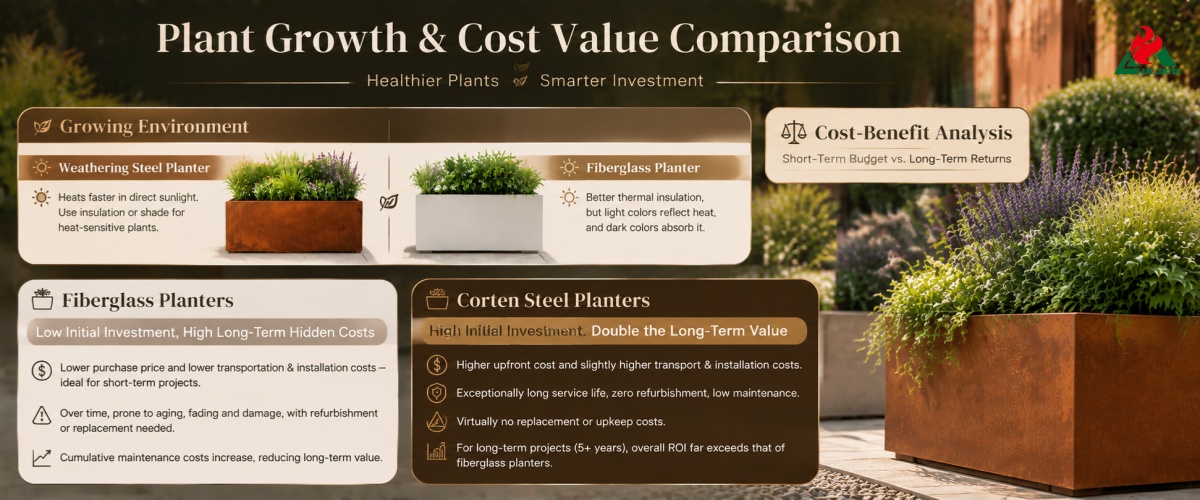
Weathering steel conducts heat more quickly, causing the pot to heat up significantly under direct, intense sunlight in summer. For shallow-rooted plants and shade-loving, heat-sensitive greenery, the growing environment can be improved by adding an insulating liner, covering the surface with a root-protecting material, providing appropriate shade, and optimizing drainage.
Fiberglass has better thermal insulation than steel, but light-colored pots tend to reflect sunlight, while dark-colored pots absorb heat; prolonged exposure to direct sunlight can similarly affect the root environment.
Overall, high-quality rusted steel planter boxes paired with professional drainage and thermal insulation designs can create a stable planting system, making long-term maintenance more hassle-free and providing a more stable growing environment for plants.
Cost-Benefit Analysis: Short-Term Budget vs. Long-Term Returns
1. Fiberglass Planters: Low Initial Investment, High Long-Term Hidden Costs
Fiberglass planters have a lower unit purchase price and lower transportation and installation costs, making them suitable for scenarios with limited budgets, short-term landscaping, and short project cycles.
However, over the long term, they experience frequent aging, fading, damage, and the need for refurbishment or replacement. Cumulative maintenance and replacement costs will continue to rise, resulting in lower long-term cost-effectiveness.
2. Corten Steel Planters: High Initial Investment, Double the Long-Term Value for Money
Rustic steel planters have higher upfront procurement costs, and their heavier weight results in slightly higher transportation and installation costs.
However, thanks to their exceptionally long service life, zero need for refurbishment, and low maintenance requirements, there are virtually no subsequent replacement or upkeep costs. For long-term landscaping projects lasting five years or more, the overall return on investment for weathering steel planters far exceeds that of fiberglass planters.
Precise Application Selection: Where are the Two Types of Planters Best Suited?
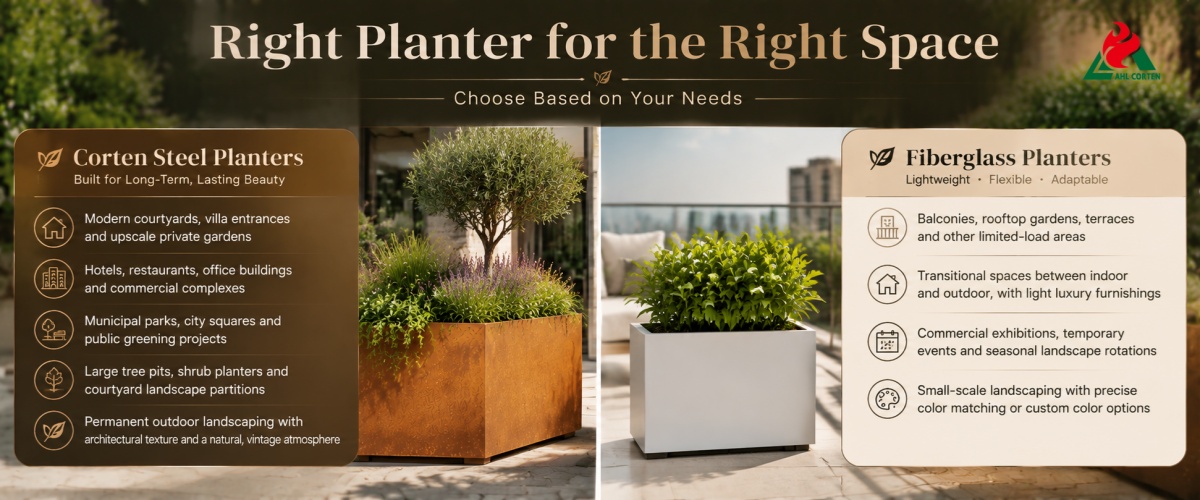
1. Scenarios Where Corten Planters are the Preferred Choice
Rusted steel planters are ideal for landscape scenarios that prioritize long-term, permanent installations, a high-end aesthetic, and low maintenance:
Modern courtyards, villa entrance landscapes, and upscale private gardens
Outdoor landscapes at hotels, restaurants, office buildings, and commercial complexes
Municipal parks, city squares, and public greening projects
Large tree pits, shrub planters, and courtyard landscape partition planters
Permanent outdoor landscaping that emphasizes architectural texture and a natural, vintage atmosphere
2. Scenarios Where Fiberglass Planters Are the Preferred Choice
Fiberglass planters are better suited for scenarios requiring lightweight solutions, flexible adjustments, temporary landscaping, or where load-bearing capacity is limited:
Balconies, rooftop gardens, terraces, and other areas with limited structural load-bearing capacity
Transitional spaces between indoor and outdoor areas, and settings featuring light luxury soft furnishings
Commercial exhibitions, temporary events, and seasonal landscape rotations
Small-scale landscaping requiring precise color matching with architectural schemes or custom color options
Why Choose AHL’s High-Quality Corten Steel Planters?
AHL weathering steel planters offer long-lasting landscape solutions, specifically designed for permanent outdoor landscaping and suitable for various high-end courtyard and commercial landscape projects.
The products are crafted from high-quality weathering steel that meets national standards. Natural weathering forms a uniform, stable protective rust layer that withstands sun, rain, and seasonal temperature fluctuations, eliminating the need for frequent rust-proofing or repainting.
Its unique, natural rust-colored texture complements a wide range of landscape materials. These planters can serve not only as planting containers but also as spatial dividers or visual focal points, enhancing the overall sophistication and design depth of any space.
Full customization is available: dimensions, shapes, steel plate thickness, drainage holes, internal thermal insulation, and installation methods can all be adjusted as needed to meet the requirements of every scenario, from small-scale garden features to large-scale municipal landscaping projects.
The design also caters to the needs of plant growth. Through scientific drainage and thermal insulation design, it ensures the durability of the planters while creating a stable and healthy growing environment for greenery, significantly reducing the burden of future maintenance.

Frequently Asked Questions (FAQ) About Corten Steel Planters
Q1: Are Corten Steel Planters More Durable Than Fiberglass Planters?
Yes. Weathering steel relies on a natural passivation layer for long-term corrosion resistance. It is structurally stable and resistant to wind and impact, with a service life of over 25 years. The durability of fiberglass depends on the quality of its coating and resin; it is prone to aging and damage during long-term outdoor use, and its overall stability is far inferior to that of weathering steel.
Q2: Are Fiberglass Planters Lighter and Easier to Use?
That’s correct. Fiberglass is extremely lightweight, making it easier to move, transport, and install. It is suitable for settings with weight restrictions or where frequent rearrangement is required. However, its light weight also results in insufficient wind stability.
Q3: Will Rusted Steel Planters Continuously Leak Rust Water And Stain The Ground?
Only during the initial weathering phase will there be slight rust water leakage; once the rust layer stabilizes, there will be no runoff pollution. When placed on light-colored surfaces or stone pavers, simply elevating the planter and adding a drainage layer will completely prevent staining.
Q4: Which Type Of Planter Is Suitable For Growing Large Trees?
Weathered steel planters are a top choice. Their high-strength metal structure can withstand soil pressure, the tree’s own weight, and wind forces, making them resistant to deformation and tipping. They are the optimal choice for large tree pits and shrub plantings.
Q5: Which Planters Should I Choose For Balcony Landscaping?
For standard balconies, fiberglass planters are the top choice due to their lightweight design that stays within weight limits. For large terraces or permanent landscaping, small, thick-walled weathering steel planters are recommended, as they offer both aesthetic appeal and stability.
Q6: Do Corten Planters Need To Be Repainted Regularly To Prevent Rust?
No. The core advantage of weathering steel is its natural rust resistance; no manual repainting or refinishing is required. Simply ensure proper drainage and prevent prolonged water accumulation—maintenance costs are extremely low.
Summary: Choosing the Right Planter Ensures a Long-Lasting, High-Quality Landscape
Neither material is inherently superior or inferior; they are simply suited for different scenarios.
Fiberglass planters excel in their lightweight design, high flexibility, wide range of colors, and low cost, making them a practical choice for short-term landscaping, flexible layouts, and spaces with weight restrictions.
Weathering steel planters stand out for their exceptional durability, high stability, low maintenance, unique texture, and long-term value, making them the preferred solution for permanent garden landscaping, high-end commercial landscapes, and permanent outdoor projects.
If you’re seeking long-lasting outdoor landscaping that’s hassle-free, low-maintenance, becomes more refined over time, and combines design aesthetics with practicality, high-quality weathering steel planters represent a premium investment that far exceeds the cost-effectiveness of short-term solutions.
Want to create a stable, visually appealing, and durable high-end garden landscape? Consider choosing AHL weathering steel planters to elevate ordinary greenery into architectural-grade artistic landscapes.
Get a Quote
Back

 Fill In The Inquiry