Can Corten Steel Water Pond Be Used With Fish Or Live Plants?
Date:2026.06.08
Share to:
In modern minimalist gardens, private villa gardens, and high-end commercial landscape designs, weathering steel water ponds have become a mainstream, premium water feature. Their unique vintage rust-red texture, paired with clean metallic lines, effortlessly creates a landscape that balances ruggedness and elegance.
Crystal-clear water, gracefully swimming fish, and lush green aquatic plants, combined with the industrial, vintage texture of corten steel, can instantly elevate the overall style of a courtyard and create magazine-worthy landscaping.
However, the vast majority of homeowners and designers share the same concerns, hesitating to implement ecological aquaculture solutions. The three main concerns are: Will the rust from the corten steel contaminate the water and harm the fish? Will the water turn yellow and murky, causing the aquatic plants to rot and wither? Will frequent rust removal and maintenance be required later on, requiring significant time and rework costs?
Many vendors offer only vague assurances of safety without explaining the underlying principles or implementation standards. This article will comprehensively address the challenges of using weathering steel for ecological fish ponds by breaking down the material’s properties, the root causes of risks, safe construction practices, planting and fish-keeping techniques, common pitfalls to avoid, and maintenance FAQs.
Key Conclusion: Corten Water Ponds are Fully Suitable for Fish and Aquatic Plants
First, let’s state a clear and authoritative conclusion: metal water ponds are safe for raising ornamental fish and growing aquatic plants, and they can create stable, aesthetically pleasing aquatic ecosystems. However, whether a safe coexistence can be achieved depends not on the material itself, but on the construction structure and isolation methods. Different construction approaches can lead to two completely opposite outcomes.
Bare-Pool Construction (Not Recommended): Extremely High Ecological Risk
The “bare pool” approach—filling the pool directly with water to house fish and planting aquatic plants without any lining or barrier—poses serious risks. When weathering steel is fully submerged for extended periods, it cannot form a stable protective rust layer and will continuously release iron ions. This not only causes the water to become cloudy, yellowish, or rust-red but also irritates fish gills, leading to stress-induced mortality. Additionally, it causes aquatic plants to suffer from root burn, yellowing leaves, and widespread wilting.
Lined Construction (Standard Solution): Balancing Aesthetics and Ecology
Standardized construction using a food-grade lining is the only perfect solution. Professional linings and protective coatings isolate the steel from direct contact with the water, ensuring clear and safe water quality inside that supports the growth of fish and aquatic plants. The exterior retains the natural patina of corten steel, achieving both high-end landscape aesthetics and a healthy ecosystem.
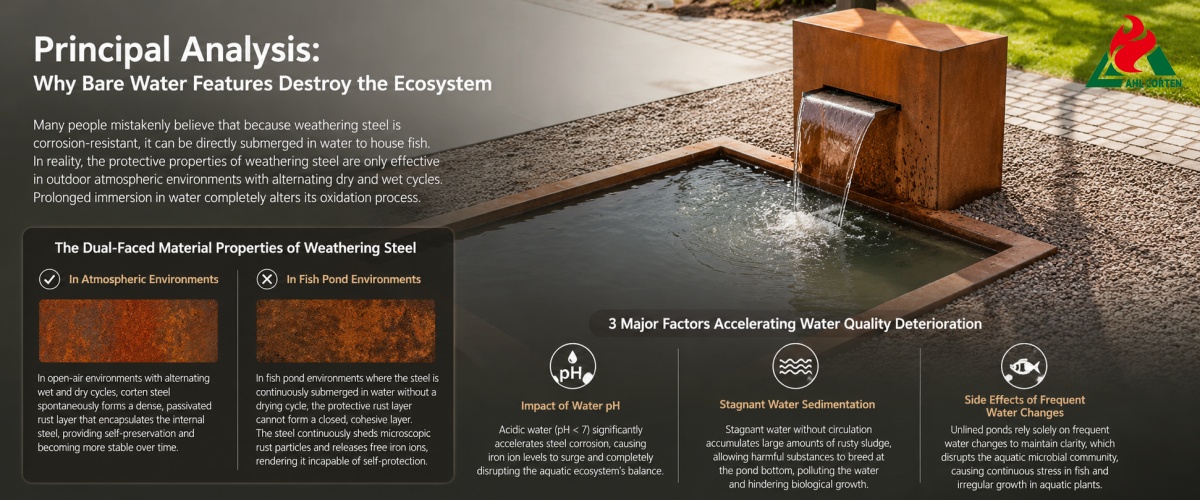
Principal Analysis: Why Bare Water Features Destroy the Ecosystem
Many people mistakenly believe that because weathering steel is corrosion-resistant, it can be directly submerged in water to house fish. In reality, the protective properties of weathering steel are only effective in outdoor atmospheric environments with alternating dry and wet cycles. Prolonged immersion in water completely alters its oxidation process.
The Dual-Faced Material Properties of Weathering Steel
In open-air environments with alternating wet and dry cycles, corten steel pondspontaneously forms a dense, passivated rust layer that encapsulates the internal steel, providing self-preservation and becoming more stable over time.
However, in fish pond environments where the steel is continuously submerged in water without a drying cycle, the protective rust layer cannot form a closed, cohesive layer. The steel continuously sheds microscopic rust particles and releases free iron ions, rendering it incapable of self-protection.
3 Major Factors Accelerating Water Quality Deterioration
Impact of Water pH: Acidic water (pH < 7) significantly accelerates steel corrosion, causing iron ion levels to surge and completely disrupting the aquatic ecosystem’s balance.
Stagnant Water Sedimentation: Stagnant water without circulation accumulates large amounts of rusty sludge, allowing harmful substances to breed at the pond bottom, polluting the water and hindering biological growth.
Side Effects of Frequent Water Changes: Unlined ponds rely solely on frequent water changes to maintain clarity, which disrupts the aquatic microbial community, causing continuous stress in fish and irregular growth in aquatic plants.
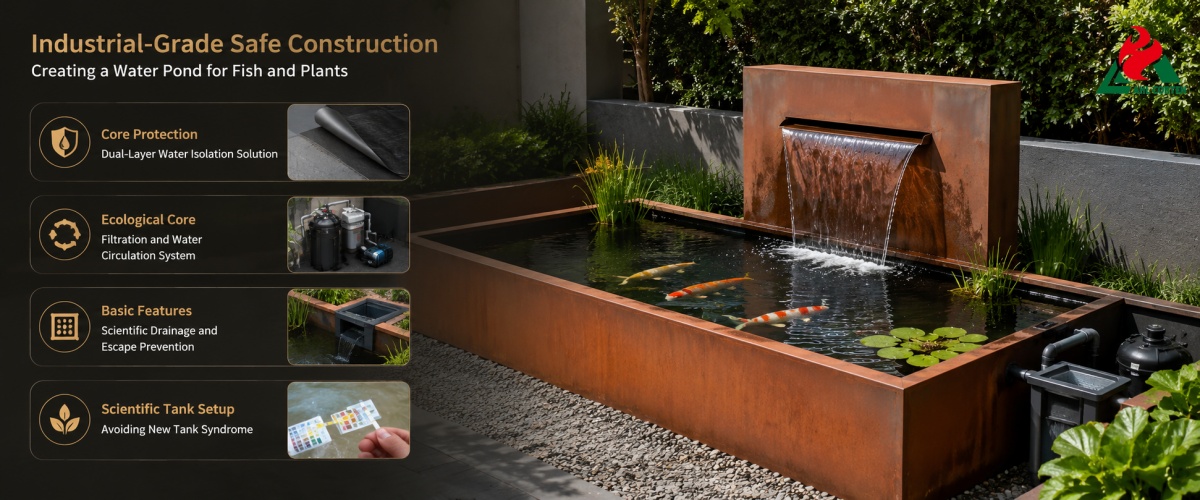
Industrial-Grade Safe Construction: Creating a Water Pond for Fish and Plants
To achieve a zero-risk ecological metal water feature, a standardized protection system must be established, comprehensively addressing four key aspects: isolation, water circulation, drainage, and initial water conditioning.
Core Protection: Dual-Layer Water Isolation Solution
This is the fundamental prerequisite for fish and plant cultivation, and both components are indispensable. Currently, there are two mainstream food-grade safety solutions available, each suited to different landscaping needs.
EPDM Fish Pond-Specific Waterproof Membrane: Extremely flexible, it conforms perfectly to the curved surfaces of steel ponds, achieving 100% physical isolation with no blind spots or leaks, and is suitable for irregularly shaped weather-resistant steel fish ponds.
Fish Pond-Grade Epoxy/Polyurea Coating: After spray application, it forms a seamless, hard protective layer with no wrinkles, preserving the texture of the metal lines. It offers a minimalist, aesthetic appearance while providing dual functions of waterproofing and rust prevention.
Ecological Core: Filtration and Water Circulation System
Weathering steel fish ponds have a regular shape that can easily create stagnant water and dead zones, so they must be paired with professional water circulation equipment.
A dual physical and biological filtration system, combined with UV sterilization lamps, efficiently traps fish waste, uneaten feed, and trace mineral impurities while suppressing algae blooms.
A directed water flow design keeps the pond water constantly circulating, preventing localized accumulation of impurities and maintaining fresh, clear water over the long term.
Basic Features: Scientific Drainage and Escape Prevention
A bottom drainage system is pre-installed to directly remove bottom sludge, fish waste, and residual debris, preventing water deterioration and sediment buildup at the source.
An overflow outlet is positioned at a high point in the pond. During heavy rain, it automatically drains excess water to prevent fish from escaping due to high water levels, while also trapping floating debris on the surface.
Scientific Tank Setup: Avoiding New Tank Syndrome
After a new corten pond is completed, it is strictly prohibited to immediately stock fish or plant aquatic plants, as this can easily lead to mass mortality. First, fill the pond with water and run the circulation equipment for 2–3 weeks, adding nitrifying bacteria to cultivate the microbial community. Once ammonia-nitrogen and nitrite levels have dropped to zero, and the coating has fully cured and is odor-free, introduce test fish to confirm water quality stability before proceeding with mass stocking and planting aquatic plants.
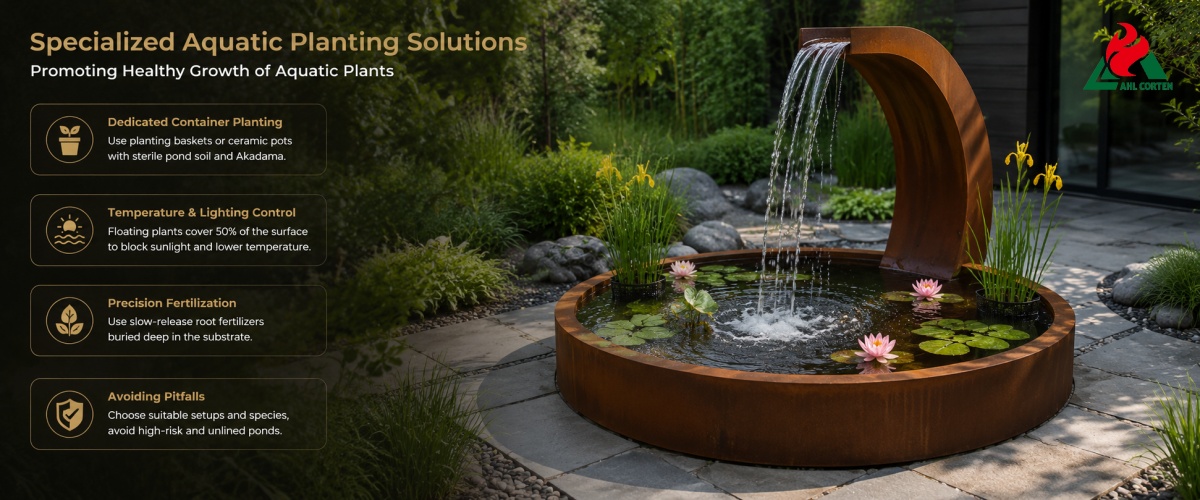
Specialized Aquatic Planting Solutions: Promoting Healthy Growth of Aquatic Plants
When planting aquatic plants in weathering steel fish ponds, standard soil-based methods used in ordinary fish ponds cannot be applied. Instead, a tailored approach must be adopted to accommodate the material’s unique properties, thereby preventing root rot, yellowing leaves, and excessive algae growth.
The Only Recommended Approach: A Dedicated Container Planting System
Do not spread soil or expanded clay pellets directly on the pond bottom, as this easily traps dirt, breeds bacteria, corrodes the pond walls, and makes future cleaning more difficult.
Optimal Solution: Use dedicated planting baskets or ceramic pots for individual planting, combined with sterile pond soil and Akadama soil, with a top layer of washed river pebbles to secure the soil.
This method provides ample nutrients for the aquatic plants while preventing fish from stirring up the mud and clouding the water. The setup can be easily moved or cleaned later, making maintenance extremely simple.
Water Temperature and Lighting Control: Addressing the Risk of Steel’s Thermal Conductivity
Weathering steel conducts heat extremely quickly. Intense summer sunlight can cause the water temperature to spike suddenly. High temperatures can scald fish, cause aquatic plants to wither, and trigger excessive algae growth.
Combine emergent and floating plants in your aquascape, ensuring that floating plants like water lilies cover 50% of the water surface. This not only blocks strong sunlight and lowers water temperature but also mimics a natural aquatic environment, helping to suppress algae blooms.
Precision Fertilization: Preventing Water Eutrophication
In isolated metal water ponds, aquatic plants cannot obtain trace elements from the steel, so manual fertilization is necessary. However, it is strictly prohibited to broadcast liquid fertilizer across the entire pond.
It is recommended to use slow-release root fertilizers buried deep in the substrate to precisely supply nutrients to the plant roots. This prevents fertilizer from spreading throughout the pond, thereby avoiding green, murky, and foul-smelling water.
Avoiding Pitfalls: Distinguishing Between Safe, Suitable, and Prohibited Applications
Weathering steel fish ponds are not suitable for all locations or aquaculture species. Accurately identifying the appropriate scenarios is essential to avoid landscape failures and wasted investment.
Highly Suitable, Zero-Risk Recommended Scenarios
Standardized weathering steel fish ponds equipped with a complete isolation liner, filtration and circulation systems, and a bottom drainage system. Raise hardy cold-water ornamental fish such as koi and goldfish, and plant resilient aquatic plants like water lilies and irises. Backyard landscapes where owners have basic maintenance awareness and can regularly test water quality, clean filter media, and trim aquatic plants.
High-Risk, Not Recommended Scenarios
Unlined pools with no insulation, stagnant water features without circulation or filtration, and scenarios where owners seek “zero maintenance” and plan to neglect the pond long-term. Scenarios involving high-end, delicate species such as crystal shrimp and angel fish, which are extremely sensitive to water quality and metal ions. Simple aquascapes created by beginners who blindly follow trends, prioritizing aesthetics over ecological compatibility.
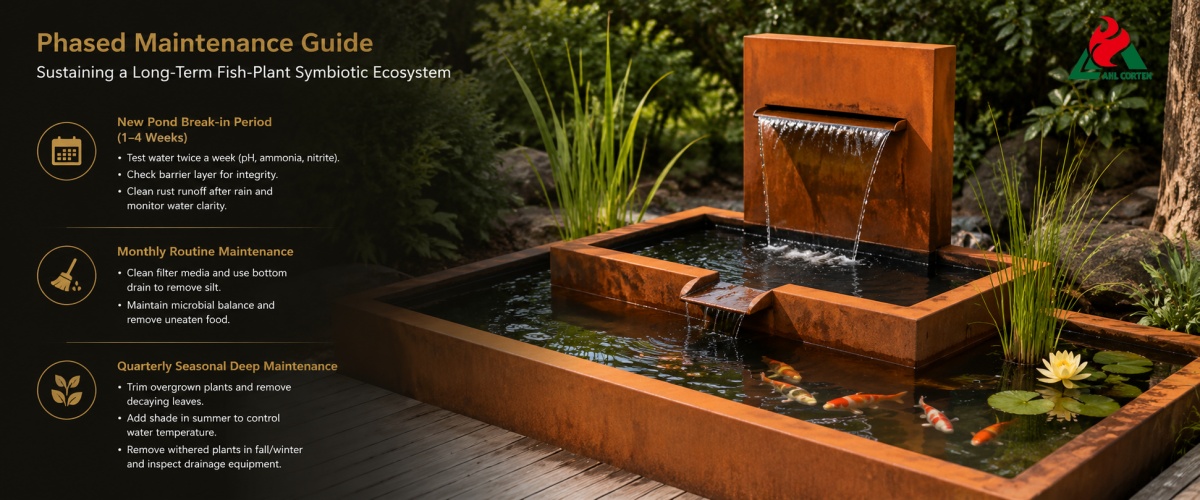
Phased Maintenance Guide: Sustaining a Long-Term Fish-Plant Symbiotic Ecosystem
High-quality corten steel water features require minimal routine maintenance. By following a phased maintenance schedule, you can ensure clear water, beautiful scenery, and a stable ecosystem year-round.
New Pond Break-in Period (1–4 Weeks)
Test the pond water for pH, ammonia, and nitrite levels twice a week, and check that the internal barrier layer remains intact. Promptly clean up rust-stained runoff outside the pond after rain to prevent contamination of surrounding paved surfaces, while monitoring changes in water clarity.
Monthly Routine Maintenance
Regularly clean the physical filter media and use the bottom drain to remove trace amounts of silt and debris from the pond bottom. Maintain a stable microbial balance in the water and promptly remove uneaten food to prevent nutrient buildup and subsequent water quality deterioration.
Quarterly Seasonal Deep Maintenance
During the high-temperature seasons of spring and summer, promptly trim overgrown aquatic plants and remove decaying or dead leaves to prevent water contamination. In summer, add shade to the water surface as needed to control water temperature and prevent fish and plants from wilting due to heat stress. During the transition to fall and winter, remove withered emergent plants, inspect drainage equipment, and prepare winterization measures.
Frequently Asked Questions (FAQ): About Corten Water Ponds
1. Will Corten Steel Water Ponds Rust, Poison the Fish, or Turn the Water Yellow?
In fish ponds with professional isolation and protective measures, the steel is completely sealed off from the water. The water remains crystal clear, free of rust stains, and non-toxic. In exposed ponds, prolonged immersion causes the steel to continuously release rust, leading to yellowing water, fish stress, and the withering of aquatic plants.
2. Is an Internal Barrier Layer Necessary for Fishkeeping?
For keeping ornamental fish and creating long-term ecological water features, a barrier layer is an essential component. Unlined ponds are only suitable for purely decorative, mirror-like water features without living organisms and cannot support the coexistence of fish and aquatic plants.
3. Which Fish, Shrimp, and Aquatic Plants are Suitable for Steel Water Ponds?
Cold-tolerant, hardy cold-water fish such as koi and goldfish are the preferred choice, paired with resilient aquatic plants like water lilies and irises. Sensitive species such as angelfish and crystal shrimp are not recommended for this environment.
4. Can an Epoxy Coating Replace a Geomembrane?
Absolutely. Epoxy and polyurea coatings specifically designed for fish ponds form seamless, hard protective layers that offer excellent waterproofing and rust prevention. They also provide a minimalist, high-end aesthetic, making them the preferred solution for custom-shaped fish ponds.
5. How Long Before I Can Add Fish and Plants to a New Pond?
After a standard 14–21-day water cycling period, wait until water quality parameters return to normal, the coating has fully cured and is odor-free, and a water test confirms everything is in order before officially introducing fish and planting aquatic plants.
6. How Do I Address Cloudy or Foul-Smelling Water Pond?
First, check if the liner is damaged. If the filter is intact, the issue is typically caused by water eutrophication or insufficient filtration. Reduce feeding, turn on the UV sterilization lamp, clean the filter media, and replenish nitrifying bacteria; the water should clear up within about 48 hours.
7. What Is the Optimal pH Range for a Corten Water Pond?
Maintaining slightly alkaline water (pH 7.2–7.8) is best for fish and plant growth. This ensures biological activity while protecting the structural stability of the pond and slowing the aging of the external steel components.
8. How Often Should Water Be Changed On a Daily Basis?
There is no need for frequent large-scale water changes. Changing 10%–15% of the water every two weeks, or 20%–30% monthly, is sufficient. Frequent small-volume changes help avoid drastic fluctuations in water quality that can cause biological stress.
Ready to Choose Your Perfect Outdoor Corten Water Pond?
Ultimately, weathering steel water ponds can achieve a refined ecological aquatic landscape where fish and aquatic plants coexist. All problems like murky water, fish and shrimp deaths, and withered aquatic plants stem from improper bare-pond construction and a lack of ecological support, not from defects in the material itself. By combining professional food-grade insulation and protection, a comprehensive water circulation and filtration system, and a scientific planting and maintenance plan, you can achieve both the unique retro industrial aesthetics of weathering steel and a stable and healthy aquatic ecosystem, completely eliminating the high costs of frequent maintenance and rework. No need to compromise between aesthetic appeal and ecological stability. Professional, standardized construction will ensure your weathering steel fish pond remains clear, beautiful, lively with fish and shrimp, and lush with aquatic plants year-round, maintaining a high-end garden aesthetic. Don't want to fall into water feature construction pitfalls and avoid ineffective investments? Inquire now! We'll customize a pond for you based on your provided dimensions!


 Fill In The Inquiry