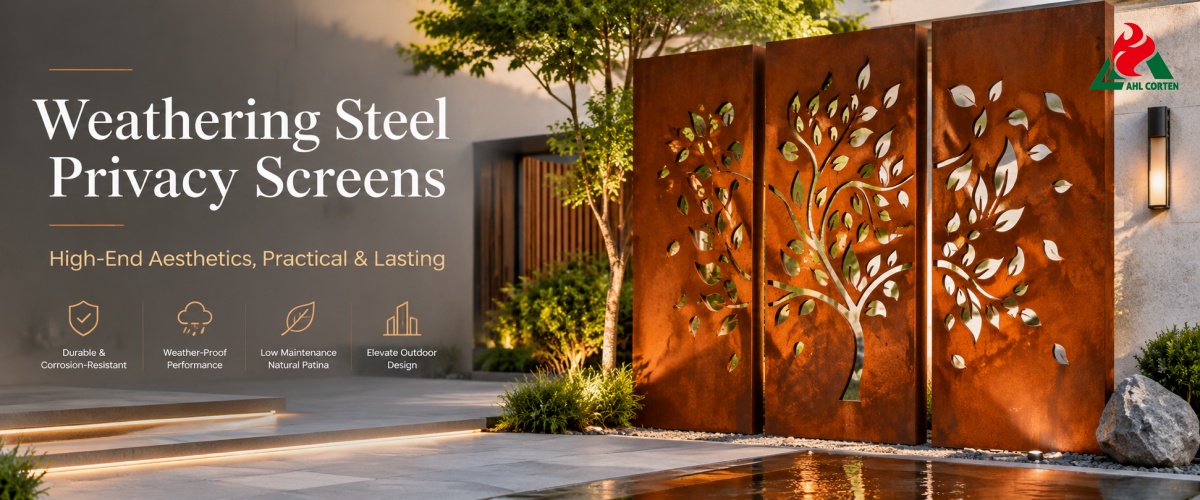
In modern garden landscaping, villa design, and architectural facade design, weathering steel screens have become a standard feature for creating a high-end ambiance. With their unique vintage rust-red texture, clean metallic lines, and natural patina that develops over time, they effortlessly achieve a variety of sophisticated aesthetic effects, including industrial, minimalist, and New Chinese styles.
Whether used as courtyard partitions, entryway screens, terrace accents, or architectural facade elements, weathering steel screens elevate the overall design and create a unique visual focal point.
However, the vast majority of designers, contractors, and homeowners share a common concern: Will the rust water produced by the weathering steel stain the surrounding expensive stone flooring, pressure-treated wood decks, and white walls?
Many worry that pursuing a momentary sense of high-end aesthetics will ultimately leave behind reddish-brown rust stains that are difficult to clean. Not only does this ruin the neat and refined look of the courtyard, but it also leads to high costs for cleaning, renovation, and rework, resulting in the awkward situation of something that “looks good but is hard to maintain.”
This article will comprehensively address the staining issues associated with outdoor metal privacy screens by examining real-world findings, staining mechanisms, high-risk scenarios, comprehensive prevention strategies, material compatibility, stain restoration, and selection and installation guidelines. It aims to help you achieve a risk-free installation that balances aesthetic appeal with practicality.
1. Actual Situation: This Occurs Only During the Initial Curing Period of New Steel
Brand-new, untreated corten steel panels do indeed pose a risk of rust runoff and staining during the initial rusting phase, which lasts 1–6 months after installation. During this period, the protective rust layer on the steel surface has not yet fully formed. Rainwater runoff washes away free iron ions from the surface, creating reddish-brown rust runoff. When this rust water drips onto light-colored, porous building materials, it can create stubborn stains.
2. Common Misconception: Staining ≠ Material Deterioration or Damage
Many people mistakenly believe that rust runoff indicates poor steel quality or ongoing corrosion and damage—this is a typical misconception. Initial rust runoff is a normal physiological process through which weathering steel forms its self-protective layer. It involves the shedding of surface rust, not uncontrolled corrosion or perforation leading to the steel becoming unusable.
3. Key Answer: Staining Is Fully Controllable and Preventable
The staining issue with metal outdoor privacy screens is not an insurmountable material defect, but rather a construction problem that can be standardized and avoided. Through processes such as factory pre-rusting and curing, professional drainage and flow management, isolated installation, and surface rust-fixing protection, the risk of staining can be reduced to nearly zero. Once the dense, passivated rust layer on the surface has fully matured, there will be virtually no rust runoff contamination in the long term, ensuring the surrounding environment remains clean and tidy.
Why Do Weathering Steel Screens Cause Rust Runoff Contamination?
1. The Dual-Layer Rusting Mechanism of Weathering Steel
The core advantage of corten steel screen lies in its ability to generate a dense, stable oxide protective layer on the surface through cycles of drying and wetting, thereby encapsulating the internal steel and achieving long-term corrosion protection. However, during the initial installation phase of a new metal garden screen, this protective rust layer is loose and not yet fully formed. Surface rust is not firmly bonded to the steel substrate and is highly prone to flaking off and washing away when exposed to water.
2. The Physical Process of Rust Water Migration
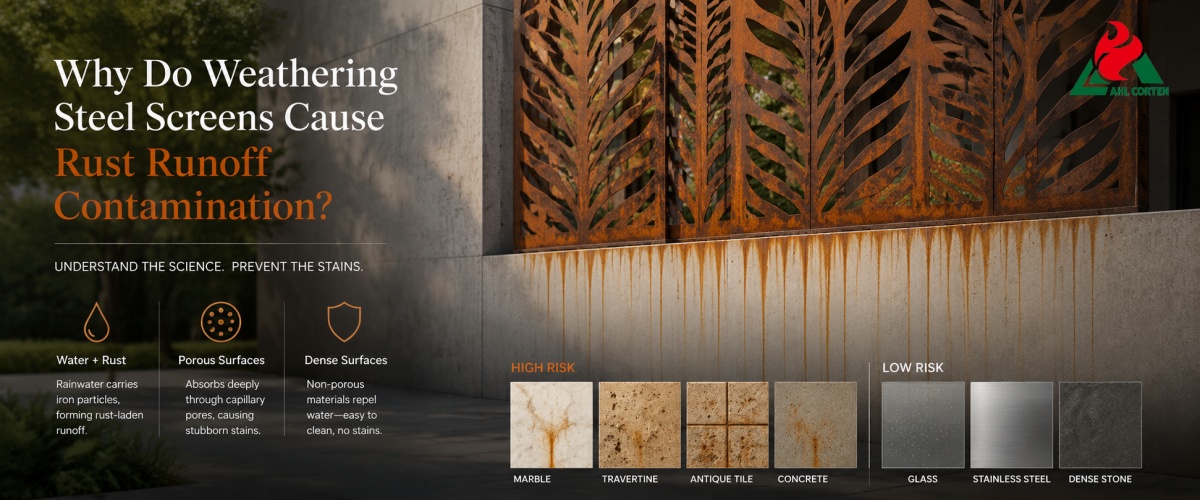
Rainwater runoff and nighttime condensation accumulate, carrying free iron ions from the steel surface and forming a reddish-brown aqueous solution containing fine particles. This rust-laden water drips vertically along the edges of the laser-cut decorative screens, flows back down the walls, and lands on the floor or adjacent wall surfaces below, forming extensive rust stains.
3. Capillary Absorption by Materials: The Core Reason Stains Are Difficult to Clean
The extent to which different building materials absorb stains depends entirely on their surface pore structure. Porous materials such as marble, travertine, antique-style tiles, pressure-treated wood, and unsealed concrete contain dense capillary pores. When rust water falls onto these surfaces, it is rapidly absorbed, penetrates, and crystallizes, forming deep, stubborn stains that cannot be completely removed by ordinary wiping or scrubbing. Dense materials such as glass, stainless steel, and high-density dark-colored stone have no permeable pores. Rust water merely adheres to the surface and can be easily rinsed away with clean water, posing virtually no risk of staining.
5 High-Risk Scenarios: Environments Prone to Widespread Staining
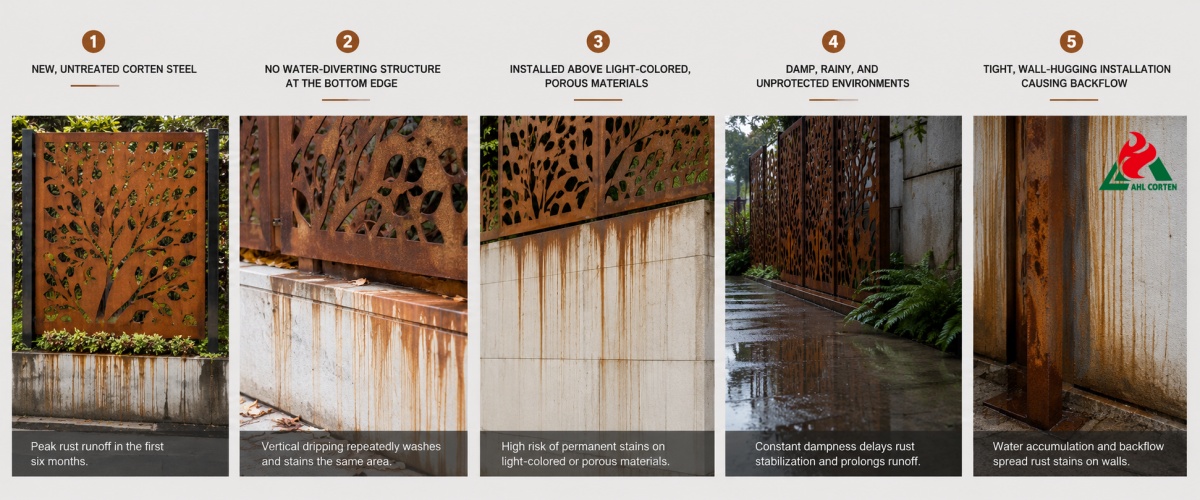
1. New, Untreated Corten Steel
Corten steel screens that leave the factory in their natural, untreated state—without artificial pre-rusting, curing, or high-pressure passivation cleaning—experience a peak in rust water runoff during the first six months after installation, when the risk of staining is highest.
2. No Water-Diverting Structure at the Bottom Edge; Vertical Dripping
Laser-cut decorative screens lack water collection or drainage structures at the bottom. Rainwater mixed with rust drips vertically along the edges of the panels, continuously washing the same ground area over time and forming permanent reddish-brown water stains.
3. Installed Above Light-Colored, Porous Building Materials
Decorative metal screens mounted directly above light-colored marble, white exterior walls, antique-style tiles, or solid wood decks constitute an extremely high-risk combination, making irreversible staining highly likely.
4. Damp, Rainy, and Unprotected Environments
In low-lying courtyards, shaded areas, and rainy, humid regions, conditions for sun-drying are lacking. Outdoor metal privacy screens remain in a constantly damp state, unable to undergo normal moisture cycles, which significantly prolongs the rust stabilization period and results in continuous rust runoff.
5. Tight, Wall-Hugging Insulation Causing Water Accumulation and Backflow
When a metal garden screen is installed flush against a wall with no ventilation gaps, a sealed, high-humidity cavity forms on the back. Condensation accumulates and flows back over time, repeatedly washing the back of the panels. Rust-stained water spreads along the wall, contaminating the wall’s paint finish.
6 Zero-Discharge Installation Solutions: Eliminating Rust Water Contamination at the Source
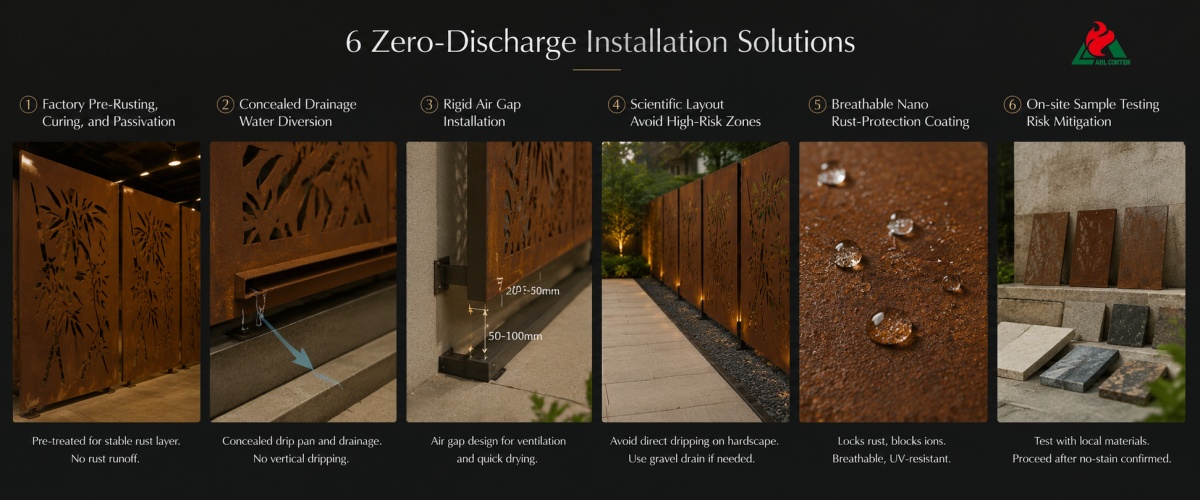
1. Factory Pre-Rusting, Curing, and Passivation Treatment (Core Solution)
Through manual accelerated rusting in the factory and multiple rounds of high-pressure purified water rinsing and passivation, surface-level loose rust is preemptively removed. This ensures that corten steel fence panels reach over 80% rust layer maturity before leaving the factory, with uniform and stable coloration, thereby preventing rust water outbreaks after installation at the source.
2. Custom Concealed Drainage and Water Diversion System
Install integrated V-shaped or U-shaped concealed drip pans along the bottom edge of decorative metal screens, paired with hidden drainage pipes. This system uniformly collects initial rust water and diverts it to lawns, gravel drainage areas, or underground drainage networks, preventing direct dripping onto hard surfaces. Install folded waterproof strips at wall contact points to prevent rust water from flowing back and contaminating the wall facade.
3. Rigid Air Gap Installation Method
Avoid wall-hugging or floor-flush installation methods; instead, use raised brackets and spacer plates. Maintain a 20–50 mm gap from the wall and a 50–100 mm gap from the floor to block capillary water absorption pathways. Adequate ventilation space accelerates the moisture cycle, quickly drying condensation and preventing moisture buildup and rust on the back of the screen.
4. Scientific Layout to Avoid High-Risk Drip Zones
When planning installation locations, avoid light-colored main walkways and core areas with high-end stone paving. If installation is unavoidable, create a 15–20 cm deep blind drain filled with dark-colored gravel directly beneath the screen to collect initial rust water, allowing it to naturally seep away and isolate the hard paving.
5. Sealing with a Breathable Nano Rust-Protection Coating
Once the rust color of the rusted steel fence panels has reached the desired state, apply a highly breathable, UV-resistant matte nano-fluorocarbon protective coating. This forms an invisible protective film that locks in the surface rust layer and blocks the migration of iron ions, while preserving the metal’s natural texture and finish. The use of ordinary varnish is strictly prohibited to prevent peeling of the paint film and crevice corrosion caused by localized water accumulation.
6. On-site Sample Testing to Mitigate Project Risks
Prior to large-scale project implementation, send small samples of the same process and material to the site in advance. Place them next to surrounding building materials and conduct 2–4 weeks of rain exposure and natural weathering tests. Proceed with bulk application only after confirming there is no risk of staining.
Classification of Stain Resistance in Mainstream Building Materials and Dedicated Protection Methods
1. High-Risk Porous Materials (Stone, Cement, Red Brick)
Includes marble, travertine, light-colored granite, unsealed concrete, and antique-style tiles. These materials have highly porous surfaces and strong absorbency, making them prone to permanent, deep-penetrating stains. Protection Plan: Dual protection is essential—combining physical barriers with stone penetrating sealants—along with a drainage system at the base to prevent rusty water from dripping directly onto the surface.
2. Low-Risk Dense Materials (Glass, Metal, Dark Stone)
Includes tempered glass, stainless steel, fluorocarbon-coated aluminum panels, and dark high-density stone. These materials have dense, non-porous surfaces with no risk of penetration. Protection Plan: Standard installation with ventilation gaps is sufficient; no complex drainage structures are required. Regular rinsing with clean water is sufficient to maintain cleanliness.
3. Medium-Risk Wood and Wood-Plastic Composite Decks
Preservative-treated wood, solid wood decks, and outdoor wood-plastic composite panels will undergo a chemical reaction when exposed to rusty water, resulting in stubborn dark brown stains. Protection Plan: Install stainless steel spacer pads. Apply 2–3 coats of outdoor waterproof, weather-resistant wood oil to the decking in advance to enhance water repellency and prevent penetration.
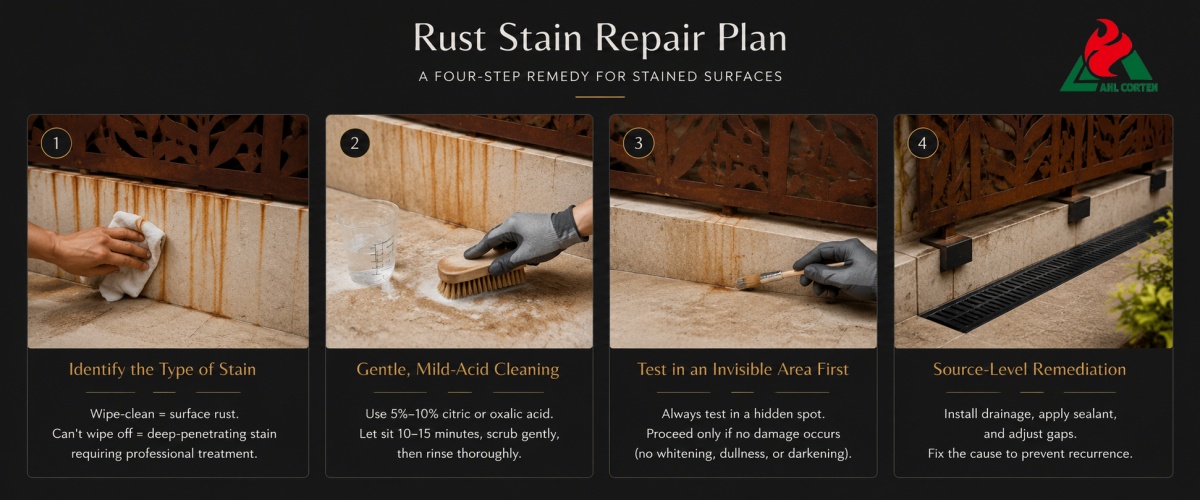
Rust Stain Repair Plan: A Four-Step Remedy for Stained Surfaces
Step 1: Identify the Type of Stain
If the stain can be removed by wiping with clean water, it is surface-level rust that has adhered to the surface and is easy to clean. If the stain cannot be wiped away and the color has penetrated the material’s texture, it is a deep-penetrating chemical stain that requires professional treatment with a mild acid to break it down.
Step 2: Gentle, Mild-Acid Cleaning
Avoid strong acidic corrosive agents such as hydrochloric acid or sulfuric acid, as they can burn the stone or damage the finish’s luster. Apply a mild solution of 5%–10% citric acid or oxalic acid to the stained area, let it sit for 10–15 minutes, then gently scrub in circular motions before rinsing thoroughly with plenty of water.
Step 3: Test in an Invisible Area First
For valuable stone and wood finishes, always perform a cleaning test in a hidden corner first. Proceed with large-scale cleaning only after confirming there is no secondary damage such as whitening, loss of luster, or darkening.
Step 4: Source-Level Remediation to Prevent Recurrence
After cleaning, promptly install concealed water drainage structures, reapply a protective sealing layer to the material, and adjust installation gaps. Cleaning without remediation will inevitably lead to recurring staining.
Frequently Asked Questions (FAQ) About Corten Steel Screens
1. Will Corten Steel Screens Stain White Walls Or Walls Painted With Latex Paint?
If installed flush against the wall without any pre-treatment on the bare steel surface, it is highly likely that the wall will become yellowed or stained with rust. This can be completely prevented by leaving a ventilation gap and installing a water-blocking structure.
2. Will Rust Water Permanently Damage Light-Colored Marble Floors?
Unprotected, light-colored, porous marble will develop permanent, stubborn stains once penetrated. Applying a stone sealer and installing drainage barriers in advance provides 100% protection against staining.
3. How Long Does the Initial Rust-Bleeding Period Typically Last?
Under natural curing conditions, the rust bleeding period lasts 6–12 months. After factory pre-curing treatment, this period is significantly shortened, with virtually no noticeable staining.
4. Should Surface Rust Discovered After Rain Be Cleaned Immediately?
Yes. Before the initial rust water has fully dried and crystallized, it can be easily removed with a high-pressure water rinse. Once it has dried and penetrated the surface, chemical treatment is required for repair, increasing maintenance costs.
5. How Can Weathering Steel Screens Be Safely Installed Above Wooden Platforms?
Stainless steel spacer washers must be used to prevent direct contact between the steel plates and the wood. Additionally, the wood should be waterproofed and sealed in advance to prevent iron ions from reacting with the tannins in the wood.
Are You Ready to Choose a High-Quality Steel Screen That’s Right For You?
Rust staining on weathering steel privacy screens is not an inherent flaw of the material, but rather a construction hazard caused by unprofessional installation. The vast majority of rust stain issues on floors and walls can be prevented in advance through standardized processes, eliminating the need to compromise on landscape aesthetics or face high rework costs. Our proprietary factory pre-rust treatment, scientific drainage systems, suspended installation, and customized material protection solutions are suitable for all types of residential and commercial projects. We eliminate rust water contamination at the source, perfectly preserving the unique vintage and premium texture of weathering steel, and delivering a stunning, low-maintenance, and flawless final result. There’s no need to blindly fall into pitfalls or pay the price for the hidden risks of cheap, untreated steel. Our professional, customized design and construction solutions address all staining concerns in one go, ensuring your weathering steel landscape remains clean, beautiful, and durable for years to come. Want to create rust-free, high-quality corten steel garden screens that require minimal maintenance? Don’t hesitate! Contact us today for a free consultation to receive a personalized, one-on-one anti-staining solution, professional construction guidance, and an accurate project quote—all to efficiently bring your high-end garden and architectural landscape projects to life!


 Fill In The Inquiry