In modern minimalist gardens, terraced lawns, rock gardens, and high-end commercial landscapes, weathering steel edgings are essential elements for creating clean lines, defining zones, and stabilizing soil to prevent erosion. With their crisp geometric contours and natural, vintage rust-brown finish, they effortlessly elevate the overall sophistication of any garden.
However, during the rainy season—with its torrential downpours and prolonged periods of overcast, rainy weather—the vast majority of homeowners, contractors, and landscape designers share a common concern. Will prolonged exposure to rainwater, saturated soil, and muddy conditions accelerate corrosion, rust, and perforation of the weathering steel edging strips?
Will the pressure from muddy water caused by heavy rain, combined with soil expansion due to water absorption, cause the edging strips to bend outward, warp, or shift out of place?
If the corten retaining walls fail, tilt, or collapse, they will not only ruin the neatness of the landscape but also damage the lawn and harm plant root systems. The costs associated with rework, replacement, labor, logistics, and replanting are extremely high, representing a hidden budget drain that is easily overlooked in garden landscaping.
Many people mistakenly believe that weathering steel is vulnerable to rain, moisture, and standing water. This is not the case. What truly affects the heavy rain resistance of weathering steel edging strips is never the rain itself, but rather the material purity, foundation construction, drainage design, and installation standards.
This article provides a comprehensive breakdown covering material principles, causes of damage, industrial-grade construction solutions, scene adaptation, rainy season maintenance, and common FAQs to help you create a garden landscape boundary that remains stable, distortion-free, and corrosion-free for 30 years.
Can Corten Steel Edgings Truly Withstand Torrential Rain?
1. Material Properties: Corten Steel Thrives in Rainy, High-Humidity Environments
Authentic industrial-grade corten steel raised beds can fully withstand continuous heavy rain, prolonged exposure to high humidity, and long-term wet-dry cycles. Unlike ordinary carbon steel, sheet metal, PVC, or galvanized iron edging, weathering steel does not rust indefinitely, peel in layers, or corrode through and break when exposed to rain. Rainwater accelerates the maturation of the surface protective layer, making the material more stable over time.
2. Structural Aspect: 90% of Storm Damage Stems From Construction Defects, Not the Material
Common issues with edge strips—such as deformation, displacement, water seepage, and collapse—are almost entirely unrelated to the material itself. The true root causes are construction and design issues, including foundation erosion and settlement, soil softening from waterlogging, lateral pressure from saturated soil expansion, insufficient anchoring, and leaking joints. Simply put: Weathering steel itself is indestructible; what is fragile is non-standard installation practices.
3. Market Comparison: Substandard Edging Is Prone to Failure in Heavy Rain
Thin-walled sheet metal (less than 1.0 mm), PVC, and standard galvanized edging available on the market will soften, bend, be washed away by muddy water, or collapse and deform after just one summer downpour. In contrast, compliant landscape edging is classified as landscape-grade underground infrastructure—not merely a disposable decorative trim—and is designed to withstand long-term exposure to rainwater erosion and soil pressure.
The Core Principle Behind Corten Steel Edging’s Resistance to Corrosion in Heavy Rain
1. Self-Healing Rust Armor That Stops Ongoing Corrosion
When ordinary carbon steel comes into contact with rainwater, it forms a loose, porous rust layer that continuously absorbs water and oxygen like a sponge, causing the rust to worsen over time until the steel eventually corrodes through and breaks.
Weathering steel is alloyed with special elements such as copper, chromium, and nickel. Through exposure to rain and wet-dry cycles, it spontaneously forms a dense, hydroxyl-based protective oxide layer 50–100 microns thick.
This passivated rust layer acts like a seamless anti-corrosion glaze, firmly sealing the steel’s internal structure, breaking the chain of subsequent corrosion, and eliminating ongoing rusting at its source.
2. Self-Limiting Oxidation: The More It Rains, The More Stable It Becomes
Ordinary metal edging tends to peel off in layers during the rainy season, becoming thin, perforated, and unusable within 1–2 years. The oxidation of weathering steel is a controlled, self-limiting process. Once the rust layer matures, the annual corrosion rate approaches zero, preventing further thinning or damage.
Rain is not a source of damage but rather a catalyst that accelerates the stabilization of the rust layer and solidifies its texture, ensuring the edging remains sturdy and visually appealing year-round.
5 Hidden Critical Causes of Failure in Metal Garden Bed Edging During Heavy Rain Seasons
1. Poor Drainage and Prolonged Waterlogging
If the site’s micro-topography lacks a drainage slope or the underlying clay is impermeable, water will pool along both sides of the rusted steel edging for extended periods.
Prolonged waterlogging causes the surrounding soil to liquefy into mud, losing its bearing capacity. Even slight pressure from muddy water can cause the edging to shift laterally, tilt, or collapse.
2. Inappropriate Soil Selection and One-Size-Fits-All Installation
Loose, nutrient-rich soil: This loose soil is easily eroded by rain, leading to hollowed-out bases and suspended foundations, which cause the edging to loosen.
Sandy Soil/Gravelly Soil: Highly permeable but with weak shear strength; prone to uneven settlement after heavy rain, causing the edging to become uneven, twisted, or deformed.
Heavy Clay Soil: Absorbs water and expands, drains extremely slowly, generating massive lateral pressure that directly bends the edging strip.
3. Shallow Installation and Sloppy Backfilling
To save labor, many contractors simply cut a shallow trench in the topsoil to embed the edging strips, without establishing a deep foundation or performing layered compaction. When heavy rain runoff turns into mudslides, shallowly buried edging acts like rootless duckweed, making it extremely prone to being completely overturned, displaced, or pulled out.
4. Sparse Anchoring and Weak Joint Connections
Along long, straight edging sections, saturated soil exerts a continuous, uniform lateral pressure. If ordinary small nails are used, anchor spacing is too wide, or specialized connectors are absent, the entire edging line will be squeezed into an irregular wavy shape, completely ruining the landscape’s lines.
5. Loose Seams and Improper Backfill Depth
Without a sand-proof overlapping structure at the joints and with uncontrolled backfill depth, muddy water from heavy rains will overflow through the gaps. This not only contaminates high-end paved surfaces but also causes uneven ground levels on both sides, resulting in crooked edging and disorganized lines.
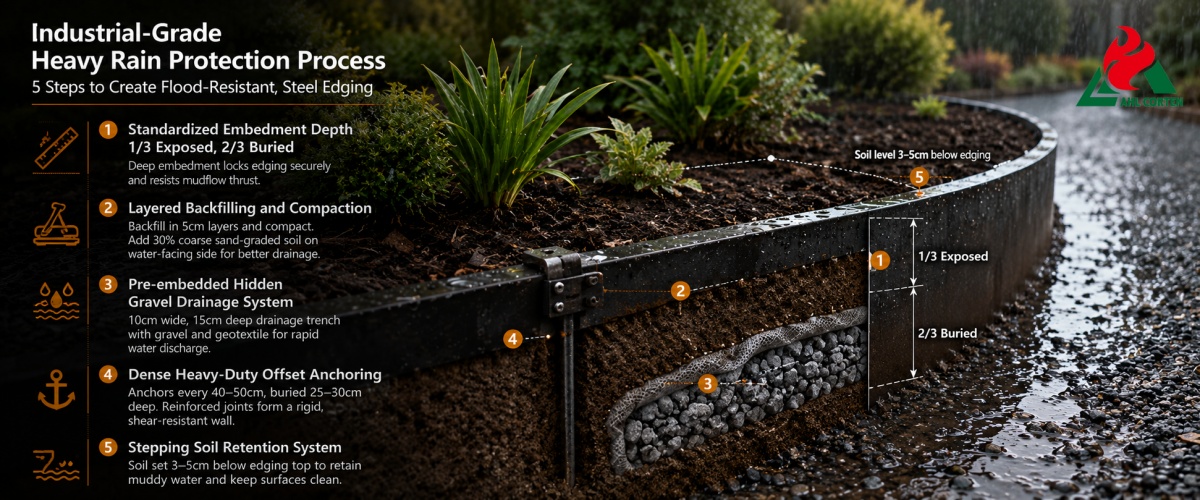
Shallow installation is strictly prohibited in high-rainfall areas; the “1/3 exposed, 2/3 buried” golden ratio must be strictly followed. For example, for a 15cm-high metal landscape edging, the groove depth must be no less than 10cm. Deeply embed the strip into the undisturbed soil layer, utilizing the soil’s lateral friction to firmly lock the structure in place and resist the thrust of mudflows.
2. Layered Backfilling and Compaction to Eliminate Underground Voids
Do not bury large clumps of soil directly; instead, use a process of backfilling in thin 5 cm layers and compacting each layer sequentially. On the water-facing side, mix in 30% coarse sand-graded soil to improve drainage and aeration. Thoroughly eliminate micro-pores and gaps in the soil to prevent rainwater from eroding and hollowing out the foundation underground.
3. Pre-embedded Hidden Gravel Drainage System
Dig a 10 cm wide, 15 cm deep drainage trench on the inner side of the edging, and lay a layer of graded gravel wrapped in geotextile. Heavy rainwater can quickly seep vertically downward and be discharged, draining saturated water in 3 seconds. This keeps the foundation dry and solid over the long term, preventing softening and settlement at the source.
4. Dense Heavy-Duty Offset Anchoring for Rigid Edge Locking
In areas with high rainfall and soft soil, standard plastic or thin metal nails are not used. Instead, heavy-duty weather-resistant steel anchors are exclusively employed. Standard spacing is 80 cm; during the rainy season, spacing is reduced to 40–50 cm, with anchors buried 25–30 cm deep. Joints are reinforced with bidirectional, widened locking connectors, transforming multiple edging sections into a single, rigid shear-resistant wall.
5. Stepping Soil Retention System to Prevent Mud Overflow
The soil surface inside the planting area is set 3–5 cm below the top of the edging, creating a natural water-retaining barrier. During heavy rains, muddy water is effectively retained and allowed to settle in place, preventing mud from overflowing and contaminating stone or washed-stone surfaces, and ensuring the edging remains clean and neat at all times.
Landscaping for High-End Villas: Precisely delineates lawns, gravel areas, and flower beds with clean, erosion-resistant lines, ideal for minimalist garden styles.
Terraced Flower Beds: Leveraging the high rigidity of steel to create layered retaining structures that withstand slope runoff and soil slippage.
High-Water-Level, Rainy-Season Gardens: Replaces rot-prone wood and rust-prone standard sheet metal, ensuring 30 years of maintenance-free, long-lasting use.
2. High-Risk Scenarios Requiring Optimization and Renovation
Low-Lying Gardens with Chronic Waterlogging: Direct installation is prohibited. Drainage systems must first be optimized and terrain slightly adjusted to ensure a dry-wet cycle environment, preventing abnormal corrosion caused by oxygen-deprived stagnant water.
Areas prone to mudslides or landslides: These structures cannot be used as the sole load-bearing element. First, construct concrete retaining walls or gabion baskets as primary protection, then use weathering steel to create refined, aesthetic edging.
Rainy Season Inspection and Low-Maintenance Care Guide
3 Key Inspections After the Rainy Season
Check for deformation and displacement: Inspect along the edges of the Corten steel raised beds for issues such as bulging, warping, or loose/floating anchor bolts.
Check for Joint Leakage: Shake the joints to check for soil hollowing, mud seeping through gaps, or voids caused by ant nests.
Check for Rust Water Overflow: Monitor the paving surface within the first six months after installation and adjust the bottom slope as needed to prevent long-term water accumulation and staining.
Minimalist Repair and Maintenance Techniques
Regularly clean joints and remove fallen leaves and silt from the base to restore the steel’s natural ventilation and moisture cycle, stabilizing the texture of the rust layer. For eroded or collapsed areas, fill with soil in layers and compact it, re-leveling any height differences to restore the stability of the retaining structure. For slightly loose anchor bolts, there is no need to remove them; simply strike them firmly to drive them back into the original hard soil layer, securing the overall structural integrity.
FAQ: Completely Addressing Concerns About Using Corten Steel Edging During the Rainy Season
1. Will Corten Steel Edging Rust Through and Become Unusable After Years of Exposure to Heavy Rain?
No. Once authentic SPA-H weathering steel has formed a dense rust layer through cycles of drying and wetting, its annual corrosion rate approaches zero. A rainy environment will only accelerate the maturation of the protective layer; it will not cause the steel to rust through. Under normal conditions, it can be used reliably for over 30 years.
2. Will Extreme Downpours Wash Away or Warp the Edging Strips?
The material itself will not be damaged. As long as industrial construction standards—including proper burial depth, reinforced anchoring, and drainage—are followed, the edging strips will act like miniature dams, fully withstanding the impact of torrential rain and muddy water as well as lateral soil pressure.
3. Is It Necessary to Apply Waterproof or Anti-Rust Coatings for Protection?
We strongly advise against it. Sealing paints and coatings block air and rain, disrupting the formation of the self-healing rust layer on corten steel. Later, cracking in the paint film and water accumulation can trigger more severe crevice corrosion, accelerating structural aging and failure.
4. What Should Be Done If Rust Water from Newly Installed Edging Stains Stone Flooring?
The first 1–6 months after installation is the rust layer stabilization period, during which a small amount of surface rust water is normal. You can lay a gravel blind drain in advance to create a barrier, or choose factory-finished products that have undergone rust-fixing pretreatment to eliminate staining at the source.
5. What are the Differences in Installation for Clay and Sandy Soils?
For clay, the panels must be thickened to 2.0 mm or more, and the density of anchor bolts must be doubled to withstand water absorption and expansion pressure. For sandy soil, the burial depth must be increased, and a geotextile filter layer must be added to prevent bottom scouring and subsidence.
6. When Is Secondary Reinforcement and Maintenance Required?
1–2 weeks after the first heavy rainstorm, a full re-inspection is needed to tighten anchor bolts and level the soil. Simple cleaning and inspections at seasonal changes and before the flood season ensure long-term stability.
7. Can Geotextile and Weed Barrier Fabric Be Used in Combination?
Highly recommended. Laying high-density geotextile on the inner side allows water to pass through while blocking soil, locks in the planting soil, prevents sand leakage through gaps, and reduces weeds along the edges, maintaining clean and tidy landscape lines over the long term.
8. How Should Localized Loosening or Deformation Be Repaired?
There is no need for large-scale demolition or reconstruction. Simply clear the affected soil, correct the vertical alignment, install additional diagonal reinforcement anchors, and pour small-scale concrete bases followed by compaction and backfilling to quickly restore the original condition—all without the waste associated with extensive rework.
Are You Ready to Choose the Corten Steel Edging That’s Right For You?
Heavy rain is never the natural enemy of weathering steel edging; rather, unprofessional installation, inadequate drainage, and shoddy foundation work are the true causes of landscape deformation, failure, and the need for rework. Authentic weathering steel relies on a unique self-protective alloy mechanism, making it naturally suited for outdoor environments with heavy rainfall, high humidity, and seasonal cycles of wet and dry conditions. It doesn’t deteriorate or look worse with use; instead, it develops a uniform, sophisticated vintage patina over time, with its texture continuously improving. Say goodbye to the short lifespan and limitations of ordinary PVC and galvanized sheet metal, and put an end to the annual maintenance and constant rework that plague your garden. With industrial-grade panel thickness, standardized deep-burial techniques, and a scientific drainage and anchoring system, a simple edging strip can become a long-lasting infrastructure solution that safeguards your garden’s cleanliness, stability, and beauty. Want to create a premium metal garden bed edging that withstands torrential rains, remains distortion-free for 30 years, and resists corrosion? Contact us now to receive a customized solution for rainy climates, detailed installation guidance, and a comprehensive rainy season maintenance manual—ensuring a worry-free, durable, and high-end garden landscape in one go!


.jpg)


.jpg)
 Fill In The Inquiry