Can Corten Steel Planters Crack or Break?
In landscape design for high-end villa gardens, rooftop gardens, and commercial plazas, weathering steel planters have become a mainstream landscaping element. With their clean geometric lines and natural, vintage rust-brown patina, they effortlessly create a minimalist, rustic, and sophisticated garden atmosphere.
However, nearly all designers and property owners share the same core concern. Will weathering steel, when left exposed to the elements for extended periods—enduring sun and rain, filled with heavy soil, and subjected to seasonal freeze-thaw cycles—develop cracks, warp, become damaged, or even break as it ages?
Many have had negative experiences with low-quality metal planters: after just one or two years of use, thin-gauge metal planters develop bulges and warping, welds tear apart, and soil and water leak out, completely ruining the overall landscape effect. Replacing these planters is not only costly but also damages the established plant root systems, resulting in a double loss.
Rusted steel planters are high-value, long-lasting landscape fixtures—not disposable items. What people truly need are high-quality products that are visually appealing, structurally stable, and remain free of deformation or cracking for a decade. This article provides a comprehensive guide covering material facts, causes of damage, distinguishing between genuine and fake cracks, selection and installation, and daily maintenance—all designed to completely eliminate any concerns about their use.
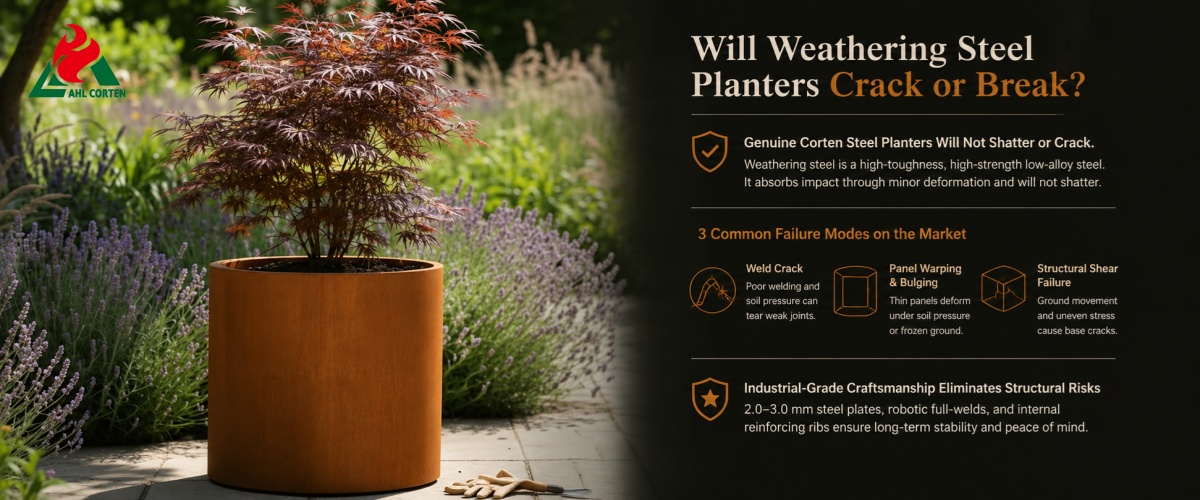
Will Weathering Steel Planters Crack or Break?
Genuine Corten Steel Planters Will Not Shatter or Crack.
Proper industrial-grade outdoor corten steel planters will absolutely not suddenly shatter or break apart like ceramic or glass. This is determined by the core material properties of weathering steel.
Weathering steel is a high-toughness, high-strength low-alloy steel, fundamentally different from ordinary brittle materials. Even when subjected to external impacts or slight compression, it absorbs the force through minor deformation and will not experience instantaneous fracture or shatter into pieces.
3 Common Failure Modes of Damaged Flower Boxes on the Market
The damage issues commonly seen in steel flower pots are not caused by natural material aging, but rather by human-induced failures resulting from improper manufacturing, structural design, or installation. These failures can be categorized into three main types.
- Weld Crack: Weathering steel sheets themselves are extremely resistant to damage; however, poor-quality welding often contains defects such as lack of fusion or slag inclusions. Lateral pressure generated by soil expansion due to water absorption can directly tear apart the weld joints.
- Panel Warping and Bulging: Panels less than 1.5 mm thick and lacking internal reinforcement structures are prone to this issue. Lateral pressure from soil and expansion due to frozen ground in winter can cause large-scale outward bulging and misalignment of the panels.
- Structural Shear Failure: Common in large commercial planters. Ground subsidence, water accumulation, and uneven stress distribution at the base generate significant shear forces, leading to fractures at the joints between the base plate and side walls.
Key Difference: Industrial-Grade Craftsmanship Eliminates Structural Risks
The crack resistance of a metal planter box never depends on the material name, but rather on the manufacturing process and structural design.
Industrial-grade corten steel planter boxes utilize 2.0–3.0 mm thick steel plates, combined with robotic full-welding technology and internal reinforcing ribs. From a structural mechanics perspective, this approach completely eliminates the potential risks of cracking, deformation, and damage, ensuring long-term stable use.
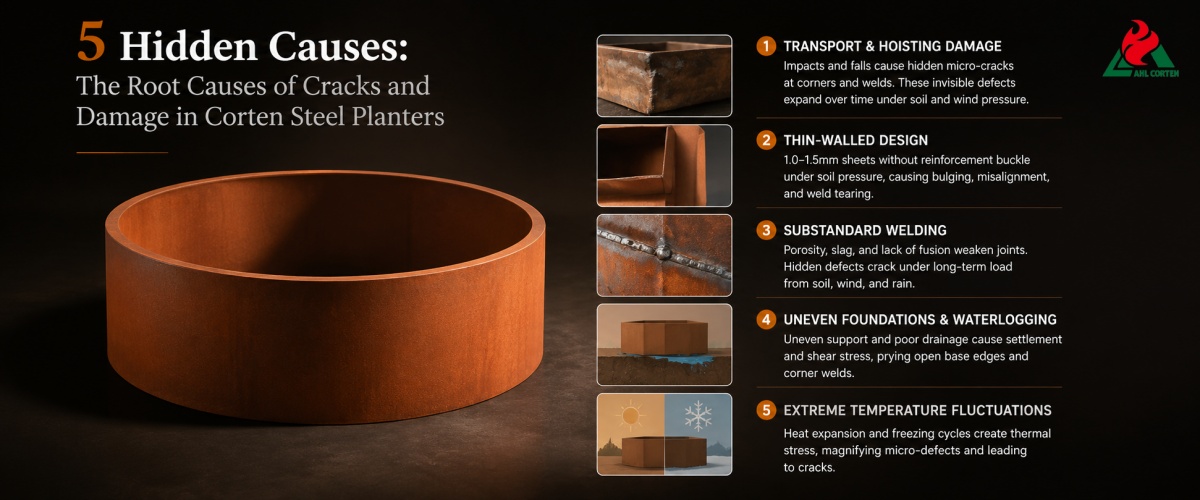
5 Hidden Causes: The Root Causes of Cracks and Damage in Corten Steel Planters
Weathering steel itself possesses excellent toughness and outstanding resistance to corrosion and deformation. All damage and failures stem from the combined effect of five controllable risk factors that arise during subsequent handling.
1. Hidden Internal Damage from Transportation and Hoisting
Most cracks were already present before the rusted steel planters were even put into use. During handling, hoisting, and unloading, falls from heights and impacts from hard objects can cause microscopic cracks and stress concentrations at welded corners that are invisible to the naked eye.
While they may appear intact initially, these internal micro-cracks will continue to expand over time under the pressure of soil and wind forces, eventually leading to complete failure.
2. Thin-Walled Design with Severe Structural Insufficiency
Low-cost, substandard planters commonly use ultra-thin 1.0–1.5mm sheets with no internal support structure. Once filled with moist soil, the soil density increases significantly, generating extreme lateral thrust.
Prolonged, sustained pressure pushes the thin sheets to their deformation limit, causing bulging, misalignment, and weld seam tearing—the most common causes of damage in home and landscape planters.
3. Substandard Welding: Industrial-Grade Defects
Welded joints are the weakest points in the overall structure of large outdoor metal planters. Small workshops use standard welding rods and rudimentary manual welding techniques, which frequently result in weld porosity, slag inclusions, and lack of fusion.
These hidden defects are invisible to the naked eye. Under repeated tugging from soil and the load of wind and rain, they will be the first to crack and fail, serving as the fatal internal cause of planter damage.
4. Uneven Foundations and Waterlogging Lead to Shear Distortion
If corten garden bed planters are placed on loose soil or uneven ground, they may become partially suspended or subjected to concentrated stress at single points. Water pooling at the base that continuously saturates the soil can lead to foundation settlement and soil softening.
With planters weighing hundreds of kilograms subjected to long-term torsional stress, powerful axial shear forces can directly pry open the bottom edge and corner welds, causing structural damage.
5. Extreme Temperature Fluctuations: Thermal Stress Causes Micro-Cracks
In regions with extreme temperature variations—such as intense heat in summer and freezing cold in winter—planters are subjected to intense heat and expansion in summer, freezing and thawing in winter, or sudden dousing with cold water while still hot.
Severe thermal expansion and contraction generate immense thermal stress, which magnifies microscopic defects at weld joints, gradually causing them to tear and crack, thereby accelerating structural failure.
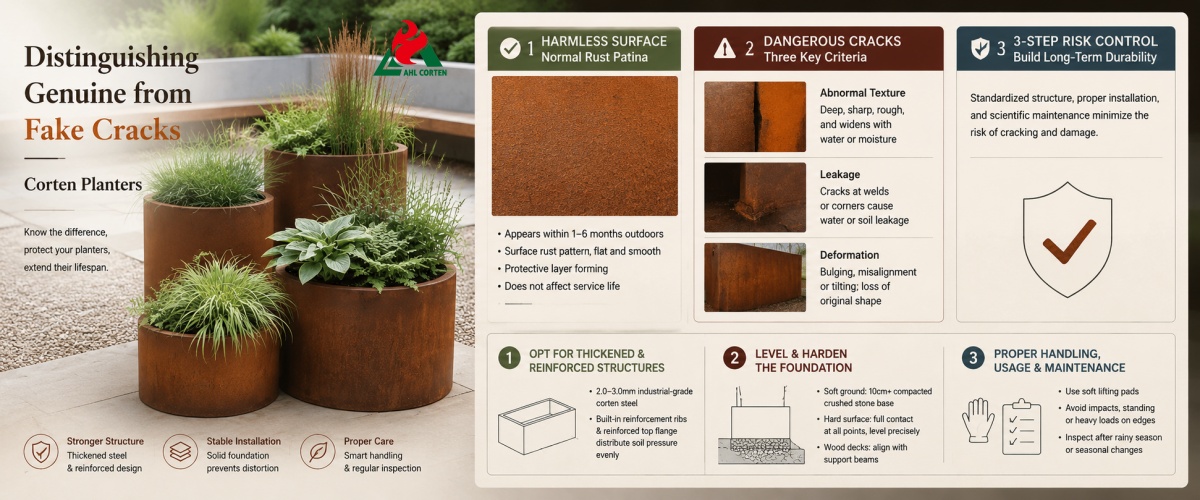
Distinguishing Genuine from Fake Cracks in Corten Planters
Within the first six months of outdoor use, weathered steel planters develop a rich rust patina on their surfaces. Many owners mistakenly interpret this natural oxidation as cracking, leading to unnecessary concern. By mastering the identification methods, you can accurately distinguish between safe rust patterns and dangerous cracks.
1. Harmless Surface: Normal Rust Patina
After 1–6 months of outdoor exposure, the planter undergoes cycles of drying and wetting, resulting in a network of patterns on the surface that resemble cracked soil or tree bark. These patterns appear reddish-brown or dark brown and are part of the normal passivation process.
This texture exists only on the surface rust layer; it feels flat and smooth to the touch, with no unevenness. It does not damage the internal structure of the steel; rather, it is a sign that the protective layer has formed densely and does not affect the product’s service life.
2. Dangerous Structural Cracks (Three Key Criteria)
True structural cracking is accompanied by distinct failure characteristics. The presence of any of the following conditions indicates that the planter’s structural integrity has been compromised and requires immediate repair.
- Abnormal texture and appearance: Cracks are noticeably deep, feel sharp and rough to the touch, and continue to widen when exposed to water or moisture from soil.
- Soil and water leakage: Cracks at welds or corners, resulting in frequent seepage, soil leakage, or water accumulation during watering.
- Overall deformation and misalignment: Irreversible outward bulging of the planter’s side walls, overall tilting, and distorted geometric lines, resulting in a complete loss of its original shape.
3-Step Risk Control Method: Eliminate the Risk of Cracking and Damage in Corten Planters From the Start
The long-term durability of corten steel trough planters does not rely on luck, but on standardized structural design, proper installation, and scientific maintenance. Follow these three steps to minimize the risk of cracking and damage.
1. Opt For Thickened And Reinforced Structures to Build A Solid Foundation
Prioritize 2.0–3.0mm industrial-grade thickened steel sheets for material selection. For residential weathering steel planters, use no less than 2.0mm; for large commercial planters, opt for 3.0mm or thicker.
Pay close attention to the internal structure—high-quality planters feature built-in rigid reinforcement ribs and reinforced top flanges. This evenly distributes lateral soil pressure, preventing deformation and cracking caused by stress concentration at the source.
2. Level and Harden the Foundation to Prevent Structural Distortion
- Soft Grass/Dirt Surfaces: Do not place planters directly on these surfaces. Instead, excavate the foundation, lay a compacted and leveled layer of crushed stone at least 10 cm thick to prevent future settlement and lifting.
- Concrete or hard surfaces: Ensure the planter’s base is fully in contact with the ground at all support points, with no single points suspended or lifted. Use rigid shims to precisely level any uneven areas.
- Wooden terrace platforms: Calculate the load-bearing capacity in advance and align the planter’s load-bearing points with the main support beams below to prevent the planter from tilting or breaking due to deformation of the wooden planks under pressure.
3. Follow Proper Handling and Usage Guidelines, and Implement Daily Maintenance
When moving or hoisting, wrap the planter with soft lifting pads to prevent hard impacts or falls from heights. Do not step on the edges of the planter or place heavy objects on top of it to avoid localized stress that could cause permanent deformation.
Conduct timely inspections after the rainy season or seasonal changes to identify and address minor issues early, preventing small hazards from escalating into structural damage.
FAQ: Comprehensive Answers to Questions About Cracks and Damage in Planters
1. Are Weathering Steel Planters Prone To Breaking Or Cracking?
Genuine industrial-grade weathering steel planters are extremely resistant to damage. Their tensile strength and impact resistance far exceed those of plastic, ceramic, and ordinary sheet metal planters. So-called “breakable” products on the market are all thin-walled, low-quality carbon steel imitations and are not made of authentic weathering steel.
2. Will They Shatter Like Ceramic When Struck By An External Force?
No. Weathering steel is a ductile metal and does not exhibit brittle fracture characteristics. Even if struck by a heavy object or subjected to a minor fall, it will only experience slight localized dents or deformation—it will not shatter or crack, ensuring extremely high structural safety.
3. Are Welds On Large Planters Most Prone To Cracking?
Substandard, hand-welded products are highly susceptible to weld cracking, but genuine products made with fully automated robotic full-penetration welding do not have this issue. Professional welding ensures that the weld material and strength are identical to the base material, eliminating any weak stress points.
4. Can Pressure From Heavy, Damp Soil Cause the Planter To Crack?
A structurally sound planter can fully withstand this pressure. Reputable manufacturers optimize the structure to handle lateral soil pressure; larger planters are reinforced with internal bracing and folded edges, allowing them to easily resist the lateral thrust of saturated soil without deforming or cracking.
5. Can Uneven Ground Cause Flower Boxes To Break?
This is a key hidden cause. Prolonged suspension at a single point and twisted stress cause the flower box’s own weight—hundreds of kilograms—to generate powerful shear forces. These forces continuously strain the welds and panel surfaces, eventually leading to cracks and breakage.
6. Are Fine Mesh-Like Patterns On the Surface Considered Cracks?
In over 95% of cases, these are normal oxidation patterns of the rust layer—a healthy sign that the protective layer is forming. If the surface feels smooth, shows no water seepage or soil leakage, and exhibits no deformation, no treatment is necessary.
7. Can Installing An Inner Liner Reduce The Risk Of Cracking?
Yes. An insulated liner can cushion the pressure from soil freezing and expansion in winter, isolate the planter from acid or alkaline soil corrosion, and reduce damage from thermal stress and temperature differences, providing comprehensive protection for the planter’s structure.
8. Is It Necessary To Apply Anti-Rust Sealing Paint To Protect The Planter?
We strongly advise against it. Sealing paint blocks the breathable oxidation pathways of weathering steel, disrupting the formation of the self-healing protective rust layer. If the paint layer cracks and allows water to penetrate later on, it can trigger hidden interlayer corrosion, accelerating structural aging and damage.
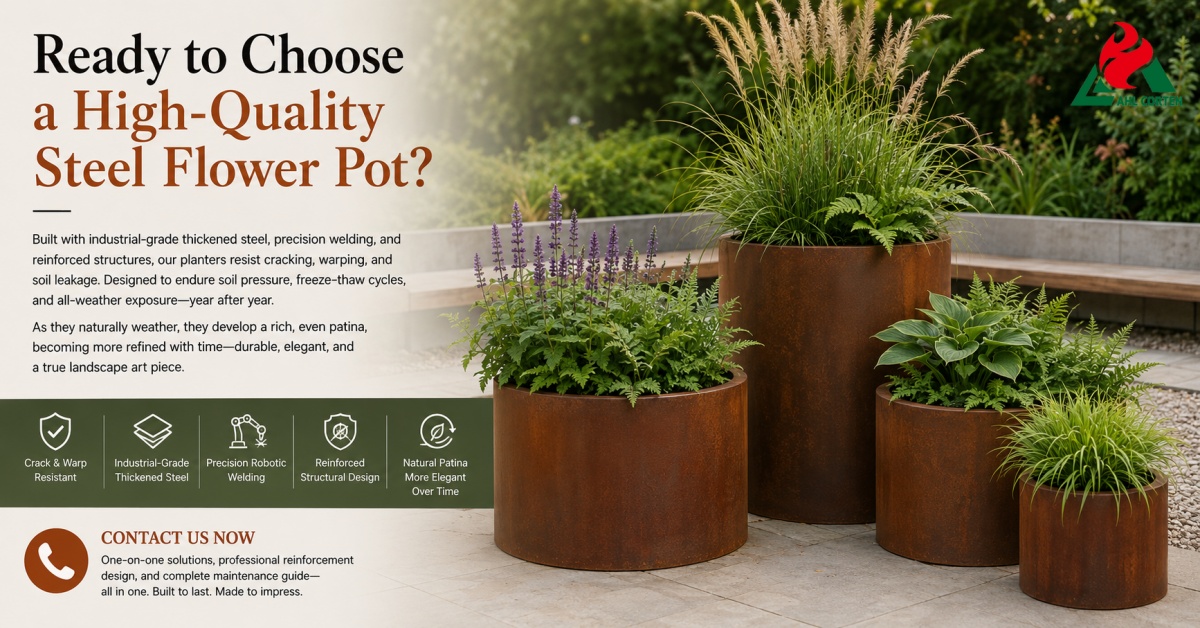
Ready to Choose a High-Quality Steel Flower Pot?
If you’ve been worried that weathering steel planters might crack, warp, leak soil, or break, you can now rest assured. Genuine weathering steel is inherently tough and durable, with low fracture risk. The vast majority of planter damage issues on the market are not caused by material defects, but by human factors such as using thin, substandard materials, shoddy welding, improper foundations, and inadequate maintenance.
To keep your garden or commercial landscape looking neat and sophisticated year-round—without the need for frequent planter replacements, rework, renovations, or damage to your plants—the key lies in industrial-grade thickened steel plates, precision robotic welding, scientifically reinforced structures, and standardized installation and maintenance. High-quality weathering steel planters withstand soil lateral pressure, winter freeze-thaw cycles, and year-round exposure to wind, rain, and sun, remaining structurally stable without warping or cracking.
Unlike ordinary disposable planters, these become more refined with use. As they naturally oxidize over time, they develop a warm, even vintage patina, becoming increasingly elegant and distinctive. They serve not only as durable, practical landscaping fixtures but also as garden art installations that accumulate the character of time.
Say no to low-quality planters that warp and crack easily, and bid farewell to constant repairs and renovations! Want to customize industrial-grade weathering steel planters that truly won’t crack or warp, and are perfectly suited for your garden or commercial space? Contact us now to receive a one-on-one site-specific solution, professional structural reinforcement design, and a complete maintenance guide—all in one go—to create a high-end landscape that remains stable, durable, visually stunning, and as good as new for years to come!
Back

 Fill In The Inquiry