A weathered steel fire pit is no ordinary outdoor accessory; it is the very soul of garden gatherings—combining vintage rusted aesthetics, unparalleled durability, and a warm, inviting ambience.
Yet with the multitude of corten fire pits available in 2026, how does one select the most suitable design for their terrace, garden, or backyard? This purchasing guide will navigate you through every step.
This article thoroughly dissects the core considerations for purchasing a Corten steel fire ring: from analysing the material's inherent advantages, to pre-purchase sizing considerations and key selection factors, through to safe placement techniques and common pitfalls to avoid. Empowering you to make an informed decision and acquire a durable, aesthetically pleasing, and practical weathering steel fire pit.
Rusted steel fire pits are the premier choice for outdoor enthusiasts in 2026 – requiring no fussy maintenance, lasting decades, and developing a uniquely distinctive vintage patina over time. With this guide, you'll select the perfect metal fire pit to transform your outdoor space into a year-round gathering spot that impresses visitors and enhances property value.
Why Choose a Weathered Steel Fire Pit in 2026?
1. Zero Maintenance Costs, Effortless Outdoor Enjoyment
Corten steel fire pits naturally develop a rust patina (typically within 2-4 months). This patina forms a stable, protective oxide layer eliminating the need for frequent repainting, sealing, or repairs—freeing you from tedious upkeep.
To accelerate rust development, a safe and convenient method involves spraying the pit's surface with saltwater. This hastens the vintage patina's emergence without damaging the steel itself.
Even if scratches or stains occur during use, no special treatment is required—as the steel weathers naturally, these marks will gradually fade, maintaining a consistently neat and aesthetically pleasing appearance.
Rusted steel fire pits are crafted from approximately 6.35mm (1/4inch) thick steel plate, combining portability with robustness: easily movable while withstanding extreme weather including rain, frost, and intense sunlight.
Exceptional structural integrity ensures a lifespan exceeding 20 years, far surpassing fire pits made from metal, plastic, or stone. This makes it an exceptionally cost-effective long-term investment.
The protective rust layer effectively prevents corrosion, ensuring long-term, stable use even in coastal humid regions or rainy climates, provided it is positioned correctly (ensuring adequate drainage).
3. Unique Aesthetic Appeal, Complementing Diverse Outdoor Styles
The rich rust patina exudes a vintage charm, effortlessly blending into modern, rustic, minimalist, or classic garden styles, adding distinctive character to outdoor spaces.
The character of the custom steel fire pit deepens over time, with the rust hue gradually intensifying to become a bespoke focal point in your garden – its visual appeal only growing with use.
Available in diverse designs including fire bowls, fire tables, monument-style burners, and curved fire pits, suitable sizes and styles can be found for spaces ranging from compact balconies to expansive backyards.
Essential Pre-Purchase Guide: Selecting the Right Size Fire Pit
Step 1: Prioritise Seating Distance Over Terrace Area
Many begin by measuring their terrace to select a fire pit, which is entirely putting the cart before the horse. The correct core principle is to start with where people will sit.
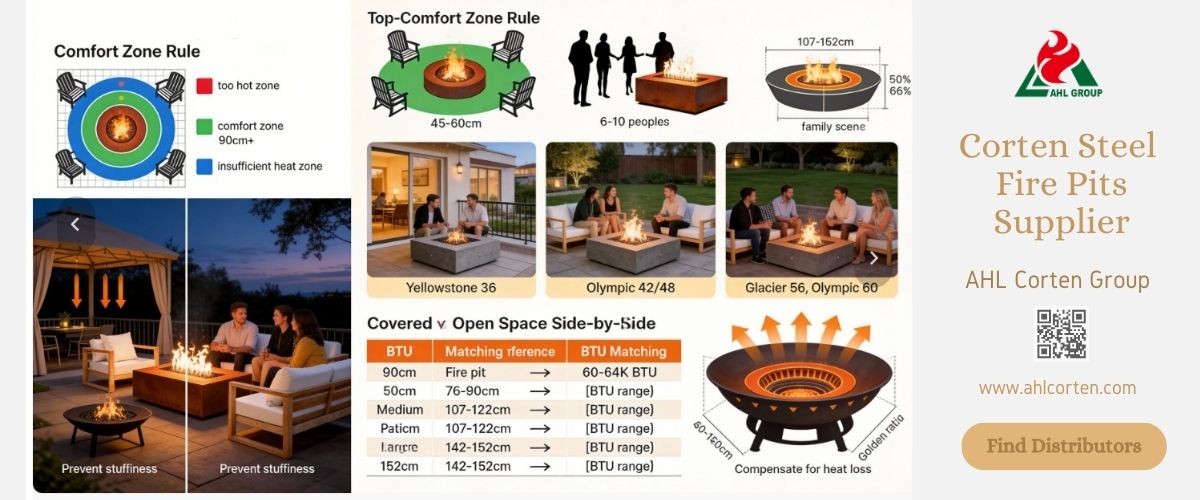
Comfort Zone Rule: The ideal distance between flames and seating is 45–60 centimetres (18–24 inches). Beyond 90 centimetres (36 inches), heat dissipates rapidly; under 30 centimetres (12 inches), it becomes uncomfortably hot.
Select By Guest Capacity: For daily use accommodating 4-6 people, choose a fire pit with a diameter of 90cm (36 inches) or larger. For 6-10 guests, select a fire pit measuring 107-152cm (42-60 inches) or larger (adjust specific dimensions based on layout).
Common Pitfalls to Avoid: Never base your selection solely on terrace area. Ensure flames remain within the seating circle rather than idle corners, guaranteeing warmth for every guest.
Step 2: Flame Coverage Must Match Fire Pit Diameter
The external dimensions of a fire pit do not equate to its flame coverage area. True warmth emanates from the burner aperture, not the fire pit's tabletop.
Illustrative Example: A 90cm (36-inch) diameter fire table may feature a burner aperture of merely 40-45cm (16-18 inches); conversely, a 152cm (60-inch) diameter model may boast a burner aperture of 76-90cm (30-36 inches). This disparity directly impacts the actual heat output.
Rule of Thumb: The flame coverage should occupy 50%-65% of the fire pit's internal area. If the flames are too small, the fire pit serves merely as decoration and fails to meet practical needs like heating.
Step 3: Determine Fire Pit Size Based on Space Usage
Different usage scenarios demand varying fire pit sizes. Selecting based on actual purpose ensures both practicality and aesthetic appeal.
Small Patios/Balconies: Prioritise fire pits measuring 76–90 cm (30–36 inches). Ideal for intimate conversations and creating a cozy ambience, such as the Yellowstone 36-inch Fire Table—compact footprint, ample heat output, suited for close-proximity dining, and straightforward installation.
Medium-Sized Patios/Family Spaces: Opt for 107–122 cm (42–48 inches) fire pits for everyday family use. These provide even warmth and accommodate leisure activities for the whole household. Examples include the Olympic 42-inch or 48-inch fireplace-style fire tables, which offer a rich flame effect without excessive glare.
Large Backyards/Entertaining Areas: Opt for fire pits measuring 142–152 cm (56–60 inches) or larger. These serve as focal points for the spaces, accommodating large gatherings and guests. Examples include the Glacier 56-inch Fire Table and Olympic 60-inch Fire Table.
Step 4: Adjust Size Based on Shading Conditions (Covered Patios vs. Open Spaces)
Metal fire pits perform distinctly differently on covered patios versus open-air spaces, requiring tailored sizing adjustments.
Covered Patios: Heat reflects downward, making flame height more critical than actual heat output. Oversized fire pits create cramped, stuffy spaces. Opt for smaller units paired with low-profile tables and high-output burners.
Open-Air Spaces: Heat dissipates rapidly, making larger burners more effective for heating. Larger fire tables also achieve greater visual harmony.
Key Considerations for Covered Patios: Prioritize ventilation and ease of cleaning. Select compact, high-heat-output models to prevent stuffiness and smoke accumulation.
Step 5: Burner Size Must Match Table Dimensions (BTU Reference Guide)
Common Misconception: Pairing oversized fire pits with excessively powerful burners often results in weak flames, inadequate heating, and a poor user experience.
2026 Compatibility Reference: 90cm (36-inch) fire pit → 60-84K BTU; 107-122cm (42-48in) dining-table fire pits → 120-180K BTU; 142-152cm (56-60in) dining-table fire pits → 180-300K+ BTU.
Important Note: The burner's BTU output must be compatible with your domestic gas supply to achieve optimal performance. Verify gas supply capacity prior to purchase.
Step 6: Adjust for Environmental Factors such as Wind and Altitude
Environmental factors significantly impact fire pit performance beyond expectations. Thoroughly consider the environmental characteristics of the intended usage scenario during procurement.
If the Usage Scenario Involves: persistent high winds, elevated altitude, or semi-enclosed spaces, it is advisable to: increase burner size, incorporate a windshield, and avoid ultra-low-power burners to ensure adequate heating and operational safety.
Seasonal Wind Variation Management: Prevailing wind directions vary across seasons.
Key Selection Factors for OptimalFire Pits in 2026
1. Fuel Type: Wood vs Propane vs Natural Gas – Select According to Requirements
Gas (Propane/Natural Gas): Offers convenient ignition, precise temperature control, clean combustion with minimal residue, and low maintenance costs. Ideal for large metal fire pit bowls and frequent daily use.
Wood: Delivers the classic crackling sound and smoky aroma of a wood fire, maximising ambience. Ideal for those prioritising experience and occasional use. Models with smoke-reduction technology are recommended to minimise eye irritation.
2026 Purchasing Tip: Prioritise gas models for frequent daily use; wood models suit occasional gatherings or ambience-focused settings. Match fuel type to your usage habits.
2. Purpose: Decorative, Functional, Or Both?
Primarily Decorative:
Recommended options include weathering steel monument-style burners and Toro fire tables. Their elegant designs serve as focal points in gardens while radiating warmth and elevating spatial aesthetics.
Primarily functional (cooking/heating): Opt for multifunctional fire tables with integrated grilling capabilities or built-in fire pits. These offer outstanding safety features while fulfilling core needs like outdoor cooking and winter heating.
Decorative and practical: Weathering steel curved fire pits are the ideal choice. Suitable for small gatherings and leisure, they also accommodate occasional outdoor cooking, offering versatile functionality for multiple scenarios.
Style Compatibility: Matching Garden Décor
Contemporary gardens: Opt for minimalist-designed weathering steel fire pits, such as the Magnum or flat-pack Minima models. Their clean lines harmonise perfectly with modern gardens' understated aesthetic.
Rustic/Vintage Gardens: Prioritise bowl-shaped weathering steel fire pits. Their natural developing patina deepens over time, enhancing the rustic charm.
Classic Gardens: The Weathering Steel Portulaca Burner is an excellent choice. Its traditional design combined with durable materials complements the refined elegance of classic gardens, ensuring timeless appeal.
Essential Features and Practical Accessories
Drainage System: This core feature prevents rainwater accumulation, ensuring proper weathering of the steel, avoiding uneven rust formation, and extending longevity.
Safety Features: Recessed design (to prevent sparks and embers from escaping), stable base (for uneven surfaces), and heat-resistant materials (to prevent burns during use) are all essential safety configurations.
Practical Accessories: Windshields (for windy conditions), firewood storage compartments (convenient fuel organisation), integrated seating (enhanced usability), and smoke-free technology (optimised experience) can be selected according to requirements.
Quality and Safety Inspection: Key Details to Note
Steel Plate Thickness : 6.35mm (1/4 inch) is the standard thickness, ensuring structural robustness without excessive bulk, facilitating easy movement and installation.
Safety Certification: Verify compliance with local safety standards. When purchasing, inspect the manufacturer's safety inspection reports and certification documents to mitigate potential hazards.
Ventilation Requirements: Adequate ventilation is essential for safe and efficient combustion. Avoid models with poor airflow and never operate a rusted steel fire pit in enclosed spaces.
Corten Fire Pit Placement Guide: Dual Considerations for Safety and Design
Essential Safety Distance Regulations
The 10-foot (3-metre) Rule: Maintain a minimum distance of 3 metres between the fire pit and structures such as houses, railings, overhanging branches, and other combustible materials. This core safety requirement effectively prevents property damage and personal injury.
Overhead Clearance Requirement: Maintain a minimum clearance of 4.5 metres (15 feet) between the fire pit and overhead structures such as awnings, parasols, or dry branches to prevent ignition from high temperatures or sparks.
Property Boundary Distance: Typically, a distance of 3-7.6 metres (10-25 feet) should be maintained between the fire pit and neighbouring property boundaries. Consult local regulations for precise measurements to avoid non-compliance.
Ideal Placement Surface: Balancing Fire Resistance And Stability
Prioritize Fire-Resistant Surfaces: Position the metal fire piton surfaces made of fire-resistant materials such as stone, gravel, or concrete. Avoid placing it directly on lawns, wooden decking, or other combustible surfaces. If placement on such surfaces is unavoidable, use a fire-resistant protective mat.
Level Ground Is Essential: A flat surface is fundamental for stable placement. If the chosen location is uneven, level the ground beforehand or construct a dedicated base to prevent tilting, which could cause uneven flames or tipping hazards.
Wind and Climate Considerations: Adapting to Different Environments
Predominant Wind Direction: Observe prevailing wind patterns across different times of day and seasons in your garden. Position the fire pit so smoke drifts away from seating areas and buildings, enhancing comfort.
Adapting to Humid Climates: In damp regions, prioritise well-ventilated placement, avoiding low-lying areas prone to water accumulation. This ensures weathering steel undergoes normal patination, preventing uneven rust formation.
Adapting to Arid Climates: Dry regions carry heightened fire risks. Increase safety distances, enhance spark control, and strictly adhere to local seasonal fire prevention regulations.
Design and Social Functionality: Creating a Welcoming Gathering Space
Seating Arrangement Planning: Position seating around the fire pit in a circular or semi-circular layout. Maintain a distance of 1.5–2.4 metres (6–8 feet) between seats and the pit's edge to ensure warmth while avoiding excessive heat and sparks.
Landscape Integration Design: Position the fire pit to highlight garden features without obstructing key vistas. Ensure visibility from interior windows allows indoor guests to enjoy the warm, flickering ambience.
Circulation Planning: Maintain unobstructed pathways between the house, seating area, and fire pit to facilitate movement and transport, enhancing gathering convenience.
Ready to Select a Corten Fire Pit Suited to Your Outdoor Space?
With its core advantages of zero maintenance, exceptional durability, and striking aesthetics, the weathering steel fire pit stands as the premier choice for upgrading outdoor spaces in 2026. Selecting a model tailored to your needs not only adds warmth to your garden but creates a dedicated focal point for outdoor gatherings, allowing family and friends to share leisurely moments.
When purchasing, simply bear in mind three key principles: determine size based on usage scenarios and seating distances; match functionality to fuel type and purpose; and align placement with safety standards and style preferences. By avoiding common pitfalls, you can effortlessly select a weathering steel fire pit offering excellent value for money and a superb user experience. Contact us now for a complimentary catalogue and quotation!

.jpg)
.jpg)
.gif)
 Fill In The Inquiry