3mm vs. 1.5mm Corten Steel Edging: Which Thickness Is Worth It?
Date:2026.05.12
Share to:
With its clean lines, vintage rusted finish, and exceptional weather resistance, corten steel edging is widely used in private gardens, walkway borders, commercial plazas, and municipal landscaping. It clearly defines the boundaries of lawns, gravel areas, and flower beds, preventing vegetation from spreading unchecked and giving the garden a cleaner, more sophisticated look.
When purchasing, buyers often face a critical decision: should they choose the more cost-effective 1.5mm thin option, or the sturdier, yet more expensive, 3mm thick option?
Many private homeowners opt for the 1.5mm option to save money, only to encounter sagging, warping, and buckling later on; conversely, some project buyers blindly choose the 3mm option, resulting in wasted costs for simple curved pathways.
The difference in thickness essentially boils down to a trade-off between initial investment and long-term maintenance costs. This article provides an in-depth comparison of 1.5mm and 3mm weathering steel edging strips across various dimensions, including application scenarios, material principles, physical properties, construction costs, and common industry misconceptions. It aims to help buyers make rational budget decisions and select the specifications that are truly suitable for their projects, ensuring both value retention and durability.
Which Thickness of Corten Steel Edging Is the Better Choice?
1. 1.5mm Weathering Steel Edging: Budget-Friendly and Highly Malleable
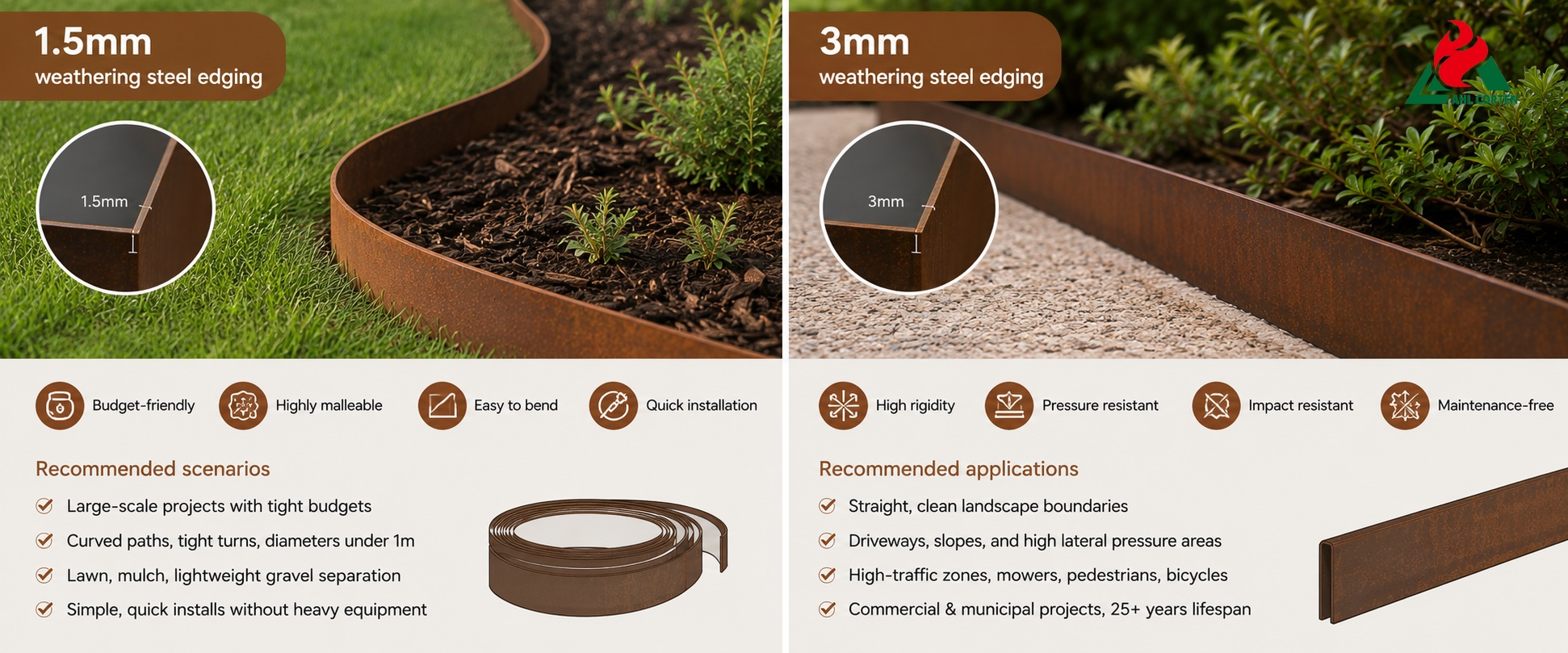
The 1.5mm thin edging strip offers excellent flexibility and can be manually bent without specialized equipment. It is better suited for low-load, low-budget landscape environments with complex shapes.
Recommended Scenarios:
Landscape projects with strict budget constraints and large-scale installations
Pathways with dense curves, frequent turns, and diameters under 1 meter
Simple demarcation between lawns, bark mulch, and lightweight gravel
Sites requiring quick and easy installation without heavy machinery
The 3mm thickened version offers exceptional rigidity and upright stability, with outstanding resistance to compression and impact. It is suitable for outdoor projects with high standards, heavy loads, and long-term service life.
Recommended Applications:
Landscape boundaries requiring straight, clean lines with zero undulation
Driveways, slopes, and areas with high lateral pressure due to significant elevation changes
High-traffic zones are subject to frequent mowing, pedestrian traffic, and bicycle use
Commercial plazas and municipal parks requiring an ultra-long service life of over 25 years
The Thickness of Corten Steel Edging Does Not Determine Its Rust Resistance
Many buyers have a misconception: the thicker the material, the better its rust resistance. This is not the case.
As long as it is genuine SPA-H weathering steel, whether it is 1.5mm or 3mm corten landscape edging, the chemical composition is exactly the same. Both follow the same oxidation principle and can naturally form a dense, stable oxide layer (patina), offering equivalent resistance to atmospheric corrosion.
The primary value of thickness lies in enhancing the steel’s rigidity and resistance to deformation.
Using 3mm corten garden edging in a gentle, private garden constitutes material redundancy and increases transportation and procurement costs; conversely, using 1.5mm edging in high-traffic areas like driveways will require repeated realignment over time, resulting in higher maintenance costs. The optimal solution is not to choose the most expensive option, but to match the application. Customizing the thickness based on lateral soil pressure, foot traffic, and design precision is the most cost-effective procurement approach.
Field Performance Comparison: 1.5mm vs. 3mm Corten Steel Edging
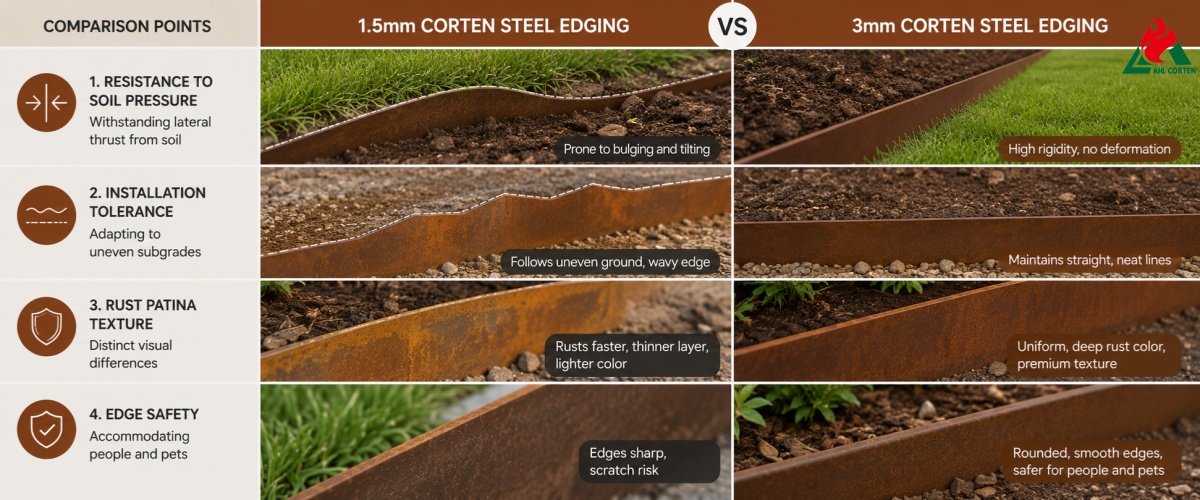
1. Resistance to Soil Pressure: Withstanding Lateral Thrust from Soil
Outdoor garden edging strips are constantly subjected to lateral thrust caused by soil compression and the expansion of lawn roots. 1.5mm sheets are relatively soft; under prolonged pressure, they are prone to localized bulging, tilting, and buckling. 3mm steel offers greater rigidity, firmly maintaining the boundary lines without being deformed by soil pressure.
2. Installation Tolerance: Adapting to Uneven Subgrades
It is difficult to achieve a perfectly level surface during outdoor construction. The thin 1.5mm corten garden edging is highly sensitive to ground elevation; even slight undulations in the subgrade cause the steel strip to twist, resulting in unsightly wavy edges. The 3mm version provides inherent structural support, allowing it to compensate for minor subgrade irregularities and maintain straight, neat lines.
Thickness indirectly affects the appearance of the rust patina. 3mm steel has a higher thermal capacity, resulting in more stable performance during wet-dry cycles. The surface develops a uniform, deep rust color with a premium, substantial texture. 1.5mm landscape edging rusts more quickly initially, but the rust layer is thin. The edges appear delicate and flimsy, lacking the rugged texture unique to weathering steel.
4. Edge Safety: Accommodating Both People and Pets
The 3mm thick corten steel metal landscape edging is easier to grind into rounded, smooth edges, making it less likely to cause cuts. It is suitable for gardens where children and pets are present. The unpolished edges of the 1.5mm edging tend to be sharp, posing a risk of scratches during installation and subsequent maintenance.
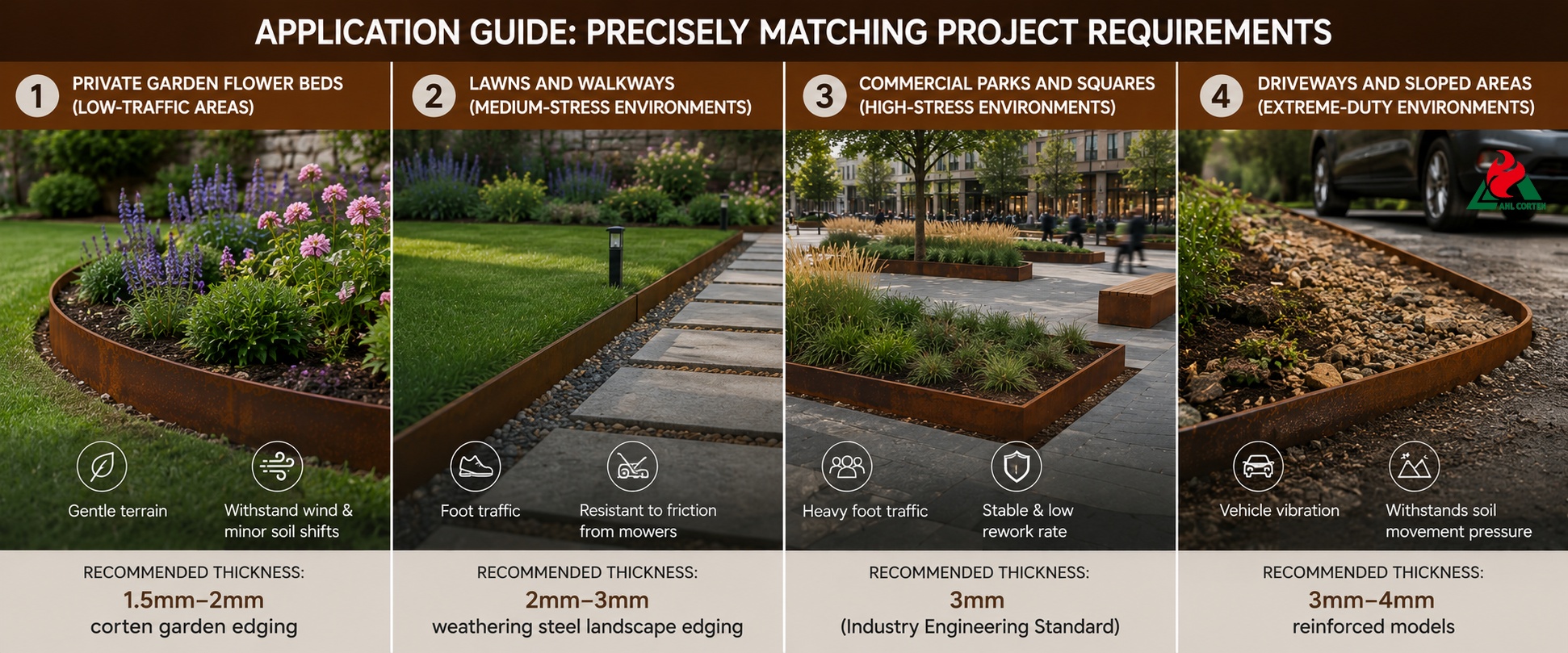
Recommended Thickness: 1.5mm–2mm corten garden edging. With gentle terrain and minimal soil pressure, the thinner steel bends naturally to fit the flower bed’s elegant curves. Paired with AHL’s custom extended anchor bolts, it can withstand wind and minor soil shifts.
2. Lawns and Walkways (Medium-Stress Environments)
Recommended Thickness: 2mm–3mm weathering steel landscape edging. Due to foot traffic and frequent friction from lawn mowers, 1.5mm edging is prone to warping and deformation. Thicker specifications maintain straight edges year-round without the need for repeated manual adjustments.
3. Commercial Parks and Squares (High-Stress Environments)
Recommended Thickness: 3mm (Industry Engineering Standard). Public spaces experience heavy foot traffic and complex ground conditions. The 3mm option offers superior stability and an extremely low rework rate, ensuring consistency and aesthetic appeal for large-scale installations.
4. Driveways and Sloped Areas (Extreme-Duty Environments)
Recommended Thickness: 3mm–4mm reinforced models. Vehicle vibrations and the immense pressure from soil movement on slopes require thick plates to maintain structural integrity and prevent long-term cracking or buckling caused by compression.
4 Hidden Key Factors That Determine the Service Life of Corten Steel Edging
1. Height of Corten Garden Edging and Depth of Installation
Thickness determines hardness, while height determines the lever arm. To prevent weed roots from penetrating, a burial depth of 10–15 cm is recommended. Even with 3 mm thick plates, insufficient burial depth can cause the edging to tilt or collapse.
2. Density of Anchor Bolt Placement
Anchor bolts act as strength multipliers. For 1.5mm-thick edging, install one anchor every 0.6–0.8 meters; for 3mm-thick edging, spacing can be increased to 1–1.2 meters. Densify the anchoring on soft soil and slopes.
3. Foundation Compaction
Loose backfill soil is highly prone to settlement. If the foundation is not compacted, thick plates may sink unevenly, while thin plates will deform with the undulations of the terrain. The quality of the foundation determines 70% of the finished product’s stability.
4. Weather Resistance in Extreme Environments
Freeze-thaw cycles in northern regions and salt fog environments along the coast place higher demands on structural strength. 3mm corten steel garden edging offers superior resistance to crushing and corrosion penetration; thick plates are the preferred choice for harsh environments.
The initial material unit price is low, and shipping costs are affordable, reducing short-term budget pressure. However, it has poor impact resistance and is easily bent by lawn mowers or deformed by soil pressure. Subsequent maintenance costs—including manual excavation, correction, and re-installation—often far exceed the price of the steel itself. Suitable for short-term landscaping and low-precision temporary projects.
2. 3mm Thick Corten Landscape Edging: Higher Initial Investment, Best Long-Term Value
Thicker plates are heavier, resulting in higher shipping costs and a larger initial purchase investment. However, they have a service life of 20–30 years and require virtually no maintenance. When annualized, the cost per year is much lower than that of the thin version. Suitable for high-end private residences and permanent commercial landscapes.
4 Common Misconceptions About Selecting Corten Landscape Edging
Fact: The key to rust resistance in weathering steel lies in its alloy composition, not its thickness. In environments with severe waterlogging or acidic soil, even the thickest steel plates will corrode more rapidly. Surface pretreatment and drainage conditions are more critical than thickness.
Misconception 2: Focusing Only on Thickness and Neglecting Foundation Work
Fact: It is an industry-recognized principle that materials account for 30% and installation for 70%. A 3mm steel plate installed on a substandard foundation will be less stable than a 1.5mm steel plate installed on a solid foundation.
Misconception 3: 1.5mm Is Suitable For All Applications
Fact: Thinner sheets are suitable for shaping, while thicker sheets are suitable for load-bearing. Using 1.5mm Corten landscape edging for driveways or areas subject to heavy gravel pressure will result in outward tilting and wavy deformation within a few months.
Misconception 4: The Faster It Rusts, the Better the Quality
Fact: Thin plates heat up quickly and rust faster initially, but the rust layer is loose and unstable. High-quality corten landscape edging requires 6–12 months of natural oxidation to form a uniform, durable, vintage-style rusted surface—this is the standard for high-quality landscaping.
1. Is 1.5mm Weathering Steel Edging Suitable For Lawn Borders?
Absolutely. It is lightweight and bends smoothly, allowing it to follow the natural curves of the lawn. As long as it isn’t subjected to violent impacts from heavy-duty mowers, it creates a refined and attractive border.
2. Why Is 3mm Edging Commonly Used In Commercial Projects?
Commercial projects prioritize low maintenance, high consistency, and clean, straight lines. The 3mm thickness withstands foot traffic and vehicle vibrations, ensuring uniform lines during large-scale installation with zero rework required later, resulting in lower overall costs.
3. Does Steel Thickness Affect the Safety of the Edging?
Yes. 3mm corten steel edging is easier to grind smooth and rounded; the 1.5mm has sharper edges. All AHL export products undergo precision edge grinding to eliminate the risk of installation-related scratches.
4. Is There a Significant Difference In Rusting Speed Between the Two Thicknesses of Corten Landscape Edging?
Initially, the 1.5mm rusts slightly faster; after 12 months, the rust layer depth, color, and texture of steel plates of the same material become consistent.
5. How Should Anchor Bolt Spacing Be Set for Different Thicknesses?
1.5mm: One fixing point every 0.6–0.8 meters; 3mm: One fixing point every 1–1.2 meters. Denser fixing is required for soft soil and slopes.
6. Do You Support Custom Sizes and Shapes?
Yes. AHL offers custom CAD drawings, including raised retaining wall profiles, custom-bent components, and special curved edging strips to suit various landscape designs worldwide.
7. How Is Export Packaging Designed to Prevent Deformation During Transport?
For 1.5mm thin sheets, we use layered stacking combined with custom solid wood reinforcement crates; for 3mm thick sheets, we use ISPM15-compliant export pallets with all-around corner protection to prevent deformation from compression during ocean transport.
Summary: Choose the Appropriate Thickness for Corten Edging, Rather Than Blindly Pursuing Greater Thickness
When purchasing weathering steel edging strips, do not get hung up on minor price differences. Thicker is not necessarily better; the most rational purchasing logic is to match the product to the site’s intended use, soil pressure, and expected service life.
AHL has 20 years of experience in manufacturing weathering steel for export and uses genuine SPA-H industrial-grade weathering steel. We can customize thickness, installation solutions, and export packaging to suit different climates worldwide. Serving both private gardens and large-scale municipal projects, we provide one-stop delivery and after-sales support.
Contact us now for a free quote: Send us the dimensions, height, and intended use to receive a comparison quote for 1.5mm and 3mm options.


.jpg)
 Fill In The Inquiry