What Happens If Your Corten Planter Lacks Drainage Holes?
Date:2026.05.11
Share to:
In recent years, industrial-style corten steel planters have become a popular choice for gardens, patios, and commercial landscapes. Their unique rust-colored texture and sturdy, durable material have made them the top choice for countless gardening enthusiasts and project buyers.
However, after receiving their orders, many people tend to overlook a critical detail: the planters lack drainage holes at the bottom, or have very few of them.
Most first-time buyers focus solely on appearance and material hardness, mistakenly believing that weathering steel’s corrosion resistance means it can withstand standing water. Little do they know that a weathering steel planter without drainage holes will ultimately become a “gorgeous coffin” for their plants.
Standing water not only kills plants but also accelerates abnormal rusting of the weathering steel and contaminates the ground surface. This article will systematically break down the chain of consequences caused by the absence of drainage holes and explain the science behind water accumulation in weathering steel.
Additionally, this article provides simple self-inspection methods and remedial solutions, and teaches you how to select professional, high-quality rusty metal planters to avoid pitfalls during procurement.
The Double Danger of No Drainage Holes: Harm to Both Plants and Planters
4 Major Fatal Hazards to Plants
1. Root Suffocation and Rot: The Number One Killer of Plants
Healthy soil requires air pockets to allow the roots to breathe. Without drainage holes, standing water fills the gaps in the soil. Prolonged stagnant water leads to root oxygen deprivation. Within just a few days, plant roots will turn from white to black, become soft, and rot—this is the primary reason potted plants die so quickly when waterlogged.
2. Damp Environments Foster Mold and Pathogenic Bacteria
Constantly damp soil is a natural breeding ground for fungi and mold. White mold will appear on the surface of the corten steel planter, and the plant stems will turn black and rot. These soil-borne diseases spread extremely rapidly. Once they proliferate over a large area, they are difficult to eradicate completely, ultimately leading to the death of the entire plant.
3. Salt Accumulation Causes Salt Damage
Tap water and fertilizers both contain mineral salts. In planters with drainage holes, excess salts can be flushed out along with the standing water.
In sealed, non-draining planters, as water evaporates, salts continue to accumulate, causing the soil’s salt concentration to rise steadily. This eventually leads to yellowing and withering of the plant’s leaf edges, stunted growth, and a continuous decline in overall health.
4. Breeding Grounds for Mosquitoes and Source of Pungent Odors
Stagnant water at the bottom of the planter triggers anaerobic reactions, emitting a pungent, rotten odor reminiscent of rotten eggs, which severely disrupts the relaxing atmosphere of patios and gardens. At the same time, stagnant water serves as an ideal breeding ground for mosquitoes, transforming what was once an attractive landscape planter into a hotspot for mosquito infestations.
Damage to the Material of Weathering Steel Planters
Disrupting the Wet-Dry Cycle Prevents the Formation of a Protective Rust Layer
Many buyers have a misconception: they believe weathering steel is the same as stainless steel and that prolonged exposure to water has no effect. The reality is quite the opposite.
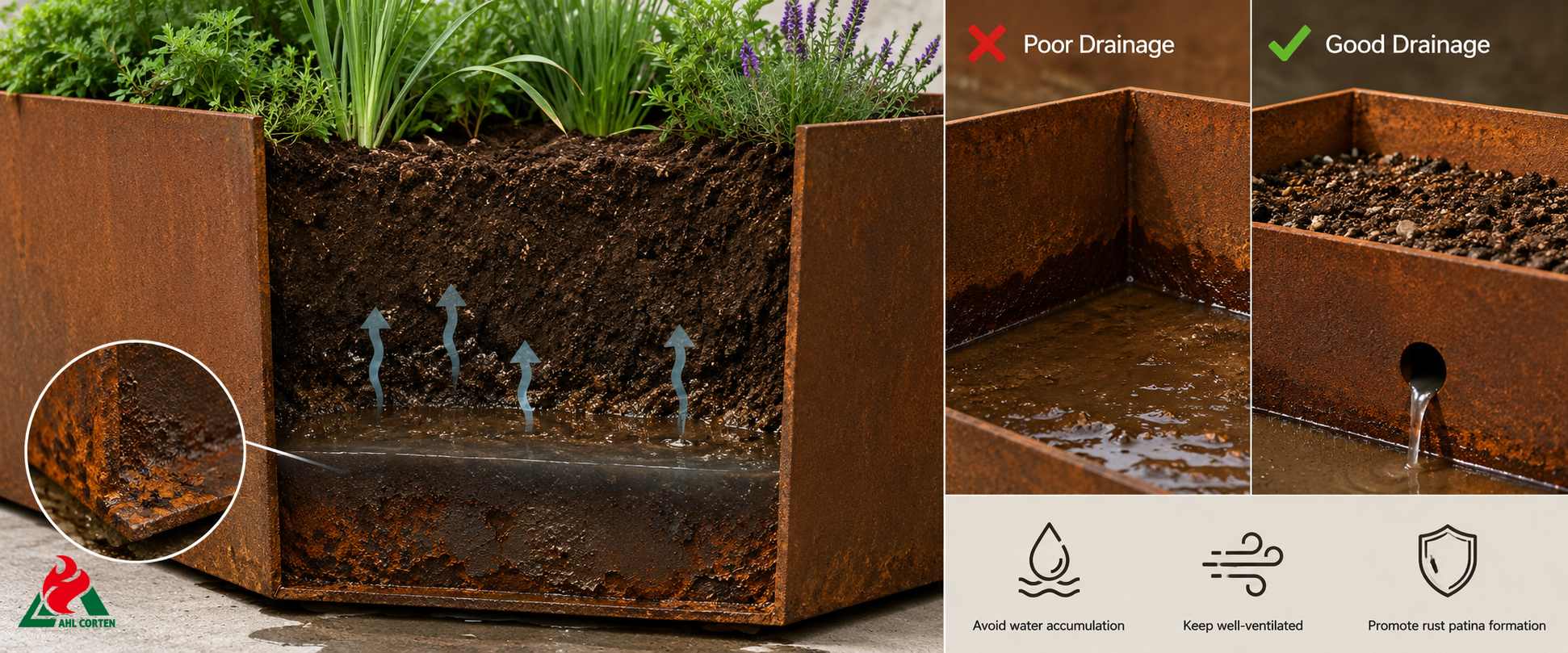
The corrosion resistance of weathering steel relies on alternating cycles of wet and dry conditions. Only in an environment of repeated wetting and thorough drying can a dense, brownish-red passivated rust layer form to protect the steel’s interior.
Corrosion of Weld Seams Shortens the Planter’s Lifespan
Without drainage holes, water accumulates at the bottom of the corten steel planter over time, keeping the steel continuously submerged in moisture. This prevents the formation of a high-quality protective layer, resulting only in loose, flaking surface rust. The pressure from standing water and chemical reactions will continuously erode the weld seams, causing rust perforation and significantly shortening the planter’s service life.
Rust Water Leakage Contaminates Expensive Paving Surfaces
Under the force of gravity, water pooled at the bottom will seep upward, causing irregular rust water to flow out from the planter’s outer walls. This rusty water stains stone, wood flooring, and concrete surfaces, leaving stubborn yellowish-brown stains that are difficult to remove, damaging the landscape’s hardscaping and causing irreversible damage.
Why is Corten Steel Planter Vulnerable to Prolonged Water Accumulation?
The Core Principle of Weathering Steel’s Rust Resistance
High-quality weathering steel relies on a dense, passivated rust layer on its surface to achieve self-repair. This protective layer can only gradually mature and stabilize in an environment where dry and wet conditions alternate. If the steel is subjected to prolonged water immersion, the passivated layer cannot form, causing the steel to continue rusting and the surface rust scale to repeatedly flake off.
The absence of drainage holes creates a permanently waterlogged area at the bottom of the custom corten planter, keeping the steel in a constantly high-humidity state. This is the weakest point of the entire planter and the most susceptible to damage.
2. Clay Soil Accelerates Corrosion
Horticultural clay has poor air permeability and high water retention. Heavy, sticky soil clings to the inner walls of the weathered steel planter, cutting off the air supply and accelerating electrochemical corrosion of the steel, thereby exacerbating localized rust damage.
Drainage Is Key to Corten Steel Maintenance
Only a scientifically designed drainage system can activate the self-healing properties of weathering steel. A well-ventilated and dry environment allows the planter to develop an even, sophisticated rust patina, preserving its industrial aesthetic for the long term.
Differences in Waterlogging Hazards Across Environments
Rainy and Snowy Seasons: Standing Water Freezes, Causing Structural Damage
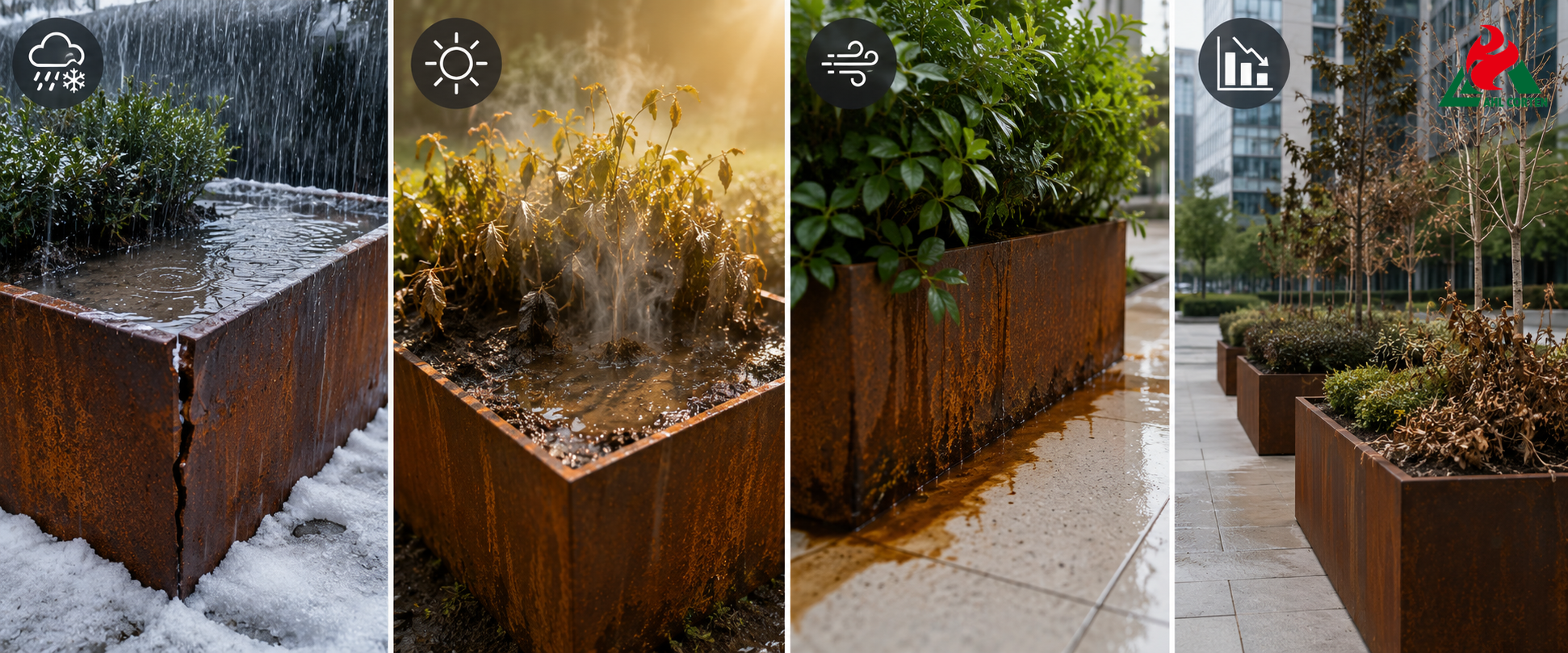
During the rainy season, corten metal planters without drainage holes become water reservoirs, causing rainwater to accumulate continuously. In winter, standing water freezes; as the water expands, it exerts internal pressure on the welds, causing structural physical damage.
Summer Heat: Standing Water Boils Plant Roots
In high-temperature summer conditions, water pooled at the bottom of the planter heats up rapidly, effectively steaming the plant roots. Hot, stagnant water accelerates the growth of anaerobic bacteria, causing rot and foul odors 3–5 times faster than usual.
Balconies have limited ventilation, causing soil moisture to evaporate slowly. A persistently high-humidity environment not only increases the risk of plant diseases but also leads to continuous seepage of rusty water, contaminating the balcony floor.
Commercial Landscaping: Standing Water Causes Significant Economic Losses
In municipal and commercial landscaping projects, the cost of replacing greenery is high. Defects in drainage design can cause large numbers of shrubs and trees to die, resulting not only in financial losses but also in the deterioration of the overall aesthetic appeal of the landscape.
Quickly Determine Whether Steel Planters Have Adequate Drainage
Watering Observation Method: Check the Rate at Which Standing Water Disappears
Water the rusty metal planter thoroughly and let it sit for half an hour. If water still pools at the bottom when the planter is shaken and no excess water drains out, this indicates that drainage is severely inadequate.
Touch Test: Checking the Moisture Level at the Bottom
Insert a dry stick deep into the potting soil. If the stick comes out covered in wet, sticky soil while the surface soil remains dry, this proves that water is pooling at the bottom of the planter.
Plant Signal Method: Recognizing Plants’ Distress Signals
If the potting soil is damp but the plant continues to wilt, the leaves turn yellow and lose their luster, or white salt deposits appear around the pot’s rim, these are all typical signs of root damage.
Smell Test: Distinguishing Healthy Soil from Decayed Soil
Healthy soil has a fresh, earthy scent; poorly drained soil emits a sour, rotten, or musty odor, allowing you to visually assess the extent of soil degradation.
How to Rescue Weathering Steel Planters Without Drainage Holes
Reporting: The Safest and Most Effective Solution
If the plant has already developed root rot or yellowing leaves, promptly remove it from the corten steel planter pot, trim away the rotted roots, disinfect the plant, and repot it into a suitable planter with standard drainage holes to maximize the plant’s survival.
Drilling Holes Manually: Professional Techniques to Avoid Damaging the Steel
Drilling holes yourself requires technical expertise and should not be attempted blindly. Weathering steel is harder than ordinary carbon steel, so you must use a cobalt-tipped high-speed steel drill bit. After drilling, carefully sand down any burrs to prevent cuts. Also, avoid drilling near weld seams to prevent localized stress corrosion, which could compromise the steel’s structural integrity.
Liner Planting: A Temporary Solution for Waterlogging
Place a perforated plastic planter or a felt planting bag inside the planter, leaving a 3–5 cm ventilation gap between the inner and outer layers. Use a well-aerated, coarse-grained growing medium such as bark or perlite to accelerate water drainage.
Purchasing Recommendations: Choose Ready-Made Products to Minimize Later Modifications
Modifying planters later is time-consuming and labor-intensive, and it can easily damage the planter and shorten its lifespan. For landscape professionals and gardening enthusiasts, purchasing ready-made planters with professional drainage designs from the outset is the most cost-effective solution.
How to Select Corten Steel Planters with High-Quality Drainage?
1. Quantitative Standards for Drainage Holes
For a standard 1-meter rectangular planter, the bottom should have 4–6 drainage holes with a diameter of 15–20 mm. Drainage holes should be located at the lowest point of the planter, and avoid reinforcing ribs to prevent water from pooling in dead zones.
2. Bottom Anti-Clogging Support Structure
High-quality, professional planters feature 1–2 cm raised feet at the bottom. This suspended design prevents drainage holes from touching the ground and becoming blocked, while also enhancing airflow beneath the planter to facilitate the even formation of a rust-passivating layer.
3. Complementary Rust-Prevention Accessories
Reputable suppliers provide matching drip trays made of the same material to catch initial rust water, protecting expensive surfaces such as stone and tiles. Some models come with removable plugs, allowing for use in both indoor and outdoor settings.
4. Special Considerations for International Purchasing
When purchasing, do not rely solely on promotional renderings; always request actual photos of the planter’s bottom. Additionally, verify the reinforced packaging process to prevent bottom deformation caused by compression during ocean transport, which could render the drainage holes ineffective.
Supplier Selection: Assessing Product Quality Through Drainage Design
Core Selection Criteria
Appearance determines first impressions, while drainage design determines the lifespan of a planter. Most low-quality products on the market focus solely on the surface rust finish, neglecting the structural design of the base, which results in inherent defects.
3 Key Criteria for Evaluating Suppliers
Authenticity of Materials and Craftsmanship
Reputable suppliers use genuine weathering steel, relying on drainage and ventilation to develop a natural rust patina; inferior products use spray-painted imitation rust, which does not require wet-dry cycles and lacks inherent weathering properties.
Transparency in Drainage Design
Professional suppliers can clearly explain the logic behind drainage holes and bottom elevation solutions, customizing drainage layouts based on planter dimensions and intended use to prevent water accumulation risks.
Comprehensive After-Sales Support
We support customization of perforation locations via CAD drawings to avoid interference with utility lines and ground lights. For issues such as transport-related deformation or manufacturing defects, we provide return, exchange, and repair solutions to ensure project progress.
AHL’s Expertise as a Professional Corten Steel Planter Supplier
With 20 years of experience in weathering steel exports, AHL has established a strong presence in the global landscape of building materials trade, specializing in the custom production of high-quality weathering steel planters.
Climate-Specific Customization: We optimize drainage hole specifications for different regions, such as rainy Western Europe and frigid North America;
FAQ: Answers to Key Questions About Corten Steel Planter Drainage
1. Can Plants Survive In Planters Without Drainage Holes?
It is extremely difficult for them to survive. With the exception of aquatic plants, 95% of landscape plants, shrubs, and succulents are sensitive to waterlogging. Planters without drainage holes are highly prone to root rot, and beginners find it nearly impossible to control watering accurately.
2. Can a Layer of Pebbles at the Bottom Replace Drainage Holes?
No. Pebbles only separate the soil layers; they cannot drain standing water. A layer of stagnant water will still form at the bottom of the rusted steel planter, and the damp environment will not improve—this is merely a temporary fix.
3. Do Drainage Holes Affect the Rust-Proofing Capabilities of Weathering Steel?
No, they enhance rust protection. Drainage holes ensure air circulation at the bottom, forming a uniform and dense protective rust layer that prevents localized peeling and abnormal corrosion.
4. How Can I Prevent Rust Water from Staining the Floor?
Rust water is a normal occurrence during the initial oxidation phase. You can choose pre-rusted products paired with a drip tray made of the same material. For stone floors, apply a stain-resistant sealant before use.
5. Should I Reduce Watering During the Rainy Season?
Completely stop manual watering during the rainy season, and regularly check whether the drainage holes are blocked by fallen leaves or soil. High-quality, well-draining planters can quickly drain rainwater, preventing waterlogging damage to plants.
6. What are the Standard Specifications for Planter Drainage Holes?
For every 0.5 square meters of corten steel planter base area, there should be at least 4–5 drainage holes with a diameter of 15–20 mm. Larger, irregularly shaped planters require additional holes to eliminate drainage dead zones.
7. Do Trees and Shrubs Require Better Drainage?
Yes. Large plants have deeper root systems and require more oxygen. In addition to increasing the number of drainage holes, a raised base design must be incorporated to ensure proper airflow and aeration at the base of the root system.
8. What Should I Do If the Drainage Specifications Do Not Match Upon Receipt?
AHL provides CAD drainage drawings for customer confirmation prior to production. If the delivered product does not match the drawings or has manufacturing defects, customers are eligible for after-sales compensation, replacement, or on-site rectification services.
Summary: Drainage Design Determines the Long-Term Value of Planters
Key Selection Principles
When purchasing weathering steel planters, don’t focus solely on price differences. The authenticity of the material, the scientific design of the drainage system, and the stability during transportation are the three core criteria for evaluating product quality. Drainage is not simply a matter of drilling holes; it is a systematic process that balances plant growth, steel maintenance, and ground protection.
Brand Selection Recommendations
By choosing AHL rusted steel planters, you gain the backing of 20 years of international trade expertise. Whether for private gardens, terrace landscaping, or large-scale commercial landscape projects, we can customize a dedicated drainage solution. Eliminate the risk of water accumulation at the source, ensuring that industrial-style weathering steel planters retain their texture over time and creating a stable, aesthetically pleasing landscape. Contact us now!


.jpg)
.jpg)
.jpg)
.png)

.jpg)
 Fill In The Inquiry