1.6mm vs 2mm vs 3mm Corten Edging: Which Is Best?
In garden landscaping, municipal greening and commercial landscape projects, weathering steel edging is a key material for enhancing the refinement of a site, defining plant boundaries and separating hard and soft landscaping elements. When selecting products, many people focus solely on the design and the texture of the rusted surface, whilst overlooking the crucial factor of steel plate thickness.
Is 1.6 mm sufficient for domestic use? Is 2 mm the optimal choice for gardens? Is the 3mm-thick variant worth the extra cost? Corten garden edging of different thicknesses varies significantly in terms of flexibility, structural strength, installation difficulty, service life and cost.
The thickness of rusted garden edging directly determines five core performance characteristics: structural load-bearing capacity, bendability, ease of installation, long-term weather resistance and overall cost of ownership.
Here is a key industry guideline for selection: thicker is not necessarily better. Blindly opting for thick steel sheets will increase material, logistics and installation costs; conversely, using thin steel sheets in high-pressure or high-footfall environments makes them highly prone to deformation, bulging and collapse, significantly shortening their service life.
This article provides a comprehensive comparison of the three mainstream steel lawn edging options—1.6mm, 2mm and 3mm—suitable for all scenarios, including DIY home renovations, private gardens, commercial plazas and municipal streets, helping you to avoid pitfalls and make the right choice.
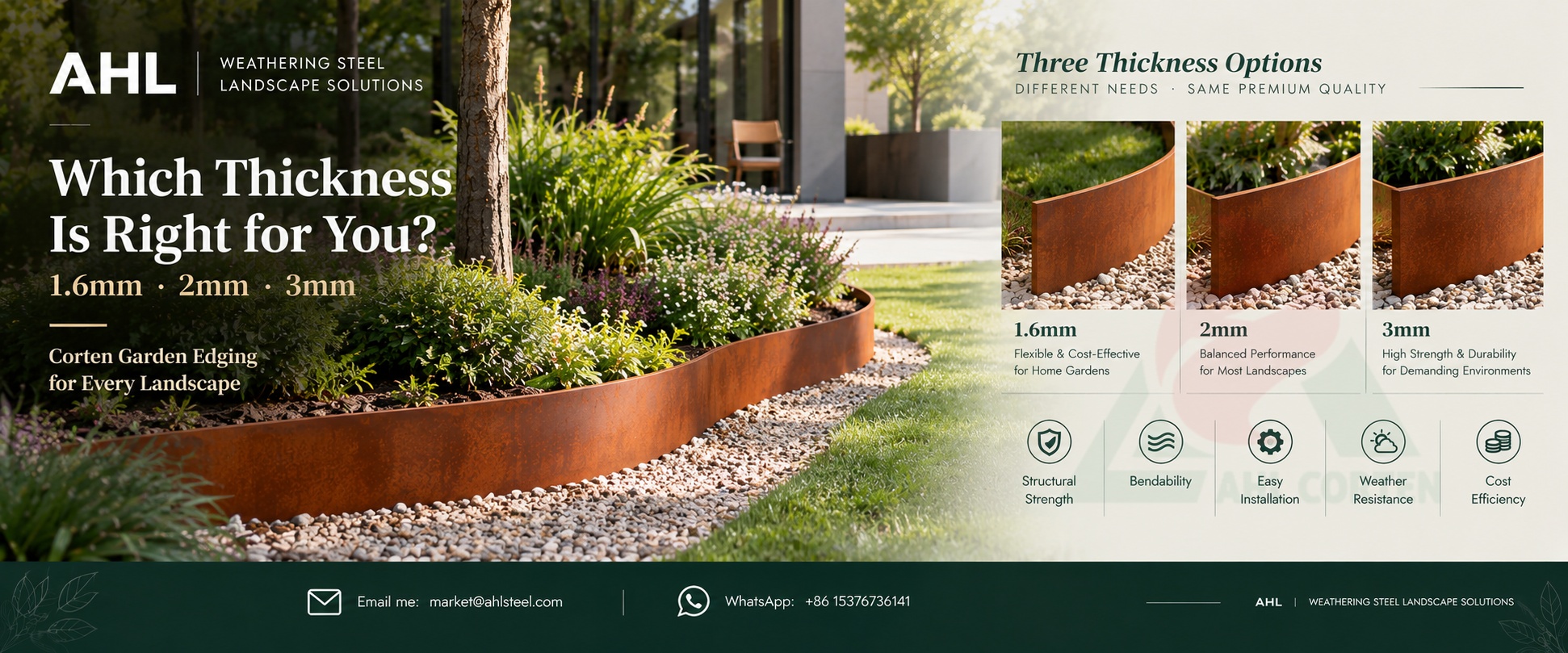
Quick Answer: Which Thickness Is Best?
| Thickness |
Best For |
Main Advantages |
Main Limitations |
| 1.6mm |
Small flower beds, decorative borders, and light-duty gardens. |
Lightweight, flexible, and economical. |
More vulnerable to bending and soil pressure. |
| 2mm |
Residential lawns, mulch borders, and standard garden edging. |
Balanced strength, flexibility, and cost. |
May need reinforcement on long or high edges. |
| 3mm |
Paths, slopes, long runs, and commercial landscapes. |
Better stiffness, impact resistance, and shape retention. |
Heavier and harder to bend manually. |
| 4mm+ |
Driveways, heavy-duty borders, retaining applications, and engineered projects. |
Highest structural reserve. |
Higher cost, greater weight, and more complex installation. |
1.6mm Corten Edging: Lightweight and Flexible
1. Best applications
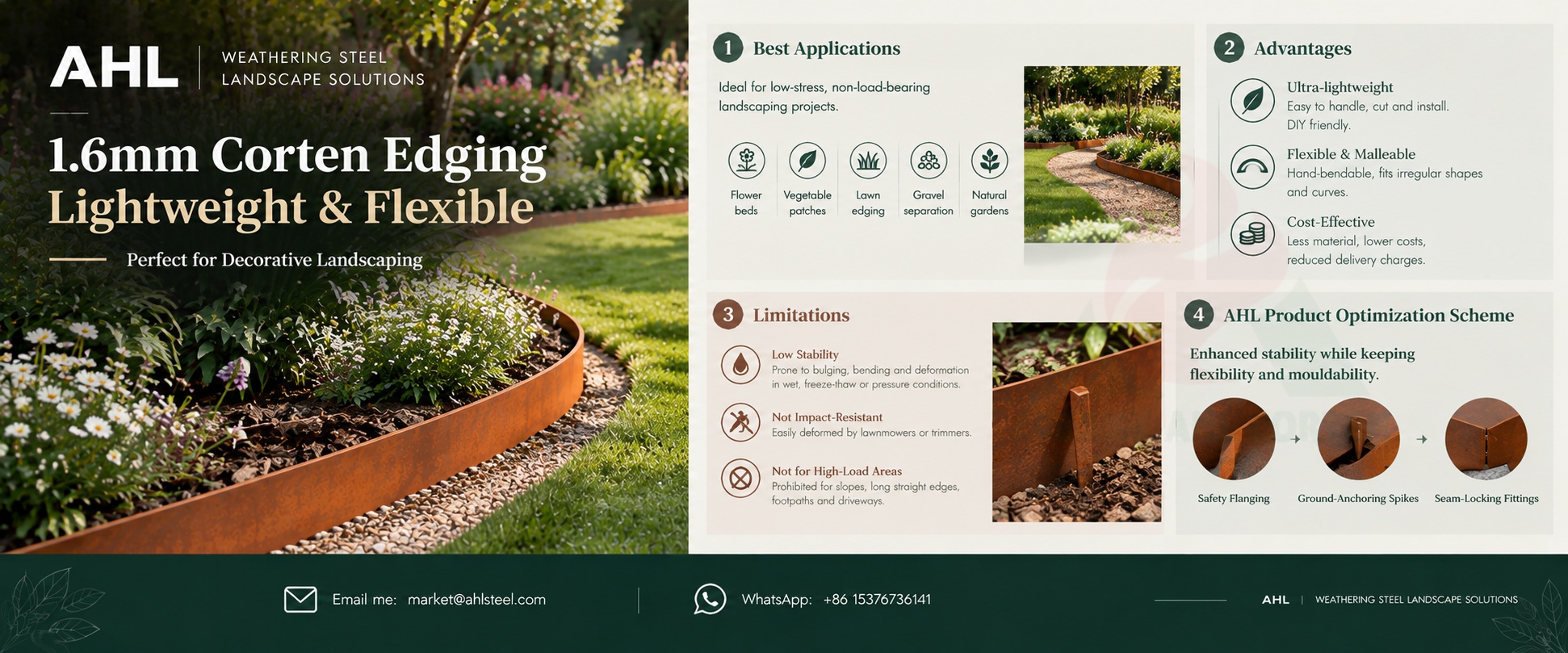
At 1.6mm, this is the thinnest standard rusted steel edging available, offering excellent flexibility and value for money. It is suitable only for low-stress, non-load-bearing decorative applications.
Key Applications: Small flower beds, vegetable patches, edging for low-level landscaping, decorative separation strips between lawns and bark/gravel areas, and natural-style gardens featuring abundant curved shapes.
This thickness is only suitable for purely decorative zoning in landscape areas where there is no soil pressure, no impact from equipment, no foot traffic and no vehicle access.
2. Advantages
Extremely lightweight; no specialist equipment is required for handling, cutting or installation, and DIY installation can be carried out by a single person, making it very accessible.
It can be bent and shaped by hand without the need for a hydraulic bending machine; smooth curves can be adjusted on-site to match the contours of the garden, making it suitable for all types of irregularly shaped flowerbeds.
Less material is required, resulting in lower unit costs and reduced delivery charges, enabling effective control of the overall budget for large-scale garden landscaping.
3. Limitations
The thin steel plate structure lacks stability; in environments subject to waterlogged soil, freeze-thaw cycles or pressure from gravel and stones, it is prone to bulging, bending, deformation and collapse.
It is not resistant to external impacts; even minor collisions with lawnmowers or trimmers can cause deformation, making it unsuitable for scenarios requiring frequent maintenance.
Its use is strictly prohibited in high-pressure, high-load scenarios such as raised flower beds on slopes, long straight edging, footpaths and the edges of driveways.
4. AHL Product Optimization Scheme
To address the issue of insufficient rigidity in the 1.6mm version, AHL has carried out structural upgrades and optimisations. Through safety flanging, extended ground-anchoring spikes and seam-locking reinforcement fittings, the structural shortcomings of thin steel sheets are compensated for, enhancing overall stability whilst retaining the advantages of flexibility and mouldability.
2mm Corten Edging: The Best All-Round Residential Option
1. Best applications
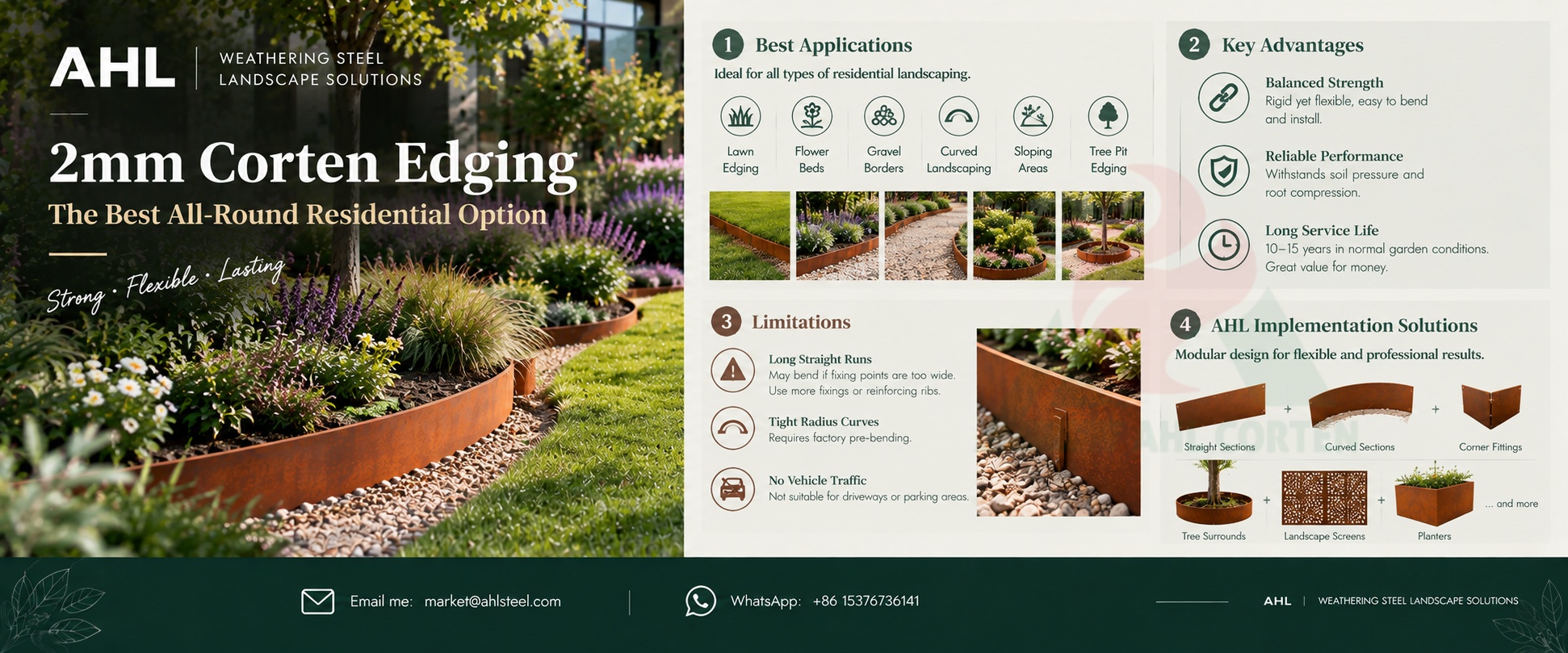
2mm corten landscape edging is the industry-recognised standard thickness for residential landscaping, striking a perfect balance between flexibility and structural strength, and is suitable for all types of standard garden landscaping.
Key applications: Residential lawn edging, garden flowerbeds, gravel path borders, moderately curved landscaping, gently sloping planting areas, and standard tree pit edging.
2. Advantages
This combines rigidity with malleability, avoiding the easy deformation of the 1.6mm version whilst remaining far easier to bend and install than the 3mm version.
It offers superior earth-retaining and edging capabilities, effectively withstanding standard soil lateral pressure and root compression, and is unlikely to shift or bulge at the edges over the long term.
It has a stable service life, lasting 10–15 years under normal garden conditions, making it the best value-for-money general-purpose option for private landscaping.
3. Limitations
When laying extremely long straight sections, if the fixing intervals are too wide, slight bending may occur; it is necessary to increase the density of fixing points or install reinforcing ribs.
Tight arcs with extremely small radii cannot be bent by hand and require pre-bending at the factory.
Its use is strictly prohibited in areas subject to vehicle traffic, such as driveways and parking areas, as this will result in permanent deformation.
4. AHL Implementation Solutions
AHL’s 2mm standard model is complemented by modular straight sections, flexible curved sections and prefabricated corner fittings, allowing for free combination and assembly. Suitable for all types of formal garden landscaping, it can be integrated with weathering steel tree surrounds, landscape screens, planters and other products to form a unified landscape system.
3mm Corten Edging: Heavy-Duty and Commercial Performance
1. Best Applications
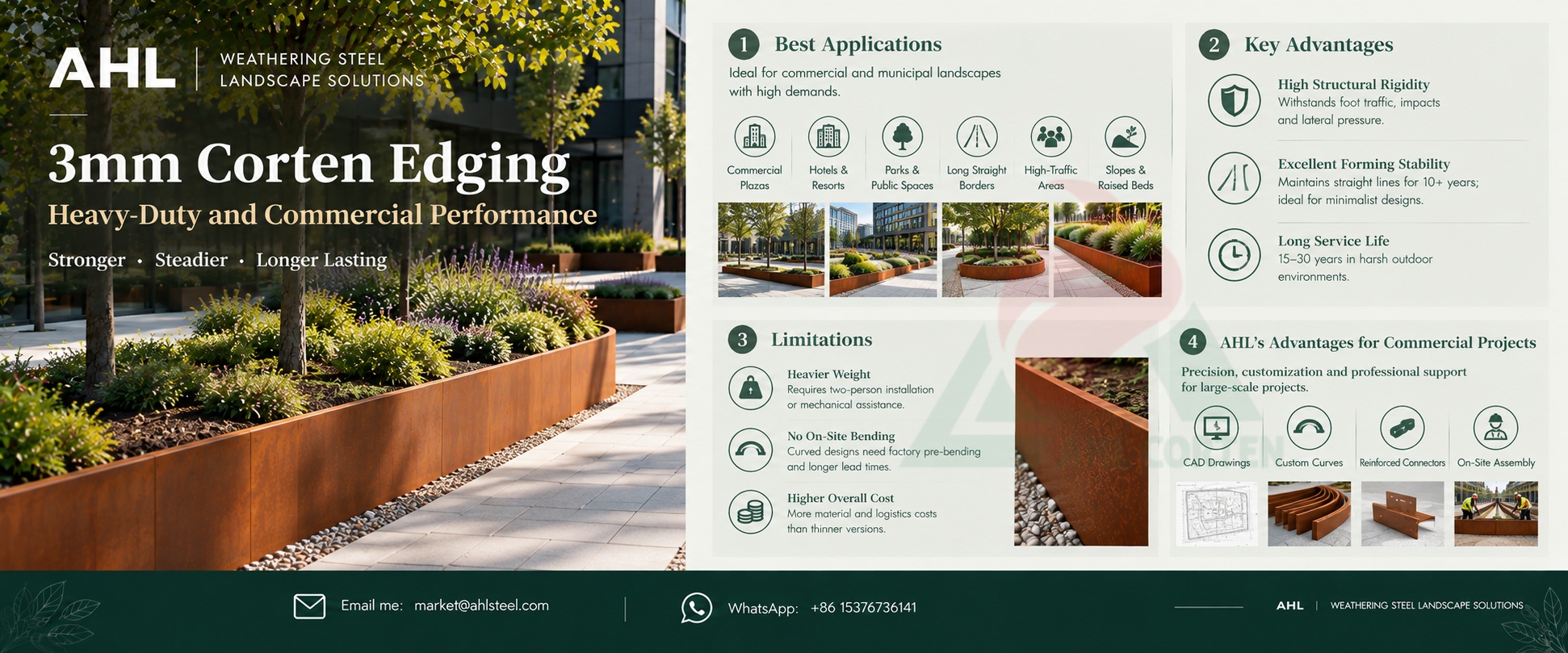
The 3mm corten edging is a heavy-duty, commercial-grade weathering steel product characterised by high rigidity, high impact resistance and high stability, designed specifically for public landscapes and challenging conditions.
Key applications: commercial plazas, hotel complexes, municipal parks, long straight landscape borders, raised flower beds on slopes, areas surrounding footpaths with high footfall, and areas requiring frequent equipment maintenance.
2. Advantages
Exceptional structural rigidity, capable of withstanding foot traffic, impacts from maintenance equipment, and lateral pressure from heavy gravel and saturated soil.
Excellent forming stability ensures straight lines are maintained even over extremely long distances; it remains free from bending or deformation for a decade, making it suitable for minimalist landscapes in high-end architectural projects.
The steel plates feature greater material allowance, offering superior resistance to corrosion and wear; in damp soil and harsh outdoor environments, they have a service life of 15–30 years.
3. Limitations
The steel plates are relatively heavy, requiring two-person collaboration or simple mechanical assistance during installation, resulting in higher labour costs.
They cannot be bent by hand on site; curved designs must rely on factory-based hydraulic rolling and pre-bending processes, leading to longer customisation lead times.
Material and logistics costs are higher than for thinner versions, resulting in a higher overall project cost.
4. AHL’s Advantages for Commercial Projects
To meet the high-precision requirements of commercial projects, AHL provides precise CAD drawings, customized pre-fabricated curves, reinforced connectors and on-site assembly services. This ensures the uniformity of lines and structural stability for large-scale, high-standard municipal and commercial projects.
Thickness Comparison: Strength, Flexibility, and Cost
| Performance Factor |
1.6mm |
2mm |
3mm |
| Lightweight Handling |
Excellent |
Very Good |
Moderate |
| Ease of Hand Bending |
Excellent |
Good |
Limited |
| Resistance to Soil Pressure |
Low to Moderate |
Moderate |
High |
| Resistance to Impact |
Low |
Moderate |
High |
| Long Straight Runs |
Limited |
Suitable with Support |
Very Suitable |
| Curved Installation |
Easy for Broad Curves |
Good for Many Curves |
Often Requires Tools |
| Commercial Suitability |
Limited |
Suitable for Light Commercial Use |
Strong |
| Installation Cost |
Low |
Moderate |
Higher |
| Material Cost |
Lowest |
Moderate |
Highest |
| Best Overall Value |
Light-Duty Use |
Residential Use |
Heavy-Duty Use |
Choose the Thickness by Edging Height
| Edging Height |
Typical Application |
Suggested Thickness |
| 50–100mm |
Decorative garden borders and low planting beds. |
1.6–2mm |
| 100–200mm |
lawns, flower beds, and mulch separation. |
2mm |
| 200–300mm |
Raised beds, gravel paths, and moderate slopes. |
2–3mm |
| 300mm+ |
Deep soil, retaining conditions, and architectural landscape edges. |
3mm+ with structural assessment. |
| Vehicle-Exposed Areas |
Driveways and heavy-use zones. |
3–6mm or an engineered system. |
Choose the Thickness by Landscape Application
| Application |
Typical Application |
Recommended Thickness |
| Small flower bed |
Decorative garden borders and low planting beds. |
1.6–2mm |
| Lawn-to-bed transition |
Lawns, flower beds, and mulch separation. |
2mm |
| Mulch border |
Lightweight decorative landscape separation. |
1.6–2mm |
| Gravel path |
Gravel paths and areas requiring greater resistance to lateral pressure. |
2–3mm |
| Long straight border |
Long landscape borders requiring improved alignment and stiffness. |
2–3mm |
| Curved garden bed |
Curved planting areas requiring flexible shaping and easy installation. |
1.6–2mm or preformed 3mm |
| Sloped planting bed |
Raised planting areas and moderate slopes requiring stronger soil retention. |
3mm |
| Commercial landscape |
Commercial plazas, public landscapes, and areas with higher traffic and maintenance loads. |
3mm+ |
| Driveway edge |
Driveways and heavy-use zones exposed to greater impact and load. |
3–6mm |
| Retaining-type edge |
Retaining conditions requiring additional structural support. |
3mm+ with structural assessment |
Thick and Curved Landscape Design: Rusted Steel Edging
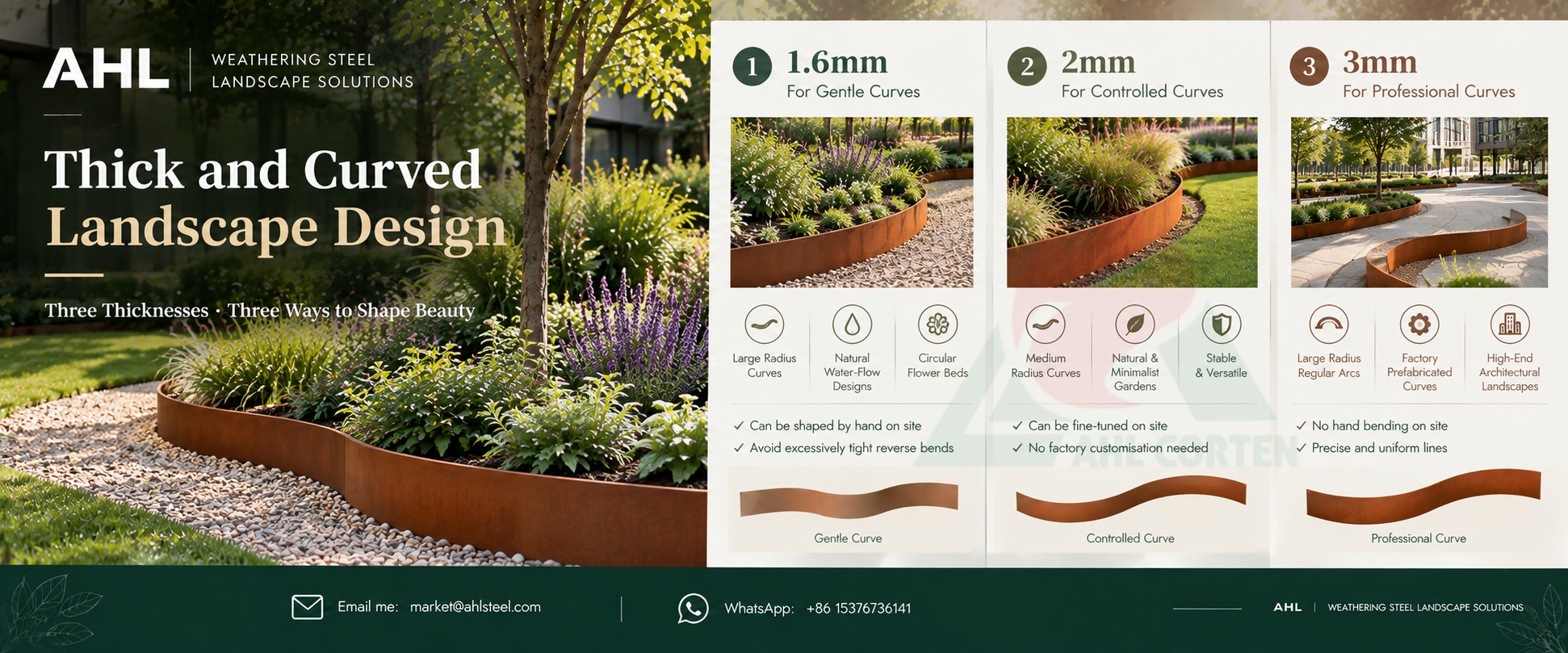
1. 1.6mm For Gentle Curves
Suitable for gentle curves with a large radius, natural water-flow designs and circular flower beds. Can be shaped by hand on site, resulting in fluid, natural curves without any harsh creases.
Take care to avoid excessively tight reverse bends to prevent stress cracking and localised dents in the steel sheet.
2. 2mm For Controlled Curves
Suitable for the vast majority of medium-radius curves in gardens; the shape can be fine-tuned on site, eliminating the need for factory-made customisation.
A versatile choice for natural and minimalist-style gardens, offering controllable shaping and excellent stability.
3. 3mm For Professional Curves
Suitable only for large-radius, regular arcs and commercial modular landscape designs. Cannot be reshaped by hand on site; all curves must be prefabricated in the factory, ensuring precise and uniform lines, making it suitable for high-end architectural landscapes.
Installation Requirements by Thickness: Corten Lawn Edging
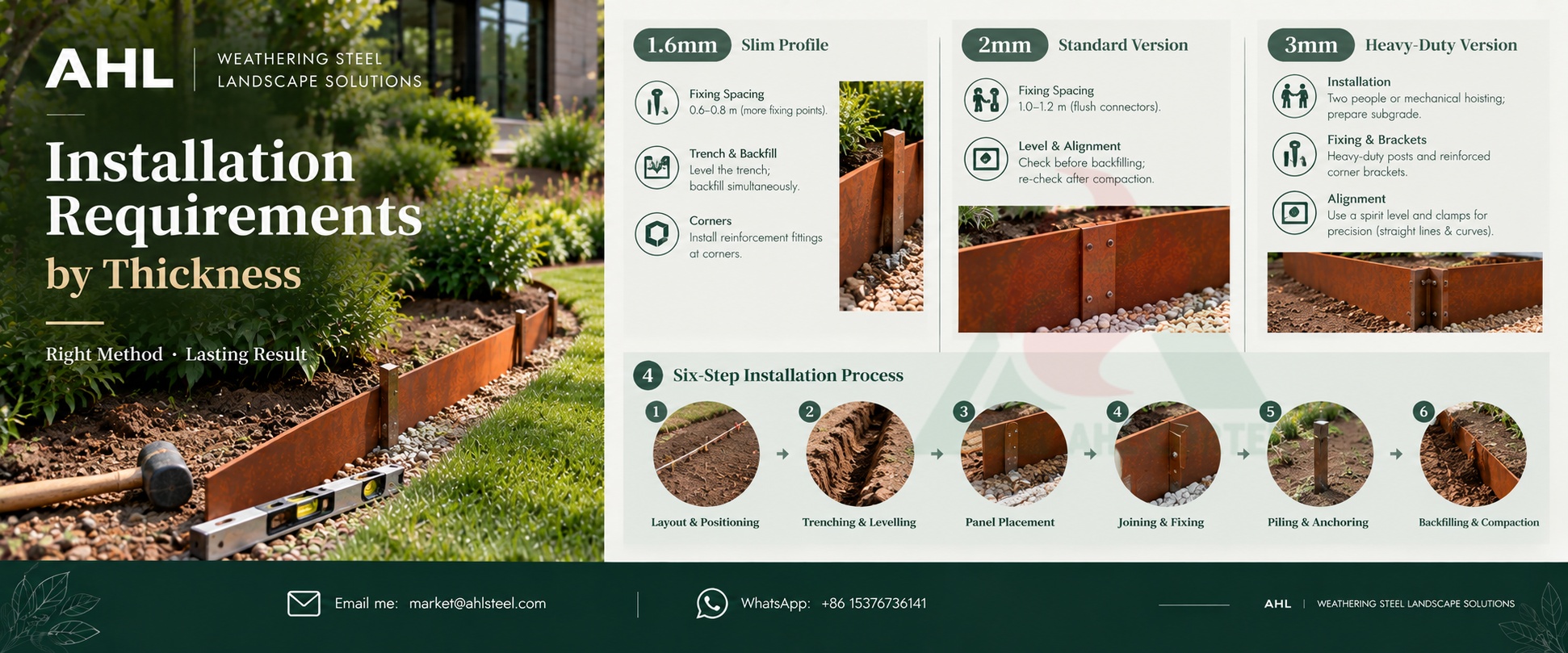
1. Key Installation Points for the 1.6 mm Slim Profile
Increase the density of fixing points, maintaining a pile spacing of 0.6–0.8 m to minimise deformation caused by panels being left unsupported.
Excavate and level the trench, backfilling soil on both sides simultaneously to prevent displacement caused by pressure on one side.
Reinforcement fittings must be installed at corners to prevent deformation caused by stress concentration.
2. Key Installation Points for the 2mm Standard Version
Standard fixing spacing is 1.0–1.2m; use flush-fitting connectors to ensure joints are smooth and seamless.
Check levels and alignment before backfilling; re-check flatness after compacting the soil.
3. Key Installation Points for the 3mm Heavy-Duty Version
Installation should be carried out by two people working together or using mechanical hoisting; level and compact the subgrade in advance.
Use heavy-duty extended fixing posts and reinforced corner brackets to ensure long-term structural stability.
Use a spirit level and specialist clamps for alignment to ensure architectural-grade precision in straight lines and curves.
4. General Six-Step Installation Process
Layout and positioning → Trenching and levelling → Panel placement → Joining and fixing → Piling and anchoring → Layered backfilling and compaction
Corten Edging Thickness and Durability
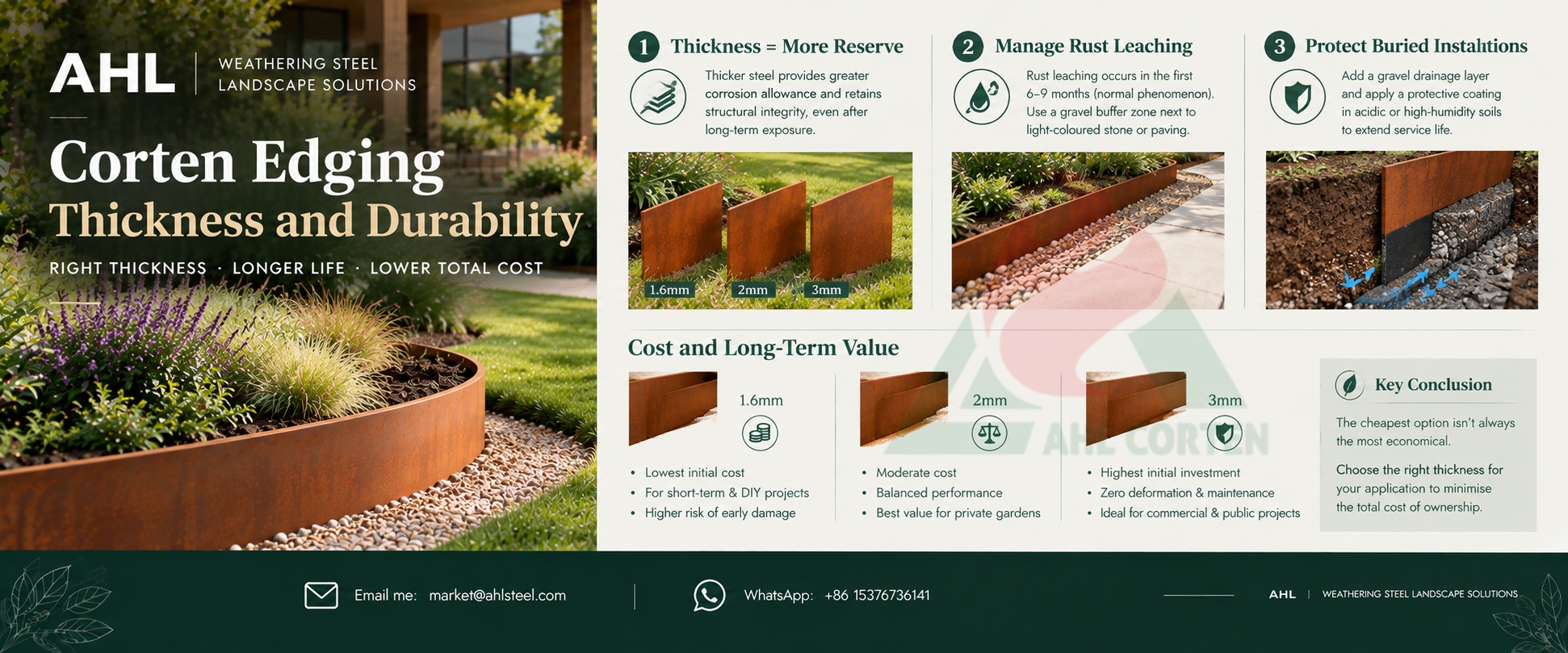
1. Thickness Affects Material Reserve
The thicker the steel plate, the greater the corrosion allowance. Even after prolonged outdoor exposure to oxidation, knocks and abrasion, it retains its structural integrity and does not fail easily.
2. Management of Rust Leaching
All weathering steel will experience rust leaching during the initial 6–9 months; this is a normal phenomenon and is unrelated to the thickness of the steel plate.
When installed adjacent to light-coloured stone or light-coloured paving, a gravel buffer zone should be provided to prevent rust leachate from staining the surface.
3. Corrosion Protection Techniques for Buried Installations
Lay a drainage layer of gravel at the bottom of the trench to prevent prolonged waterlogging of the buried steel plates.
In acidic or high-humidity soil conditions, apply a protective coating to the buried sections to extend their service life.
Cost and Long-Term Value
1.6 mm: Lowest initial cost; suitable for short-term decorative applications and DIY projects with limited budgets. Incorrect use in high-pressure environments may lead to premature damage, resulting in a low long-term return on investment.
2 mm: Moderate cost and balanced performance; virtually no ongoing maintenance costs and a stable service life, making it the best long-term value-for-money option for private gardens.
3mm: The highest initial investment, but with zero structural deformation and zero maintenance requirements. Suitable for commercial and public projects, it avoids future replacement and repair costs, offering the highest overall return on investment.
Key Conclusion: Opting for the cheapest option does not equate to saving money; selecting the appropriate thickness for the specific application is the only way to minimise the total cost of ownership over the product’s lifecycle.
Common Mistakes When Choosing Corten Edging Thickness
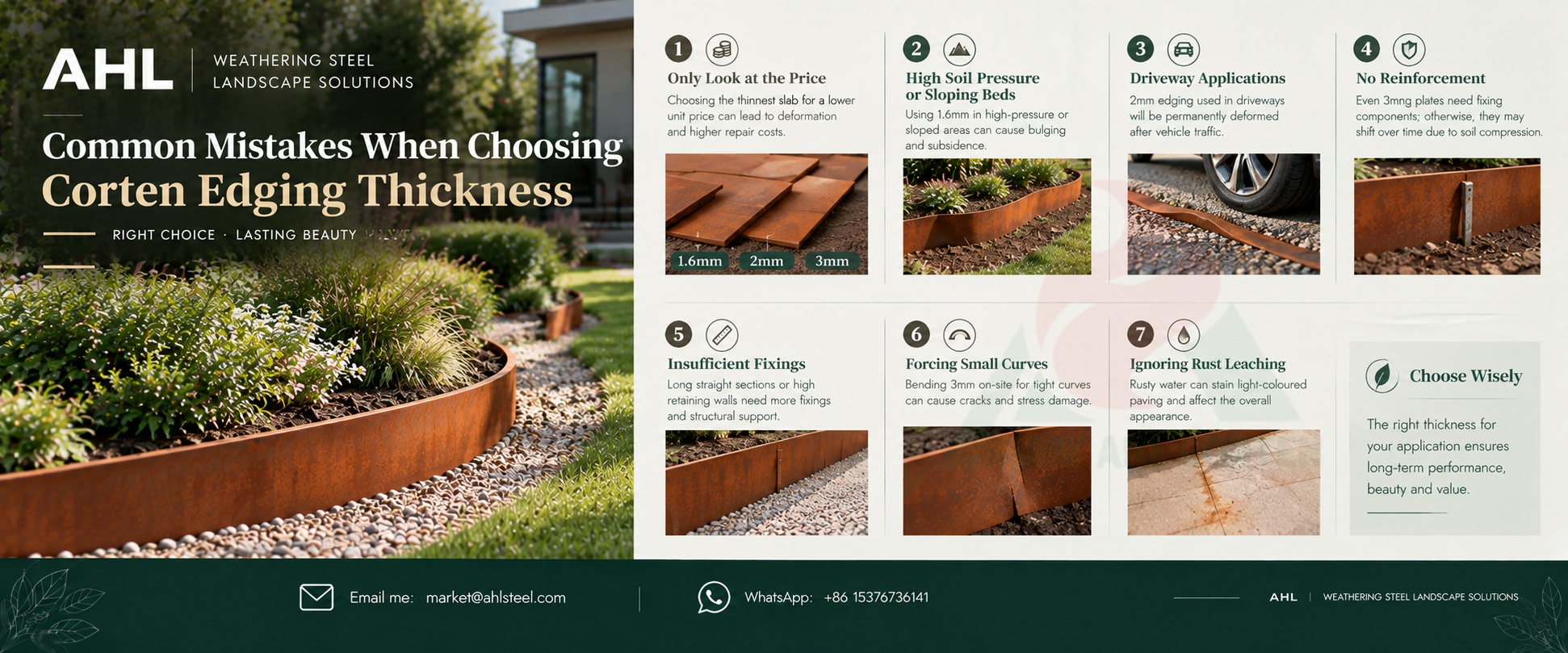
Misconception 1: Selecting the thinnest slab based solely on unit price whilst ignoring suitability for the specific application; the costs of subsequent deformation and repairs far exceed the price difference.
Misconception 2: Using 1.6mm thin slabs in areas subject to high soil pressure or on sloping raised flower beds will result in bulging and subsidence within a short period.
Misconception 3: Using 2mm edging slabs as the boundary for driveways; these will become permanently deformed and unusable after being run over by vehicles.
Misconception 4: Believing that thicker plates require no reinforcement; 3mm plates, lacking fixing components, will still shift out of position over time due to prolonged soil compression.
Misconception 5: Failing to increase the frequency of fixings along long straight sections or to provide structural reinforcement for high retaining walls, leading to overall deformation.
Misconception 6: Forcibly bending 3mm-thick plates on-site to create small-radius curves, causing the steel plates to crack and suffer stress damage.
Misconception 7: Neglecting protection against rusty water, which contaminates light-coloured paving and detracts from the overall aesthetic appeal of the landscape.
Why Choose AHL Corten Edging?
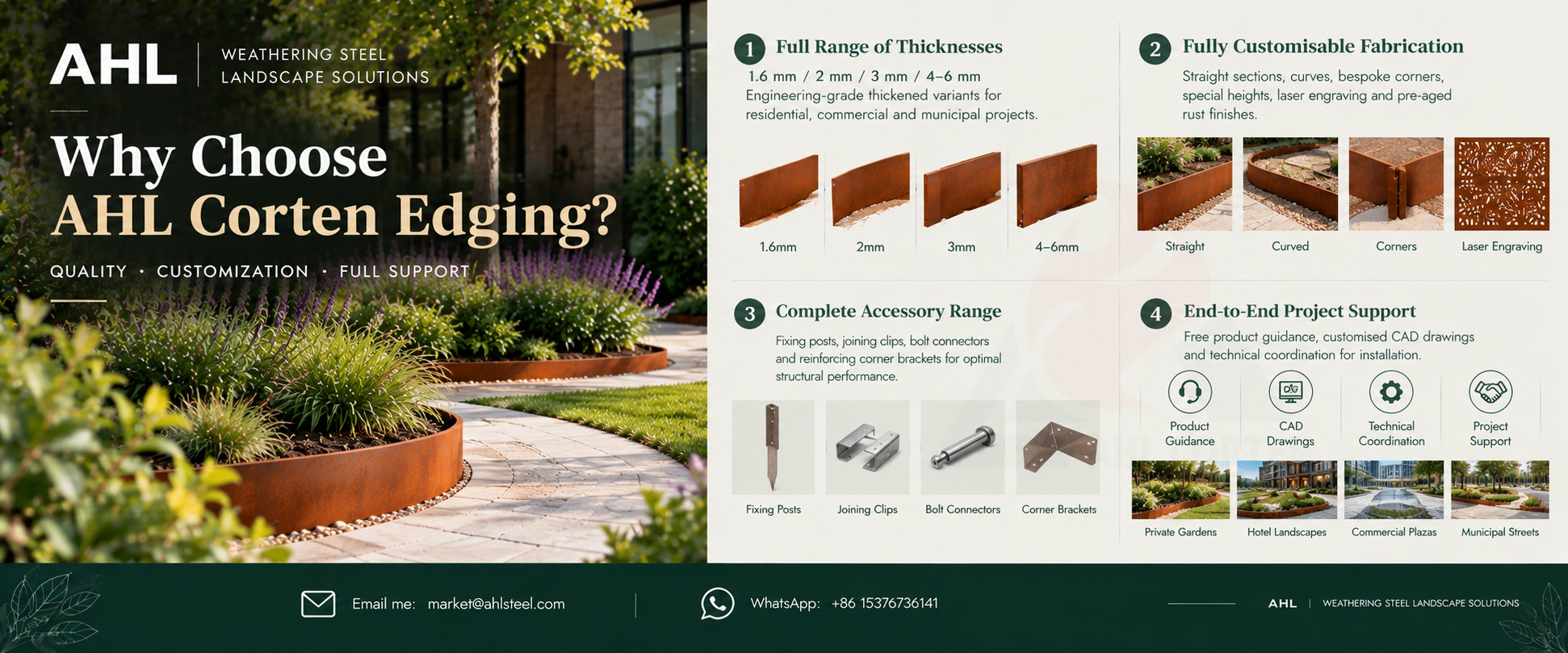
AHL offers a full range of metal garden edging thicknesses, including 1.6 mm, 2 mm, 3 mm and 4–6 mm engineering-grade thickened variants, suitable for residential, commercial and municipal applications.
We support fully customisable fabrication: straight sections, irregular curves, bespoke corners, special heights, laser engraving and pre-aged rust finishes, to meet all design requirements.
A comprehensive range of accessories is available, including specialised fixing posts, joining clips, bolt connectors and reinforcing corner brackets, ensuring that plates of different thicknesses deliver optimal structural performance.
We provide end-to-end project support: free product selection guidance, customised CAD drawings and technical coordination for installation, facilitating the implementation of projects ranging from private gardens and hotel landscapes to municipal streets and commercial plazas.
Are You Ready to Choose Your Corten Steel Edging Thickness?
A simple guide to selection: choose 1.6–2 mm for garden decoration, 2 mm for general landscaping, 3 mm for commercial heavy-duty applications, and the reinforced engineering grade for driveways and retaining walls.
If you are unsure about the soil pressure at the site, the curvature of the design, or the load-bearing standards, and are unable to accurately match the thickness specifications, please feel free to contact the AHL team at any time.
We provide free, one-on-one product selection advice, precise quotations and customised drawing support to ensure your project is implemented successfully the first time and remains durable in the long term.
Need a Factory Quote for Corten Steel Edgings?
Send your drawings, size list, quantity, and destination country. Corten Factory can support custom weathering steel fabrication, export packing, and project quotation.
FAQ
Is 1.6mm Garden Edging Strong Enough?
It is suitable for small flower beds, decorative garden borders, and low-pressure applications. It is less suitable for long unsupported runs, high soil pressure, slopes, driveways, and high-traffic areas.
Is 2mm Metal Edging the Best Choice?
For many residential landscapes, 2mm offers a practical balance of strength, flexibility, weight, and cost. It may require stronger fixing or reinforcement in long, tall, sloped, or high-impact applications.
Is 3mm Rusted Steel Edging Worth The Extra Cost?
It can be worth the additional cost when the project requires greater stiffness, impact resistance, long-term alignment, or commercial-grade performance. It is often a better choice for long runs, slopes, pathways, and commercial landscapes.
Which Steel Landscape Edging Thickness Is Easiest to Bend?
1.6mm is generally the easiest to bend, while 2mm remains workable for many broad curves. 3mm usually requires more force, specialised tools, or factory-preformed curves, especially for small radii.
Can 3mm Rusted Steel Edging Be Bent By Hand?
Large-radius curves may be possible with suitable preparation, but 3mm edging is generally more difficult to bend manually. Professional rollers, hydraulic tools, or preformed sections may be better for accurate curves.
What Thickness Is Best for Lawn Edging?
2mm is often a practical choice for standard residential lawn edging. Light-duty decorative borders may use 1.6mm, while lawns exposed to heavy soil pressure, gravel, or equipment may benefit from 3mm.
What Thickness Is Best For Driveway Edging?
Driveway edging should generally be of 3mm or thicker material, depending on vehicle loads, installation depth, support, and whether vehicles may directly contact the edge. Heavy-duty or engineered applications may require 4–6mm.
Does Thicker Rusted Steel Edging Last Longer?
Thicker material generally provides more structural strength and corrosion allowance, but lifespan also depends on drainage, soil moisture, salt exposure, installation quality, and maintenance. Thickness alone does not guarantee a specific service life.
Does Corten Steel Edging Need Drainage?
Yes. Good drainage reduces prolonged moisture exposure and helps the protective patina develop more consistently. Avoid water traps, blocked drainage routes, and constant contact with wet organic matter.
Can AHL Provide Custom Edging Thickness?
Yes. AHL can provide 1.6mm, 2mm, 3mm, and thicker custom Corten edging, including straight, curved, rolled, preformed, and reinforced solutions for residential and commercial projects.
Back

 Fill In The Inquiry