What Thickness of Corten Screen Should I Choose for My Garden?
Date:2026.06.23
Share to:
Weathering steel screens are a popular landscaping element in modern courtyards, villa landscapes, and commercial gardens. Combining an artistic openwork design, a natural, vintage rust patina, and the function of spatial partitioning, they effortlessly enhance the sophisticated ambiance of outdoor spaces.
When making a purchase, many people focus solely on the pattern and style, while overlooking the thickness of the steel sheet—a critical factor. In fact, thickness directly determines the screen’s structural stability, wind resistance, service life, and final appearance.
Insufficient thickness can lead to issues such as swaying in the wind, panel dents, warped edges, and overall deformation during long-term outdoor use. This is especially true for laser-cut, openwork designs, where the openwork itself weakens the panel’s strength, making thin panels more prone to failure.
Choosing the right thickness for your specific setting not only balances aesthetics and value but also ensures decades of maintenance-free, stable, and durable performance, keeping your garden landscape looking its best for years to come.
Why Is the Thickness of Corten Steel Screens So Critical?
1. Ensuring Structural Integrity and Preventing Deformation and Sway
Most metal privacy screens utilize laser-cut patterns, which inherently weaken the panel’s overall strength to some extent. Thicker panels offer greater rigidity, effectively resisting the pulling force of outdoor winds. Whether in open-air environments with strong winds or in large-scale screen installations, thick panels prevent wobbling, bending, and warping, consistently maintaining a flat and uniform visual appearance.
2. Extending Outdoor Service Life and Offsetting Natural Corrosion Loss
The core characteristic of weathering steel is that a dense rust layer naturally forms on its surface, providing self-preservation against corrosion. However, during the weathering process caused by years of sun and rain exposure, the steel’s thickness gradually diminishes by a small amount. Thin panels are prone to damage over time due to corrosion and stress fatigue. Thicker panels provide ample corrosion allowance, significantly doubling their service life and ensuring true long-term durability.
3. Enhanced Impact Resistance for Safer Daily Use
Corten garden screens are typically installed as freestanding structures and are prone to daily impacts from pedestrians, pets, and light objects. Sheets of sufficient thickness offer superior resistance to dents and bending, preventing easy indentations or deformation. With excellent self-supporting performance, they eliminate potential safety hazards.
Mainstream Thickness Specifications and Basic Characteristics of Weathering Steel Screens
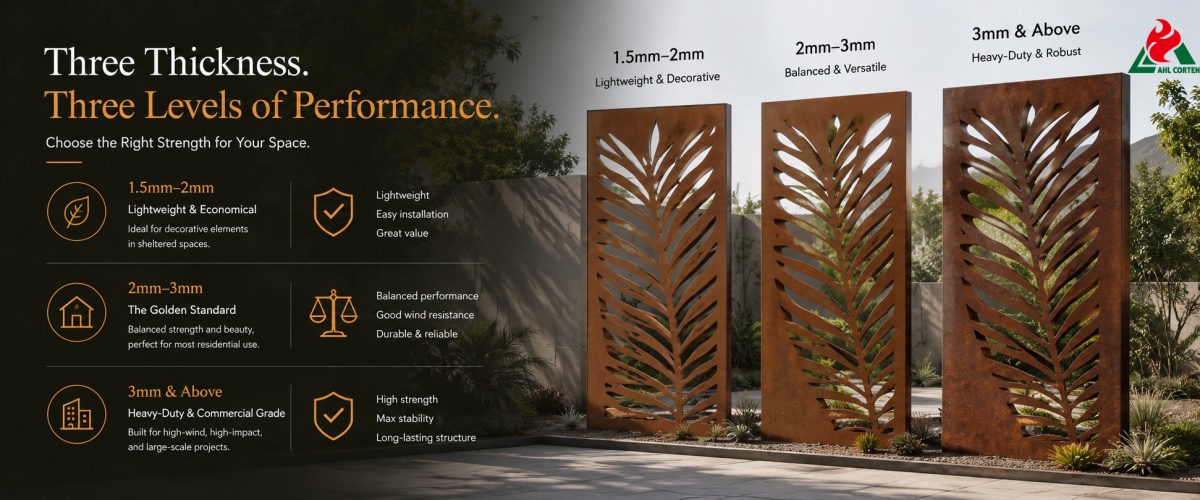
Landscape weathering steel screens come in three mainstream thickness ranges, each corresponding to different budgets, applications, and performance requirements, covering all residential and commercial scenarios.
1.5mm–2mm: Lightweight and Economical, Focusing on Decorative Aesthetics
This is an entry-level, lightweight specification featuring light panel weight, easy installation, and outstanding value for money. It offers good overall toughness and is resistant to brittle fracture, making it suitable for lightweight decorative landscaping. The core focus of this thickness is aesthetic appeal. With moderate structural strength, it is better suited for sheltered environments and scenarios with low wind pressure, but is not recommended for open-air use in strong winds or for large-scale floor-to-ceiling installations.
2mm–3mm: The “Golden Standard” for Residential Use—A Balance of Aesthetics and Performance
2–3mm is currently the most popular standard thickness for private gardens and residential landscaping, and is widely recognized in the industry as the “all-around golden standard.” It strikes a perfect balance between panel weight, structural rigidity, wind resistance, and cost. It resists warping from daily exposure to sun and rain, can be installed as a freestanding structure, and is suitable for the vast majority of residential applications.
3mm and Above: Heavy-Duty Commercial Grade, High Strength and Stable Structure
Thickened specifications of 3mm and above fall under industrial and commercial standards. The panels offer exceptional rigidity, with maximum resistance to wind, impact, and deformation. They feature a more substantial visual texture and a stronger architectural texture, making them suitable for large-scale screens, open outdoor spaces, high-wind areas, and high-end commercial landscape projects.
Comparison Chart: Corten Steel Screens of Different Thicknesses for Specific Applications
1.5mm–2mm: Small Spaces, Low Wind Pressure, Budget-Friendly Choice
Suitable for wall-mounted or fence-mounted installations; not suitable for freestanding large screens. Ideal for small courtyards, corner decorations, landscape accents, and indoor-outdoor transition spaces. Prioritize this specification for sites with low wind pressure and architectural shelter where the goal is to quickly enhance the aesthetic appeal of a courtyard at a low cost. It is lightweight, easy to install, and suitable for DIY projects.
2mm–3mm: The Top Choice for Most Residential Gardens
Suitable for residential freestanding partitions, garden privacy screens, space division, and creating visual focal points in landscapes. Can withstand typical outdoor wind conditions and seasonal weather changes. Resists bending, curling, and warping during long-term outdoor use. Balancing aesthetics, durability, and value, this is the foolproof, all-purpose specification for residential gardens.
3mm and Above: Large Areas, Strong Winds, and High-End Commercial Settings
Specifically designed for open outdoor spaces and windy coastal areas, the extra-large freestanding Corten steel privacy screens. Effectively dissipates wind pressure on large panel surfaces and prevents long-term stress-induced deformation. Ideal for projects with higher demands for structural stability and visual quality, such as commercial plazas, high-end vacation rentals, scenic area landscaping, municipal projects, and upscale clubs.
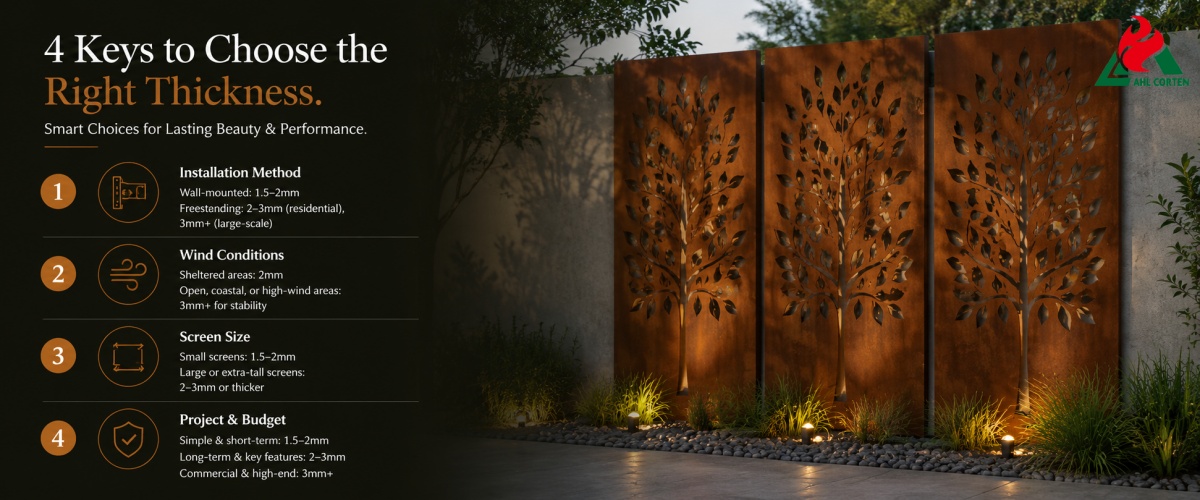
A Step-by-Step Guide to Choosing Screen Thickness: 4 Scientific Selection Criteria
1. Select Based on Installation Method
Wall-mounted or lean-to installation: With minimal stress and no wind pressure concerns, 1.5–2mm is entirely sufficient—lightweight and easy to secure.
Freestanding installation: Requires self-supporting wind resistance; 2–3 mm is preferred for residential use, while large-area freestanding installations must use 3 mm or thicker panels.
2. Select Based on Local Wind Conditions
Sheltered areas, such as those protected by buildings or deep within courtyards: Standard 2 mm panels are sufficient for long-term use. Open, unobstructed areas; windy coastal regions; and high-altitude areas with strong winds: Must upgrade to 3 mm or thicker panels to ensure structural stability.
3. Select Based on Screen Size
Small decorative screens: With a small wind-exposed area, thin panels are less prone to warping, so economy-class specifications are sufficient.
Large, extra-tall, or extra-wide screens: Due to the large wind-exposed area and concentrated stress, thicker panels are required to prevent sagging in the center or warping at the edges.
4. Select Based on Project Characteristics and Budget
Simple home decor and short-term landscaping: Prioritize 1.5–2mm panels to control costs and achieve quick results.
Long-term home gardens and primary landscape features: Opt for the 2–3mm “gold standard” specification—a one-time investment that provides years of worry-free use.
Commercial projects, high-end custom work, and long-term landscape projects: Use heavy-duty specifications of 3mm or thicker to balance aesthetic appeal with structural stability.
How Metal Screen Thickness Affects Overall Project Costs and Long-Term User Experience
1. Differences in Installation Difficulty
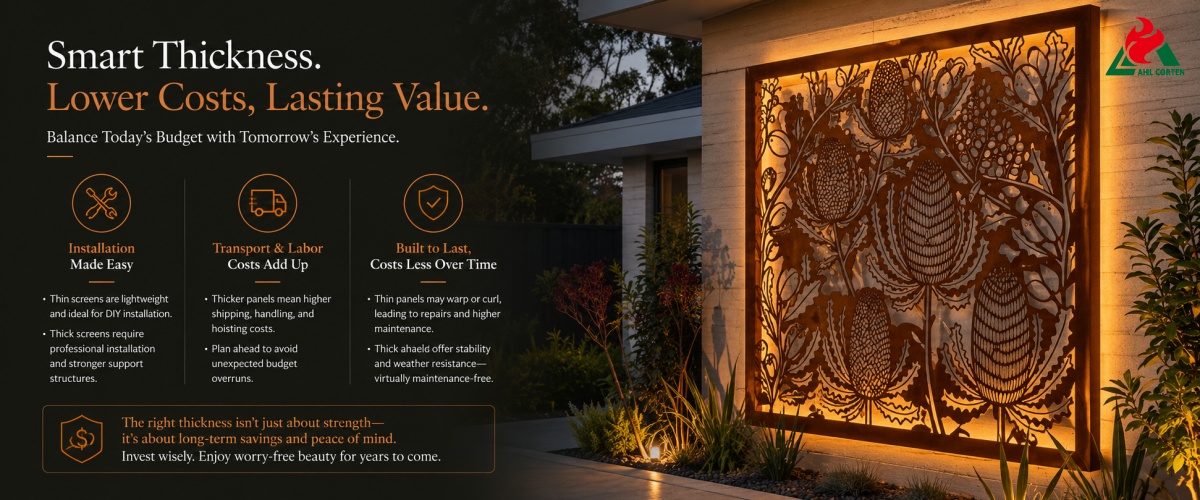
Thin screens are lightweight and easy to transport, making them suitable for DIY installation by homeowners without the need for specialized equipment or a large team. Thicker screens are heavier, placing higher demands on mounting brackets, ground anchors, and frame structures, and typically require standardized installation by a professional team.
2. Differences in Transportation and Labor Costs
The thicker the corten metal screen panels and the heavier their weight, the higher the costs for transportation, handling, and hoisting will be. Initial budgets must take these factors into comprehensive consideration to avoid hidden cost overruns.
3. Differences in Long-Term Maintenance Costs
Thin panels are prone to warping and edge curling in harsh environments, requiring regular inspections, adjustments, and repairs later on, resulting in higher long-term maintenance costs. Thick panels offer structural stability and strong weather resistance, requiring virtually no maintenance and eliminating the need for frequent inspections or renovations, making them more cost-effective over their entire lifecycle.
High-Quality Corten Screens: A Long-Term Investment in Your Garden
High-quality weathering steel screens are far more than ordinary decorative pieces; they are high-end outdoor landscape assets that combine aesthetic appeal, functionality, and value retention. Thanks to their unique self-healing rust layer mechanism, they can withstand year-round exposure to sunlight, heavy rain, and temperature fluctuations without rusting through or crumbling and flaking off like ordinary wrought iron. Over time, the rust patina naturally deepens and develops richer layers, presenting a unique natural texture each year that significantly enhances the aesthetic appeal and sophistication of your garden design. Additionally, they require no painting, rust prevention, or touch-ups—they are virtually maintenance-free. A single installation ensures decades of reliable use, offering greater long-term value compared to wooden, plastic, or ordinary metal screens.
Essential Purchasing Checklist: Choosing the Right Thickness + Details to Avoid Pitfalls
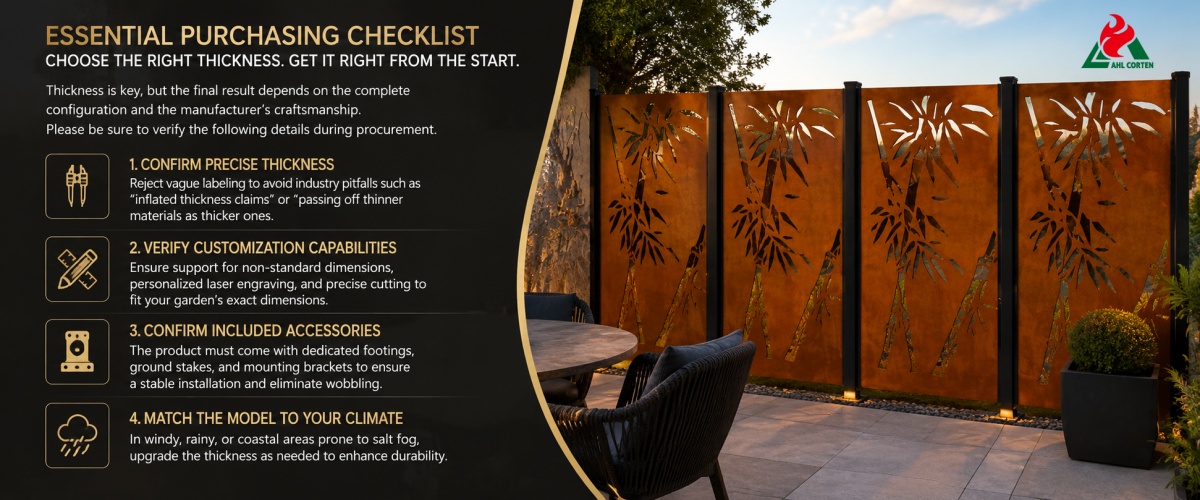
Thickness is key, but the final result depends on the complete configuration and the manufacturer’s craftsmanship. Please be sure to verify the following details during procurement. First, confirm precise thickness specifications. Reject vague labeling by manufacturers to avoid industry pitfalls such as “inflated thickness claims” or “passing off thinner materials as thicker ones.” Second, verify customization capabilities, including support for non-standard dimensions, personalized laser engraving, and precise cutting to fit your garden’s exact dimensions—eliminating the need for compromises during installation. Third, confirm the included accessories. The product must come with dedicated footings, ground stakes, and mounting brackets to ensure a stable installation and eliminate the risk of wobbling. Fourth, select the appropriate model based on local climate conditions. In windy, rainy, or coastal areas prone to salt fog, upgrade the thickness specification as needed to enhance durability.
Frequently Asked Questions (FAQ) About Corten Steel Screens
Q1: Is a 2mm Weathering Steel Screen Sufficient For a Residential Yard?
This is more than sufficient for the vast majority of standard private yards. For freestanding screens in areas sheltered by buildings, with gentle winds, and of standard dimensions, 2mm provides ample stability. In areas with strong, unobstructed winds or for extra-large screens, upgrading to 2.5–3mm is recommended for greater stability.
Q2: Does a Thicker Screen Make Installation Easier?
Not necessarily. Thicker sheets are heavier, placing higher demands on mounting brackets and fastening techniques, which increases installation difficulty. Thinner sheets are lightweight and easy to handle, making them better suited for simple installations and DIY projects.
Q3: Do Large-Sized Screens Require Thicker Sheets?
We recommend prioritizing thicker panels. Large-sized screens have a larger wind-exposed surface area; thin panels subjected to long-term stress are prone to sagging in the middle and warping at the edges. A thickness of 3mm or more effectively mitigates the risk of deformation, ensuring long-term flatness and aesthetic appeal.
Q4: Does Panel Thickness Affect The Rusting Effect Of Weathering Steel?
No. The oxidation and rusting of weathering steel is a surface chemical reaction unrelated to panel thickness. Screen panels of different thicknesses will all naturally form a uniform and stable protective rust layer, with no difference in the color or texture of the rust.
Q5: What Is The Optimal Overall Thickness For Residential Gardens?
2–3 mm is the ideal “golden” thickness for residential use, striking a perfect balance between strength, weight, aesthetics, cost, and durability. It is suitable for all residential applications, including privacy screens, space partitioning, and landscape design.
Are You Ready to Choose the Perfect Outdoor Corten Steel Screen For You?
The performance and lifespan of a corten steel screen are entirely determined by its thickness. Thicknesses of 1.5–2 mm are suitable for budget-friendly, light-duty decorative applications; 2–3 mm are suitable for most residential yards; and thicknesses of 3 mm or more are specifically designed for high-wind environments, large-scale installations, and high-end commercial projects. Selecting a thickness that precisely matches your application not only prevents wasted budget but also completely resolves common issues such as swaying, warping, curling edges, and frequent maintenance, ensuring your garden screen maintains a smooth, sophisticated aesthetic year-round. Still struggling to decide which thickness to choose for your home garden, or unsure about the right sizing solution? No need for trial and error! Contact us immediately for a free consultation and quote. Our professional landscaping team will create a customized weathering steel screen solution based on your site’s wind conditions, screen dimensions, installation method, and budget—helping you make the right choice the first time and achieve a perfect landscape effect!


 Fill In The Inquiry