Corten steel fire pits are a central outdoor feature in modern gardens, upscale bed-and-breakfasts, and “light luxury” camping settings. With their unique weathered, rust-colored texture, a look that becomes more refined over time, and their paint-free, low-maintenance, and weather-resistant properties, they have become a popular choice for outdoor social gatherings. Many homeowners and construction teams share a common misconception: they focus solely on the fire pit’s design and materials while neglecting the selection of the ground surface. In fact, the ground is far more than a simple placement surface; it is the key factor determining the fire pit’s safety, service life, and the integrity of the garden’s flooring. Improper ground placement can lead to a series of problems, including permanent rust stains on the ground, fire hazards due to high temperatures, corrosion of the fire pit’s base, and the unit tilting or tipping over. The long-term value of a high-end weathering steel fire pit depends entirely on the scientific selection of the ground surface and proper installation techniques.
Why Do Corten Fire Pits Have Special Requirements for the Ground?
While ordinary carbon steel fire pits and stone fireplaces are generally compatible with most surfaces, genuine weathering steel fire pits possess unique physical and chemical properties that impose strict and specific technical requirements on the installation surface. These requirements stem primarily from four key characteristics.
1. Initial Rust Water Seepage Can Easily Cause Permanent Staining Of The Ground
The first 3–6 months after installation mark the active oxidation phase for weathering steel, during which the dense, protective passivation layer on the surface has not yet fully formed and sealed. When exposed to rain or morning dew, the steel releases a weakly acidic rust water containing free iron ions—a phenomenon known in the industry as “rust water runoff.” This liquid is highly penetrating; once it lands on porous or light-colored surfaces, it forms stubborn rust stains that cannot be removed with conventional cleaners, completely ruining the aesthetic appeal of the patio paving.
2. High-Temperature Thermal Radiation Demands Extremely High Fire-Retardant Properties in Surfaces
When a fire pit is burning, the core temperature can reach several hundred degrees Celsius, and intense thermal radiation is continuously emitted downward from the bottom. Ordinary flammable surfaces with low flash points cannot withstand this intense heat and are highly prone to charring, warping, and catching fire. Only a hard inorganic substrate—which is non-combustible, has a high melting point, and matches the thermal expansion coefficient of steel—can eliminate these high-temperature safety hazards.
3. Cyclic Exposure To Wet And Dry Conditions Directly Impacts The Fire Pit’s Corrosion Resistance Lifespan
The core principle of weathering steel’s corrosion resistance is the alternating cycle of wet and dry conditions; a dry, well-ventilated environment aids in the formation of a passivation layer. Damp, waterlogged conditions and enclosed, airtight surfaces block this process, causing oxygen deprivation and suffocation at the bottom of the fire pit, which leads to pitting corrosion and accelerated localized rusting, directly shortening the equipment’s service life by more than 70%.
4. Heavy-Load Bearing Capabilities Require an Absolutely Level and Stable Surface
Corten steel fire pits have significant dead weight, and the load increases further when combined with the weight of firewood. Soft or uneven ground can cause uneven settlement, leading to the fire pit tilting and its center of gravity shifting. Under extreme wind and rain or from external impacts, this can easily result in serious safety incidents such as embers scattering or the equipment overturning.
4 Optimal Surface Types for Corten Steel Fire Pits
Taking into account thermodynamic properties, rust-stain protection, and landscape aesthetics, the following four surface types have been verified through high-end garden projects and engineering studies as the optimal choices, and can be tailored to suit various garden styles.
1. Concrete Surfaces: Industrial-Grade Stability—The Top Choice for Permanent Installation
Concrete is the most reliable, non-combustible base material for outdoor landscaping. With its high thermal inertia and load-bearing capacity, it is the best choice for the long-term, permanent installation of a Corten steel fire pit. It quickly absorbs the high heat conducted downward from the fire pit, preventing thermal cracking and settlement deformation. It firmly anchors the fire pit’s center of gravity, eliminating the risk of tilting. Professional Installation Recommendations: Light-colored exposed concrete has many pores and easily absorbs rust water. We recommend using dark charcoal-colored inorganic concrete or applying a polymer-based fluorocarbon stain-resistant sealant to the installation area to form a waterproof and stain-resistant protective layer.
2. Dark-Colored Heavy-Duty Paving Stones: Combining Aesthetics and Practicality
High-density stones such as black basalt, dark gray flamed granite, and dark slate are well-suited for modern minimalist and high-end New Chinese-style gardens. These stones have extremely low porosity, effectively resisting the penetration of iron ions. At the same time, the dark base naturally blends with minor initial rust stains, allowing the naturally weathered texture of the metal fire pit to seamlessly integrate with the ground, developing a more vintage look the longer it is used.
3. Graded Gravel Layer: Naturally Breathable, Zero Water Pooling
A gravel base is ideal for natural-style settings such as American-style estates, Japanese kare-sansui gardens, and “light luxury” camping, making it an extremely cost-effective eco-friendly choice. The gaps between the gravel form natural, breathable drainage channels, allowing rust-stained water from rain to seep away quickly—leaving no standing water or residue and completely preventing yellowing or staining of the ground. At the same time, the permeable base ensures a continuous cycle of moisture and drying at the bottom of the outdoor fire pit, helping the anti-corrosion layer set properly. Upgrade Option: Install a gravel stabilization mesh + a custom metal drip tray to completely resolve the issue of fire pit tables shifting on gravel surfaces.
4. Industrial-Grade Fireproof Mat: Versatile and Flexible, Designed for Sensitive Surfaces
If you need to place a backyard fire pit on flammable high-end surfaces such as wooden decks or composite decking, a professional fireproof mat is the only safe solution. Made of a composite material featuring multiple layers of fiberglass and aluminum foil, it effectively blocks high-temperature heat radiation and prevents sparks from flying. This creates a microscopic thermal barrier between flammable surfaces and the high-temperature fire pit, allowing for flexible placement and installation as needed.
4 Types of High-Risk Surfaces Strictly Prohibited to Avoid Safety and Damage Risks
To eliminate fire hazards and protect high-end garden paving, it is strictly prohibited to place rusted steel fire pits directly on the following four types of surfaces—these are absolute red-line prohibitions.
1. Wooden/Composite Wood Decks
The sustained high heat from the fire pit will directly char the wood fibers, causing the boards to become brittle, warp, and crack. When heated, composite wood materials will also soften and release harmful gases. Even more dangerous is the risk of flying sparks falling into the gaps between the boards and smoldering, triggering hidden fires—posing an extremely high safety risk.
2. Natural Lawns/Moist Landscaped Areas
The high temperatures from a fire pit table can instantly scorch a lawn’s root system, leaving unsightly blackened and charred patches. At the same time, the damp, oxygen-rich environment of the lawn keeps the bottom of the fire pit in a persistently damp and stuffy state, disrupting the natural wet-dry cycle of weathering-resistant steel, accelerating pitting corrosion and aging at the base, and significantly shortening the equipment’s lifespan. Additionally, soft lawns lack sufficient load-bearing capacity, making the fire pit prone to tilting and wobbling, which poses a risk of charcoal spilling.
3. Light-Colored, Porous Natural Stone
Materials such as marble, light-colored limestone, and sandstone are highly porous and have strong adsorption properties. Initial rust water will quickly seep into the stone, forming deeply ingrained rust-yellow stains that cannot be completely removed by any industrial cleaner, directly ruining the cost and aesthetic value of high-end paving.
4. Loose, Uneven Bare Sand Soil
Soft, sandy soil lacks structural load-bearing capacity and is highly prone to localized subsidence after repeated cycles of high heat and moisture. If the metal fire pit’s center of gravity becomes unbalanced, it may tilt or shift. It is highly susceptible to tipping over during strong winds or upon impact, leading to serious safety incidents such as spilling charcoal, burns, and fires.
Industrial-Grade Corten Fire Pit Protection Techniques
Mastering standardized protection techniques allows you to successfully navigate the outdoor fire pit’s initial oxidation phase while maintaining both the aesthetic appeal of the ground surface and the long-term durability of the equipment.
1. Color Matching Method: Opt for Dark-Colored Surfaces
Plan ahead by using dark-colored stone, dark concrete, or gravel as the base. Take advantage of the material’s dark undertones to naturally blend in minor initial rust stains, eliminating the need for frequent cleaning.
2. Physical Isolation Method: Mandatory Protection During the Oxidation Phase
During the active oxidation phase—the first 3–6 months of rusted steel fire pit use—it is essential to lay down a fire-resistant mat or install a custom metal drip tray to fully contain rust water and sparks, thereby preventing ground contamination and heat damage.
3. Elevated Ventilation Method: Provide a Bottom Air Gap
Use the original support legs to elevate the fire pit 5–10 cm off the ground, creating a convection airflow channel at the bottom. This not only rapidly dissipates residual heat from the bottom and prevents water accumulation but also ensures that the weathering steel undergoes normal dry-wet cycles, accelerating the formation of the passivation and anti-corrosion layer.
After each use and once the fire pit has completely cooled, promptly remove any damp ashes from the interior. Damp wood ashes are highly alkaline; if left to accumulate over time, they will absorb moisture, accelerating electrochemical corrosion inside the fire pit and exacerbating rust water leakage issues.
Safety Checklist Before Using a Corten Fire Pit: Ensure Hazard-Free Operation
Before lighting the fire for the first time, be sure to complete the following four core checks; normal use is permitted only after all standards are met. 1. Load-bearing Capacity Check: The ground must be solid with no hollow spots or soft foundations, capable of withstanding heavy loads and alternating high and low temperatures over the long term, with no risk of subsidence. 2. Safety Distance Check: Maintain a safety distance of ≥3 meters between the fire pit and flammable plants, wooden fences, building exterior walls, and overhead cables; ensure there are no overhanging tree branches above. 3. Drainage and Ventilation Check: Place the fire pit in an open, well-ventilated area with a pre-established drainage slope on the ground so that rainwater can drain away quickly by gravity, leaving no localized standing water or dead zones. 4. Levelness Verification: Use a spirit level to calibrate the fire pit’s levelness and fine-tune the support foot shims to prevent issues such as center-of-gravity shifts, charcoal buildup, and equipment tilting.
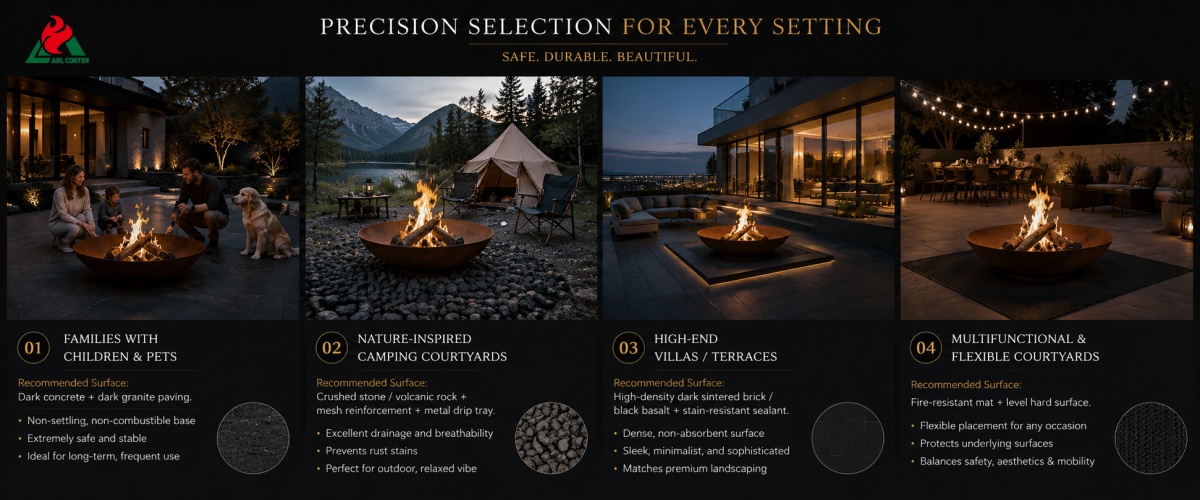
Precise Selection of Corten Steel Fire Pits for Specific Settings
1. Courtyards for Families with Children and Pets
Prefer dark-colored concrete + dark-colored granite paving. The hard base ensures zero settlement and zero flammability risk. The overall structure is sturdy and durable, suitable for long-term, frequent use, and completely eliminates safety hazards.
2. Nature-Inspired Camping Courtyards
Features a base of crushed stone or volcanic rock, reinforced with a sturdy mesh and a metal drip tray. This design balances the natural aesthetic with drainage and breathability, leaving no rust stains and perfectly complementing a relaxed outdoor camping atmosphere.
3. High-End Villas/Terraces
Features high-density dark sintered brick and black basalt, paired with a stain-resistant sealing coating. The dense, non-absorbent surface and clean, sophisticated lines perfectly complement the modern minimalist and high-end rooftop terrace landscapes.
4. Multifunctional and Flexible Courtyards
Combines industrial fire-resistant mats with a level, hard surface, allowing for flexible repositioning to suit various party scenarios while balancing aesthetics, safety, and mobility.
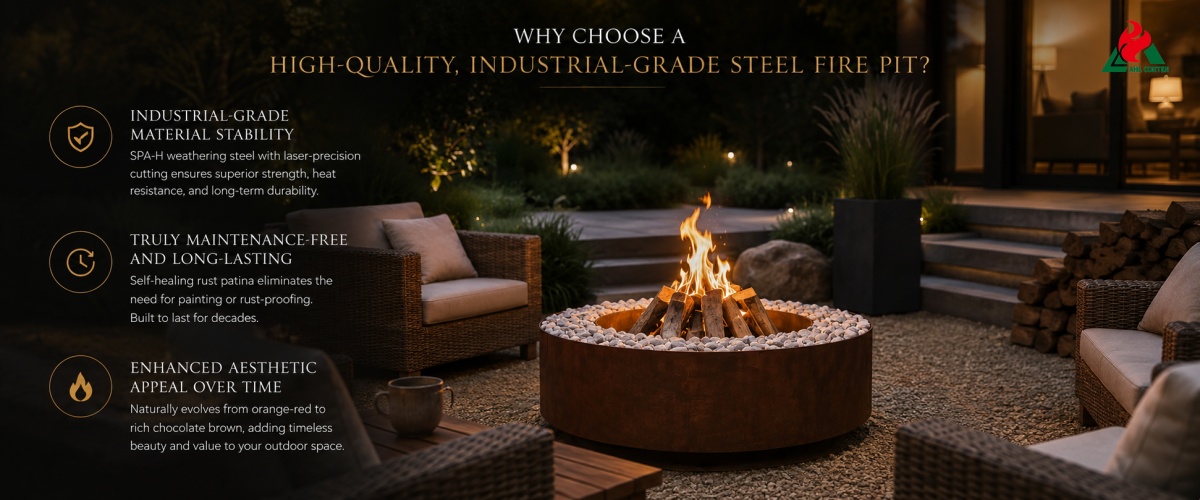
Why Choose a High-Quality, Industrial-Grade Steel Fire Pit?
A premium weathering steel fire pit is far more than a simple wrought-iron container; it is a high-end outdoor system that combines structural safety, long-lasting corrosion resistance, and aesthetic appeal.
Industrial-Grade Material Stability: Crafted from genuine SPA-H weathering steel thick-gauge sheets and processed using fully automated laser technology, it remains distortion- and crack-free even after enduring alternating heat and cold as well as wind and rain erosion, offering exceptional structural load-bearing capacity.
Truly Maintenance-Free and Long-Lasting: The naturally passivated rust layer is self-repairing, eliminating the need for painting or rust-proofing maintenance. With a service life spanning decades, you can say goodbye to frequent repairs.
Enhanced Aesthetic Appeal Over Time: The color naturally transitions from an initial orange-red to a rich chocolate brown, featuring a fine, sophisticated texture that becomes increasingly refined with age, enhancing the overall aesthetic of your garden and increasing its property value.
Frequently Asked Questions (FAQ) About Corten Steel Fire Pits
Q1: Can a Corten Steel Fire Pit Be Placed Directly On a Light-Colored Concrete Surface?
We do not recommend placing it directly on the surface. Light-colored concrete is porous and absorbs water; initial rust runoff can cause extensive, permanent rust-yellow stains. If this is unavoidable, apply a stain-resistant sealant in advance or install a drip tray for isolation and protection.
Q2: Can a Rusted Steel Fire Pit Be Temporarily Placed On a Lawn?
Absolutely not. High temperatures will directly scorch the lawn’s root system, leaving charred, sunken patches. Additionally, a damp lawn will accelerate corrosion at the bottom of the fire pit, significantly shortening the product’s lifespan—creating a dual safety hazard.
Q3: Is a Fire-Resistant Mat Required When Using a Fire Pit On a Wooden Deck?
Yes, it is mandatory. Wood and composite decking are flammable materials; high-temperature heat radiation and flying sparks can easily cause smoldering fires. A fire-resistant mat is the only effective safety measure.
Q4: How Long Does The Rust-Staining Period Last For a Fire Pit? Can This Process Be Accelerated?
Under natural conditions, the rust-staining period lasts 3–6 months and stops automatically once the surface passivation layer is fully formed. You can opt for factory-finished products that have undergone a pre-stabilization treatment to skip this unsightly rust-staining phase entirely, allowing you to use them with peace of mind right out of the box.
Q5: Do I Need to Store The Fire Pit Indoors During Winter When It Rains Or Snows?
No need to store it indoors. Weathering steel is specifically designed for extreme outdoor environments, and exposure to wind, snow, rain, and dew helps the protective layer form. Simply clean out any standing water and damp ashes from the fire pit after rain, and ensure the bottom remains well-ventilated.
Are You Ready to Choose a Corten Steel Fire Pit That’s Right for You?
The premium value of a weathering steel fire pit stems not only from the natural texture of the material itself but also from the scientific selection of the ground surface and proper installation techniques. High-quality materials provide a durable foundation for the fire pit, while a properly matched grounding system eliminates all risks—including fire hazards, ground staining, equipment corrosion, and tipping or overturning. By selecting concrete, dark-colored stone, gravel, or fire-resistant mats based on your yard’s style, and strictly adhering to safety and inspection standards, you can ensure your metal fire pit becomes a central yard feature that remains durable, visually appealing, and worry-free for decades to come. Contact us now!

.jpg)


 Fill In The Inquiry