How to Seal Raised Corrugations on Corten Steel Siding | Expert Guide
Date:2026.06.16
Share to:
With its unique natural rust-colored texture, exceptional weather resistance, and minimalist industrial aesthetic, corten steel wall cladding has become a mainstream exterior material for modern architecture, high-end vacation rentals, and garden landscapes. Its ability to age gracefully over time without the need for painting sets it apart from conventional aluminum panels, painted surfaces, and stone facades.
Many contractors and property owners hold a misconception: they believe that since corten steel is inherently rust-resistant, it does not require meticulous sealing. In fact, while the panels themselves are corrosion-resistant, this does not mean the wall system is impervious to water leakage. In particular, the raised corrugated seams of corrugated corten steel siding represent the weakest points in the entire exterior wall’s waterproofing system. Inadequate sealing can lead to a series of irreversible construction issues.
Issues such as rainwater leakage, blackening and staining of the wall surface, moisture and mold in the internal insulation layer, thermal expansion and contraction deformation of the panels, and loosening of screws are mostly not caused by material defects, but rather by non-standard corrugated sealing processes.
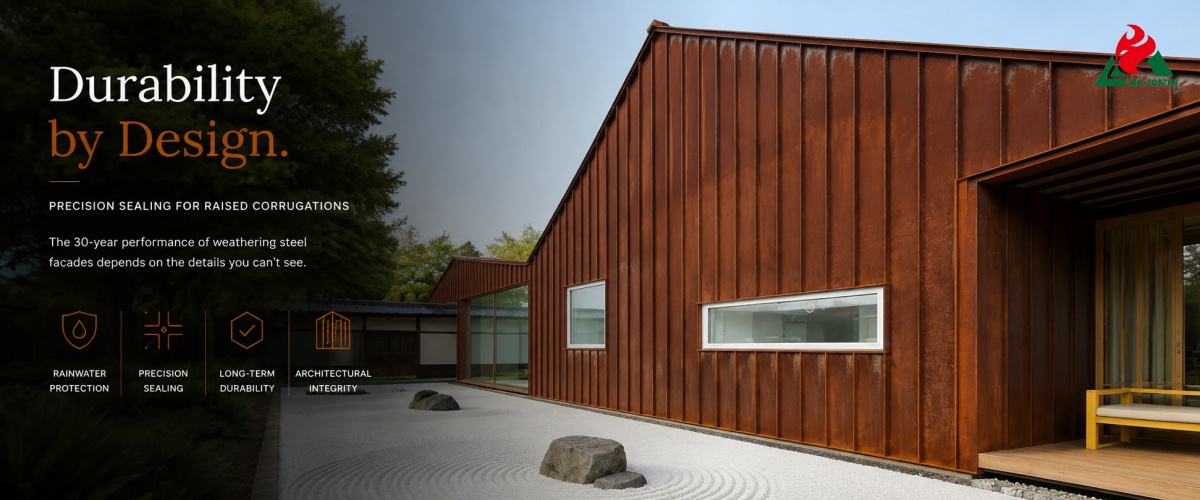
The 30-year durability of high-end weathering steel facades depends 90% on invisible, microscopic sealing details. This article provides a comprehensive overview of sealing technology for raised corrugations, covering principles, pre-installation inspections, four professional sealing methods, standardized construction procedures, key pitfalls to avoid, and scenario-specific solutions.
Weathering steel corrugated wall panels are specialized architectural curtain wall cladding panels made from SPA-H high-strength weathering steel as the base material and formed through cold rolling. They are widely used in landmark buildings, high-end residential properties, resort hotels, and landscape curtain wall projects. Unlike ordinary carbon steel or sheet metal wall panels, they possess a unique self-healing corrosion-resistant mechanism. Under long-term outdoor exposure to alternating wet and dry conditions, a dense, brownish-red passivation layer (patina) 50–100 μm thick spontaneously forms on the panel’s surface. This natural protective layer acts like a metal armor, firmly sealing the base material and blocking oxygen and moisture. It eliminates deep corrosion, peeling, and perforation at the source, truly achieving decades of maintenance-free use without the need for painting. At the same time, the corrugated raised structure significantly enhances the wall panels’ resistance to wind pressure and shear forces. The three-dimensional play of light and shadow creates a striking visual texture, allowing the building’s facade to combine a rugged industrial aesthetic with the natural patina of time, thereby continuously enhancing the building’s high-end recognition and asset value.
Why are Raised Corrugations Prone to Leaks and Sealing Failures?
Raised corrugations are the structural core of corrugated wall panels, enhancing wall rigidity and optimizing the building’s facade lines. However, their unique three-dimensional geometry also makes them a high-risk weak point for exterior wall waterproofing, with four major physical vulnerabilities that cannot be resolved through the material’s inherent properties.
Capillary and Siphon Gaps: Hidden Pathways for Water Infiltration
At panel joints and the intersections of corrugations with trim components, numerous microscopic gaps form due to manufacturing tolerances and on-site installation precision. Under wind pressure during rainy weather, these gaps create a capillary siphon effect, drawing rainwater back into the interior of the wall panels. This continuously saturates the insulation layer and the framing structure, leading to hidden leaks.
Thermal Fatigue Displacement: Tearing Through Standard Sealing Layers
Outdoors, the surface temperature of steel panels can reach 60–70°C in summer and drop below freezing in winter. These extreme temperature fluctuations cause the steel panels to continuously expand and contract. Stress concentration is most pronounced at the ridges of the corrugations. Ordinary rigid sealants cannot accommodate these high-frequency micro-displacements, leading to cracking, delamination, powdering, and peeling within just 1–2 years, completely losing their waterproofing capability.
Wind and Rain Pressure Differential Effect: Forced Rainwater Penetration
During heavy rain and strong winds, positive pressure forms on the windward side of the corrugations, while negative pressure forms at the overlapping seams, creating a natural physical pumping effect. Corrugated joints that are not properly sealed will be forced to fill with rainwater due to this pressure differential, causing water accumulation and leakage inside the wall. Over time, this accumulation creates structural hazards.
Dirt and Water Accumulation in Grooves, Deteriorating Façade Aesthetics
Corrugated grooves with failed sealing are prone to accumulating dust, stains, and fallen leaves. Standing water and dried stains form stubborn black water marks. This not only ruins the natural, uniform vintage texture of weathering steel but also causes uneven oxidation in localized areas, resulting in color variations and mottling.
Pre-Construction Inspection of Corrugated Sealing to Prevent Future Failures at the Source
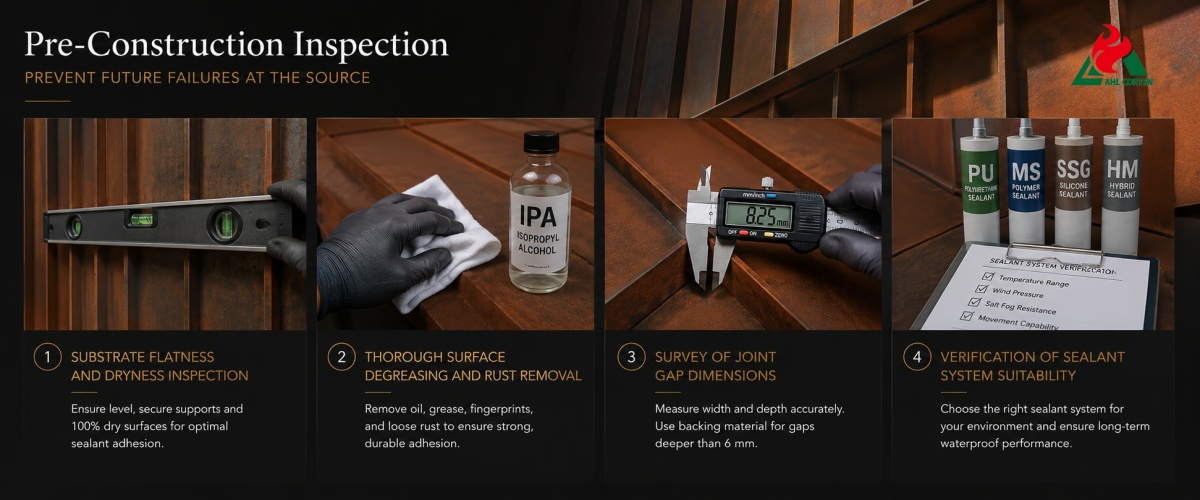
The vast majority of issues with peeling, delamination, and water leakage in sealant layers stem from inadequate substrate preparation during the initial stages. Before applying sealant, four standardized inspections must be completed.
Substrate Flatness and Dryness Inspection
Wall panel support studs must be level and secure to prevent panel warping, buckling, or misalignment, ensuring neat and uniform joint lines. The substrate must be 100% completely dry. Walls with morning dew or those not fully dried after rain will form microscopic water films, which directly block molecular bonding between the sealant and the steel, making large-scale delamination and leaks highly likely in the future.
Thorough Surface Degreasing and Rust Removal
During the manufacturing and installation of weathering steel, the surface may retain cutting oil, rust-preventive grease, fingerprints, and loose rust particles. The surface must be cleaned using isopropyl alcohol (IPA) industrial cleaner with a two-way wiping motion to thoroughly remove contaminants, expose the dense substrate, and ensure high-strength adhesion of the sealant.
Survey of Joint Gap Dimensions
Accurately measure the width and depth of the corrugated lap joints, distinguishing between narrow gaps, wide gaps, and irregular cavities. When the gap depth exceeds 6 mm, direct full-fill application is strictly prohibited; a backing material must be used to prevent curing stress imbalance and internal cracking of the sealant.
Verification of Sealant System Suitability
Select the appropriate sealing system based on environmental factors at the project site, including seasonal temperature variations, wind pressure, and coastal salt fog. Ensure that the selected materials can completely block high-pressure water infiltration while also possessing high movement recovery capabilities to accommodate long-term expansion and contraction of the steel plates.
4 Professional Sealing Techniques for Corrugated Surfaces
Given the three-dimensional structure of weathering steel corrugations, the industry employs four established sealing techniques that can be flexibly combined based on building type, environmental conditions, and budget, effectively addressing waterproofing, structural integrity, and aesthetic appeal.
This is a classic flexible waterproofing process suitable for the vast majority of corrugated lap joints, bolt holes, and fine gaps. It offers convenient installation and strong adaptability. Preferably use neutral silicone curtain wall sealant or modified polyurethane MS sealant, which must have a movement capacity of ≥±50%, UV resistance, and aging resistance to accommodate the high-frequency expansion and contraction of steel. The use of cheap acidic silicone sealant is strictly prohibited. Acidic substances react chemically with the active iron ions in weathering steel, corroding the natural passivation layer and forming permanent black rust bands.
Closed-Cell Backing Rod Filling Process (For Wide Joints)
For wide, irregular cavities at the junctions of corrugated panels with eaves and flashing panels, backing rods are an essential complementary construction technique. Insert a closed-cell polyethylene backing rod with a diameter slightly larger than the joint into the depth of the gap to precisely control the depth of sealant application. This eliminates stress cracking caused by three-sided adhesion of the sealant, ensures the sealant’s bidirectional tensile elasticity, and simultaneously saves material, reduces construction costs, and achieves long-term waterproofing.
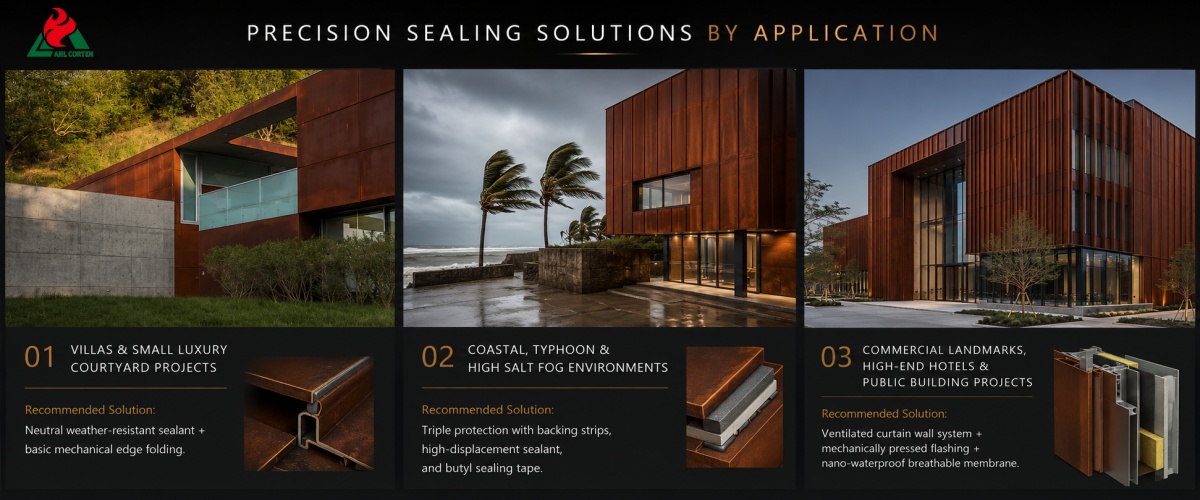
Butyl Sealant Tape + Waterproof Membrane Laminating Process (Top-Tier Solution for Extreme Environments)
Designed for extreme conditions such as coastal salt fog, typhoon-induced torrential rain, and high humidity and extreme cold, this is the standard dual-protection system for high-end curtain wall systems. Leveraging the non-curing and self-healing properties of butyl rubber, the sealing tape is pre-installed within the corrugated overlap and mechanically secured with bolts. The outer layer is sealed with weather-resistant sealant. Even if the surface sealant ages and develops micro-cracks, the inner butyl tape continues to provide waterproofing, completely eliminating the risk of water infiltration due to wind pressure.
Mechanical Edging + Sealant Composite System (For Landmark Buildings)
For high-standard projects such as large-scale commercial landmarks and luxury resort hotels, a dual-line defense of “rigid structural drainage + flexible sealant waterproofing” is employed. Customized integrated CORTEN steel edge trims, copings, and flashing components are designed to match the corrugated panel profiles. Secured through mechanical interlocking, they intercept over 95% of gravity rainwater. Minor remaining gaps are filled and sealed with high-elasticity sealant, upgrading single-layer waterproofing into a systematic drainage and sealing system that balances structural stability with a minimalist facade aesthetic.
Industrial-Grade 5-Step Standardized Construction Process, Zero-Defect Sealing
To achieve long-lasting waterproofing for corrugated joints—free from cracking or discoloration—it is essential to strictly follow the manufacturer’s standardized five-step construction process, eliminating arbitrary construction practices and simplified procedures. Step 1: Deep degreasing and cleaning. Wipe the corrugated panel’s top surface, ribs, and lap joints in both directions with IPA cleaner to thoroughly remove oil, surface rust, and construction residue. Allow the surface to air dry completely to ensure the substrate is clean and dry. Step 2: Precise surveying and backing rod installation. Measure the gap dimensions with a caliper. Insert closed-cell backing rods of the appropriate size as needed, leaving standard spacing for sealant application to ensure an optimal thickness-to-width ratio of the sealant. Step 3: Bubble-free, uniform sealant injection. Use an electric caulking gun at a 45° angle to apply sealant at a steady rate, working continuously from bottom to top to fill all fine grooves and dead corners of the corrugated surface, eliminating the risk of air pockets and voids. Step 4: Timed Compaction and Trimming. Within 10 minutes before the sealant surface dries, use a specialized curved scraper to compact and trim the sealant, removing excess material to form a smooth, even, continuous sealing line, ensuring the sealant’s density. Step 5: Comprehensive Inspection. Inspect the transition zones of corrugated joints section by section to eliminate water-trapping dead zones, gaps in the sealant layer, and panel burrs, ensuring smooth overall drainage and a complete seal.
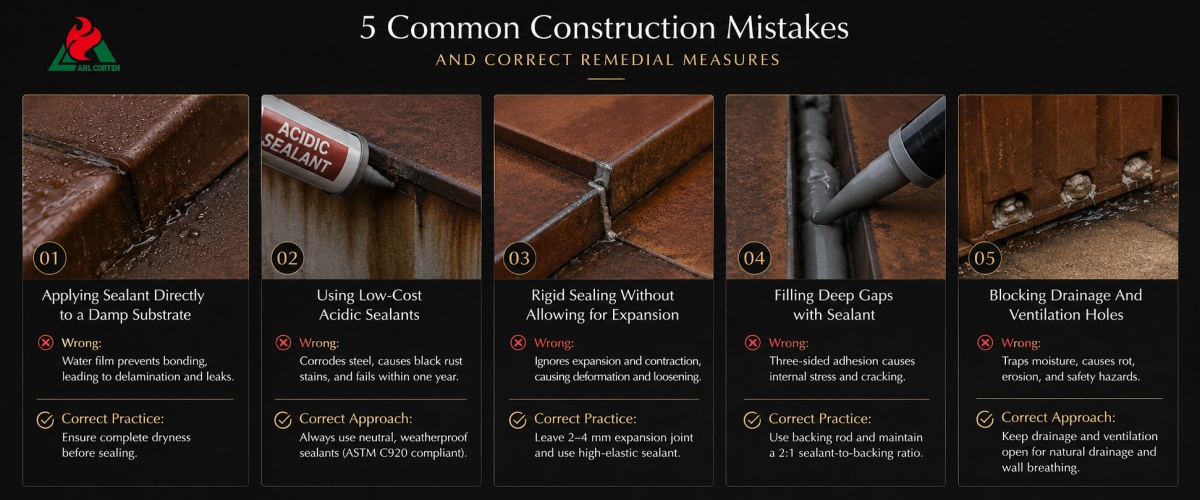
5 Common Construction Mistakes and Correct Remedial Measures
Based on extensive project reviews, 90% of subsequent plumbing leaks and rework issues stem from five common hidden construction mistakes. These seemingly minor operational errors can completely ruin an entire high-end exterior wall project.
Mistake 1: Applying Sealant Directly to a Damp Substrate
After rain or when morning fog has not yet dissipated, a water film invisible to the naked eye remains on the wall surface. This film completely prevents the sealant from bonding, leading to delamination, cracking, and leaks within a short period. Correct Procedure: Allow the surface to air dry naturally or use a fan to dry it. Only proceed with construction after confirming complete dryness by wiping the surface with a paper towel.
Misconception 2: Using Low-Cost Acidic Sealants
Acidic sealants release acetic acid during curing, which corrodes the passivation layer of weathering steel, causing permanent black rust staining on both sides of the joint. Additionally, they lack UV resistance and will degrade and fail within one year. Correct Approach: Consistently use neutral, weatherproof curtain wall sealants that comply with the ASTM C920 standard.
Misconception 3: Rigid Sealing Without Allowing for Expansion
Welding or filling gaps completely with a hard resin completely ignores the thermal expansion and contraction properties of steel. The inability to release massive stress will lead to panel deformation and loosening of the substructure. Correct Practice: Leave a 2–4 mm flexible expansion joint and use a highly elastic sealant to cushion deformation stress.
Misconception 4: Filling Deep Gaps with Sealant
Filling deep gaps completely with sealant subjects the sealant to stress on three sides. After curing, internal stress concentrates, making it highly prone to internal cracking and water penetration. Correct Practice: First insert a backing rod and strictly maintain a 2:1 sealant-to-backing ratio—the optimal construction ratio.
Misconception 5: Blocking Drainage And Ventilation Holes On the Back Panel
Blocking drainage holes on the back panel to achieve a smooth facade prevents condensation and seepage from escaping the wall interior. Over time, this causes rot and erosion of the stud structure, posing a safety hazard.
Correct Approach: Follow the principles of curtain wall ventilation to ensure that ventilation channels and drainage holes on the back panel remain fully unobstructed at all times, enabling the wall to breathe and drain naturally.
Q1: Weathering Steel Siding Is Inherently Rust-Resistant, So Why Is Precise Sealing Necessary?
Material rust resistance ≠ system waterproofing. While the panels themselves will not rust through, water infiltration through joints and cavities in the corrugated profile can corrode the internal framing and insulation layers, leading to structural hazards and blackening of the wall surface. Sealing protects the entire wall system, not just the panels themselves.
Q2: Are Corrugated Wall Panels More Prone to Leaks Than Flat Panels?
The risk is higher when installation is not done according to standards, as the three-dimensional corrugations can create capillary gaps and pathways for wind-driven water infiltration. However, when standard sealing techniques are applied, the corrugated structure can be transformed into a drainage advantage, rapidly channeling rainwater away, resulting in waterproofing performance far superior to that of ordinary flat exterior walls.
Q3: How Do I Choose a Sealant Suitable for Weathering Steel?
Prioritize neutral silicone curtain wall sealants or modified MS polyurethane sealants with a movement capacity of ≥±50% and UV resistance and aging resistance. Absolutely avoid acidic sealants and low-quality, unbranded sealants to prevent panel corrosion and premature aging and failure.
Q4: Will The Sealing Process Damage The Natural Weathered Appearance Of Weathering Steel Cladding?
No. Compatible neutral sealants are non-corrosive and only cover the fine joints. The exposed panels will continue to weather naturally, and over time, the color will blend evenly without any obvious artificial marks, leaving the overall facade texture unaffected.
Q5: Do Sealed Joints Require Regular Maintenance?
High-quality sealing systems have a service life of 15–20 years, with worry-free use guaranteed for the first 10 years. For large-scale projects, we recommend routine inspections every 5 years; after extreme typhoons or heavy rains, a simple visual inspection is sufficient. Maintenance costs are extremely low.
Ready to Choose Your Perfect Outdoor Corten Steel Siding?
The premium feel and enduring durability of weathering steel corrugated facades rely not only on the material itself, but also on the meticulous sealing process achieved through the raised corrugations. The material provides basic corrosion resistance, while professional sealing technology addresses core concerns such as water seepage, deformation, dirt accumulation, and blackening. The combination of these two elements creates a high-end curtain wall system that combines aesthetics, stability, and durability. Abandoning the haphazard approach of simply applying sealant, we match the sealing system to the specific project scenario and strictly adhere to a standardized five-step construction process, avoiding common construction pitfalls. This ensures that weathering steel facades remain clean, beautiful, leak-free, and require zero repairs for decades. For a long-lasting and stable high-end weathering steel curtain wall, choosing a professional, complete sealing solution is the most cost-effective long-term investment. Contact us now for a free design, plan and quote.




 Fill In The Inquiry