What Size Corten Steel Fire Pit Is Best for Commercial Outdoor Spaces?
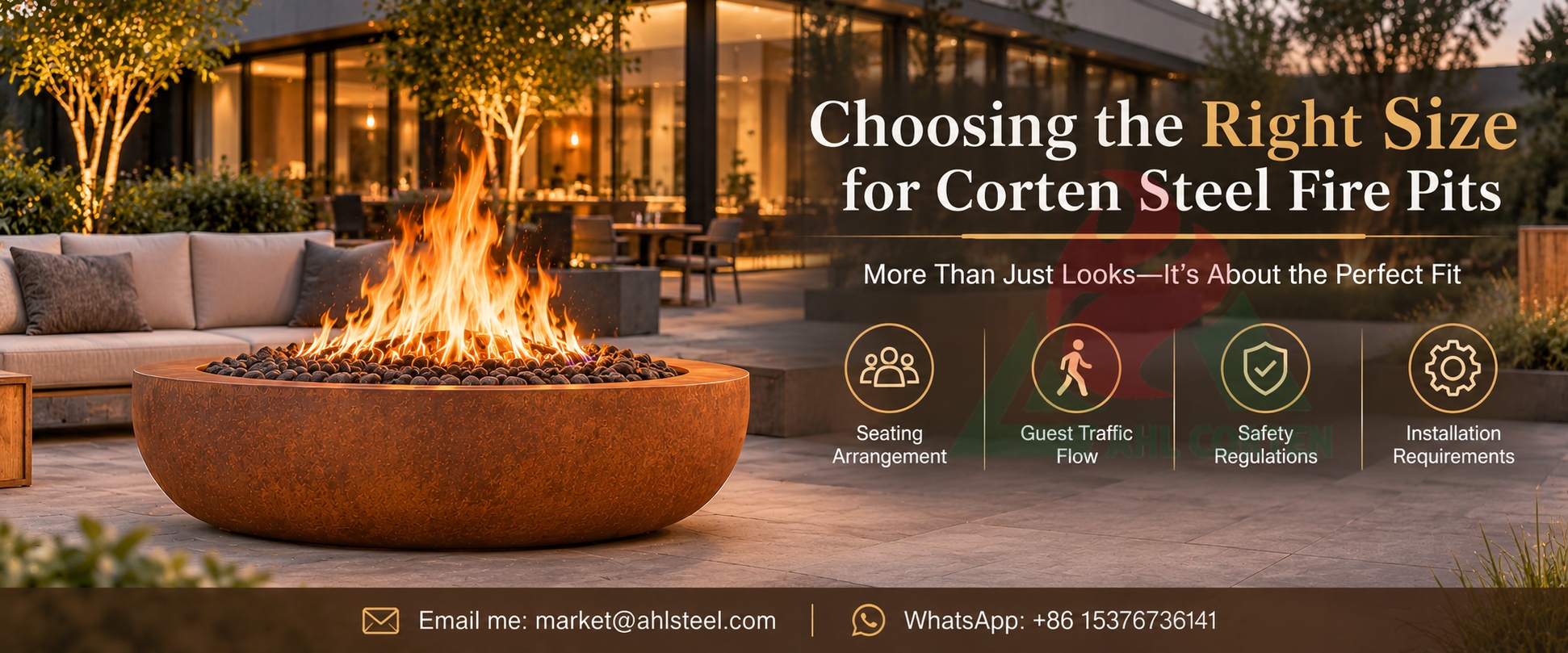
Corten steel fire pits have become popular outdoor focal points in commercial landscapes—such as hotels, restaurants, and resorts—thanks to their unique rust-colored texture. However, many buyers fall into a common trap: they focus solely on appearance and size, while neglecting how well the dimensions align with the site, foot traffic, and safety regulations.
When selecting weathering steel gas fire pits for commercial projects, size is not merely a matter of aesthetics.
The dimensions must be compatible with seating arrangements, guest traffic flow, flame effects, fuel systems, and installation conditions.
If the fire pit is too small, it won’t create enough ambiance to serve as a landscape focal point; if it’s too large, it will take up too much terrace space, block walkways, and make future maintenance more difficult.
There is no one-size-fits-all solution for every commercial venue. When purchasing, be sure to comprehensively compare the outer dimensions, actual combustion area, height, and installation requirements before finalizing a plan.
Why Do Fire Pit Dimensions Matter in a Commercial Setting?
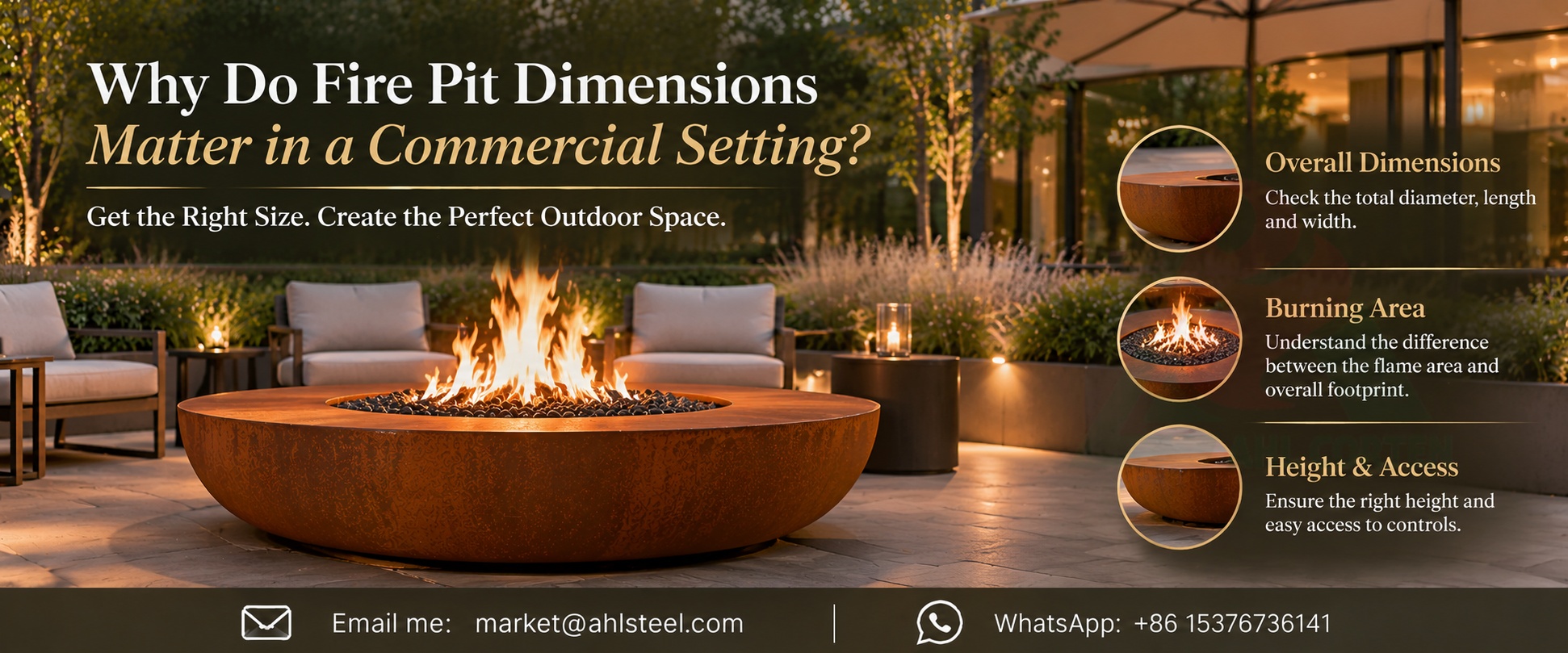
Many vendors only list the outer diameter, but structural designs vary greatly between products, so procurement decisions shouldn’t be based on a single number.
1. Overall Diameter, Length and Width
For round models, focus on the overall outer diameter; for square and rectangular models, verify the total length and width.
You need to confirm whether the listed dimensions include: the outer rim, the fire pit body, the base support structure, and any peripheral accessories.
Two fire pits with similar outer diameters may have completely different internal structures and rim widths; be sure to refer to product drawings rather than relying solely on images.
2. Burning Area vs. Overall Footprint
The burning area—the core opening where flames are generated—is not the same as the fire pit’s overall exterior dimensions.
Some fire pits have wide, thick outer rims but a small central burning opening; others have similar exterior dimensions but a larger burning area.
This is particularly critical for commercial leisure areas, as it determines the final visual flame effect and serves as a key metric for comparing quotes.
3. Height and Access to Controls
The height of the fire pit directly determines how well it complements surrounding furniture.
Low-profile models are suitable for lounge chairs, while taller models pair well with other seating arrangements.
You should also pay attention to the locations of the ignition switch, gas shut-off valve, access panel, and fuel lines to ensure sufficient operating space is reserved.
> Important Reminder: Product dimensions, installation footprint, and safety clearance distances are three separate metrics that must be verified individually.
Commercial Corten Steel Fire Pit Sizes: A Practical Comparison
The following table provides useful reference dimensions for comparing different commercial outdoor layouts.
| Fire Pit Size |
Possible Layout Direction |
Main Points to Check |
| Round, 30–42 in (762–1,067 mm) diameter |
Compact lounge areas and smaller seating groups |
Footprint, surrounding circulation and burning area |
| Round, 48–60 in (1,219–1,524 mm) diameter |
Central gathering areas and larger patios |
Furniture arrangement, rim width and equipment configuration |
| Round, 72 in (1,829 mm) diameter |
Open outdoor spaces requiring a stronger visual feature |
Installation area, handling, support and maintenance |
| Rectangular, 60–72 in long × 24 in wide (1,524–1,829 × 610 mm) |
Linear seating and sofa arrangements |
Length-to-width ratio, burner length and walkway access |
| Custom dimensions |
Projects requiring coordination with architecture or landscape features |
Drawings, burner compatibility and installation interfaces |
These are reference product dimensions, not universal commercial standards. The suitable size for a particular project depends on the complete layout, product configuration, and installation requirements.
Why Should You Compare the Complete Dimensions?
Select the size of the metal fire pit based on the seating layout and pedestrian flow.
Commercial fire pits should blend into the overall outdoor layout and must not obstruct the normal movement of guests and staff.
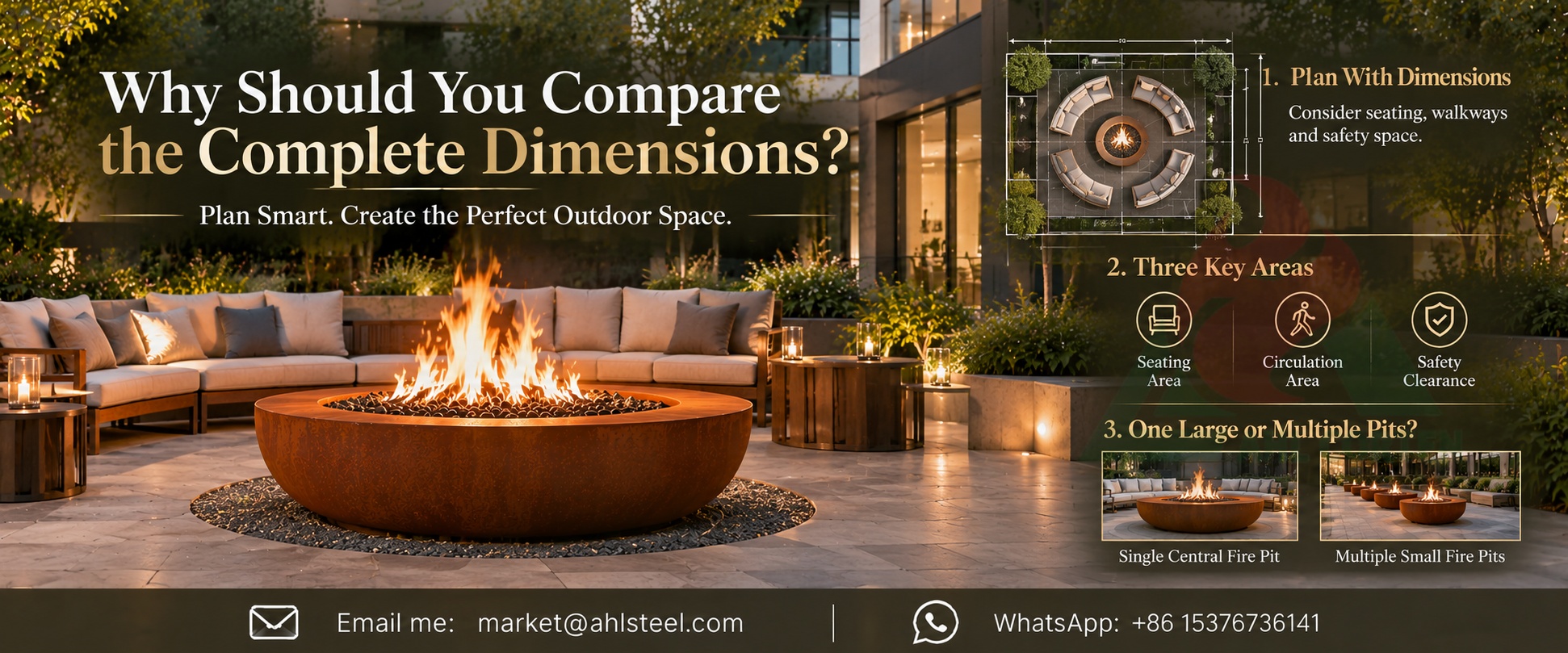
1. Prepare a Site Plan With Dimensions
Mark sofas, lounge chairs, dining tables, entrances and exits, guest walkways, planting areas, and landscape features on the plan.
Determine the fire pit placement configuration in advance: a circular layout with seating around the center, a layout with two sets of sofas flanking the fire pit, or a layout with a long bench on one side.
**The outer diameter of the fire pit cannot be used directly to estimate seating capacity**; it must be evaluated in conjunction with the overall layout.
2. Distinguish Between 3 Types of Spaces
Seating Area: The area where guests sit and use furniture.
Circulation Area: Pathways for guests and service staff to move through.
Safety Clearance Area: Isolation distances required for products, fuel systems, and site regulations.
Do not apply a one-size-fits-all safety distance; refer to the product manual and local fire codes.
3. A Single Large Fire Pit or Multiple Small Corten Steel Fire Pits?
Both options have their advantages; there is no absolute “better” or “worse.”
Single Central Fire Pit: Creates a unified visual focal point, suitable for hotel courtyards and main restaurant patios, fostering a cohesive social gathering space.
Multiple Small Fire Pits: Allows for the creation of separate leisure zones, ideal for resorts and large commercial patios, dividing large spaces into multiple intimate group areas.
When comparing options, consider the number of units, fuel lines, maintenance procedures, and consistency in product style.
The final choice should prioritize aligning with the client’s desired experience and site layout.
Which Sizes and Shapes Suit Different Commercial Outdoor Spaces?
Different commercial environments have different furniture layouts and operational requirements. The following comparisons can help narrow down the initial product selection.
| Commercial Setting |
Product Directions to Compare |
Information to Confirm |
| Restaurant patio |
Round or square fire pits with different footprints |
Service routes, furniture, installation approval and fuel type |
| Hotel courtyard |
One central focal point or multiple separate units |
Landscape plan, operation and equipment connections |
| Resort lounge area |
Round, rectangular or custom designs |
Seating arrangement, site conditions and maintenance |
| Outdoor bar |
Fire tables or rectangular models coordinated with sofas |
Entrances, guest movement and control access |
| Campsite or holiday park |
Wood-burning or approved gas models |
Local restrictions, fuel management, cleaning and installation |
Restaurant Terraces
Restaurant terraces require a balance between the guest experience and service flow.
Compact models are suitable for small corners; large, open terraces can accommodate a central, oversized fire pit.
Before selecting a model, verify the placement of dining tables, service aisles, entrances and exits, and nearby flammable materials, while also confirming that local permits and fuel types permit their use.
Hotel Courtyards and Resort Recreation Areas
Hotels and resorts often incorporate fire pits as part of their landscaping.
Round fire pits are ideal for creating a central gathering spot; rectangular models complement long sofas and architectural lines more easily.
For large areas, compare a single main landscape model with a multi-unit configuration, while also considering maintenance and operation plans.
Outdoor Bars
Prioritize styles that complement existing outdoor furniture, such as elongated fire tables.
Be sure to avoid placing fire pits near entrances and exits to ensure smooth guest flow and allow staff easy access for maintenance and control of components.
Campgrounds and Vacation Campsites
Pay close attention to local fire safety regulations, fuel storage, ash disposal, and daily supervision.
Installation requirements for wood-burning and gas-powered models vary significantly; do not apply the same layout plan to both.
Does Fuel Type Affect the Size You Should Choose?
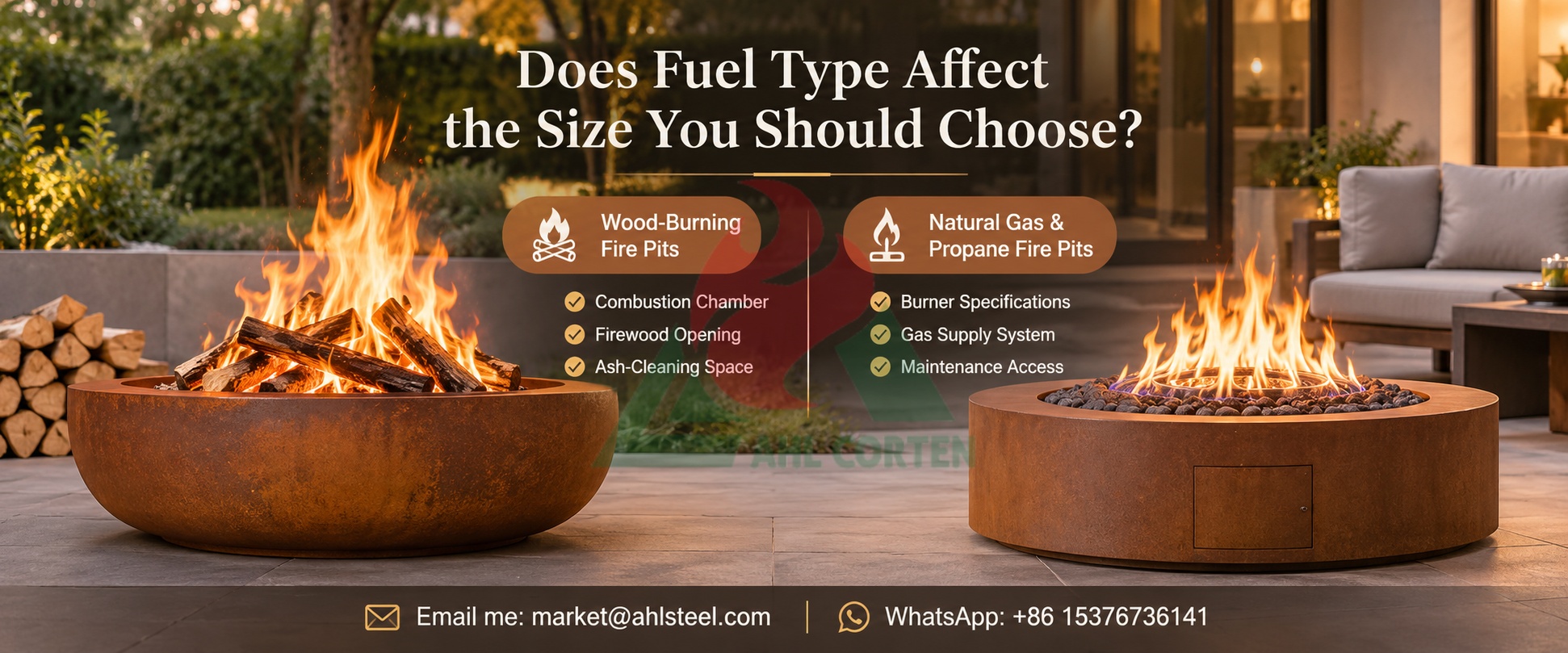
Fuel type directly impacts internal structure, support equipment, and maintenance space, making it a key variable in the selection process.
1. Wood-Burning Fire Pits
Do not focus solely on the outer casing size; instead, pay close attention to the internal dimensions of the combustion chamber, the firewood loading opening, and the ash-cleaning space.
A wide outer casing does not necessarily indicate ample combustion chamber space.
In commercial settings, you must also consider dedicated personnel management, fuel storage, and ash removal solutions.
2. Natural Gas and Propane Fire Pits
Focus on verifying burner specifications, ignition methods, gas supply systems, valves, and maintenance access.
Natural gas and propane components are not directly interchangeable; equipment configurations must match the gas source and on-site conditions.
If the outer casing is custom-sized, confirm in advance whether the structure can accommodate the selected burner.
> A common misconception: The larger the enclosure, the better the heating performance.
> Heat output is determined by the burner, the gas supply system, and the product’s structure; the heating range cannot be judged solely by the outer diameter.
> When requesting a quote, the enclosure dimensions and burner parameters must be confirmed separately.
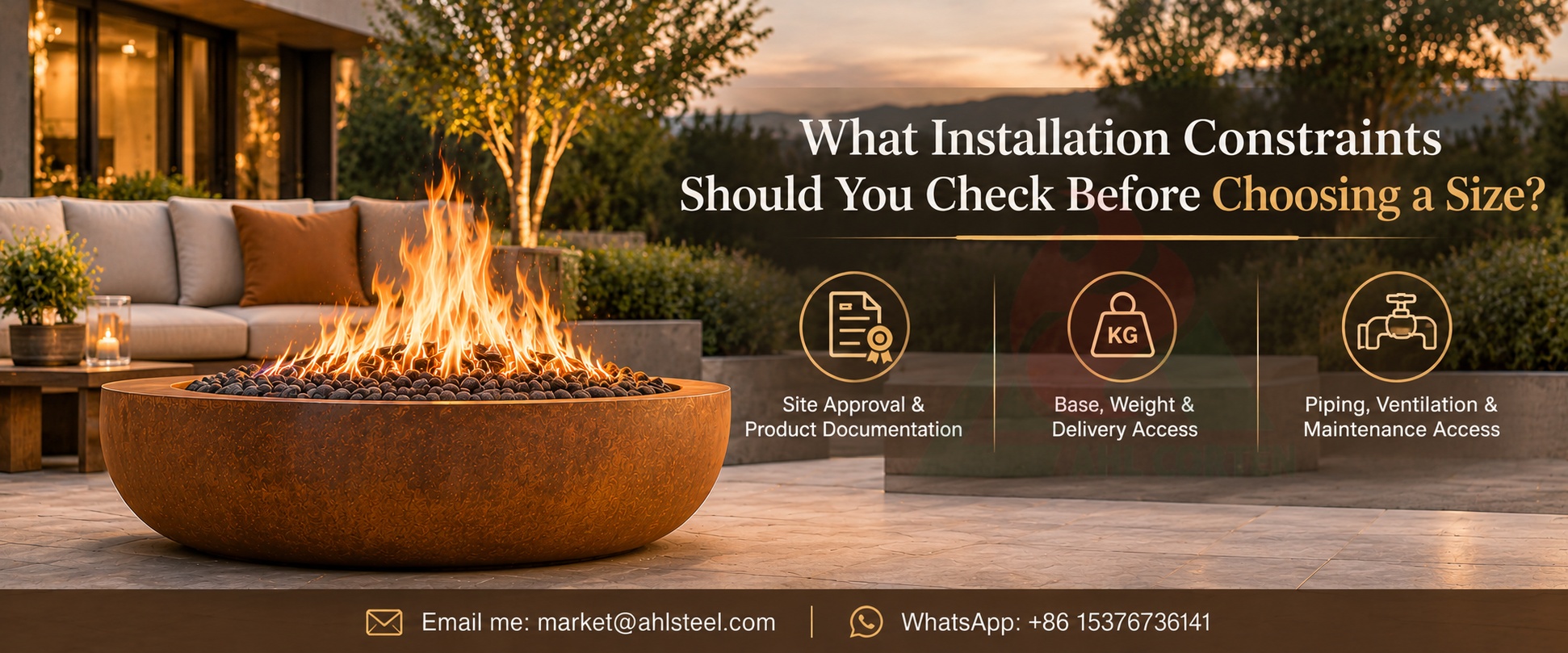
What Installation Constraints Should You Check Before Choosing a Size?
A fire pit that looks great in a photo may not necessarily be suitable for your project site.
1. Site Approval and Product Documentation
For commercial and public projects, first confirm that the selected fuel type and installation method comply with local regulations.
A “commercial-grade” appearance does not necessarily mean the product meets local fire safety and certification requirements. For public projects such as hotels and restaurants, we recommend consulting with local professionals in advance to verify approval requirements.
2. Base, Weight of Filled Equipment, and Delivery Access
For installations on patios or rooftops, a professional must assess the floor’s load-bearing capacity and verify the product’s weight along with the weight of the filled accessories.
For large fire pits, you must also verify the delivery route: gate width, turning radius, package dimensions, and unloading location.
Lifting and positioning plans for large-sized fire pits differ significantly from those for smaller models.
3. Piping, Ventilation, and Access for Maintenance
Gas models require reserved piping connections, ventilation space, and access panels.
Wood-burning models follow the instructions in their respective product manuals.
Piping specifications, ventilation requirements, and safety clearances vary by model; refer to the equipment documentation and local codes.
Does a Larger Corten Fire Pit Need Thicker Steel?
Many buyers assume that the larger the size, the thicker the steel plate must be. This is not necessarily true.
Steel plate thickness requires a comprehensive evaluation in conjunction with the overall structural design, taking into account the following factors:
Overall dimensions and shape, unsupported spans, panel reinforcement plans, the distinction between the weathering steel outer shell and internal combustion components, and long-term high-temperature operating environments.
The material requirements differ for the outer shell, combustion chamber, combustion components, and support frame.
Simply increasing the thickness of the outer shell does not guarantee that high-temperature deformation will not occur, nor does it meet all commercial installation requirements.
When requesting a quote, ask the supplier to provide a complete structural design rather than simply thicker steel plates.
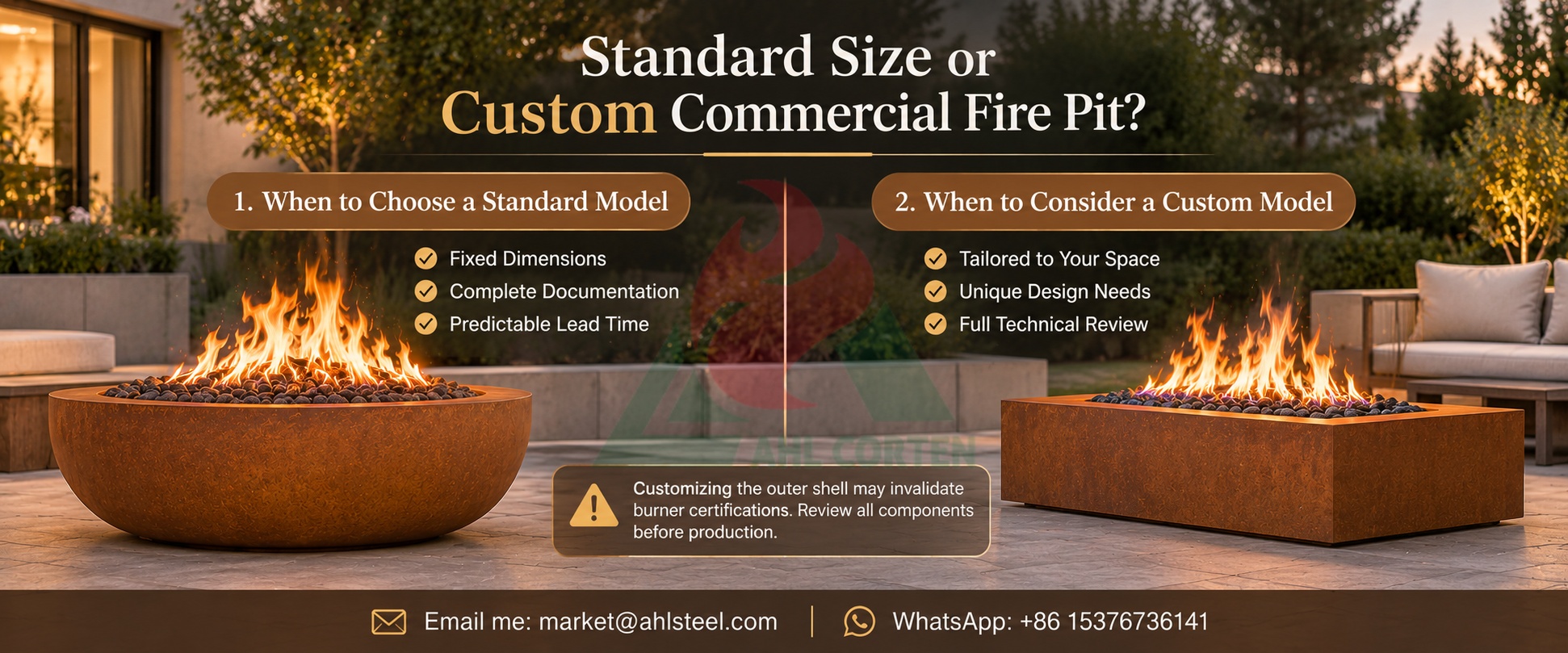
Standard Size or Custom Commercial Fire Pit?
1. When to Choose a Standard Model
Standard models feature fixed dimensions and standard equipment configurations, come with complete drawings and certification documents, allow for easy comparison of options, and offer more predictable lead times.
This is provided that the external dimensions, fuel configuration, and installation requirements perfectly match the site.
Even when selecting a standard model, be sure to request the full set of technical documentation—do not rely solely on product images.
2. When to Consider a Custom Model
If the fire pit needs to align with existing furniture, architectural features, bench seating, or unique landscape designs, the outer shell dimensions can be customized.
⚠️ Important Risk Warning: Modifying the outer shell may invalidate the original burner certifications and technical documentation.
The weathering steel shell, combustion system, control components, and installation interfaces must be reviewed simultaneously; production should not begin until everything has been confirmed to be correct.
Are You Ready to Choose a Weathering Steel Fire Pit Solution Tailored Just for You?
The right weathering steel fire pit must not only complement your outdoor landscape design but also meet the site-specific installation, safety, and maintenance requirements.
Whether for a hotel courtyard, restaurant patio, resort leisure area, or commercial landscape project, we recommend comparing the outer dimensions, combustion area, fuel configuration, and installation restrictions before finalizing your choice.
AHL can provide weathering steel fire pit selection solutions tailored to your project needs, verifying dimensions, structural design, fuel systems, and scope of supply.
Simply submit the following information to receive a customized quote: project location and intended use, site plans or actual photos, preferred dimensions and design, fuel type, purchase quantity, and delivery schedule requirements.
Planning to install a weathering steel fire pit for a hotel, restaurant, or commercial landscape project? Send us your site layout, target dimensions, fuel type, and project location to receive a personalized quote that includes fire pit styles, system options, and installation details.
FAQ
1. What Size Rusted Steel Fire Pit Is Suitable for a Restaurant Patio?
There is no universal standard. The decision requires a comprehensive assessment of available space, furniture layout, guest traffic flow, the burning area, and local installation codes. The final determination is based on a dimensioned floor plan and product technical documentation.
2. Is a 48-Inch Fire Pit Large Enough for a Hotel Lounge Area?
A 48-inch fire pit can be an option, but its suitability depends on the overall dimensions, combustion opening, furniture placement, and mandatory safety distances. Be sure to review the product drawings before placing an order.
3. Should I Choose One Large Fire Pit or Multiple Small Ones?
A single large fire pit creates a unified visual focal point; multiple small fire pits are suitable for dividing the space into separate lounge areas. When comparing options, consider piping, maintenance, and operational procedures.
4. Which Is Better Suited for Commercial Seating Areas: Round or Rectangular Fire Pits?
Round fire pits are ideal for gathering around and socializing; rectangular ones pair more easily with long sofas and linear seating. Choose based on your furniture layout and landscape style.
5. Does a Larger Fire Pit Provide More Heat?
Not necessarily. Heat output depends on the burner, fuel supply system, and product configuration. You must request the technical specifications for the specific model; do not estimate based on external dimensions alone.
6. How Much Safety Clearance Should Be Left Around a Commercial Fire Pit?
There is no standard value; it depends on the product model, fuel type, surrounding combustible materials, and local regulations. Follow the manufacturer’s instructions and local fire safety requirements.
7. Are the Layout Requirements the Same for Gas-Fired and Wood-Burning Fire Pits?
No, they are not. For gas-fired models, the focus is on piping, burners, and ventilation; for wood-burning models, planning must account for adding fuel, ash removal, and fire barriers.
8. Can Weathering Steel Fire Pits Be Custom-Sized?
Yes, they can be customized. However, once the outer shell is modified, the burner, support structure, and associated certifications must all be re-evaluated simultaneously. Production will begin only after the drawings and scope of supply have been confirmed.
9. What Documents Should Be Requested When Procuring For Commercial Projects?
External dimension drawings, structural drawings, dead weight specifications, fuel system specifications, installation instructions, and product certification documents applicable to the local jurisdiction.
Want to Create a Unique Backyard Steel Fire Pit? Contact Us!
Back


 Fill In The Inquiry