What Is the Ideal Thickness for Corten Steel Siding?
Date:2026.07.17
Share to:
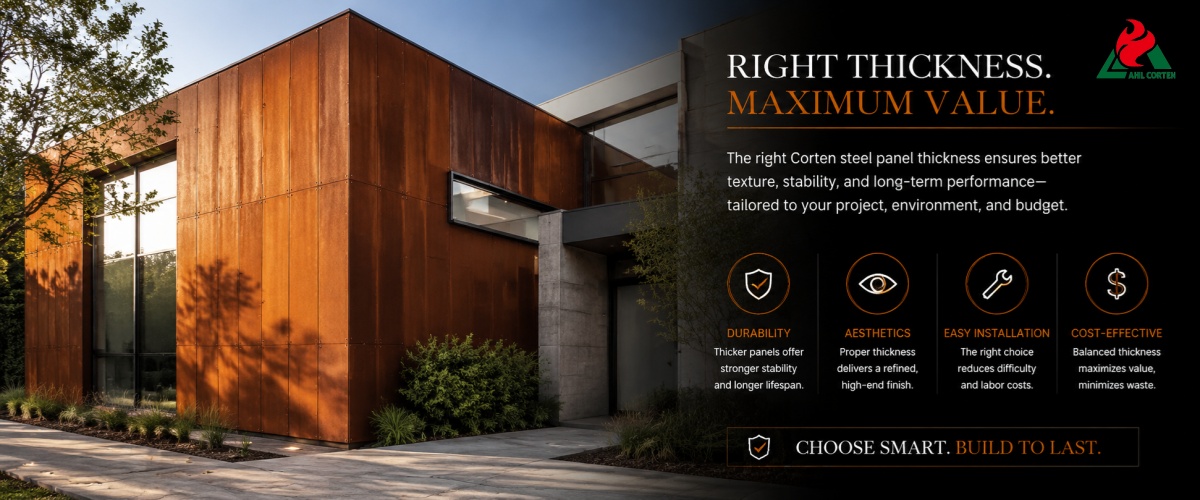
Thanks to their vintage, natural rusted texture, excellent weather resistance, and ultra-low maintenance costs,corten wall panels have become a popular choice for modern residential facades, courtyard landscaping, and commercial curtain walls. When making a purchase, many people focus solely on the type of steel while overlooking thickness—a critical parameter.
In fact, the thickness of weathering steel siding directly determines the finished product’s visual texture, structural stability, installation difficulty, and service life. Choosing the wrong thickness can result in minor issues such as panel deformation and a cheap, metallic appearance, or, in severe cases, compromise building safety and significantly increase long-term maintenance costs.
There is no one-size-fits-all “universal thickness,” nor is thicker steel always better. Only by selecting the appropriate thickness based on the project context, usage environment, and budget can the long-term value of weathering steel wall panels be maximized.
Mainstream Thickness Specifications and Basic Applications of Corten Steel Sidings
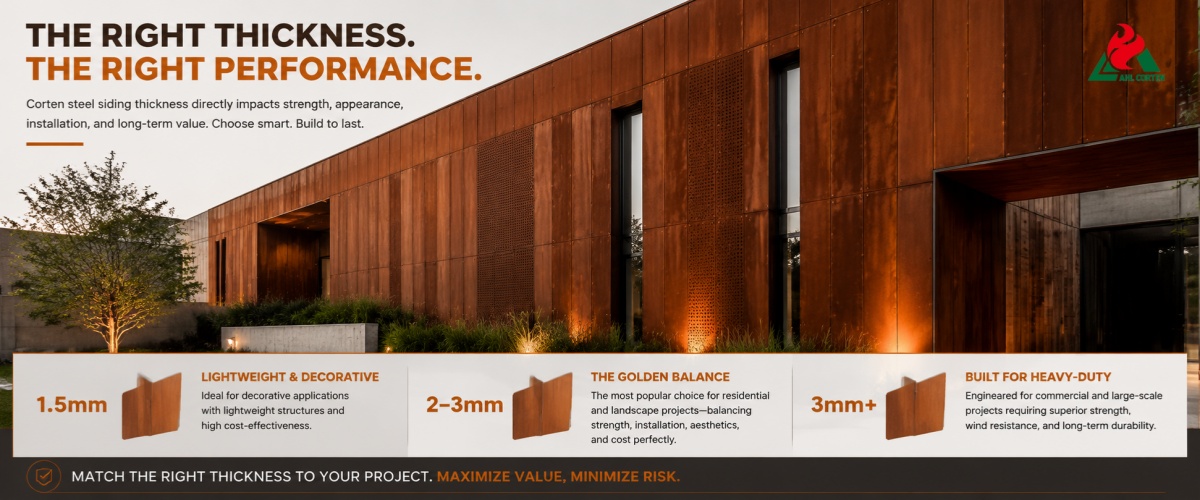
The thickness specifications for corten metal siding on the market are well-defined. Different thicknesses correspond to specific applications, suitable scenarios, and cost-effectiveness ranges, allowing for precise matching of various project requirements.
1.5 mm: Dedicated Thickness for Lightweight Decorative Applications
Focusing on lightweight construction and high cost-effectiveness, this thickness is primarily intended for purely decorative purposes and does not require high-strength structural load-bearing capacity.
2–3 mm: The Industry’s “Golden Balance” Thickness
The mainstream choice for residential and landscape projects, this thickness achieves a perfect balance between structural strength, ease of installation, aesthetic appeal, and cost, making it the most versatile specification.
3mm and Above: Thickness for Commercial Heavy-Duty Structural Applications
Designed specifically for commercial landmarks and heavy-duty landscape projects involving large spans, high wind loads, and heavy loads, this option emphasizes ultimate stability and a premium visual finish.
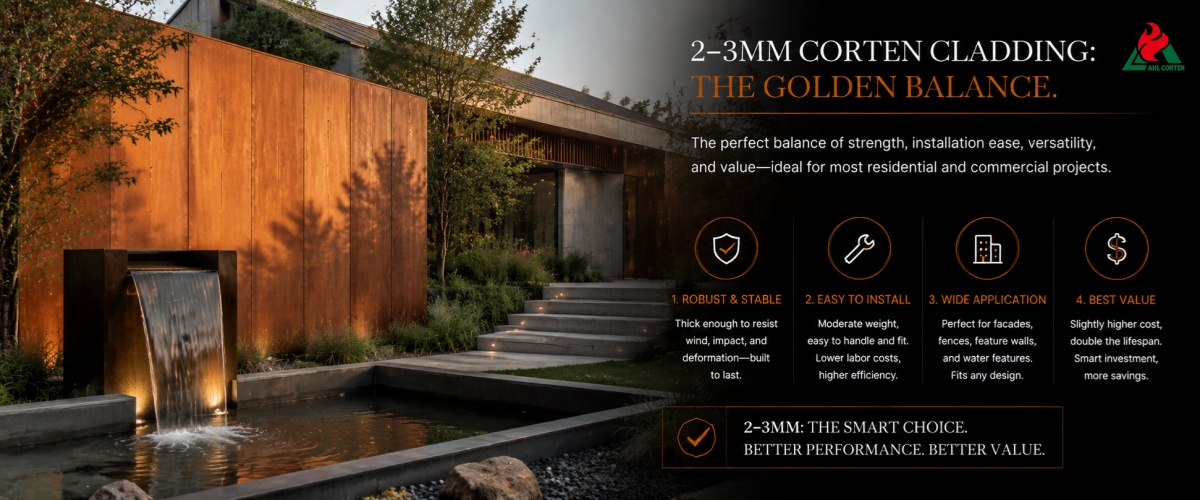
2–3mm Corten Metal Cladding: The Optimal Solution for Most Projects
For the vast majority of residential homes, garden landscapes, and small-to-medium-sized commercial projects, 2–3mm is widely recognized by the industry as the “golden balance” thickness, offering unmatched comprehensive advantages.
1. Robust Structure, Eliminating Issues of Deformation Common in Low-Cost Products
Thin corten metal panels of 1.5 mm or less are prone to “tin-plate effects”—such as bulging and warping—due to thermal expansion and contraction caused by temperature fluctuations and wind pressure during long-term outdoor use, resulting in a cheap and rough appearance.
In contrast, 2–3 mm thick wall panels offer sufficient rigidity and excellent resistance to wind pressure and impact. They can easily withstand lateral soil pressure and water pressure from water features, making them suitable for landscape walls, flower bed retaining walls, and waterfront facades, while remaining flat and distortion-free over the long term.
2. Easy Installation, Effective Control of Labor Costs
This thickness offers a moderate weight: 2mm steel sheets weigh approximately 15.7 kg per square meter, while 3mm steel sheets weigh approximately 23.5 kg per square meter. No large-scale lifting equipment is required; installation can be completed by hand or with simple tools, significantly reducing on-site construction complexity and labor costs. It is also compatible with various processes such as laser cut-out, edge folding, and on-site welding. Welding is unlikely to burn through the material, resulting in smooth and aesthetically pleasing finished seams that perfectly accommodate a wide range of custom design shapes.
3. Versatile for a Wide Range of Applications, Suitable for Home Renovation and Landscape Projects
Thicknesses of 2–3 mm are suitable for mainstream applications such as residential curtain walls, courtyard fences, landscape feature walls, and water feature facades. They can be secured using a furring strip support system without placing excessive loads on the building structure, and they complement a wide range of modern architectural and landscaping styles.
4. Exceptional Value for Money, More Cost-Effective in the Long Run
Compared to 1.5mm thin panels, 2–3mm panels incur only a slight increase in material costs, yet deliver double the service life and a more refined textural finish. Compared to heavy panels 5mm or thicker, this specification offers significant advantages in material procurement, transportation, hardware, and installation costs, making it the optimal commercial choice that balances quality and budget.
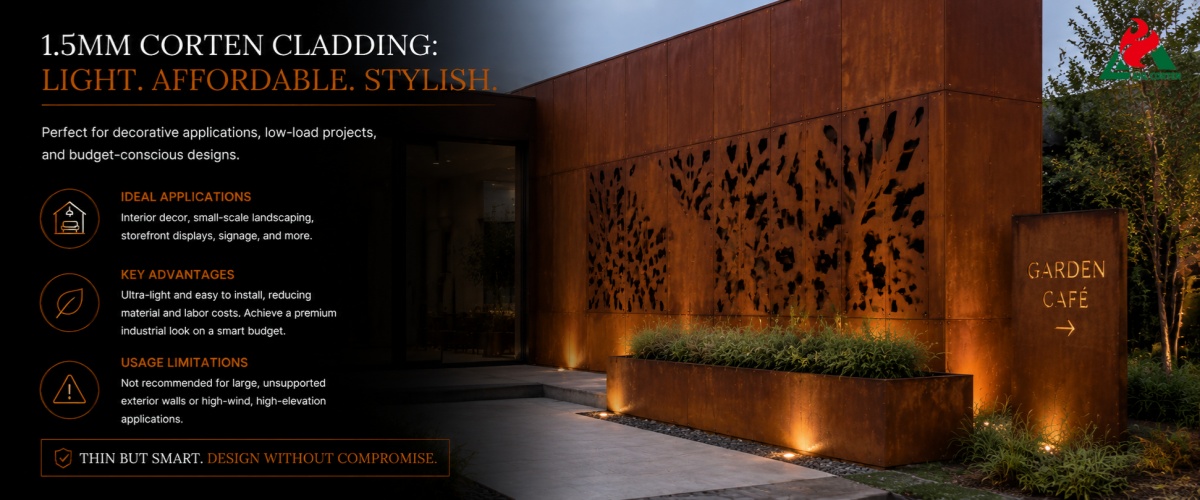
1.5mm Weathering Steel Cladding: A Lightweight, Budget-Friendly Decorative Solution
While 1.5mm-thick rusted steel sidings are not suitable for large-scale, load-bearing exterior facades, it is an excellent choice for light decorative applications, low-load scenarios, and budget-conscious projects.
Small-Scale Landscaping: Non-load-bearing elements such as edging for low flower beds, lawn borders, and small freestanding planters.
Lightweight Exterior Walls: Storefront displays, directional signage, and small exterior wall cladding with reinforced backing panels.
2. Key Advantages of Corten Metal Siding
The panels are ultra-lightweight, making transportation, handling, and installation extremely easy. They can even be secured using nail-free adhesive or lightweight self-tapping screws, resulting in a highly efficient installation. This significantly reduces material and supporting framing costs, making it possible to achieve the niche, high-end industrial look of weathering steel on a lower budget.
3. Clear Usage Limitations for Rusted Steel Siding
Strictly prohibited for use on large, unsupported exterior walls or wind-facing facades at high elevations. In open-air environments with strong winds or extreme temperature fluctuations, thin panels are prone to slight deformation, which may affect overall aesthetics and stability.
Corten Metal Panels 3mm and Thicker: The Quality Foundation for High-End Commercial Projects
When a project requires extra-large panel sizes, extreme flatness, high load-bearing capacity, and a landmark-level visual presence, thicknesses of 3mm and above (4mm, 5mm, 6mm) are the only optimal choice.
1. Ideal Applications
High-end commercial buildings: High-rise curtain walls and long-span exterior facades, suitable for harsh environments with high altitudes and high wind pressures.
Heavy-duty landscape projects: Large retaining walls, public art installations, outdoor steel staircases, and load-bearing landscape bridges.
High-end custom water features: Large water-retaining overflow walls capable of withstanding high water pressure over the long term with zero structural risks.
2. Core Advantages
The panel’s rigidity and flatness are unmatched; even extra-large single panels exhibit no localized deformation, featuring straight, crisp lines and a highly distinctive architectural texture. The panels’ thick, three-dimensional cross-sections exude a sense of industrial luxury, offering visual impact that thin panels cannot match—perfectly aligning with the quality requirements of high-end landmark projects.
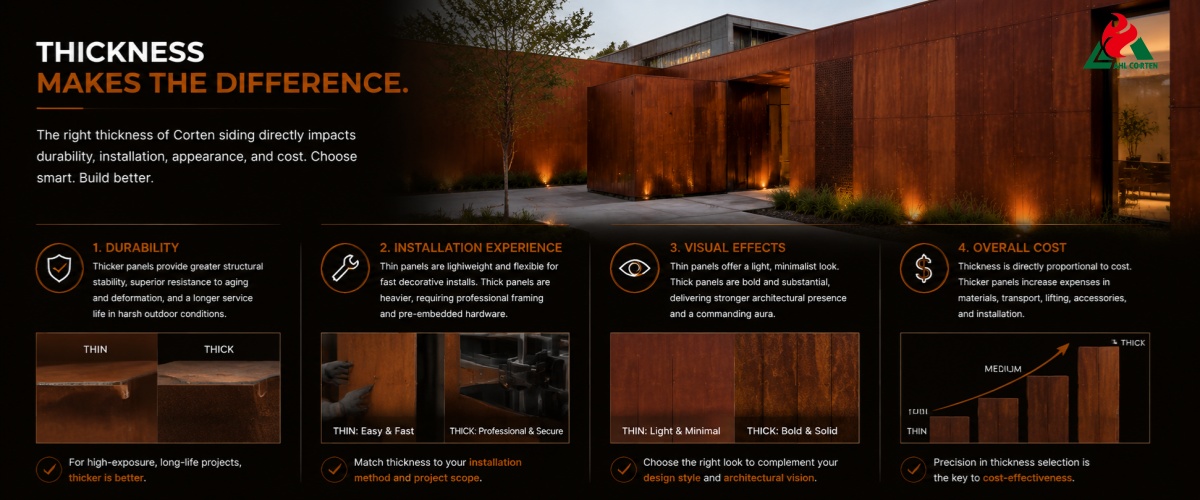
Impact of Thickness on the Four Core Performance Characteristics of Corten Sidings
1. Durability
The thicker the panel, the greater its structural stability during long-term outdoor use, and the better its resistance to aging and deformation. For projects with high exposure and long service life, thicker panels are the preferred choice.
2. Installation Experience
Thin panels are lightweight and flexible, easy to handle, and suitable for rapid decorative installation. Thick panels have greater dead weight and require specialized framing and pre-embedded mounting hardware, making them better suited for standardized, professional installation.
3. Visual Effects of Corten Metal Cladding
Thin panels have a light, minimalist texture and complement soft, lightweight design styles. Thick panels are three-dimensional and substantial, offering a stronger architectural presence and a commanding aura, making them ideal for rugged industrial styles and high-end minimalist architecture.
4. Overall Cost of Corten Cladding
Thickness is directly proportional to cost; the thicker the panels, the higher the costs for materials, transportation, hoisting, accessories, and installation. Blindly increasing thickness will only lead to budget waste; precise selection is the key to cost-effectiveness.
Quickly Select the Right Thickness Based on Project Scenarios (Practical Guide)
No need to rely on experience for blind selection—match the thickness to the specific scenario for precise, error-free results. Residential Exterior Walls (Villas, Custom-Built Homes): Prioritize 2 mm; use 3 mm locally for wind-exposed areas, waterfront sections, and load-bearing joints to balance safety, aesthetics, and budget. Garden Landscaping and Small-Scale Features: Choose 1.5–2 mm for decorative elements; select 3 mm for load-bearing components such as retaining walls and water feature bases. Commercial Corten Metal Panels and Public Buildings: For large-area, high-altitude facades and areas subject to high wind pressure, uniformly select a thickness of 3 mm or greater. Highly Exposed and Harsh Environments: In coastal areas, open highlands, and regions with strong winds, prioritize thicker options to mitigate the risk of long-term deformation.
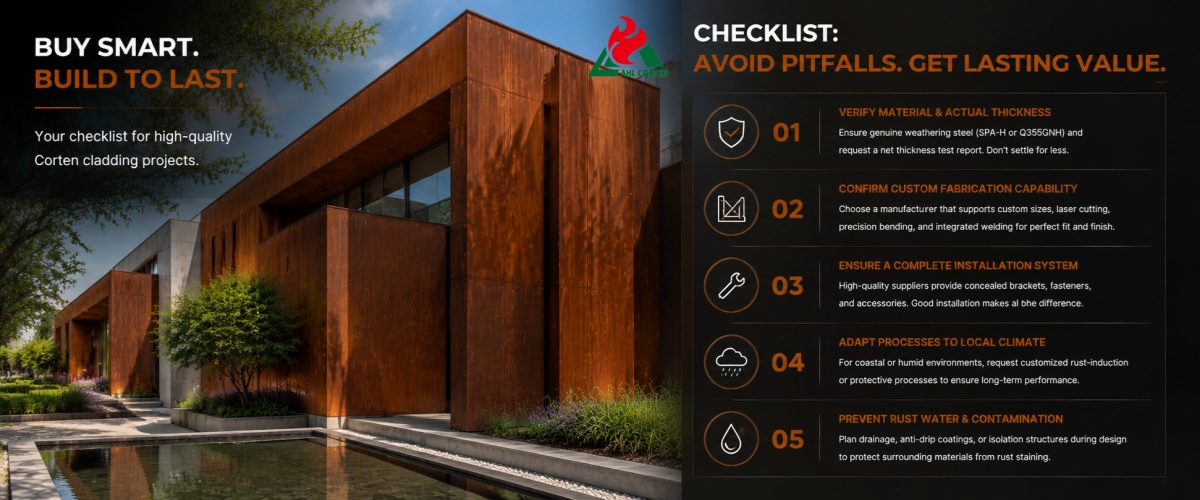
Checklist for Avoiding Pitfalls When Purchasing Corten Cladding
1. Verify Material and Actual Thickness
The market is rife with issues such as ordinary steel sheets with rust-effect paint being passed off as weathering steel, and falsely labelled thicknesses. When purchasing, confirm that the material meets the SPA-H or Q355GNH standard for weathering steel, and request a net thickness test report to prevent substandard workmanship.
2. Confirm the Manufacturer’s Custom Fabrication Capabilities
Landscape and architectural projects often involve non-standard dimensions, and on-site cutting can compromise the integrity of the sheet edges. Prioritize manufacturers that support custom fabrication based on drawings, laser cutting, precise edge folding, and integrated welding. This allows for direct on-site assembly of finished products, resulting in higher efficiency and better quality.
3. Ensure a Complete Installation System
In weathering steel projects, “30% depends on materials, 70% on installation.” Purchasing bare sheets alone can lead to issues such as detachment and deformation. High-quality suppliers provide specialized concealed brackets, fasteners, and welding accessories to ensure installation stability.
4. Adapting Processes to Local Climate Conditions
In coastal environments with high salt fog and humidity, weathering steel struggles to form a dense protective layer, which can accelerate corrosion. It is necessary to customize specialized rust-induction or protective processes in advance to adapt to local climatic conditions.
5. Preemptively Prevent Rust Water Leakage and Contamination
During the first 1–2 years of the rusting period, weathering steel produces rust water, which can easily contaminate surrounding building materials such as white stone, light-colored wall tiles, and glass. During the design phase, drainage channels, anti-drip coatings, or isolation structures must be incorporated to eliminate the risk of contamination.
1. What Thickness of Corten Steel Wall Panels Offers the Best Durability?
For standard residential and small-to-medium-sized commercial exterior walls, 2–3 mm thickness provides optimal durability. The core durability advantage of weathering steel comes from its dense rust layer, not simply its thickness. This specification ensures a stable service life of over 50 years, matching the building’s overall lifespan. Increasing the thickness further offers minimal improvement in lifespan while only adding unnecessary costs and structural loads.
2. Are 2mm Weathering Steel Wall Panels Prone to Warping?
Not at all, provided they are manufactured using proper techniques. 2mm panels possess sufficient rigidity; as long as they are properly reinforced with folded edges during fabrication and the stud spacing is maintained within the standard range of 600–800mm, they will not develop a wavy deformation even during strong winds or heavy rain, ensuring stable and long-lasting flatness.
3. Is It More Difficult to Install Panels Thicker Than 3 mm?
Thicker panels have greater dead weight and cannot be secured using standard nail-free methods. However, when paired with modular pre-embedded or concealed back-anchor suspension systems, the installation process becomes standardized and highly efficient, with precision and safety far exceeding those of thin-panel installation methods.
4. Does the Thickness of The Steel Panels Affect the Color or Speed of Rusting?
Not at all. The rusting effect and rate of color change in weathering steel are determined by the steel’s alloy composition (the ratio of copper, chromium, and nickel) and the local climate conditions—whether dry or humid—and are unrelated to panel thickness. Under the same installation process and environmental conditions, the final rust color and texture of thick and thin panels will be identical.
5. What Is the Most Suitable Thickness for the Exterior Walls of a Custom-Built Villa?
For large main wall surfaces, 2 mm is the preferred choice as it offers the best value for money. For areas such as water-facing base, stair risers, retaining walls, and corners prone to impact or high wind pressure, we recommend upgrading to 3 mm to ensure an adequate safety margin.
Choosing the Right Thickness to Unlock the True Long-Term Value of Weathering Steel
The unique appeal of weathering steel lies in its natural texture that matures over time and its long-lasting quality that requires minimal maintenance. However, even the finest material requires the right thickness to perform optimally. 1.5 mm is suitable for lightweight decorative applications; 2–3 mm is suitable for the vast majority of residential and landscape projects; and 3 mm or thicker is suitable for high-end commercial projects with heavy loads. By dispelling the misconception that “thicker is better” and selecting the appropriate thickness based on specific needs, you can strike the right balance between aesthetics, safety, and budget. Only when the thickness is precisely matched to the installation system can weathering steel wall panels withstand decades of wind and rain while maintaining their smooth texture and architectural presence, serving as a long-lasting, high-quality element in both architecture and landscaping.

 Fill In The Inquiry