Large Round Corten Steel Planters: Sizes and Buying Guide
Large round corten steel planters are a popular landscaping feature in modern gardens, hotel entrances, commercial atriums, and landscape projects. With their warm, natural rust-colored texture, they create a soft, sophisticated contrast when paired with outdoor materials such as greenery, paving, gravel, and natural wood.
However, when selecting a large planter, appearance alone isn’t enough. How do you choose between diameters of 800 mm, 1,000 mm, or 1,500 mm? Which is more suitable—a low, bowl-shaped design or a tall, cylindrical one? If you want to plant a tree, does a larger diameter automatically mean it will be sufficient?
Making the right choice requires a comprehensive evaluation of external dimensions, internal planting space, planter structure, drainage design, and installation conditions. This article compiles reference guidelines for mainstream sizes and key purchasing considerations to help residential and commercial landscaping projects select the most suitable large round rusted steel planters.
What Qualifies as a Large Round Corten Steel Planter?
“Large” is merely a product description—it is not a standardized industry specification. Different manufacturers use varying classification criteria: some vendors classify planters with a diameter of 800 mm as “large,” while others only consider models 1,200 mm or larger to be large planters.
When purchasing, don’t just say, “I want a large round planter.” Be sure to specify the actual dimensions in millimeters:
· Outer diameter
· Overall height
· Inner diameter at the top
· Bottom structure type
· Required effective planting depth
Round weathering steel planters also come in a variety of shapes, including cylindrical, shallow bowl-shaped, and tapered (wider at the top and narrower at the bottom). The visual impact varies significantly between these shapes, and the usable planting space inside also differs.
Outer Diameter vs. Usable Planting Space
Many buyers fall into a common trap: judging the internal planting space solely based on the outer diameter. The usable planting area inside the rusty metal planter is typically smaller than the externally specified dimensions. Factors affecting this include:
· Steel plate wall thickness
· Rolled or folded edge construction
· Internal lining
· Bottom structure
· Built-in support components
The total height of the planter is also not equivalent to the effective planting depth. Some round planters may appear very tall from the outside, but the internal base and lining take up a portion of the space, resulting in a very shallow planting depth.
When using these containers for planting trees, never rely solely on the outer diameter. You must also evaluate the size of the root ball, the space available for root growth, the planting depth, and future maintenance requirements.
Before placing an order, request dimensioned drawings from the manufacturer to clarify the outer diameter, inner top diameter, total height, and effective planting depth.
Large Round Corten Steel Planter Sizes at a Glance
The following are the mainstream reference specifications available on the market. These specifications are provided solely as a starting point for selection discussions; they are not universal standards, nor do they imply that all specifications are in stock.
| Specification (Diameter × Height) |
Suitable Applications |
Key Items to Confirm Before Purchase |
| Ø800 × 400 mm |
Low floral arrangements and herb-combination landscaping |
Planting depth, opening size and drainage structure |
| Ø1000 × 500 mm |
Courtyard focal features and mixed planting beds |
Internal space, soil-fill weight and load capacity of the installation base |
| Ø1200 × 600 mm |
Large planting beds and medium-sized shrub planting |
Root-ball size, planter structure and on-site lifting conditions |
| Ø1500 × 400 mm |
Low landscape forms and bottomless tree surrounds |
Bottom structure and ground-base conditions |
| Ø1500 × 600 mm |
Large commercial landscapes and tree planting after professional assessment |
Root requirements, effective planting depth and fully loaded total weight |
| Custom diameter and height |
Special layouts and complete landscape projects |
Fabrication drawings, production lead time and transportation restrictions |
Even with the same diameter but different heights, their uses can vary greatly. For example, a shallow planter with a diameter of 1,500 mm and a height of 400 mm, and a deep planter with a height of 600 mm, are suitable for completely different plants. First, determine the diameter and height, then check the internal space and structure.
How Do You Choose the Right Planter Diameter and Height?
1. Start with the Available Footprint
Before selecting dimensions, measure the installation site on-site. Large round planters can take up more space than expected, and when placed next to entrances, walkways, or recreational areas, they can easily encroach on passageways.
You’ll need to record the following information:
· Available floor space
· Safe distance from walls and buildings
· Pedestrian pathways and circulation areas
· Locations of doors, steps, and outdoor seating
· Space reserved for future maintenance
For commercial projects, we recommend marking the outline on blueprints or laying out lines directly on the ground to visually compare the effects of different sizes before placing an order.
2. Match the Proportions to the Landscape Design
The height-to-width ratio directly determines the visual impact. Wide and low designs: Expansive horizontally, suitable for ornamental grasses and mixed flower beds; close to the ground, creating a low-key and soft appearance. Tall cylindrical designs: Strong vertical lines, suitable for framing views, entrance focal points, and along pathways; offering a more striking visual impact.
Multi-Container Arrangements: Combine round planters of different diameters to create a sense of rhythmic variation. Using a uniform weathering steel material helps maintain stylistic consistency across dispersed landscape areas.
3. Check Plant Requirements Before Finalizing the Size
The plants you intend to grow is the key factor in selecting the right size. Flowers, shrubs, and trees differ significantly in root system size, required soil depth, and watering and maintenance needs.
Confirm the following before selecting a planter:
· Plant species and mature spread
· Root ball size
· Required soil depth
· Drainage and irrigation solutions
· Long-term maintenance plan
When planting trees, it is recommended to consult a landscape or horticultural professional to assess the root system. No matter how large the outer diameter, if the effective depth is insufficient, it will not support the tree’s long-term healthy growth.
Corten Steel Planters: Should You Choose a Model with a Base or a Tree Ring Without a Base?
This is a crucial decision in the procurement process. While the two look similar, their installation methods are completely different.
| Comparison Factor |
Planter Box with Bottom |
Bottomless Tree Ring |
| Core Use |
Independent, enclosed planting container |
Defines the planting area and connects to the native soil layer |
| Structure |
Side walls plus a bottom panel |
Circular side walls only, with no bottom panel |
| Planting Space |
Limited by the internal dimensions of the planter |
Roots can extend downward into the existing soil |
| Installation Requirements |
Requires a level support surface and a drainage system |
Requires preparation of the existing soil and ground drainage |
| Key Items to Check |
Drainage holes, support feet and inner liner |
Soil conditions, fixing method and underground drainage |
When to Choose a Planter with a Base
Suitable for patios, paved courtyards, hard surfaces and similar settings, where it is used as a freestanding container. Before placing your order, confirm the following: whether drainage holes are provided, the location of the drainage outlet, whether support feet are included, and whether a liner is needed.
When to Choose a Bottomless Planter
Most commonly used in landscaping projects, these outdoor steel planters serve solely as edging and do not isolate the soil beneath. They cannot be placed directly on paved surfaces and must be used with certified native potting soil.
If you’re unsure which type to choose, send the installation surface and planting plan to the manufacturer to help determine the appropriate style.
What Steel Thickness and Construction Should You Look for?
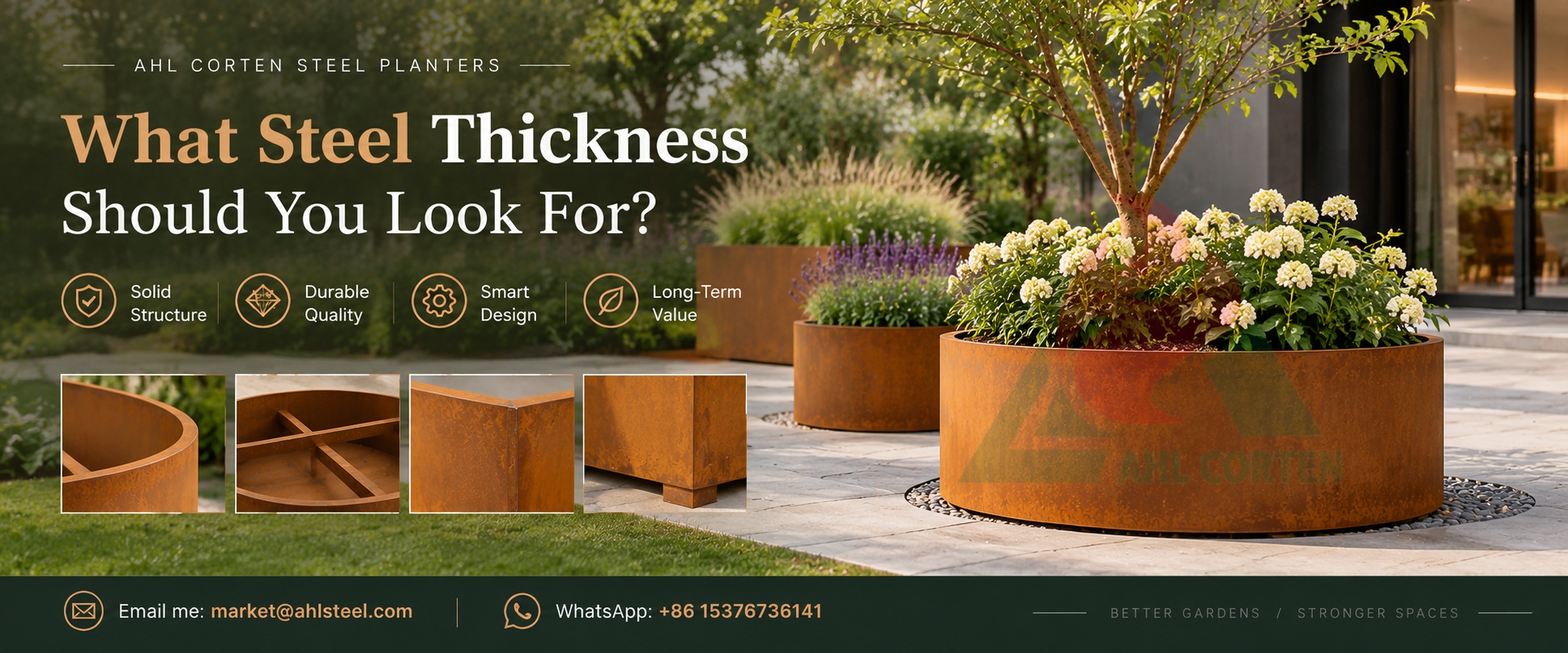
For large round planters, structural design is just as important as dimensions. The stability of the planter is determined by a combination of wall thickness, diameter, height, internal reinforcement, and soil load.
Do not compare sidewall thickness in isolation; for a complete structural assessment, verify the following:
· Sidewall sheet thickness
· Bottom plate thickness (for models with a bottom)
· Internal reinforcing ribs and support structures
· Top edge rolling/folding process
· Welding process for connecting sidewalls to the bottom plate
· Support footers and drainage layout
Once filled with soil, water, and plants, the overall load is very high; the planter’s structure and the installation surface’s load-bearing capacity must be evaluated together.
Pay close attention to the top edges, welds, and bottom details:
· Whether the top edge is folded, rolled, or left straight
· Whether the side walls are rolled into a continuous curve or welded in sections
· Whether the welds are neat and aesthetically pleasing
· The connection method between the bottom panel and side walls
· Whether the drainage holes are integrated into the design
For large-sized products, prioritize requesting structural drawings for the specific model; do not rely solely on renderings.
There is no single universal wall thickness that fits all styles. Shallow, low-profile planters; tall, cylindrical planters; models with bottoms; and bottomless tree rings all experience different stress patterns and require different sheet metal specifications. When comparing prices, evaluate the entire structural assembly; do not simply assume that thicker walls are always better.
Why Does Corten Steel Planter Drainage and Ground Clearance Matter?
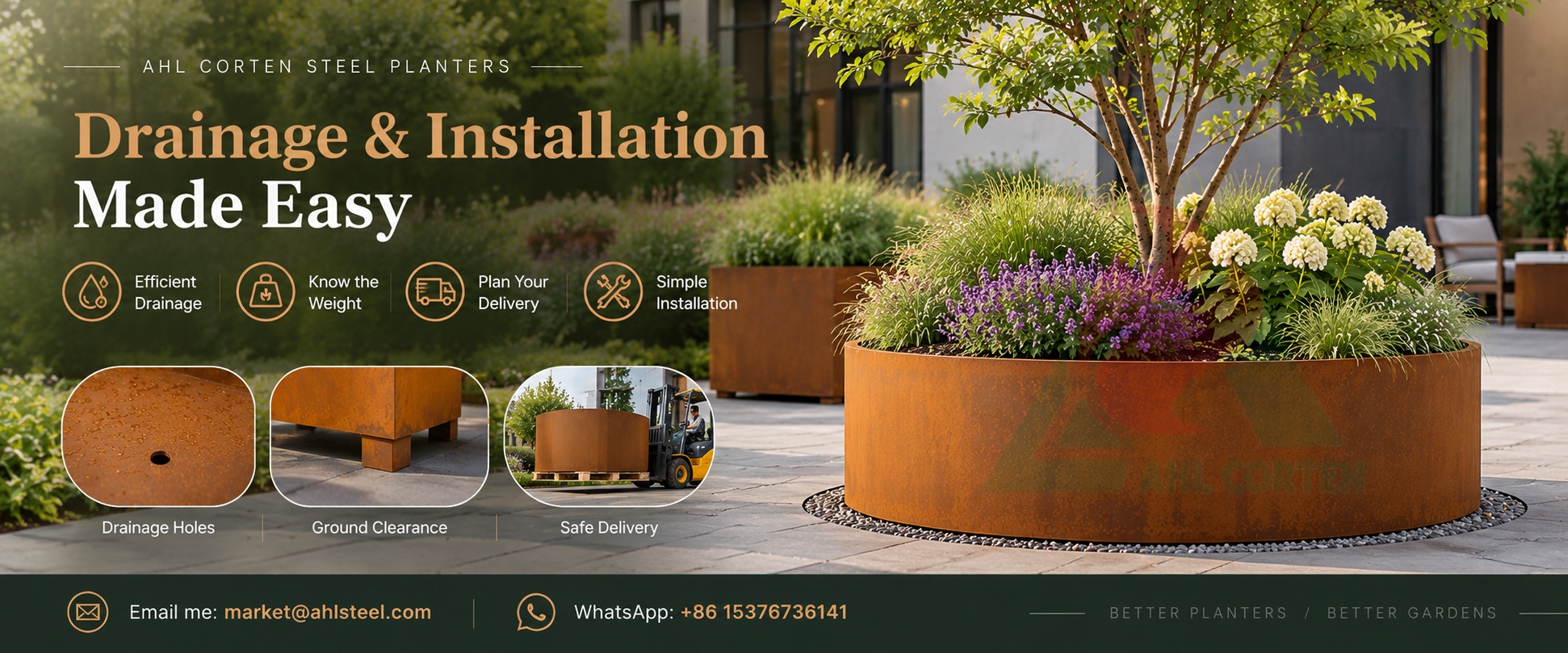
Drainage is fundamental to outdoor gardening. Waterlogged roots not only affect plant survival but also accelerate localized corrosion of the steel garden pot.
For models with a base, drainage involves more than just drilling a few drainage holes. You must also confirm that the drainage path is unobstructed:
· Number and location of drainage holes
· Whether the inner liner blocks the drainage outlets
· Whether the support legs provide sufficient clearance from the ground
· Whether the paved surface blocks drainage
· Where excess rainwater is directed
Even if drainage holes are present, water will still pool if the outlets are blocked or the ground is completely impermeable.
Distinguish Between Standard Planting Baskets and Water-Storage Structures: Standard planting boxes and water-storage self-watering containers are two distinct systems. Do not block the drainage holes on standard models yourself; if your project requires water storage or automatic irrigation, order a custom model designed for that purpose—do not modify standard containers.
What Should You Know About Corten Steel Planter Weight, Delivery, and Installation?
Logistics and on-site installation challenges are often overlooked with large planting boxes. Just because the dimensions fit on the blueprints doesn’t mean they can be transported smoothly to their intended locations.
Distinguish between two types of weight: the empty container’s weight and the fully loaded weight after filling with soil and planting. When soil, plants, and standing water are added, the total weight will be significantly greater than that of the empty container. When placing them on rooftops, balconies, elevated platforms, or similar locations, structural load-bearing capacity must be verified by professionals; do not rely on experience with ground-level placement.
Verify transportation routes before production: door openings, hallway widths, turning spaces, elevator dimensions, load limits, unloading points, and lifting equipment. The outer dimensions of the packaging will also exceed the product’s actual dimensions.
For some oversized specifications, a modular, separable design can be used to address delivery challenges. However, not all round planters support this approach, so the following must be confirmed in advance: whether separable production is supported, the assembly method, on-site assembly difficulty, the appearance of the seams, structural strength, and accompanying installation instructions. Plan the transportation logistics in advance to avoid situations where the product cannot be delivered after production is complete.
Standard vs. Custom Round Weathering Steel Planters
Standard, in-stock models are ideal when the dimensions and structure perfectly match your project, offering faster delivery. Custom models are suitable for unique landscape designs and specific planting requirements.
| Project Requirement |
Solution Selection |
Key Focus Points |
| Standard layout |
Standard-size planter boxes |
Dimensions, bottom structure and delivery format |
| Distinctive entrance focal feature |
Custom diameter and height |
Drawings and effective planting depth |
| Coordinated multi-pot arrangement |
Custom sizes within the same series |
Proportional consistency and matching rust-color effect |
| Tree planting or special plants |
Project-specific structure |
Root-ball support, drainage and maintenance space |
| Narrow site-access route |
Split-section structure |
Packaging, lifting and joining workmanship |
For custom projects, please provide dimension drawings and specify the intended use. The manufacturer will evaluate the manufacturing process, structure, and delivery time before providing a quote.
Factors Affecting the Price of Large Round Weathering Steel Planters
The price is not determined solely by diameter; it is influenced by a combination of factors, including:
1. Diameter and Height: Larger dimensions require more material and make the rolling process more difficult.
2. Sheet Thickness and Structure: Side walls, base plates, and reinforcing components all affect the cost.
3. Forming and Processing Techniques: Rolling, welding, edge grinding, and surface treatment
4. Drainage and Accessories: Drainage holes, support feet, liners, and other accessories are priced separately
5. Surface Finish: Different surface treatments, such as natural pre-rusting and fixed rust treatment
6. Order Quantity, Packaging, Shipping, and Unloading Plans
When comparing quotes from multiple suppliers, ensure that specifications are standardized—including diameter, base type, sheet metal specifications, and scope of delivery—to guarantee a fair comparison.
How to Submit Information to Obtain an Accurate Quote
Selecting large circular round custom corten planters requires balancing aesthetics, plant requirements, planter structure, and installation conditions. AHL can provide solution evaluations based on project dimensions, structure, and usage scenarios; product availability, customization capabilities, and technical details must be confirmed on a per-order basis.
If you are looking for large round weathering steel planters, please send us your selected diameter, height, planting requirements, and purchase quantity to receive a customized quote that includes weathered steel planter structure, drainage solutions, and shipping arrangements.
FAQ
1. What Size Qualifies as a Large Round Weathering Steel Planter?
There is no uniform standard, but diameters of 800 mm, 1,000 mm, 1,200 mm, and 1,500 mm are commonly classified as large. Be sure to specify both the diameter and height when placing an order.
2. How Do I Choose the Right Diameter and Height?
First, confirm the available space; then consider the landscape proportions; finally, match the plant’s requirements. Focus on the internal opening and effective planting depth—don’t just look at the outer diameter.
3. Are Large Round Weathered Steel Planters Suitable for Growing Trees?
Yes, but you’ll need to ensure that the tree species, root ball, and root growth space are compatible. Before final installation, we recommend consulting a landscape horticulture professional for an assessment.
4. Should You Choose a Tree Ring With a Base or Without a Base?
Use freestanding pots with bases on hard surfaces or patios; for landscaping that connects directly to native soil, choose a tree ring without a base. Note that the base-less version cannot be placed on paved surfaces.
5. How Thick Should the Steel Plate Be?
Thickness depends on the diameter, height, bottom structure, and intended use. The manufacturer must provide a complete set of structural parameters; wall thickness cannot be specified in isolation.
6. Do Large Planters Require Drainage Holes?
The vast majority of planters require drainage holes to prevent waterlogging and root rot. It is also essential to ensure that drained water flows away smoothly and does not pool at the bottom of the planter.
7. Can Special Diameters Be Customized?
Customization is supported within the manufacturer’s production capabilities. Production can proceed after providing dimensional drawings and an assessment of the intended use.
8. Can Extra-Large Planters Be Shipped In Separate Parts?
Some models support a modular design, but not all round planters are suitable. It is necessary to confirm the assembly process, appearance, and structural strength in advance.
Back
 Fill In The Inquiry