How to Prevent Corten Steel Screens From Leaning in Strong Winds?
Corten steel screens, with their unique rusted finish, have become a popular choice for privacy and landscaping in gardens and commercial settings. However, many completed projects face the same challenge: during high winds, the screens sway and tilt, posing a safety hazard.
Weathering steel is simply a type of steel; it does not inherently possess wind-resistant properties. The stability of metal privacy screens relies on a complete load-bearing system: panels → posts → connectors → foundation.
Whether it’s a DIY installation in a private yard or a large-scale landscape project, ensuring the screen’s stability requires designing the entire structural system from the ground up.

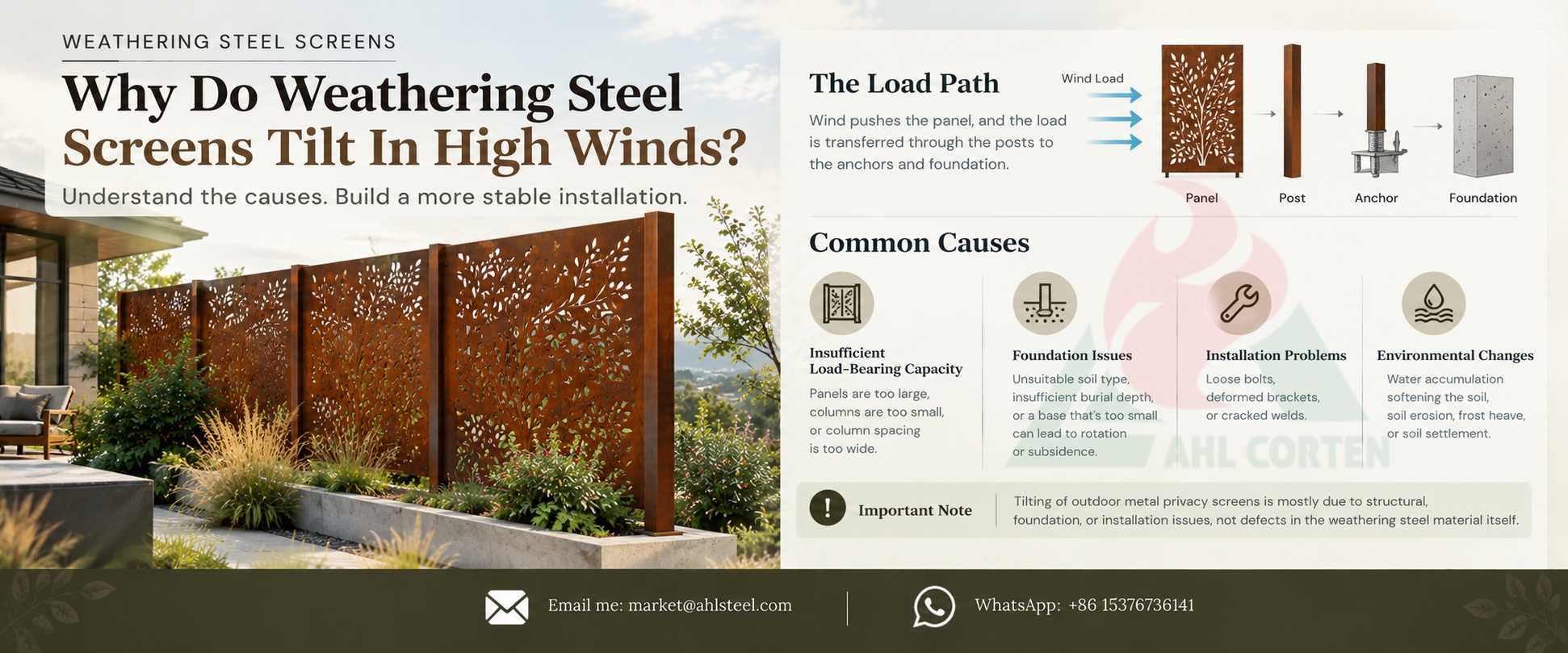
Why Do Weathering Steel Screens Tilt In High Winds?
Wind exerts a lateral thrust on the rusted steel screen panels. The load is transmitted along the panels and fasteners to the posts, and then transferred to the anchors and the foundation. If any single point in this load-bearing chain is weak, it can cause the screen to tilt.
Common causes fall into four categories:
- Panels are too large, column cross-sections are too small, or column spacing is too wide, resulting in insufficient load-bearing capacity;
- The foundation is unsuitable for the soil type, the burial depth is insufficient, or the concrete base is too small, leading to rotation or subsidence;
- Substandard installation details: loose bolts, deformed brackets, or cracked welds;
- Changes in the foundation’s surrounding environment: water accumulation softening the soil, soil erosion, frost heave, or soil settlement.
Important Note: Tilting of outdoor metal privacy screens is mostly due to structural, foundation, or installation issues, not defects in the weathering steel material itself.
Choosing the Right Dimensions, Design, and Structure for Corten Steel Laser-Cut Panels
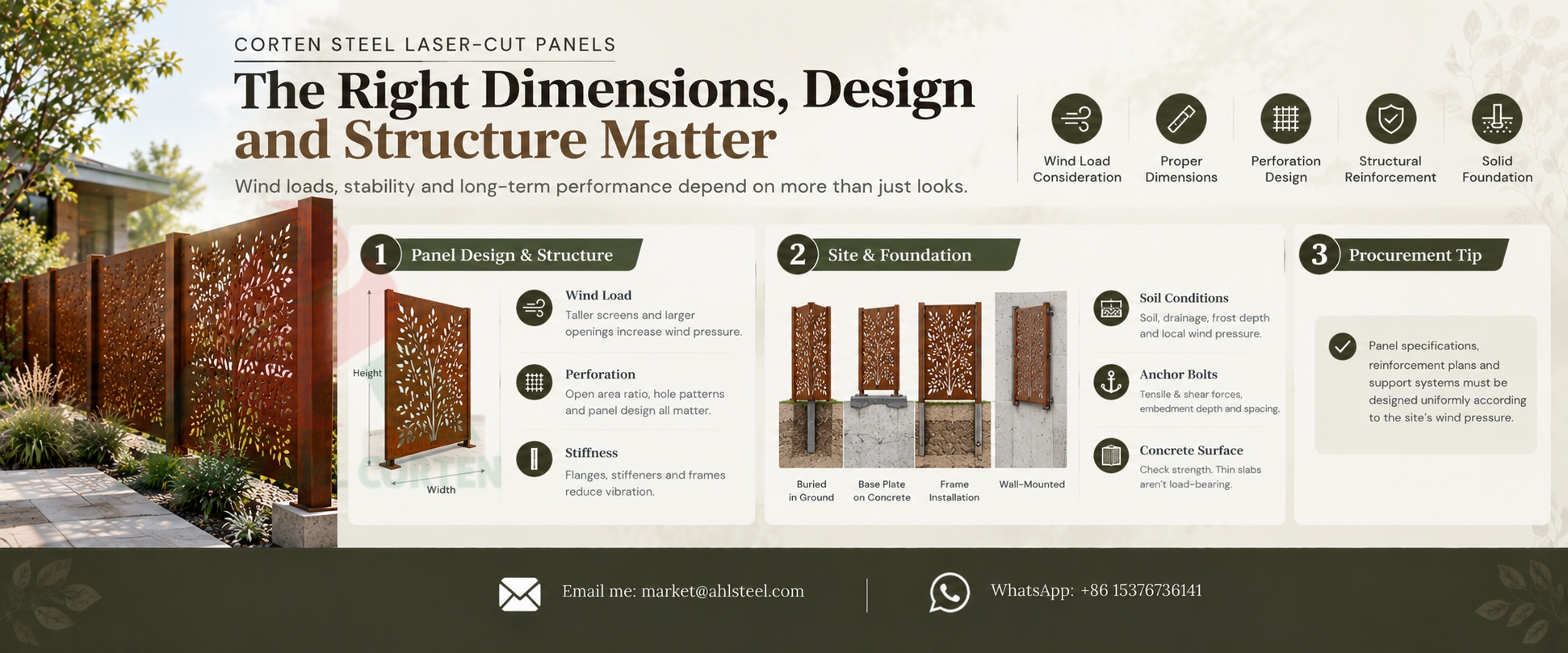
The height, width, and perforation pattern of the screen directly determine the magnitude of wind loads; therefore, decisions should not be based solely on aesthetic preferences.
The taller the laser-cut metal screens, the greater the wind-induced moment, and the requirements for the support columns and foundation will increase exponentially. Before placing an order, provide the manufacturer with the following site information: total height of the screen, width of each panel, column spacing, installation location, and whether the site is in an open area near the coast.
Many people mistakenly believe that perforated panels are inherently wind-resistant, but this is a misconception. Perforations can divert some airflow, but the open area ratio, hole patterns, and panel design all affect the effectiveness. Perforations do not proportionally reduce wind pressure, and custom-cut panels must be included in structural calculations.
Panel stiffness depends on more than just steel plate thickness. Flanges, internal stiffeners, and external frame reinforcement can all reduce panel vibration. Thicker steel plates can enhance panel rigidity but cannot compensate for weaknesses such as insufficient column strength, loose anchor bolts, or unstable foundations.
✅ Procurement Tip: Panel specifications, reinforcement plans, and support systems must be designed uniformly in accordance with the site’s wind pressure.
Select Sturdy Columns and Pair Them With a Foundation Solution Suitable for the Site
Rusted steel screens come in various installation configurations, and the load-bearing logic differs completely between them: columns buried in the ground, base plates anchored to concrete, the entire frame secured in place, or wall-mounted installations. It is essential to use a support scheme verified by the manufacturer or a project-specific structural design to ensure that wind loads are safely transferred to the ground.
There is no universal standard for foundation burial depth. Foundation design depends on soil conditions, underground drainage, local frost depth, the dimensions of the metal privacy fence screen, and regional wind pressure. For tall screens or open, wind-exposed sites, it is recommended that foundation parameters be calculated by professionals.
If installing on a concrete-paved surface, verify the strength of the base material. When selecting anchor bolts, consider both tensile and shear forces, and confirm the embedment depth, anchor bolt spacing, and distance from the concrete edge. Thin paving slabs and decorative thin-layer concrete cannot be used as load-bearing foundations.
✅ Purchasing Tip: Foundation and anchor bolt solutions must be determined based on the entire screen assembly, soil conditions, and engineering codes.
When Reinforcing Corten Garden Screens, Carefully Inspect All Connection Joints
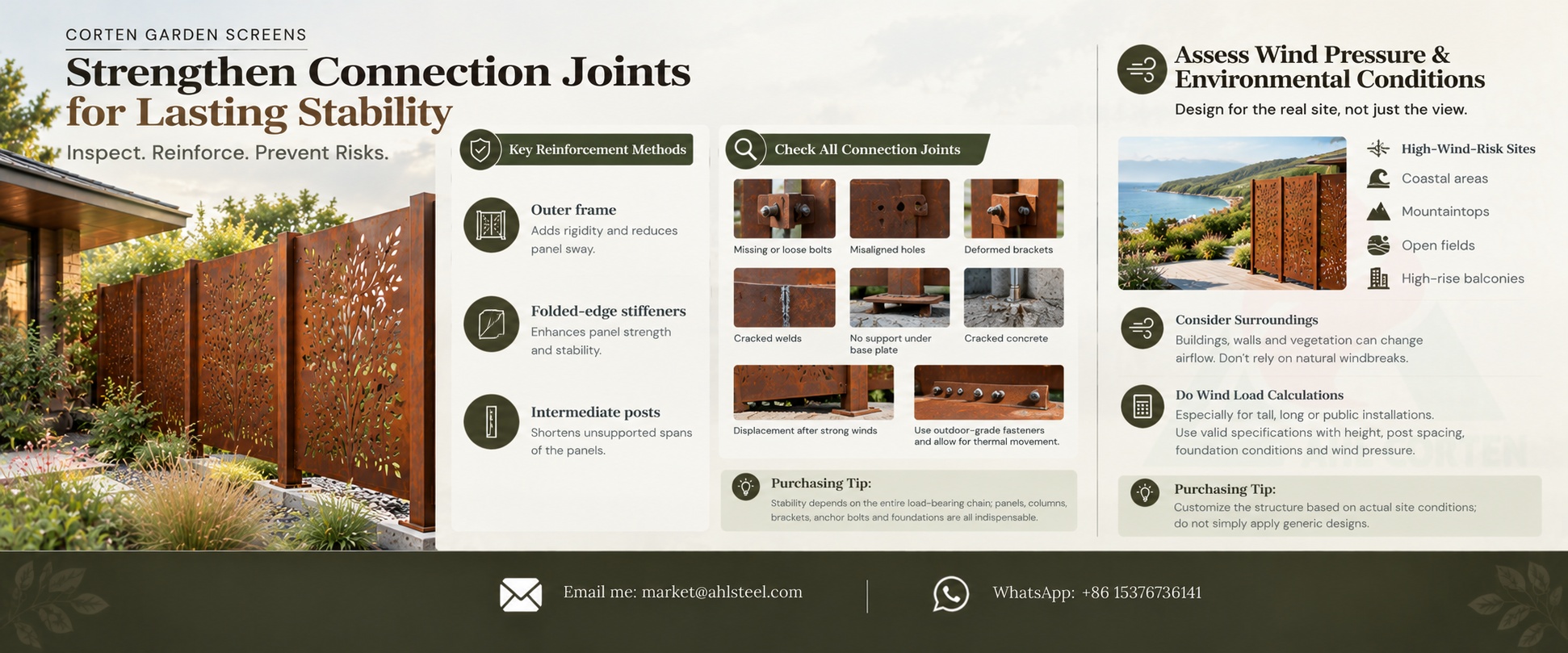
You can reduce panel sway by installing an outer frame, folded-edge stiffeners, or additional intermediate posts to shorten the unsupported span of the panels. However, reinforcement must target the weakest points. Reinforcing the corten steel panels alone will not resolve issues caused by foundation movement; simply adding an extra post will still fail if its base lacks sufficient load-bearing capacity.
Conduct regular inspections of all fasteners, focusing on the following potential hazards: missing or loose bolts, misalignment of bolt holes, deformation of brackets, cracked welds, panels suspended without support beneath the base plate, cracking of concrete around anchor bolts, and displacement following strong winds.
Fasteners must be made of materials suitable for outdoor use to prevent galvanic corrosion with the weathering steel. Connection joints must also allow for thermal expansion and contraction of the steel; do not arbitrarily enlarge holes or reduce the number of fixing points. Additionally, avoid dead corners where water can pool at joint locations, as prolonged water accumulation accelerates rusting and compromises structural durability.
✅ Purchasing Tip: Stability depends on the integrity of the entire load-bearing chain; panels, columns, brackets, anchor bolts, and foundations are all indispensable.
Assessing Site Wind Pressure and Surrounding Environmental Conditions
The following are considered high-wind-risk sites: coastal areas, mountaintops, open fields, and high-rise balconies. Even the same type of windbreak will require completely different support solutions when placed in a sheltered courtyard versus an open coastal area.
Surrounding buildings, walls, and vegetation can alter the direction of airflow. Do not rely on adjacent buildings or trees as permanent windbreaks. Trees grow, are pruned, and shed leaves, making their wind-blocking effectiveness inconsistent; therefore, design should be based on the site’s actual wind pressure.
For tall screens, long row screens, and installations in public areas, it is recommended to perform wind load calculations. Do not blindly trust vague marketing claims of “wind-resistant models”; a valid wind-resistance specification must specify the corresponding height, post spacing, foundation conditions, and applicable wind pressure.
✅ Purchasing Tip: Customize the structure based on actual on-site conditions; do not simply apply generic designs.
How Should a Corten Steel Windbreak That Has Already Tilted Be Repaired?
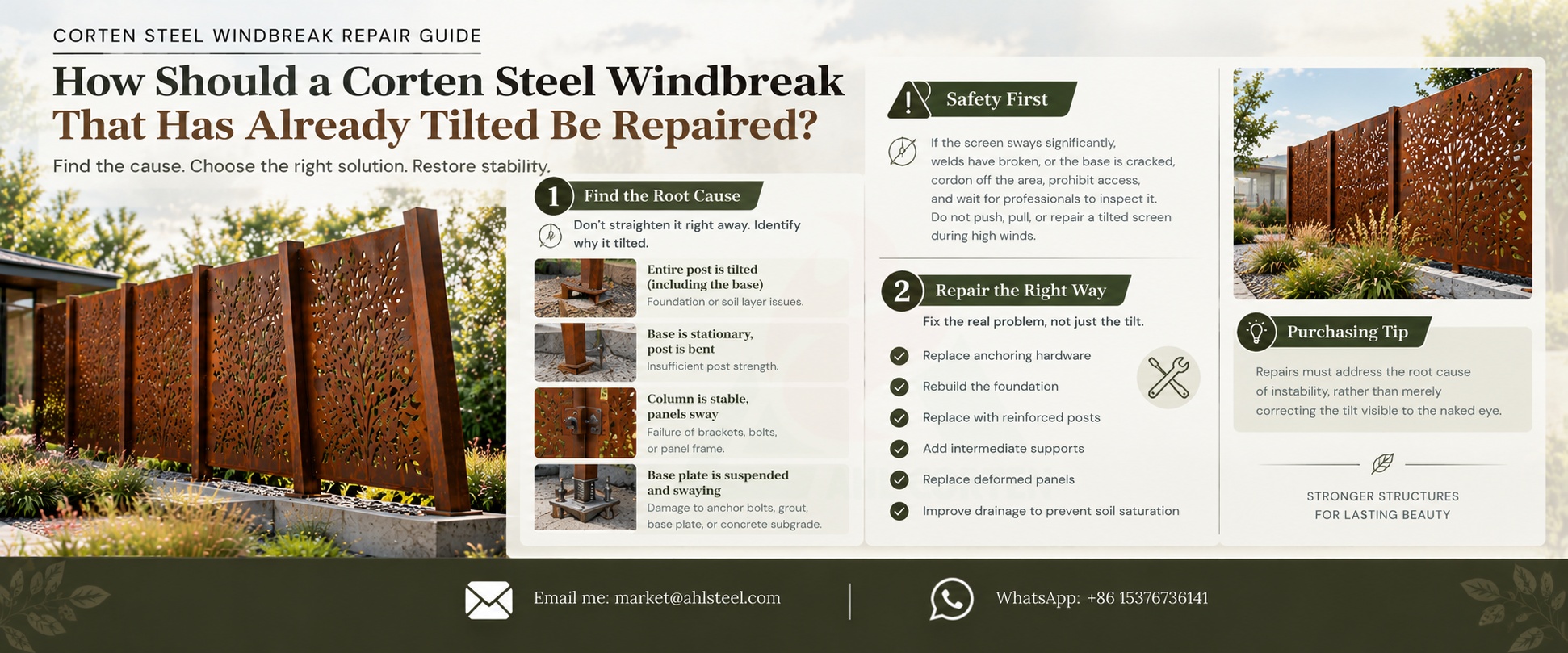
Repair Step 1: First, identify the root cause of the displacement; do not immediately attempt to straighten it.
- The entire post, including the base, is tilted: Foundation or soil layer issues
- The base remains stationary, but the post itself is bent: Insufficient post strength
- The column is stable, but the panels sway back and forth: Failure of brackets, bolts, or the panel frame
- The base plate is suspended and swaying: Damage to anchor bolts, grout, the base plate, or the concrete subgrade
Safety First: If the screen sways significantly, welds have broken, or the base is cracked, immediately cordon off the surrounding area, prohibit access, and wait for professionals to inspect it. Do not attempt to push, pull, or repair a tilted screen during high winds.
Perform targeted repairs based on the root cause: replace anchoring hardware, rebuild the foundation, replace with reinforced posts, add intermediate supports, replace deformed panels, and improve drainage to prevent soil saturation. Simply straightening the screen or adding temporary braces only masks the problem; structural hazards remain.
✅ Purchasing Tip: Repairs must address the root cause of instability, rather than merely correcting the tilt visible to the naked eye.
Frequently Asked Questions
1. Why Do Corten Steel Garden Screens Tend to Tilt in Strong Winds?
Wind loads are transmitted along the panels, connectors, and posts to the foundation. If any point in this chain has insufficient load-bearing capacity, becomes loose, or experiences soil instability, the screen will tilt. The rusting characteristics of weathering steel do not imply that the screen inherently possesses wind resistance.
2. Are Perforated Corten Screens More Wind-Resistant Than Solid Screens?
Under certain conditions, perforations can reduce wind pressure, but this is not always the case. The outcome ultimately depends on the perforation pattern, open area ratio, panel dimensions, and the entire support system; wind pressure does not decrease in direct proportion to the open area.
3. What Is the Appropriate Embedment Depth for Corten Steel Screen Columns?
There is no fixed standard embedment depth. It is determined by the screen dimensions, wind pressure, column specifications, soil conditions, and local frost heave requirements. Prioritize the manufacturer’s verified design or specialized structural calculations; do not rely on generic values found online.
4. Will Thickening the Steel Plates Prevent the Screen From Tilting?
You cannot rely solely on thickening the steel plates. Tilting failures mostly originate from the columns, anchor bolts, or foundation placement. The entire load-bearing chain must meet standards; reinforcing a single component cannot guarantee overall stability.
5. Can Corten Steel Screens Be Installed Directly On a Concrete Surface?
Yes, but the concrete substrate must meet load-bearing requirements. Verify the slab thickness, concrete grade, and presence of cracks, and confirm the anchor bolt embedment depth and edge clearance. Ordinary paving bricks cannot serve as load-bearing bases.
6. How Should Existing Screens That Are Already Wobbling or Tilting Be Reinforced?
First, inspect and identify the location of the failure, then replace components as needed, rebuild the foundation, or add additional supports. If the screen is visibly wobbling, isolate it immediately; do not attempt to prop it up yourself with makeshift supports.
7. Is a Structural Analysis Required for Tall Metal Screens?
This depends on the height, length, site conditions, and local codes. For open, wind-exposed sites and public landscape projects, it is strongly recommended to provide a complete load analysis report; verbal claims of “wind resistance” alone are insufficient.
Conclusion & Consultation Guidelines
To ensure weathering steel screens can withstand strong winds, wind-resistant design must be incorporated from the planning stage. Matching appropriate panel dimensions with the structure, and combining them with columns, connectors, anchor bolts, and foundations with sufficient load-bearing capacity, creates a stable structural system.
For screens that are already tilted, prioritize identifying the root cause rather than merely performing a temporary realignment. If you are planning a garden partition or commercial landscaping project, please feel free to contact AHL Corten Group.
We offer custom weathering steel screens, providing perforation patterns and structural support solutions tailored to your site, along with professional manufacturing and installation recommendations based on your site’s wind pressure and soil conditions.
Want the Latest Catalog for Corten Steel Screens? Contact Us!
Back

 Fill In The Inquiry