What Height Should Corten Bollard Lights Be?
With its natural rust-colored texture, the corten steel low-profile bollard light is a highly popular pathway lighting product for modern gardens and commercial landscapes.
When selecting corten steel lights, many designers and property owners focus primarily on the height of the garden light. However, height is not the only factor that determines lighting performance. Lenses, reflector structures, and glare-reduction designs—that is, the fixture’s optical distribution—are equally crucial.
A well-designed low-profile luminaire is likely to provide better lighting performance than a taller model with an improperly designed light distribution. The ideal solution requires a comprehensive assessment that takes into account height, light output, installation location, spacing between luminaires, and the surrounding landscape.
.jpg)
What Are the Common Height Ranges for Corten Lights, and Why Is There No Unified Standard?
1. Mainstream Reference Heights
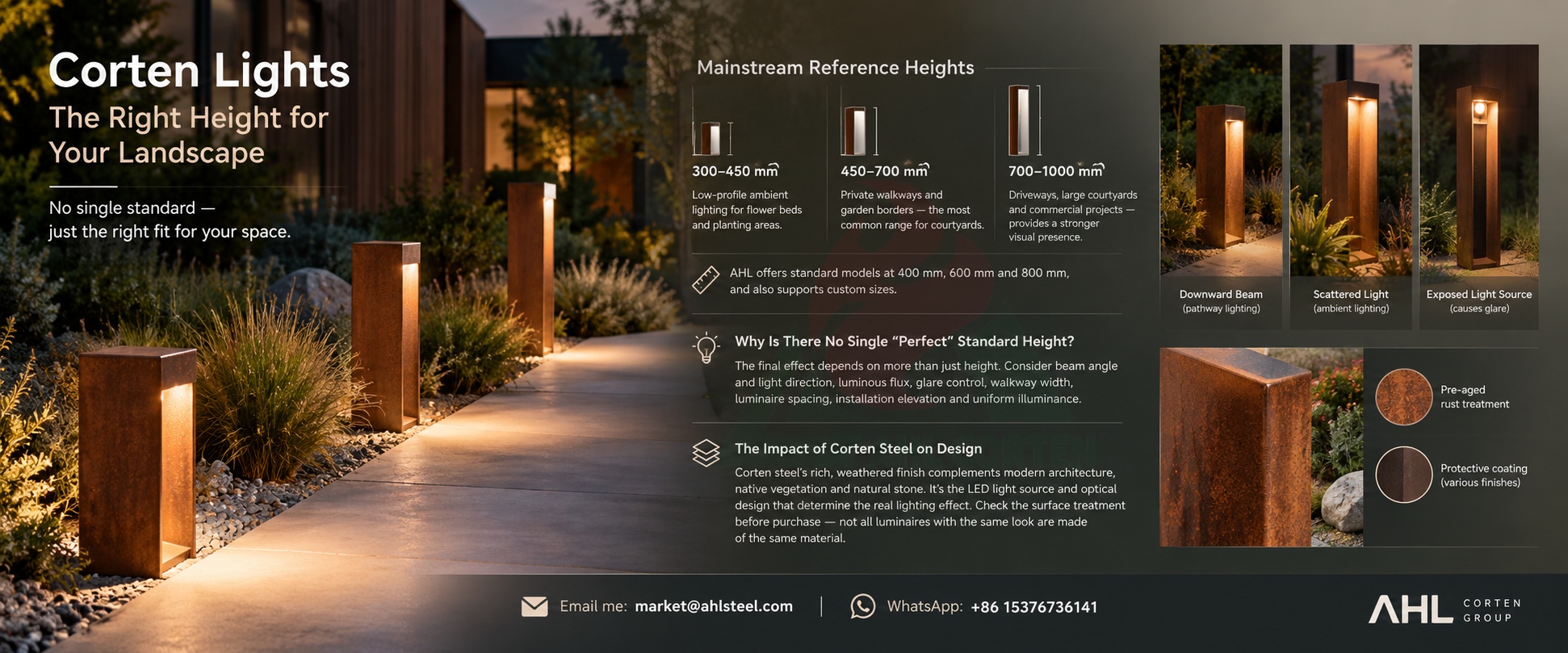
- 300–450 mm: Low-profile ambient lighting for flower beds and planting areas
- 450–700 mm: Private walkways and garden borders—the most common range for courtyards
- 700–1000 mm: Driveways, large courtyards, and commercial projects—provides a stronger visual presence
These figures are intended only as a reference for preliminary design and are not mandatory standards.
AHL offers standard models at 400 mm, 600 mm, and 800 mm, and also supports custom sizes.
2. Why Is There No Single “Perfect” Standard Height?
Two low-profile post lights of the same height can produce vastly different final effects. Some direct light toward the walkway surface, while others scatter light, leaving the light source exposed and causing glare when pedestrians look directly at it.
When evaluating heights during the selection process, be sure to consider these factors simultaneously: beam angle and light direction, actual luminous flux, glare-control and anti-glare structures, walkway width, luminaire spacing, installation elevation, and uniform illuminance on the pavement.
Professional landscape luminaires offer multiple light distribution options to accommodate different walkway widths and luminaire spacing. This demonstrates that height alone is insufficient to judge the quality of lighting.
3. The Impact of Corten Steel on Design
Corten steel’s unique vintage rusted finish complements modern architecture, native vegetation, and natural stone exceptionally well. While the materials determine the aesthetic character, it is the LED light source and optical design that ultimately determines the effectiveness of the pavement lighting.
Some models on the market undergo pre-aged rust treatment, while others are coated with a protective finish. When purchasing, verify the surface treatment; do not assume that all luminaires with the same appearance are made of the same material.
Recommended Starting Heights for Corten Low-Pole Lights in Different Settings
| Application |
Recommended Starting Height |
Key Considerations |
| Flower Borders and Planting Beds |
300–450 mm |
Create soft accent lighting without overpowering the main visual features. |
| Private Garden Pathways |
450–600 mm |
Provide adequate path illumination while prioritizing glare control. |
| Patios and Courtyard Walkways |
450–700 mm |
Balance functional lighting with landscape aesthetics. |
| Driveways and Entrance Gates |
600–900 mm |
Support clear visibility for drivers and use appropriate light distribution to limit light spill. |
| Commercial Campus Landscapes |
600–1000 mm |
Consider site scale, pedestrian routes, and consistency with the overall design. |
| Steps and Changes in Level |
Project-Specific Height |
Clearly define edges and avoid shadows that could obscure changes in level. |
The table above lists only design starting points; these should not be directly equated with the final lighting results. The final spacing between lights and the uniformity of brightness depend on the luminaires’ optical parameters, the road width, and the illuminance requirements.
In many cases, it is not suitable to rely solely on low-profile post lights for stairways; combining them with stair lights and handrail light strips yields better results.
Garden Pathways: How to Choose Corten Low-Profile Lights of the Right Height?
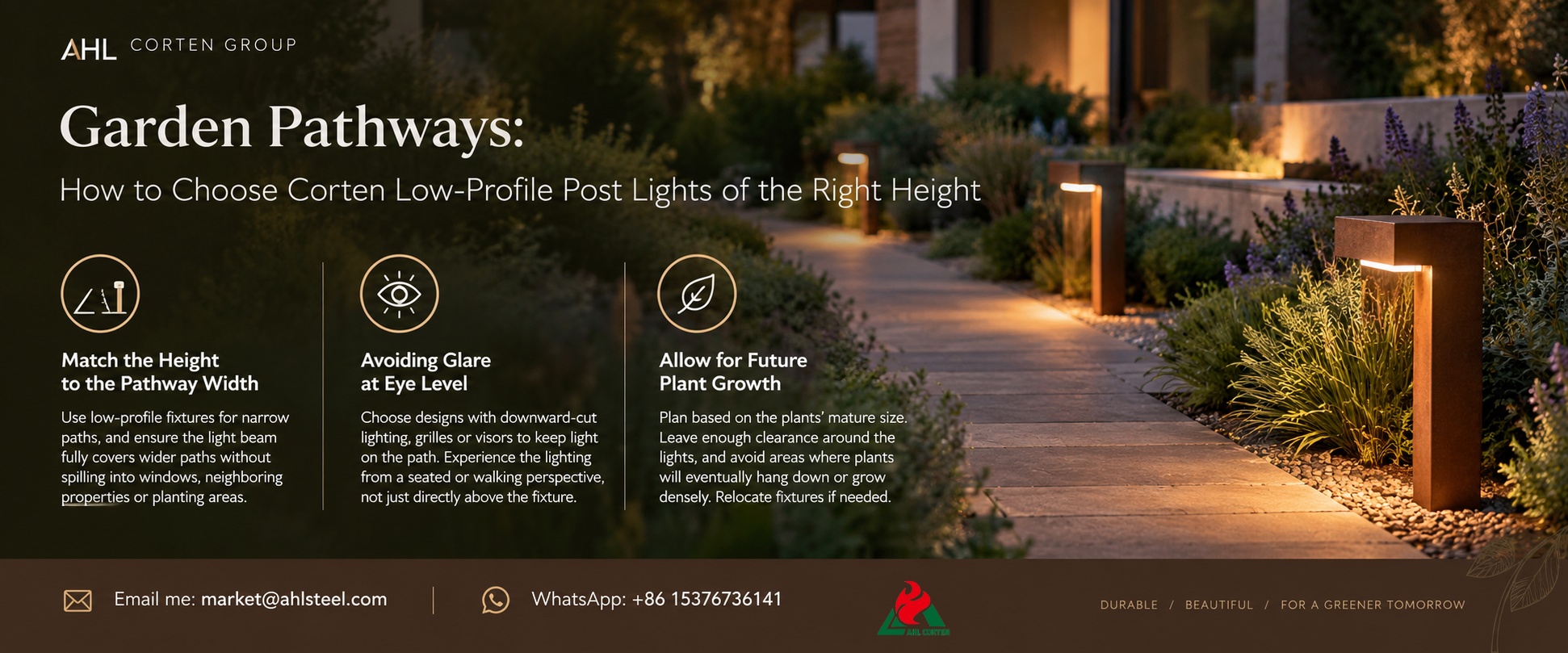
1. Match the Height to the Pathway Width
Narrow garden paths are best suited for low-profile rusted steel lights with effective glare-control features, placed close to the edge of the path. For wider main pathways, it’s not necessarily best to choose taller lights right away. First, ensure the light beam fully covers the path surface while avoiding light spill into indoor windows, neighboring properties, and planting areas.
As shown in manufacturers’ pathway lighting examples, low-profile lights can also be suitable for wide pathways thanks to different optical designs.
2. Avoiding Glare at Eye Level
Although low-profile post lights are generally below an adult’s standing eye level, there is still a risk of glare. When sitting in a seating area, walking toward the light on a slope, or standing near a window, it is easy to look directly at the light source, which can cause discomfort.
Prioritize designs with downward-cut lighting, grilles, or light-blocking visors to ensure light falls precisely on the walking surface. When evaluating lighting, don’t just stand directly above the fixture—experience it from the perspective of someone walking or sitting.
3. Allow for Future Plant Growth
When selecting heights and locations, plan based on the plants’ mature size—do not rely solely on their current seedling stage. Newly planted flowers and grasses will not block the light initially, but as they grow over several years, their foliage can easily obstruct the pathway bollard light output.
Leave sufficient clearance around outdoor bollard lighting and avoid areas where plants will eventually hang down or grow densely. If a flower bed becomes too dense, relocating the fixtures is often more practical than simply raising them.
How Light Height Affects Illumination Range and Spacing Between Lights
1. Height and Illumination Coverage
Simply raising a corten light can theoretically expand the light spot’s range, but this does not guarantee sufficient brightness or a comfortable visual experience. Rather than focusing on “how far the light can reach,” the more critical issue is ensuring uniform illuminance on the walkway surface without glaring contrasts between garden bollard light and shadow.
Therefore, when selecting a model, installation height and optical distribution must be evaluated together—they cannot be considered in isolation.
2. Height and Light Spacing
Do not apply fixed spacing formulas. At the same height, the layout for professional asymmetrical optical distribution fixtures will be completely different from that for openwork or ornate decorative fixtures.
If possible, request IES/LDT light distribution files from the manufacturer to verify the following: illuminance continuity along the entire walkway; the presence of dark spots between fixtures; excessively bright spots; light spill causing nuisance; and lighting transitions at corners and entrances/exits.
Lighting spacing is determined by a combination of height, light distribution, walkway width, and illuminance standards.
3. Reducing Glare and Uneven Illumination
Compare the luminaires’ light-blocking and cut-off performance, as well as the contrast between bright and dark areas. A decorative luminaire that looks attractive does not necessarily provide comfortable, glare-free lighting for pedestrians.
Perform separate calculations for steps and areas with elevation changes; do not simply replicate the lighting layout used for straight, level walkways to prevent shadows from creating tripping hazards.
A Comprehensive Guide to Selecting Lights
1. Determine the Height Based on Lighting Objectives
First, clarify the core function of the fixture, then select the size: Functional pathway lights: illuminate walkways, control glare, and provide uniform illuminance; Decorative accent lights: highlight flower beds and landscape features; not suitable for use as the sole lighting source for main walkways; Entrance signage lights: enhance entrance visibility and match the scale of the building.
Many decorative, open-work, low-profile column lights offer striking visual appeal, but their light distribution may not meet safety standards for walkway lighting and cannot directly replace professional walkway lights.
2. Comparing Luminous Flux, Color Temperature, and Light Distribution—Don’t Just Look at Height and Wattage
Focus on comparing lumen output, beam distribution, color temperature, and glare rating, rather than just wattage or fixture height. Obtain the complete set of luminaire specifications, including LED modules, optical structures, and surface treatment solutions. The orientation of the corten steel bollard light source directly determines the nighttime experience.
3. Consider Customized Dimensions
Customizing the height allows the luminaires to better harmonize with the proportions of perimeter walls, vegetation, and architecture. You can also customize openwork patterns, surface treatments, and mounting bases.
AHL supports custom heights and can produce custom landscape lights based on project drawings. Please note that if the standard height or light outlet is modified, the garden bollard light distribution and electrical safety performance must be re-verified.
4. Calculate the Total Implementation Cost
When budgeting, do not limit calculations to the unit price of the luminaires; also include: concrete foundations, embedded anchors, cable installation, electrical protection, transformer control systems, installation labor, provision of access for maintenance, spare parts, and anti-corrosion protection for the paving. While the luminaires themselves may be inexpensive, if the drivers are hidden beneath the paving and difficult to access for maintenance, long-term maintenance costs will be high.
Frequently Asked Questions
1. What Is the Optimal Height for Garden Bollard Lights?
There is no single “best” height. During initial planning, choose shorter models for accent lighting; for most private garden walkways, 450–700 mm is a good starting point. The final effect is determined by the light distribution, glare control, and installation location.
2. What Height is Recommended for Walkway Bollard Lights?
For most private walkways, 450–600 mm is a good starting point. Wider paths and commercial areas may require taller models; the final decision should be based on light distribution calculations.
3. Can 300 Mm Low-Profile Lights Be Used for Garden Walkways?
They can be used for narrow paths and atmospheric lighting, provided the pathway bollard light distribution adequately illuminates the path surface, plants do not block the light, and there are no dark spots after installation. Height alone is not sufficient to determine suitability.
4. How Should the Installation Spacing for Outdoor Low-Profile Post Lights Be Determined?
Spacing is highly dependent on the product and site conditions; there is no standard value. Use the manufacturer’s light distribution data and consider path width, illuminance, and glare control when planning the layout.
5. Does a Taller Light Provide Better Illumination?
Not necessarily. Increasing height changes the size of the light spot, but it is the luminous flux and optical glare control design that determine whether the lighting is comfortable and sufficient. Low-profile lights with appropriate pathway bollard light distribution often perform better than taller models that produce excessive glare.
6. What IP Rating Is Recommended for Outdoor Low-Profile Post Lights?
The IP rating should match the usage environment and local regulations; IP65 is a common specification for outdoor low-profile post lights. However, IP65 does not mean the luminaire can be submerged in water for extended periods; confirm the entire solution with the manufacturer and installer before purchasing.
7. Can the Height of Corten Low-Profile Post Lights Be Customized?
Yes. AHL offers standard models at 400, 600, and 800 mm, and also supports custom sizes. After customization, be sure to confirm the mounting structure, maintenance space, and lighting parameters.
How to Choose the Height for Corten Steel Lights?
First, determine the lighting purpose and the width of the walkway. For private walkways, start with a height of 450–600 mm, then use the luminaire’s photometric data to verify illuminance uniformity and glare levels.
For large-scale spaces, taller luminaires may be preferred—provided the beam pattern and visual comfort suit the setting; shorter models are suitable for ambient accent lighting and narrow paths, but be sure to avoid obstruction by vegetation.
Before construction begins, ensure that the foundation, drainage, electrical safety, and access for future maintenance are all in place. Height is just one component of the overall pathway bollard light design and should not be the sole criterion for selecting fixtures.
Are You Ready to Choose the Perfect Outdoor Corten Steel Lights for Your Space?
Looking for a corten steel lighting solution for your garden or commercial project?
Contact the AHL Weathering Steel Team. We offer customization of height, surface finishes, and light distribution patterns to provide a one-stop solution for your landscape lighting project.
Want the Latest Catalog for Rusted Steel Lights? Contact Us!
Back


 Fill In The Inquiry