How to Prevent Corten Steel Edging from Moving or Leaning?
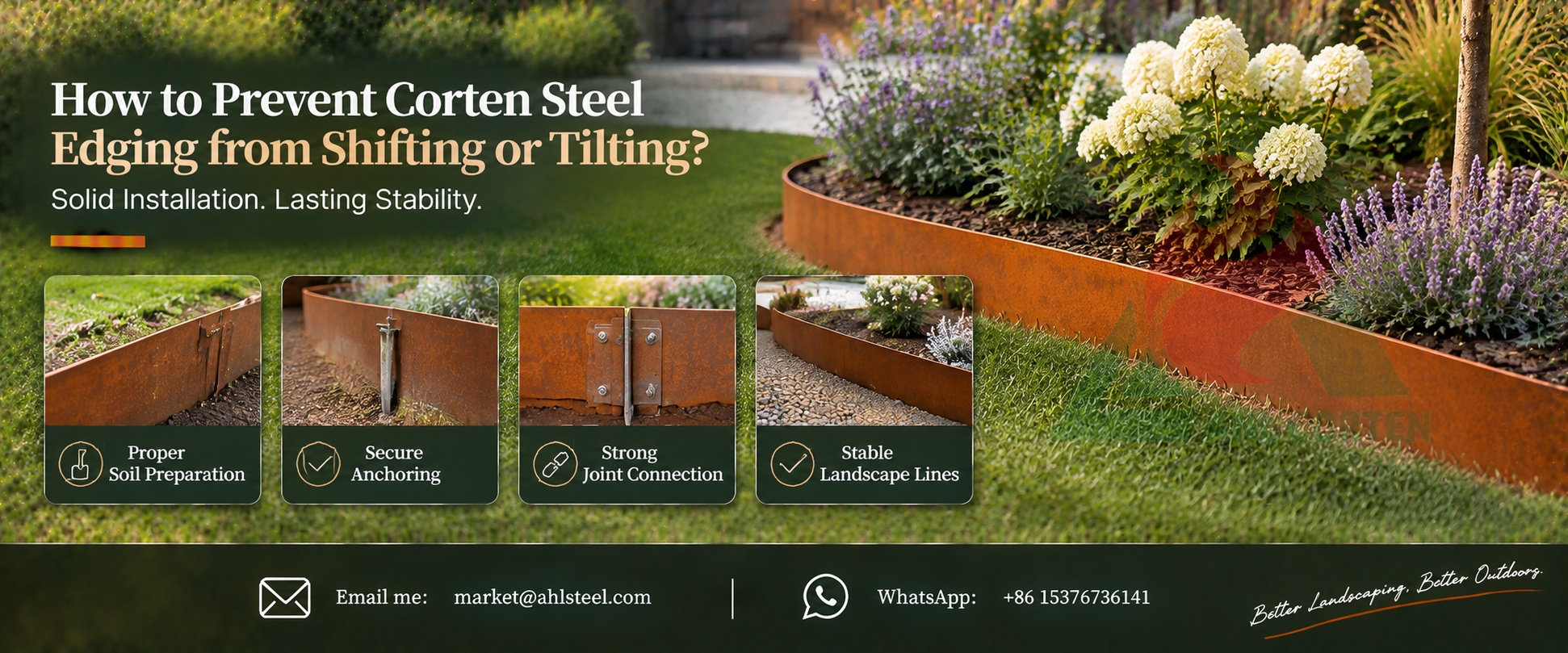
Corten steel edging can create clean, defined boundaries between lawns, flower beds, and garden paths. However, if it is not properly secured, the panels may loosen, shift, or tilt inward or outward over time, disrupting the originally neat landscape lines.
If such issues arise, do not immediately replace the edging panels; instead, prioritize inspecting the support, joint, and anchoring solutions. The stability of the edging depends on a comprehensive system—soil preparation, burial depth, ground spike placement, joint connections, and earth-retaining loads must all be compatible with the specific product model.
This article is intended for landscape architects, contractors, and wholesalers to help you identify the root causes of shifting and tilting, master stable installation methods, and confirm product specifications before placing an order.
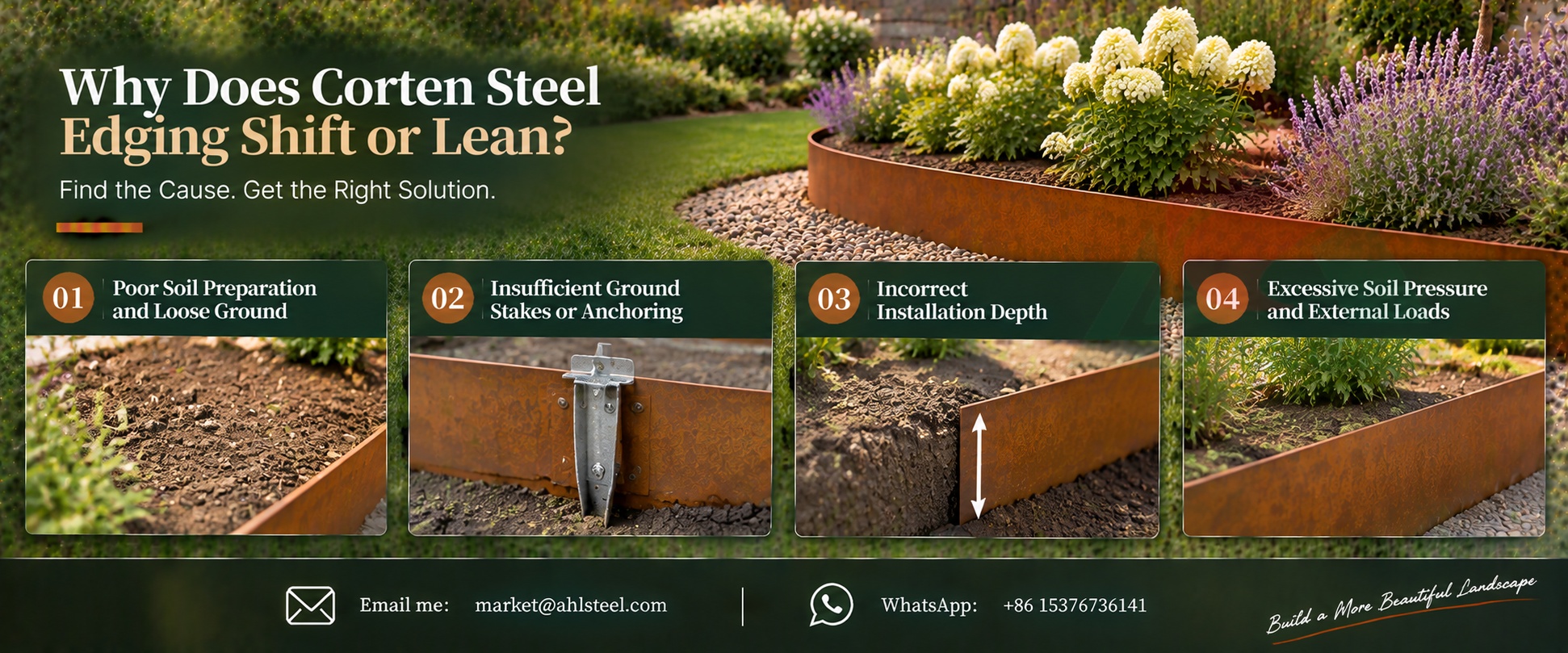
Why Does Corten Steel Edging Shift or Lean?
1. Poor Soil Preparation and Loose Ground
Metal landscape edging requires uniform support along its entire length.
Underground rocks, old tree roots, and uncompacted backfill can all cause the steel plates to become suspended or subjected to uneven stress.
Many installers simply hammer the steel plates into the ground, skipping the site preparation process. As the soil settles over time, the edging can easily become misaligned. To maintain alignment, obstacles must be cleared before installation, and backfill must be compacted in layers.
2. Insufficient Ground Stakes or Anchoring
Ground stakes and anchors are the core components that secure the steel garden edging in the ground.
A lack of fasteners, mismatched component specifications, and ground stake placement that does not meet product requirements are the most common causes of instability.
Fixing methods vary by fencing series: some use standalone ground anchors, others feature base pins, and some come with diagonal braces. Do not simply copy the ground stake layout from other models; strictly follow the installation drawings for the specific product.
3. Incorrect Installation Depth
The visible height of the panels and the total height are two distinct parameters that are easily confused.
Some edging designs require the bottom to be buried in the soil; others, such as those with a base, only need to be placed flat on the ground and do not require burial.
Blindly digging trenches of a uniform depth will either result in the metal garden edging being buried too deep—leaving insufficient height above ground—or too shallow—providing inadequate support. The burial depth must be determined based on the product model, installation elevation, and lawn elevation.
4. Excessive Soil Pressure and External Loads
Standard partition-type steel landscape edging is only suitable for demarcating the boundaries between lawns and gravel areas or flower beds; it is not suitable for directly supporting elevation differences or serving as retaining walls for steps.
If used to support a thick layer of soil in an elevated planting area, the lateral soil pressure will continuously push outward against the steel panels, causing them to gradually tilt. In such scenarios, specialized reinforcement, thicker panels, or dedicated retaining wall systems are required; decorative edging cannot be used as a substitute.
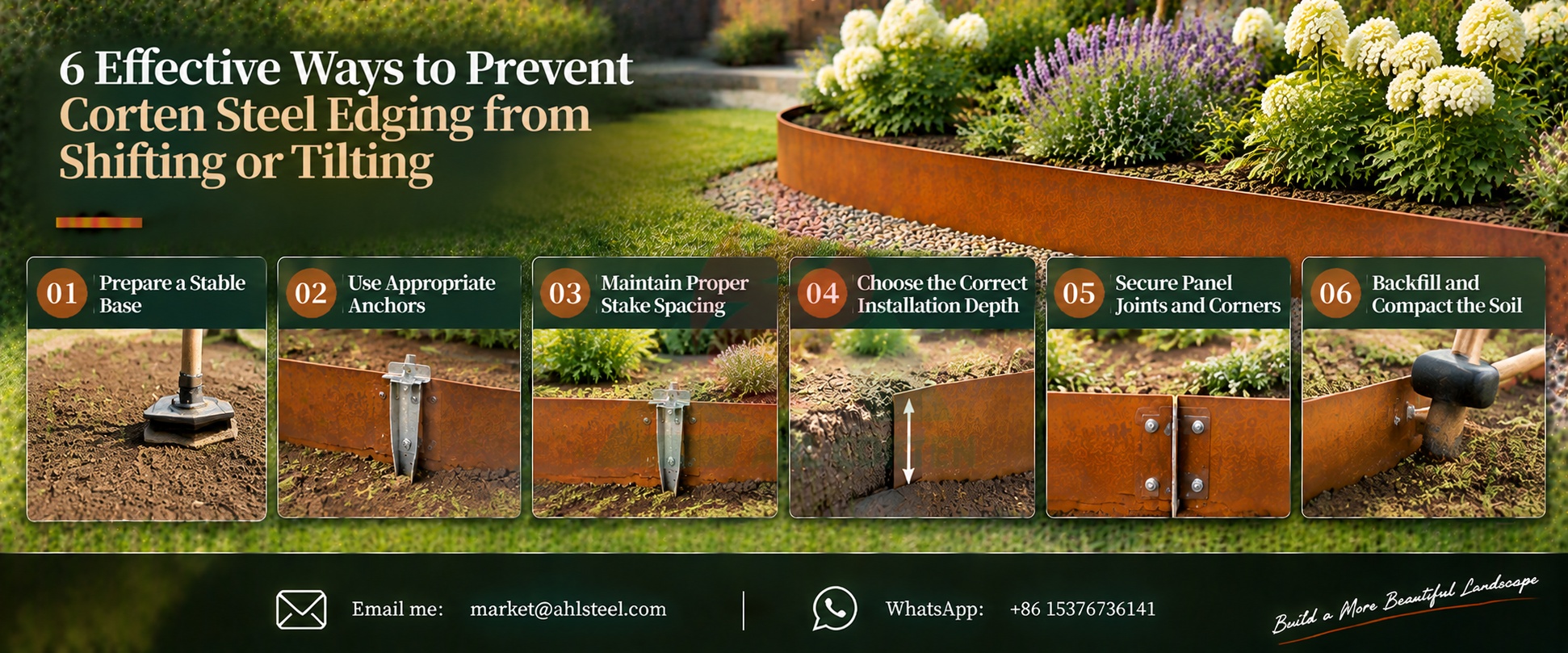
6 Effective Ways to Prevent Corten Steel Edging from Shifting or Tilting
1. Prepare a Stable and Compacted Base
First, stake out the boundaries, confirm the locations of underground utilities, and clear away obstacles such as tree roots and rocks.
The base must be level to prevent the metal garden edging from being partially suspended.
Select a foundation solution based on the product type: edging with a base only requires a level, hardened, or natural soil surface; buried edging requires digging a trench. Backfill material should be compacted in layers; it is not necessary to lay a crushed stone base in all situations—the solution should be tailored to the site.
2. Use Appropriate Ground Stakes and Anchors
Accessories must be the specific models designated for that edging type; verify the length and connection method.
The anchoring solutions for lawn dividers, raised flower bed edging, and bolt-fastened edging are completely different.
Accessories include ground stakes, fixing pins, diagonal braces, and connecting plates; different accessories cannot be interchanged arbitrarily. When placing an order, clarify whether accessories are included as standard with the product or need to be purchased separately.
3. Maintain Proper Stake Spacing
Use the quantities and locations indicated on the manufacturer’s drawings as a reference.
Joints, corners, and end points are vulnerable areas that require additional reinforcement.
There is no universal standard for ground stake spacing. The raised flower bed model may require multiple ground stakes per meter plus diagonal braces; do not directly apply the specifications of one product to another. Request a layout diagram from the supplier before purchasing.
4. Choosing the Correct Installation Depth
Before excavating the trench, determine the finished ground level.
Distinguish between the panel’s above-ground height, the depth buried underground, and the base structure.
Deeper burial does not necessarily mean greater stability. Models with support bases must not be buried deeply; for recessed metal landscape edging, ensure that the specified burial depth is met. All burial depth requirements must follow the product drawings.
5. Secure Panel Joints and Corners
Join panels using the matching connecting plates, bolts, and self-tapping screws.
Align and adjust as you assemble; do not wait until all panels are laid before making adjustments.
Joint structures vary significantly between manufacturers. Do not cut connection points or alter the assembly method on your own, as this can lead to wider gaps and future detachment. Use original manufacturer corner fittings whenever possible for curved sections and corners.
6. Backfill and Compact the Soil Carefully
Complete the panel assembly, anchoring, and shoring before backfilling.
Backfill in small, incremental layers, compacting each layer as you go, and check regularly to ensure the top edge remains straight.
Do not attempt to force tilted steel panels back into position by relying solely on backfill. If panel displacement is detected during backfilling, stop filling immediately, reinforce the supports, and do not bury potential hazards beneath the soil.
For construction projects and wholesale orders, please contact AHL in advance to confirm panel configurations, joint solutions, and compatible fasteners. Obtain dimensional drawings to convert your inquiry into a comprehensive supply proposal.
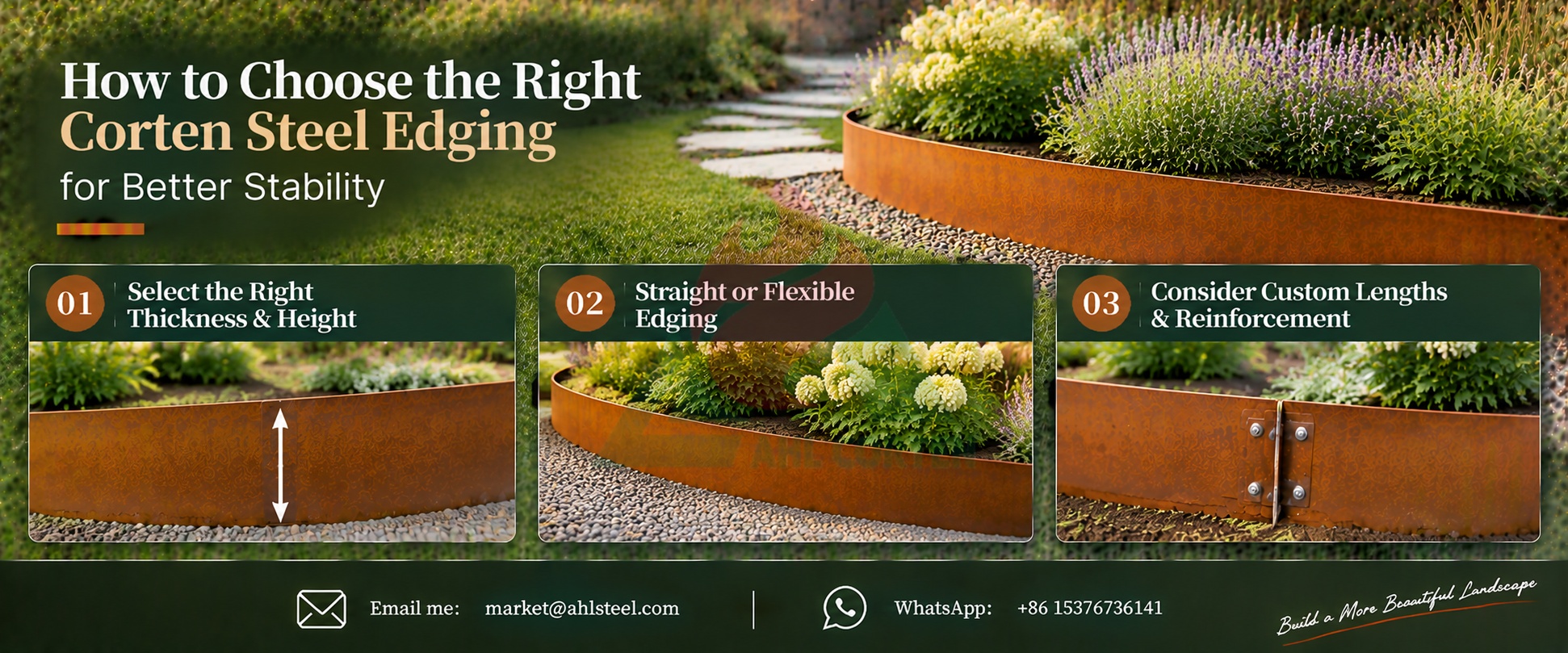
How to Choose the Right Corten Steel Edging for Better Stability
1. Select the Appropriate Thickness and Height
First, determine the intended use: simply to delineate a paved area, or to raise a flower bed or act as a retaining wall.
AHL typically offers weathering steel edging in thicknesses of 1.6 mm and 2.0 mm.
However, sheet thickness does not equate to load-bearing capacity. Even thick steel sheets will tilt under heavy lateral pressure if they lack support. When placing an order, provide the exposed height, retaining height, and site conditions so the supplier can recommend the appropriate solution.
2. Straight Edging vs. Flexible Edging
Corten flexible edging is suitable for gentle curves and can be gradually bent and shaped on-site.
Rigid straight edging is not suitable for forced bending; it is prone to deformation and cracking. Curved applications require factory pre-bending.
Before placing an order, confirm whether on-site bending is supported or if curved sections must be prefabricated at the factory, as well as the jointing method for curved sections.
3. Consider Custom Lengths and Reinforcement Options
Custom lengths allow joints to avoid corners, intersections, and flower bed edges, resulting in a more rational layout.
However, simply adjusting the length does not automatically provide the necessary retaining load-bearing capacity. For applications involving elevation differences, additional reinforcement structures—such as posts, diagonal braces, and ground anchors—must be installed.
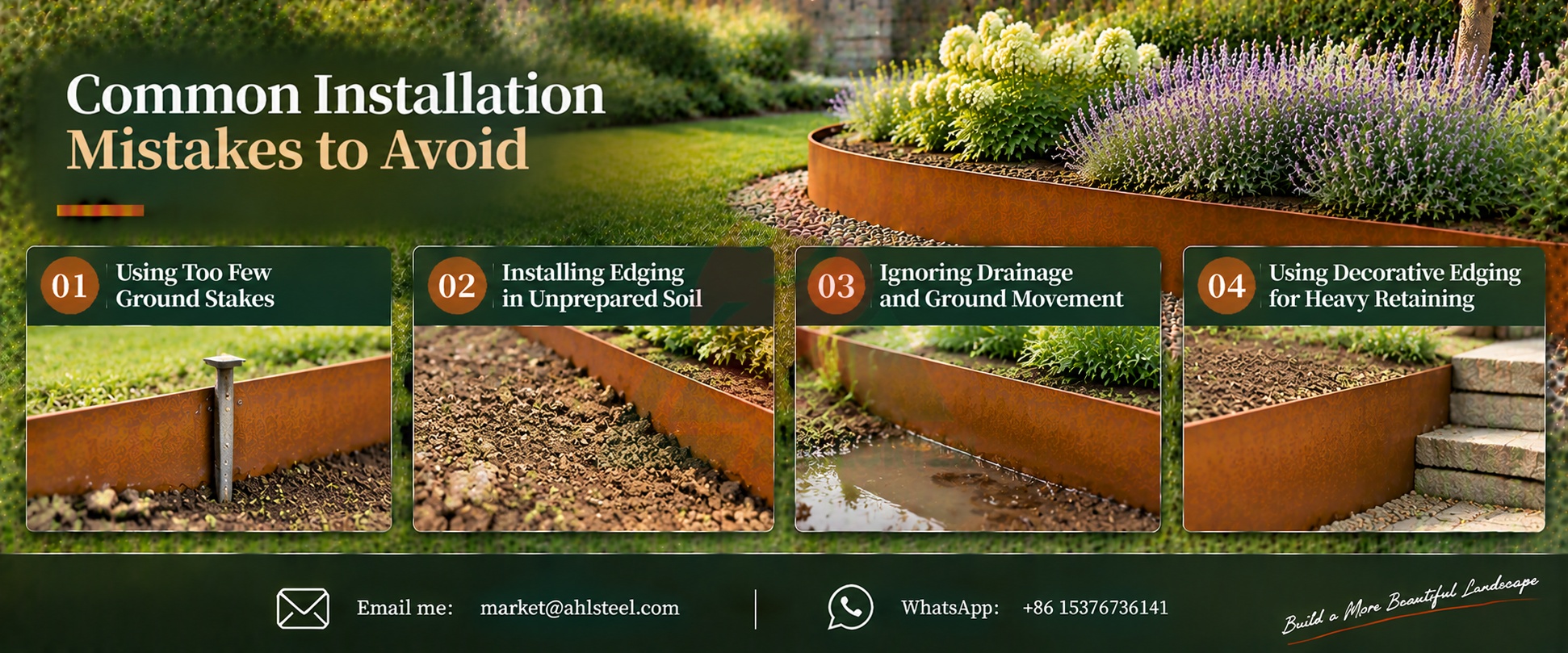
Common Installation Mistakes to Avoid
1. Using Too Few Ground Stakes
Many installers see that the rusted steel edging appears stable before backfilling and decide on their own to reduce the number of ground stakes.
The lateral pressure exerted after backfilling is far greater than when the panels are installed on empty ground. Diagonal braces, ground anchors, and fixing pins each serve a specific purpose and cannot be substituted for one another.
2. Installing Edging in Unprepared Soil
Rocks and tree roots can press against the steel panels, causing localized stress concentrations.
Although some products come equipped with micro-adjustable ground stakes to help avoid obstacles, do not assume that all models have this feature. Prioritize clearing the subgrade rather than relying on accessories to force a fit in poor ground conditions.
3. Ignoring Drainage and Ground Movement
If the edging continues to tilt repeatedly after installation, the problem is often not with the steel panels themselves.
Prolonged exposure of the base to rainwater, poor drainage, and ongoing settlement of backfill soil can all cause the edging to gradually shift. For raised edging and bolted models, special attention must be paid to drainage design.
4. Using Decorative Edging for Heavy Retaining Applications
Standard landscape edging cannot replace steps or retaining wall structures.
Simply increasing the thickness of the steel plate does not meet the requirements for a retaining structure. In scenarios with significant elevation differences, specialized raised planter edging or retaining wall systems with independent supports should be selected.
Why Choose AHL Corten Steel Edging?
1. Standard Specifications
Standard single-piece length: 1075 mm; available thicknesses: 1.6 mm and 2.0 mm.
Height specifications include: 100 mm exposed + 100 mm embedded, 150 mm exposed + 100 mm embedded, and other styles.
When placing an order, request dimensional drawings to clarify the exposed height, total height, and base structure to avoid misunderstandings. Also, confirm the material and surface weathering process.
2. Customization Support
We support customization of height, length, and curved edging.
For rolled curves, special corners, or irregular layouts, confirm the feasibility of fabrication and joint solutions before placing an order; production will not begin until written confirmation is received.
3. Installation Compatibility
Compatible with original manufacturer’s connecting plates, ground anchors, and diagonal braces.
Before placing an order, verify the list of accessories, whether they are included in the package, and whether they are suitable for the on-site soil conditions.
4. B2B Supply Support
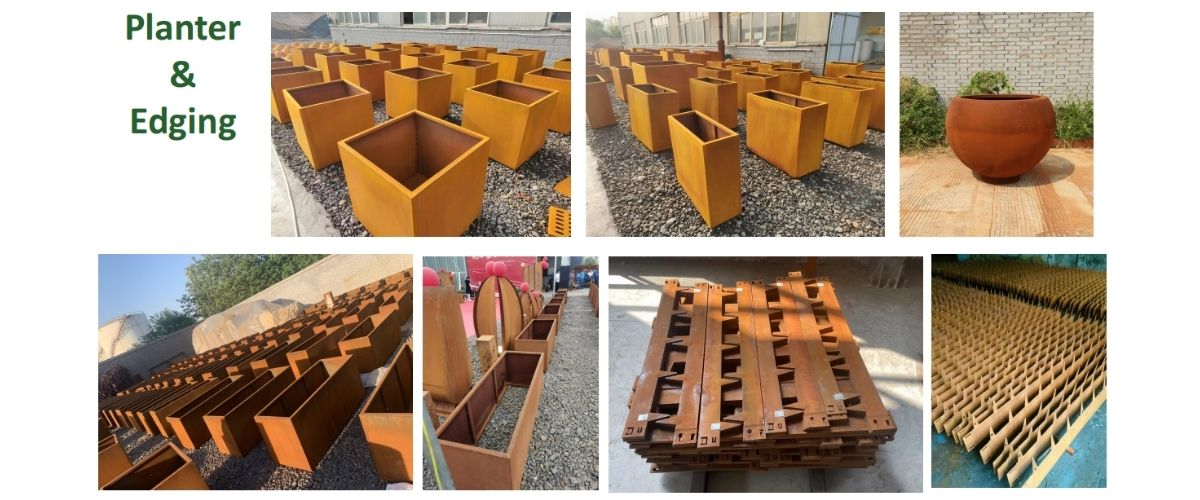
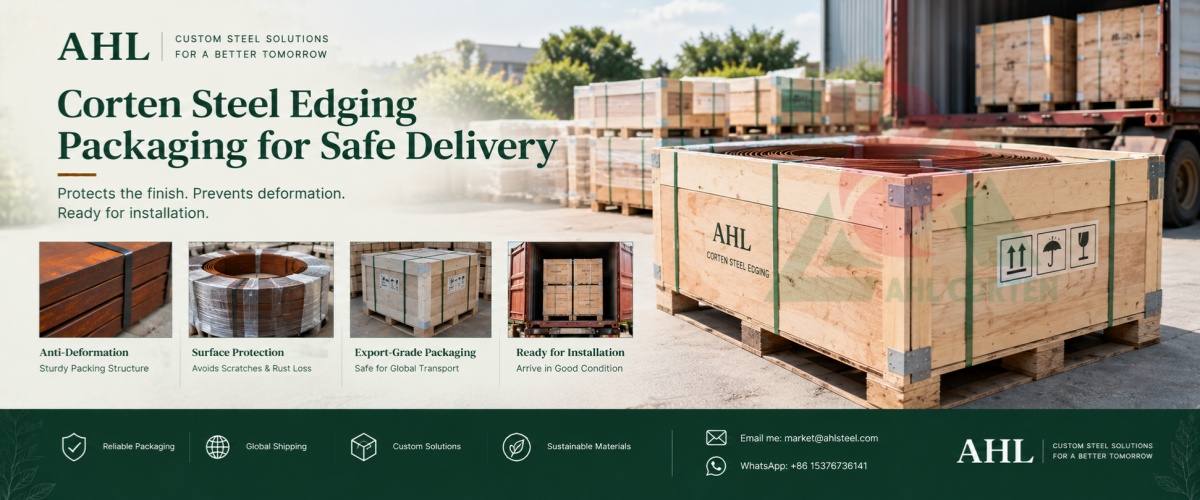
We can provide packaging specifications, quantity per package, logistics parameters, and bulk pricing.
When comparing costs, do not focus solely on the unit price of the steel plates; be sure to include accessories, fastening systems, and technical drawing support in your evaluation.
Frequently Asked Questions
Q: Why Do Corten Steel Garden Edging Panels Keep Tilting?
A: Check the following in order: the compaction of the base, the arrangement of ground anchors, and the stability of the joints. The most common cause is using standard edging panels to retain thick layers of soil, resulting in loads exceeding the product’s design capacity. In such cases, an upgraded retaining wall solution is required.
Q: How Deep Should Rusted Steel Garden Edging Be Buried?
A: There is no uniform standard; it depends entirely on the panel design. Buried edging should be installed according to the drawings; models with bases do not require burial and can be secured by placing them flat on the ground.
Q: How Many Ground Anchors are Needed Per Meter for Metal Garden Edging?
A: Follow the manufacturer’s drawings. Panel height, design, and soil conditions will all affect the spacing; do not apply parameters from other products.
Q: Can Weathering Steel Edging Be Installed Directly On Loose Soil?
A: Loose soil must be compacted in advance. Verify that the accompanying ground anchors provide sufficient holding power; if necessary, change the foundation plan—do not proceed with installation directly.
Q: If The Steel Plate Is Thicker, Does That Mean It Won’t Bend Or Tip Over?
A: Thickness is only one factor. Joints, anchoring, bracing, and load type are equally critical. In elevated retaining wall applications, even thick panels still require diagonal bracing for reinforcement.
Q: How Do You Secure Corten Steel Edging Along Curved Sections?
A: Use flexible edging designed for bending. Shape it gradually, increase the density of ground anchors, and backfill only after the line has been calibrated. Rigid panels for curved sections must be prefabricated at the factory.
Q: Can AHL Customize the Dimensions of Steel Landscape Edging?
A: We support custom dimensions. Please submit the height, thickness, length, curved layout, and quantity. Place your order after confirming the manufacturing process, joints, and delivery date.
Are You Ready to Choose the Perfect Outdoor Corten Steel Edging for Your Project?
Stable and durable weathering steel edging results from the combination of the right profile, proper anchoring, and a suitable foundation. Proper burial depth, secure joints, and layered backfilling are just as important as the quality of the steel plates themselves.
If you are planning a landscaping project or preparing to stock and wholesale weathering steel edging, please feel free to contact AHL.
Send us your layout drawings, required exposed height, retaining height difference, site soil conditions, and estimated purchase quantity. We will provide product drawings, installation plans, packaging information, and a quote—offering you a complete and stable edging solution, not just raw steel plates.
Need a Factory Quote for Corten Steel Edging?
Send your drawings, size list, quantity, and destination country. Corten Factory can support custom weathering steel fabrication, export packing, and project quotation.
Back

 Fill In The Inquiry