How to Choose Flexible Corten Steel Edging for Curved Garden Borders
Curved flowerbeds and winding paths can lend a garden a soft, dynamic atmosphere. However, conventional straight garden edging struggles to follow the fluid, organic curves of such natural shapes.
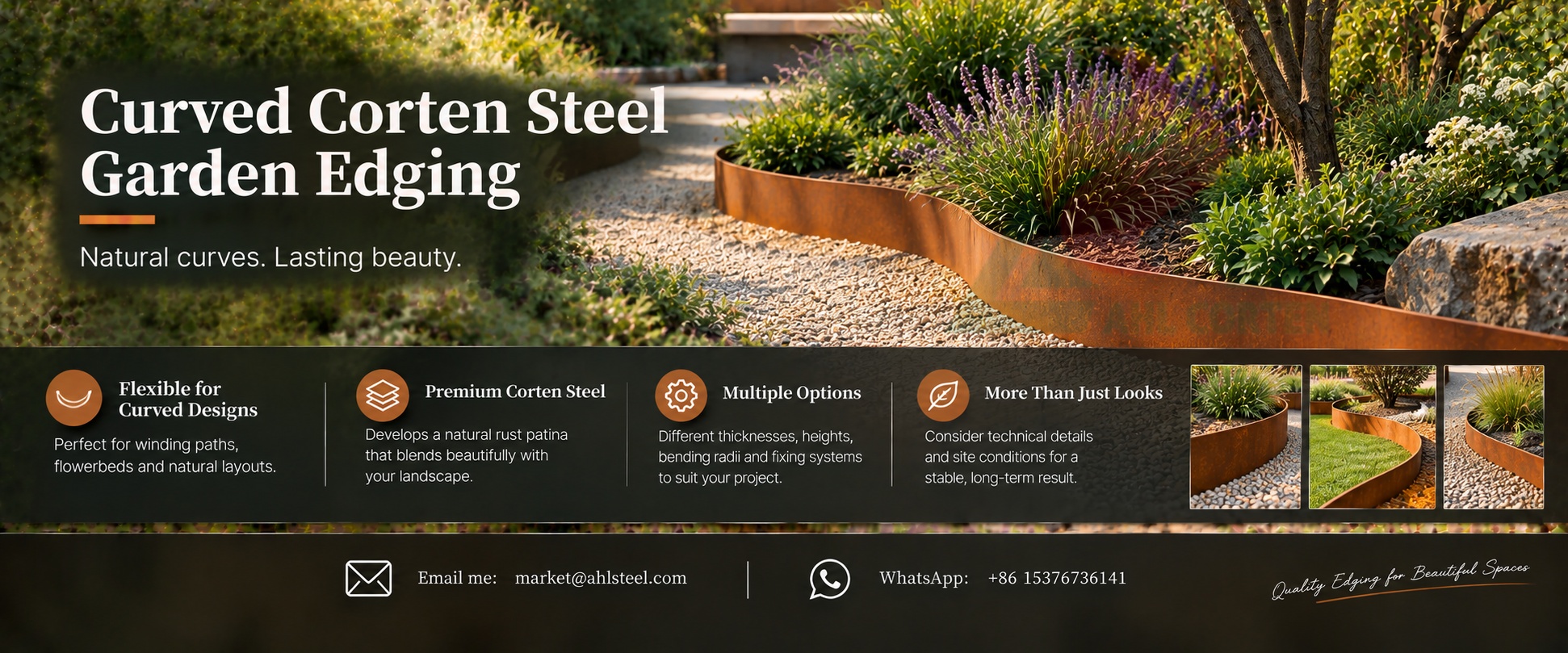
Flexible corten steel garden edging is designed specifically for these curved settings. It creates smooth, seamless boundaries between lawns, planting beds and gravel paths.
The unique natural patina of weathering steel blends beautifully with stone, natural timber and greenery. However, for landscape architects, contractors and specifiers, product selection cannot be based solely on appearance. Factors such as sheet thickness, minimum bending radius, edging height, fixing hardware and on-site soil conditions will all directly impact the final result.
This article will guide you through the key considerations for selecting curved weathering steel edging, compare the differences between standard and bespoke options, and help you plan an installation scheme to create curved landscape borders with clean, flowing lines.
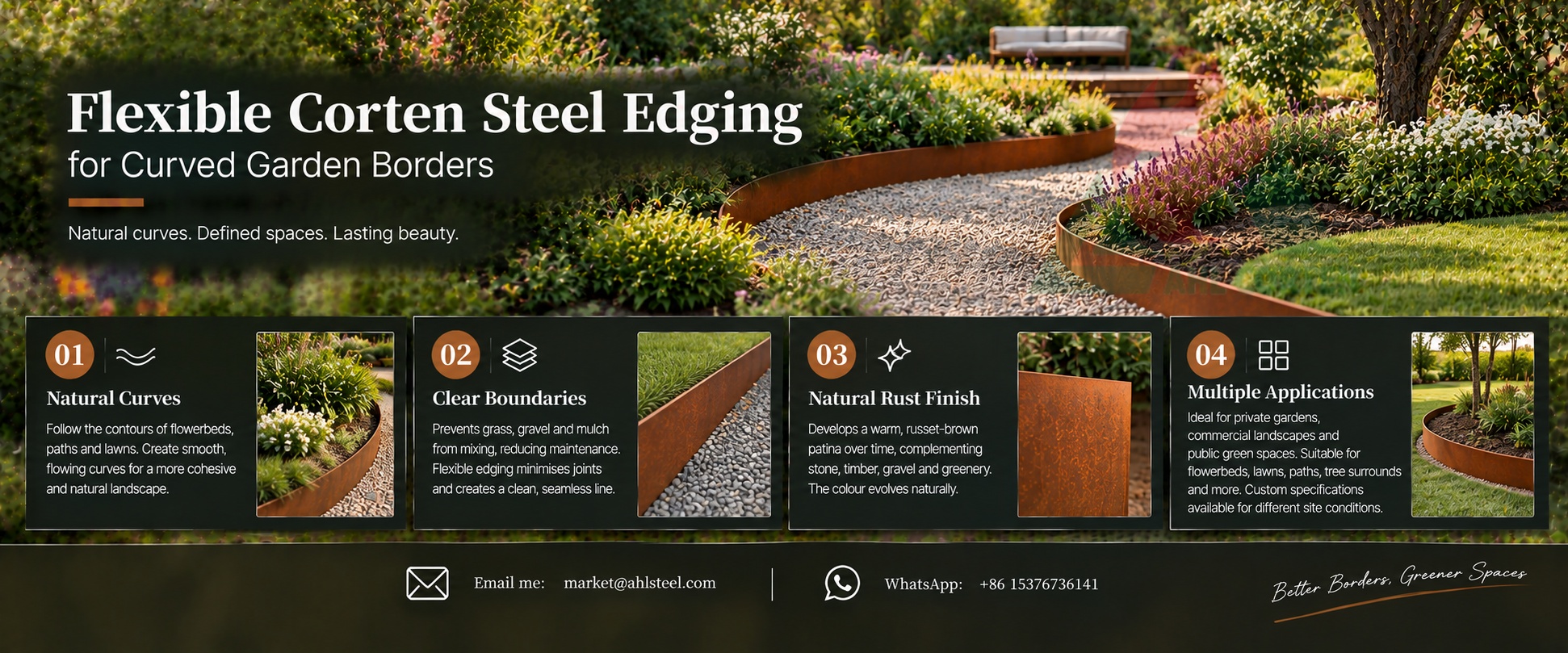
Why Use Flexible Corten Steel Edging for Curved Garden Borders?
1. Create Smooth and Natural Garden Curves
Flexible rusted steel garden edging can be laid to follow the contours of wide arcs, natural flowerbeds and winding footpaths. It is ideal for natural-style gardens, avoiding the disjointed feel created by harsh right angles.
Coherent, flowing curves visually link the various areas of the garden. They can both guide visitor pathways and frame groups of plants, creating a more cohesive landscape design.
2. Define Clear Boundaries Between Landscaping Materials
Metal edging creates a sturdy barrier, preventing lawn, gravel and bark mulch from intermingling and spreading, thereby reducing the workload required for future maintenance.
If short straight sections are joined together to form a curved boundary, the result is numerous joints and a fragmented line. Flexible edging minimises joints, creating a clean, seamless boundary.
3. Enhance Outdoor Aesthetics with a Natural Rust Finish
Weathered steel gradually develops a warm, russet-brown patina when exposed to alternating wet and dry conditions outdoors. It creates a layered contrast with light-coloured gravel, dark stone, natural timber and greenery, making it suitable for both modern courtyards and natural-style gardens.
The rust colour is the result of the material’s natural weathering, and the hue will continue to evolve. Before purchasing, it is important to understand the weathering characteristics of weathering steel to avoid any misunderstandings regarding the final appearance.
4. Adapting to Different Garden Layouts
Supplier of flexible metal garden border edging, suitable for private gardens, commercial landscaping and public green spaces.
Common applications: curved flowerbed borders, lawn edging, gravel paths, tree surrounds and decorative planting areas.
Specifications vary according to site conditions; a single set of specifications cannot be applied universally to all projects. The edging profile and fixing method must be selected based on the design and soil type.
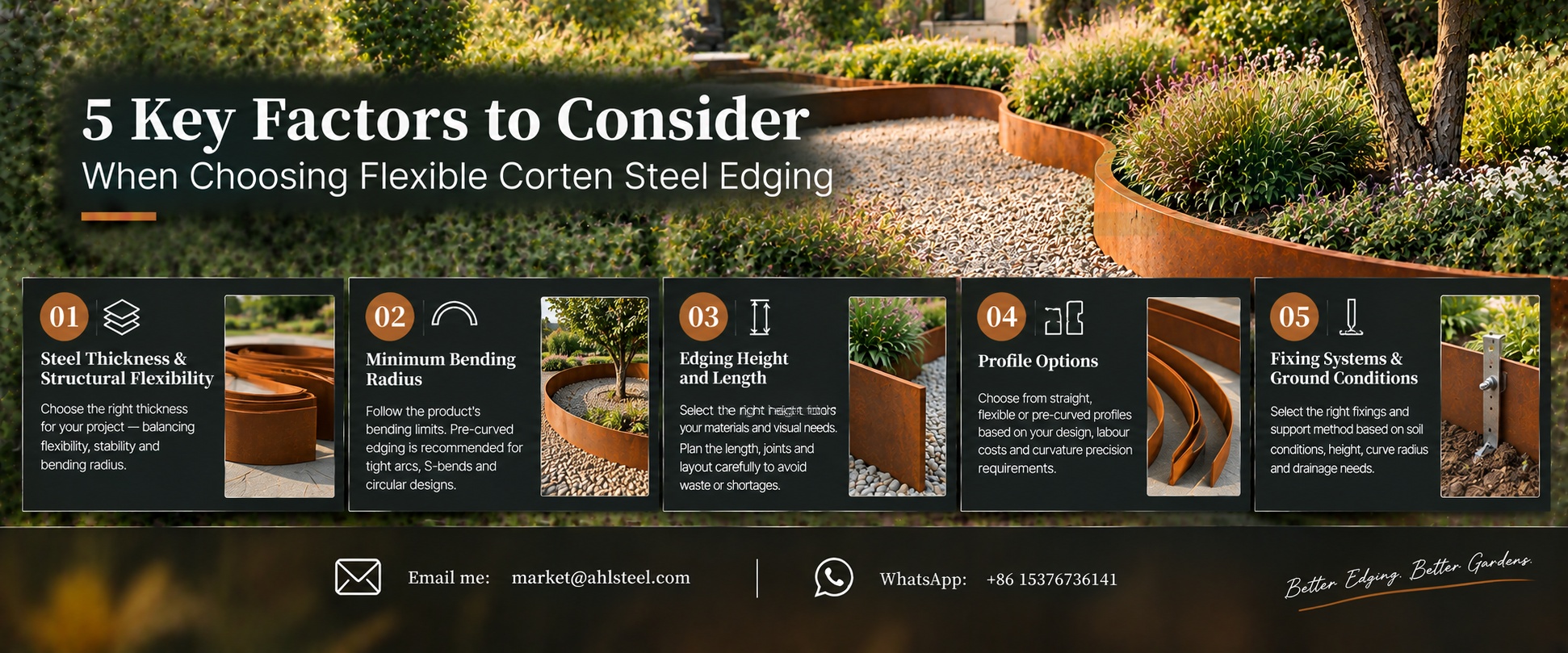
5 Key Factors to Consider When Choosing Flexible Corten Steel Edging
1. Steel Thickness and Structural Flexibility
Thickness determines both rigidity and the difficulty of bending. Thinner sheets are easier to bend and form on site; thicker sheets are more rigid, but require greater external force to bend, and some may need to be pre-curved at the factory.
When selecting a product, it is necessary to consider the bending radius, the height of the garden bed steel edging, and the intended use — whether it is simply for partitioning, or for retaining earth or gravel.
Do not blindly opt for the thinnest option, nor is thicker necessarily better.
It is advisable to request the recommended thickness range for the relevant product from the manufacturer to avoid the sheet being too rigid, which may prevent the desired curved effect from being achieved.
2. Minimum Bending Radius
Every flexible edging product has a bending limit; the minimum bending radius is determined by the sheet thickness, the profile design and the processing method.
Tight-radius arcs, continuous S-bends and neat circular tree pits: Prioritise factory pre-curved edging, as this ensures a more stable and uniform curvature.
Under no circumstances should you force the metal landscape edging beyond its bending limits, as this may cause creases on the surface or localised bulging and deformation, thereby spoiling the landscape lines. Before placing an order, confirm the curvature specified in the drawings and check the product’s permitted bending range.
3. Edging Height and Length
Height is determined by the material being separated and visual requirements: low-profile metal lawn edging is suitable for demarcating lawns and flowerbeds; high-profile edging is suitable for preventing soil, mulch or gravel from spilling over.
The length of individual sections affects the number of joints, handling difficulty and installation efficiency. Longer sections result in fewer joints and a more continuous line, but are more difficult to transport and position in confined spaces.
When measuring the total perimeter, allow for cutting, overlapping and joints, and plan the layout carefully to avoid material shortages or wastage.
4. Straight, Flexible or Pre-Curved Profiles
Straight edging: Suitable for neat, geometric layouts.
Flexible edging: Suitable for free-form, organic curves; adjustable on-site to adapt to varied site contours.
Factory-pre-curved edging: Features a fixed, uniform curvature; suitable for repetitive arcs and circular planting beds, reducing on-site fabrication and ensuring greater consistency.
The final selection should take into account the overall design complexity, labour costs and curvature precision requirements. For large-scale commercial projects with numerous repetitive arcs, pre-curved edging should be prioritised to ensure a more controllable outcome.
If a project features both straight and curved areas, the two types may be used in combination; however, the connection method between the two products must be confirmed in advance to avoid unsightly or mismatched joints.
5. Fixing Systems and Ground Conditions
The fixing solution is determined by soil conditions, the height of the Corten Steel Lawn Edging, the radius of the curve, and whether the edging is intended to retain soil.
Loose, loose soil, slopes, exposed areas to the wind, and firm, level ground all require different support and reinforcement methods.
Confirm the required ground pegs, connectors and burial depth; do not assume that a single set of fixing components will suit all soil types.
Consider drainage simultaneously to direct the flow of rainwater and prevent it from eroding the rear of the edging or hollowing out the soil, which could cause the metal garden border edging to shift.
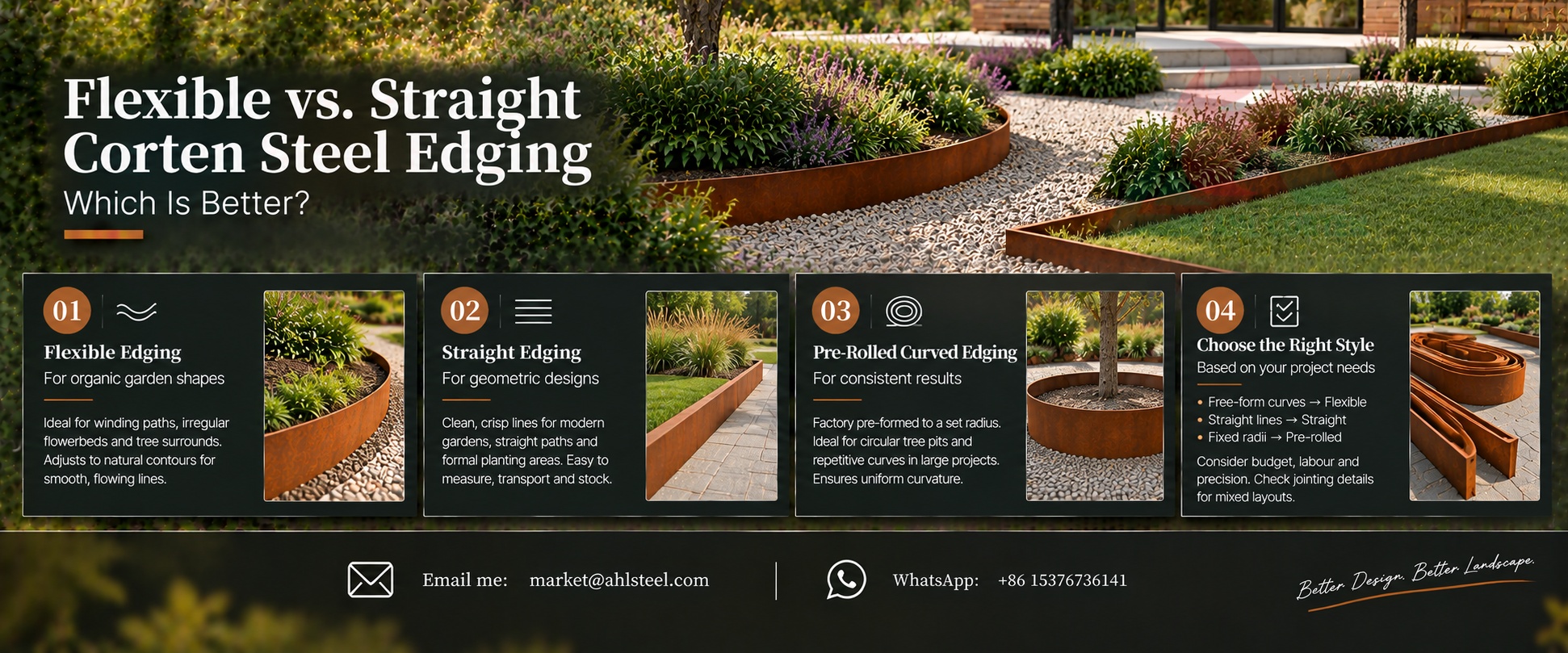
Flexible vs. Straight Corten Steel Edging: Which Is Better?
1. Flexible Edging for Organic Garden Shapes
Suitable for winding paths, irregularly shaped flowerbeds and edging around the bases of large trees. It can be adjusted to follow the natural contours of the terrain, avoiding the need to force the landscape into straight lines.
Flexible edging offers excellent value for money when designers seek soft, continuous lines that can be fine-tuned on site.
2. Straight Edging for Geometric Landscape Designs
With clean, crisp lines, this style suits modern gardens, straight footpaths and formal planting areas, creating a stronger architectural feel.
Straight edging is simple to measure, transport and replace, making stockholding and inventory management more convenient for suppliers.
3. Pre-Rolled Curved Edging for Consistent Results
pre-formed to a specified radius before leaving the factory. Suitable for circular tree pits and repetitive curved shapes in large quantities; commonly used in commercial landscaping projects.
Factory forming reduces the amount of on-site bending required, ensuring all sections have a uniform curvature and a more visually consistent appearance.
4. How to Choose Based on Project Requirements
Free-form curves → Flexible style; neat, straight-lined gardens → Straight style; fixed radii and repetitive arcs → Pre-rolled style.
Budget, labour hours and precision requirements must all be taken into account. When using a mixed layout, verify the jointing arrangements for different styles in advance.
How to Install Flexible Corten Steel Edging Around Curved Borders
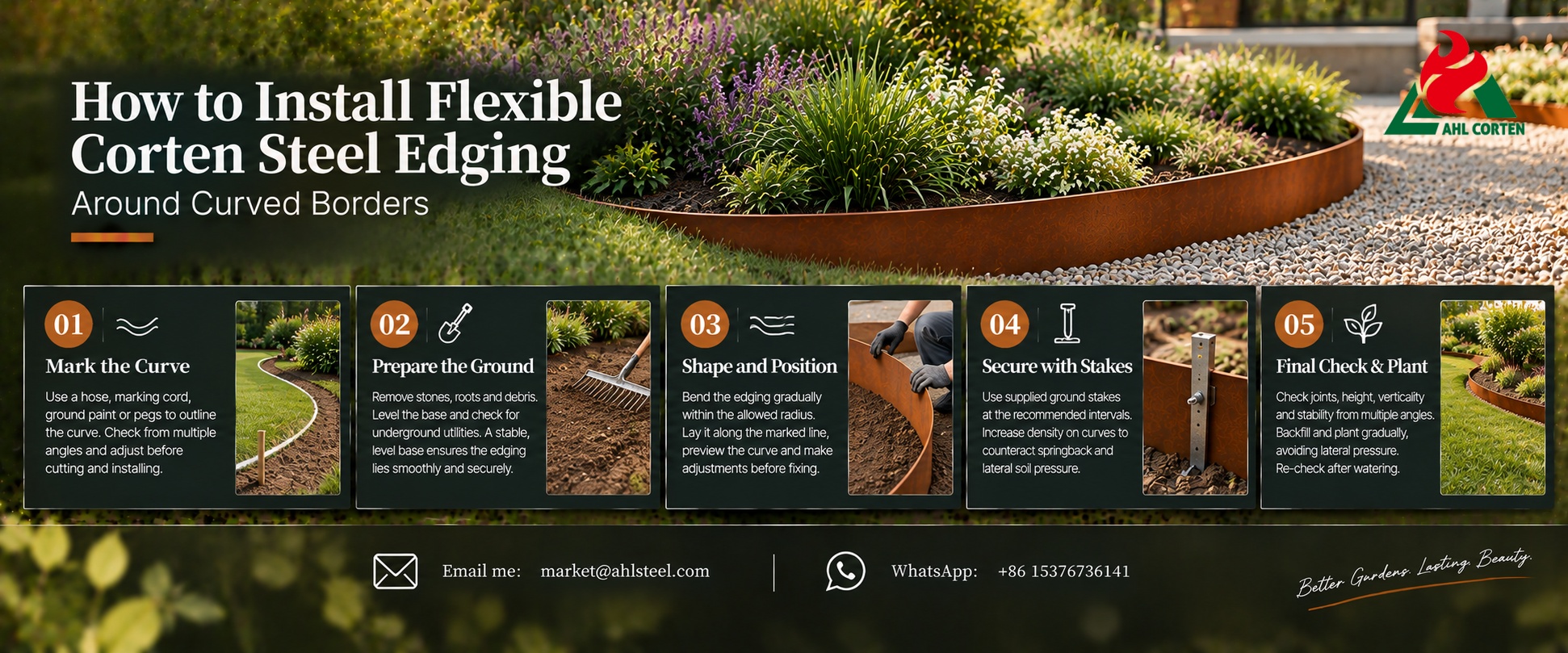
Step 1 – Mark the Desired Garden Curve
Use a hose, marking cord, ground paint or ground pegs to outline the desired curved boundary.
View the curve from multiple angles to ensure it flows smoothly, whilst checking that it aligns with footpaths, plants and drainage arrangements.
Adjust the line as required before cutting the steel and securing it in place.
Step 2 – Prepare the Ground
Clear stones, tree roots and debris from the marked area. Level the base to ensure the edging can be buried to a uniform depth and lies smoothly along the marked curve.
Check for underground utilities before excavating. A level and stable base is essential for aligning the rusted metal edging and securing it firmly.
Step 3 – Shape and Position the Edging
Shape the edging gradually, adhering to the permitted bending radius. Do not force bends to avoid sharp kinks or wrinkling of the panels.
Lay the panels along the marked lines, preview the overall smoothness of the curve, and secure them only once you are satisfied, to allow for adjustments at this early stage.
Step 4 – Secure the Edging with Fixing Stakes
Use the manufacturer’s supplied ground stakes and secure them at the recommended intervals. In curved sections, increase the density of the stakes to counteract the springback of the steel and lateral soil pressure.
Soil compression alone is insufficient to maintain the curved shape over the long term; fasteners are essential. Continuously check the curvature and height during the securing process.
Step 5 – Check Alignment and Complete Landscaping
Before backfilling, check the joints, height, verticality and overall stability, and examine the lines from multiple angles to ensure they are smooth.
Proceed with backfilling and planting gradually, taking care not to apply lateral pressure to the newly installed rusted steel garden edging. After backfilling and watering, re-check the edging for any displacement.
Standard vs. Custom Flexible Corten Steel Edging
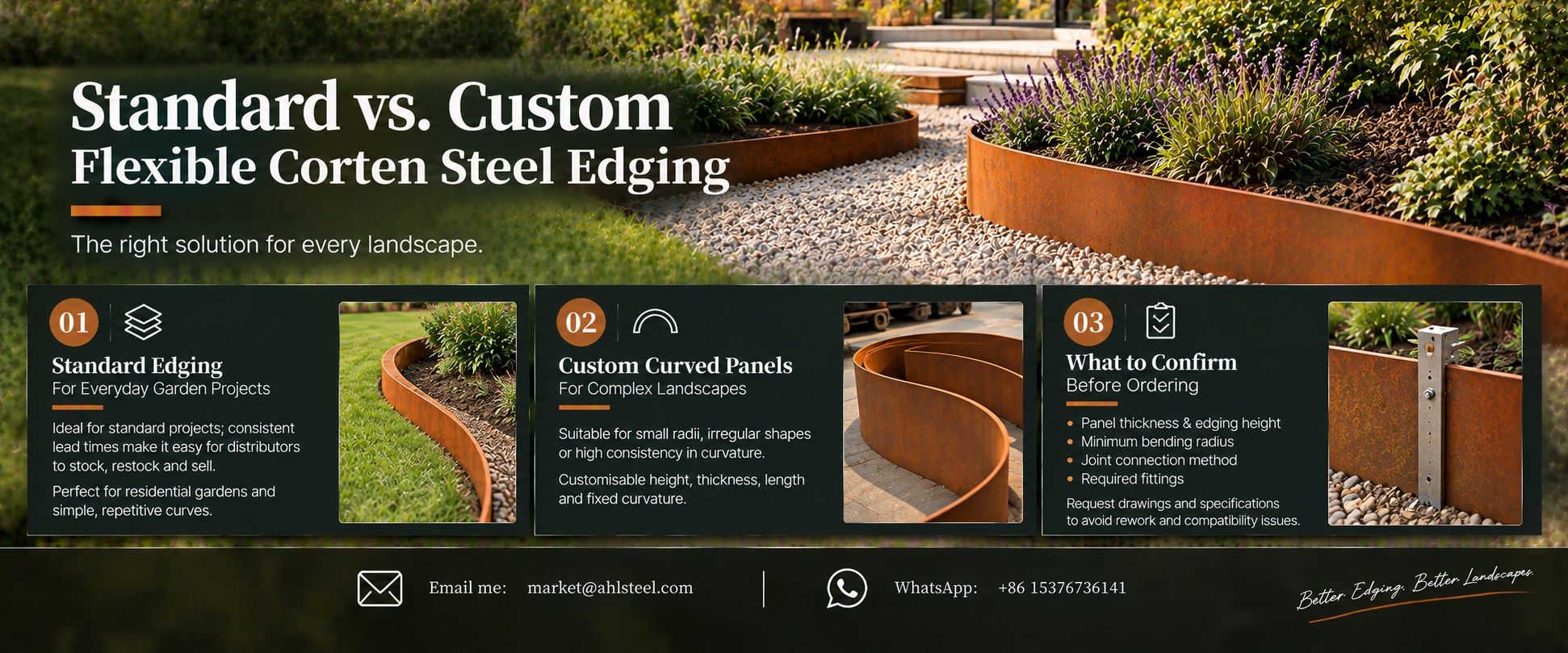
1. Standard Edging for Everyday Garden Projects
Suitable for standard garden projects; lead times are consistent, making it convenient for distributors to stock, restock and sell to the public.
For private residential projects and scenarios involving simple, repetitive curves, standard specifications are recommended as they simplify the procurement process.
2. Custom Curved Panels for Complex Landscapes
Suitable for landscape projects requiring small radii, irregular shapes or high consistency in curvature.
Height, thickness, length and fixed curvature can be customised. Before ordering, confirm manufacturing feasibility, tolerance ranges, minimum order quantities and production lead times.
3. What to Confirm Before Ordering
Panel thickness, edging height, minimum bending radius, joint connection method and accompanying fittings.
Request drawings and technical specifications in advance to avoid rework costs resulting from manufacturing errors or on-site compatibility issues.
Why Choose AHL Corten Steel Edging?
- Standard specifications: Length 1075 mm, thickness 1.6 mm / 2.0 mm, height 100 mm and 150 mm, covering most standard garden projects.
- Customised solutions: Subject to production capacity, we support custom heights, thicknesses and lengths, as well as factory-pre-curved edging.
- B2B project support: For landscape contractors, retailers and distributors, we provide product specifications, packaging materials and bulk quotations. Simply provide project drawings to receive a tailored solution.
Frequently Asked Questions
1. Can Rusted Steel Edging Be Bent Into Curves?
Yes. However, this depends on the sheet thickness, profile and the required radius. Gentle curves can be bent on site; for small-radius, high-precision arcs, we recommend pre-forming at the factory.
2. What Is the Minimum Bending Radius for Corten Steel Lawn Edging?
There is no standard specification; this is determined by the sheet thickness and the manufacturing process. Please send the design curvature to the manufacturer for verification before placing an order.
3. Is Flexible Corten Steel Edging Suitable for Flower Beds?
It is highly suitable and is a common solution for curved flower borders. Depending on whether it is intended purely as a boundary or as a retaining wall, select the appropriate height and fixing method.
4. Can Thick Rusted Landscape Edging Be Rolled Into Curves?
Thick sheets can be rolled, but this requires specialised equipment and greater forming force; feasibility must be assessed on a case-by-case basis, as there is no one-size-fits-all answer.
5. Is Pre-Curved Corten Edging Better Than Flexible Edging?
Pre-curved edging offers the advantage of consistent curvature, making it suitable for bulk projects with a fixed radius; flexible edging offers greater flexibility, making it suitable for irregular, organic shapes that require on-site adjustment. Choose according to your needs.
6. How Do You Secure Curved Metal Garden Edging?
Use the manufacturer’s supplied ground pegs, driving them into the ground at the specified intervals, with additional pegs at the curved sections. The fixing method should be tailored to the soil type and the height of the edging.
7. Can AHL Manufacture Custom Curved Corten Steel Edging?
We can assess customisation requests; please provide the dimensions, bending radius, plate thickness and estimated purchase quantity so that we may evaluate feasibility and provide a quotation.
Are You Ready to Choose the Perfect Corten Steel Edging for Your Outdoor Space?
Flexible weathering steel edging allows you to bring your ideas for curved garden designs to life, creating clean, flowing and naturally continuous landscape boundaries.
The key to selecting the right product lies in matching the sheet thickness, bending radius, edging height, fixing method and on-site conditions.
If you are planning a curved flower bed, tree pit or bespoke landscaping project, please contact AHL with your drawings, desired curvature, sheet specifications and estimated purchase quantity.
We will help you confirm suitable products, assess customisation feasibility and bulk order requirements, and provide a bespoke quotation for your project.
Want to Get Your Own Corten Edging? Click to Customize!
Back

 Fill In The Inquiry