How to Fix a Scratched or Damaged Corten Steel Screen Panel?
Date:2026.05.14
Share to:
Many property owners and project buyers often find themselves eagerly awaiting the arrival of their custom corten steel screens, only to discover scratches and dents on the surface of the panels.
Most people’s first reaction is to worry that this decorative metal feature will be completely ruined. However, unlike ordinary painted metal, weathering steel possesses a unique self-healing oxidation property.
The vast majority of surface scratches, installation wear, and minor dents do not compromise the structural strength of the outdoor privacy screens. In natural environments, the steel will gradually develop a rust layer (patina), causing the damaged areas to fade and become virtually invisible.
Drawing on professional engineering experience, this article clearly categorizes damage levels. It teaches you how to distinguish between minor scratches that require no intervention and damage that needs manual repair, while helping you avoid common maintenance pitfalls. Combined with AHL’s professional supply and maintenance solutions, you can easily care for your weathering steel screens.
1. Most Damage Can Be Repaired; Some Does Not Require Repair
Corten steel is not a coated metal; it is an active steel that develops a rust layer over time. Whether it can be repaired and how it should be repaired depends entirely on the depth and type of damage.
Blindly sanding or misusing chemical agents can cause permanent color discrepancies. This is also the most common pitfall in weathering steel maintenance.
2. Damage Classification and Corresponding Solutions
a. Minor Surface Scratches (No Grooves)
Damage Condition: The corten steel screen only exposes the bright steel substrate; there are no obvious physical grooves; the surface has slight wear.
Treatment: No manual repair required. With the help of air and moisture, natural oxidation will allow the damaged area to blend seamlessly with the surrounding rust color within 2–4 weeks.
b. Damage to Pre-formed Rust Layer
Condition: The uniform rust layer pre-formed at the factory has been scratched, resulting in a patchy and uneven surface color.
Treatment: Lightly sand the surface to maintain the sheet’s permeability, then allow it to undergo a second round of natural oxidation to restore its appearance.
c. Deep Scratches and Dents on Corten Screens (with burrs)
Damage Condition: Scratches penetrate deep into the rusted steel screen surface, creating distinct grooves with metal burrs along the edges.
Solution: Use fine sandpaper to grind away the burrs, preventing water accumulation in the grooves that could cause irregular rust flow. After sanding, allow the surface to oxidize and renew naturally.
d. Welded Seams and Chipped Edges (High-Risk Damage)
Damage Description: Cracked weld seams and chipped edges, which are structural weak points of the corten steel screen and can accelerate electrochemical corrosion.
Solution: Do not attempt to sand these areas yourself. Professional repair is required using weathering steel electrodes of the same material to prevent permanent rust-induced voids.
e. Outdoor Metal Screens: Perforations and Structural Deformation
Damage Condition: Perforations through the metal panels and severe twisting or deformation, compromising structural stability.
Solution: Direct replacement of the panels is recommended. Structural repairs are more costly than replacement and cannot restore the original factory flatness.
3. AHL Industry Advisory: Avoid Excessive Repairs to Prevent Further Damage
The primary cause of damage to corten steel privacy screens is often not transportation-related impacts, but rather improper repairs. Many users, eager to fix the issue, use strong acids, polishing machines, or low-quality fillers to treat scratches. This destroys the steel’s chemical activity, resulting in permanent pitting and color discrepancies. Adhering to the principle of allowing natural repair without artificial intervention is the core logic of weathering steel maintenance.
Repair Tool Checklist: Categorized by Damage Severity
Different levels of damage require completely different repair tools. Clearly defining the limits of DIY repairs can help you save money while avoiding repair risks.
1. Minor Scratches (Difficulty: ★☆☆☆☆)
Essential Tools: Soft-bristle brush, lint-free microfiber cloth, neutral industrial cleaner. Key Steps: Clean only surface dust and stains. Do not sand vigorously; preserve the steel’s original oxidized texture.
2. Moderate Scratches and Dents (Difficulty: ★★★☆☆)
Essential Tools: 120–240-grit sandpaper, rust-removing cleaning pads. Key Steps: Sand only the raised burrs; do not damage the surrounding intact rust layer to prevent large-scale color discrepancies.
3. Structural and Weld Damage (Difficulty: ★★★★★)
Essential Tools: Specialized weathering steel welding rods, angle grinder, sheet metal shaping tools. Recommendations: Do not attempt DIY repairs. Welding with incompatible materials will create permanent rust-prone gaps; contact AHL after-sales for professional repair.
4. Scope of DIY vs. Professional Repairs for Rusty Metal Screens
DIY-friendly tasks: Deburring, cleaning oil stains, and routine monitoring of oxidation. Professional-only tasks: Hole repair, major dent repair, weld reinforcement, and structural repairs.
3 Step Standard Repair Process: Precise Operation Even for Beginners
Step 1: Deep Cleaning + Precise Damage Assessment
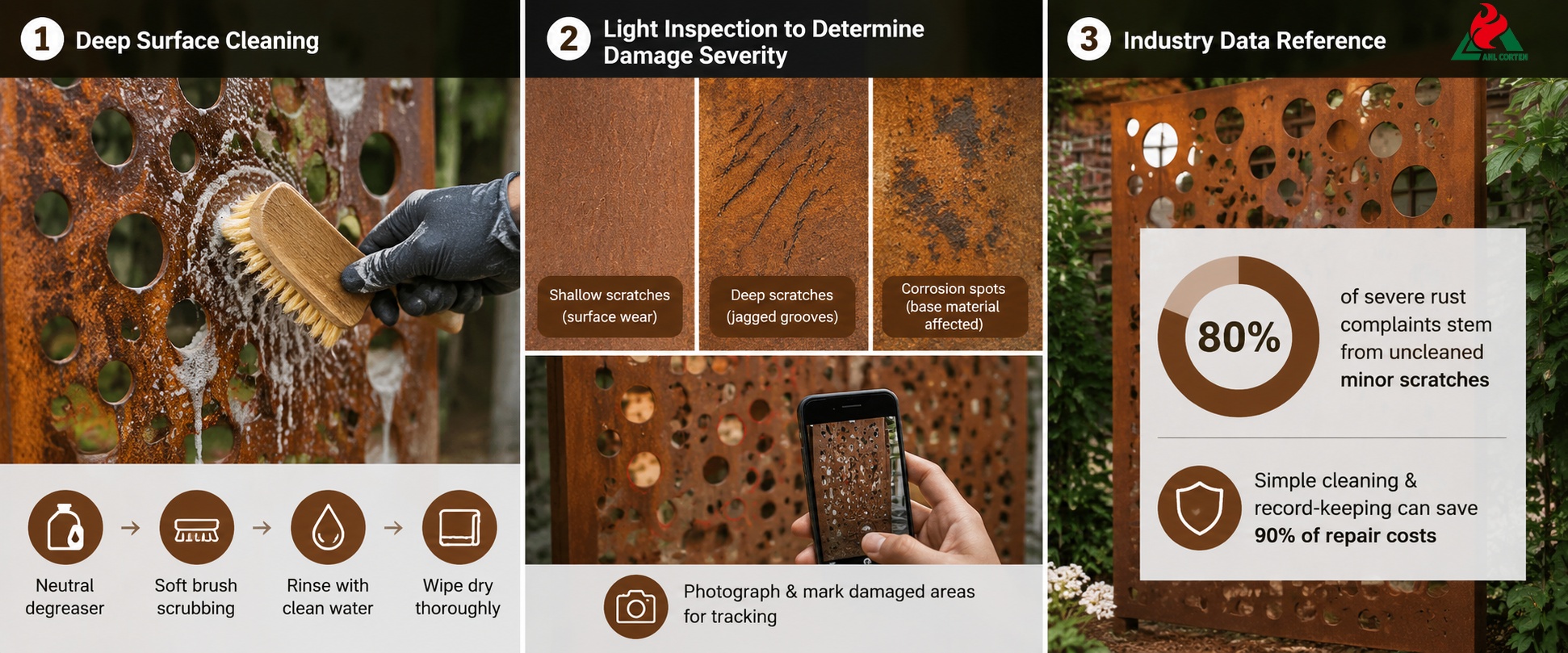
1. Deep Surface Cleaning
Construction dust, fingerprints, and oil residue can hinder the formation of a protective rust layer and accelerate localized corrosion. First, scrub the damaged area with a neutral degreaser and a soft brush, then rinse with clean water to remove any remaining impurities. After cleaning, be sure to wipe the surface dry to prevent moisture from accelerating corrosion.
2. Light Inspection to Determine Damage Severity
Examine the condition of scratches in a well-lit environment: Shiny, shallow marks indicate surface wear; jagged grooves indicate deep damage. If dark corrosion spots appear, it indicates that impurities have penetrated the base material, requiring immediate intervention. For large-scale corten steel screens, it is recommended to photograph and mark the damaged areas to facilitate tracking of oxidation and discoloration later.
3. Industry Data Reference
According to AHL after-sales statistics, 80% of complaints regarding severe rust stem from minor scratches that were not cleaned promptly. Simple cleaning and record-keeping procedures can save 90% of subsequent repair costs.
Step 2: Fine Sanding to Facilitate Natural Secondary Oxidation
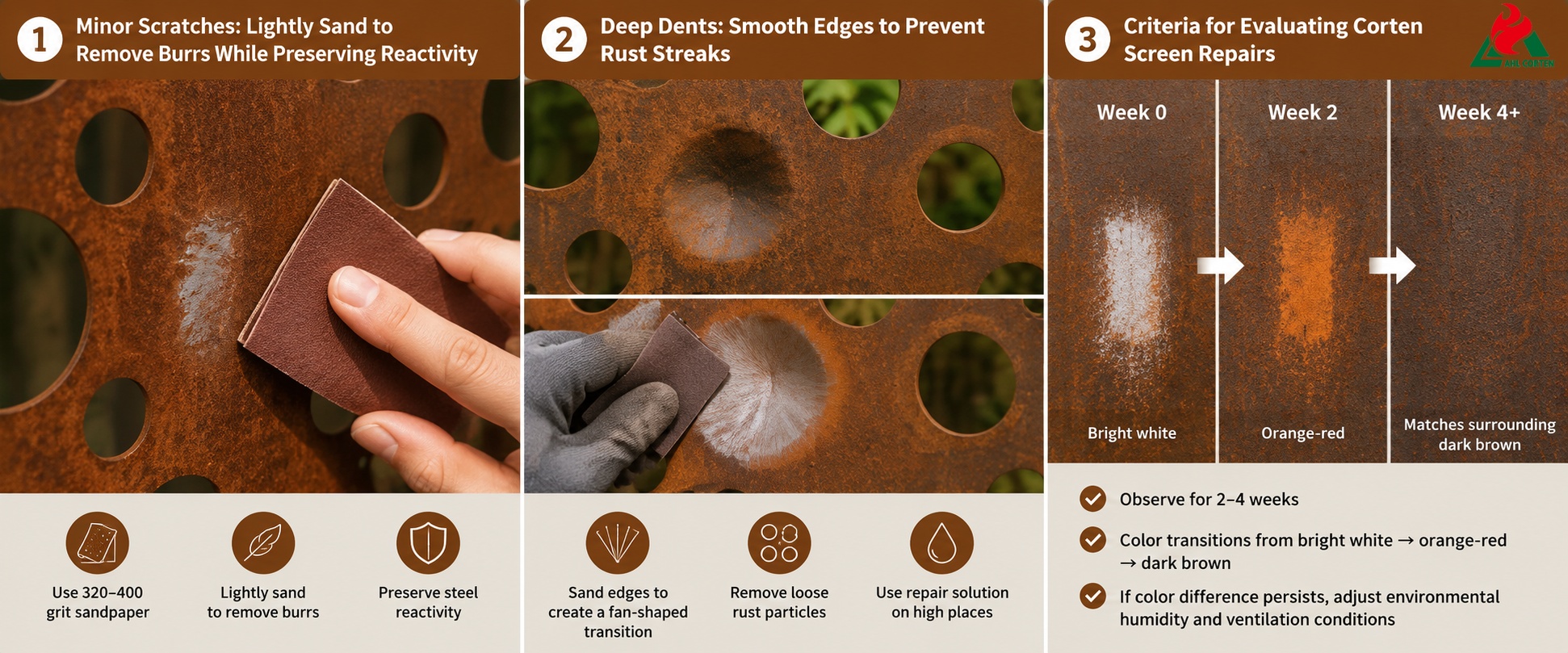
1. Minor Scratches: Lightly Sand to Remove Burrs While Preserving the Steel’s Reactivity
If there are raised metal burrs at the scratch site, use 320–400-grit fine sandpaper to lightly sand the area smooth. Avoid excessive polishing; preserving the base material’s reactivity is essential for the rapid formation of a new protective rust layer.
2. Deep Dents: Smooth Edges to Prevent Rust Streaks
Sand the edges of the indentation to create a gentle, fan-shaped transition, avoiding sharp corners where water can pool. Remove loose rust particles from the dent. For corten steel screen panels in high places, apply a small amount of specialized repair solution to accelerate crust formation and prevent rainwater from washing away the rust and creating unsightly streaks.
3. Criteria for Evaluating Corten Screen Repairs
Observe the repaired area for 2–4 weeks. If the damaged area gradually changes from bright white to orange-red and eventually approaches the surrounding dark brown color, the repair is successful. If significant color differences persist over time, this is typically due to an imbalance in environmental humidity cycles, and ventilation conditions must be adjusted.
Step 3: Localized Protection for Specific Climatic Conditions
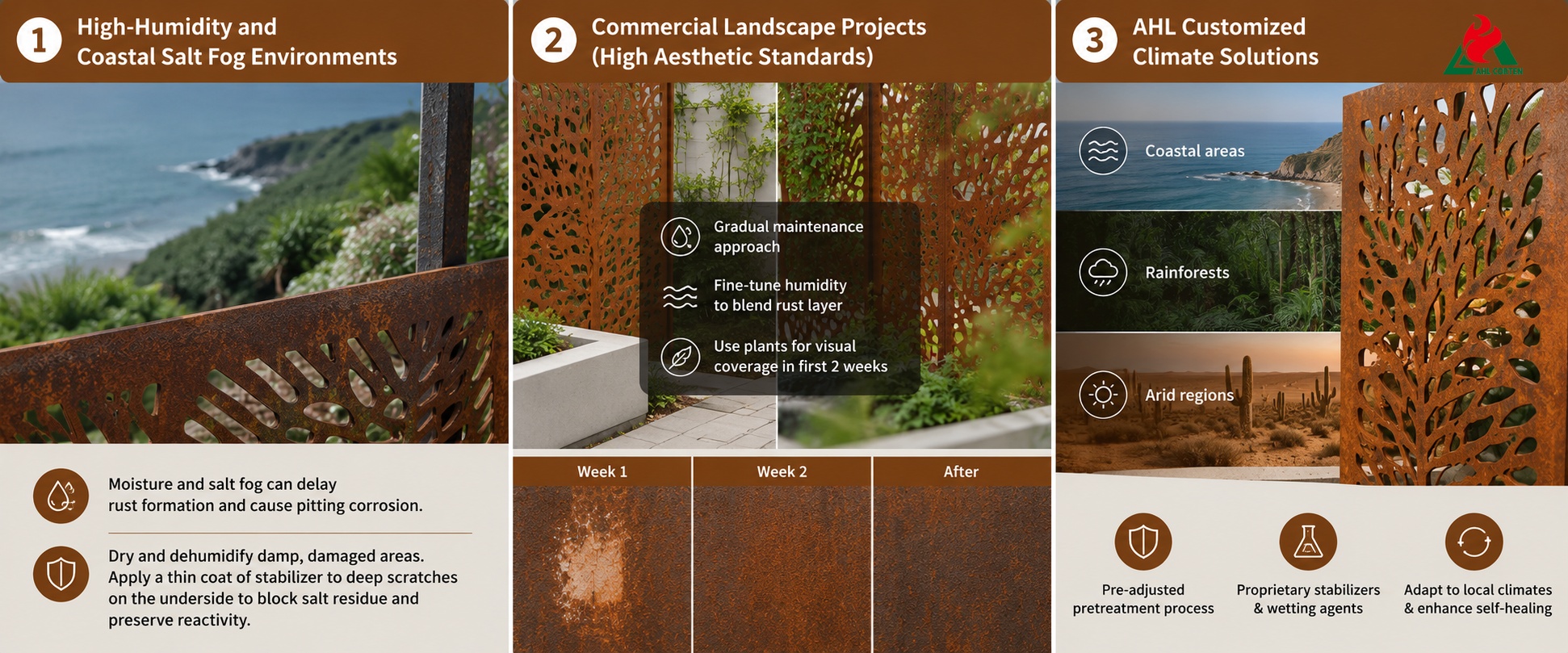
1. High-Humidity and Coastal Salt Fog Environments
Moisture and salt fog can delay the formation of the rust layer and lead to pitting corrosion. Manually dry and dehumidify damp, damaged areas. Apply a thin coat of a specialized stabilizer to deep scratches on the underside to block salt residue and lock in the substrate’s reactivity.
There is no need to pursue an instant, flawless finish; instead, adopt a gradual maintenance approach. Fine-tune the surrounding humidity to guide the rust layer to spread and blend into the damaged area; for the first two weeks after repair, use plants to provide simple visual coverage, minimizing the appearance of color differences.
3. AHL Customized Climate Solutions
For different environments such as coastal areas, rainforests, and arid regions, AHL can pre-adjust the pretreatment process for rusty metal screens. Combined with proprietary stabilizers and wetting agents, these solutions adapt to local climates and enhance self-healing capabilities.
Avoiding Pitfalls: 4 Maintenance Practices You Must Never Do with Corten Screens
1. Do Not Perform Large-Scale Rust Removal or Polishing on Corten Screens
Do not use a polishing machine to grind away the intact rust layer on the edges. Once the natural protective patina is damaged, it will permanently turn white and will not blend with the main body of the corten garden screen.
2. Corten Screens: Avoid Strong Acids and Alkalis
Industrial rust removers and chlorine-based cleaners alter the steel’s alloy composition. This leads to black spots and discoloration over time, causing irreversible damage.
3. Corten Screens: Never Apply Anti-Rust Paint
Paint isolates the surface from air, blocking the corten steel’s natural oxidation and self-healing process. As the paint peels, it leaves unsightly, patchy damage.
4. Corten Screens Do Not Blindly Pursue Instant, Flawless Appearance
The beauty of weathering steel lies in the patina developed over time. AHL’s specialized rust removal and restoration spray can shorten the color-blending cycle to just a few days, making it ideal for rapid touch-ups in high-visibility areas.
Replacement Criteria: When Must Corten Screens Be Replaced?
The purpose of maintenance is to restore aesthetics and corrosion resistance. If any of the following three conditions occur, prioritize replacing the corten screen panels to ensure project safety.
1. Structural Distortion of Corten Screens
Impacts causing bends or creases alter the internal stress of the steel. Forced repairs cannot restore flatness and will also reduce wind resistance.
2. on Welding and Mounting Points of Corten Screens
Tears in welds or screw holes pose a risk of collapse during strong outdoor winds. Surface repairs are prohibited for such damage; replacement is mandatory.
3. Corten Screens: Perforations and Extensive Edge Chipping
Through-holes allow water to seep in and corrode the internal framework. Repair costs far exceed the cost of replacement, and the aesthetic result after repair is extremely poor.
4. AHL Post-Sales Damage Mitigation Plan
For severe damage, please send actual photos. Our technical team will conduct a rapid assessment via CAD and support localized repairs or modular replacements, eliminating the need to scrap the entire screen. For large-scale projects, reserve spare panels to enable quick, seamless replacement.
Corten Screens Proactive Protection: Reducing the Probability of Screen Damage at the Source
1. Procurement and Acceptance: 3 Strict Quality Inspection Standards
Packaging Inspection: ISPM 15-compliant wooden crates are used, lined with EPE foam and corner protectors to prevent damage during ocean transport.
Edge Finishing: Panels are chamfered and polished to a smooth finish, free of burrs, to prevent secondary scratches during handling and installation.
Supporting Documentation: An official maintenance manual is provided upon shipment, covering scratch treatment, cleaning, and solutions for abnormal rusting.
Daily Maintenance: Golden Rules for Corten Steel Screens
Regular Gentle Dusting: Use a soft brush and clean water to remove dust, bird droppings, and debris to prevent dirt buildup and corrosion.
Ensure Drainage and Ventilation: Leave drainage gaps at the bottom; do not install flush against walls. Allow air circulation on both sides to ensure more even rust patina development.
Avoid Rough Scrubbing: Do not use steel wool or stiff brushes to scrub the surface, as this may damage the stable rust layer.
Structural Advantages of AHL Corten Steel Screens
All screens are designed with scientifically engineered drainage and ventilation gaps. The low-maintenance structural design reduces long-term upkeep and is suitable for long-term outdoor landscape use.
Frequently Asked Questions About Corten Steel Screens
1. Will Self-Repairing Corten Screens Worsen Scratch Damage?
Following the principle of minimal intervention will not worsen the damage. Most damage stems from the use of incorrect tools, such as polishing machines or strong acid solutions. Simple cleaning followed by rest will trigger the steel’s self-healing ability.
2. Will the Rust Color Be Inconsistent After Repairing Corten Screens?
Short-term color variations are normal. By maintaining a cycle of wet and dry conditions, the color will gradually deepen over several weeks and eventually blend seamlessly.
3. Can Corten Screens Be Used In Coastal Salt Fog Environments?
They can be used, but require enhanced maintenance. In coastal areas, ensure thorough desalination cleaning and, if necessary, apply a protective sealant to delay salt fog corrosion.
4. How Should Scratches Caused By Transportation Be Handled?
Take panoramic and detailed photos immediately and contact after-sales service for an assessment. Surface scratches will heal naturally, while structural damage may qualify for a replacement solution.
Custom High-Quality Screens—A One-Stop Solution to Prevent Damage
Tired of worrying about shipping scratches and construction damage to your weathering steel screens? Choose AHL to eliminate panel damage at the source. With years of expertise in weathering steel metal landscaping, we ship our products in marine-grade protective packaging and employ precision edge finishing to minimize impact damage, making them suitable for complex project sites such as coastal areas, wetlands, and arid regions. Whether for small-scale garden decorations or large-scale commercial landscape projects, we offer custom dimensions, pre-weathering treatments, and climate-adapted solutions. We provide an official maintenance manual throughout the process, backed by a professional after-sales technical team that offers free damage assessments, repair guidance, and modular replacement services—significantly reducing your rework costs and project timelines. Looking for high-quality, low-waste, and low-maintenance corten steel screens? Request a quote today! Simply provide your project site details, dimensions, and aesthetic requirements, and we’ll quickly deliver a customized quote and engineering plan. With project-reserve materials, free technical site surveys, and one-stop after-sales support, AHL is dedicated to delivering authentic, premium rusted steel screens that combine texture and durability.

.jpg)
.jpg)
 Fill In The Inquiry