Focus On The Latest News
Home > News
How Should Corten Steel Edging Be Packaged for Shipping?
Date:2026.10.08
Share to:
Corten steel edging is highly favoured for gardens and commercial landscaping projects due to its clean lines and excellent weather resistance.

However, whether transported by domestic road freight or shipped overseas, inappropriate packaging can easily lead to deformation of the profiles and damage to the surface rust layer. To ensure the goods are ready for immediate installation upon arrival at the site, a professional export-grade packaging solution is essential.

This article will outline the various risks involved in the transport of rusted steel garden edging, standard packaging structures, and key packaging considerations for different surface treatments, to assist buyers in assessing a supplier’s packaging capabilities.

weathering steel landscape edging
Want the Latest Catalog of Garden Edging? Contact Us!

Quick Answer: How Should Corten Steel Edging Be Packaged?


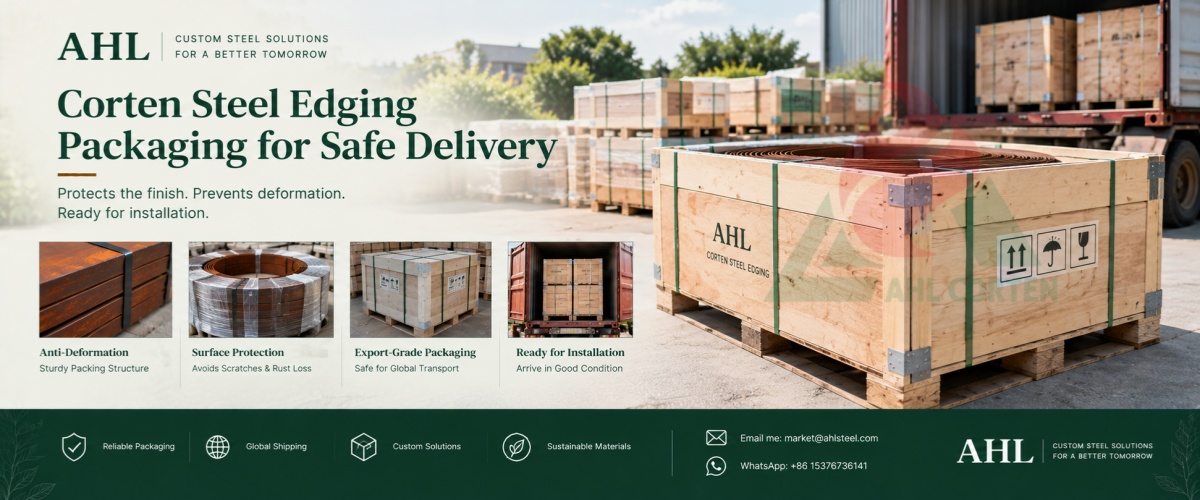
Rusted steel edging should be packed in secure, rigid bundles with protective separators, reinforced corners and strong strapping. For international shipping, pallets, timber skids or export-grade wooden crates should be used to prevent bending, scratches, moisture damage and shifting during handling.


Packaging Element Recommended Solution Main Benefit
Surface Protection Cardboard, foam, or woven separators. Prevents metal-to-metal rubbing and surface scratches.
Corner Protection Reinforced edge guards and corner protectors. Reduces impact damage during lifting, handling, and transport.
Structural Support Timber skids, battens, or rigid support frames. Helps prevent bending, twisting, and deformation in transit.
Bundle Securing Strong straps with protective blocks or edge guards beneath the straps. Keeps Corten steel edging stable and minimises movement during transport.
Outer Packaging Pallet, wooden frame, or export crate. Provides protection against stacking loads, loading pressure, and handling impact.
Moisture Control Ventilation, drainage gaps, desiccants, or route-appropriate moisture protection. Reduces condensation, water pooling, and uneven rust marks during sea freight.
Accessory Packaging Counted and labelled bags, cartons, or boxes. Prevents missing stakes, connectors, screws, and other installation fixings.
Shipping Labels Product code, quantity, dimensions, package weight, and handling marks. Simplifies receiving, inventory checking, unloading, and installation.
Ready to Elevate Your Landscape Design? → Get in Touch

What are the Risks of Damage During the Transport of Corten Steel Edgings?


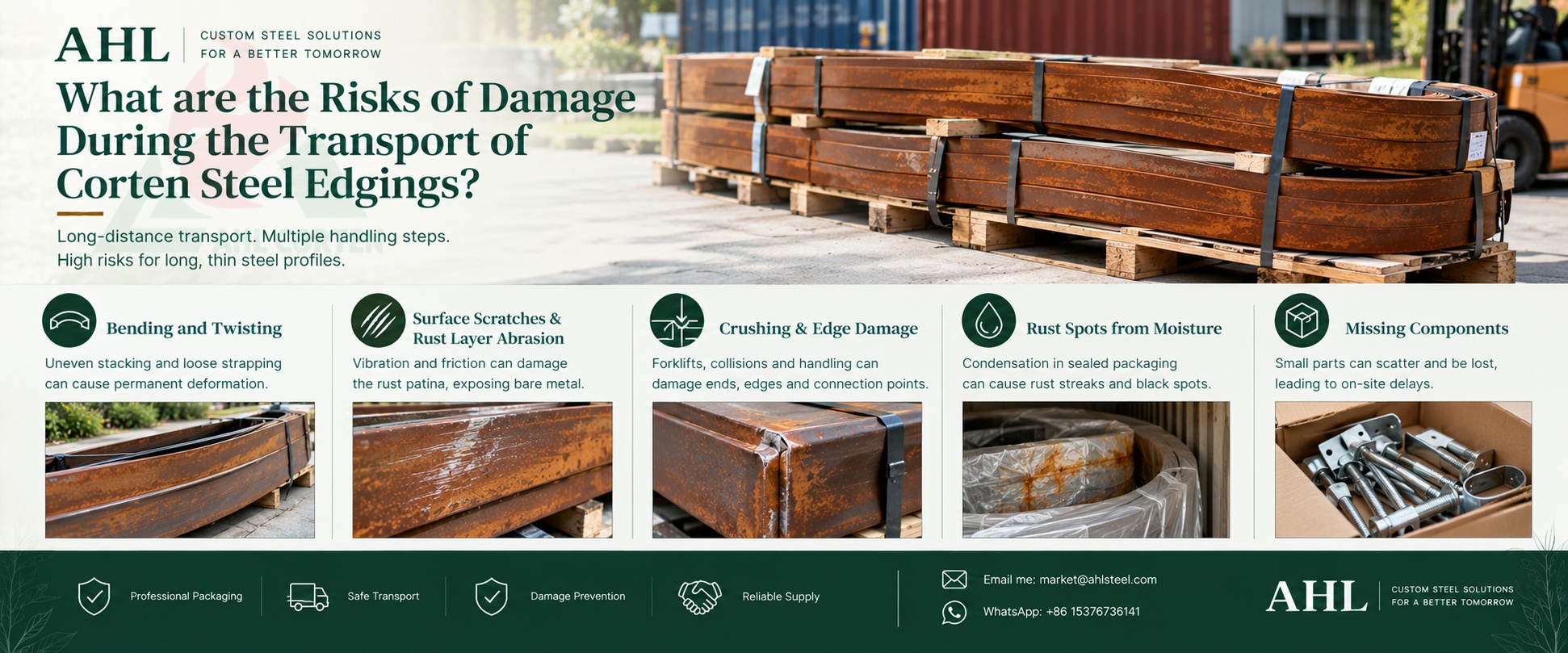
Long, thin metal profiles face multiple risks of damage during long-distance freight transport and container transhipment.


1. Bending
a
nd Twisting


Long edging strips measuring 2,000–3,000 mm or more have a high aspect ratio and are highly susceptible to bending and twisting when subjected to uneven stacking forces.

Loose strapping can cause the profiles to sag, resulting in permanent bowing. Upon arrival, these profiles cannot be aligned flush with the ground, directly affecting the quality of the installation.


2. Surface Scratches and Rust Layer Abrasion


The continuous vibration during long-distance transport causes the steel sections to rub and bump against one another.
For weathering steel products with a pre-formed rusted surface, this friction can damage the established rust patina, exposing shiny patches of bare metal and spoiling the overall appearance.


3. Crushing
a
nd Damage to Edges, Corners and Connection Points


Loading and unloading by forklift trucks, as well as collisions during container handling, are the most common causes of damage to the ends of the sections, bevelled edges, joining grooves and fixing holes.

Should the ends become crushed and deformed or the grooves be damaged, construction personnel will need to carry out on-site correction and repairs, thereby delaying the project schedule.


4. Rust Spots Caused By Moisture In Sealed Packaging


Weathering steel requires alternating dry and wet conditions to form a stable protective rust layer.
If wrapped in completely airtight plastic film, temperature differences within the container will cause condensation; as the moisture cannot escape, unsightly rust streaks and localised black spots will form.


5. Issues with Missing Components


Ground anchors, joining pieces, 90° corner joints and stainless steel fasteners are small components.
If left loose, they are likely to scatter and be lost during transit, causing work to be halted mid-installation on site.


Have Questions About Profiles, Finishes, or Shipping? → Talk to an Expert


Core Packaging Structure for Bespoke Corten Landscape Edging


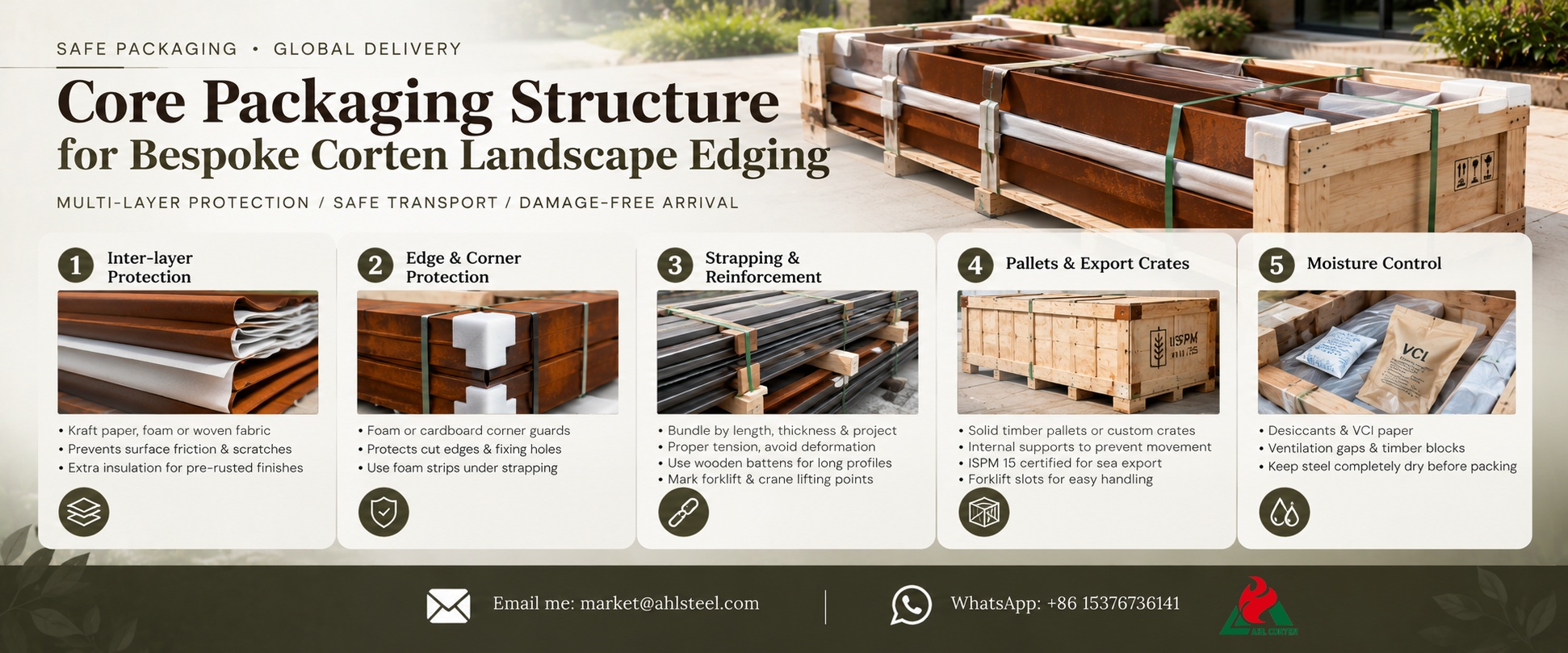
Proper packaging can prevent the vast majority of transport damage. The entire system is divided into five key modules: interlayer protection, edge and corner protection, strapping and reinforcement, palletised wooden crates, and moisture-proof treatment.


1. Inter-layer Separation Protection


Separating material is placed between the visible surfaces of each edging strip to prevent direct friction between steel components.

Optional materials: kraft paper, foam padding, woven fabric.

Standard uncoated weathering steel: Basic separation protection is sufficient, with a focus on preventing scratches.
Pre-rusted finished products: Thicker insulation is required; in certain operating conditions, a protective film should be applied to the surface to prevent the rusted surface from wearing away or discolouring.

When stacking or nesting items, a layer of insulation must be placed between each layer to prevent surface scratches caused by transport vibrations.


2. Edge, Corner and Point Protection


Edges, cut edges, joint grooves and fixing holes are high-risk areas for impact and must be fitted with corner guards.
Use foam corner protectors or cardboard sleeves to wrap the exposed ends and corners of the profiles.
Foam protective strips must be placed beneath strapping bands. If metal strapping bands are pressed directly against the surface of the weathering steel, indentations will remain permanently on the subsequently formed rust layer, affecting the appearance.


3. Strapping and Reinforcement


Group and bundle items according to profile length, sheet thickness and project area to facilitate sorting and retrieval on site.
Maintain appropriate tension in the strapping bands to secure the profiles against movement, whilst ensuring the pressure is not excessive enough to cause deformation.
Long profiles must not be supported solely at both ends; wooden battens must be fitted at regular intervals to provide full-span support, preventing the centre from sagging or bowing.
Mark the lifting points for forklifts and cranes on the packaging crates to ensure that the profiles are not damaged during loading and unloading operations.


4. Selection of Pallets and Export Crates


Standard orders: Use reinforced solid timber pallets; the profiles should be fitted with protective corner guards before being stacked on the pallets.
High-value, large-volume export projects: Use custom-made solid timber frame crates with internal supports to restrict the movement of the profiles within the crate.
For export by sea, timber compliant with ISPM 15 heat treatment must be used to meet the phytosanitary requirements of various countries and avoid customs detention.
Standard forklift slots must be provided in the wooden crates to facilitate loading and unloading at ports and construction sites.


5. Moisture Control During Transport


For sea transport and transport to high-humidity regions, moisture protection does not mean complete sealing.

· Use desiccants and VCI (vapour-phase corrosion inhibitor) paper to absorb moisture inside the crate.
· Leave ventilation gaps in the packaging and use timber blocks to elevate the goods, ensuring air circulation and preventing the build-up of condensation.
· Before packing, ensure that the
rusted steel edging itself is completely dry; do not seal damp steel directly into the packaging.

Delivery instructions: In humid conditions, customers must remove the outer packaging within 48 hours. If construction cannot commence immediately, the product must be stored in a well-ventilated, dry location, elevated off the ground.


Corten steel edging factory


Find the Right Edging Profile & Finish for Your Design → Request Our Latest Catalog


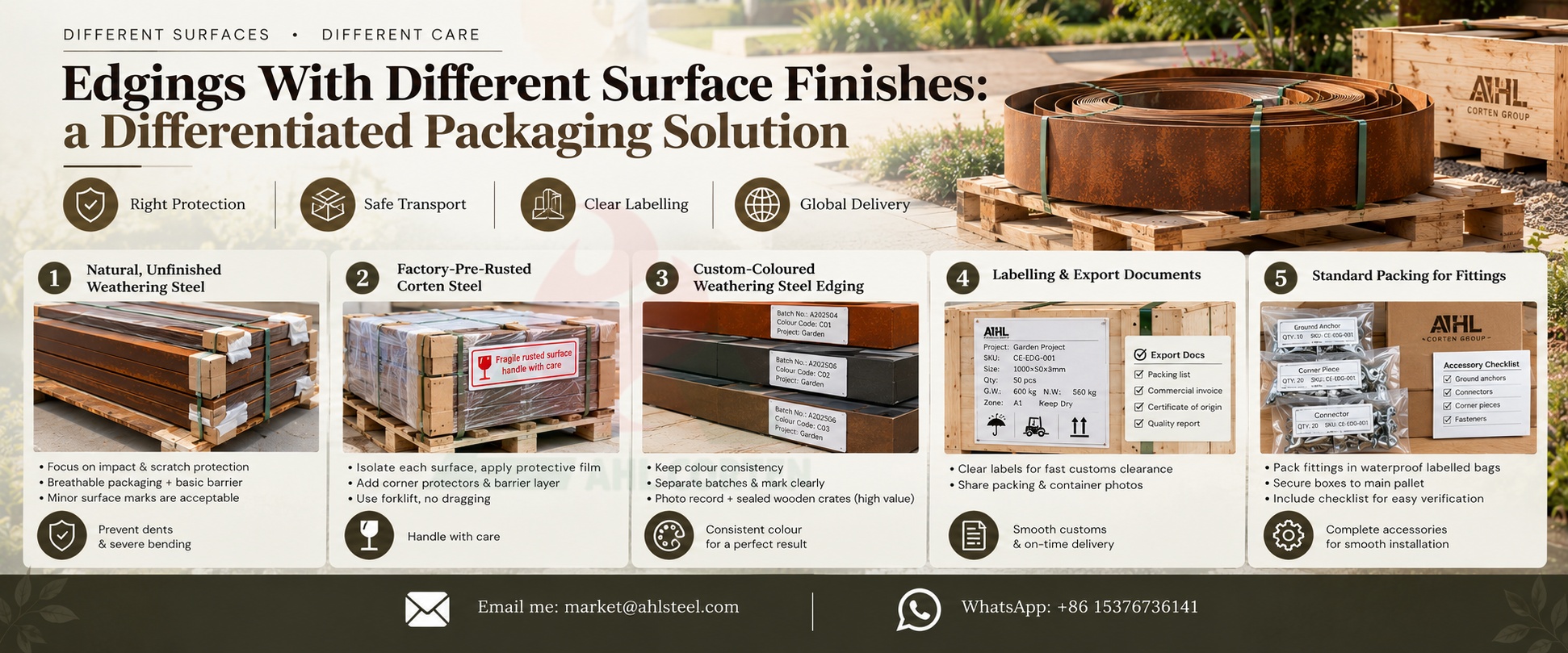
Edgings With Different Surface Finishes: a Differentiated Packaging Solution


As the protective requirements vary depending on the surface finish of the finished product, a single packaging solution cannot be applied universally to all products.


1. Natural, Unfinished Weathering Steel


The focus is on protection against impact and deep scratches; fully sealed packaging is not required.
Breathable packaging, combined with a basic barrier layer and corner protectors, is sufficient.
Minor surface marks caused during transport are permissible, as the product will continue to rust naturally once installed outdoors. The primary focus is on preventing physical damage such as dents and severe bending.


2. Factory-Pre-Rusted
Corten
 Steel


The pre-rusted surface is extremely fragile and requires a higher level of protection.
Each visible surface should be isolated as far as possible, and a protective film should be applied to the surface.
Print the following warning on the packaging: ‘Fragile rusted surface – handle with care’, to remind loading and unloading personnel not to drag the products.
Prioritise handling using forklift trucks; dragging the profiles along the ground is strictly prohibited.


3. Custom-Coloured Weathering Steel Garden Edging


Colour-matched finished products require extremely high colour consistency.
Pack different batches separately and mark the outer packaging with the batch number, colour code and project section.
Take photographs of the products prior to packing and provide these to the client with the consignment as a basis for quality verification.
For high-value projects, it is recommended to use sealed wooden crates with internal supports to minimise shaking and friction. For projects with tight deadlines, consider air freight to reduce transit times.


Packaging Labelling and Export Documentation


Clear labelling speeds up customs clearance and facilitates the rapid distribution of materials on site.
Each pallet and wooden crate must be labelled with:

  • Project name, product SKU and specifications
  • Profile dimensions, quantity per package, gross and net weight
  • Site installation zones, operational warnings (keep dry, forklift lifting points)

Export documentation: Packing list, commercial invoice, certificate of origin, quality inspection report.

Prior to dispatch, we provide the client with photographs of the packing and container loading process to ensure full transparency throughout the shipment process.


Standard Packing Procedures for Fittings


Ground anchors, straight connectors, corner pieces and stainless steel fasteners must not be placed loose within the profile bundles.

1. Count the fittings, place them in waterproof labelled bags, and mark the bag with the fitting model, quantity and the SKU of the matching skirting strip.
2. Place the accessory bags into dedicated cardboard boxes, which must be securely fastened to the main pallet.
3. Include a checklist inside each box so that the customer can quickly verify that all accessories are present upon receipt.


Looking for the Latest Edging Catalog? → Get Your Free Copy


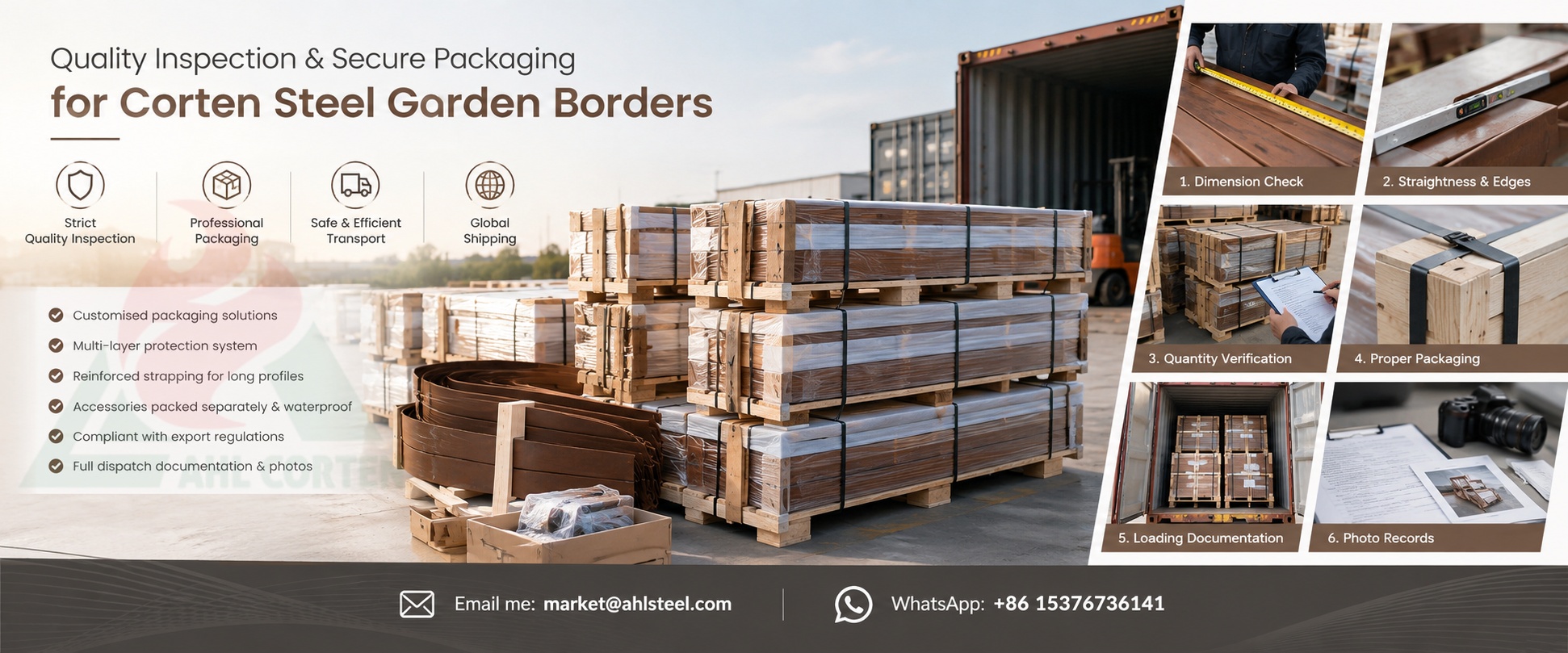
Key Points for Pre-Dispatch Quality Inspection


Before goods leave the factory, a comprehensive packaging quality inspection must be carried out:

1. Verify that the dimensions, height and thickness of the profiles match those specified in the drawings.
2. Inspect the straightness, edges and cut-outs of the profiles to ensure there is no physical damage.
3. Count the quantities of the main products and accessories, and cross-check against the packing list.
4. Verify that corner protectors, separator layers, timber battens and strapping are suitable for the chosen mode of transport (sea freight / road freight / air freight).
5. Retain photographic records of the finished products, packaging and container loading for archiving.


Essential Reading for Purchasing: Key Questions to Ask Suppliers


When purchasing
corten lawn edging, it is essential to confirm the packaging terms to avoid incurring additional costs later on:

1. Is export-grade wooden crate packaging included in the quotation, or is it charged separately?
2. Are separator layers installed between the profiles to prevent friction and scratches during sea transport?
3. How are the edges and joint grooves protected?
4. Do the exported timber pallets comply with the ISPM15 heat treatment standard?
5. How are small fittings packed and secured to prevent loss?
6. Can photographs of pre-shipment quality inspections and container loading documentation be provided?
7. Can you provide the packaging dimensions and weight in advance to facilitate our logistics arrangements?


AHL Corten Steel Garden Border Packaging and Transport Advantages


  • Customised packaging: Packaging solutions are designed according to profile length, plate thickness, surface finish and order volume.
  • Multi-layer protection system: A combination of separator paper/foam, corner protectors, full-span timber battens and reinforced pallets to withstand jolts and impacts.
  • Rigid strapping reinforcement specifically designed to prevent bending and twisting of long profiles.
  • Accessories are packed separately in waterproof packaging and securely fastened to the main pallet to prevent loss.
  • Full compliance with export regulations, suitable for various modes of transport including sea freight, air freight, rail and road transport.
  • Comprehensive dispatch documentation, including actual photographs of quality inspections and container loading, ensuring a transparent and controllable procurement process.

Bespoke Corten landscape edging
Get the Latest Garden Edging Catalog → Download Now

Frequently Asked Questions (FAQ)


Q: What Is
t
he Standard Transport Packaging for Weathering Steel Garden Edgings?


A: The profiles are bundled in groups, with separating material placed between layers and corner protectors fitted. They are secured onto reinforced wooden pallets or ISPM15 wooden crates, with moisture-proof material added depending on the mode of transport.


Q: How Can Long
Rusted
 Steel Edgings Be Prevented from Bending During Transport?


A: Wooden battens are used to provide multi-point support along the entire length of the profiles, combined with strapping at appropriate intervals to ensure no sections of the profiles are left unsupported, thereby preventing sagging or bowing.


Q: Do Pre-Rusted Edgings Require Special Packaging?


A: Yes. As the rusted surface is prone to abrasion, insert foam or paper between each profile to provide separation; apply surface protection film where necessary, and mark the crate with ‘Handle with Care’ instructions.


Q: Will Ground Anchors
a
nd Joining Fittings Be Shipped Together?


A: After checking the quantity of matching fittings, they are placed in waterproof packaging bags and secured to the main pallet; they will not be scattered amongst the stack of profiles, thus preventing loss.


Q: Are
Corten
Edgings Suitable for International Sea Freight Export?


A: Yes. The complete packaging complies with export quarantine standards and is compatible with global logistics solutions, including full container loads, consolidated shipments, air freight and rail transport.


Q: For Large-Scale Landscaping Projects, Can
t
he Packaging Be Customised?


A: Yes. We can provide customised packaging based on the site’s forklift equipment, bundling specifications and site-specific distribution requirements.


Summary: Complete Protection for Corten Steel Edgings From Factory to Construction Site


Poor-quality packaging can lead to a range of additional costs, including warped profiles, damage to the rusted surface and work stoppages on site.


Only an engineering-verified, export-grade packaging solution can ensure that
weathering steel edgings arrive at the construction site in perfect condition, ready for installation straight out of the box.

If you are planning a residential or commercial landscaping project, please provide us with the dimensions, length in metres, surface finish and delivery destination of the edging strips to receive a comprehensive product and logistics packaging solution.

Request Our 2026 Garden Edging Product Guide → Download Catalog
Back
Next:
Back to list
Fill In The Inquiry
After receiving your enquiry, our customer service staff will contact you within 24 hours for detailed communication!
* Name:
*Email:
* Telephone/Whatsapp:
Country:
* Inquiry: