Corten Steel Screen Fence: Design Options and Installation Guide
Modern garden design often requires balancing privacy, spatial division, and aesthetic appeal. Corten steel garden screens are the perfect solution to meet all these needs simultaneously.
Weathered steel fence panels not only create clear boundaries and provide moderate visual screening, but also serve as architectural landscape elements with a strong structural presence.
Weathering steel gradually develops a natural rust-brown patina over time, creating a unique texture that pairs perfectly with stone, natural wood, gravel, and greenery.
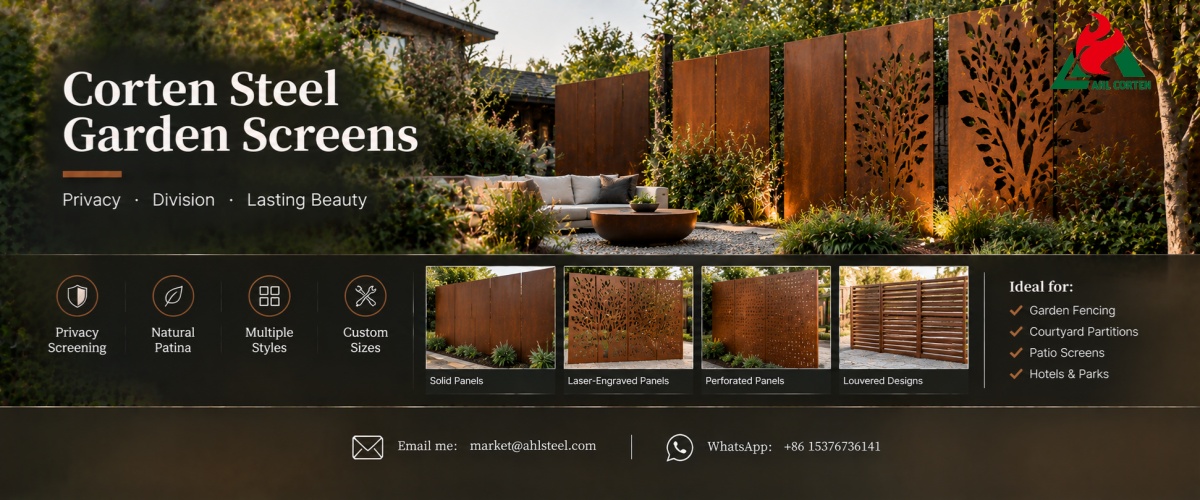
Suitable applications include garden fencing, courtyard partitions, patio screens, as well as commercial landscape projects such as hotels and parks.
A wide variety of styles are available, including solid panels, laser-engraved panels, perforated panels, and louvered designs, with custom sizes also available.
For retailers, distributors, and landscape engineering procurement professionals, clarifying the product selection, basic structure, installation requirements, and procurement costs in advance is essential to transforming design concepts into stable and durable finished products.
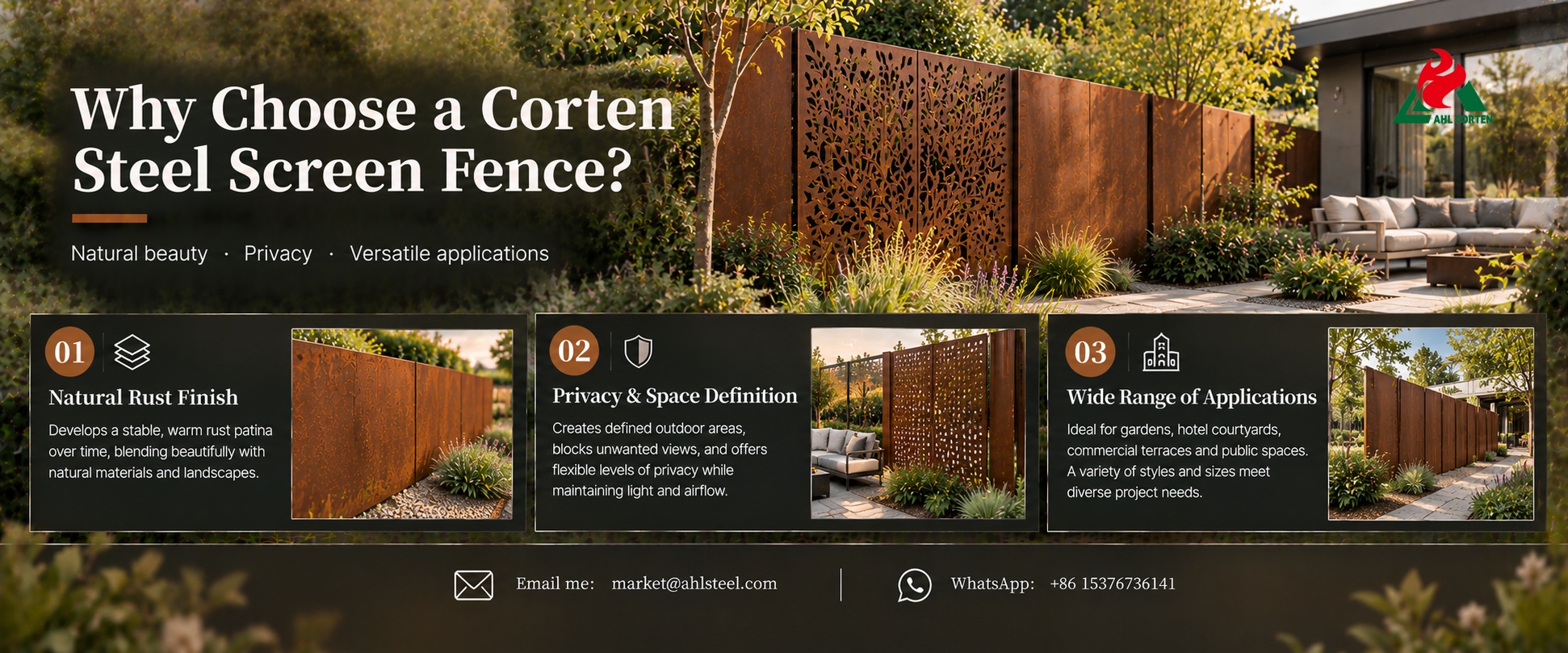
Why Choose a Corten Steel Screen Fence?
1. Distinctive Natural Rust Finish
When exposed to alternating wet and dry conditions outdoors, weathering steel gradually develops a stable, brownish-red rust patina, adding a warm, rich textural dimension to residential and commercial landscapes.
Unlike ordinary fences, which can appear harsh and out of place, it blends seamlessly into the overall landscape material scheme, becoming a natural part of the garden.
2. Privacy and Outdoor Space Definition
Decorative metal privacy screens can delineate leisure areas, block unwanted views, and separate different functional zones within a yard—without necessarily requiring fully enclosed high walls.
Depending on the panel design, they can provide varying degrees of privacy while maintaining ventilation, allowing light to pass through, or offering a partially obscured view of the surrounding landscape.
This flexibility makes them suitable for everything from small patios to large-scale landscapes.
3. Suitable for Residential and Commercial Landscapes
Corten privacy fencing is suitable for a variety of settings, including private gardens, hotel courtyards, commercial terraces, and public landscapes.
Its rugged texture complements modern minimalist styles, while perforated and ornate designs also pair well with natural-style gardens.
For B2B sellers, the product appeals to a broad audience; by carefully matching panel styles, dimensions, and support structures, it can meet the diverse needs of various projects.
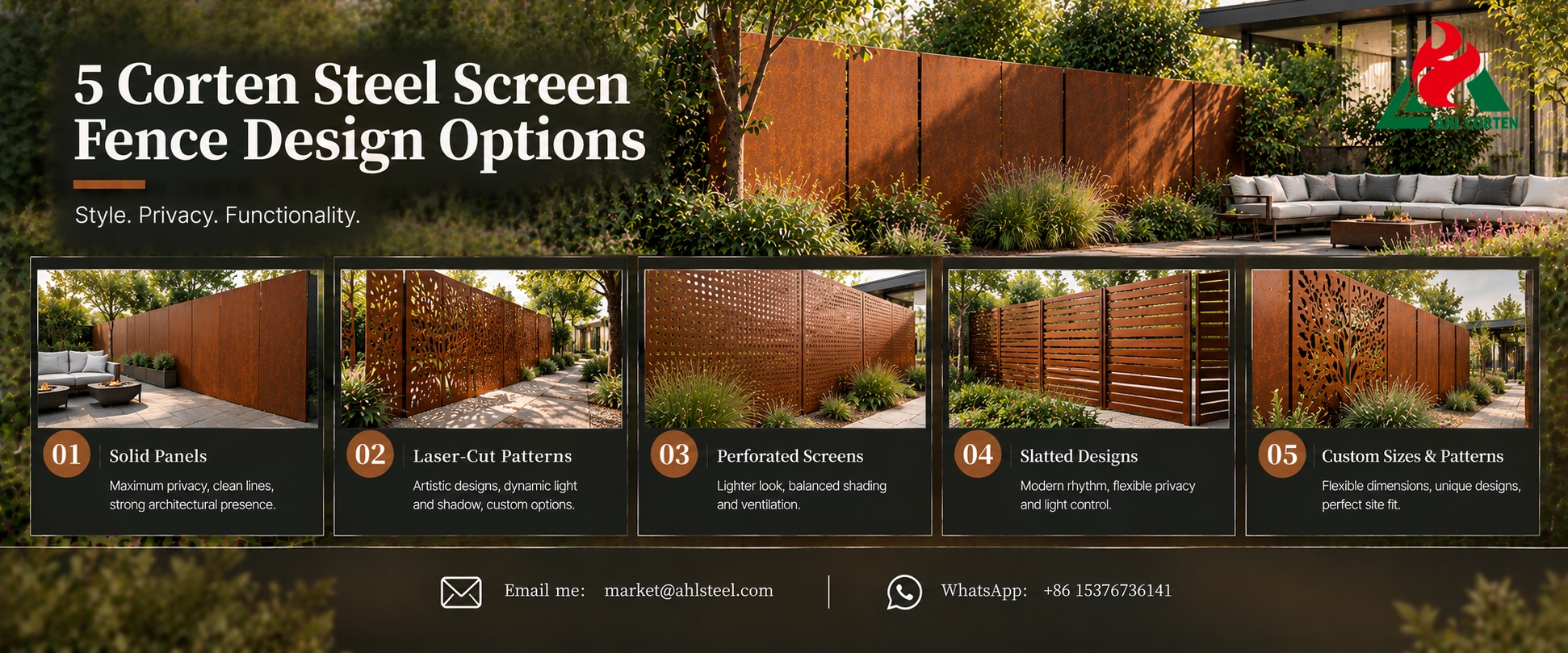
5 Corten Steel Screen Fence Design Options
1. Solid Panels for Greater Visual Privacy
Solid corten garden screens are ideal for areas requiring strong screening, such as leisure areas, around hot tubs, along patio edges, and as site boundaries. The panels feature a clean, seamless surface with a strong architectural presence.
⚠️ Important Note: Solid panels have a large wind-exposed surface area and are subject to high wind loads. The taller and wider the screen, the more critical it is to reinforce the posts and foundation.
Solid corten steel privacy screens are ideal for modern gardens that prioritize clean, simple lines and can be paired with plants to soften their bold, angular appearance.
2. Laser-Cut Decorative Patterns
Laser-cut corten steel panels can feature geometric designs, botanical motifs, abstract lines, or custom patterns, making them perfect for high-end private residences and commercial projects with specific brand identity requirements.
The openwork patterns create dynamic patterns of light and shadow on the ground and walls as sunlight changes throughout the day. The level of privacy is determined by the open area ratio, pattern size, and installation angle.
When ordering custom-made screens for a project, be sure to confirm the manufacturing drawings, tolerance ranges, and production lead time in advance to avoid design discrepancies later on.
3. Perforated Screens for a Lighter Appearance
Perforated rusted steel screens strike a balance between shading, ventilation, and aesthetics. Uniformly spaced holes reduce the heavy, solid appearance of large panels, creating a lighter, more layered visual effect.
Do not assume that perforation automatically results in low wind loads. Actual wind resistance is determined by the perforation rate, hole shape, panel size, and the overall frame; the entire structure must be reviewed.
Ideal for patios and garden spaces where a soft, layered effect is desired, and where screens should not appear overly bulky.
4. Slatted Designs for Modern Outdoor Spaces
Slatted designs feature horizontally or vertically arranged steel slats with clean, orderly lines that exude a modern rhythm, making them a popular choice for courtyard partitions and patio zoning.
The spacing between the steel slats directly determines the level of privacy and light transmission: narrower spacing provides greater coverage, while wider spacing offers better transparency and a more decorative effect.
When multiple panels are arranged in a continuous pattern with uniform lines, they can integrate large outdoor spaces more harmoniously.
5. Custom Sizes and Pattern Designs
Custom panels can be flexibly adjusted in height, width, segmentation, and connection points to suit the site, making them ideal for irregularly shaped areas.
Special sizes, corner designs, continuous patterns, and even project-specific logos can be accommodated. Before placing an order, confirm the drawings, tolerances, connection methods, and packaging plan with the manufacturer.
For landscape contractors, custom corten privacy screens fit the site more seamlessly, resulting in a more cohesive and unified look than forcing standard panels together.
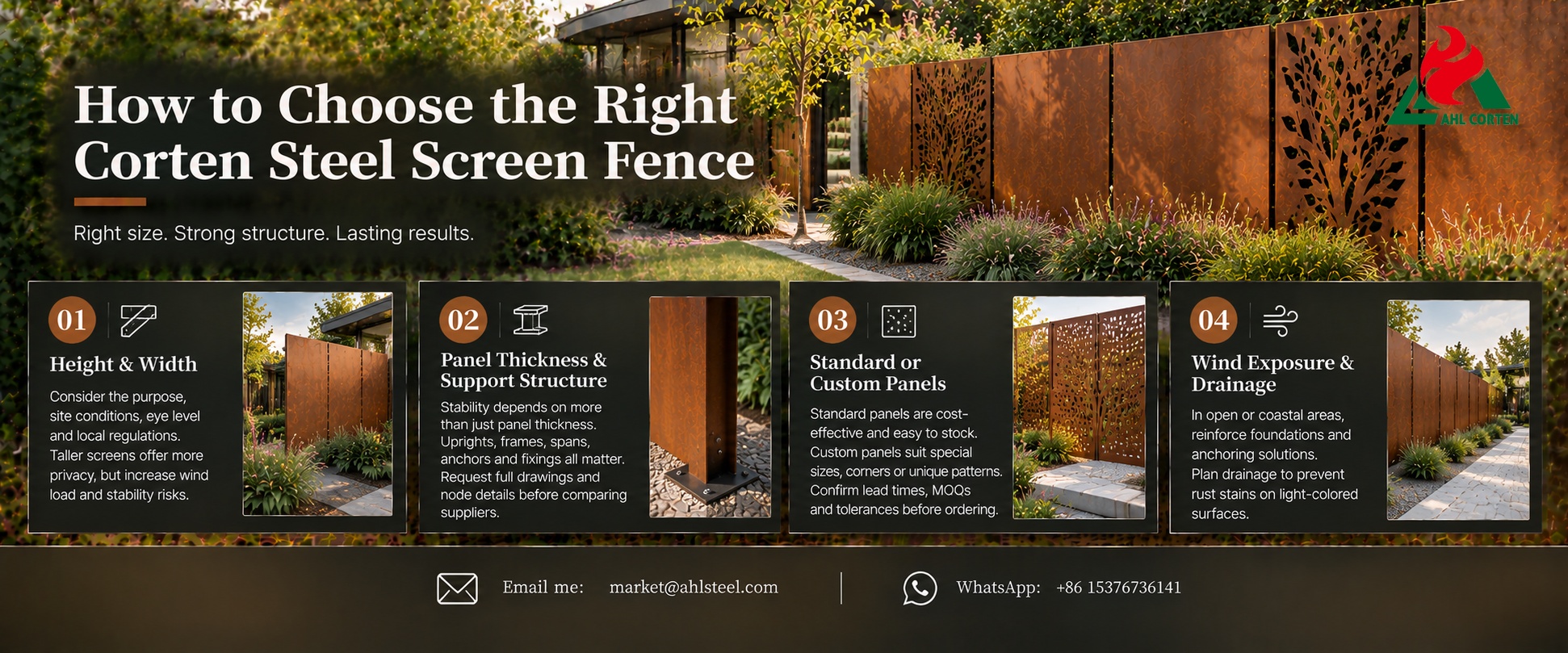
How to Choose the Right Corten Steel Screen Fence
1. Determine the Required Height and Width
First, clarify the screen’s primary purpose: is it for privacy, wind protection, space division, or purely decorative?
Height and width must be determined by comprehensively considering the site dimensions, human eye perspective, local planning regulations, and the proportions of the surrounding landscape.
Taller screens provide better privacy, but their wind-exposed surface area increases accordingly, raising stability risks—a factor that requires careful evaluation.
2. Select the Right Panel Thickness and Support Structure
Panel thickness is only one factor affecting stability. Uprights, frames, spans, embedded anchors, and anchoring methods collectively determine long-term safety.
Do not base price comparisons solely on steel plate thickness. The most prudent approach is to request complete structural drawings and fixation node diagrams before comparing proposals from different suppliers.
3. Choosing Between Standard and Custom Panels
Standard panels have fixed dimensions, a simple procurement process, and are easy to stock and restock. They are suitable for garden projects with conventional boundaries and high-volume, repetitive production, and are inventory-friendly for distributors.
Custom panels are suitable for projects requiring special widths, corners, or unique patterns. Before ordering custom panels, confirm delivery times, minimum order quantities, and tolerance requirements.
4. Consider Wind Exposure and Drainage
In open areas, coastal regions, rooftop terraces, and building wind tunnels—where wind speeds are higher—the foundation and anchoring solutions must be reinforced.
Drainage design should not be overlooked. Plan rainwater flow in advance to prevent rusty water from directly washing over light-colored paving or concrete, leaving rust stains that are difficult to clean.
How to Install a Corten Steel Screen Fence
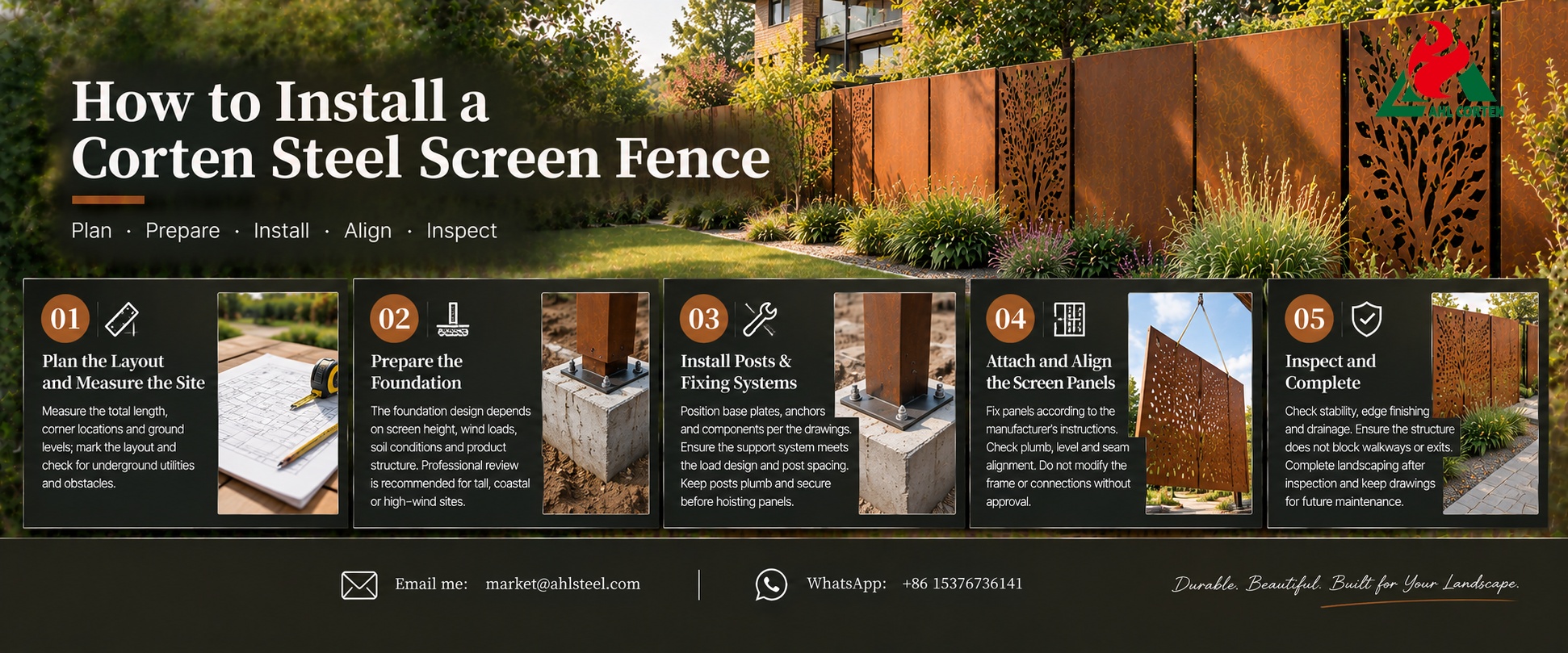
Step 1 – Plan the Layout and Measure the Site
Measure the total length, design height, corner locations, and ground level differences; calculate the number of panels, column locations, and joint positions.
Mark the layout on-site while checking for underground utility lines, drainage pipes, and other underground obstacles. Thorough preliminary planning can significantly reduce the need for rework during installation.
Step 2 – Prepare the Foundation
The foundation design is determined by the screen height, local wind loads, soil conditions, and product structure.
For tall screens, locations near wind openings, or coastal sites, it is recommended that professionals review the foundation and anchoring plans; simple ground-insert anchors should not be used.
Step 3 – Install Posts and Fixing Systems
Position the base plates, embedded parts, anchor bolts, and other components according to the drawings. The support system must align with the preliminary load design, post spacing, and panel connection methods.
Ensuring the posts are plumb and securely fastened before hoisting the panels is essential for guaranteeing a straight and stable final structure.
Step 4 – Attach and Align the Screen Panels
Secure the corten fence panels strictly in accordance with the manufacturer’s installation instructions, continuously checking for plumb and level alignment, seam alignment, and fixation points.
Do not cut or modify the frame or connecting structures on your own without the manufacturer’s approval. Temporary supports may be used for reinforcement during the hoisting phase; do not leave unsupported, partially assembled structures in place during high-wind conditions.
Step 5 – Inspect and Complete the Installation
After installation is complete, conduct a comprehensive inspection of stability, edge finishing, and drainage flow to ensure the structure does not obstruct walkways, main entrances, or emergency exits.
Finalize landscaping around the perimeter only after the structure has passed inspection. Safely store installation drawings and product documentation for future repair and maintenance.
Note: Specific construction procedures shall be governed by the product manual and the structurally approved project plan.
Maintenance and Long-Term Care of Corten Steel Screen Fences
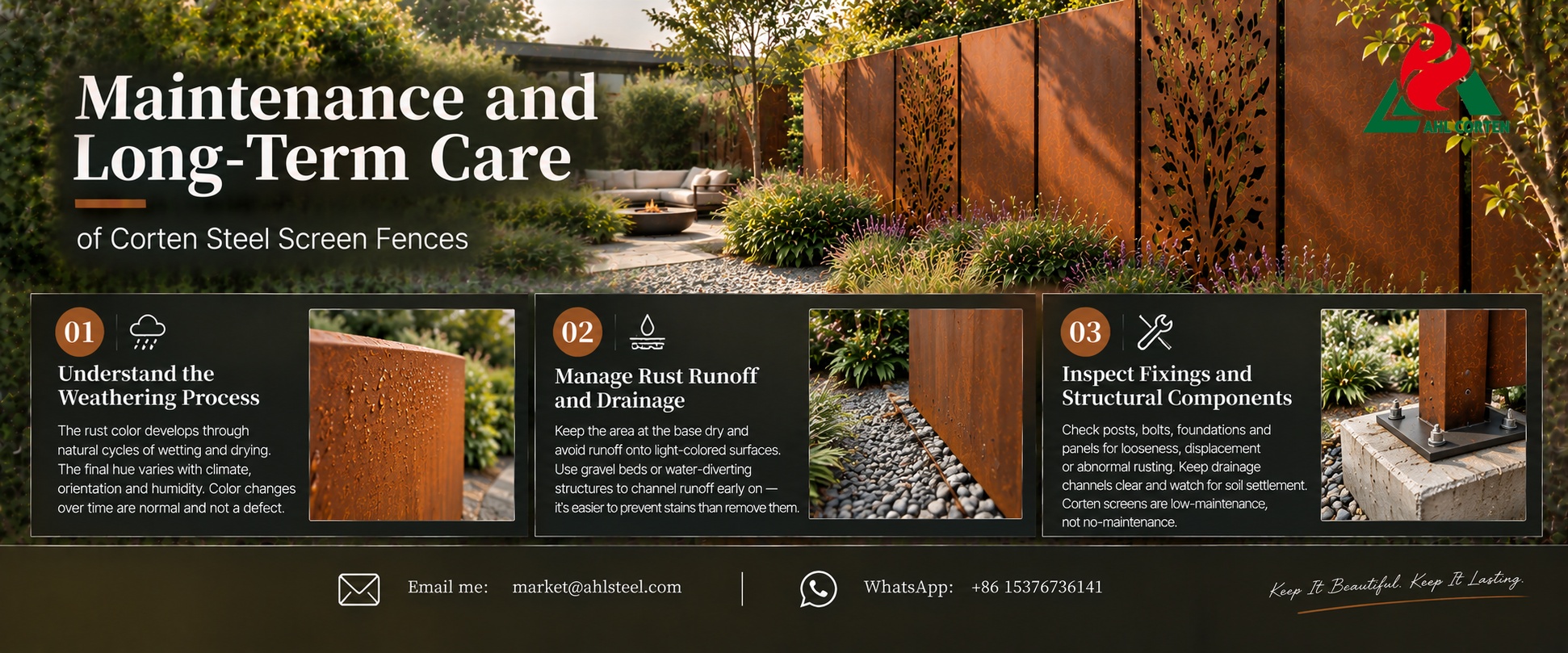
1. Understanding the Weathering Process
The distinctive rust color of weathering steel results from repeated cycles of drying and wetting. The rate of color change and the final hue will vary depending on climate, orientation, and humidity.
The color immediately after leaving the factory differs from the appearance after several seasons of outdoor exposure. This natural change is a characteristic of the material and does not constitute a quality defect.
2. Managing Rust Runoff and Drainage
Ensure proper drainage to prevent rainwater from pooling at the base or flowing directly onto light-colored hard surfaces. Light-colored stone and concrete are more prone to rust stains.
Prevent rust stains by using a gravel bed or water-diverting structures to channel runoff early on; prevention is far simpler than removing rust stains later.
3. Inspecting Fixings and Structural Components
Regularly inspect posts, bolts, foundations, and outdoor metal panels for looseness, displacement, or abnormal rusting to ensure drainage channels remain unobstructed and that the surrounding soil has not settled.
Weathering steel screens are **low-maintenance products, not zero-maintenance products**. Proper selection and regular inspections are essential for long-term stability.
Why Choose AHL Corten Steel Screen Fences?
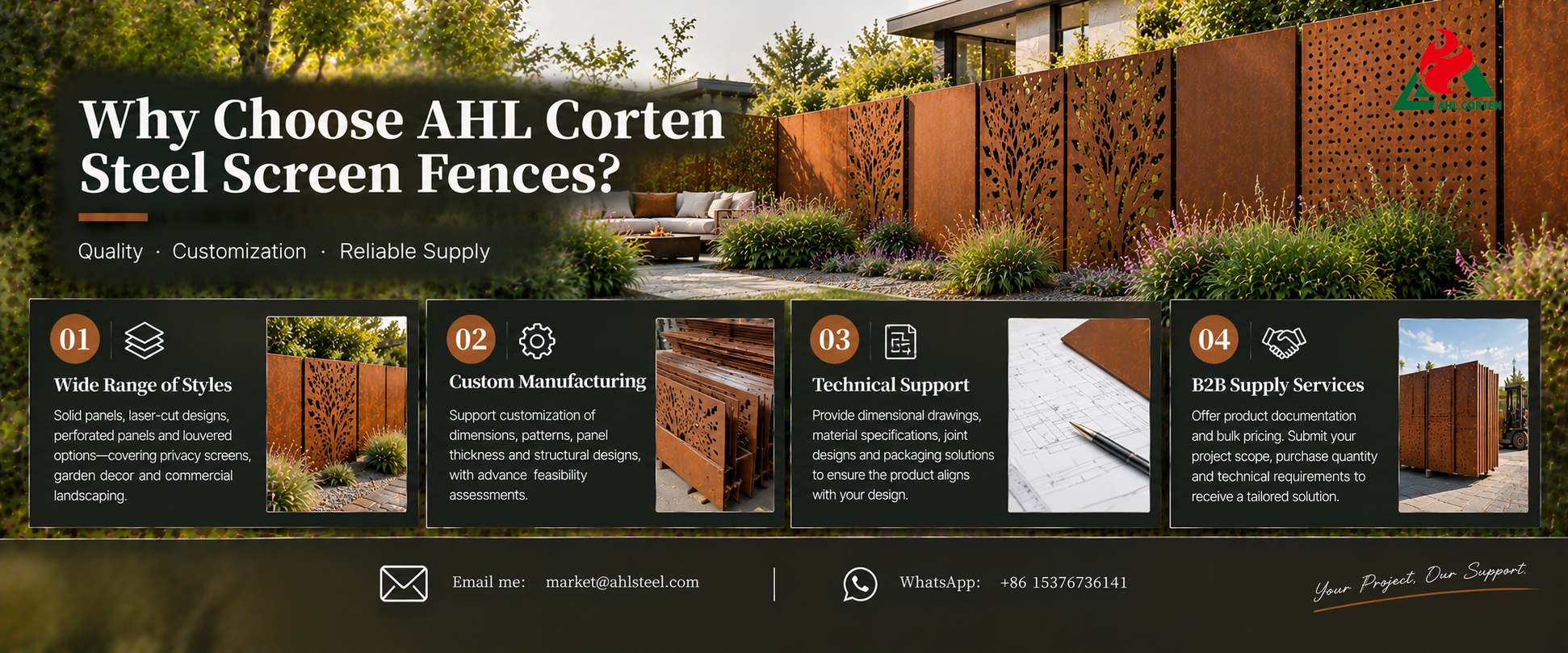
- Wide Range of Styles: Solid panels, laser-cut designs, perforated panels, and louvered options—covering privacy screens, garden decor, and commercial landscaping.
- Custom Manufacturing: Within our production capacity, we support customization of dimensions, patterns, panel thickness, and structural designs, with advance feasibility assessments.
- Technical Support: We provide dimensional drawings, material specifications, joint designs, and packaging solutions to ensure the product aligns with your design.
- B2B Supply Services: For landscape contractors, retailers, and distributors, we offer product documentation and bulk pricing. Submit your project scope, purchase quantity, and technical requirements to receive a tailored solution.
Frequently Asked Questions
1. Is Corten Steel Suitable for Garden Screen Fences?
Yes, provided that the material, panel style, support structure, and installation environment are all compatible. Its weathered texture makes it a popular choice for privacy screens and garden decor.
2. What Is the Best Thickness for a Corten Steel Screen Fence?
There is no standard thickness. The appropriate specification depends on panel size, support span, wind conditions, and project requirements. A comprehensive evaluation of the entire structure is necessary; thickness alone should not be the sole factor in selecting a design.
3. Do Corten Steel Screen Fences Provide Complete Privacy?
Yes. Solid laser-cut fence manufacturers offer the greatest privacy; perforated, laser-cut, and louvered styles provide partial privacy while allowing light and air to pass through. Confirm the open area ratio and line-of-sight angles before placing an order.
4. Are Perforated Corten Steel Screens Suitable for Windy Areas?
Yes, but it is incorrect to assume that perforations automatically eliminate wind loads. Wind resistance is determined by the open area ratio, hole pattern, panel dimensions, and anchoring solution; the entire structure must be re-evaluated based on on-site wind conditions.
5. How Do You Install Corten Steel Decorative Panels?
Standard process: Site survey and layout → Foundation construction → Installation of posts and hardware → Hoisting and alignment of panels → Stability inspection. The entire process must follow the manufacturer’s drawings and structural design.
6. Does Corten Steel Fencing Require Maintenance?
It is low-maintenance, not maintenance-free. Regular inspections of bolts, posts, and drainage are required. Additionally, rust runoff should be channeled in advance to protect surrounding light-colored paving.
7. Can Corten Fence Panels Be Customized?
Yes, we support customization of dimensions, patterns, panel thickness, and joints, subject to factory production capacity. Submit drawings, target dimensions, and project requirements for an assessment of delivery time and feasibility.
Find the Right Corten Steel Screen Fence for Your Project
An excellent weathering steel screen fence is the result of a combination of the right design, a reliable support structure, a standardized installation plan, and a reasonable maintenance schedule.
Whether you need solid privacy panels, laser-cut designs, perforated panels, or custom sizes, the specifications must be tailored to the on-site environment.
If you are planning a garden, patio, or commercial landscaping project, please contact AHL to request a product catalog and review technical specifications. Submit your drawings, dimensions, and estimated purchase quantity to receive a personalized quote.
Want the Latest Prices for Outdoor Privacy Screens? Contact Us!
Back

 Fill In The Inquiry