An elegant garden consists of more than just plants, flowers and outdoor furniture. The transitional boundaries between different areas also determine the overall character of the entire garden.
Without clear edging, the lawn will gradually encroach upon flowerbeds, gravel paths and paved areas, making the garden appear untidy and disorganised. Traditional concrete and stone edging is heavy and rigid, making it difficult to integrate into a minimalist, modern landscape. Weathered steel lawn edging is an excellent choice that balances practicality with design appeal.
Corten lawn edging’s distinctive warm, rust-coloured finish creates a natural contrast with green grass, ornamental grasses, gravel and stone; it can be used to create crisp, straight lines as well as flowing curves, circular tree surrounds and geometric shapes.
Whether for private gardens, commercial landscapes or hotel and resort projects, the right edging design can clearly delineate spaces whilst maintaining a cohesive landscape style. Below, we share eight popular modern design schemes, complete with key selection criteria to help you plan your garden project.

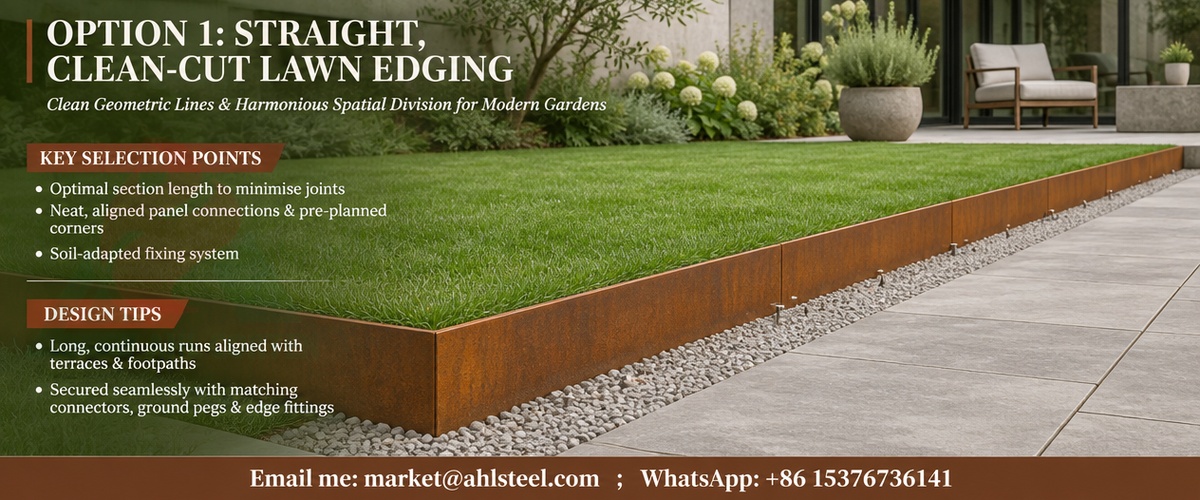
Option 1: Straight, Clean-Cut Lawn Edging
Straight edging is a classic choice for modern gardens, offering clean lines and a strong sense of order. You can use weathering steel edging to separate a rectangular lawn from flowerbeds, gravel areas or paved terraces. When designing, try to align the edging with the edges of terraces, footpaths or buildings to create a more harmonious overall look.
This option is ideal for modern gardens that prioritise clean, geometric lines and clear spatial division.
Key Selection Points
- Choose an appropriate single-section length to minimise unnecessary joints
- Confirm the method of joining the panels to ensure neat, aligned joints
- Finalize the corner treatment plan before placing your order
- Select a suitable fixing system based on soil conditions
Design Tips
Where possible, use long, continuous sections of edging to highlight the lawn’s outline and create a unified, clean garden layout. In addition to the steel panels themselves, matching connectors, ground pegs and edge-finishing fittings are required to ensure the edging is secure and seamless.
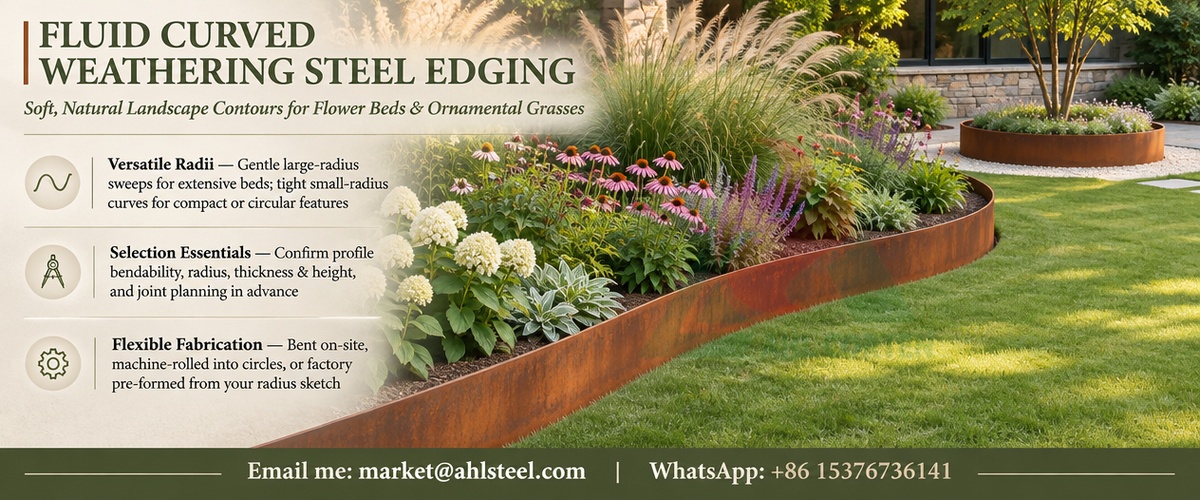
Option 2: Fluid Curved Edging Around Flower Beds
If you prefer a soft, natural landscape atmosphere, curved rusted metal garden edging is an excellent choice. Smooth curves envelop flowerbeds and ornamental grass areas, softening the harshness of rigid, rectangular lawns and lending the garden a more natural feel.
Large-radius curves are gentle and soothing, suitable for extensive flowerbeds; small-radius curves can be used for compact planting areas or circular landscape features.
Not all profiles can be bent at will; it is essential to confirm the suitability of the selected profile in advance.
Key Considerations for Selection
- Specify the required bending radius before placing an order
- Check the sheet thickness and edging height
- Confirm whether bending will be carried out on-site or pre-formed in the factory
- Plan the joint locations to avoid creases or bulges after the sheets have been bent
- Curved edging can be flexibly bent on-site, machine-rolled into a circle, or pre-formed in the factory.
Design Tips
If your garden features multiple curved borders, provide a simple sketch with the radii marked. Suppliers can then determine the processing method based on the sketch and provide a more accurate quotation.
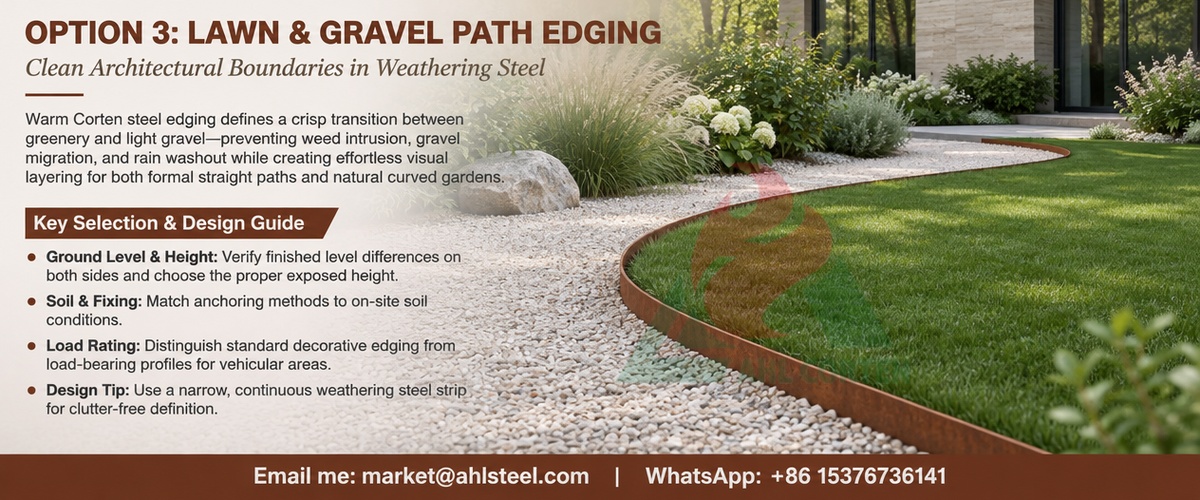
Option 3: Edging to Separate Lawns from Gravel Paths
Combining lawn with gravel paths is a common textural pairing in modern gardens. However, without a boundary to separate them, weeds can grow through the gravel, whilst the gravel itself is prone to being trodden into the lawn or washed away by rain.
Metal garden bed edging can clearly separate the two materials. The warm, rust-coloured finish pairs well with light-coloured gravel, natural stone and greenery, creating a rich visual layering. Straight-line designs are suitable for formal paths, whilst curved styles are ideal for casual, natural-style gardens.
Key Considerations for Selection
- Confirm the difference in finished ground levels on both sides
- Select an appropriate exposed height
- Check the fixing method and on-site soil conditions
- Distinguish between standard decorative edging and load-bearing types; standard edging is not suitable for heavy loads or vehicular traffic
Design Tips
Use a narrow, continuous strip of flexible landscape edging to demarcate the boundary between the lawn and light-coloured gravel; the clean lines ensure the garden does not appear cluttered.
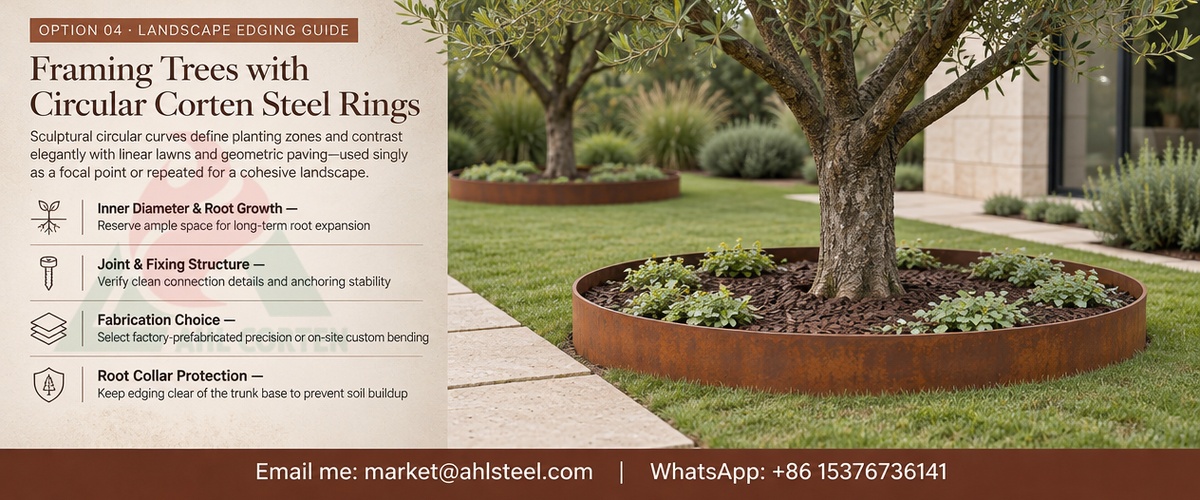
Option 4: Framing Trees with Circular Corten Steel Rings
Circular corten steel tree rings make excellent visual focal points in a garden. Corten steel rings can be used individually to define the planting area for a single tree or a groundcover zone, clearly separating them from the surrounding lawn.
You can install a single ring as a focal point, or repeat the same design throughout a larger garden to create a unified aesthetic. The circular curves provide an interesting contrast to straight lawns, rectangular paving and geometric flowerbeds.
Key Selection Points
- Confirm the inner diameter of the ring
- Check the joint structure and fixing method
- Decide whether to use factory-prefabricated rings or those bent on-site
- Allow for tree root growth by reserving sufficient space
Important reminder: Do not place the edging directly against the tree trunk; protect the root collar and prevent soil from accumulating at the base of the trunk.
Design Tips
Using the same style of circular tree edging across different areas of the garden, with consistent materials and shapes, helps to link the various planting zones together, creating a more cohesive landscape.
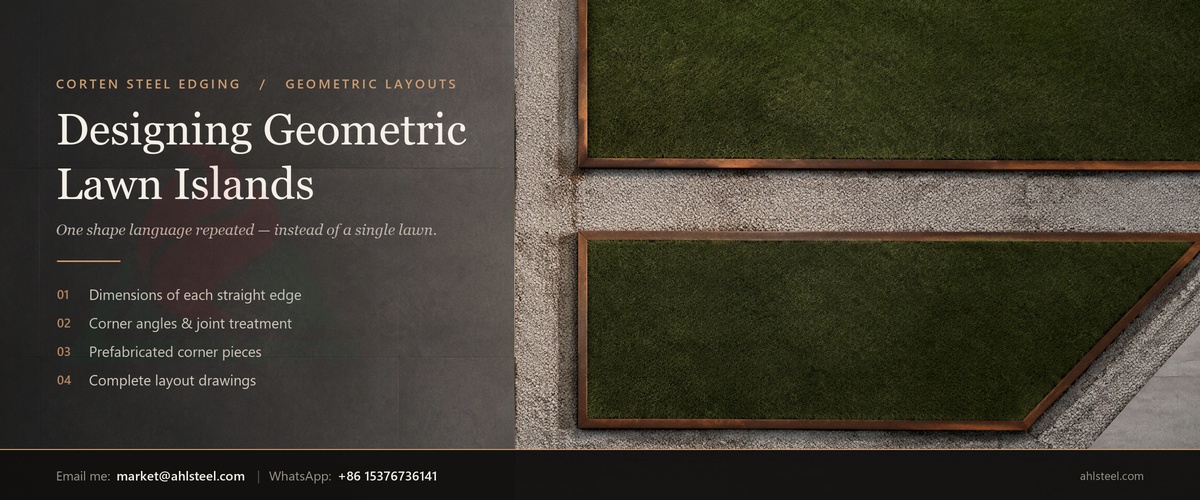
Option 5: Designing Geometric Lawn Islands
For a stronger architectural and sculptural effect, consider designing geometric lawn islands. Rather than a single large lawn, use rusted landscape edging to delineate independent lawn sections in rectangular, angled or polygonal shapes.
These lawn islands can be positioned alongside a terrace, with the perimeter bordered by gravel or raised flowerbeds. Repeating the same geometric shapes helps to create a unified design language across large outdoor spaces.
Key Considerations for Selection
- Specify the dimensions of each straight edge
- Clarifying corner angles and joint treatment solutions
- Confirm whether prefabricated corner pieces are available
- Provide complete layout drawings
Precise measurement is particularly crucial when multiple panels intersect at different angles. Plan in advance to minimize on-site cutting and adjustments.
Design Tips
Select a small number of repeating geometric shapes and avoid an excessive number of sharp corners. This maintains a clean visual appearance whilst also facilitating future trimming and maintenance.
Option 6: Build Layered Borders with Raised Planting Edges
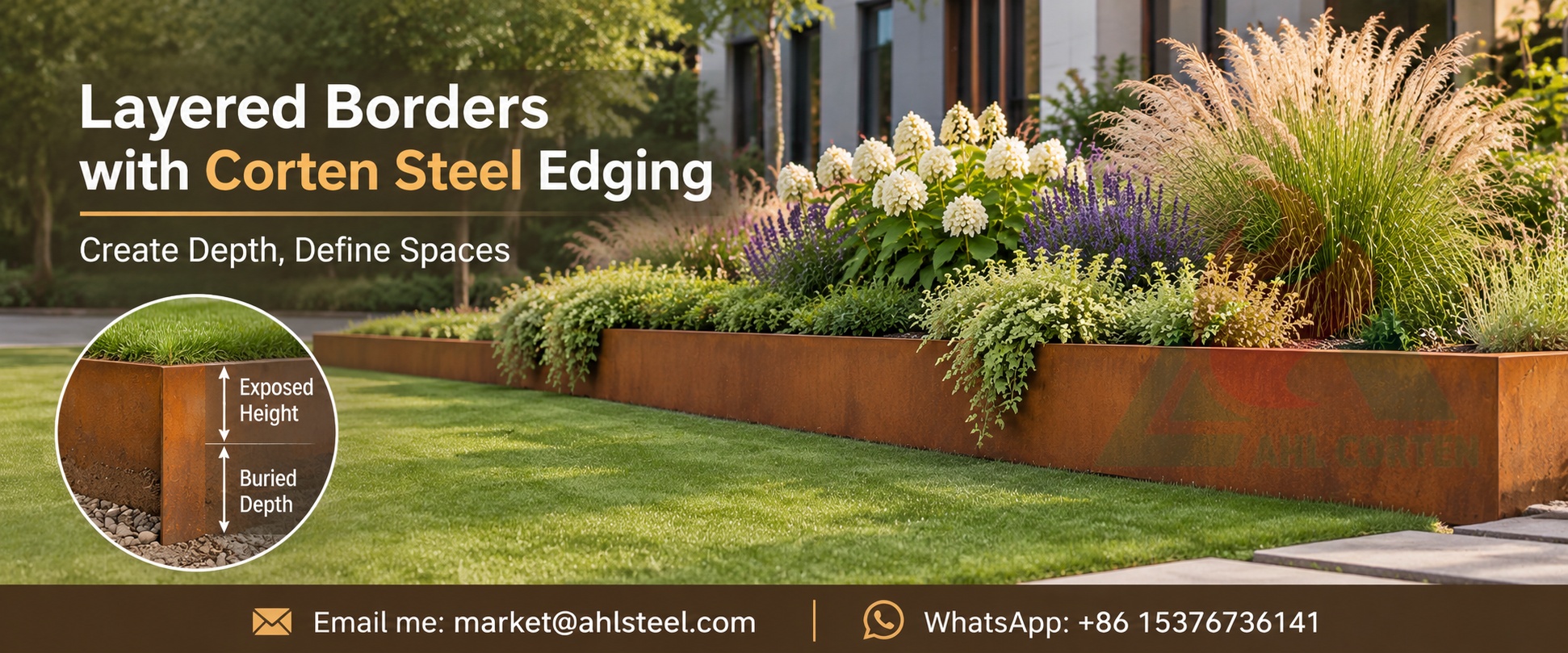
A garden does not necessarily need to be entirely level. Combining a low-lying lawn with slightly raised flowerbeds can add vertical layers, giving the landscape a greater sense of depth. Rusted metal garden edging can be used to demarcate two areas with different elevations, enclosing raised flowerbeds.
Create a lawn in the lower area and plant ornamental grasses, flowers and shrubs in the raised section. Raised planting borders place higher demands on product structure than standard decorative edging.
Key Selection Criteria
- Confirm the total height of the edging and the height exposed above ground
- Distinguish between the section buried underground and the exposed section
- Assess soil pressure and backfill height
- Verify panel thickness, reinforcement plans and support structures
- Confirm whether the profiles possess earth-retaining capacity
Ordinary flexible decorative edging cannot be used directly as an earth-retaining structure; areas subject to high soil pressure require specialised structural reinforcement.
Design Tips
Draw sectional drawings, marking the lawn elevation, soil cover height, exposed steel height and burial depth to facilitate precise product selection and construction.
Option 7: Pair Lawn Edging with Paving and Stepping Stones
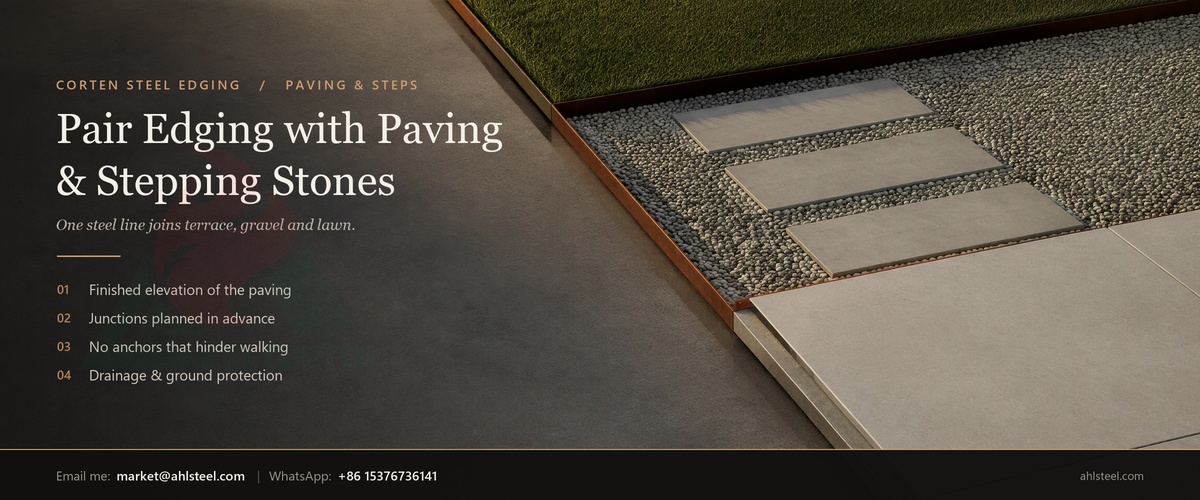
Metal garden bed edging can also connect lawns, hard landscaping, terraces and stepping-stone paths. A straight section of edging extends along the edge of the terrace, whilst another section separates the lawn from the gravel surrounding the stepping stones.
This smooths the transition between different materials, creating a more cohesive garden design. The warm, rust-coloured finish of weathering steel complements a variety of outdoor materials, including concrete paving, natural stone and wooden decking.
Key Considerations for Selection
- Confirm the finished elevation of the paving
- Plan the junctions between the steel edging and the paving in advance
- Avoid ground anchors and fasteners that could hinder walking or maintenance operations
- Consider drainage and ground protection
The junctions between materials require careful planning. Whilst the boundary may look attractive on paper, construction details must be refined to account for paving thickness and ground conditions.
Design Tips
Ensure the edging follows the same layout as the paving to enhance the overall harmony of the garden.
Option 8: Combine Lawn Edging with Matching Corten Planters
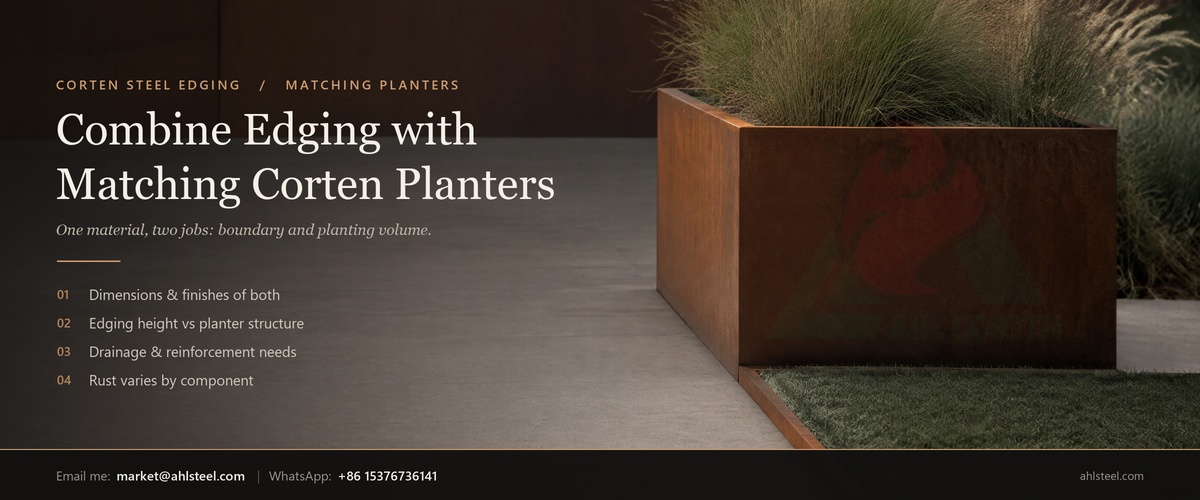
To achieve a unified material style in the garden, combine corten steel lawn edging with matching weathering steel planters. The edging defines the boundaries of the lawn and flowerbeds, whilst the planters are positioned at entrances, on patios and in relaxation areas to provide additional planting space.
This combination is ideal for modern private gardens, hotel gardens and commercial landscaping projects.
Note that the two serve different functions: the edging defines boundaries, whilst the planters must support the soil, ensure proper drainage and provide structural stability.
Key Considerations for Selection
- Confirm the dimensions and surface finishes of both product types separately
- Verify the height of the edging against the structural parameters of the planters
- Clarify the drainage and reinforcement requirements for the planters
- Coordinate the overall planning, installation and the visual harmony with surrounding plants
- Understand the natural rusting characteristics of weathering steel: different components rust at varying rates, making it difficult to achieve a completely uniform colour
Design Tips
Use weathering steel sparingly as an accent rather than covering the entire area. Combine edging, planters and other landscape elements to create visual balance and a more sophisticated effect.
Quick Selection Guide: Find the Right Edging Style for You
| Desired Garden Effect |
Recommended Design Solution |
Information to Prepare in Advance |
| Clean, minimalist modern courtyard |
Straight-line lawn edging |
Segment lengths, corner angles and finished levels |
| Soft, natural and relaxed garden |
Curved planting-bed edging |
Curved drawings, bending radius and total length |
| Clear separation between lawn and gravel |
Lawn-to-gravel boundary edging |
Levels on both sides, pathway width and soil conditions |
| Highlighted tree landscape feature |
Circular tree surround |
Ring diameter, layout drawing and site photographs |
| Strong architectural feel and minimalist form |
Geometric lawn islands |
Dimensioned plan drawing and corner angles |
| Vertical layering and raised planting beds |
Raised planting retaining-edge system |
Fill height, soil conditions and structural requirements |
| Connection between paving and stepping-stone paths |
Paving transition edging |
Paving dimensions and connection-detail plan |
| Unified material palette throughout the garden |
Edging combined with Corten steel planter boxes |
Overall design plan, quantities and surface-finish requirements |
Once you have chosen your preferred design, send the layout drawings or reference diagrams to the supplier and discuss the profiles, dimensions and connection methods.
How to Choose the Right Height, Thickness and Fixing Fittings?
Once you have selected the design, the next step is to determine the product specifications.
1. Selecting the Edging Height Based on Function
The height depends on its purpose: whether it is simply for demarcation, or whether it needs to retain earth or manage differences in ground level. When comparing specifications, distinguish between the following four concepts:
- Total height: The overall height of the steel plate
- Exposed height: The visible portion above ground level
- Burial depth: The portion buried in the ground
- Ground spike length: The length of the additional fixing components
AHL standard edging is available with exposed heights of 100 mm or 150 mm, and thicknesses of 1.6 mm or 2.0 mm. The final specifications should be determined based on the intended use and on-site installation conditions; please confirm the latest specifications before placing an order.
2. Selecting Sheet Thickness Based on Design and Support Conditions
Thickness affects rigidity, dead weight and bendability. Thinner sheets are easier to bend and shape; thicker sheets offer greater rigidity and are suitable for applications requiring high stability. However, thickness is not the sole criterion; a comprehensive assessment is required, taking into account: the height of the edging, profile style, bending radius, soil type, fixing method, lateral soil pressure, and whether the application is decorative or for structural earth retention.
For curved projects, confirm the minimum achievable bending radius with the supplier before finalising the design.
3. Confirm the Full Set of Installation Fittings
A complete edging system consists of more than just steel panels. Depending on the product style, fittings may include: integrated ground spikes, separate ground pegs, connecting plates, locking clips, screws, specialised corner pieces and edge-sealing components.
Before placing an order, confirm which fittings are included in the quotation and which need to be purchased separately. At the same time, calculate the effective coverage length; do not base your quantity calculations solely on the nominal length, as overlaps at joints will reduce the usable length.
.jpg)
Precautions For Installing Weathering Steel Lawn Edging
Thorough preparation in advance can reduce installation difficulties and improve the final result.
1. Lay out and mark positions: Mark straight sections, curves, corners and circular areas, then calculate the quantity required
2. Check soil conditions: Confirm whether the soil is suitable for the selected fixing method
3. Check elevation: Ensure the exposed heights of the lawn, gravel and paving on both sides are consistent
4. Plan joints: Arrange joints and corners sensibly to avoid gaps or misalignment
5. Consider drainage: The edging must not obstruct the existing drainage flow
6. Protecting surrounding surfaces: During the initial rusting phase, rusty water may stain paving; take protective measures in advance
7. Follow product instructions: Install according to the fixing method for the specific profile; installation methods vary by style
Installation methods vary depending on the profile, thickness and soil conditions; do not apply a one-size-fits-all approach.
FAQ
1. Is Weathering Steel Edging Suitable For Curved Lawns?
Yes. However, the achievable radius depends on the panel thickness, height, profile and fabrication method; please confirm the radius before placing an order.
2. What Is the Appropriate Height for a Lawn Edging?
This depends on the material being separated and whether soil retention is required. When comparing specifications, be sure to distinguish between total height, exposed height and burial depth.
3. What Thickness of Sheet Should I Choose for My Garden Boundary?
This should be determined by considering the edging dimensions, design, soil conditions and intended use. Thin and thick sheets differ in terms of bendability and rigidity; do not select a type based solely on thickness.
4. Can Weathering Steel Edging Be Used Around Trees?
Yes, it can be fashioned into a circular tree surround. However, ensure sufficient space is left for root growth; do not place it directly against the trunk, and do not bury the root collar.
5. Can Edging Be Used to Separate Lawns from Gravel?
This is a very common solution. Select an appropriate exposed height and fixing method; however, edging cannot completely prevent grass roots from spreading or gravel from shifting.
6. Can Standard Decorative Edging Be Used as a Retaining Wall for Raised Flower Beds?
Not necessarily. Standard decorative edging is only suitable for demarcation; raised flower beds are subject to earth pressure and require specialised structural profiles and reinforced supports.
7. Are Ground Spikes and Connectors Included In the Quotation?
This depends on the supplier and product configuration. Some styles come with integrated ground spikes, whilst others require connection plates and ground spikes to be purchased separately. Please check the accessories list before placing an order.
8. Can Lengths, Corners and Circular Rings Be Customised?
Customisation is supported within the limits of manufacturing capabilities; please provide dimensioned drawings so that we can assess cutting, rolling and joining solutions.
9. How Should the Length of a Curved Edging Be Measured?
First, mark out the arc on a drawing or on-site, recording the total length and the radii of the different sections; for complex shapes, please provide dimensioned drawings.
Looking for Reliable Corten Steel Lawn Edging for Your Landscaping Projects or Wholesale Collection?
AHL offers standard 1075 mm edging sections and customized solutions for different project requirements. We support discussions on length, height, thickness, cutting options, and curved profiles.
Contact AHL today to share your project dimensions and estimated quantities. Request our product specifications and a competitive wholesale quotation for your next order.
Need a Factory Quote for Corten Steel Edgings?
Send your drawings, size list, quantity, and destination country. Corten Factory can support custom weathering steel fabrication, export packing, and project quotation.


 Fill In The Inquiry