Corten Steel Pathway Lights vs. Bollard Lights: Which Should You Choose?
Selecting outdoor lighting for garden walkways and commercial landscapes involves more than just choosing an attractive housing.
You need to consider how the lighting guides pedestrians and illuminates the path, how it complements the surrounding landscape, and whether the fixtures can operate reliably in all-weather conditions.
Corten steel pathway lights and weathering steel post lights are two popular choices in today’s landscape projects.
Both feature the distinctive vintage rusted finish unique to weathering steel, but they differ significantly in design, installation height, and suitable lighting scenarios.
So which type of Corten steel outdoor light should you choose?
The answer depends on your lighting objectives, the width of the walkway, the desired visual style, and the fixtures’ optical performance. Don’t assume that taller lights are brighter or produce better results; be sure to compare light distribution, glare control, and installation requirements before making a purchase.
This article will outline the key differences between the two, helping private homeowners, landscape architects, contractors, and commercial buyers find the lighting solution best suited for their projects.
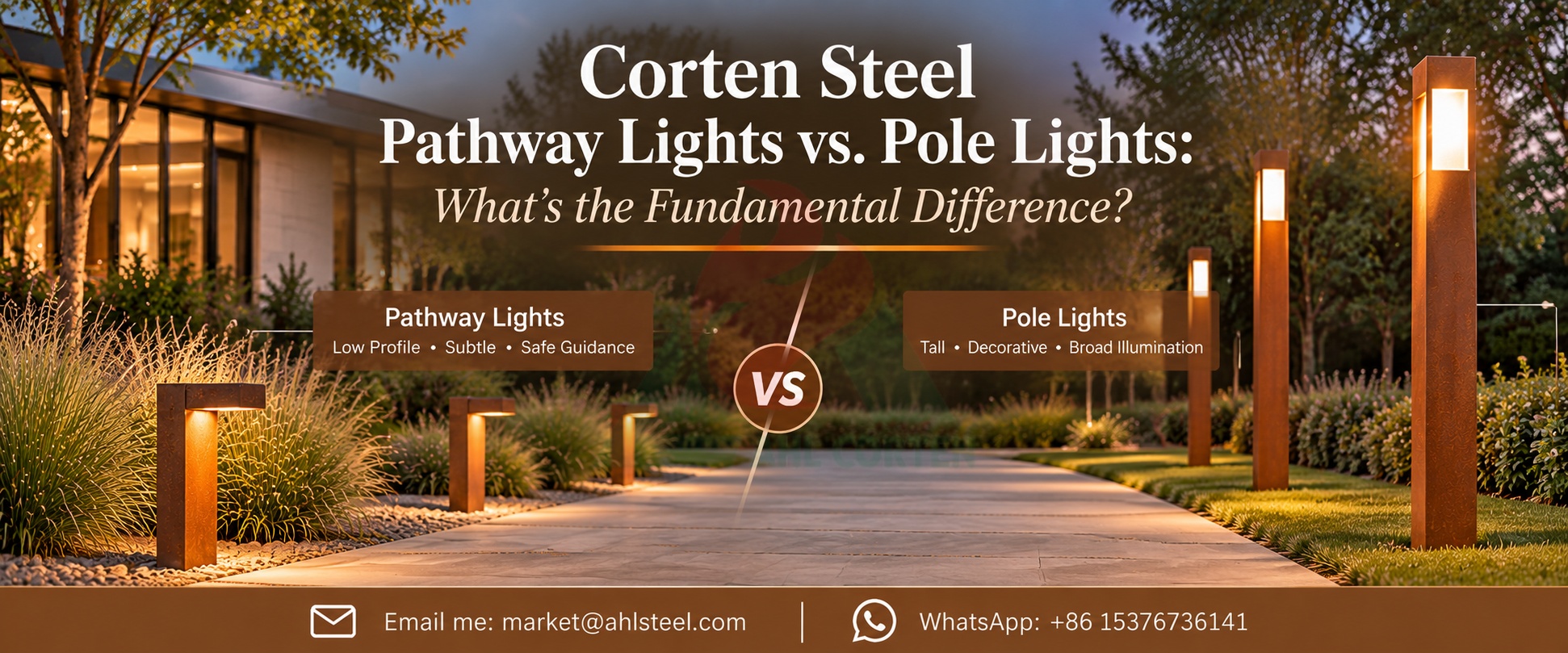
Corten Steel Pathway Lights vs. Pole Lights: What’s the Fundamental Difference?
Many people confuse these two categories, so let’s first clarify the definitions.
1. Pathway Lights Refer to **Lighting Applications**.
Pathway lighting is specifically designed for pedestrian routes such as walkways, garden paths, and entryways, with the purpose of enhancing safety and guiding foot traffic.
There are many forms of walkway lights; low-profile ground-mounted models, recessed lights, and post-mounted models can all be classified as walkway lighting.
Low-profile weathering steel pathway lights are suitable for softly accenting paved areas, lawns, and the edges of flower beds; they are understated and do not overshadow the scenery.
2. Post-Mounted Lights Refer to the **Structural form of the Luminaire**.
They are freestanding fixtures mounted on a base or ground anchors, with height, design, and light distribution varying according to the design.
Corten steel post lights combine functionality with ornamentation: during the day, they serve as landscape elements; at night, when illuminated, they define spaces and light pathways.
They can be installed along main garden paths, hotel entrances, courtyards, public walkways, and other locations.
To facilitate procurement comparisons, this article clearly distinguishes between two product categories:
- Compact path lights: Low-profile, discreet, and designed for localized spot lighting
- Pole lights: Upright landscape elements with a strong visual presence, capable of providing various types of pathway lighting
This is merely a classification for procurement purposes and is not a mandatory industry standard. A pole light, if properly designed optically, can also serve as pathway lighting on its own.
Quick Comparison: Corten Steel Pathway Lights vs. Corten Steel Pole Lights
| Purchase Option |
Potential Application |
Key Considerations |
| Standard models |
Projects using existing fixture designs |
Dimensions, specifications and availability |
| Appearance customization |
Projects requiring a particular height or profile |
Impact on electrical design, heat management and protection |
| Mounting customization |
Projects with specific fixing conditions |
Base dimensions, hole positions and cable entry |
| Coordinated landscape lighting |
Projects requiring a consistent visual style |
Optical performance, colour temperature and maintenance |
No single model is inherently brighter or more energy-efficient; the final effect depends on the light source, optical design, installation height, and site layout.
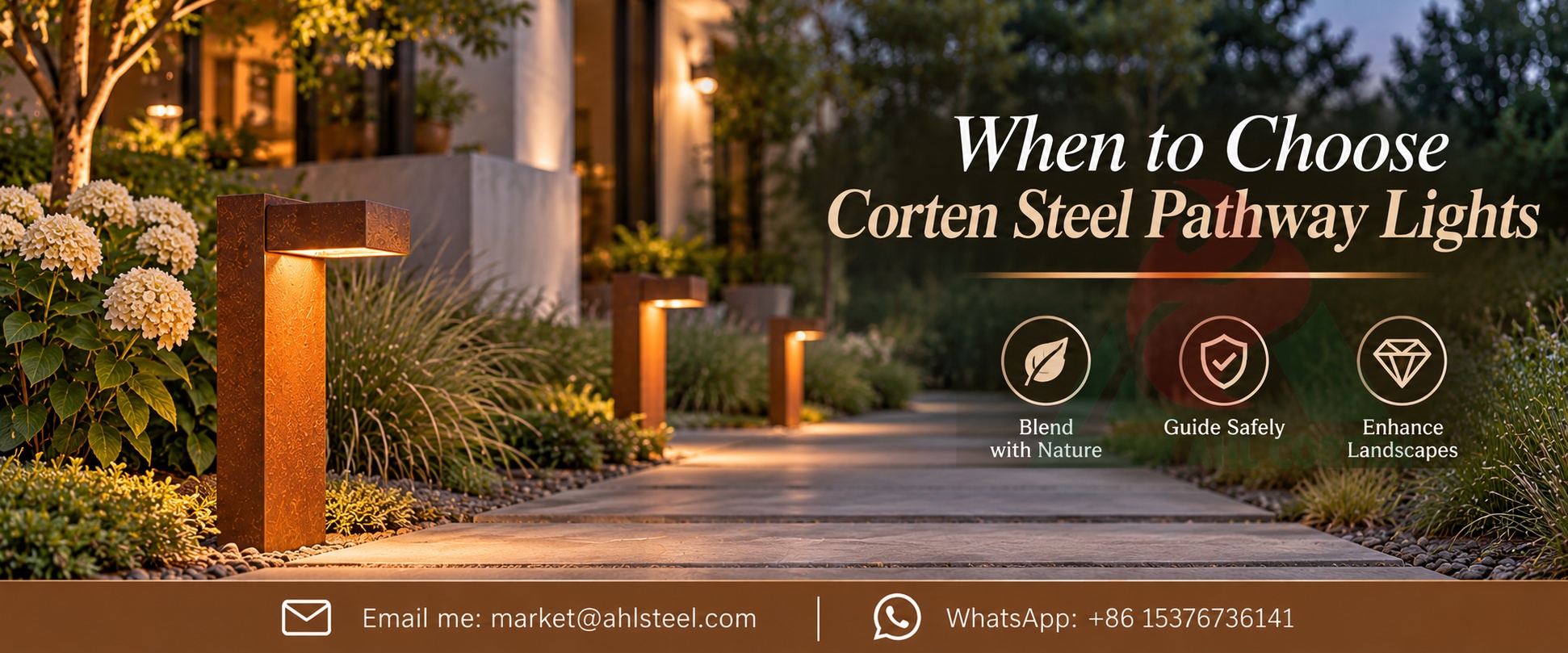
When to Choose Corten Steel Pathway Lights
If you want subtle, understated lighting that serves only as a guide to specific points, prioritize compact pathway lights.
1. Soft Lighting Suitable for Garden Paths
If your garden design emphasizes plants, stone paving, and natural wood textures—and you don’t want the outdoor landscape lighting to become a visual focal point—low-profile path lights are an excellent choice.
They blend seamlessly into the landscape, outlining walking paths without detracting from the garden’s natural focal points.
Suitable Settings:
Private garden paths, gravel walkways, paved courtyards, small landscaped areas, and secondary pedestrian pathways.
One important reminder: Just because a decorative light looks attractive doesn’t mean it provides sufficient illumination to ensure safe passage. Before purchasing, be sure to check the light distribution pattern to confirm that the light falls on the walking area.
2. Border Lighting for Flower Beds and Small Landscape Accents
Low-profile path lights are ideal for placement along the edges of flower beds, lawn borders, and around distinctive landscape features.
When planning the layout, anticipate the height of plants as they mature. As shrubs and ornamental grasses grow, they can easily block the corten steel outdoor lights and alter the lighting effect.
Also, ensure sufficient access space is reserved to facilitate future landscaping maintenance and lighting fixture upkeep.
3. Key Checklist for Selecting Corten Steel Pathway Lights
Before placing an order, verify each of the following points:
- Light emission direction and actual illumination range
- Whether pedestrians along the path will see the light source directly
- Fixture dimensions and installation depth
- Wiring method and power supply voltage requirements
- Whether surrounding plants or structures will block the light
- Whether access for inspecting electrical components has been provided
If you prioritize a discreet appearance and spot-specific ground lighting, compact path lights are the better choice.
When to Choose Rusted Steel Pole Lights
Pole lights are ideal when you want a distinct landscape design while also requiring stable, continuous pathway lighting.
1. Creating a Continuous Rhythm Along Main Pathways
Arranging a row of pole lights at equal intervals along main garden paths creates a neat, rhythmic landscape.
During the day, the poles themselves serve as landscape elements; at night, the light defines the path and improves visibility for pedestrians.
Pole lights with different optical designs can emit light downward, sideways, or in multiple directions.
When selecting a model, be sure to match the pole height, beam angle, and walkway width. A taller pole does not necessarily mean a larger illumination area.
2. Courtyards, Entrances, and Cultural and Tourism Commercial Projects
Weathered steel pole lights are ideal for settings where the fixtures themselves need to be integrated into the architectural landscape.
Recommended settings: hotel and resort walkways, restaurant patios, commercial courtyards, main garden entrances, garden paths around office buildings, and outdoor leisure areas.
For commercial projects such as hotels and bed-and-breakfasts, it is also important to consider the visual experience from multiple angles. Guests may approach the lights from different directions or sit near them to rest.
A well-designed system must provide sufficient pavement illuminance while avoiding glare.
3. Checklist for Selecting Weather-Resistant Steel Pole Lights
When evaluating pole lights, verify the following parameters:
- Unidirectional / bidirectional / multidirectional light distribution
- Light source shielding structures and glare control solutions
- Pole height, diameter, and base dimensions
- Mounting method and anchoring foundation requirements
- Ease of replacement and maintenance for the power supply and light source components
- Compatibility with the electrical system and the project’s power supply plan
Important Reminder: Decorative post lights **must not be used as crash barriers** unless the product has undergone specific impact testing.
If you want distinctive vertical landscape elements that also illuminate the entire walkway, choose post lights.
Lighting Parameters More Important Than the Name “Corten Steel Bollard Lights”
While appearance is certainly important, it is the optical and electrical parameters that determine whether a luminaire can meet a project’s requirements.
1. Light Distribution and Glare Control
Light distribution refers to the way light spreads after it is emitted from the luminaire.
Some Corten steel outdoor lights direct light downward in a concentrated beam, while others disperse light to one or multiple sides.
You cannot determine the actual light pattern simply by looking at the pattern of openings in the housing.
The core purpose of pathway lighting is to illuminate the walkway, not to unnecessarily light up plants or windows.
Glare control is equally critical. No matter how bright the pathway lights are, if pedestrians or people sitting nearby can directly see the light source, the experience will be poor.
For commercial projects, always request optical data and light distribution test reports from suppliers whenever possible.
2. Luminous Flux, Illuminance, and Uniformity
Lumens represent the total output of a light source, while illuminance represents the brightness reaching the ground; the two are not directly equivalent.
Higher lumens do not necessarily mean better walkway lighting; the beam angle, installation height, and reflectivity of the ground surface all affect the final visual experience.
For commercial projects, ensure uniform illuminance on the pavement and avoid excessive contrast between light and shadow.
Do not rely solely on wattage or lumens to estimate the number of fixtures needed.
3. Color Temperature and Dimming Control
Color temperature determines the outdoor ambiance.
In settings such as gardens, courtyards, and bed-and-breakfasts, warm light is more effective at creating a relaxed and comfortable atmosphere. For other projects, select the color temperature based on design objectives.
Confirm the following before placing an order:
Available color temperature range; whether dimming is supported; and compatibility with timers, motion sensors, and smart control systems.
Do not assume that all models support color temperature adjustment or smart control.
4. Outdoor Protection and Electrical Details
Weather-resistant steel housings are designed solely for weather resistance; **this does not guarantee that the entire fixture meets waterproofing standards**.
The driver, wiring locations, and sealing gaskets are the key factors for waterproofing.
When purchasing, verify the protection rating, input voltage, power supply solution, and wiring instructions.
For export or public projects, ensure compliance with the target market’s electrical safety standards.

How to Plan the Height, Spacing, and Quantity of Bollard Lights
There is no universal formula for installation spacing; the layout should be determined based on the lighting design.
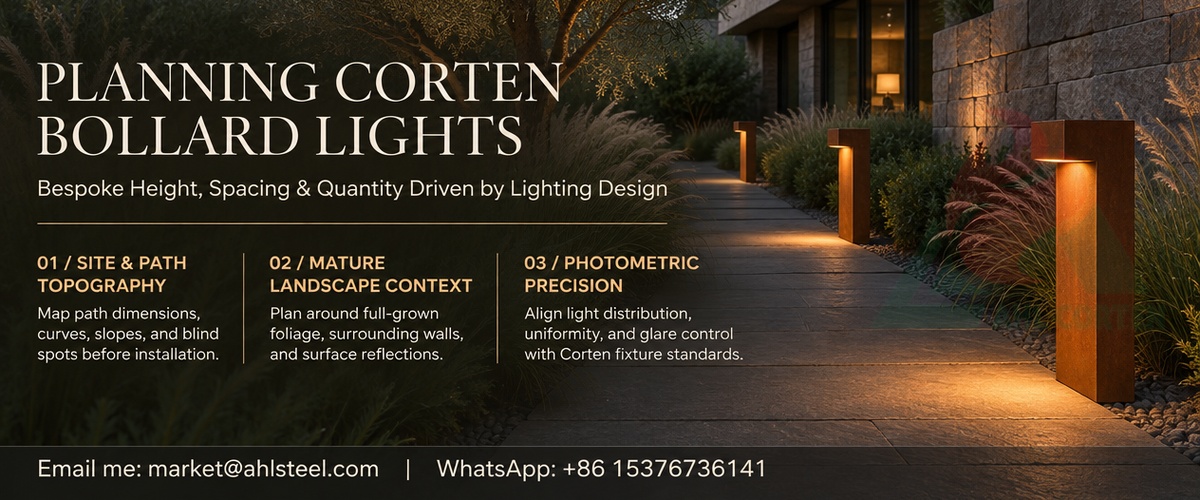
Step 1: Measure the Path Dimensions and Site Topography
First, measure and sketch a simple site plan, noting:
Total length and width of the path; straight sections and curves; entrances and intersections; steps and slopes; areas requiring enhanced illumination.
The layout for a narrow private garden path will be completely different from that of a wide main path at a hotel.
Mark the fixture locations on the drawing in advance to identify lighting blind spots early on.
Step 2: Consider Plants and Surrounding Structures
Plants, walls, and outdoor furniture can all alter the path of light.
When selecting fixture types and planning the layout, plan based on how the plants will look once they’ve matured, rather than just the current appearance of the open space.
Also, be mindful of reflections from seating areas and paved surfaces.
Step 3: Request Photometric Data for Large-Scale Projects
For large-scale projects with high standards, request photometric data from suppliers.
Designers can use this information to evaluate light distribution, illuminance uniformity, and glare risks to determine appropriate fixture locations and spacing.
The final layout must align with the model, installation height, walkway dimensions, and project standards of wholesale corten garden lights.
Can Weathering Steel Pathway Lights and Post Lights Be Used Together?
Absolutely. Using them in combination is the preferred solution for many landscape projects.
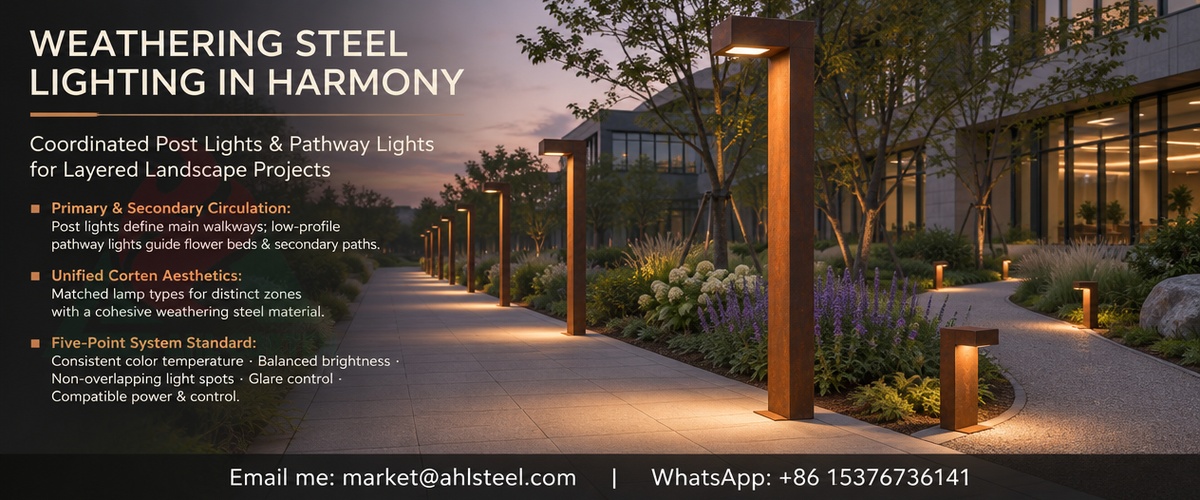
For example: Post lights can be arranged in a continuous line along the main walkway of a commercial park, while low-profile pathway lights can be placed along the edges of flower beds and on secondary paths.
This “primary and secondary” approach distinguishes between circulation levels while maintaining a unified weathering steel material and a harmonious style.
When implementing a mixed-configuration scheme, several conditions must be verified simultaneously:
Color temperature must remain consistent; brightness must be balanced; light spots must not overlap and cause waste; glare must be controlled from all viewing angles; and power supply and control systems must be compatible.
The key to a combined lighting layout is not simply adding more fixtures, but rather matching the appropriate lamp types to different areas.
Standard Model vs. Custom Corten Steel Lights
Standard products are often suitable when their dimensions, lighting performance and mounting arrangements meet the project requirements.
Custom solutions may be considered when a project requires a particular appearance or installation interface.
| Purchase Option |
Potential Applications |
Key Considerations |
| Standard models |
Projects using existing fixture designs |
Dimensions, specifications and availability |
| Appearance customization |
Projects requiring a particular height or profile |
Impact on electrical design, heat management and protection |
| Mounting customization |
Projects with specific fixing conditions |
Base dimensions, hole positions and cable entry |
| Coordinated landscape lighting |
Projects requiring a consistent visual style |
Optical performance, colour temperature and maintenance |
FAQ
1. Are Post Lights a Type of Corten Pathway Light?
Yes. Pathway lights refer to the purpose of lighting, while post lights refer to the form of the fixture. As long as the optical design is appropriate, post lights can be used for pathway lighting.
2. Which Model Is Better for a Narrow Garden Path?
Prioritize low-profile path lights for subtle, spot lighting. Ultimately, the choice depends on path width, light distribution, glare control, and illuminance requirements.
3. Does a Taller Post Light Mean Higher Brightness?
No. Height does not equal brightness; the effect is determined by a combination of light source output, optical lenses, beam angle, and installation position.
4. What Is the Typical Spacing for Installing Path Lights?
There is no uniform standard. Spacing depends on the luminaire’s photometric parameters, installation height, path width, and uniformity of illuminance requirements. For high-standard projects, it is recommended to request a layout calculation plan.
5. Can Pole Lights Be Combined With Other Small Garden Lights?
Yes. Use pole lights for main paths and low-profile pathway lights for secondary paths and flower borders. When combining them, ensure consistent color temperature and brightness, and manage glare and the power supply system.
6. What Protection Rating Is Required for Outdoor Garden Lights?
The protection rating must match the installation environment. The entire fixture assembly (including wiring and drivers) must meet the standard; do not rely solely on the material of the housing.
7. Are Fixtures With a Rust-Effect Coating the Same as Those Made of Genuine Corten Steel?
No, they are not. A rust-effect coating is merely a surface finish; the base material is not weathering steel. If a project specifies weathering steel, be sure to confirm the material specifications.
8. Can the Lamp Height, Design, and Base Be Customized?
Customization is possible, but modifications to the housing or cutouts may affect heat dissipation, water resistance, and optical performance, so technical review is required.
9. What Information Is Needed for a Quote?
Project location, walkway dimensions, preferred lamp models, estimated quantity, installation conditions, and electrical requirements. Drawings and on-site photos will also help us provide a precise solution.
Are You Ready to Choose the Perfect Outdoor Corten Steel Lights for Your Space?
Whether you choose weathering steel pathway lights or post lights, the key is to understand the site conditions, the desired lighting ambiance, and the product’s technical specifications.
AHL can provide weathering steel outdoor lighting solutions based on your design drawings, dimensions, and intended use.
Please have the following information ready to help us quickly match you with the right solution:
Project type and installation environment; path length and width; preferred lamp style and estimated height; light output direction and aesthetic style; power supply method and electrical requirements; purchase quantity and target export market.
Not sure which model to choose? Send us your layout diagram, path dimensions, style preferences, and project address to receive a customized quote for compatible fixtures, electrical specifications, and installation plans.
Need a Factory Quote for Corten Steel Lights?
Send your drawings, size list, quantity, and destination country. Corten Factory can support custom weathering steel fabrication, export packing, and project quotation.
Back


 Fill In The Inquiry