Corten Steel Edging: Expert Tips for Designing Gardens
Date:2025.12.10
Share to:
There's a garden material that, like fine wine, only improves with age—corten steel edging. Unlike ordinary steel that rusts and corrodes, corten edging cleverly harnesses the rusting process to form a natural protective layer, allowing garden borders to develop a deeper character over time.
Weathering steel edging combines vintage-modern aesthetics with exceptional durability and low-maintenance properties, making it perfectly suited for Australia's harsh climate.
This guide unlocks professional insights into metal lawn edging—from design integration and installation techniques to rust water management and material pairing—empowering you to create a garden space that blends visual appeal with practical functionality.
Want the Latest Catalog of Garden Edging? Contact Us!
Why Choose Corten Steel Lawn Edging for Your Garden?
1. The Timeless Beauty of Weathering Steel Edging
The aesthetic essence of corten lies in its evolving rust layer (patina):
Newly installed, it appears in a simple silver-gray hue. Over time, exposure to sun and rain gradually forms a vibrant orange-red rust layer, ultimately settling into a deep earthy brown.
This patina is not a sign of decay but a dense, protective oxide layer. It imparts dynamic textural shifts to the border, adding seasonal depth to your garden.
Its style versatility is exceptional—seamlessly integrating into modern minimalist, vintage rustic, or native Australian gardens.
2. Unmatched Durability of Corten Steel Lawn Edging
In Australia's extreme climate, metal garden edging demonstrates exceptional advantages:
Withstands intense sunlight and torrential rain without rotting like wood or cracking like plastic.
Outlasts traditional edging materials by 25-50+ years;
Truly “set it and forget it”—once a stable rust patina forms, no painting or sealing is needed. Requires virtually zero maintenance for long-term performance.
Want a Free Quote on Corten Steel Edging? Contact us!
Layout and Styling Techniques for Corten Borders
1. Creating Geometric Borders with Corten in Gardens
For formal gardens or minimalist spaces, corten can be used to create clean geometric borders:
Employ straight lines and right angles to outline square or rectangular lawns and flower beds;
This design creates a strong visual focal point, contrasting the smooth lawn with rust-colored borders, elevating the boundary from a simple divider to a design highlight.
2. Corten Borders for Fluid Curves
Corten's strength and flexibility allow it to effortlessly form natural curves:
Use it to trace winding garden paths or create kidney-shaped, wavy flowerbed edges;
Curved designs add movement to expansive flat gardens, guiding the eye's flow to soften the space and break monotony.
3. Material Pairing Techniques for Corten Borders
Strategically combining a metal landscape border with other materials doubles its aesthetic impact:
Plant Pairings: Perfectly complements Australian native flora like kangaroo paw, silver wattle, and ornamental grasses. Plants with deep purple foliage create a striking contrast against rust-toned borders for high visual impact.
Mulch Pairings: Dark bark mulch accentuates Corten Steel's warm hues, while light-colored gravel fosters a natural, rustic ambiance.
Paving Pairings: Combine with bluestone or charcoal-colored pavers for modern sophistication; pair with reclaimed red brick or natural slate to amplify rustic charm.
Want a Custom Corten Steel Edging? Contact Us!
Garden Applications for Corten Borders
1. Corten Pathway Borders
Using corten steel as pathway borders offers both aesthetic appeal and practicality:
Effectively secures loose materials like gravel or bark, preventing them from spilling onto lawns or flower beds;
Its sturdy structure withstands soil pressure without deformation or damage, making it suitable for growing vegetables or flowers.
The elevated design improves drainage and facilitates gardening maintenance while adding vertical dimension to the garden through height variation. The rust-colored borders create a stunning contrast with vibrant flowers and lush green foliage.
3. Corten Borders Define Fire Pit / Patio Areas
Define functional spaces in your courtyard's focal area with metal landscape borders:
Create circular or square borders around fire pits to naturally separate leisure zones from other areas, enhancing spatial cohesion.
Pair with AHL Group's custom Corten fire pits to establish a unified outdoor lounge area. The vintage rust hue adds warmth to evening gatherings around the fire.
Want to Get Your Own Corten Edging? Click to Customize!
How to Properly Install Corten Steel Garden Borders?
1. DIY-Friendly Installation Steps
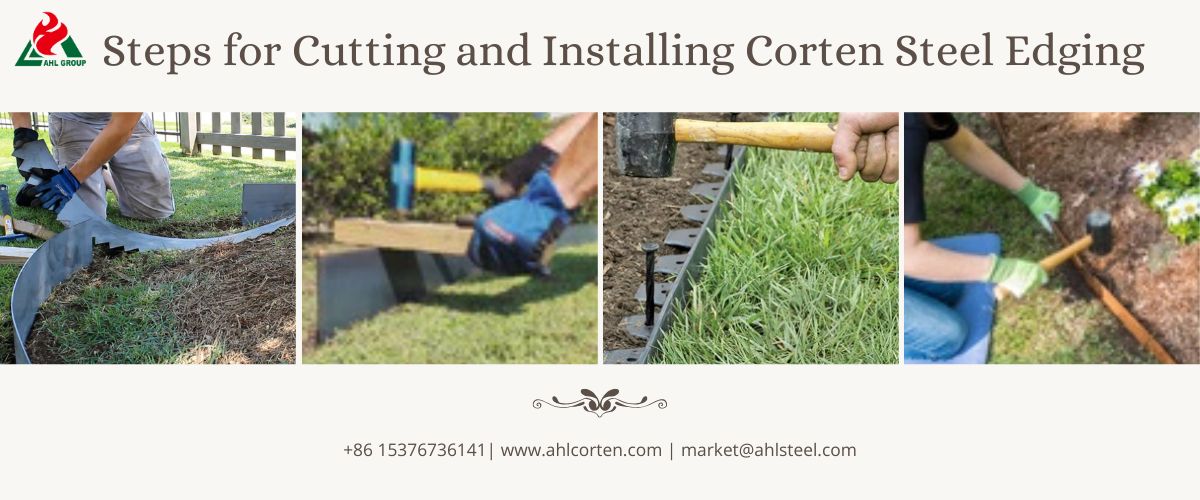
Corten steel edging offers moderate installation difficulty and can be handled independently with proper preparation:
Essential Tools: Angle grinder (with metal cutting disc), rubber mallet, spirit level, chalk line, safety gloves, and safety goggles;
Layout Preparation: Mark the boundary outline on the ground using chalk powder or a chalk line. For curved sections, use a string to shape the curve first, ensuring the design aligns with expectations.
2. Optimal Height and Embedding Depth for Corten Steel Edging
Height and embedment depth require precise adjustment for different scenarios:
Lawn edging: Exposed height of 50-75 mm (2-3 inches) to serve as a mowing strip for easy lawn trimming;
Flowerbeds / Gravel Path Boundaries: Exposed height 100-150 mm (4-6 inches) to effectively prevent soil or gravel overflow while creating a distinct boundary definition;
Raised Beds: Exposed height ≥200 mm (≥8 inches) to fulfill low retaining wall functionality;
Burial Depth Principle: Regardless of application, one-third of the total border height must be buried underground to ensure structural stability and withstand soil pressure and frost heave.
3. Leveling Techniques for Uneven Ground
Even on uneven garden surfaces, metal landscape borders can be installed perfectly level:
Before installation, stretch a taut chalk line along the boundary contour as a leveling reference.
During installation, use the chalk line as a standard. Gently tap the boundary with a rubber mallet to align its top with the chalk line, preventing unevenness.
Want to Create a Unique Corten Lawn Edging? Contact Us!
Rust Bleeding Management for Corten Steel Edging
1. Preventing Staining on Paved/Concrete Surfaces
For 6-12 months after installation, the rust layer on corten steel is unstable and may bleed. Take these precautions:
Never install rusted steel edging directly adjacent to light-colored concrete or tile to prevent staining from rust runoff.
Create a 5-10 cm buffer zone between the edging and sensitive materials, filled with dark-colored mulch or dark gravel. This both conceals the initial rust runoff and prevents contact with valuable paving materials.
2. Rust Stain Removal (If Staining Occurs)
If staining occurs accidentally, address it as follows:
Use oxalic acid-based rust removers sparingly in multiple applications to avoid damaging surrounding materials.
However, prevention is optimal—the buffer zone significantly reduces staining risk.
Want to Get Your Own Corten Edging? Click to Customize!
Long-Term Maintenance of Corten Steel Boundaries
1. Maintenance of Weathering Steel Boundary Rust Layers
The rust layer on corten steel serves as its core protective barrier. Maintenance should adhere to the “hands-off” principle:
Avoid sanding, painting, or sealing, as these actions disrupt natural rust formation and compromise corrosion resistance.
After approximately one year post-installation, the rust layer fully stabilizes into an inert protective coating requiring no further maintenance.
2. Corten Steel Borders: Thickness Selection
Thickness directly impacts the border's lifespan and stability. Select based on application:
Standard Garden/Lawn Borders: 1.6 mm (Grade 16), lifespan exceeding 25 years;
High-traffic/driveway edging: 3.0 mm (No. 11 gauge), withstands greater abrasion, lifespan over 40 years;
Retaining wall edging: 4.0 mm or greater, meets load-bearing requirements, lifespan of over 50 years.
3. Corten Steel Edgings' Resistance to Crushing and Impact
When installed at standard burial depth, they withstand impacts from residential or commercial mowers without deformation.
For high-traffic pedestrian areas, thicker gauges provide superior resistance to long-term foot traffic pressure.
Want to Create a Unique Corten Lawn Edging? Contact Us!
CortenSteel Garden Borders FAQ
1. Are Corten Steel Edgings Suitable For Modern-Style Gardens?
Absolutely. Their clean lines and distinctive rust patina perfectly complement the crisp aesthetics of contemporary gardens, serving as a focal point whether in geometric layouts or minimalist designs.
2. What Is the Optimal Height for Lawn Edging?
We recommend an exposed height of 50-75 mm. This height clearly defines the lawn area while also serving as a mowing strip, facilitating easy trimming.
3. Can I Bend Corten Steel Edging Into Curves Myself?
Yes. Expose Corten Steel to sunlight to slightly warm it, enhancing its flexibility. You can then manually press it into gentle curves. For sharper curves, use bending tools or molds to gradually shape it..
4. How Well Does Corten Steel Pair With Australian Native Plants?
Excellent. Corten Steel's earthy tones complement the rugged texture of native plants, enhancing the garden's natural charm while reducing maintenance effort..
5. Is DIY Installation of Weathering Steel Edging Difficult?
Moderately challenging. The main hurdles are cutting and shaping the material. With the proper tools and step-by-step planning, most people can complete the installation over a weekend.
6. How Deep Should Steel Garden Edging Be Buried?
At least one-third of its total height. For example, a 150mm-high edging requires a 50mm burial depth to ensure structural stability.
7. CanCorten Steel Edging Be Used On Uneven Ground?
Yes. By using a chalk line as a reference and leveling each section during installation, you can achieve a smooth edge even on uneven surfaces.
8. How Can Rust Staining Be Prevented?
The key is to create a 5-10 cm buffer zone filled with dark mulch or gravel, preventing rust water from directly contacting light-colored paving materials or concrete.
9. Does Rusted Steel Edging Require Sealing?
No. Sealants hinder the formation of the natural rust layer, compromising its corrosion resistance. Simply allow it to weather naturally.
10. Can Lawnmowers Damage Corten Steel Edging?
No. When installed at the standard burial depth, the edging structure remains stable and can withstand normal lawnmower impacts..
11. What Thickness Is Recommended For Flower Bed Edging?
Standard flower beds require 1.6 mm (No. 16 gauge); larger beds or those with higher soil pressure should use 3.0 mm (No. 11 gauge). .
12. What Is the Lifespan of Weathering Steel Edging?
Depending on thickness, it can last 25-50+ years, making it one of the most durable garden edging materials available.
Conclusion: Corten Steel Edging — A Long-Term Investment for Garden Excellence
With its unique aesthetic appeal, exceptional durability, and design flexibility, Corten steel edging stands as the preferred material for modern garden design. By following the professional tips in this article—from material pairing and installation standards to rust water management—tall corten steel edging can become the crowning touch of your garden, continuously enhancing the character of your outdoor space for decades.
Ready to select Corten steel edging uniquely suited for your garden? Contact us now to receive a free quote and our latest catalog!

.jpg)
.jpg)
 Fill In The Inquiry