2mm vs 3mm Corten Planters: Which Lasts Longer Outdoors?
Corten steel planters are a familiar choice for commercial landscapes and high-end residential gardens. Buyers comparing 2mm and 3mm models often face an upgrade decision before they have reviewed the construction details.
The price difference should be checked against like-for-like quotations, including reinforcement, base design and finish—not thickness alone. The default assumption is simple: “3mm is thicker, so it must last longer.”
Yet a planter can become unusable through panel bowing, trapped water or failed joints without its walls first rusting through: extra thickness directly improves stiffness, but drainage and weld performance still require their own design checks.
Use the table below to identify what deserves attention before paying for an upgrade.
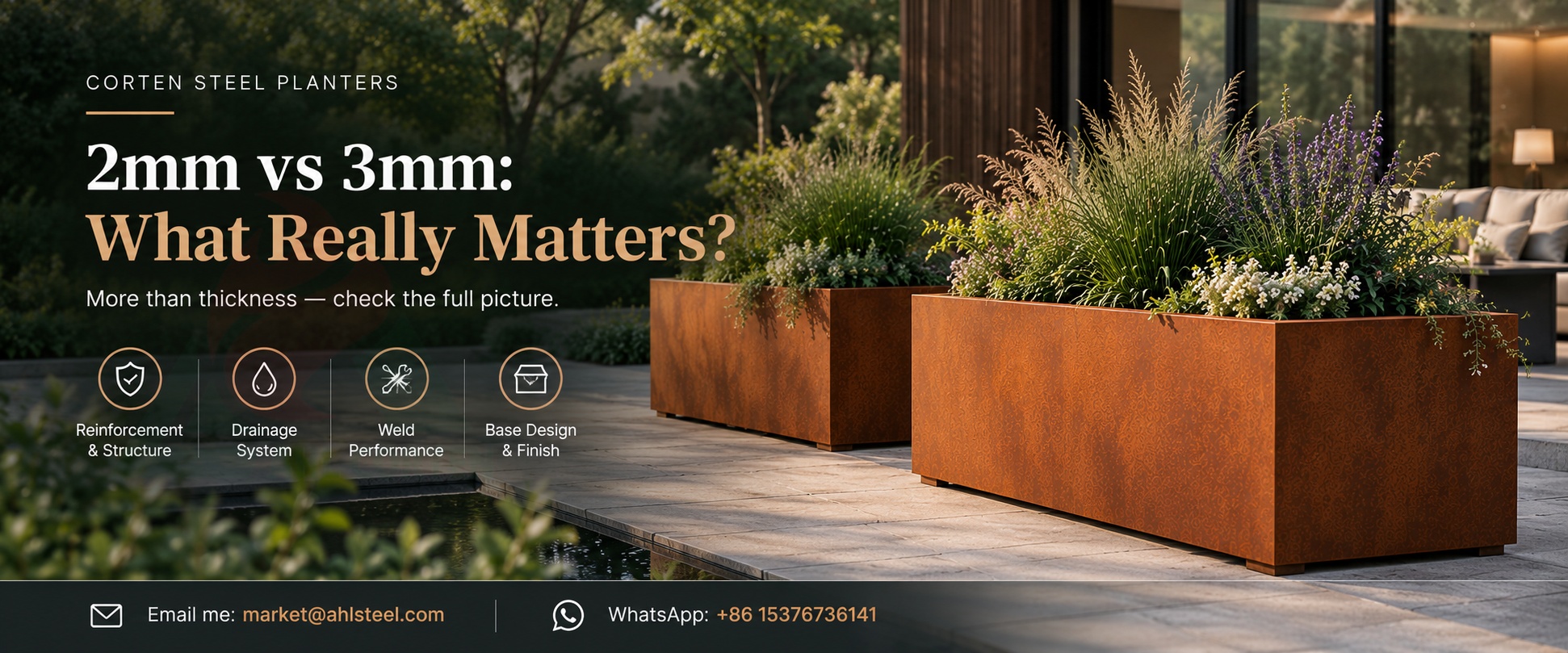
Quick Answer:Which Lasts Longer Outdoors?
| Thickness |
Best Suited For |
Main Advantages |
Main Limitations |
Expected Outdoor Service Life* |
| 2 mm |
Residential planters and garden beds up to 600 mm high in dry or semi-arid regions |
Lightweight; can be moved manually; minimal welding distortion; low cost |
Prone to bulging over long spans; low impact resistance; unsuitable for saturated soil |
10–15 years |
| 2.5 mm (if available) |
Medium-sized commercial planters around 800 mm high |
A balanced compromise |
Regular stock availability needs to be confirmed |
15–20 years |
| 3 mm |
Commercial plazas and municipal projects; planters at least 800 mm high; long sides exceeding 1.2 m: coastal locations |
High rigidity; resistance to deformation; stable welding; greater corrosion allowance |
Heavy; higher shipping costs; lifting equipment required; unit price 40–50% higher |
20–25 years |
| 3 mm + Liner / Base Detailing |
High-humidity or salt-spray environments; automatic irrigation; maintenance-free requirements |
Service life depends on construction detailing rather than thickness alone |
Highest overall cost |
25+ years |
*Service-life estimates and performance claims are translated from the supplied text and have not been independently verified.
What Actually Determines a Corten Planter's Lifespan?
1. Corrosion Allowance
Under suitable wet–dry conditions, Corten develops a patina that slows corrosion. A 3mm panel contains 50% more steel than a 2mm panel, but that does not guarantee 50% longer life. It provides an extra material reserve—not a fixed lifespan increase.
2. Structural Stiffness
For otherwise identical flat panels, bending stiffness increases with thickness cubed. A 3mm panel is approximately 3.4 times stiffer than a 2mm panel. This can reduce bowing, but panel height, unsupported span, folded edges and reinforcement still determine actual performance.
3. Water Management
Trapped water creates persistent wetness and can add pressure against rusty metal planter box walls. Thicker steel cannot correct blocked outlets or poor base drainage. Specify a suitable growing medium, clear drainage outlets and a safe discharge route alongside the steel thickness.
.jpg)
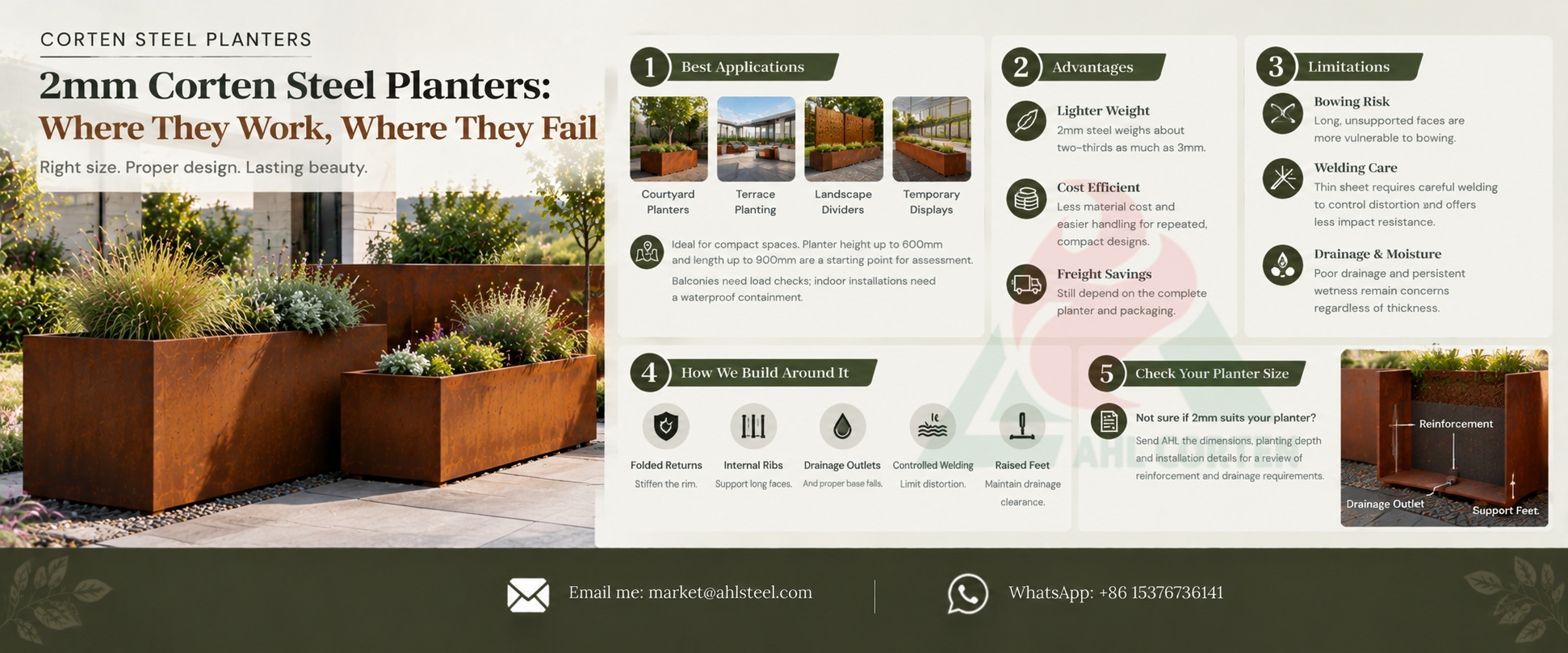
2mm Corten Steel Planters: Where They Work, Where They Fail
1. Best Applications
Suitable for compact courtyard planters, terrace planting, landscape dividers and temporary displays. Planters up to 600mm high and 900mm long are a starting point for assessment—not guaranteed limits. Balconies need load checks; indoor installations need waterproof containment.
2. Advantages
For identical panels, 2mm steel weighs approximately two-thirds as much as 3mm steel. It can reduce material cost and handling weight, making it attractive for repeated, compact designs. Safe lifting and freight savings still depend on the complete weathering steel planter and packaging.
3. Limitations
Long, unsupported faces are more vulnerable to bowing. Thin sheet also requires careful welding to control distortion and offers less resistance to impact. Poor drainage and persistent wetness remain concerns regardless of thickness.
4. How We Build Around It
- Specify reinforcement alongside thickness:
- Folded returns to stiffen the rim.
- Internal ribs where long faces need support.
- Clear drainage outlets and suitable base falls.
- Controlled welding sequences to limit distortion.
- Raised feet or a support ring to maintain drainage clearance.
5. Check Your Planter Size
Not sure if the 2mm suits your planter? Send AHL the dimensions, planting depth and installation details for a review of reinforcement and drainage requirements.
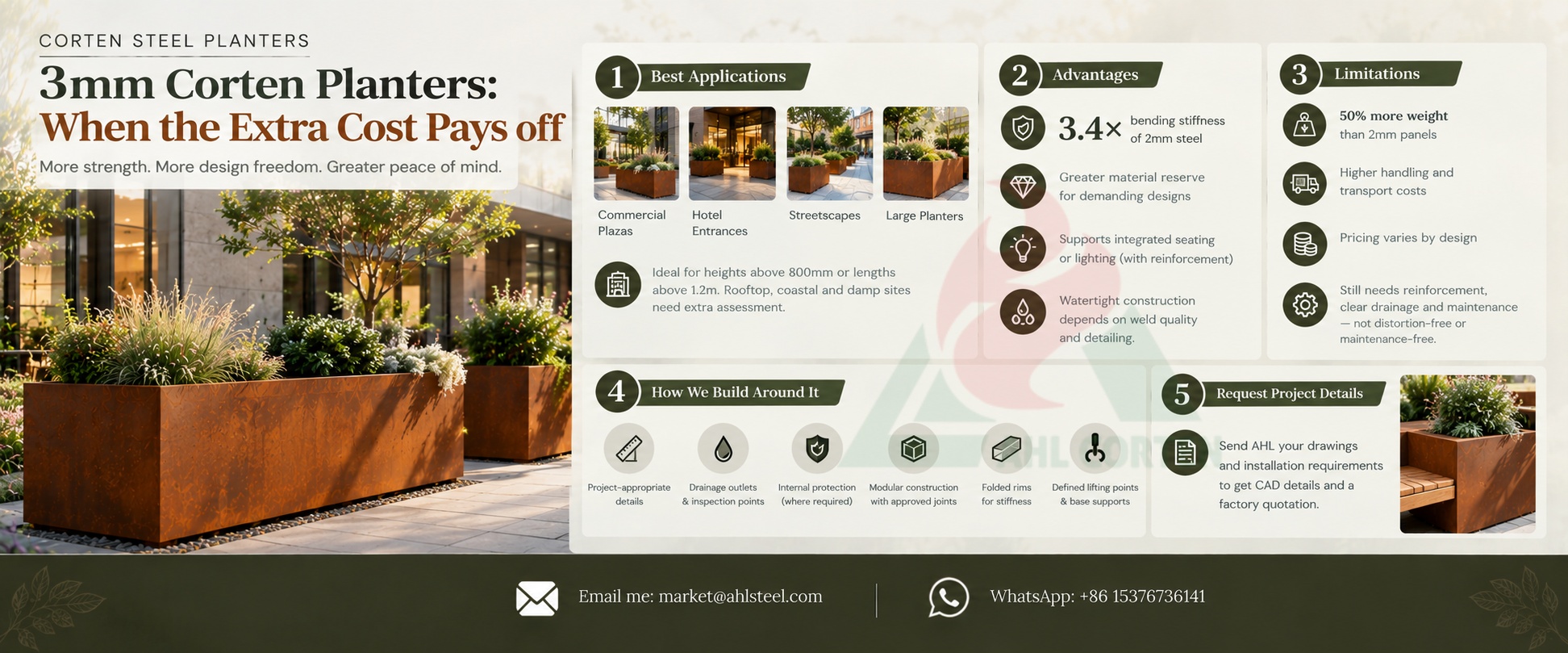
3mm Corten Planters: When the Extra Cost Pays Off
1. Best Applications
Consider 3mm steel for commercial plazas, hotel entrances, streetscapes and large planters. Heights above 800mm or lengths above 1.2m warrant closer structural review—not automatic approval. Rooftop installations require load checks, while coastal and persistently damp sites need additional corrosion assessment.
2. Advantages
For otherwise identical flat panels, 3mm steel provides approximately 3.4 times the bending stiffness of 2mm steel. It offers greater material reserve and can support demanding designs, including integrated seating or lighting, with appropriate reinforcement. Watertight construction depends on weld quality and detailing—not thickness alone.
3. Limitations
Equivalent panels weigh 50% more than 2mm panels, potentially increasing handling and transport costs. Lifting requirements depend on the finished assembly. Pricing varies by design, and thicker steel still needs reinforcement, clear drainage and maintenance—it does not guarantee distortion-free or maintenance-free performance.
4. How We Build Around It
- Specify project-appropriate details:
- Accessible drainage outlets and inspection points.
- Compatible internal protection where required.
- Modular construction with approved joint and assembly details.
- Folded rims that provide stiffness without trapping water.
- Defined lifting points and base supports.
5. Request Project Details
Specifying 3mm for a commercial project? Send AHL your drawings and installation requirements to request CAD details and a factory quotation.
2mm vs 3mm Rusted Steel Planters: Side-by-Side Comparison
| Comparison Factor |
2 mm |
3 mm |
Practical Impact on the Project |
| Sheet Weight (kg/m²) |
15.7 |
23.6 |
Shipping costs, lifting requirements, and floor loading |
| Flexural Rigidity (Relative) |
1.0 |
3.4 |
Whether long sides are prone to bulging |
| Impact Resistance |
Moderate |
High |
Suitability for commercial and high-traffic settings |
| Watertight Welding |
Difficult |
Feasible |
Requirements for integrated irrigation and leak prevention |
| Manual Forming |
Easy |
Equipment required |
Custom shapes and rounded corners |
| Corrosion Allowance |
Baseline |
+50% |
Suitability for coastal and industrial environments |
| Material Cost (Relative) |
1.0 |
1.4–1.5 |
Project budget |
| Expected Service Life (Residential) |
10–15 years |
20–25 years |
Replacement interval |
| Best Applications |
Residential / Decorative |
Commercial / Municipal |
— |
*Sheet weights (kg/m²) are theoretical steel weights. Service-life ranges should be validated for the specific project. Figures and performance claims are translated from the supplied image and have not been independently verified.
Choosing by Corten Steel Planter Size and Site Conditions
1. Choose Thickness Based On Dimensions
| Planter Dimensions |
Typical Applications |
Recommended Thickness |
| ≤400 mm high, with side lengths ≤600 mm |
Tabletop / Balcony / Decorative Use |
2 mm |
| 400–600 mm high, with side lengths ≤900 mm |
Garden Planters |
2 mm with Folded Edges |
| 600–800 mm high, with side lengths of 900–1200 mm |
Commercial Entrances / Terraces |
2.5–3 mm |
| ≥800 mm high, or any side length >1200 mm |
Public Plazas / Municipal Projects |
3 mm with Reinforcing Ribs |
| Any size near vehicle traffic or machinery |
Parking Areas / Construction Sites |
3 mm with Impact-Protection Features |
*Thickness recommendations are translated from the supplied image and have not been independently verified.
2. Choose Thickness Based On The Environment
| Environment |
Risk Level |
Recommendation |
| Dry Inland Areas |
Low |
2 mm is sufficient |
| High Rainfall / Poor Drainage |
Moderate to High |
2 mm with improved drainage, or 3 mm |
| Coastal Salt-Spray Exposure (<5 km from the Coast) |
High |
3 mm with regular rinsing |
| Industrial / Polluted Areas |
High |
3 mm |
| Areas Subject to Freeze–Thaw Cycles |
High |
3 mm with detailing to accommodate freezing expansion |
| Rooftops / Indoor Atriums |
Moderate (Leakage Risk) |
3 mm with watertight welds and a waterproof containment tray |
*Risk levels and recommendations are translated from the supplied image and have not been independently verified.
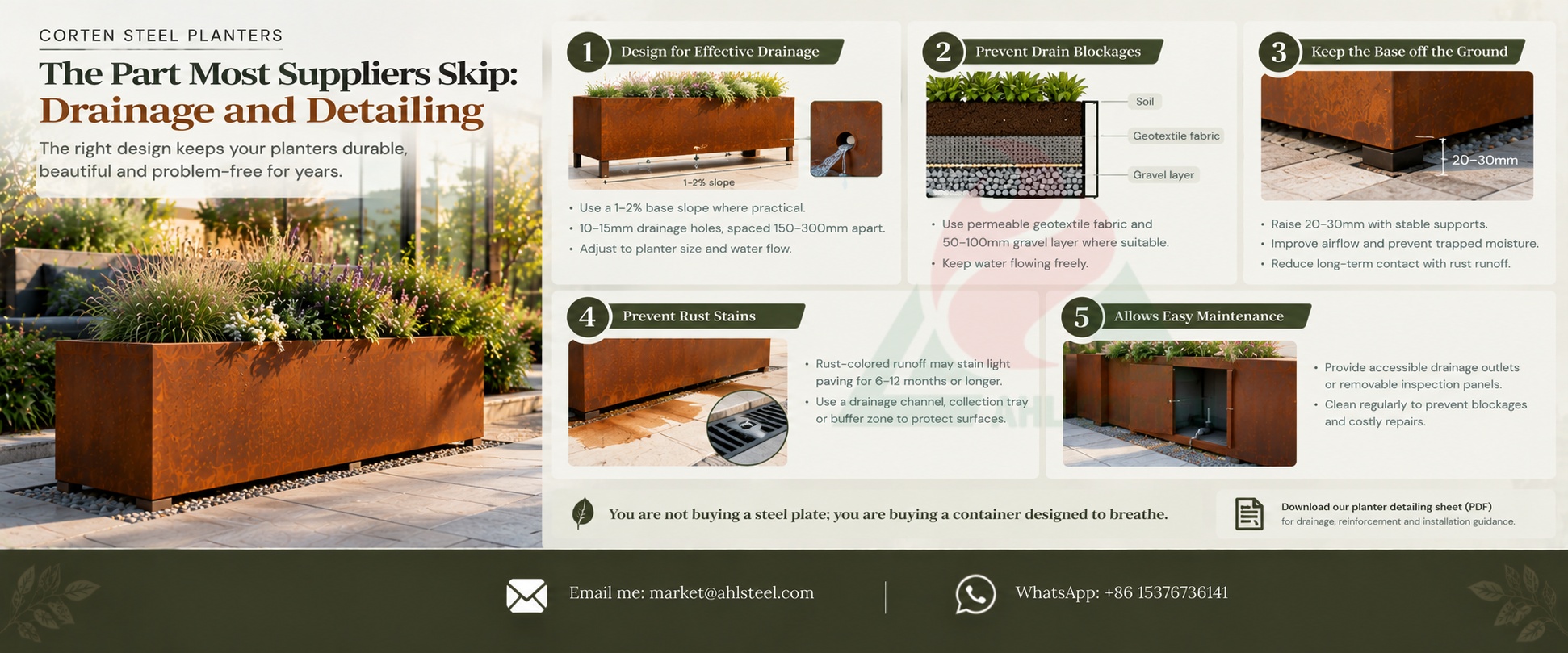
The Part Most Suppliers Skip: Drainage and Detailing
Choosing the right Corten steel thickness is only half the job. Proper drainage, ground clearance, and installation details are equally important for long-term durability.
1. Design for Effective Drainage
Use a 1–2% base slope where practical, with 10–15mm drainage holes spaced approximately 150–300mm apart. Adjust these dimensions according to planter size and water flow.
2. Prevent Drain Blockages
Use permeable geotextile fabric and a 50–100mm gravel layer where suitable to reduce soil particles entering drainage outlets. Ensure water can escape freely.
3. Keeping the Base off the Ground
Raise the steel planter box 20–30mm using stable supports to improve airflow, prevent trapped moisture, and reduce prolonged contact between rust runoff and paving.
4. Prevent Rust Stains
Rust-colored runoff may stain light-colored paving for the first 6–12 months or longer. Use a drainage channel, collection tray, or suitable buffer zone to protect surrounding surfaces.
5. Allows Easy Maintenance
Large planters should have accessible drainage outlets or removable inspection panels. Regular cleaning helps prevent blockages and costly repairs.
Remember: You are not buying a steel plate; you are buying a container designed to breathe.
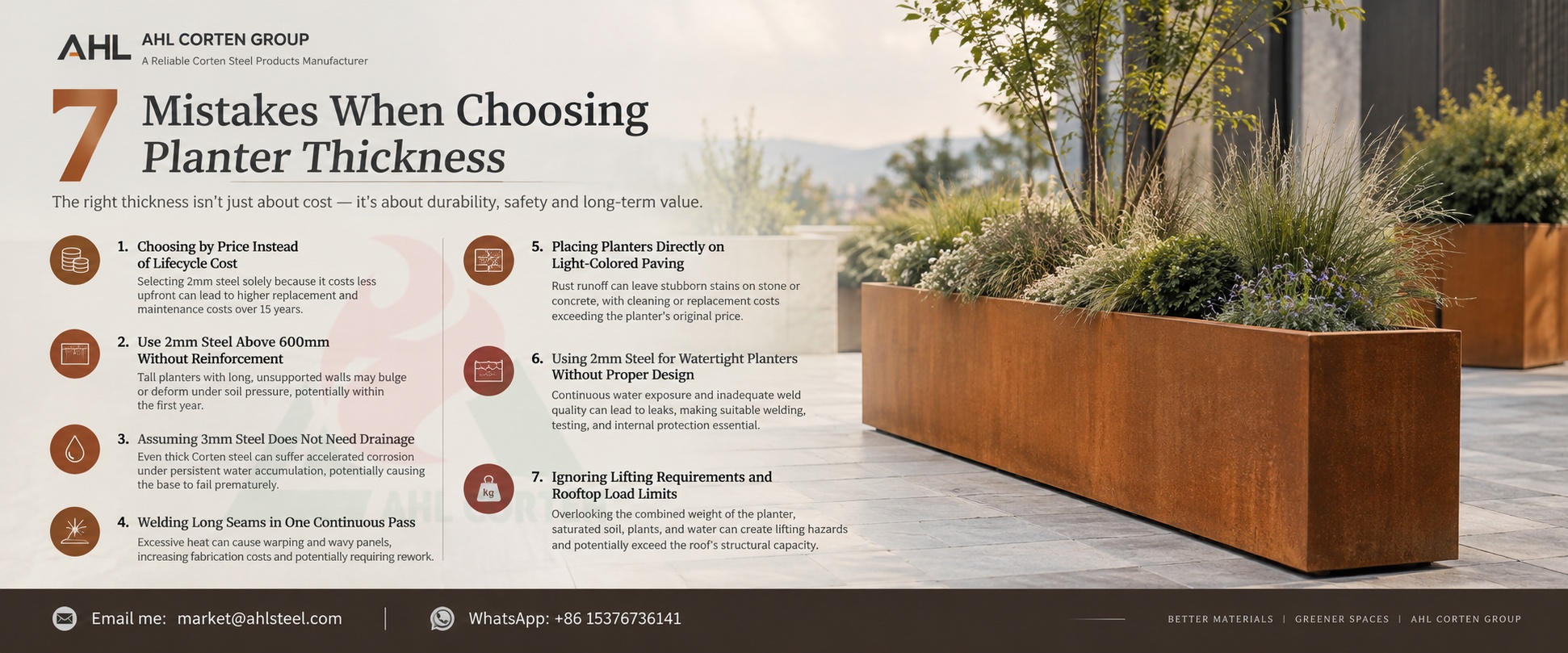
7 Mistakes When Choosing Planter Thickness
1. Choosing by Price Instead of Lifecycle Cost
Selecting 2mm steel solely because it costs less upfront can lead to higher replacement and maintenance costs over 15 years.
2. Use 2mm Steel Above 600mm Without Reinforcement
Tall planters with long, unsupported walls may bulge or deform under soil pressure, potentially within the first year.
3. Assuming 3mm Steel Does Not Need Drainage
Even thick Corten steel can suffer accelerated corrosion under persistent water accumulation, potentially causing the base to fail prematurely.
4. Welding Long Seams in One Continuous Pass
Excessive heat can cause warping and wavy panels, increasing fabrication costs and potentially requiring rework.
5. Placing Planters Directly on Light-Colored Paving
Rust runoff can leave stubborn stains on stone or concrete, with cleaning or replacement costs exceeding the planter's original price.
6. Using 2mm Steel for Watertight Planters Without Proper Design
Continuous water exposure and inadequate weld quality can lead to leaks, making suitable welding, testing, and internal protection essential.
7. Ignoring Lifting Requirements and Rooftop Load Limits
Overloading the combined weight of the planter, saturated soil, plants, and water can create lifting hazards and potentially exceed the roof's structural capacity.
Are You Ready to Choose Your Corten Steel Planter Thickness?
As a starting point, consider 2mm steel for compact residential planters and 3mm steel for larger or more demanding commercial designs. Deep planters, long unsupported panels and integrated seating may require thicker steel, additional reinforcement or a dedicated support frame. The correct specification depends on the complete design—not thickness alone.
Unsure how planter dimensions, soil loading, drainage or installation conditions affect your choice? Contact the AHL team to discuss your project before finalising the specification.
We provide free, one-on-one selection advice, project-specific quotations and customised drawing support to help you coordinate thickness, reinforcement, base construction and drainage for your Corten steel planters.
Need a Factory Quote for Corten Steel Planters?
Send your drawings, size list, quantity, and destination country. Corten Factory can support custom weathering steel fabrication, export packing, and project quotation.
FAQ: Corten Steel Planter Thickness
1. How Long Does a 2mm Corten Planter Last?
A 2mm Corten steel planter can last for many years when properly designed, installed, and maintained. Its lifespan depends on drainage, climate, planter dimensions, soil contact, and fabrication quality. Smaller planters generally experience less structural stress, while large units may require reinforced corners or folded edges to reduce deformation and extend service life.
2. Is 3mm Overkill for a Residential Garden?
No, 3mm Corten steel is not necessarily overkill for a residential garden. While 2mm steel may be sufficient for small, freestanding planters, 3mm offers greater rigidity for larger units or designs with long, unsupported sides. The best thickness depends on planter dimensions, soil load, budget, and the desired balance between durability and cost.
3. Will Thicker Corten Steel Rust Slower?
No, thicker Corten steel does not inherently rust more slowly than thinner steel of the same grade under identical conditions. Both develop a protective surface patina through alternating wet and dry cycles. Thicker steel simply provides more material to tolerate metal loss over time, while suitable drainage and exposure conditions help promote stable patina development.
4. Can a 2mm Planter Be Made Watertight?
Yes, a 2mm Corten steel planter can be fabricated to hold water, but watertightness depends on weld quality, corner joints, and structural design. Continuous, properly executed welds and suitable leak testing are essential. However, prolonged water retention can affect corrosion behavior, so a planter designed to hold water may require a different internal protection system from a conventional soil planter.
5. Why Is My Corten Planter Bulging?
A Corten steel planter usually bulges because soil pressure, retained water, or root growth pushes against its walls. Thin steel and long unsupported panels are particularly vulnerable to deformation. To prevent bulging, consider thicker steel, reinforced corners, folded edges, internal stiffeners, or a suitable frame. Proper drainage also helps reduce excessive pressure from waterlogged soil.
6. Do Corten Planters Need Drainage Holes?
Yes, most Corten steel planters used for growing plants need drainage holes to prevent waterlogging. Standing water can damage plant roots and create unfavorable corrosion conditions. Position the holes to allow effective drainage, and consider adding a suitable drainage layer or filter fabric. For elevated installations, ensure excess water can drain safely without damaging the surface below.
7. Will Corten Stain My Paving?
Yes, Corten steel planters can stain paving as rust-colored runoff carries iron oxides onto surrounding surfaces. Staining is especially common during the initial patina development period and in areas exposed to frequent rain or irrigation. To reduce the risk, direct drainage away from paving, elevate the planter where appropriate, and allow the patina to stabilize before installation on sensitive surfaces.
8. How Thick Should a Corten Planter Be for a Rooftop?
A 3mm rusted steel planter can be a practical starting point for many rooftop applications, but it is not a universal specification. The required thickness depends on planter size, soil depth, unsupported spans, wind exposure, and reinforcement. Rooftop projects must also account for the combined weight of saturated soil, plants, water, and containers, as well as drainage and structural load limits.
9. Can 3mm Corten Be Bent Into Curves?
Yes, 3mm Corten steel can generally be bent into curves using suitable metal fabrication equipment. The achievable radius depends on the steel grade, bending method, tooling, and required finish. Tighter curves may require specialized processes and careful springback control. For curved planters, confirm the intended diameter, curve profile, joint design, and finish requirements with your manufacturer before production.
10. Does Corten Steel Need Painting Inside a Planter?
No, Corten steel planters do not normally need internal painting when used for conventional soil planting and designed for effective drainage. An interior coating may be unnecessary and could deteriorate under prolonged contact with moisture and soil. However, applications involving standing water, aggressive growing media, or special contamination requirements may need additional protection based on the intended use and material compatibility.
Back

 Fill In The Inquiry