What Is the Best Height for a Corten Steel Water Wall?
Corten steel water curtain walls have become a highly popular water feature in courtyards, patios, commercial entrances, and hotel landscapes thanks to their unique rust-colored texture and the gentle sound of flowing water. The choice of height directly affects its visual proportions, the sound of the water, and how well it harmonizes with the surrounding environment.
If the height is too high, a small courtyard may feel oppressive and cramped; if it is too low, it may lack sufficient visual impact in a spacious garden or commercial space. In reality, there is no one-size-fits-all standard height; the ideal dimensions require a comprehensive assessment that takes into account the site’s space, viewing angles, water flow effects, reservoir structure, and installation conditions.
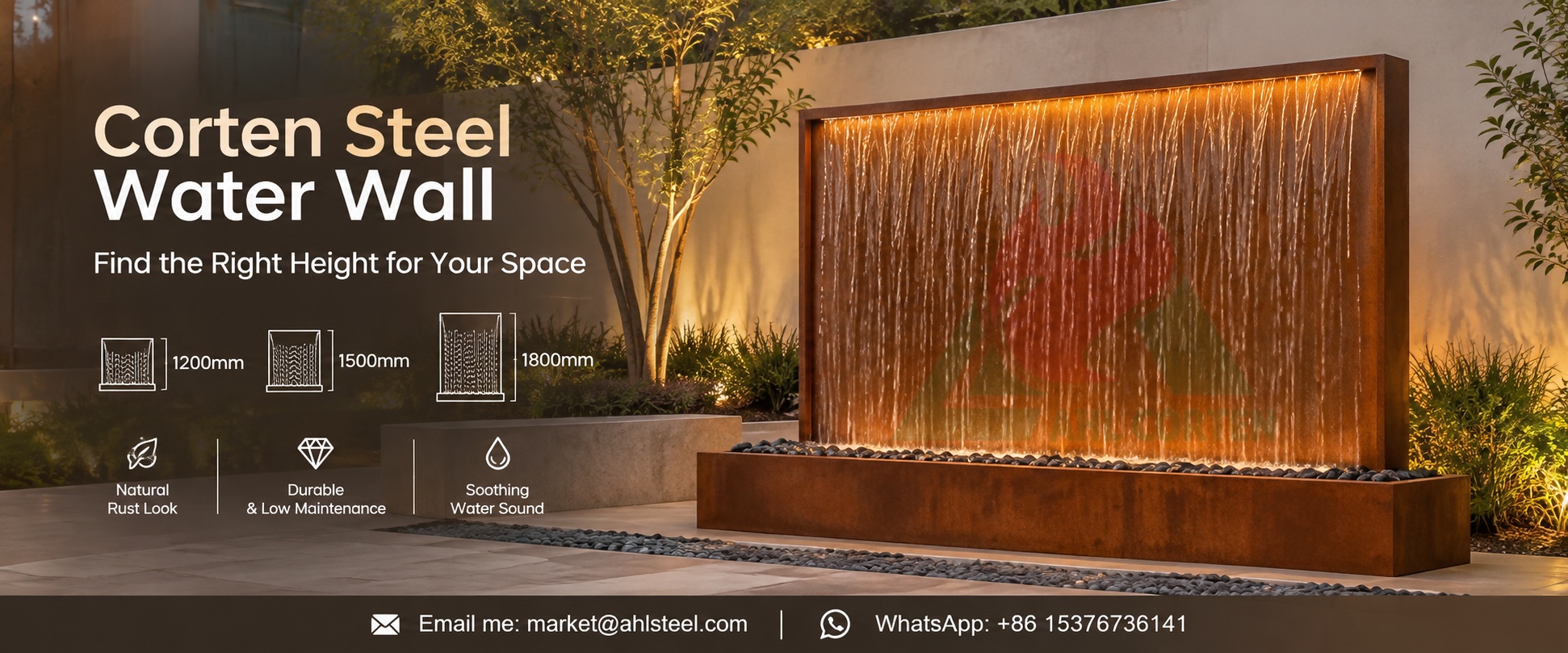
For private gardens and landscape projects, 1200mm, 1500mm, and 1800mm are the most commonly used starting reference sizes. This article will help you understand the concept of sizing, compare the appropriate scenarios for different heights, and explain how height affects water flow, pumps, and installation plans—all to help you make a precise selection.
What Height are You Actually Measuring?
Many buyers fall into a common trap: confusing the height listed on the product with the visible height after installation. The dimensions listed by the seller do not necessarily match the height you’ll see when standing in your yard, nor do they equal the vertical distance the water falls.
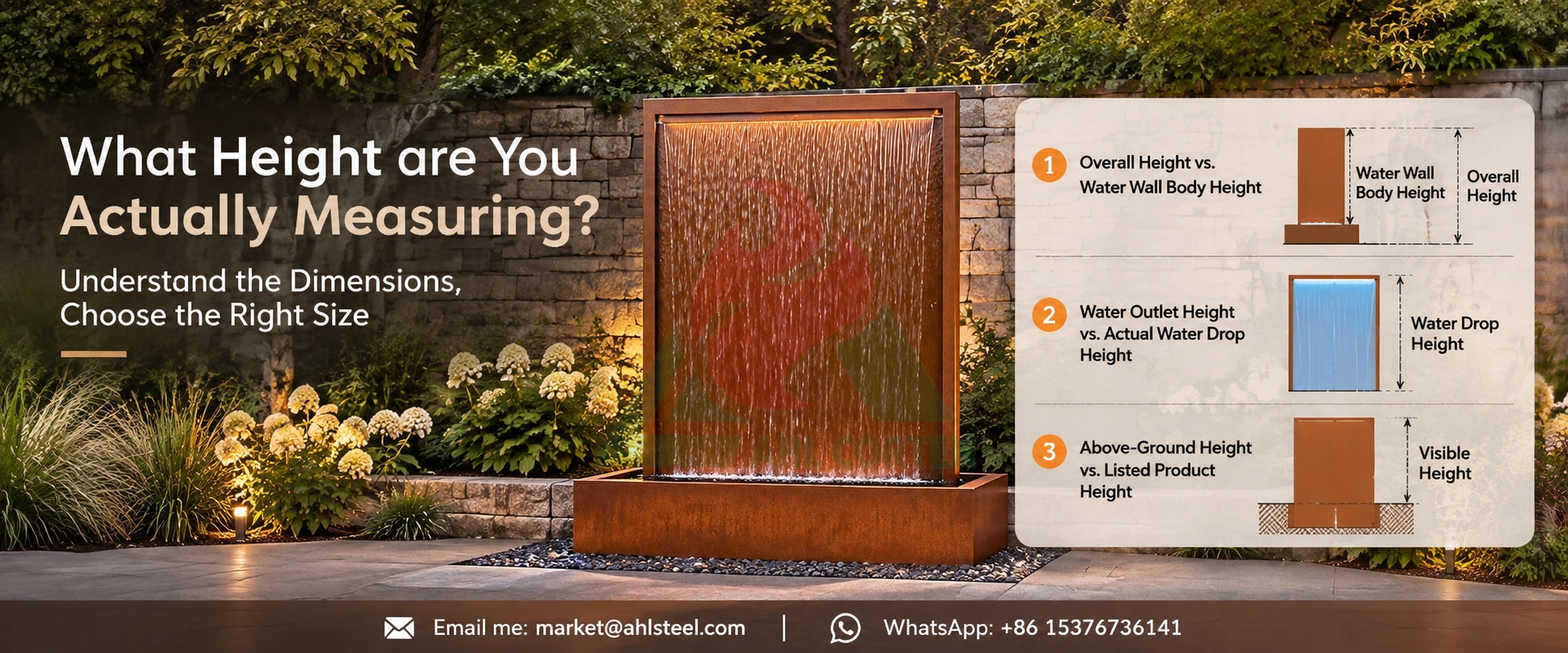
1. Overall Height vs. Water Wall Body Height
Overall height refers to the total height of the entire water feature once it is fully assembled, including the weathering steel main wall, the base reservoir, the support base, and other structural components. The garden water wall body height, however, refers solely to the height of the vertical steel panel through which the water flows.
For example, a metal water curtain with a main steel panel height of 1,500 mm will have a significantly greater total height when the water basin and base are added. If the water basin is installed below ground level, the visible height above ground will change again. When requesting a quote, be sure to ask the supplier to provide cross-sectional drawings that indicate the elevations of the main structure, the water basin, and the reference ground level.
2. Water Outlet Height vs. Actual Water Drop Height
The height of the water outlet is not the same as the actual water drop height. There are two mainstream water flow styles on the market: wall-mounted water flow and free-fall water curtains. In the wall-mounted style, the water flows gently down the surface of the steel panel, with the water layer hugging the panel closely; in the free-fall style, the water drops directly from the outlet into the reservoir below, creating a more intense auditory and visual impact.
Even if the total height of both products is exactly the same, different outlet positions will result in completely different water flow effects and sound levels. Before placing an order, confirm the following: outlet position, whether it is a wall-hugging or free-fall design, the point where the water stream hits the surface, the actual vertical drop, and the flow distribution plan.
3. Above-Ground Height vs. Listed Product Height
Water tanks come in two configurations: above-ground monolithic units and sunken, buried tanks. With buried tanks, part of the structure is concealed below ground level, so the final visible height will be lower than the total height listed for the product.
In this case, a cross-sectional diagram is crucial, as it clearly illustrates the finished ground level, tank location, water level, outlet height, and space for future maintenance. Do not rely solely on product images to estimate the final result, as images often fail to convey the height variations caused by underground structures.
Corten Steel Water Wall Heights: A Practical Comparison
Different heights create entirely different landscape atmospheres. The dimensions listed below are commonly used as references in project design; they are not rigid standards. Final adjustments must be made based on structural requirements, site conditions, and water flow effects.
- 1000–1200 mm: Low-focal-point water features for small courtyards and leisure areas; suitable for placement next to sofas or tea tables, aligned with the viewing angle from a seated position; emphasis should be placed on matching the proportions of the water basin and coordinating with surrounding greenery.
- Approximately 1500 mm: Suitable for medium-sized patios, main garden features, and architectural landscape elements; this is the most versatile specification on the market, with a focus on balancing width-to-height ratios and viewing distance.
- Approximately 1,800 mm: Garden feature walls and main focal points at main entrances. These create a stronger vertical atmosphere and require proper support and reinforcement, as well as reserved access for maintenance, while also accounting for the impact of high winds.
- 1,800 mm and above: Water features for large parks, hotels, and commercial landmarks. These are custom-made and have strict requirements for the underlying structure, foundation, pump system, and transportation and hoisting.
Short Corten steel waterfall walls are better suited for small courtyards, as they are gentle and unobtrusive; tall models are ideal for open spaces, serving as vertical visual focal points. When selecting a model, be sure to distinguish between wall-mounted water features and rain curtain water features, as their basin sizes, flow rate requirements, and installation plans differ. We recommend first determining your desired ground-level visibility height, then confirming the complete configuration—including steel panels, basins, and pumps—to match that height.
Selecting the Appropriate Height for a Water Curtain Wall to Complement Outdoor Spaces
When selecting the height, the goal isn’t simply to go as high as possible; the key is to achieve a balance between the rusted steel water feature and the surrounding environment, ensuring a comfortable visual experience from all primary viewing angles.
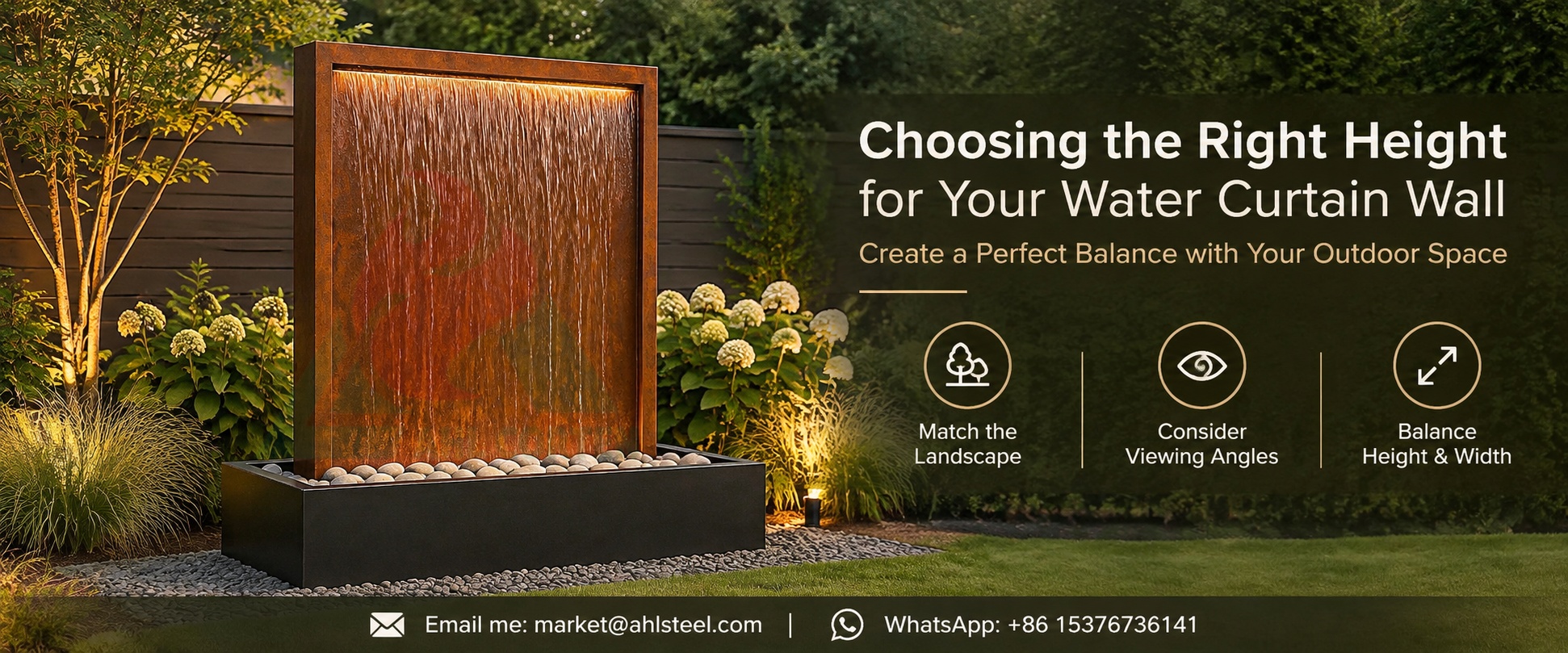
1. Matching the Scale of the Surrounding Landscape
First, observe the heights of surrounding fences, feature walls, trees, trellises, and building facades. Low-profile water curtain walls are well-suited for multi-layered plant arrangements and low-lying stone landscaping, blending naturally into the garden; tall, weather-resistant steel water curtain walls are ideal for minimalist architectural backdrops, creating a striking vertical contrast.
At the same time, clarify the water feature’s role in the design: if it serves as the main focal point, choose a more prominent vertical height; if it acts as a backdrop, opt for a medium height paired with greenery and outdoor furniture; if it’s merely a decorative accent, a compact, low-profile model will suffice.
2. Carefully Assess Key Viewing Angles
Just because a water curtain wall looks good from the front doesn’t mean it will appear harmonious when viewed from seating areas, indoor windows, or walkways. Before finalizing the height, consider all primary viewing locations: outdoor dining tables, lounge sofas, garden walkways, indoor picture windows, and the main entrance.
Even a height difference of just a few hundred millimeters in a small courtyard can significantly impact the overall aesthetic. If conditions permit, use a simple frame or string to mark the proposed height and get a visual sense of the proportions, avoiding the disappointment of discovering a lack of harmony only after completion.
3. Balance Height and Width
Height must always be evaluated in conjunction with width. Tall, narrow designs feature clean lines and lean toward a modern architectural style; low, wide designs extend horizontally, creating a relaxed atmosphere, and are suitable for gardens with a horizontal layout.
When comparing design options, comprehensively review the width of the water wall, the length, width, and depth of the pool, the support structure, the available installation space, and the proportions relative to the surrounding landscape. Simply increasing the height without adjusting the base or width can easily result in a top-heavy appearance and disproportionate balance. If you’re unsure about the proportions, you can provide photos of the site so the supplier can help you evaluate them.
Do Taller Water Walls Necessarily Produce Louder Water Sounds and More Splashing?
Many clients have a misconception: the taller the wall, the louder the sound and the more water splashes. In reality, the sound and splash effects are not determined solely by the height of the steel panel; they depend primarily on the design of the water outlet, the height difference of the water flow, and how the water interacts with the steel panel and the pool.
With a wall-hugging water flow, the water spreads across the surface of the weathering steel, producing a gentle sound with minimal splashing; with a free-falling rain curtain, the water drops from mid-air, creating a distinct sound and causing water to splash outward more easily. For water walls of the same height, the experience of these two discharge methods is worlds apart.
The full range of factors affecting the water flow effect includes: the width and shape of the outlet, the uniformity of water distribution, flow rate, actual drop height, pool depth and water level, on-site wind conditions, and the placement of surrounding paving and furniture. If the water feature is located close to seating areas, doors, or windows, be sure to discuss your desired sound level and splash control requirements in advance.
Product images make it difficult to assess the dynamic flow effect; if possible, request a video of the system in operation with the same configuration from the supplier. Ensure the style in the video matches your design—do not use footage of a low-profile, wall-mounted water feature to estimate the effect of a tall rain curtain. For projects with noise reduction or splash control requirements, be sure to have the manufacturer review the entire configuration in advance; do not rely solely on height specifications.
How Does Corten Water Wall Height Affect Pump Selection?
The pump is the core component of a water wall system, but pump selection should not be based solely on the total height of the steel plate. The pump must deliver the target flow rate at the outlet after accounting for pipeline losses; the key factor is the effective head, not the product’s apparent height.
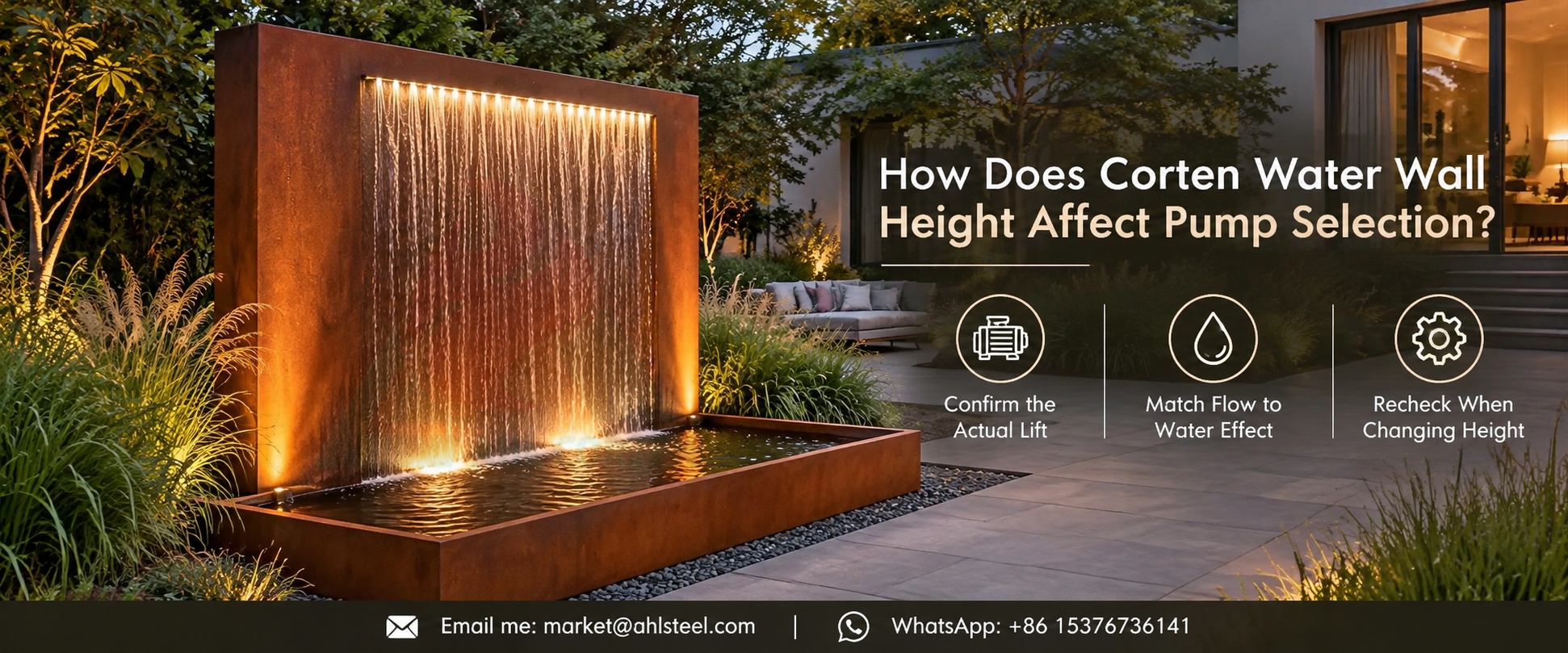
1. Confirm the Actual Lift from the Pump to the Outlet
The total height of the entire water feature includes structures such as the water basin and base, which are not factored into the pump’s effective head. When reviewing the design, it is essential to confirm the pump’s installation location, outlet elevation, piping route, pipe diameter, vertical lift height, target flow rate, and the hydraulic losses caused by elbows and piping. Only with these data points can the appropriate pump be selected.
2. Matching Flow Requirements to the Intended Water Effect
Narrow, wall-hugging water flows and wide rain curtains require completely different flow rates. Even if the head is sufficient, if the flow rate does not match the water distribution channel, issues such as intermittent flow and uneven water distribution will occur. When selecting a pump, you must simultaneously consider the width of the water curtain, the outlet structure, the water distribution plan, the vertical lift, and the intended water flow pattern.
3. Re-evaluate the System When Changing the Height
If the standard height is increased from 1,200 mm to 1,800 mm, the original pump configuration cannot simply be reused. A change in height alters the outlet elevation, hydraulic requirements, piping layout, water distribution effect, and even the support structure.
Customizing the height involves adjusting the entire water feature system—it is not simply a matter of extending a single steel panel. This is why, when requesting a custom quote, you need a quote for the entire system rather than just the steel panel alone.
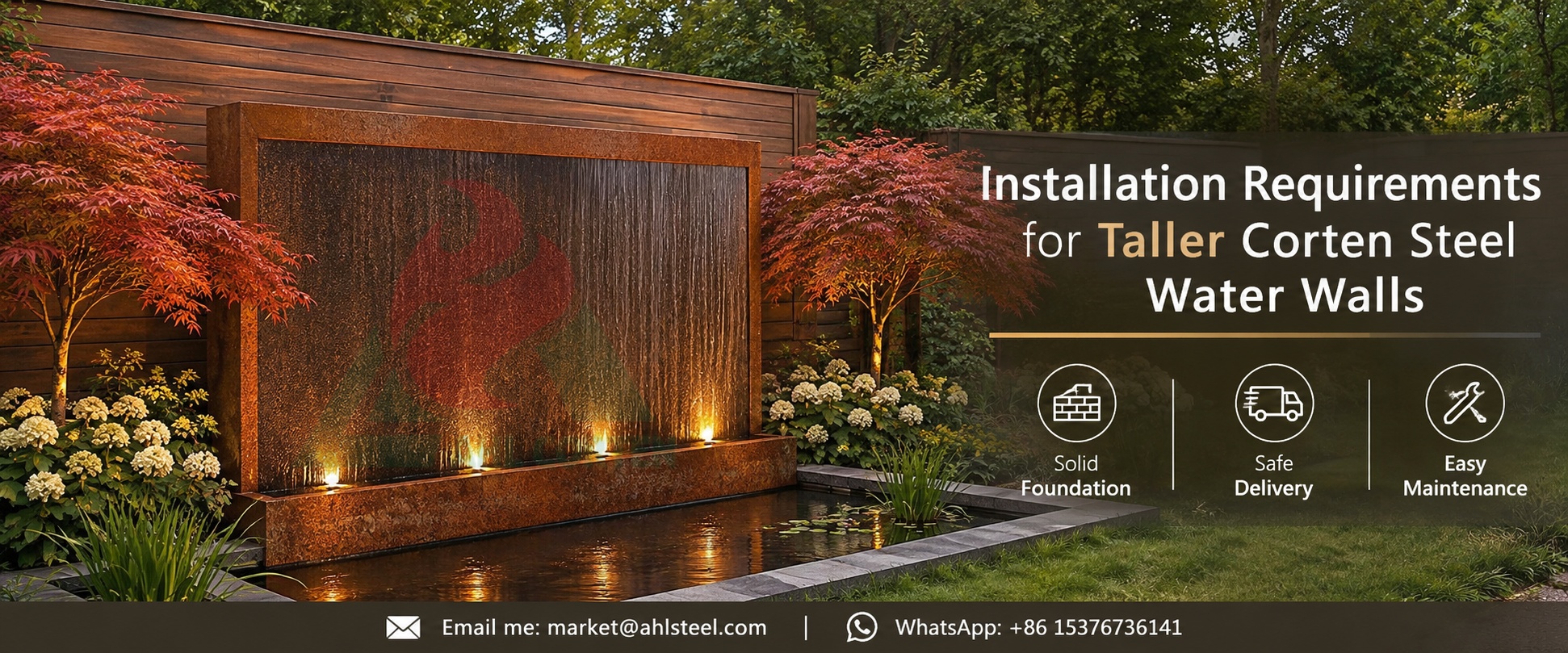
Why Do Installation Requirements Matter for Taller Corten Steel Water Walls?
The taller the structure, the greater the demands on support, transportation, and future maintenance—details that must be carefully considered during the initial planning phase.
1. Foundation and Support
Taller water walls come in three types: freestanding, wall-mounted, and those with a fixed base, each with different foundation requirements. You must confirm the foundation’s load-bearing capacity, anchoring plan, finished ground elevation, basin location, and structural interfaces. Do not assume that the foundation plan for a shorter model can be directly applied to a taller one.
2. Overall Weight and Delivery Access
Taller models use thicker steel plates, reinforced ribs, and larger water tanks, resulting in increased overall weight. Before placing an order, inspect the delivery route in advance: check the main gate, walkway width, steps, turning space, and operating locations for lifting equipment. Confirm the product dimensions, packaging format, and weight beforehand to avoid delivery issues upon arrival.
3. Pump Access, Power, and Pipework
Sufficient access space must be reserved for the pump, electrical connections, and piping to facilitate future maintenance and replacement. Confirm the pump’s disassembly method, power source locations, and connection methods for the piping and water basin. Electrical work and installation must comply with local codes and be performed by a licensed electrician. While an aesthetically pleasing, integrated water feature is important, it should not come at the expense of future maintenance accessibility.
Standard Height vs. Custom Height: Which Should You Choose?
There is no absolute superiority between standard and custom models; the choice depends on your site conditions and design objectives.
· If your site dimensions perfectly match a standard model: Prioritize the standard height. The design is well-established, pump compatibility is reliable, and pricing and delivery times are more predictable. Simply verify the overall dimensions, water flow effects, and installation conditions.
· If you need to align the elevation with existing feature walls or buildings: Prioritize a custom main structure height; confirm the top surface elevation, mounting points, and support plan.
· If the water reservoir is sunken or buried: Be sure to provide a cross-sectional diagram to verify the visible height, reservoir location, and access for maintenance.
· For special rain curtain or wall-climbing water effects: Review the entire water system to ensure the water outlets, flow rates, pumps, and water basins are properly coordinated.
· For large-scale commercial or specialty landscape projects: Conduct a specialized structural review covering the structure, components, transportation, and site conditions.
Adjusting the height does not mean other components can remain unchanged. The final dimensions, pumps, outlets, basins, and support structures must all be reviewed simultaneously—this is key to ensuring a successful custom water feature installation.
Common Water Wall Height Mistakes to Avoid
Many water feature projects fail to meet expectations in the end, and the root cause is often oversights in the initial design phase:
- Confusing the height of the steel panel structure with the total assembled height of the entire unit;
- Overlooking the buried water basin, leading to an incorrect assessment of the visible height upon completion;
- Equating the height of the steel panel with the water flow head;
- Simply pursuing a taller water feature while ignoring spatial proportions;
- Assuming that a taller structure will inevitably produce louder water sounds and more splashes;
- Increasing the steel panel height without verifying the pump and water distribution system;
- Focusing only on front-view renderings while ignoring maintenance space and depth dimensions;
- Failing to verify access routes before ordering large-scale water features;
- Comparing wall-mounted and free-fall rain curtain models based solely on height.
Verifying these details in advance can significantly reduce design changes and prevent issues after installation.
Customizing Rusted Steel Water Curtain Solutions for Your Project
The optimal height for a weathering steel water curtain is one that complements your landscape scale, viewing angles, water flow effects, and installation conditions. Compact, low-profile models are ideal for small courtyards, while taller models can create iconic vertical landscapes in hotel lobbies, commercial entrances, and open gardens.
AHL offers both standard and custom weathering steel water curtain walls, with dimensions, basin designs, water outlet configurations, and配套 pumps and lighting adjustable to your needs. Whether you choose a ready-made standard model or a custom height, we will thoroughly review the entire water system, structure, and installation plan before production to ensure consistent water flow.
If you are considering a weathering steel water curtain, please send us your site dimensions, desired visible height, basin design, and flow effect requirements to receive a customized quote that includes the water curtain, reservoir, pumps, and lighting options.
Want the Latest Prices for Rusted Steel Water Walls? Contact Us!
FAQ
1. What Is the Optimal Height for a Courtyard Water Curtain Wall?
There is no uniform standard. 1,000–1,200 mm is suitable for small courtyards; 1,500 mm and 1,800 mm are the most common specifications, depending on the space, viewing distance, width-to-height ratio, and water flow effect.
2. Is a 1,200 mm Water Curtain Wall Suitable for a Small Courtyard?
1,200mm is a very safe starting size for small courtyards and pairs well with lounge seating and greenery. However, you should also consider the width of the water curtain wall and the size of the water basin—height alone isn’t the only factor.
3. When Should You Choose an 1,800 mm Rusted Steel Water Curtain Wall?
This option is recommended when you want a stronger vertical visual focal point, or when pairing with taller architectural backgrounds, large gardens, or commercial landscapes. Be sure to verify support and reinforcement requirements, maintenance access, pump configuration, and on-site installation conditions.
4. Does the Listed Height Include the Rusted Steel Water Basin?
Not necessarily. Some specifications list only the main steel structure, while others indicate the total height of the entire unit. Before placing an order, be sure to confirm the listed dimensions and whether they include the base and water basin.
5. Is the Total Height the Same as the Water Drop Height?
No, they are not the same. The total height refers to the physical dimensions of the product, while the water drop height is determined by the position of the outlet and the landing point. The calculation methods for wall-mounted and rain curtain models differ.
6. If I Increase the Height of the Water Curtain Wall, Do I Have to Replace the Pump?
Not necessarily, but you must verify the pump specifications after adjusting the height. Pump selection depends on the effective head, flow rate, outlet width, piping losses, and the desired water flow effect; the old pump cannot simply be reused.
7. Will the Sound of the Water Necessarily Become Louder If the Height Is Increased?
No, it will not automatically become louder. The sound of the water is determined by a combination of flow rate, outlet design, actual drop height, reservoir structure, and the surrounding environment. A wall-mounted water feature of the same height will produce significantly less noise than a free-falling rain curtain.
8. Can the Water Reservoir Be Buried Underground?
Some models support sunken or semi-buried reservoirs; however, the structure, finished elevation, waterproofing, and space for future inspection and maintenance must be confirmed in advance.
9. Can the Height of a Weathering Steel Water Curtain Wall Be Customized?
Yes, they can be customized; however, adjusting the height constitutes a modification to the entire system. The support structure, water outlets, pumps, and basin design must all be evaluated simultaneously to confirm manufacturing feasibility.
10. What Information Is Needed to Obtain An Accurate Quote?
Visible height above ground, available width and depth, site drawings or photos, preferred water flow style, whether the basin is above-ground or buried, installation conditions, purchase quantity, and shipping address.
Back


 Fill In The Inquiry