In 2026, garden design is undergoing a profound transformation: people are no longer blindly pursuing elaborate ornamentation, but are placing greater emphasis on the inherent beauty of ‘time’ and ‘materials’.
Many meticulously designed gardens fail to live up to expectations, and the problem often lies in the choice of planters – selecting the right ones can double the garden’s appeal, whilst choosing the wrong ones can significantly detract from even the most carefully curated arrangements.
The numerous drawbacks of traditional planters have led an increasing number of gardening enthusiasts to turn to corten steel planters.
Common issues with traditional planters include: plastic planters cracking and becoming brittle after two years of sun exposure, giving them a cheap appearance; ordinary painted metal planters rusting and corroding from the inside out at the slightest knock, rendering them unattractive; and ceramic or stone planters being heavy and fragile, prone to cracking during winter freeze-thaw cycles, which can render expensive investments a waste. Even more troublesome is that most planters suffer from water leakage, leaving unsightly ‘red stains’ on the ground.
Corten planters, however, address these very issues. Durable and weather-resistant, with a naturally evolving rust patina, they blend seamlessly with the garden’s natural landscape, serving not only as planting containers but also as artistic landscape features.
This article will guide you through three key aspects—‘selection criteria, recommended settings and maintenance tips’—to help you avoid substandard products and choose the best planters that can withstand wind, rain and severe cold whilst coexisting harmoniously with your garden. This is not merely a buying guide, but a sustainable investment plan for your garden.
What Makes a Corten Steel Planter Truly ‘The Best’?
Not all rust-coloured planters are high-quality weathering steel planters. The very best square corten steel planters must meet professional standards across three dimensions—appearance, structure and function—balancing aesthetics, durability and practicality.
Appearance: The Evolution of Rust Tones and Patina Texture Highlight the Beauty of Ageing
The core appeal of the bestrusty metal planters lies in the texture of their rust tones as they change over time—this is also what sets them apart from ordinary rusted metal planters.
The evolution of the rust colour must be controllable, and there are two main modes: the natural evolution mode, which undergoes a complete colour-changing cycle of 6–9 months, gradually transitioning from light orange to dark brown; and the pre-catalysed mode (recommended), where reputable suppliers apply a ‘pre-rust’ treatment in advance, so that the product arrives in a stable orange-brown hue, eliminating the need to wait through the ‘grey steel’ phase for several months.
The mature rust colour should exhibit a deep, chocolate-like bronze hue, rather than a cheap, bright red coating—the latter is often a painted imitation of ordinary carbon steel that cannot form a genuine protective rust layer and has an extremely short lifespan. Today, pre-oxidation and rapid rusting technologies are available on the market to significantly shorten the natural rusting cycle, ensuring uniform rust colour whilst meeting the time requirements of both commercial and domestic projects.
Structure: Industrial-Grade Durability, Where Details Determine Longevity
Corten steel planters become extremely heavy when filled with wet soil; structural design directly determines their stability and lifespan, which is the key factor distinguishing high-quality from inferior products. There are clear standards for steel plate thickness; 2.0mm is the industry’s ‘golden standard’. Products thinner than 1.5mm are highly prone to bulging and deformation of the side walls during large-scale planting or winter freeze-thaw cycles; for commercial projects or large-scale planting troughs, a thickness of 3.0mm is recommended to ensure greater structural integrity. High-quality weathering steel planters can also undergo complex processes such as bending, welding and openwork engraving, transforming flat steel sheets into three-dimensional landscape artworks. Edge finishing must be meticulous; the top edges must feature a ‘folded edge’ design, which not only enhances lateral strength but also conceals sharp metal edges, preventing injuries to family members or pets. Welding standards must be met; full-penetration welding is far superior to spot welding, and welds must be ground smooth to ensure the overall structure is seamless. Furthermore, specialised weathering steel electrodes must be used for welding; ordinary electrodes lack weathering elements such as copper and chromium, which can cause the welds to rust faster than the main body, ultimately leading to cracking or ‘black rust water’ issues.
Function: Plant-Friendly Design For Better Growth
An excellent weathering steel planter must not only be attractive and durable but also provide a favourable environment for plant growth—a planter that looks good but lacks proper drainage is, in essence, a ‘grave’ for plants.
The drainage design must be scientifically sound, with drainage holes of 20–30 mm in diameter provided at the base. A recessed design should be adopted to prevent blockages from ground debris; for larger planters, drainage holes should be arranged in a matrix pattern to ensure smooth gravity drainage and prevent waterlogging and root rot. A proper drainage system not only protects the plants but also reduces excessive oxidation of the steel, thereby extending the planter’s lifespan.
Bottom support is essential; high-quality weathering steel planters are fitted with concealed support feet measuring 15–25 mm. This ‘water-permeable foot’ design elevates the planter, maintaining airflow beneath the base. This not only prevents root rot but also minimises direct contact between the rust layer and the ground, thereby avoiding ground stains. It also reduces dust accumulation at the base, making cleaning easier and facilitating handling and hoisting.
Mobility can be customised to suit your needs. Medium-sized rusted steel planters for use on patios can be fitted with built-in heavy-duty castors, allowing you to adjust their position according to the season or your preference, thereby enhancing flexibility of use.
Choose by Size and Style: The Perfect Planters for Your Garden
Different garden sizes and styles call for different corten steel planters. By combining the needs of your plants with the aesthetics of the space, you can select planters that are the right size and complement the overall style, thereby enhancing the garden’s overall appeal.
Size Guide: Suitable for Different Plants and Garden Spaces
The size of a planter directly influences plant growth and spatial harmony; it must be chosen precisely according to the plant type and placement context, balancing both practicality and aesthetics.
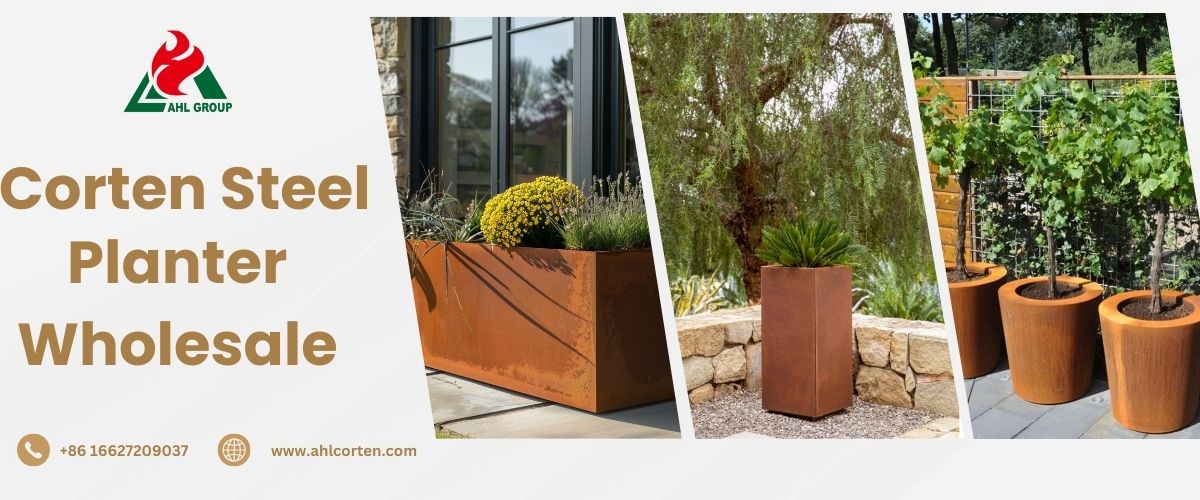
Cubic Corten Steel Planters (40×40×40cm/50×50×50cm) are suitable for planting medium-sized shrubs, roses and similar plants. They are ideal for garden entrances and as corner accents; placing them symmetrically creates a neat and imposing look.
Tall/Columnar Weathering Steel Planters (30×30×90cm/40×40×100cm) are suitable for climbing plants, pencil pines and Japanese maples. They can be used to decorate door frames, fill vertical gaps on walls and add depth to the garden.
Long trough/rectangular corten steel planters (100×30×40cm/120×40×50cm) are suitable for ornamental grasses, bamboo and similar plants. They can be used to screen terrace edges or divide spaces, whilst their linear design visually extends the garden’s length.
Bowl-shaped/Low-profile Rusted Steel Planters (diameter 60–100 cm, height 20–30 cm) are suitable for shallow-rooted plants such as succulents and herbs. They can serve as tabletop ornaments or focal points in Zen gardens, offering a simple yet refined aesthetic.
Large tree-planting corten steel planters (≥120×120×80cm) are suitable for planting topiary trees such as olive trees and Japanese maples. They can serve as central courtyard features, enhancing the garden’s grandeur, and are also suitable for planting in public spaces.
Style Recommendations: Corten Planters to Complement Garden Aesthetics
Rusted steel planters come in a variety of styles, allowing selection based on the garden’s overall character; through their design, they imbue the garden with distinct visual narratives.
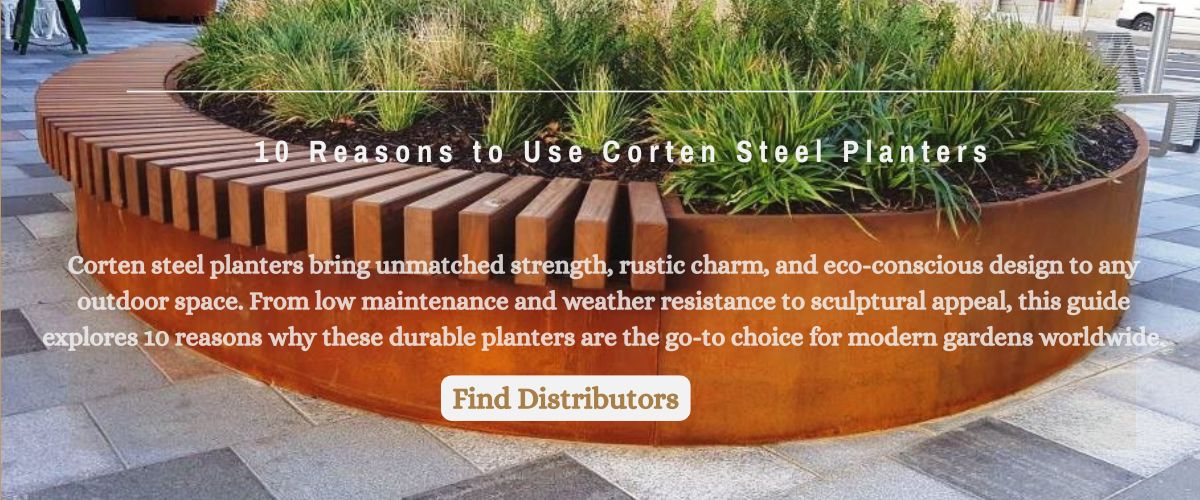
Circular/curved metal planters possess a naturally soft and fluid aesthetic with a centripetal quality, making them ideal as focal points in courtyards. They can be used to create circular planting areas around topiary trees or as curved retaining walls that follow the natural contours of the terrain, fostering an atmosphere of organic growth. Note that curved edges must be finely polished to conceal weld seams, thereby highlighting the high-quality craftsmanship.
Rectangular/rigid corten steel planters emphasise order and stability, aligning with modern industrial aesthetics. They can be arranged in rows at entrances or along both sides of corridors to create a strong sense of ceremony; alternatively, they can be utilised to create stepped planters that address drainage issues on sloping terrain whilst producing clean, crisp lines.
Linear/slender metal planters, minimalist yet directional, can serve as edging between lawns and gravel, delineating precise landscape contours; they can also be placed along walls or floor-to-ceiling windows as spatial dividers, taking up minimal width and thus suiting narrow, elongated gardens or balconies.
Material Pairings: Blending Corten Planters Seamlessly into the Garden
The distinctive rust-red texture of weathering steel, when paired with different materials, can create unique garden aesthetics. The key lies in creating material contrasts to enhance depth and dimension.
Weathering steel + wood: warm and natural. This combination features different materials within the same colour palette. Pairing dark-stained wood or teak with rust-red planters allows the warmth of the wood to counterbalance the cold, hard feel of the metal. This suits naturalist and rustic-style gardens, aligning with the rustic charm of English natural gardens.
Weathering steel paired with dark stone creates a modern, imposing look. Using black basalt and dark grey granite as a base highlights the rust tones of the weathering steel, offering a striking contrast and a sense of substantial texture. This combination is suitable for modern minimalist and Italian-style gardens, creating a calm and sophisticated landscape atmosphere.
Weathering steel paired with light grey or white stone creates a high-contrast, eye-catching effect. The light-coloured backdrop highlights the patina details of the weathering steel, resembling a natural painting. However, it is important to note that this combination is prone to rust staining; it must be paired with concealed drainage channels or rust-proof sealant to prevent damage to the light-coloured stone.
Buying Guide: Choosing the Best Planters for Your Garden
Corten garden planters are not merely planting containers; they are also landscape sculptures for your garden. By considering your garden setting and following these tips to avoid pitfalls, you can select high-quality, durable products that are perfectly suited to your needs and steer clear of potential pitfalls.
Recommended Rusted Steel Planters for Different Garden Settings
Different garden settings have different requirements. By selecting planters specifically tailored to your needs, you can balance aesthetics with practicality, ensuring the planters become the finishing touch to your garden. Large, statement-making rusty steel planters are ideal for spacious garden entrances, large terraces or courtyard corners, where they create a striking visual impact. Opt for thickened steel plates to ensure stability, and choose models with concealed, adjustable bases for easy levelling. A built-in anti-overflow system protects plant roots, whilst the base can be fitted with forklift slots or concealed castors to facilitate initial positioning and adjustments. Modern minimalist large rusted metal planters are ideal for minimalist-style gardens, corridors or walkways, emphasising clean lines. Featuring a slender design that does not obstruct passage, the sides require internal reinforcement to prevent deformation when filled with soil; drainage holes at the base must be aligned with a vertical gradient to completely eliminate waterlogged areas, aligning with the modern minimalist aesthetic of ‘restrained luxury’. Natural, rustic custom steel planters, suitable for layered backyards and naturalistic gardens, emphasising a sense of wild harmony. Combine planters of varying heights (e.g. 30cm, 60cm, 90cm) to mimic the undulating contours of natural slopes, ideal for ornamental grasses and perennial flowers; it is recommended to add a high-density insulating liner inside to mitigate the impact of summer heat conduction from the metal on plant roots, ensuring suitability for complex outdoor environments. Compact weathering steel planters are ideal for urban balconies and narrow side gardens, prioritising flexibility and practicality. Constructed from 1.5–2mm steel plates, they balance lightness with durability. They must be fitted with a drip tray made from the same material to prevent rust water from damaging balcony flooring. The total weight when filled with soil must be calculated in advance to ensure it does not exceed the balcony’s load-bearing capacity, making them the perfect entry-level choice for urban gardening enthusiasts. Weathering steel wall planters/modular planters are suitable for gardens, B&B courtyards or commercial spaces requiring privacy screening, combining practicality with aesthetic appeal. Featuring a modular design to ensure uniform spacing, they can be integrated with automatic drip irrigation systems to guarantee even plant growth; wind-resistant design must be considered to withstand crosswinds, creating a 'breathable' privacy screen that offers greater visual appeal than solid walls.
Tips for Avoiding Pitfalls When Purchasing in 2026: Steer Clear of Substandard Planters
The market is flooded with ordinary carbon steel products masquerading as weathering steel planters; whilst they may appear similar, their lifespan differs vastly. Master these three techniques to easily avoid pitfalls. Magnet test: Genuine landscape corten steel planters are magnetic. If a seller claims the product is “rust-free antique-style stainless steel”, it is highly unlikely to be genuine weathering steel. Such products cannot form a protective patina layer, resulting in a significantly shorter lifespan. Weight test: A genuine weathering steel planter measuring 50cm square and 2mm thick should weigh no less than 15kg; If it feels unusually light, be wary of insufficient steel plate thickness. Such planters are prone to deformation and rust, and cannot be used long-term. Weld and Edge Inspection Method: High-quality weathering steel planters have smooth, flat welds that match the body colour, with no gaps or breaks; the edges feature a folded design with no sharp burrs. If the welds are spot-welded, blackened, or the edges are unfinished, these are inferior products and should be avoided at all costs.
Care Guide: Ensuring Planters Remain Beautiful and Durable
Maintaining high-quality corten steel rectangular planters is extremely simple and requires no complicated procedures. By following natural principles and carrying out basic maintenance, you can allow them to develop a rich patina over time whilst extending their lifespan.
Pre-planting Preparation: Safeguarding Your Steel Planters
Simple preparations before planting can effectively extend the life of the planters whilst providing a better growing environment for plants and preventing issues later on. Create a drainage layer by laying 3–5 cm of expanded clay or coarse gravel at the bottom to act as a drainage buffer; place a layer of geotextile fabric over the gravel to filter out fine sand and prevent soil from blocking the drainage holes. This is a common and highly effective solution in modern garden drainage design, saving time and effort whilst protecting the planter. Ensure internal protection: although weathering steel is corrosion-resistant, applying eco-friendly bituminous paint to the interior of the planter or installing a liner further isolates the soil from the steel. This prevents prolonged contact with damp soil from accelerating oxidation, thereby extending the planter’s lifespan.
Daily and Seasonal Maintenance
Maintaining rusty metal planter boxes requires little time; simply carrying out basic tasks in line with the changing seasons is sufficient, making it even less hassle than mowing the lawn.
Watering requires some care: as steel conducts heat quickly, avoid watering at midday in summer. It is recommended to water in the early morning or late evening, allowing the evaporation of water to dissipate heat, protect the plant roots, and reduce direct water runoff onto the steel.
Seasonal maintenance should be carried out promptly. Before the rainy season begins, clear any debris from the drainage holes to ensure water flows freely. In cold regions during winter, reduce the frequency of watering to prevent soil heaving from exerting pressure that could damage the planters’ welds and side walls. Weathering steel possesses excellent frost resistance, so there is no need to move the planters indoors.
Managing the rust patina requires a few techniques. The formation of the weathering steel’s patina relies on a ‘cycle of wet and dry’; exposure to strong sunlight after rain is the ideal time for patina formation. Leave a 1–2 cm gap beneath the planter to ensure air circulation; as the rust patina is unstable during the first six months, place a temporary protective mat or gravel of a similar colour beneath the planter to prevent rust dust from staining the ground; once the rust patina has reached the desired state, apply a specialised sealer to minimise rust dust shedding and preserve the attractive appearance. Cleaning should be gentle; there is no need for chemical cleaners or steel wool – simply rinse the surface with clean water to remove dust; If scratches appear on the surface, there is no need to worry; natural oxidation will automatically repair these 'wounds' within a few weeks, forming a complete patina layer.
FAQ: Expert Answers to Queries on Selecting and Using Planters
Many people have numerous questions regarding weathering steel planters. Below are professional answers from horticultural experts addressing frequently asked questions to help put your mind at ease.
Q1: Will Corten Planters Constantly Leak Rusty Water And Stain The Garden Floor?
A: No. Only during the first 6–12 months (the patina formation period) will a small amount of rust powder flake off, which is a normal phenomenon. This issue can be effectively resolved through the retailer’s ‘pre-rust treatment’ or by using a dedicated drip tray; once the patina layer has stabilised, the rust colour will generally no longer flake off, nor will it stain the floor.
Q2: Will the Limited Number of Drainage Holes In Planters Cause Plant Roots to Rot?
A: No. High-quality round corten steel planters are scientifically designed with an appropriate number and distribution of drainage holes based on their volume. Combined with a drainage layer at the bottom, this ensures excess water is quickly drained away, preventing waterlogging. As long as expanded clay and geotextile fabric are laid as required, root rot can be completely avoided.
Q3: Do I Need To Move Corten Steel Planters Indoors During Winter?
A: Absolutely not. Weathering steel possesses exceptional resistance to freezing and cold temperatures; it is one of the few materials suitable for year-round outdoor storage and withstanding wind and snow. Its resistance to freeze-thaw cycles far exceeds that of ceramic or stone planters, so there is no need to worry about damage if left outdoors during winter.
Are You Ready to Choose a Weathering Steel Planter?
Choosing the perfect landscape corten steel planters is not merely about adding a decorative piece to your garden; it is a sustainable investment in your gardening. It supports the growth of your plants and bears witness to the changing seasons in your garden, allowing your garden to become increasingly stylish and warm as the years go by. If you’re looking to select the perfect corten planter for your garden but are unsure how to determine the right size or avoid common pitfalls, please feel free to contact us. Simply send us the dimensions of your garden or balcony, along with your preferred plant varieties, and we’ll provide you with a personalised recommendation for weathering steel planters, complete with a free quote and product catalogue, helping you effortlessly create a beautiful, low-maintenance garden landscape!

 Fill In The Inquiry