Landscape Edging Guide: How to Pick the Perfect Edging for Your Garden
In the design of courtyard landscapes, private gardens, and commercial landscaping projects, landscape edging is a key detail that is often overlooked yet crucial to the overall refinement of the space. Many issues—such as courtyards that fail to live up to their aesthetic potential or require excessive maintenance—stem from inadequate edging design.
Though seemingly unremarkable, edging design serves multiple purposes: defining zones, creating a neat and tidy appearance, and facilitating long-term maintenance. High-quality edging can create clear, crisp boundaries for lawns, flower beds, walkways, and paved areas.
Conversely, poor-quality edging materials lead to messy boundaries, uncontrolled lawn growth, soil spillover, and rampant weeds—all of which significantly diminish the courtyard’s aesthetic appeal while increasing the workload for daily cleaning and maintenance.
The market offers a vast array of garden edging materials, with significant variations in price, durability, and aesthetics. It can be difficult for homeowners and landscape designers to quickly identify the most suitable and cost-effective solution for their gardens.
This article will comprehensively break down the core value of landscaping edging, key selection criteria, and a comparison of the pros and cons of mainstream materials. It will focus on analyzing the unique advantages of corten steel edging and provide professional selection and installation tips to help you choose the right landscaping edging solution in one go.
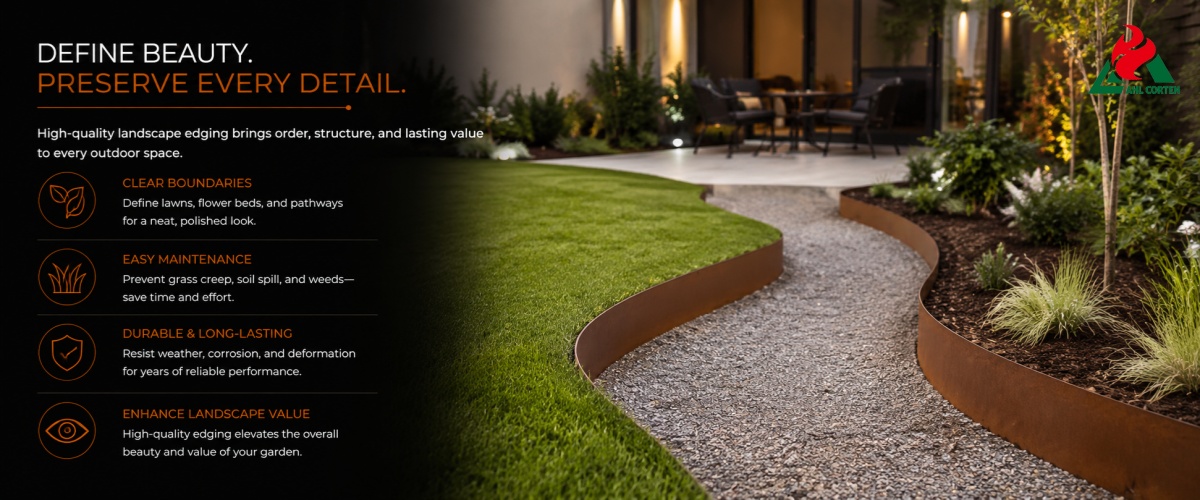
The 5 Core Practical Benefits of Garden Edging
Garden edging is by no means merely a decorative element; rather, it is a fundamental landscape component that balances aesthetics with practicality, enhancing the overall appearance of a garden through attention to detail while reducing long-term maintenance costs.
1. Defining Spatial Structure and Organizing Garden Zones
Border edging serves as the “invisible framework” of a garden space. It clearly delineates the boundaries between lawns, flower beds, greenery areas, gravel paths, and hardscaped surfaces, creating a well-defined layout and eliminating a cluttered visual appearance.
2. Maintaining Clean Lines and Reducing Maintenance Effort
High-quality edging strips are highly stable and resistant to shifting, sagging, or warping. They effectively prevent lawn weeds from spreading outward and stop soil, gravel, and compost from spilling onto walkways and the ground from flower beds.
Neatly defined borders are not only aesthetically pleasing but also simplify trimming and sweeping tasks, significantly reducing the time required for daily garden maintenance.
3. Enhancing Landscape Texture and Elevating the Garden’s Aesthetic Appeal
Clean, crisp edging lines are a hallmark of sophisticated gardens. Meticulous edge treatment minimizes the rough appearance of the yard, making the overall landscape more refined, orderly, and design-oriented, thereby significantly elevating the yard’s overall style.
4. Suppress Weed Growth and Reduce Long-Term Maintenance Burden
A complete edging barrier structure blocks the spread of lawn roots and reduces the growth of weeds across different areas. This reduces the frequency of weeding and trimming at the source, helping to create a low-maintenance yard.
5. Protects Soil Ecology and Prevents Soil Erosion
Edging barriers securely hold soil in place within flower beds and planting areas, preventing soil erosion and nutrient loss caused by rainwater runoff. By reducing competition between weeds and landscape plants for water and nutrients, they promote the healthy growth of greenery and flowers, resulting in more lush and vibrant growth.

6 Key Considerations for Selecting Landscape Edging Barriers
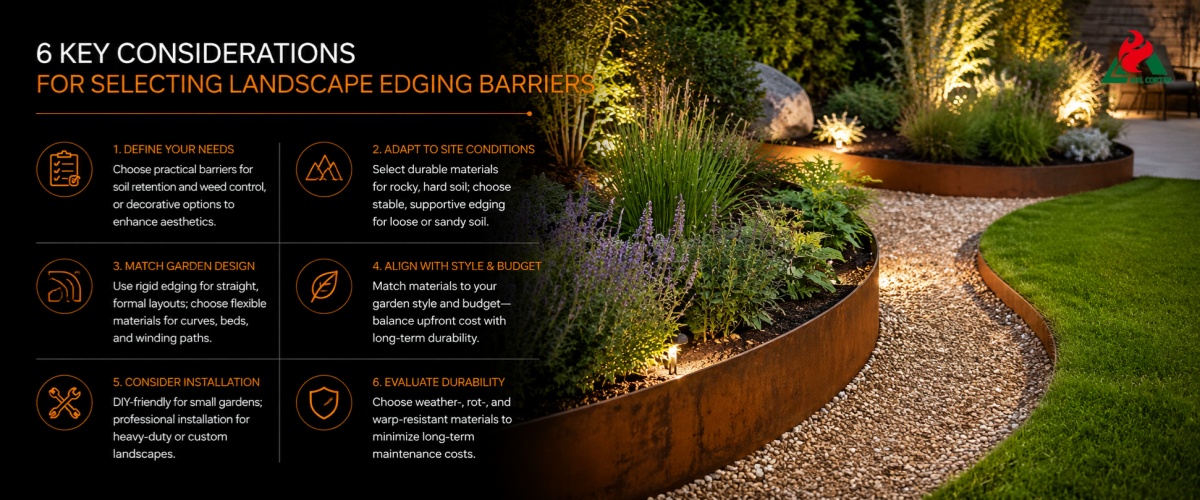
Since the topography, style, soil type, and climatic conditions vary from one yard to another, blindly following trends when selecting materials can easily lead to poor compatibility, susceptibility to damage, and aesthetic mismatches. Before making a selection, it is essential to carefully consider the following six key factors.
1. Define Your Needs: Practical Barrier or Decorative Feature
First, identify your core need: If practicality is the priority, choose materials with high hardness and stability that focus on soil retention, weed control, and spill prevention; if the emphasis is on aesthetic appeal, opt for decorative edging materials with diverse shapes and unique textures.
2. Adapting to On-Site Soil and Topographical Conditions
Hard soil with many rocks and tree roots is difficult to work with and requires materials that are highly durable and resistant to breakage; loose sandy soil and soft planting soil are prone to collapse and shifting, making them suitable for heavy, stable edging structures with strong support.
3. Matching the Garden’s Design: Straight, Orderly Lines or Fluid Curves
For formal, straight-lined gardens, rigid, pre-formed edging materials are suitable; for natural-style gardens, curved flower beds, and winding paths, flexible materials that can be bent freely without breaking are needed to conform to irregular shapes and create smooth, flowing lines.
4. Aligning with the Garden’s Overall Style and Budget
Modern minimalist and industrial-style gardens are well-suited to edging with a metallic finish; rustic and country-style gardens are best complemented by wood, natural stone, or red brick edging. At the same time, consider your budget to balance initial costs with long-term durability, avoiding hidden costs from frequent replacements of low-cost materials.
5. Consider Installation Methods: DIY or Professional Installation
Some lightweight, flexible edging strips can be easily installed by yourself, making them suitable for small private gardens; Rigid, heavy-duty materials and custom-shaped designs require professional measurement and installation, making them suitable for large-scale landscaping projects and high-end custom gardens.
6. Evaluate Durability and Long-Term Maintenance Costs
Outdoor materials must withstand sun exposure, rain, and temperature fluctuations. Prioritize materials that are weather-resistant, rot-resistant, age-resistant, and resistant to warping to reduce long-term maintenance costs associated with repairs, renovations, and replacements.
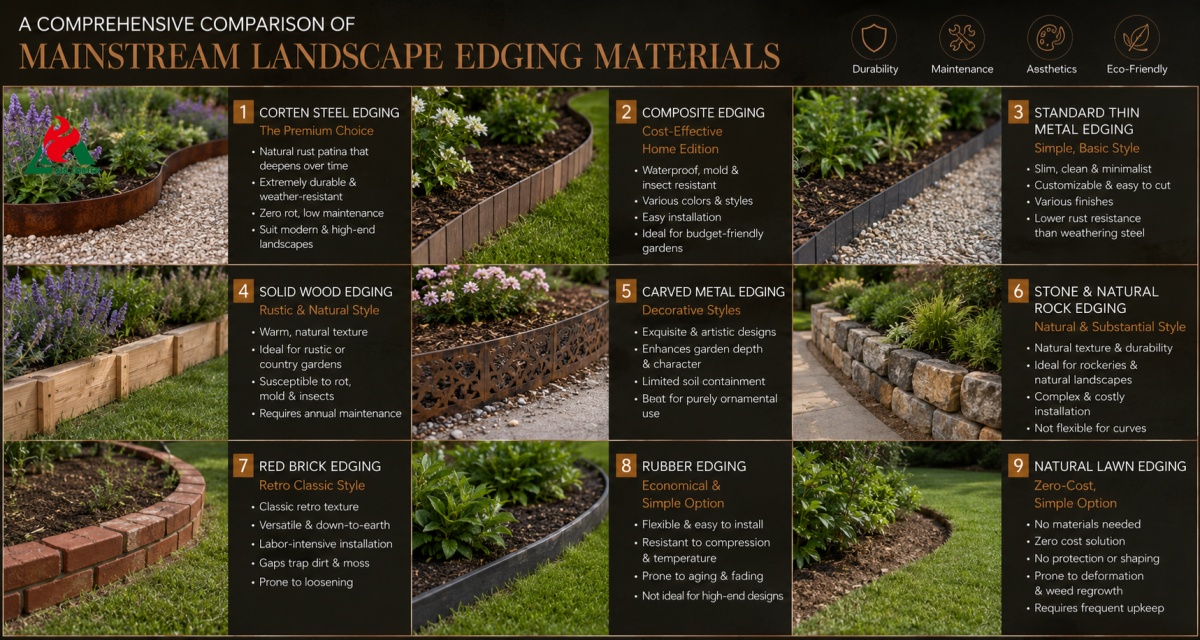
A Comprehensive Comparison of Mainstream Landscape Edging Materials
Currently, the mainstream edging materials used in garden landscaping include weathering steel, composite materials, ordinary metals, wood, stone, red brick, rubber, and more. Each material has distinct advantages and disadvantages, as well as specific applications.
1. Corten Steel Edging | The Premium Choice
As a premium standard in modern landscaping, corten steel edging has become designers’ top choice for garden edging solutions thanks to its unique advantages. It complements a wide range of high-end landscape styles, including modern, minimalist, and Southwest natural styles.
It features a natural, vintage rust-colored texture that deepens over time, giving it an increasingly sophisticated look that blends seamlessly with greenery, stone, and outdoor architecture. With high hardness and excellent structural integrity, it can be shaped into straight, precise lines or bent to create smooth curves.
Its core advantages include weather resistance, corrosion resistance, zero rot, and resistance to aging. It withstands heavy rain, high temperatures, humidity, and high-salt-fog coastal environments, offering an exceptionally long service life. Additionally, it requires no frequent repainting or maintenance, making it a cost-effective, high-end solution that is installed once and remains maintenance-free for the long term.
2. Composite Edging | Cost-Effective Home Edition
Made from a composite of wood fibers and recycled plastic, it is waterproof, moisture-resistant, mold-resistant, and insect-resistant, completely eliminating the problem of rot associated with solid wood. Available in a wide range of colors and styles to suit most home garden designs, it is easy to install and affordably priced.
It adapts well to fluctuations in soil temperature and humidity, is resistant to cracking and warping, and is ideal for basic, durable garden renovations on a tight budget.
3. Standard Thin Metal Edging | Simple, Basic Style
These slim-profile edging strips are available in customizable sizes and can be easily cut to create clean, crisp, minimalist borders, making them suitable for various simple landscape finishes. With a variety of surface finishes available to match different garden color schemes, they are quick and easy to install.
However, compared to weathering steel, standard metal offers weaker rust resistance. Long-term outdoor use can lead to rust, peeling, and corrosion, significantly reducing its durability.
4. Solid Wood Edging | Rustic and Natural Style
Wooden edging naturally exudes a warm, organic texture, making it ideal for gardens with rustic, country, or natural themes, creating a soft and soothing atmosphere. Thicker solid wood styles can create neat and refined boundary lines.
The drawbacks are quite obvious: when exposed to the outdoors, they are highly susceptible to moisture, rot, mold growth, and insect infestation. They require annual maintenance with preservative paint, entail cumbersome upkeep, and have a limited lifespan.
5. Carved Metal Edging | Decorative Styles
With exquisite and elegant designs and strong decorative appeal, these edgings add a unique artistic flair and depth to gardens, making them ideal for English-style gardens, vintage gardens, and light-luxury landscapes.
Primarily designed for aesthetic appeal, they offer limited functionality. They provide poor resistance to soil pressure and are ineffective at preventing soil overflow; during strong winds or heavy rain, they struggle to securely hold the soil in place, making them suitable only for purely ornamental landscaping.
6. Stone and Natural Rock Edging | Natural and Substantial Style
With natural textures, a substantial feel, and robust durability, these options add a touch of rustic charm and dimensional depth to the garden, making them ideal for rockeries, water features, and natural-style landscapes.
Installation is complex and costly; the fixed shapes cannot be flexibly bent, making them poorly suited for gardens with irregular curves and limiting renovation flexibility.
7. Red Brick Edging | Retro Classic Style
With a classic, retro texture, this style suits rustic and pastoral-style gardens. It can be freely assembled into straight lines or simple curves, offering a versatile and down-to-earth aesthetic.
The drawbacks include a labor-intensive installation process, gaps that easily trap dirt and grime, susceptibility to moss growth, and a tendency to loosen or shift over time, resulting in poor neatness and durability.
8. Rubber Edging | Economical and Simple Option
Made of flexible material with a high cost-performance ratio, it resists compression and temperature fluctuations, is unlikely to crack or break, and is extremely easy to install, making it suitable for temporary edging and simple garden renovations.
However, it has a somewhat cheap appearance, offers poor support, and is prone to aging and fading over time, making it unsuitable for high-end, sophisticated garden designs.
9. Natural Lawn Edging | Zero-Cost, Simple Option
Requires no additional materials; simply use tools to trim the edges and create a natural lawn border—zero cost and the simplest solution. Suitable only for minimalist, natural-style gardens. It offers no protection or shaping capability, is highly prone to deformation and weed regrowth, and requires extremely frequent maintenance.
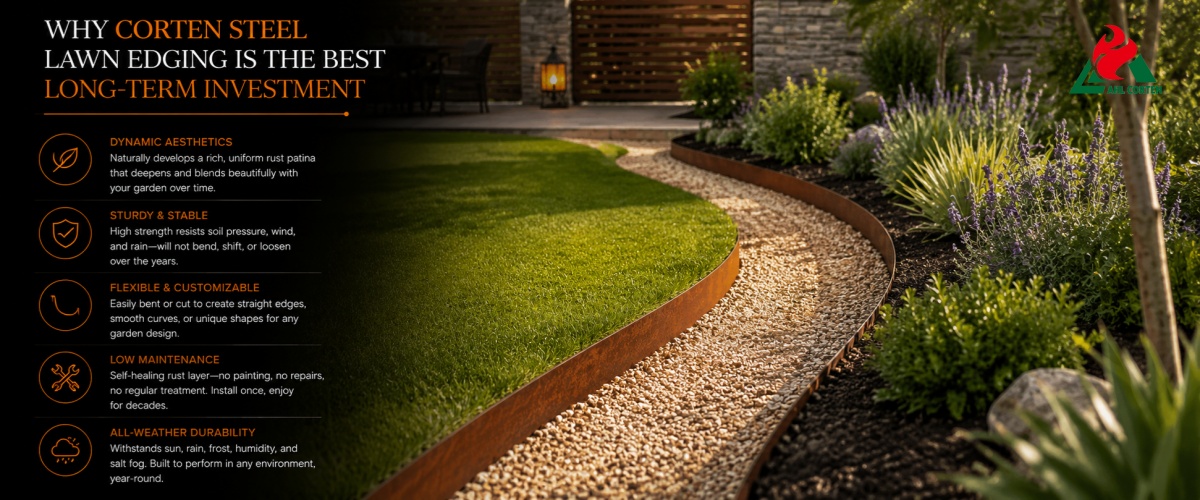
Why Is Corten Steel Lawn Edging the Best Long-Term Investment for Your Yard?
Among all edging materials, rusted steel edging has become the top choice for high-end residential yards and commercial landscaping projects thanks to its combined advantages in aesthetics, performance, durability, and low maintenance—offering far better long-term value than traditional materials.
1. Dynamic Aesthetics: The More You Use It, the More Sophisticated It Becomes
Unlike ordinary materials that look worn, faded, and aged over time, weathering steel naturally oxidizes with age, developing a uniform, warm, vintage rust patina. The color tones deepen and become more nuanced year after year, seamlessly blending with natural greenery and hardscape elements to create a unique garden ambiance.
2. Sturdy Structure, Resistant to Deformation and Shifting
With its high hardness and strong structural integrity, weathering steel resists soil pressure and withstands wind and rain erosion. It will not collapse, bend, or loosen even after long-term use. It consistently maintains neat and crisp boundary lines, completely eliminating the recurring issues of deformation and rework associated with ordinary edging materials.
3. Flexible Customization, Suitable for All Garden Designs
The material can be freely bent and cut, allowing for both straight, crisp borders and smooth, natural curved flower beds or irregularly shaped walkways. It adapts to all types of garden layouts and design styles, offering exceptional customization flexibility.
4. Low Maintenance Throughout, Saving Time and Effort
It features a self-healing passivated rust layer, eliminating the need for painting, frequent repairs, or regular treatment. Once installed, it requires virtually zero maintenance, completely eliminating the ongoing maintenance costs associated with traditional wood, stone, or rubber materials.
5. Superior Weather Resistance, Suitable for All Complex Environments
It withstands harsh outdoor conditions such as intense sunlight, heavy rain, frost, humidity, and high salt fog in coastal areas. Resistant to corrosion, aging, and temperature fluctuations, it maintains stable performance year-round and can be used with confidence in gardens across the country.
Garden Edging: Professional Selection and Installation Tips
Choosing the right material is just as important as using the right installation method. Proper installation maximizes the edging’s lifespan, ensures a neat and secure border, and prevents future issues.
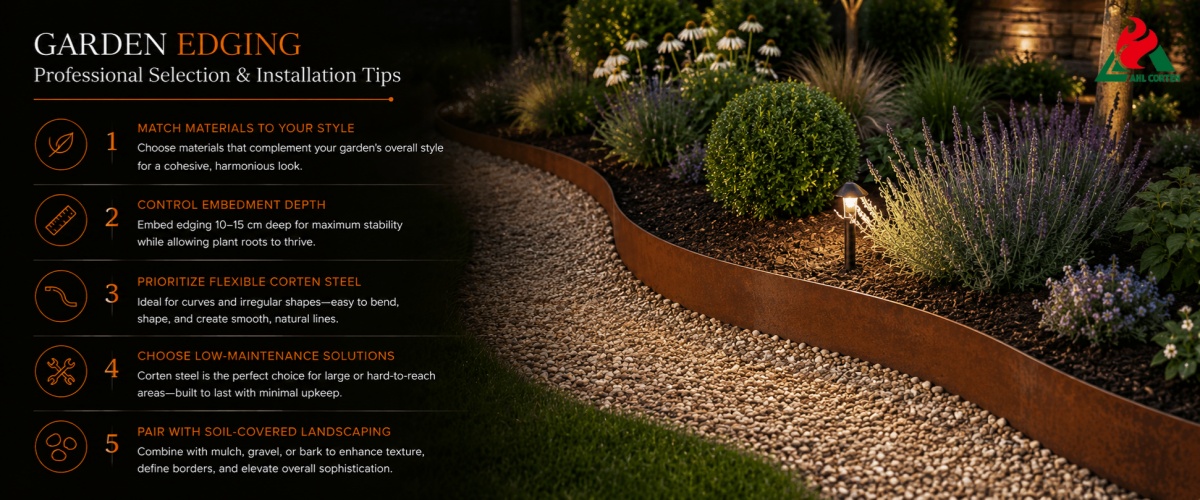
1. Precise Matching of Materials to Garden Styles
For modern, minimalist, or industrial-style gardens, weathering steel bed edging is the top choice; for rustic or natural styles, stone, red brick, or solid wood are ideal; and for simple, functional gardens, composite or rubber materials can be selected to blend seamlessly with the surroundings.
2. Control Embedment Depth to Ensure Stability
The standard embedment depth is 10–15 centimeters. This firmly secures the edging strips, preventing shifting or collapse, while also allowing plant roots to grow freely—balancing stability with the needs of your greenery.
3. Prioritize Flexible Corten Steel For Curved Designs
For irregularly shaped areas such as arched flower beds and winding walkways, prioritize bendable rusted steel garden edging. It offers smooth, natural lines and excellent shaping performance, preventing issues like breakage, stiffness, or curled edges.
4. Low-Maintenance Corten Steel Solutions are Ideal for Large Gardens
For large courtyards, elevated areas, and hard-to-maintain zones, weathering steel edging is the preferred choice. This significantly reduces the frequency of future maintenance and avoids the hassle of repeated repairs and replacements.
5. Combine with Soil-Covered Landscaping to Enhance Overall Sophistication
Once the edging is installed, pairing it with surface materials such as bark, gravel, and humus can further enhance the layering of the boundaries, making the courtyard landscape more complete, sophisticated, and cohesive.
Frequently Asked Questions about Corten Steel Edging
1. What Is the Primary Function of Garden Edging?
Its primary functions are to define zones, stabilize soil, prevent runoff, block weeds, protect the soil, and simplify maintenance. At the same time, it tidies up the lines of the garden, enhances the overall aesthetic quality of the landscape, and achieves both aesthetic and practical value.
2. Which Type of Garden Edging Is Best Suited for DIY Installation?
Rubber and composite materials are lightweight and flexible. They require no specialized tools and are easy to install, making them ideal for homeowners to install themselves. They offer great value for money and a low learning curve.
3. What Is the Standard Embedding Depth for Garden Edging?
The standard recommended embedding depth is 10–15 centimeters, which is approximately one-third of the edging's total height. This is the optimal standard that balances stability with plant growth.
4. Can Corten Steel Edging Be Used to Create Curved Borders?
Yes. Weathering steel is extremely flexible and can be bent and shaped as desired, making it perfectly suited for various arched, curved, and irregular garden designs. It features natural, flowing lines and holds its shape firmly.
5. Does Rusted Steel Edging Border Require Frequent Maintenance?
They require virtually no maintenance. With a built-in corrosion-resistant passivation layer, they will not rot, peel, or age, and do not require painting or repairs. They are a classic example of a landscape component that is installed once and requires minimal maintenance for a lifetime.
6. How Can Edging Design Reduce the Overall Maintenance Requirements for a Garden?
Opt for low-maintenance edging materials like weathering steel, paired with groundcover materials and drought-tolerant plants. This reduces weed growth and soil erosion at the source, significantly lowering the workload of daily garden maintenance.
Conclusion | Are You Ready to Choose Your Own Outdoor Corten Steel Edging?
Landscape metal edging is a key detail that determines both the sophistication of a garden and the difficulty of its maintenance; the choice of material directly impacts the garden’s aesthetics and functionality for decades to come.
Compared to traditional materials like wood, stone, rubber, and red brick, weathering steel edging perfectly balances unique aesthetics, exceptional durability, and ultra-low maintenance costs—without the hidden expenses of frequent repairs, replacements, or renovations.
Whether for renovating a private backyard, customizing a high-end villa garden, or commercial landscaping projects, corten steel garden edging is the optimal solution that maximizes both value and sophistication.
Want to customize a metal landscape edging solution tailored to your garden? Unsure about design, dimensions, or layout coordination? Contact us today to receive a free, one-on-one professional design consultation, precise quotes, and detailed installation plans—effortlessly creating a clean, refined, and timeless high-end garden landscape!
Back

 Fill In The Inquiry