Is 2mm Corten Steel Thick Enough for a Large Planter?
Many landscape designers, landscaping contractors, and homeowners grapple with a key question: Is 2mm-thick corten steel safe and durable enough for large-scale landscape planters?
The article provides a precise conclusion: 2mm steel planters are not a universal standard; they are “sufficient under certain conditions.” Provided the dimensions are reasonable, reinforced structures are incorporated, and drainage is properly designed, 2mm steel plates are entirely suitable for large-scale planters.
However, in scenarios involving extra-long or extra-tall structures, tree planting, or commercial heavy-load applications, using bare 2mm steel plates alone may lead to issues such as deformation, bulging, and weld seam cracking. In such cases, thicker plates or structural upgrades are essential.
Most users fall into a common misconception: they focus solely on comparing steel plate thickness while neglecting factors such as span, soil pressure, drainage, and reinforcement techniques. In reality, the service life of a weathering steel planter is determined by a combination of thickness, structure, and drainage.
Drawing on AHL’s engineering experience with weathering steel, we will provide a comprehensive explanation covering suitable applications, stress principles, selection criteria, reinforcement solutions, and key pitfalls to avoid—helping you accurately select the right specifications for your corten steel planter.
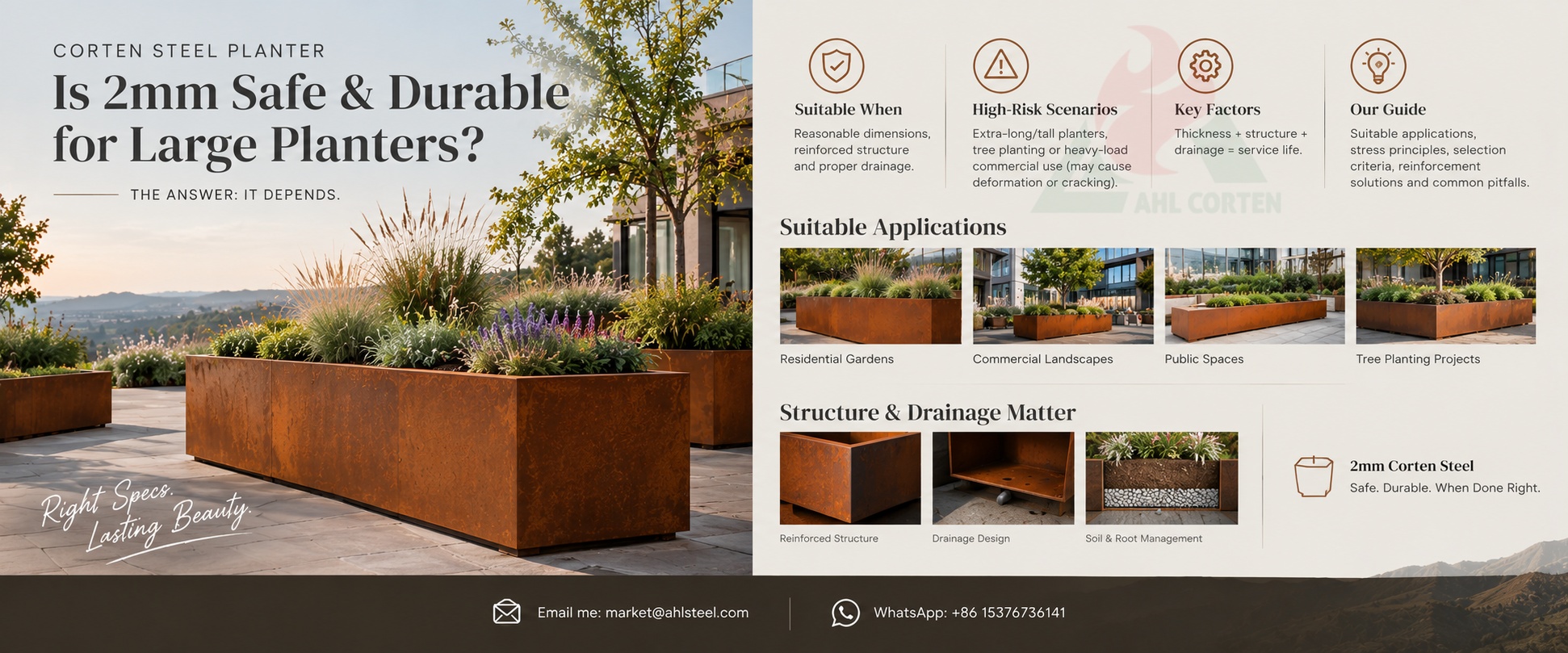
Quick Answer: Is 2mm Corten Steel Suitable for Large Planters?
| Planter Type |
Is 2mm Suitable? |
Recommended Approach |
| Small Decorative Planter |
Usually Yes |
Standard construction with drainage. |
| Medium Residential Planter |
Often Yes |
Reinforced rim and raised base recommended. |
| Large Rectangular Planter |
Sometimes |
Use short spans, folded edges, and internal stiffeners. |
| Long Trough Planter |
Not Always |
Consider 3–5mm steel or cross-bracing. |
| Planter Over 80cm High |
Generally Not Preferred |
Use 3–4mm steel with reinforcement. |
| Planter Over 120cm High |
Usually Insufficient Alone |
Use 4mm+ steel and engineered reinforcement. |
| Large Tree Planter |
Not Recommended as a Standalone Wall Thickness |
Use heavier steel, an internal frame, and a structural design. |
| Commercial or Public Planter |
Project-Dependent |
Specify steel thickness through a structural assessment. |
Why Planter Size Matters More Than Thickness Alone
Many people mistakenly believe that “the thicker it is, the more durable it is,” but in reality, the risk of deformation in garden planters is largely determined by their size and the environment in which they are used. At the same thickness, the stress on large metal planters increases exponentially.
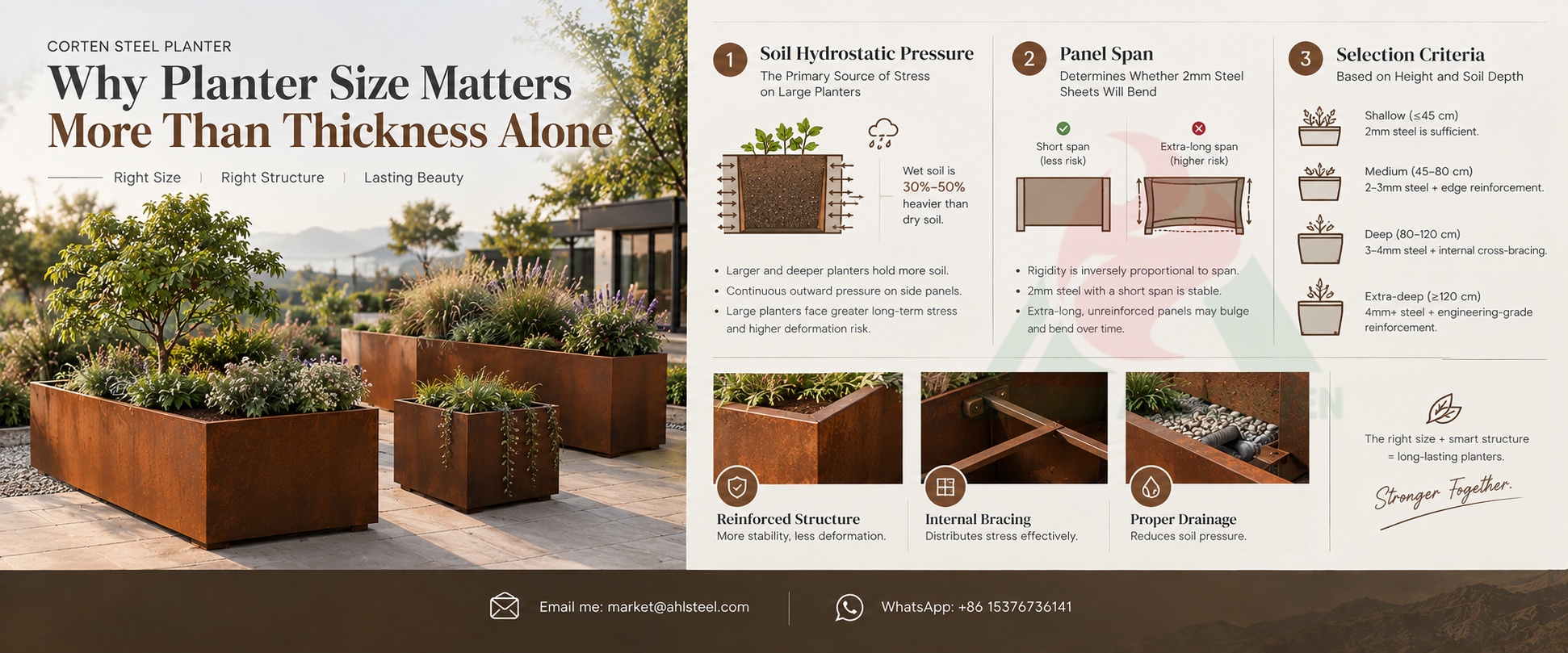
1. Soil Hydrostatic Pressure: The Primary Source of Stress on Large Planters
Dry soil has limited weight, but the weight of saturated soil after rain increases by 30%–50%.
Large, deep planters hold a greater volume of soil, which exerts a continuous outward lateral thrust on the side panels—known as hydrostatic pressure.
Pressure in small planters is manageable, whereas large planters endure continuous loads over the long term, making thin steel panels highly susceptible to fatigue deformation.
2. Panel Span: Determines Whether 2mm Steel Sheets Will Bend
The rigidity of a steel plate is inversely proportional to its span. 2mm weathering steel with a short span has sufficient rigidity and is resistant to deformation.
However, an extra-long, unreinforced plate—even if made of high-quality material—will gradually bulge outward and bend under soil pressure, compromising the overall linear design.
3. Strict Selection Criteria Based on Height and Soil Depth
- Shallow planters (up to 45cm): 2mm weathering steel fully meets usage requirements
- Medium-depth planters (45–80 cm): 2–3 mm sheet metal is recommended, and edge reinforcement is required
- Deep planters (80–120 cm): 3–4 mm sheet metal is recommended, with the addition of internal cross-bracing
- Extra-deep tree planters (120 cm and above): Sheet metal of 4 mm or thicker is mandatory, using an engineering-grade reinforcement structure
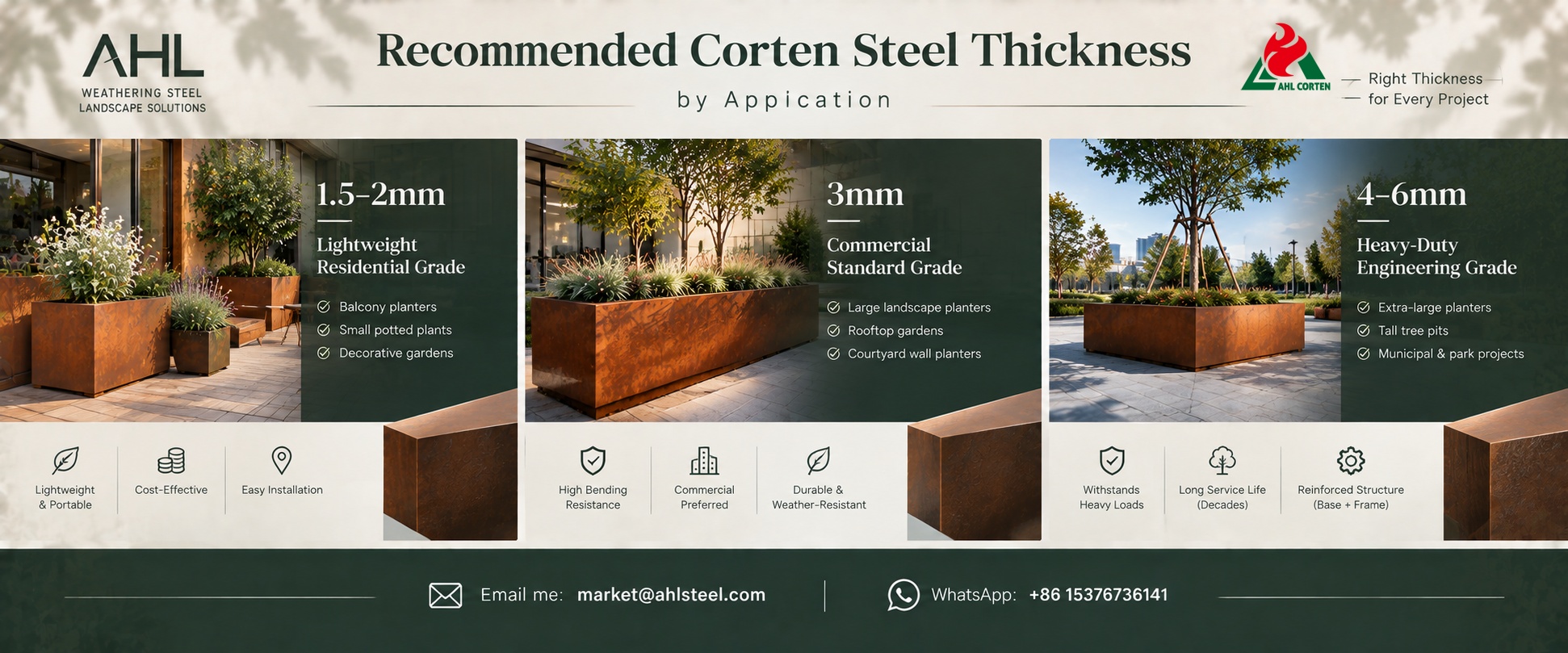
Recommended Corten Steel Thickness by Application
Weathering steel of different thicknesses corresponds to different application grades, and there are clear industry standards for selection, ranging from residential decoration to municipal engineering.
1. 1.5–2mm Lightweight Residential-Grade Planters
Featuring portability and high cost-effectiveness, these are suitable for small potted plants, balcony planters, and decorative garden planters.
The sheets are lightweight, making transportation and installation convenient, and they can be easily repositioned.
When used for large planters, it is essential to ensure proper edge rolling, reinforcement, a raised base, and a complete drainage system; otherwise, deformation and water accumulation may occur.
2. 3mm Commercial Standard Grade (Industry-Preferred Planter)
3mm is the industry gold standard for large-scale landscape planters and the standard thickness for commercial projects.
Its resistance to bending is significantly superior to that of 2mm panels, making it suitable for long, rectangular planting troughs, rooftop gardens, and tall courtyard wall planters.
It can withstand the planting loads of shrubs and small trees, and its weather resistance and fatigue resistance make it suitable for high-traffic public settings.
3. 4–6mm Heavy-Duty Engineering-Grade Planter
Specifically designed for extra-large planters, extra-tall tree pits, municipal plazas, and heavy-duty landscape designs in parks.
It can withstand the expansion forces of large tree roots, strong wind loads, and long-term saturated soil pressure, with a service life of up to several decades.
Extra-large planters must be paired with thickened base plates and built-in steel frame structures to prevent deformation and damage after long-term use.
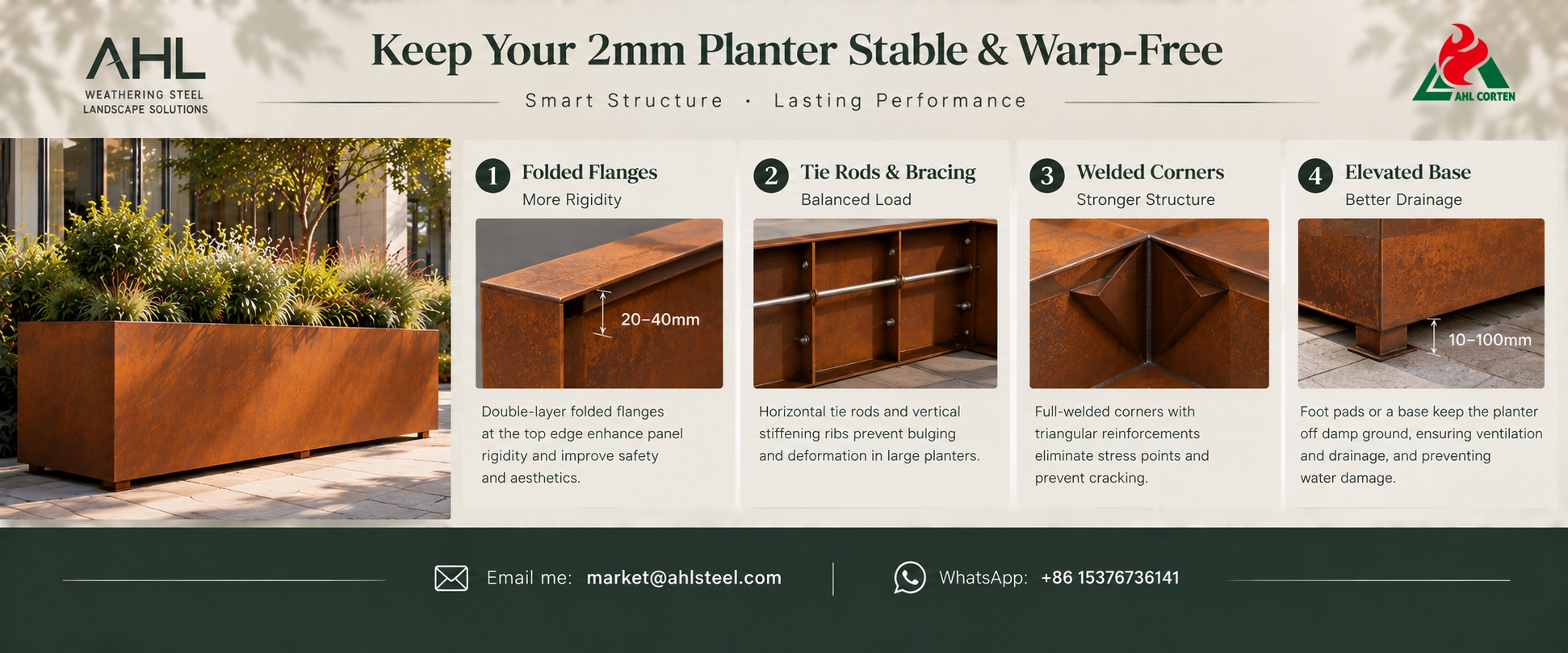
How to Ensure a 2mm Large Planter Remains Stable and Does Not Warp?
While 2mm-thick panels are certainly suitable for large flower boxes, the key to balancing cost and stability lies not in using thicker panels, but in meticulous structural engineering design.
1. Double-Layer Folded Flanges: Enhancing Panel Rigidity
Creating a 20–40mm double-folded flange at the top edge of the planter is equivalent to adding an integrated load-bearing beam to the sheet.
This not only significantly enhances the side panels’ resistance to bulging but also rounds off sharp edges, improving both safety and aesthetics.
2. Internal Tie Rods and Cross Bracing
For extra-long rectangular planters, install horizontal tie rods and vertical stiffening ribs in the middle section of the planter body.
This balances lateral soil pressure in both directions, addressing the issue of 2mm bulging and deformation in the center of large panels at its root.
3. Fully Welded Reinforced Corners
The four corners of the planter are stress concentration points and the areas most prone to cracking and deformation.
We use a full-weld process combined with triangular internal corner reinforcements instead of standard spot welding, which enhances the torsional strength of the corners and prevents weld seam cracking and adhesive failure.
4. Elevated Base Design
The base of the planter should be fitted with 10–100mm-high foot pads or a base to ensure it is fully elevated off the ground.
This prevents the bottom panel from coming into direct contact with damp ground, ensuring adequate ventilation and unobstructed drainage at the base, thereby eliminating localized water accumulation, corrosion, and rust damage to the bottom panel.
Drainage Is as Important as Steel Thickness
Many people focus only on the thickness of the steel panels and overlook drainage. Without proper drainage, even the thickest steel panels will fail prematurely.
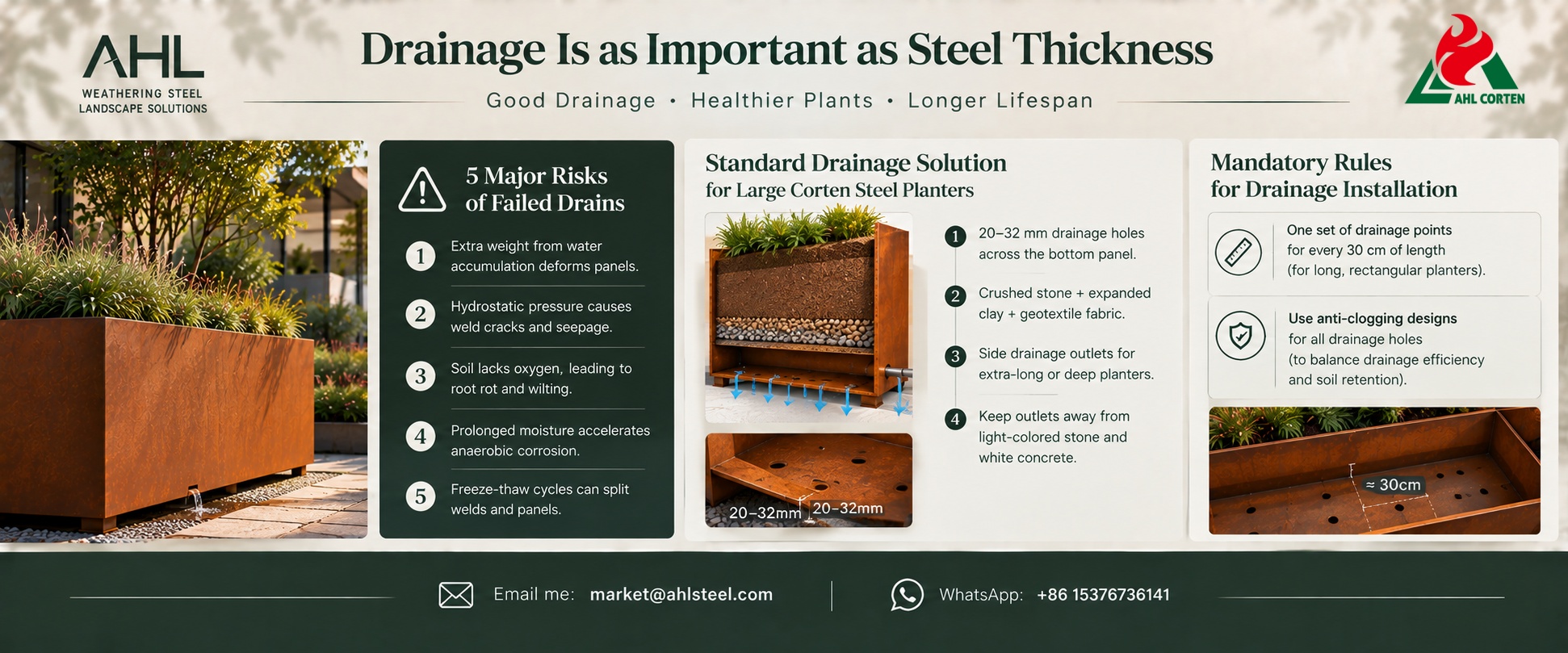
1. 5 Major Risks Posed by Failed Drains
Prolonged water accumulation in the soil increases weight, significantly raising the compressive load on the side panels and accelerating panel deformation.
Continuous hydrostatic pressure erodes welds, causing micro-cracks and water seepage.
Lack of oxygen in the potting soil leads to root rot and plant wilting, compromising the aesthetic appeal.
Prolonged moisture at the bottom causes localized anaerobic corrosion, damaging the passivation layer of weathering steel.
During the winter and summer freeze-thaw cycles, frozen water expands and can split the welds of the planter.
2. Standard Drainage Solution for Large Corten Steel Planters
Drainage holes measuring 20–32 mm in diameter are evenly spaced across the bottom panel to prevent localized water accumulation and dead zones
A drainage layer of crushed stone and expanded clay pellets is laid at the bottom, combined with geotextile fabric, to prevent soil from clogging the drainage holes
Extra-long or extra-deep planters are equipped with low-positioned side drainage outlets to rapidly discharge water accumulated during heavy rain
Drainage outlets should be positioned away from light-colored stone and white concrete to prevent rust-stained water from staining the paving during the initial period
3. Mandatory Rules for Drainage Installation in Large Planters
For long, rectangular planters, reserve one set of drainage points for every 30 cm of length to ensure comprehensive drainage with no dead zones.
All drainage holes must incorporate anti-clogging designs that balance drainage efficiency with soil retention.
How do I Choose the Right Thickness for my Planter Size?
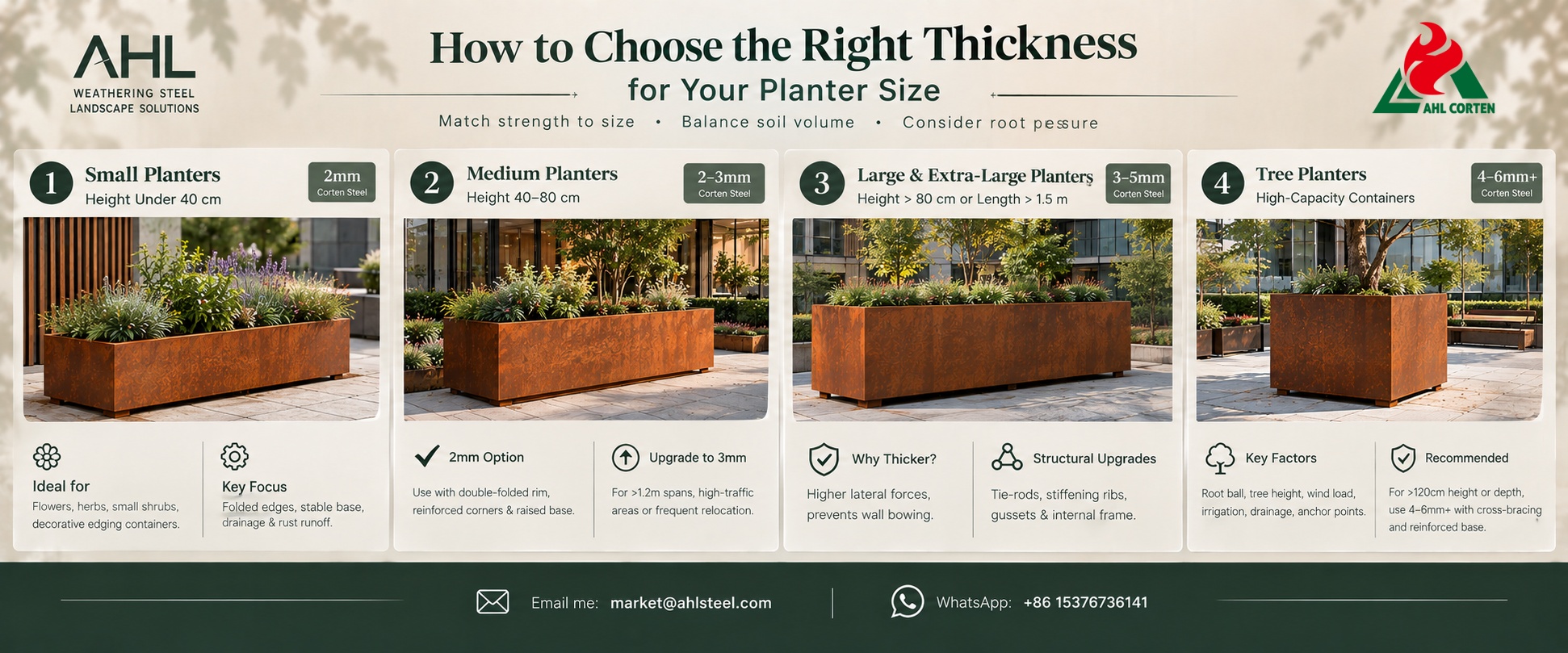
Selecting the optimal corten steel planter thickness requires matching material strength to container dimensions, soil volume, and root pressure.
1. Small Planters (Height Under 40 cm)
For compact, low-profile containers, 2mm Corten steel provides more than enough structural rigidity without adding unnecessary weight.
Ideal Applications: Flowers, herbs, small ornamental shrubs, and decorative edging containers.
Key Engineering Focus: Prioritize clean folded top edges, a stable base, proper drainage hole alignment, and early rust runoff management over structural reinforcement.
2. Medium Planters (Height 40–80 cm)
Containers in this mid-range size generally perform best with 2mm to 3mm corten steel.
2mm Steel Requirement: Fully suitable provided the design incorporates a double-folded top rim flange, reinforced full-height corner welds, and a raised drainage base.
When to Upgrade to 3mm: Highly recommended for metal planters with continuous horizontal spans exceeding 1.2 meters, units installed in high-traffic commercial zones, or planters frequently relocated via pallet jacks or forklifts.
3. Large & Extra-Large Planters (Height > 80 cm or Length > 1.5 m)
Large-format planters experience exponentially higher outward lateral forces from deep, wet soil. Relying on unreinforced 2mm steel at this scale introduces high risks of wall bowing.
Recommended Specifications: Specify 3mm to 5mm Corten steel plate.
Essential Structural Upgrades: Must integrate internal cross-bracing tie-rods, horizontal stiffening ribs, heavy-duty gussets, and a load-bearing internal skeleton frame. As length, width, and soil depth increase simultaneously, both plate thickness and internal bracing density must scale up accordingly.
4. Tree Planters & High-Capacity Containers
Large-format tree planters demand maximum structural integrity to support massive soil volumes, heavy root ball expansion, and dynamic wind loads acting on the tree canopy.
Critical Evaluation Factors: Root ball volume, mature tree height, localized wind shear load, automated drip irrigation entry, drainage capacity, and internal root ball anchor points.
Recommended Specifications: For tree containers exceeding 120 cm in height or depth, utilize 4mm to 6mm+ heavy Corten steel plate, fully supported by heavy internal cross-bracing and a reinforced base plinth.
2mm Vs 3mm Corten Steel Planter
| Factor |
2 mm Corten Steel |
3 mm Corten Steel |
| Weight |
Lighter and easier to handle. |
Heavier and more robust. |
| Material Cost |
Usually lower. |
Usually higher. |
| Suitable Planter Size |
Small to medium planters, or reinforced large planters. |
Medium to large planters. |
| Resistance to Bending |
Depends strongly on reinforcement. |
Better baseline rigidity. |
| Installation |
Easier for residential projects. |
Requires more handling support. |
| Commercial Use |
Suitable when structurally reinforced. |
More suitable for heavy-duty applications. |
| Custom Fabrication |
Flexible and cost-effective. |
Better for long spans and deep soil. |
| Best Value |
Lightweight residential landscaping. |
Long-term architectural and commercial projects. |
Common Problems with Underspecified Large Planters
If the steel plates used for flower boxes are too thin or lack proper structural support, various quality issues will gradually emerge within 1–3 years, affecting both the landscape and safety.
- Outward bulging of side panels: Unreinforced, long-span exposed panels bulge in the center under the pressure of wet soil, causing distortion of the lines.
- Cracks in corner welds: Stress concentration combined with excessive loads leads to weld separation, water seepage, and loosening.
- Rust and damage to the bottom plate: When placed directly on the ground without elevation and with blocked drainage, prolonged water accumulation causes localized corrosion and perforation.
- Rust stains on paving: Failure to control rust runoff early on leaves stubborn yellowish-brown stains on light-colored surfaces.
- Structural fatigue and aging: Prolonged and repeated stress and deformation reduce the plates’ toughness, significantly shortening the overall service life.
Large Planter Design Checklist
- Structural Inspection: Verify length, width, and height dimensions; ensure panel thickness matches specifications; install reinforcement structures; and verify the load-bearing capacity of the base.
- Drainage Inspection: Verify the size and spacing of drainage holes; check the clearance height of the base plate; inspect the anti-clogging drainage layer; and review the runoff protection plan.
- Planting Inspection: Ensure soil depth matches plant root system; provide wind-resistant reinforcement for tall plants; reserve irrigation connections
- Appearance Inspection: Select bare steel or pre-rusted finish; apply stain-resistant protection in advance; choose a sealing coating as needed
.jpg)
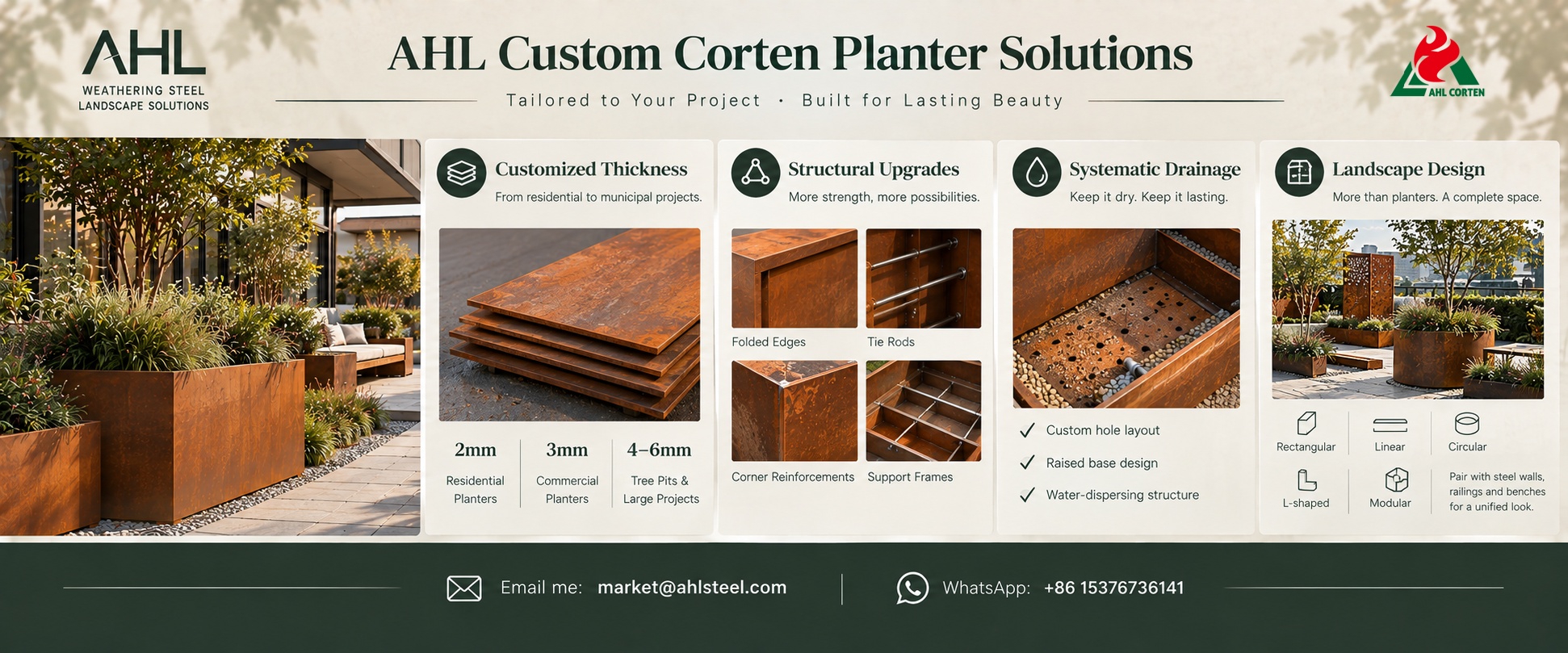
AHL Custom Corten Planter Solutions
AHL does not use a one-size-fits-all approach but instead customizes thickness and structural solutions based on project dimensions, soil cover depth, application scenarios, and environmental conditions.
Precise Thickness Customization
For medium-sized residential planters, the 2mm reinforced solution is the preferred choice, striking a balance between cost and aesthetics; commercial large planters come standard with the 3mm heavy-duty solution; and extra-large tree pits and municipal projects use 4–6mm thickened panels to accommodate long-term heavy loads.
Professional Structural Upgrades
Customizable features include folded edges, internal tie rods, corner reinforcements, and built-in support frames, enabling 2mm panels to achieve structural stability comparable to 3mm panels.
Systematic Drainage Customization
Drainage hole layouts, raised bases, and water-dispersing structures are customized according to planter dimensions, eliminating water accumulation, corrosion, and staining of surrounding paving at the source.
Customized Landscape Designs
We support customization of rectangular, linear, circular, L-shaped, and modular planters, which can be paired with corten steel landscape walls, railings, and benches to create an integrated courtyard landscape.
How to Choose Between 2mm and 3mm?
Choose 2mm if you:
Need a medium-sized residential planter.
Want lower weight and easier handling.
Has moderate soil depth.
Prefer a cost-efficient custom solution.
Can include reinforced edges and drainage.
Do not use to support large trees or extreme soil loads.
Choose 3mm if you:
Need a long trough planter.
Have a deeper soil bed.
Want improved rigidity.
Are installing in a commercial landscape.
Expect frequent movement or handling.
Want greater structural tolerance over time.
Choose 4–6mm if you:
Are specifying extra-large or very tall planters.
Need to support trees.
Are working in a public or high-traffic area.
Requires large unsupported spans.
Need a robust architectural structure.
Requires crane lifting or permanent installation.
.jpg)
Frequently Asked Questions (FAQ): Corten Steel Planter
Q: Is 2mm Corten Steel Really Sufficient for Large-Sized Planters?
A: It is sufficient under certain conditions. For medium-sized, short-span planters, it can be used stably as long as it is reinforced and equipped with proper drainage; however, we do not recommend using 2mm bare steel plates alone for extra-long, extra-tall, tree-planting, or commercial applications.
Q: What Is the Most Suitable Thickness for Garden Planters?
A: 2–3 mm is optimal for home gardens; 3 mm is the minimum for large-scale commercial landscaping; and planters larger than standard for planting trees require 4 mm or more.
Q: Can a 2mm Corten Planter Withstand the Pressure of Wet Soil?
A: A 2mm planter that is properly reinforced and has a reasonable span can support the load normally; however, unreinforced planters with long spans are highly prone to deformation under the weight of wet soil.
Q: Does a Thicker Steel Plate Mean a Longer Service Life for the Planter?
A: Thickness is the foundation, but drainage, structure, installation environment, and maintenance methods have a greater impact on service life.
Q: Do Corten Steel Planters Need to Have Drainage Holes?
A: Yes, they must have drainage holes. Drainage is essential for preventing deformation, corrosion, and root rot in plants.
Q: Are 3mm Corten Steel Planters Suitable for Home Gardens?
A: They are very suitable. With manageable weight and greater stability, they are the preferred choice for permanent garden landscaping.
Q: What Thickness of Corten Steel Is Needed for Large Planters Designed to Hold Trees?
A: We recommend 4mm or thicker, paired with an internal steel frame and a reinforced base to withstand root expansion and long-term soil pressure.
Q: Can AHL Customize Reinforced 2mm Large-Sized Steel Planters?
A: Yes. We can customize a complete reinforced structure and drainage system based on project dimensions to achieve a cost-effective solution.
Ready to Choose a Planter That Suits Your Outdoor Garden?
While 2mm weathering steel is not unsuitable for large planters, it is a cost-effective and practical engineering solution—provided it is paired with appropriate spans, reinforced structures, and a comprehensive drainage system.
Simply comparing steel plate thickness is meaningless; scientific structural design, drainage systems, and customized manufacturing processes are the key to ensuring that large metal planters remain free of deformation and corrosion for decades.
If you’re planning a courtyard landscape, commercial landscaping, or municipal project and are unsure about planter thickness or structural selection, please contact the AHL team. We provide one-on-one dimension calculations, thickness selection, structural optimization, and end-to-end implementation guidance to tailor a unique weathering steel planter solution for your project.
Get a Free Catalog and Price!
Back

 Fill In The Inquiry
