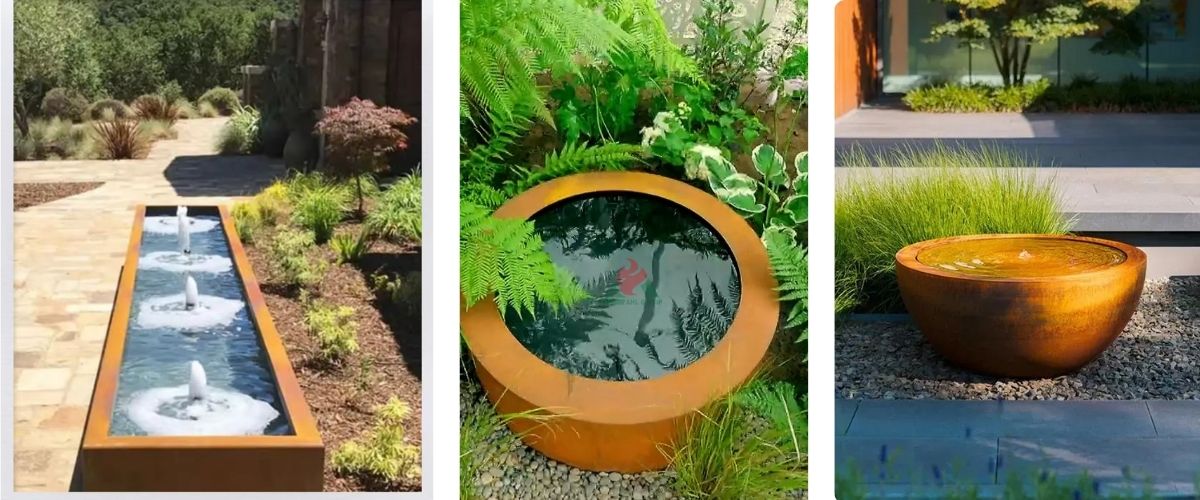
The corten steel pond serves as the visual centrepiece of the high-end garden, seamlessly blending the textured, industrial patina of rust with the vibrant energy of natural water to create a highly distinctive focal point within the landscape.
However, in daily use, issues such as cloudy water, algae growth, sediment build-up and limescale deposits along the waterline often detract from its aesthetic appeal and can shorten the lifespan of the structure.
Proper cleaning of a corten steel water pondis by no means a simple matter of ‘removing grime’; rather, it is a systematic process that integrates safe cleaning, dynamic circulation and rust layer management.
This article will provide a detailed breakdown of the professional daily and deep cleaning procedures, enabling you to effortlessly maintain a clear, elegant and durable metal water fountain at minimal cost.
Safety Preparations Before Cleaning the Corten Water Pond
It is essential to make thorough preparations before cleaning a corten steel pool. This not only protects the pool and equipment and ensures personal safety, but also increases the efficiency of the subsequent cleaning process by 50%.
Electrical Safety for Cleaning Corten Steel Water Ponds
The pool’s core power comes from submersible pumps, shore-based pumps, as well as LED lighting and the electrical control system; therefore, electrical safety precautions must be prioritised before cleaning.
Complete Power Disconnection: Disconnect all electrical equipment (pumps, UV algae control lamps, landscape lighting) from the main control box. Operating live equipment is strictly prohibited to prevent injury from induced electricity or electrical leakage.
Electrical Protection: If the control box or transformer is located on the shore or outdoors, check that the seals are intact to prevent water splashes from entering the electrical control system during cleaning, which could cause equipment damage.
Water Flow and Drainage Preparation
Adjusting the water flow prior to cleaning helps us pinpoint the areas requiring focused attention.
Low-flow inspection: Before switching off the system completely, reduce the water flow to a minimum and observe whether there is uneven splashing at the outlets to identify those blocked by scale deposits.
Handling Residual Water: If work inside the tank is required, open the drain valve to remove all residual water from the tank bottom. This prevents slipping and ensures cleaning agents are not diluted, which could compromise cleaning effectiveness.
Selecting the Appropriate Cleaning Time
Corten steel is sensitive to ambient temperature; choosing the wrong time to clean may damage the oxide layer on the steel surface, thereby affecting its protective properties.
Avoid high temperatures and direct sunlight: During midday in summer or in strong sunlight, the surface temperature of corten steel can exceed 60°C. Spraying cold water or cleaning agents directly onto the surface at this time can cause ‘thermal stress’ due to the extreme temperature difference, potentially resulting in micro-cracks or the detachment of the dense rust layer.
Preventing odours: High temperatures accelerate the decomposition of algae and sediment, producing pungent odours that can affect the cleaning experience.
Optimal cleaning times: It is recommended to clean in the early morning (before 8 am) or late afternoon (after 5 pm). At these times, the light is soft, making it easier to observe the distribution of deposits, and cleaning agents are less likely to evaporate rapidly, resulting in more effective results.
Preventing Secondary Contamination
Rust stains on corten steel are highly staining; therefore, a ‘zonal isolation’ strategy should be adopted during cleaning to prevent contamination of the surrounding environment.
Floor protection: Lay protective sheeting on stone, wooden flooring or lawns around the pool to prevent rust-containing wastewater from splashing and causing permanent stains.
Plant protection: If there are aquatic organisms in the pool or valuable plants in the surrounding area, ensure that the cleaning agents used are ‘biodegradable’ to avoid harming plants and aquatic life.
Essential Tools and Consumables for Cleaning Corten Steel Ponds
Given the unique material composition of the metal trough water features and the precision of their circulation systems, selecting the appropriate tools and consumables is essential to both protect the natural rust patina on the steel surface and extend the service life of core components such as the water pump. Professional tools are key to achieving efficient and safe cleaning.
Basic Tools for the Daily Cleaning of Corten Water Ponds
It is recommended that these tools be stored in a storage box next to the tank for easy access during routine surface maintenance.
Microfibre cloth/natural sponge: Used to wipe limescale and fingerprints from the edges of the Corten steel; their soft texture will not damage the rust layer.
Note: The use of steel wool or abrasive scouring pads is strictly prohibited, as these tools will scratch the protective rust layer, leading to uneven rusting of the Corten steel. Once the protective rust layer on Corten steel is damaged, it will accelerate internal corrosion and shorten its service life.
Long-handled soft-bristle brush: Used to clean deposits from the corners of the pool base and stone joints; the soft bristles prevent scratching the pool structure.
High-density pool base net: Used for daily removal of fallen leaves, insects or pollen, preventing them from rotting and producing acidic substances that corrode the Corten steel.
Low-pressure garden hose/bucket of clean water: Used to rinse away surface dust. Take care to avoid using a high-pressure water jet at close range, to prevent the mature oxide layer from being washed away. The impact of a high-pressure water jet can destroy the dense rust layer on the surface of Corten steel, affecting its corrosion resistance.
Recommended Consumables and Chemical Additives
When selecting consumables, the characteristics of Corten steel must be given priority, and products that damage the rust layer should be avoided.
Mild, neutral cleaning agents: Specifically designed for metal landscaping, these contain no strong acids or alkalis, are environmentally friendly and safe, and will not damage the Corten steel’s rust layer. When cleaning Corten steel, mild, neutral cleaning agents are the best choice, as they effectively remove dirt without damaging the rust layer.
Water clarifiers: These rapidly settle minute particles in the water, keeping the water in large metal water fountains crystal clear and enhancing the aesthetic quality of the landscape.
Daily Cleaning Routine For Corten Steel Water Features (5 Minutes a Day)
A well-maintained corten steel water feature requires minimal effort to keep clean. By following the ‘light maintenance’ routine outlined below for just 5 minutes a day, you can prevent the build-up of debris and ensure that the metallic sheen of the corten steel complements the crystal-clear water.
Removing Surface Debris and Oil Films
The clarity of the water’s surface directly determines the overall visual appeal of a Corten steel pond. Leaves, insects and the film of oil formed by dust in the air, if not removed promptly, will hinder oxygenation of the water and affect the pond’s ecosystem.
Technique: Using a fine-mesh net, gently skim the surface debris along the direction of water circulation (usually near the overflow or return inlet), taking care to avoid disturbing the water.
Frequency: Daily cleaning is recommended; increase the frequency during windy or autumn seasons when leaves fall.
Cleaning Surface Algae
Under certain lighting conditions, a small amount of algae may grow on the inner walls of the steel water feature, or the surface may feel slippery. This is a normal phenomenon in ecological ponds, but excessive algae can affect the aesthetic appearance.
Instructions: Use a professional soft brush or sponge to wipe visible patches of green algae locally, following the principle of 'from top to bottom, from inside to outside’. First clean the area above the waterline, then tackle the submerged sections, taking care not to disturb sediment at the bottom of the pond, which could cause the water to become cloudy. Note: Never use a hard brush to scrub the pond bottom vigorously; only treat floating algae attached to the pond walls.
Light Rinsing and Water Top-up
Water evaporation causes the water level to drop, which not only affects the overflow effect but may also cause the pump to draw in air, resulting in equipment damage.
Instructions: Gently rinse the edges of the corten steel with a low-pressure hose to remove limescale caused by alternating wet and dry conditions. Slowly top up the pool with fresh water until the water level returns to the standard mark. Note: It is recommended that the amount of water added be kept within 10% of the total water volume to avoid a sudden influx of untreated water, which could disrupt the established micro-ecological balance of the pool.
Corten Water Pond Deep Cleaning Procedure (Once Per Quarter)
At the change of seasons each quarter, the cortensteel water pond system requires a comprehensive ‘check-up’. The purpose of deep cleaning is not merely to make the tank ‘look as good as new’, but also to restore the filtration system’s flow rate, ensuring the cortensteel’s rust patina becomes deeper and more stable.
Clean The Filter First, Then Clean The Tank
Many people are in the habit of scrubbing the tank first and then cleaning the filter cartridges, but this is a serious misconception. If the filtration system is already operating at full capacity, the fine debris stirred up whilst cleaning the tank bottom will immediately clog the filter pump and may even burn out the motor. Instructions: Switch off the circulation pump, remove the physical filter wool and biological filter cartridges, and rinse them thoroughly using undisturbed water from the tank (not tap water) to protect the nitrifying bacteria on the cartridges. At the same time, remove any debris entangled in the pump’s intake (such as long-fibred algae or fine sand) to ensure the circulation channels remain unobstructed—this is a prerequisite for cleaning the tank bottom. As the ‘heart’ of the tank, the pump’s efficiency directly determines the effectiveness of the cleaning process and the lifespan of the equipment.
Cleaning Pond Bottom Sediments
Pond bottom sludge is the primary source of ammonia nitrogen. Deep cleaning does not mean ‘draining and scrubbing’, but rather the targeted removal of organic matter to minimise disruption to the pond’s ecosystem. Instructions: Use a pond vacuum or siphon to remove pond bottom sludge in sections, cleaning only 1/2 or 1/3 of the pond bottom area at a time. Retain some of the existing biofilm to prevent drastic fluctuations in water quality, which could hinder subsequent ecological recovery. Note: Under no circumstances should a high-pressure water jet be used to blast the sediment directly from the pool floor, as this will cause the entire pool to become severely cloudy within seconds, making it difficult to clarify.
Wiping the Corten Steel Inner Walls
This is the most critical step in cleaning a corten steel pool. The appeal of corten steel lies in its dense oxide layer; improper wiping will shorten its service life.
Instructions: Use a damp microfibre cloth or nano-sponge to gently wipe away the white limescale at the waterline. For stubborn stains, a very dilute citric acid solution may be used, but the area must be rinsed thoroughly with clean water immediately afterwards to prevent residual chemicals from corroding the rust layer. Prohibited Actions: Do not use steel wool or hard scrapers, and do not use strong acids, strong alkalis or industrial descaling agents, as these will completely destroy the protective rust layer of corten steel. The rust layer acts as its ‘self-protective armour’; once damaged, it will accelerate internal corrosion.
Refilling and Water Quality Stability
Refilling after deep cleaning directly affects subsequent water quality stability and requires particular attention. Instructions: The volume of top-up water should not exceed 50% of the total water volume (unless water quality has severely deteriorated). After switching on the circulation pump, run it continuously for 24 hours and observe whether the flow rate at the overflow weir has returned to a uniform and smooth state. Water Quality Stabilisation: After topping up the water, a small amount of water stabiliser or nitrifying bacteria may be added to help the pond rapidly re-establish its ecosystem and shorten the water quality stabilisation period.
Rust Layer Management for Corten Steel Water Ponds
The appeal of rusted steel water ponds lies in their ‘living’ nature—over time, the colour gradually transitions from a vibrant orange-yellow to a deep reddish-brown. However, factors such as water quality, sunlight and impurities can interfere with this natural process. Only by learning how to manage the rust layer can a corten water fountain maintain its elegant appearance. The core advantage of corten steel lies in its ability to form a stable rust layer that requires little maintenance; however, scientific rust layer management can further extend its lifespan.
Distinguishing Between a Healthy Rust Layer and Surface Damage
Understanding the natural evolution of corten steel is the first step towards effective maintenance.
Healthy rust layer: The surface exhibits a uniform, granular reddish-brown or bronze colour, with a slightly rough texture, but it does not flake or crumble. This is a dense protective layer that prevents further oxidation of the steel plate.
Surface damage: This manifests as large areas of black spots, blistering, peeling, or exposure of the bare metal. This is usually caused by the failure of the protective layer due to strong acids or alkalis, or scratches from hard objects.
Expert advice: The aim of rust layer management is not to make the pool ‘spotless’, but to guide the rust layer into a ‘stable state’ to achieve long-term protection.
Chemicals Strictly Prohibited (Red Line Warning)
The oxide layer on corten steel water feature surfaces is extremely sensitive to chemical environments; the following agents are absolutely prohibited. Strictly prohibited: Strong descaling agents (containing hydrochloric acid or phosphoric acid), bleaching agents (containing chlorine), and strong paint strippers.
Consequences: These chemicals react violently with the oxide layer, causing irreparable ‘white spots’ or ‘blackened, decayed’ areas on the corten steel surface; they may even penetrate the steel plate, causing permanent damage. Harsh chemicals such as bleach and ammonia-based products will severely damage the rust layer on corten steel, causing it to lose its protective properties.
Safe options: Use only neutral detergents (pH ≈ 7) or highly diluted natural vinegar/citric acid for spot treatment, and rinse thoroughly immediately after treatment.
Common Aesthetic Issues and Treatment Methods
For common ‘unsightly’ issues with corten steel basins, the following tiered treatment approach can be adopted to resolve the problem whilst preserving the rust layer.
Issue A (White deposits/limescale): Caused by calcium and magnesium ions left behind after hard water evaporates, commonly found at the waterline or overflow edges.
Treatment: Dampen a soft cloth with warm water and wipe repeatedly; if the limescale is thick, gently wipe with a nano-sponge, taking care not to abrade through the underlying rust layer.
Problem B (Localised darkening/soiling): Caused by fallen leaves, bird droppings or algae settling on the pool walls; their decomposition alters the local pH, causing the rust layer to darken.
Treatment: Rinse immediately with running water and scrub gently with a soft brush. The colour may appear slightly darker temporarily after cleaning, but will blend in with the overall rust colour after a while.
Self-Repair Maintenance of the Oxide Layer
If the rust layer is accidentally damaged (exposing the silver-white metal), there is no need to worry unduly. Corten steel water pond has a strong self-repairing ability; follow the steps below.
Smooth the surface: Gently sand the damaged edges with fine-grit sandpaper to ensure a natural transition between the damaged area and the surrounding rust layer.
Expose to the air: Keep the damaged area dry and exposed to the air; you may spray a small amount of water to accelerate the rusting process.
Allow self-repair: Corten steel has a strong self-repairing ability; usually, after 2–4 weeks, the new and old rust colours will gradually blend, restoring the overall aesthetic. This self-repairing characteristic is one of the core advantages that distinguishes corten steel from ordinary steel, enabling it to autonomously restore its protective properties following minor damage.
Common Mistakes When Cleaning CortenWater Ponds: Does Scrubbing Make Them Dirtier?
During the daily maintenance of metal water fountains, many people inadvertently cause the water quality to deteriorate rapidly and the rust finish to be damaged due to being ‘overzealous’ or using ‘inappropriate methods’. Be sure to avoid the following four most damaging common mistakes.
Vigorous Scrubbing, Triggering a ‘Sediment Storm’
Typical behavior: Vigorously scrubbing the tank bottom and walls with a stiff-bristled brush or high-pressure water jet.
Consequences: Fine particles and biomass settled at the bottom are thoroughly stirred up, causing the entire tank to become instantly cloudy—a condition that may persist for weeks. Aggressive mechanical friction also scrapes away the protective rust layer before it has fully stabilised, exposing patches of silver-white bare metal and disrupting the visual uniformity.
Correct approach: Spot cleaning; use a vacuum siphon to remove sediment directly from the pool floor rather than stirring it up.
Inappropriate Use of Cleaning Agents, Leading To Uncontrolled Rust Discolouration
Typical behaviour: Using agents containing strong acids (such as toilet cleaners), strong alkalis or high-concentration chlorine (bleach) in pursuit of rapid stain removal.
Consequences: Chemical burns – strong acids react violently with iron oxide, causing the originally elegant reddish-brown rust colour to rapidly turn a ghastly white or black and rotten; ecological collapse – residual chemicals kill beneficial bacteria in the pool, causing the water to lose its self-purification capacity.
Correct approach: Adhere strictly to the ‘neutral principle’; use only corten steel-specific neutral cleaners when necessary, and rinse thoroughly with clean water immediately after wiping.
Insufficient Circulation After Cleaning, Triggering An ‘Algal Bloom’
Typical behaviour: After a large-scale water change or cleaning, switching off the pump or reducing circulation time to save electricity.
Consequences: Nutrient surge – During cleaning, sediment releases nutrients such as phosphorus and nitrogen; if the water becomes stagnant and there is ample light, algae will proliferate within 24 hours; Secondary fouling – A slimy green film will quickly form on surfaces that have just been cleaned.
Correct procedure: For 48 hours following cleaning, the water circulation system must operate at full capacity around the clock, whilst utilising UV sterilisation lamps to inhibit algal growth.
Extreme Cleaning Frequency (Either Too Frequent or Too Infrequent)
Typical behaviour: Frequent daily wiping (overzealous), or failure to clean for years (neglectful).
Consequences: Excessive frequency — Frequent disturbance disrupts the biofilm formed on the corten steel surface, causing the rust layer to remain in an unstable, active oxidation state, thereby accelerating corrosion; Neglect — Excessive accumulation of sediment creates anoxic zones, leading to pitting corrosion of the steel plates and the development of unpleasant odours.
Correct approach: ‘Seasonal deep maintenance + dynamic fine-tuning’ — clear fallen leaves in spring, focus on algae control in summer, inspect equipment in autumn, and implement frost protection in winter.
Are You Ready to Choose a Corten Water Feature Tailored Just for You?
No more worries about cloudy water, uncontrolled rust layers or cumbersome maintenance. Our rusted steel water features are all crafted from premium corten steel, which naturally develops a stable protective rust layer. Combined with a scientifically designed circulation and filtration system, they retain the unique texture of industrial design whilst significantly reducing daily maintenance costs. Whether it’s a small cascading feature in a corner of your garden or a large pond running through your landscape, we can customise the dimensions and design to suit your needs, ensuring every detail complements the style of your garden. From material selection to craftsmanship, and from bespoke design to ongoing maintenance, we provide professional services throughout the entire process, allowing you to effortlessly enjoy a weathering steel water feature that combines aesthetic appeal with practicality. Contact us today for a quote to unlock your very own outdoor landscape surprise, and let your garden embrace the timeless industrial aesthetics and natural vitality that endure over time.


.jpg)
 Fill In The Inquiry